Original Research Article
Telemedicine: an ICT based healthcare approach
to ensure health service for all
Rasheda Akhtar
1, Sazzadul Alam
1*, Noor Kutubul Alam Siddiquee
2INTRODUCTION
A well-functioning healthcare system is essential in improving the overall population’s health status, and reducing financial hardship by providing safeguard and timely responsiveness of healthcare sector according to needs.1 Despite being a limited resource country, Bangladesh has set an example for other developing countries in terms of making improvement. The country has committed to achieving universal health coverage (UHC) by 2032 through increasing its coverage as well as improving the service quality.2 Despite enormous efforts,
healthcare service is still an intimidating challenge area of Bangladesh healthcare systems. According to WHO, “Bangladesh suffers from both a shortage of and geographic mal-distribution of HRH (human resource for health). There are an estimated 3.6 physicians per 10,000 population and 2.2 nurses and midwives per 10,000 populations.”3
Severe gap exists between sanctioned and filled health worker positions: 34% vacancy in sanctioned health worker positions under DGHS.3 Health workers are concentrated in urban secondary and tertiary hospitals, although 70% of the population lives in rural areas.4
ABSTRACT
Background: Despite enormous efforts, healthcare service is still a daunting challenge area of Bangladesh healthcare systems. Bangladesh suffers from both a shortage of and geographic mal-distribution of human resource for health, as well as inadequate resources. Considering the challenges, telemedicine can be a blessing especially to the people living in hard-to-reach and rural areas. The current study was conducted on to measure the outcomes of providing telemedicine service at the field level.
Methods: The study was conducted in Nagarkanda Upazilla of Faridpur district. Mixed method approaches including user experience and perception survey, case study and in-depth interview were adopted in order to bring a comprehensive scenario.
Results: Around 50% of the users used to visit telemedicine center frequently. For quality of service provided from telemedicine service point, there were few benchmarks like service provider’s behavior, waiting time, accessibility, distance, cost of treatment, willingness to pay and referral mechanism. Telemedicine service centers were found situated within the reach of people (within 1-2 km of 83.30% km). 97% participants rated service provider’s behavior as good. Cost of treatment including diagnosis, prescription and medication was found within 501-3000 BDT for 60% of participants.
Conclusions: Although the studied telemedicine service was not comprehensive in nature, itstill helped to save time, reduce cost and most of all increased access to healthcare services.
Keywords: Telemedicine, Barriers, Service providers, Treatment cost, Service quality
1
Department of Anthropology, Jahangirnagar University, Savar, Dhaka, Banglade
,
2FK Exchange Fellow, Nepal Health Research Council, Ramshah Path, Kathmandu, Nepal
Received: 12 June 2019
Revised: 22 July 2019
Accepted: 30 July 2019
*Correspondence:
Dr. Sazzadul Alam,
E-mail: [email protected]
Copyright: © the author(s), publisher and licensee Medip Academy. This is an open-access article distributed under the terms of the Creative Commons Attribution Non-Commercial License, which permits unrestricted non-commercial use, distribution, and reproduction in any medium, provided the original work is properly cited.
Considering the challenging healthcare situation of Bangladesh, introduction to telemedicine service can be regarded as a blessing. Telemedicine service can bridge the gap between increased needs and limited resource. WHO stated telemedicine service as the delivery of health care services, where distance is a critical factor, by all health care professionals using information and communication technologies for the exchange of valid information for diagnosis, treatment and prevention of disease and injuries, research and evaluation, and for the continuing education of health care providers, all in the interests of advancing the health of individuals and their communities.5 Low and middle-income countries like Bangladesh need telemedicine service more than anyone else; where disease is prevalent, number of health service providers are small in number with respect to the size of population, specialized physicians are not available, and there is inadequate healthcare infrastructure.
Telemedicine service was first introduced in Bangladesh during 1999 by a charitable trust named Swinfen Charitable, although many healthcare services providers were practicing some forms of informal tele-consultations with their peers living around the world.6 An evaluation report from the first year operation of 27 referral cases showed the usefulness and cost-effectiveness of such technologies.7 In 2011, Government formally introduced telemedicine service for the first time in eight hospitals.8 Department of Biomedical Physics and technology at University of Dhaka started piloting telemedicine service project titled “Providing Telemedicine Service at the Field Level through Locally Developed Modern Medical Equipment and Software” in union level with the support from access to information (A2I) program by People’s Republic of Bangladesh.
The service includes a variety of applications and services using two-way audio, video and email communications that use internet, mobile phones, wireless tools and other forms of telecommunication technologies. The project was initiated aiming to improve the quality of life of the deprived people of the world through development and dissemination of affordable essential technology. The current study sought to look after the impacts of the project as impact study enables implementer and researcher to identify the ways and means to enhance sustainability of project supported initiatives. The current paper has been prepared in order to ascertain and record major achievements of the project, success stories and critically reflecting on the implementation performance.
A brief conceptual understanding of telemedicine
Worldwide, a large portion of people are still living in rural and hard to reach areas. People living in such areas are the primary shareholder who constitutes underserved and disadvantaged population. In many cases they lack required and quality health services.9 The situation becomes worse during emergency period like natural
calamities or other emergency needs like pregnancy related complications.10 In modern times, this age old disparity is becoming less and less of an obstacle to obtaining quality health care. Different innovative ideas and technological advances, like telemedicine allow the practice of medicine when the patients somehow face problem (e.g., lack of healthcare facility, lack of skilled healthcare workers, poor transpiration system, geographic barriers etc.,) to access the service in person.11,12
The worldwide interest for telemedicine has been increased in last few decades because of its robustness. de Souza et al have described five key characteristics of a telemedicine system-overcome geographic distance, increased interaction and exchange of information, effective collaboration, development of a newer version of clinical protocols for diagnoses and treatments and overcome the challenges of face-to-face consultation.12 Telemedicine may reduce hospital costs and save time because the patient may be able to recover at home.13
Researchers around the world have tried to understand the rapid shifts in tasks and responsibilities resulting from the use of different forms of healthcare technology. Oudshoorn examined the works of patients, home-care nurses and physicians when employing an ambulatory electrocardiogram (ECG) recorder to detect heart beat irregularities.14 The author observed that, this device requires patients to take over tasks that were formerly performed by doctors, and to learn when to monitor and what data to pass on to physicians. The study also highlighted the invisible work performed by physicians and nurses, making the patient self-reliant.
Wiskin argued that, digital technologies such as mobile health or telemedicine are not trending towards basic care; rather it is encouraging a system of self-diagnostic. As a result, the market is experiencing a significant increase in self-diagnostic tools and equipment.15 He further added that digital technology changes the traditional perceptions of time and space in healthcare sector and demonstrates the evolving relationship between products and social actors. This technological shift indicates significant changes not only in the relationship between patients and medical professionals, but also in terms of the patient’s relationship with themselves. In this way, telemedicine and other closely related forms of technologies with similar purposes may increase the authority of patients. From this point of
view, clinical relation especially doctor-patient
relationship can be analyzed where both parties strive to maintain the distribution of authority which define their social position. This authority can also be described in terms of respect and medical knowledge.
body has been shaped through socio-political and hierarchical relations and that no human body exists outside of medical discourse. According to Foucault, human body is perceived as it has been constructed through discourse, practice, and the “medical gaze”. This perspective is especially helpful when critically analyzing the rise of telemedicine since this innovation allows previously “subordinate” people to monitor and regulate their own health; they represent a shift in both the social order and how we contextualize human behavior and autonomy.15 Patients in our society often belong to subordinate position because of the possession of medical knowledge and healing skills by the doctors. Researchers around the world have started gathering evidence about how application of diverse technologies especially telemedicine in health sector can change the amount of capital of both physicians and patients.
METHODS
The study was conducted in Nagarkanda Upazilla of Faridpur district from March 2017 to October 2017. The reason to choose this site is that the Dhaka University Telemedicine Program was implemented in this area by Department of Biomedical Physics and Technology, with the support from A2I.
A mixed method approach including both qualitative and quantitative tools was used in this study. Researchers mainly used three types of methods - survey, case study and in-depth interview. Thirty-five surveys were conducted with telemedicine service recipients. Samples were taken using simple random sampling. Samples were selected randomly from the list of people who received service from different telemedicine point. As the project was launched in Nagarkanda Upazilla pilot basis, as a result the numbers of service recipients were around 160. We wanted to make sure that everyone has an even chance and probability of being selected in the sample. So, we used this probability sampling method.
For qualitative part, case studies with people who got service from telemedicine point and in-depth interview (IDI) with service provider (who provides service in the telemedicine point) were conducted. For case studies, we considered few criteria like referral, satisfaction and multiple receipts of service. A total of four case studies and 2 in-depth interviews were conducted.
For analysis purpose, SPSS (version 21) was used for quantitative part and thematic analysis was done for qualitative data.
RESULTS
The study participants were comprised of 53.30% of female and 46.70% of male. All of them had previously received telemedicine service. Most of the participants (33.30%) were from the age group of 21-30 years. Study
found that, older people had less frequency to accessing telemedicine service.
People’s health seeking behavior in Bangladesh depends heavily on their income-expenditure. Considering the significant implications of income and expenditure over health seeking behavior, the study tried to get an overview of household’s income and expenditure for health purposes. Around 50% households had monthly income between 8001 to 15000 BDT per month. 33.30% and 10% earned between 15001 to 25000 BDT per month. For treatment related expenditure, 43.30% said that they had spent between 201 to 400 BDT per month for their family. 36.70% and 16.70% said that, they had to spend from 401 to 600 BDT and 601 to 1000 BDT per month. Only 3.30% families were found spending about 1001-1500 BDT per month for treatment purpose.
The participants were asked about the healthcare facilities they usually visit for disease or complication. More than 50% participants said that, they visit telemedicine service point for common disease and complication. 33.9% participants were found visiting local clinic and private hospitals.
Figure 1: Visit to healthcare facilities.
Visiting these healthcare facilities does not indicate that people were cured. So, we kept a section about different healthcare facilities people visited and got cured. 85.7%
participants mentioned they got cured visiting
telemedicine service point.
Community based telemedicine service is a new concept in Bangladesh. As a new healthcare system, the primary challenge was to disseminate information and to attract people. Without proper information people would not come to telemedicine service point. We asked the participants from where they first came to know about telemedicine service. 46.70% said that, they first came to know about telemedicine service from their neighbors who either took service from telemedicine point or heard from someone else. Second highest responses were recorded for relative (23.30%). After that, the participants were asked to give their opinion about telemedicine service in general. 70% participants opined that; telemedicine service was a type of health service where doctor treat patient through internet, computer or 50.8% 33.9% 5.1%
5.1% 1.7% 1.7%
webcam. Participants were also asked to mention about available services provided from telemedicine service point. Most of the participants describe telemedicine service for prescription of medicines (35.7%), assessment of disease (33.3%) and for referral of diagnostic test (28.60%). One of the service providers said, telemedicine centers were not in a position to provide advanced level service. The centre mostly provides services for common diseases and complication. Although, there are some options to do some basic tests and measurement like BP, diabetics and blood test, but still telemedicine centers are unable to fulfill the entire patient’s demand.”
Service quality is another prevalent factor which can significantly affect healthcare service as well as people’s perception. This study considered ranges of issues related to quality including people’s perception, waiting time to get service, distance of healthcare facilities etc.
The study tried to find out the distance of healthcare facilities people usually visit from their home. Based on majority’s responses, the distance seemed okay. 43.30% participants said the distance was around 2 km. 40% and 10% participants said the distance was chronologically 1 km and 4 km from their home. 53.30% participants said about using van as mode of transportation and 30% said about walking to reach telemedicine service point. Roksana (42), one of the telemedicine service receivers said, “Telemedicine service is limited by the speed, quality and availability of Internet connections. People have to face problems in terms of speed and clarity of communication”.
Amount of time needed to get service is one of the potential indicators of patient satisfaction as well as healthcare quality. The study tried to draw a comparison between telemedicine service and other facilities in terms of required time (in minutes) to get service. For general service facilities, most of the participants (63.30%) said that they had to spend 41-60 minutes to get complete service. On the other hand, for telemedicine service, 43.30% said about 4-7 minutes as required time to get complete service. 40% said that, they used to need 1-3 minutes to get full service. Therefore, compared to other services, telemedicine is time saving, feasible and easy to access.
Waiting time can make the service period lengthy. Therefore, we asked the participants about waiting time for getting service. 83.30% aid that, they did not have to wait at all to get service. On the other hand, 13.30% said about more than 20 minutes as waiting time. In addition, we asked the participants if they would make future contact with telemedicine service point if they face any problems. 96.70% participants said that, they would make future contact.
Service provider’s behavior is also a key component in quality healthcare service. Therefore, we asked the participants about their experience regarding service
provider’s behavior. 97% rated service provider’s behavior as “good.” Rest 3% rated as “very good.” No one rated service provider’s behavior negatively. After that, we asked the participants if they faced any problems in terms of getting service. Almost all the participants (97%) said that, they did not face any problems in terms of accessing service.
In this study, we considered treatment cost as one of key issues to effectiveness and sustainability of telemedicine program. We asked the participants how much they had to pay including medication, diagnosis etc., in order to get the service from telemedicine point. Highest response (20%) was found within the range of 501-1000 BDT,
1001-1500 BDT and 2001-3000 BDT. 16.70%
participants said that, they had to pay around 500 BDT for the entire service. The findings showed a range of cost from 500 BDT to around 3000 BDT. Now the question is, whether this cost was within people’s affordability range. Therefore, we asked one question to the participants regarding the affordability of treatment cost. 80% study participants mentioned the range within their reach. Only 16.70% said that, they faced problems in order to manage the required money for the treatment.
Figure 2: (a) Cost of telemedicine services and (b) people's affordability.
It is also necessary to make balance between treatment cost and willingness to pay. In the context of Bangladesh, there is still a huge gap in terms of people’s willingness to pay. The study wanted to draw a scenario about balance between willingness to pay and actual treatment cost. We asked the participants how much they had paid
Series1, 501-1000, 20.00% Series1, 1001-1500, 20.00% Series1, 2001-3000, 20.00% Series1, 0-500,
16.70% Series1, 1501-2000, 13.30% Series1, >3000,
10.00%
a
as consultation fee. 96.70% said of paying 51-100 BDT as consultation fees. Besides, when we asked the participants how much they were willing to pay, 90% said that they were ready to pay 51-100 BDT as consultation fee.
Studied telemedicine program was not equipped to provide all sorts of service but it performed as a bridge between patient and specialized service. In this process, referral is considered as one of the most effective components and 100% participants mentioned about promoting referral as a potential way to ensure quality healthcare service. We asked them about the reason to refer other people to telemedicine service point. 60% participants described telemedicine service as “affordable and cheap” and 36.70% mentioned about good quality.
As people showed enormous interest in telemedicine service, we asked them to provide some suggestions to
make telemedicine service more effective and
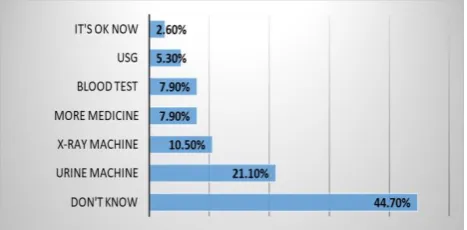
comprehensive. Most of them mentioned about bringing new diagnostic technologies like urine testing machine, X-Ray machine, USG and blood testing machine. Still, a large portion of the participants could not mention any concrete suggestion.
Figure 3: Features to add in order to make telemedicine service more effective.
“Telemedicine” project started its journey during 2013. Initially it had only three entrepreneurs. During the preliminary stage, SAMAMA (a local non-government organization) was responsible for field level monitoring and supervision and Telemedicine Department of University of Dhaka was the software and logistic supplier. However, Telemedicine Department has been operating the service for last sixteen months. Number of service centers has been increased to twenty.
People usually come to telemedicine centre for fever, pain, cold, headache, diabetics, neonatal problem, child problems, pregnancy related complication and various other issues. Initially, people had to face problems sometimes regarding the availability of doctors. One of the service receivers said, “Sometimes we had to come back home as there was no doctor available. Besides, service centers were also not open in working time. Many people stopped going there due to this problem”. Now, the situation has been changed. Biomedical Physics and
Technology Department, University of Dhaka has taken over the responsibility. There are 20 telemedicine service centers and 8 doctors now. Among them, six doctors work full time. Besides, telemedicine service providers have made informal agreement with diagnostic centers, as they have to refer patient for different pathological test
frequently. This has made the service more
comprehensive and people-oriented.
DISCUSSION
Bangladesh is now at a crucial point of development with United Nations resolution for Universal Health Coverage. The discussion of greater healthcare access and importance of application of technologies in this process has covered the widespread attention. However, the evidence about the potential impacts of using such technologies is scarce. The findings of this study suggest that, telemedicine program has achieved a lot within 16 months. Telemedicine is considered as one of the most effective tools in ensuring inclusion and increase overall accessibility to healthcare services of the rural and under-served communities by bridging the gap between urban and rural areas.
The current study showed that telemedicine service reduces significant amount of time and cost for the user to access the required health services; which comply with other studies conducted in similar contexts.17–24 Majority of participants indicated that they had access their required health services within an hour. In terms of cost, the study revealed that the telemedicine service reduces the health care cost of patient to a great extent.
Cost of treatment is one of the biggest factors for healthcare sector especially in low and middle-income countries like Bangladesh. It is the largest responsible sector for out-of-pocket expenditure. Out-of-pocket expenditure are primary means of financing healthcare in
much of Asia, where the ratio ranges from 30% to 82%.25
Huq et al talked about the unpredictability of healthcare expenditures. They said that, this uncertainty may impose a negative impact over the poor households and can blockade the possibility of welfare of and financial security of the household.26
telemedicine service can increase accessibility of people living in rural and hard to reach areas. Findings showed that telemedicine can be a cheaper and easier approach to make available modern healthcare facilities among large population who are living in remote areas. This finding resembles with other studies.19,27–29
The current telemedicine program was found to be offering only basic treatment and diagnosis facilities such as- fever, cold, pain, minor wound, blood pressure, pregnancy issues, sugar level related complications etc. At the same time, the centers referred the patients to the experts. Participants opined to increase the area of treatment, especially for gynecological, neonatal and child problem. Still, the existing program achieved success and became proven effective with limited diagnosis and treatment facilities. Other studies have also highlighted this feature of effectiveness and success of telemedicine in resource limited settings and rural areas.30–32
Quality of service and patient satisfaction has been a widely discussed issues over the years.33 Different scholars have defined the phrase “service quality” in different ways. Parasuraman et al (1985) describes as “a measure of the degree of discrepancy between client’s perceptions and expectations.”34 On the other hand, client dissatisfaction occurs when expectations of the clients are greater than actual performance of service delivering centers and users feel that the quality of perceived service is less than the satisfactory level.”34 Findings of this study suggested patient satisfaction, timely service and decreased waiting time; although most of the service users mentioned about more comprehensive services. Some studies in developing country context also indicated the significant role of telemedicine to enhance quality of healthcare services in terms of patient
satisfaction, timely services and decreased of
communication barriers.6,35–37
The issue of sustainability has long been a key area of concern associated with telemedicine. This concern includes availability of doctors and equipment, underdeveloped infrastructure, load-shedding in rural areas, internet connectivity, and willingness of the trained local service provider in the long run, set up cost, maintenance, people's perception etc. During the initial period of the studied telemedicine program, there were some issues in terms of the availability of doctors, lack of electricity, low bandwidth etc. The implementing agency has been working to recover most of the challenges since
its inception. In addition, inclusion of more
comprehensive service was found to be a priority issues for the implementer. Other studies have also identified these areas as the key to ensure sustainability.5,38,39
CONCLUSION
In a nutshell, we want to conclude by saying that the study provides a number of insights and lessons for future
research and policy development. Since telemedicine practice is increasing day-by day in Bangladesh, it is very much needed to develop and implement laws and regulations regarding the service provisions, as well as guidelines for personnel who are involved with this. In addition to this, relevant government entities have to take over the responsibility as it is primarily for the underserved and disadvantaged population. Telemedicine program does not have the capacity to provide specialized services. Further studies are needed to explore in more details for successful scale up and greater inclusion around the country.
ACKNOWLEDGEMENTS
The authors would like to thank A2I (access to information, Prime Minister’s Office), the study participants and study team members.
Funding: No funding sources Conflict of interest: None declared
Ethical approval: The study was approved by the Institutional Ethics Committee
REFERENCES
1. Ahmed S, Mahmood I. Health Systems in
Bangladesh. Heal Syst Policy Res. 2012;1:366-74.
2. El-Saharty S, Sparkes SP, Barroy H, Ahsan KZ,
Ahmed SM. The Path to universal health coverage in Bangladesh: bridging the gap of human resources for health. A world bank study. Washington DC; 2015.
3. Ministry of Health and Family Welfare. HRH Data
Sheet 2014. 2014.
4. Global Health Workforce Alliance. Scaling up,
saving lives: task force on scaling up education and Training for health workers. 2008.
5. World Health Organization.
Telemedicine-Opportunities and developments in Member States. Global Observatory for eHealth series. 2011: 2.
6. Nessa A, Al Ameen M, Ullah S, Kwak K.
Applicability of telemedicine in Bangladesh: current status and future prospects. In: Proceedings-3rd International Conference on Convergence and Hybrid Information Technology, ICCIT 2008. 2009;948-53.
7. Vassallo DJ, Hoque F, Roberts MF, Patterson V,
Swinfen P, Swinfen R. An evaluation of the first year’s experience with a low-cost telemedicine link in Bangladesh. J Telemed Telecare. 2001;7:125-38.
8. Hoque MR, Mazmum MFA, Bao Y. e-Health in
Bangladesh: current status, challenges, and future direction. Int Technol Manag Rev. 2014;4:87-96.
9. McCarthy D. The virtual health economy:
10. Ajami S, Lamoochi P. Use of telemedicine in disaster and remote places. J Educ Health Promot. 2014;3:26.
11. Ackerman MJ, Filart R, Burgess LP, Lee I,
Poropatich RK. Developing next-generation
telehealth tools and technologies: patients, systems,
and data perspectives. Telemed e-Health.
2010;16:93-5.
12. de Souza CHA, Morbeck RA, Steinman M, Hors
CP, Bracco MM, Kozasa EH, et al. Barriers and benefits in telemedicine arising between a high-technology hospital service provider and remote public healthcare units: a qualitative study in Brazil. Telemed e-Health. 2017;23:527-32.
13. Eron L. Telemedicine: The Future of Outpatient
Therapy? Clin Infect Dis. 2010;51:224-30.
14. Oudshoorn N. Diagnosis at a distance: The invisible
work of patients and healthcare professionals in cardiac telemonitoring technology. Sociol Heal Illn. 2008;30:272-88.
15. Wiskin M. The virtual gaze: vital self-technologies and the evolution of telehealth-an excerpt. Plot(s), Des Stud J. 2017;4.
16. Foucault M. Open up a few corpses. In: The Birth of
the Clinic: An Archaeology of Medical Perception. Paris, France; 1973: 135-9.
17. Parajuli R, Doneys P. Exploring the role of
telemedicine in improving access to healthcare services by women and girls in rural Nepal. Telemat Informatics. 2017;34:1166-76.
18. Jha AK, Gurung D. Reaching the unreached: a
model for sustainable community development
through information and communication
technology. JNMA J Nepal Med Assoc.
2011;51:213-4.
19. Thapa D, Sein MK. Trajectory of Affordances:
Insights from a case of telemedicine in Nepal. Inf Syst J. 2018;28:796-817.
20. Shimmura S, Shinozaki N, Fukagawa K, Shimazaki
J, Tsubota K. Real-time telemedicine in the clinical assessment of the ocular surface. Am J Ophthalmol. 1998;125:388-90.
21. Weiner M, Schadow G, Lindbergh D, Warvel J,
Abernathy G, Dexter P, et al. Secure Internet video conferencing for assessing acute medical problems in a nursing facility. Proceedings AMIA Symp. 2001;751-5.
22. Hassibian M, Hassibian S. Telemedicine
Acceptance and Implementation in Developing Countries: Benefits, Categories, and Barriers. Razavi Int J Med. 2016;4.
23. Kalam A. Current Situation and Future Opportunity
of Telemedicine in Bangladesh. University of Tomso. 2011.
24. Alkmim MB, Figueira RM, Marcolino MS, Cardoso
CS, Pena de Abreu M, Cunha LR, et al. Improving patient access to specialized health care: the Telehealth Network of Minas Gerais, Brazil. Bull World Health Organ. 2012;90:373-8.
25. van Doorslaer E, O’Donnell O, Rannan-Eliya RP,
Somanathan A, Adhikari SR, Garg CC, et al. Effect of payments for health care on poverty estimates in 11 countries in Asia: an analysis of household survey data. Lancet. 2006;368:1357-64.
26. Huq NM, Al-Amin AQ, Howlader SR, Kabir MA.
Paying Out of Pocket for Healthcare in Bangladesh - A Burden on Poor? Iran J Public Health. 2015;44:1024-5.
27. Bagchi S. Telemedicine in rural India. PLoS Med. 2006;3:82.
28. Pal A, Mbarika VWA, Cobb-Payton F, Datta P,
McCoy S. Telemedicine diffusion in a developing country: the case of India (March 2004). IEEE Trans Inf Technol Biomed. 2005;9:59-65.
29. Ishfaq R, Raja U. Bridging the healthcare access divide: a strategic planning model for rural telemedicine network. Decis Sci. 2015;46:755-90.
30. Vinals F, Mandujano L, Vargas G, Giuliano A.
Prenatal diagnosis of congenital heart disease using four-dimensional spatio-temporal image correlation (STIC) telemedicine via an Internet link: a pilot study. Ultrasound Obstet Gynecol. 2005;25:25-31.
31. Froehlich W, Seitaboth S, Chanpheaktra N, Pugatch
D. Case report: an example of international
telemedicine success. J Telemed Telecare.
2009;15:208-10.
32. Brear M. Evaluating Telemedicine: lessons and
challenges. Heal Inf Manag J. 2006;35:23-31.
33. Ahsan M, Hasin A, Sarker S, Islam N, Shareef MA.
Perception of customer satisfaction and healthcare service quality in the context of Bangladesh. Int J Qual. 2011;5:237-44.
34. Parasuraman A, Zeithaml VA, Berry LL. A
Conceptual Model of Service Quality and Its Implications for Future Research. J Mark. 1985;49:41–50.
35. Sorwar G, Mustafizur Rahamn M, Uddin R, Hoque
M. Cost and Time Effectiveness Analysis of a Telemedicine Service in Bangladesh. Stud Health Technol Inform. 2016;231:127-34.
36. Patterson V, Singh M, Rajbhandari H, Vishnubhatla
S. Validation of a phone app for epilepsy diagnosis in India and Nepal. Seizure. 2015;30:46-9.
37. Graham LE, Flynn P, Cooke S, Patterson V. The
interdisciplinary management of cerebral
haemorrhage using telemedicine - a case report from Nepal. J Telemed Telecare. 2001;7:304-6.
38. Sanders J, Bashshur R. Challenges to the
Implementation of Telemedicine. Telemed J. 1995;1:115-23.
39. Bashshur R, Shannon G, Sapci H. Telemedicine
Evaluation. J Telemed eHealth. 2005;11:296-316.