Original Research Article
Vaccination coverage and its determinants in rural areas of district
Doda of Jammu and Kashmir, India
Rajnesh Kumar*, Kanchan Mukherjee
INTRODUCTION
Vaccination has been identified as one of the most efficient and cost-effective public health interventions. No other public health intervention has been as effective in reducing under-five mortality and morbidity. Vaccination is the single most reliable way of preventing a large number of deaths among infants and children below the age of 5 years and is a major contributor to decline in under-5 mortality rate. However,
vaccine-preventable diseases (VPDs) are still responsible for over 5 lakh deaths annually in India.1
In India, the immunization program began long ago in the year 1978, yet the percentage of complete vaccination coverage is still low even after more than 4 decades of efforts.2
In India, of the 8,26,000 deaths in under-5 children in 2008, almost 6,04,000 deaths were due to vaccine-ABSTRACT
Background: India accounts for the highest number of under-five deaths in the world. Estimates claim that 89 lakh children in India receive fewer vaccines or no vaccine at all. One out of every three children in India does not receive all vaccines under the universal immunization programme. 5% children in urban and 8% children in rural areas remain unimmunized. According to NFHS-4 data complete vaccination coverage in India stands at 62%. The objectives of this study were to evaluate complete vaccination coverage, dropout rate and identify factors for failure of vaccination coverage in Doda district of Jammu and Kashmir, state of India.
Methods: A cross-sectional quantitative study was conducted to evaluate the complete vaccination coverage by using an interview schedule devised as per WHO-UNICEF coverage cluster survey reference manual and National Immunization Schedule. A pre-determined sample size according to the WHO-UNICEF coverage cluster survey reference manual was adopted for the purpose of the study.
Results: Of the total 207 children included in the study 66.2% (n=137) were fully immunized. 19.8% of the children had dropped out and did not receive the recommended dose of pentavalent vaccine. Among the reasons for low complete vaccination coverage, lack of awareness, mother too busy and vaccinator being absent were identified as the major reasons.
Conclusions: Complete vaccination coverage has shown an increase with an increase in the coverage of the individual vaccines. But the coverage is still low and more efforts are needed to further improve the vaccination coverage.
Keywords: Vaccination coverage, Under-five mortality, Universal immunization programme, National immunization schedule
School of Health Systems Studies, Tata Institute of Social Sciences, Mumbai, India
Received: 24 July 2019
Revised: 05 September 2019
Accepted: 06 September 2019
*Correspondence:
Dr. Rajnesh Kumar,
E-mail: [email protected]
Copyright: © the author(s), publisher and licensee Medip Academy. This is an open-access article distributed under the terms of the Creative Commons Attribution Non-Commercial License, which permits unrestricted non-commercial use, distribution, and reproduction in any medium, provided the original work is properly cited.
preventable diseases including diarrhoea, pertussis, measles, meningitis, and pneumonia.3
Every year, vaccination averts an estimated 2-3 million deaths from diphtheria, tetanus, pertussis (whooping cough) and measles. Among all the child deaths nearly 17% of deaths are due to vaccine-preventable diseases.4
An estimated 89 lakh children in India receive a few vaccines or no vaccine at all. One out of every three children in India does not receive all vaccines under the Universal Immunization program. 5% of children in urban and 8% of children in rural areas are unimmunized.5
The district-level household and facility survey, DLHS-3 (2007-08) reported complete vaccination coverage of 54% for India and 62.5% for the state of Jammu and Kashmir.6
The last National Family Health Survey; NFHS-4 (2015-16)provides estimates for immunization coverage at national, state and district level. The complete vaccination coverage as per NFHS-4 for India is 62%, for the state of Jammu and Kashmir is 75% while in district Doda, the complete vaccination coverage reported by NFHS-4 was 43% for the entire district and only 38.5% for rural areas. This shows the huge gap in vaccination coverage for rural areas as nearly more than 80% of the population of the district resides in rural areas.7
Mission Indradhanush was launched by the Ministry of Health and Family Welfare Government of India in December 2014 to vaccinate all those children who have been partially vaccinated or unvaccinated. The mission was aimed at achieving more than 90% coverage by the end of the year 2018. In the state of Jammu and Kashmir district, Doda was also among one of the high focus districts in this mission. About 0.953 lakh children were immunized under the mission in the state during the year 2017-18.8
Despite the presence of universal immunization program in the country and availability of free vaccines provided through the public health system across the country, we still have not been able to achieve universal immunization coverage.
Objectives
The objectives of the present study were to determine the complete vaccination coverage in rural areas of Doda district of Jammu and Kashmir, to estimate the dropout rate and to identify the determinants of vaccination coverage in rural areas of Doda district of Jammu and Kashmir.
METHODS
Quantitative study design was used to conduct the study. The study was a descriptive cross-sectional study and
used primary as well as secondary data. The study participants included children in the age group of 12-23 months old for the evaluation of vaccination coverage. The study was conducted from 1st April 2018 to 30th November 2018. Respondents for vaccination coverage evaluation were mothers who were permanent residents of the district or those who were living in the district for more than two years and had no immediate plan (within next two years) to move out of the district. Semi-structured interviews were also conducted with medical officers, Auxiliary nurse-midwives (ANMs) and other health workers to probe the reasons affecting vaccination coverage.
The sample size was calculated with the help of WHO- UNICEF vaccination coverage cluster survey reference manual. A pre-determined sample size according to the WHO-UNICEF coverage cluster survey reference manual was adopted for the purpose of the study. As per the said reference manual, the sample size at z value (confidence interval)=1.96 and precision level (d) of 10% is 207. Therefore a sample size of 207 was considered as the final sample for the study.9
Purposive sampling was used to include blocks, village panchayats and villages for data collection. The entire district had 8 rural blocks out of which 4 rural blocks viz., Bhaderwah, Assar, Thatri and Bhagwa were selected for data collection by taking into consideration the accessibility, time limit, financial resources and security scenario.
Secondary data was collected from health facilities viz., sub centers and primary health centers for two blocks namely block Assar and block Bhagwa. From each health facility, a list of the total eligible children was prepared from the vaccination registers based on the date of birth and then the required numbers of sampling units were drawn randomly from each health center selected for data collection. Quantitative data collection tools viz., interview schedule and a semi-structured interview guide, adopted and modified from the WHO-vaccination coverage cluster survey reference manual was used to collect the data. The standard tool was modified according to the national immunization schedule for coverage evaluation and to suit the local geographical and cultural context regarding reasons for the failure of vaccination. Primary data was collected from blocks Bhaderwah and Thatri whereas secondary data from health centers were collected from block Assar and Bhagwa. Data analysis was done by using Statistical package for social sciences (SPSS-25). Descriptive statistical analysis like frequency has been computed for the desired variables. The analysed data has been presented in tables and figures wherever required.
RESULTS
Caste wise analysis of the sample shows that 69% of the respondents were from general caste, 25% were from scheduled castes and 5% were from scheduled tribes.
Majority of the deliveries (82%) were institutional deliveries, the majority of which were conducted at the district hospital and community health centers.
Table 1: Socio and demographic distribution.
Religion Caste Sex
Hindu Muslim General Scheduled caste Scheduled tribe Male Female N (%) N (%) N (%) N (%) N (%) N (%) N (%)
76.3 (n=158) 23.7 (n=49) 68.8 (n=143) 25.5 (n=53) 5.3 (n=11) 63.3 (n=131) 36.7 (n=76)
Total (n=207) Total ( n=207) Total (n=207)
Table 2: Type of delivery and source of data.
Delivery type Source of data
Institutional Home Immunization cards Health facility registers
N (%) N (%) N (%) N (%)
81.6 (n=169) 18.4 (n=38) 50.7 (n=105) 49.3 ( n=102)
Total (n=207) Total (n=207)
Of the total 207 children included in the study 66.2% (n=137) were considered as fully vaccinated as they had received birth dosages i.e., BCG, OPV and hepatitis-B, three doses each of pentavalent vaccine and OPV, and one dose of measles. In addition, most of these had also received two doses of IPV and the first dose of vitamin-A, and a few had also received booster doses of DPT, OPV and measles. 33.8% (n=70) of the children were partially immunized as they have missed either one or more doses.
Table 3: Complete vaccination coverage.
Variables N (%)
Fully immunized children 66.2 (n=137)
Partially immunized children 33.8 (n=70)
Unimmunized children 0 (n=0)
Total 100 (n =207)
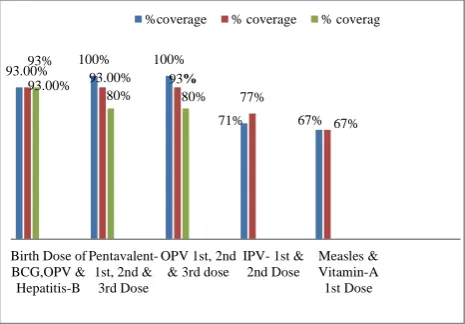
94% (n=194) of the children in the study were found to have received all the recommended birth doses i.e., BCG, OPV and hepatitis-B, while 2.9% (n=6) of the children were found to have not received the birth doses of BCG, OPV and hepatitis-B. The status of the birth doses of 3.4% (n=7) of the children could not be determined either due to unavailability or ambiguity of the data.
The analysis of data shows that the first dose of the pentavalent vaccine given at the age of 6 weeks had 100% (n=207) coverage while 2nd and 3rd doses given at the age of 10 and 14 weeks had a coverage of 93% (n=193) and 80% (n=166) respectively.
The coverage of the first dose of OPV given at the age of 6 weeks was 100% (n=207), while 2nd and 3rd doses given at the age of 10 and 14 weeks had coverage of 93% (n=194) and 80% (n=167) respectively.
The coverage of the first dose of measles given at the age of 9-12 months was 67.6% (n=140).
In the present study, no significant association was found between gender and vaccination coverage. The complete vaccination coverage for boys was 66.4% (n=87) and for girls was 65.8% (n=50).
Figure 1: Vaccination coverage for different vaccines.
Dropout rate
It is the proportion of the children who have received one or more vaccines but have failed to turn up for subsequent doses. It is expressed in percentage.
Dropout rate is calculated as follows:
(Pentavalent 1 cumulative total Pentavalent 3 cumulative total) Pentavalent 1
Cumulative total 100
(207 166) 207 100 = 19.8%
93.00% 100% 100%
71% 67%
93%
93.00% 93%
77%
67% 93.00%
80% 80%
Birth Dose of BCG,OPV & Hepatitis-B
Pentavalent-1st, 2nd &
3rd Dose
OPV 1st, 2nd & 3rd dose
IPV- 1st & 2nd Dose
Therefore, almost one-fifth of the children dropped out and did not receive the recommended dose of pentavalent vaccine.
Reasons for drop out and low vaccination coverage
Regarding drop out, data could be collected from only 24 respondents. Among the reasons for dropouts, the most common reason reported was lack of awareness about the need for returning to get 2nd and 3rd dose. About 45% (n=11) of the respondents reported that they did not know about the need of return for 2nd and 3rd dose. In addition, 30% (n=7) of the respondent mothers reported that they remain too busy in household work and working in the fields and could not find time to visit the health center. 25% (6) of the respondents reported that they did visit the health facility for vaccination but, vaccinator was not present at the health center and they have to return back.
Semi-structured interviews were conducted with medical officers and Auxiliary nurse midwives (ANMs) at primary health centers (PHCs), New type primary health centers (NTPHCs) and sub-centers (SCs) to get their perspectives on the issues that emanate from the health systems. Interview conducted with a medical officer at a primary health center in one of the blocks revealed no major obstacle from the health systems. It was reported that vaccination services are provided round the year. Vaccine supply and the cold chain are also maintained well. The PHC had a dedicated MCH and immunization section and staff providing the vaccination services. There was no shortage of vaccine or staff reported by the Medical officer.
On the contrary, the factors which medical officer cited for the low vaccination coverage in the area were the accessibility of the services. In the block, there was only one PHC which catered to all the health needs of the population. People had to travel several kilometers on foot to reach PHC and get their children vaccinated. Sometimes they have to lose their wages and don’t come for vaccination or other preventive health services like ANCs in order to save their time and wage loss.
Similar issues were reported from the interviews with the medical officers of another block from which secondary data was collected. Lack of awareness was pointed out by the medical officer as a reason for low vaccination coverage. Accessibility was again reported as a problem for low vaccination coverage. The interview with ANM also suggested the lack of education and awareness as one of the problems responsible for the low coverage of vaccination. In the winter season snowfall sometimes becomes a major problem for health workers and population as well.
Regarding the maintenance of vaccination records, health facilities in these blocks had vaccination registers on which the vaccinations given were recorded. But the records were not properly maintained and there was a lot
of ambiguity. For two blocks for which primary data was collected interviews could be conducted with two medical officers only. Out of 5 PHCs, medical officers were found at two of them only and at NTPHCs medical officer was found at one NTPHC only.
At one of the PHC even in the afternoon staff was not available. There were only two health workers who could not give information about vaccination coverage. The staff nurse who was in charge of the vaccination section was also not available.
Observation of the vaccination records which could be accessed at health facilities revealed that vaccination records were not satisfactory at all the health facilities. At one of the primary health center vaccination records were maintained in a diary by the ANM instead of the register due to unavailability of the same. At one of the NTPHC no vaccination records were available at all.
At one of the sub-center vaccination register was available but there was no entry for the last two years in the register and the ANM available had joined the sub-center just few days back, so she could not give information about vaccination coverage and vaccine availability.
In one of the blocks adverse reaction following immunization (AEFI) was reported to be one of the reasons why people don’t turn up for subsequent doses.
Health workers hardly organize any vaccination camps or awareness sessions for the improvement of vaccination coverage, especially in hard to reach areas due to lack of planning, staff and other resources as well as lack of motivation for the same. In some of the facilities, the vaccine is given on 15th of every month and this has become a norm in the community to visit the health center on 15th of every month for vaccination. While at other health facilities one day of the week (Wednesday) is dedicated to vaccination so that people visit the health center on this day every week to get their children vaccinated. One finding at two of the primary health centers was that in the absence of nurse in charge of vaccination other staff hardly had any sense of responsibility of discharging the duty of providing vaccination. Hence, the absence of role shifting is a key hindrance to effective immunization coverage.
DISCUSSION
A study conducted by Qureshi and et al, in Srinagar (J and K) reported complete vaccination coverage 75%.10 Another study done in the rural set up of Uri in Kashmir had coverage of 58%.11 Findings of the present study shows complete vaccination coverage of 68%.
The results of our study are somewhat similar to Study by Hartesh et al in rural and urban blocks of Udaipur with the exception that their study had 10% unimmunized children while in our study all children were either completely or partially immunized.12
Another study by Pandey and et al in rural Rajasthan had a complete vaccination coverage of 76.19% which is again nearly similar to findings of our study. Some of the reasons for not immunizing the children in their study included unawareness of need to return for 2nd and 3rd dose, mother too busy, fear of side reactions which are common to findings in our study.13
Gender inequity in vaccination coverage has been a consistent finding in earlier studies but evaluation of NFHS survey data by researchers have found that gender inequity haven’t increased over time.14 The UNICEF coverage evaluation survey 2009 shows complete vaccination coverage for boys was 61.9% and 59.9% for girls.15 No significant association was found between gender and vaccination coverage in the present study as complete vaccination coverage among boys was 66.4% (n=87) and for girls was 65.8% (n=50).
Impact of accessibility of health systems on vaccination coverage is evident from the study of Datar et al as children residing in areas having no nearby health facility are more likely to remain unimmunized.16 Distance of health facility from home has been found to be a factor for not immunizing children in present study too.
CONCLUSION
The findings of the study indicate that complete vaccination coverage is more when compared to NFHS-4 data. It is possible that the newer initiatives and efforts like Indradhanush mission and Measles-Rubella campaign are likely the potential reasons to increase the vaccination coverage. But some of the basic hurdles and issues in complete vaccination coverage are still present. The lack of awareness of need to return for 2nd and 3rd dose and absence of vaccinator are some of the factors affecting the vaccination coverage. The study highlights some of the pertinent health systems issues which need to be addressed and more efforts are needed to further improve the vaccination coverage in the district.
Recommendations
Organizing the IEC campaigns and vaccination camps in inaccessible areas can be a strategy to create awareness as well as to provide vaccination. Creating awareness and imparting the true knowledge about the adverse effects
following immunization (AEFI) to alleviate the fears of mothers who consider mild fever after vaccination as an illness can help in reducing dropouts. Capacity building and imparting training to all the relevant health workers in the health facility to train them to provide vaccination and maintaining the vaccination records will be usefull to improve the vaccination coverage. Proper maintenance of the vaccination records, use of vaccination registers to keep the records and use of data to identify the children who are dropped out will go a long way in decreasing drop-out rate and improving the full immunization rate.
Limitations
Purposive sampling was used instead of tested sampling strategies like cluster sampling techniques (WHO/UNICEF 30 7 cluster sampling technique). Small sample size of the study due to the above mentioned factors is also the limitation of the study.
ACKNOWLEDGEMENTS
We acknowledge the cooperation of study participants including health workers for their participation in the study.
Funding: No funding sources Conflict of interest: None declared Ethical approval: Not required
REFERENCES
1. Vashishtha VM, Kumar P. 50 years of immunization in India: progress and future. Indian Pediatr. 2013;50:111-8.
2. Lahariya C. A brief history of vaccines and vaccination in India. Indian J Med Res. 2014;139:491-511.
3. Black RE, Cousens S, Johnson HL, Lawn JE, Rudan I, Bassani DG, et al. Global, regional and national causes of child mortality in 2008: a systematic analysis. Lancet. 2010;375(9730):1969-87.
4. Goyal S, Kumar V, Garg R. Evaluation of primary immunization coverage among children in a rural block of district Rohtak, Haryana, India. Int J Community Med Public Health. 2017;4:1612-9. 5. Press Information Bureau, Government of India.
Available at: http://pib.nic.in/newsite/mbErel.aspx? relid=117759. Accessed on 23 May 2018.
6. District Level Household Survey-3, 2007-08. Available at: http://rchiips.org/PRCH-3.html. Accessed on 16 October 2018.
7. National Family Health Survey-4 fact sheets, 2015-16 Available at http://rchiips.org/nfhs/factsheet_ NFHS-4.shtml. Accessed 16 October 2018.
9. World Health Organisation Vaccination Coverage Cluster Surveys: Reference Manual Version 3 Working Draft Updated July 2015. Available at: https://www.who.int/immunization/monitoring_surv eillance/Vaccination_coverage_cluster_survey_with _annexes.pdf. Accessed on 24 November 2017. 10. Khan MS, Qureshi UA, Bilquees S, Qurieshi MA,
Pandit I, Haq I, et al. Immunization Coverage in Block Hazratbal of District Srinagar, Jammu & Kashmir. Acad Med J India. 2014;2:45-8.
11. Singh A, Senger KPS, Singh AK, Singh AK. Immunization status of children visiting a health centre in Uri, Jammu and Kashmir: reasons for drop-outs from immunization. Int J Community Med Public Health. 2017;4:2725.
12. Pahwa HS, Goyal D, Sareen D. Evaluation of immunization coverage and its determinants in children aged 12-24 months from rural and urban areas of Udaipur, Rajasthan, India. Int J Contemp Pediatr. 2019;6:837-41.
13. Pandey NL, Paliwal A, Sharma BN, Choudhary RC, Bhardwaj SL. Evaluation of Immunization coverage in the rural area of Jaipur, Rajasthan using the WHO cluster sampling technique, Int J of Med Sci Educ. 2016;3(1):16-24.
14. Mathew J. Inequity in child immunization in India: a systematic Review. Indian Pediatr. 2012;49:203-23.
15. UNICEF. 2009 Coverage Evaluation Survey. Available at: https://data.unicef.org/wp-content/ uploads/country_profiles/India/immunization_count ry_profiles/immunization_ind.pdf. Accessed on 17 March 2018.
16. Datar A, Mukherji A, Sood N. Health infrastructure and immunization coverage in rural India, Indian J Med Res. 2007;125:31-42.