Original Research Article
Assessment of immunization coverage in district Srinagar of Kashmir
Ambrine Ashraf, Sheema Samreen*,
S. M. Salim Khan, Inaamul Haq, Mariya Amin
INTRODUCTION
One of the most important and successful strategy in public health and preventive medicine so far is immunization. It is till now most safe, cost effective and powerful intervention that has decreased the burden of vaccine preventable infectious diseases all over the world whether in developed or in developing world.1
It has been estimated that almost 2-3 million deaths are avoided globally every year from diphtheria, tetanus, pertussis, haemophilus type b because of immunization. This number can further be decreased to additional 1.5 million if there is improvement in global immunization coverage. But still 19.4 million infants are still missing out basic vaccines as per WHO.2 Protection through immunization against vaccine preventable diseases, disabilities and death is the right of every child.3
Although history of immunization in India dates back to about 1800 A.D but the current immunization in India started with the launch of Expanded Program for Immunization EPI in 1978 which included BCG, DPT, OPV and typhoid vaccines.4-6 EPI gained boost in 1985 as the Universal Immunization Program (UIP).5,7 Over these years the program became more refined and many more vaccines were added in the schedule. Currently the routine immunization has changed rapidly, based on the reports of immunization coverage, 2012-2013 was declared as period of intensification in immunization & to supplement this Mission Indradhanush was launched in December 2014 by Ministry of Health and Family Welfare, India.8 This initiative aimed to increase the immunization among pregnant and children of underserved population by 90%.8 Presently Universal Immunization Program in India offers vaccines against ten major killer diseases.9,10 Despite all these efforts, the immunization coverage is not up to mark and India still
ABSTRACT
Background: Immunization is till now most safe, cost effective and powerful intervention that has decreased the burden of vaccine preventable infectious diseases all over the world. The aim of this study was to estimate the immunization coverage among children aged 12-23 months in district Srinagar of Jammu and Kashmir.
Methods: The study sample included 30 clusters from district Srinagar selected as per the 30×7 cluster sampling method.
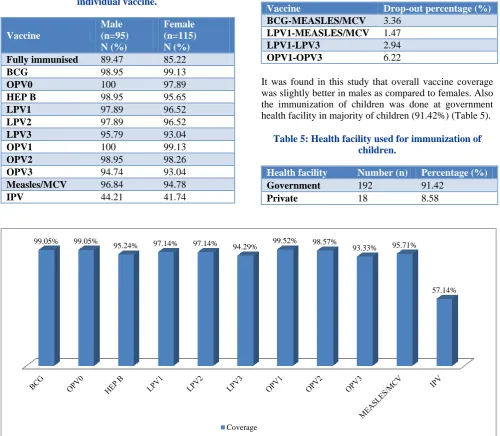
Results: It was found that fully immunized children were 87.14% and 12.26% of children were partially immunized and none was unimmunized. Regarding the individual vaccine coverage, it was highest for OPV1 (99.52%) followed by BCG and OPV0 (99.05%) and lowest for Hepatitis birth dose (95.24%). The dropout was found highest (6.22%) for OPV1-OPV3 and lowest (1.47%) for LPV1 - measles/MCV (1.47%).
Conclusions: The immunization of district Srinagar is above 85% and this gives a positive hope for better future to reach coverage of 100%.
Keywords: Immunization, Drop outs, Health facility, Kashmir, Srinagar, Coverage
Department ofCommunity Medicine, Government Medical College, Srinagar, Jammu and Kashmir, India
Received: 05 November 2018 Accepted: 06 December 2018 *Correspondence:
Dr. Sheema Samreen,
E-mail: [email protected]
Copyright: © the author(s), publisher and licensee Medip Academy. This is an open-access article distributed under the terms of the Creative Commons Attribution Non-Commercial License, which permits unrestricted non-commercial use, distribution, and reproduction in any medium, provided the original work is properly cited.
accounts for 7.4 million unimmunized children.11 This calls for a serious concern and continuous monitoring and evaluation should be the step to improvise. The monitoring of immunization can give us an idea about the lacunae and scope for improvement. Cluster sampling technique is most widely and commonly used for evaluation of immunization coverage and has proved effective in such evaluation.12 So far data on immunization of children of district Srinagar was not available so this study was undertaken to assess the ground level situation of immunization in district Srinagar.
Aim and objectives
The aim of this study was to estimate the overall immunization coverage among children aged 12-23 months in district Srinagar of Jammu and Kashmir.
METHODS
The present cross-sectional study was carried out by Department of Community Medicine (SPM), Govt. Medical College in District Srinagar in May 2017. The permission for conduction of study was taken from the Directorate of Health Services, Kashmir. Ethical clearance was also obtained from the Institution.
The study was carried out in district Srinagar which is the summer capital of Jammu and Kashmir and has a total population of 1,236,829 as per census 2011.13Cluster sampling was done. The study sample included 30 clusters from the entire population of District Srinagar selected as per the 30×7 cluster sampling method. As the village/ward list was not available to department at the time of study so line listing of villages/wards could not be done for selecting the clusters.
Regarding sampling, the district was divided into four zones covering directions of east, west, north and south. A total of 30 clusters were chosen randomly from the above four zones giving a total sample size of 210 children in the age-group of 12 to 23 months.
Six teams comprising of post graduate scholar, 5-6 undergraduate students and one senior resident supervised by faculty members of Department of Community Medicine, Govt. Medical College Srinagar were formed. The training for conduction of study and collection of data was done in the department beforehand. For data collection the team members first identified the cluster area and then chose a random point in a random direction to select the first house. After enquiring about the presence of eligible child in the house, the head of family was explained about the objective of the study and informed consent was taken from mother/caregiver of child.
All eligible children in the household were included in the study. Infant immunization cluster form by WHO was used for interview.14 The immunization history of the child and other necessary information was collected. Simultaneously immunization cards were checked and their photographs taken for records and avoiding information bias.
After completing first household, the team moved on to the next house in a specified chosen direction and the process was repeated till seven eligible children were included for each cluster.
Information on the immunization card was taken as final for considering a child as immunized or not immunized. If the child had received one dose of BCG, three doses of LPV (liquid pentavalent vaccine), three doses of OPV (oral polio vaccine) and one dose of measles/MCV (measles containing vaccine) then he/she was considered fully immunized. If he/she had received none of these vaccines then child was considered as unimmunized and partially immunized if some doses were given, but immunization was not complete for his age. BCG scar was also checked in every child. The 9-month measles immunization was considered to be on time if it was administered between 9 months and 12 months.
The sample size of 210, allows vaccine coverage to be estimated with a 95% confidence interval (±10 percentage points), on the assumption of a design effect (increase in variance due to clustering) of 2.14 Immunization coverage was calculated using BCG, OPV, measles, LPV i.e. fully immunized = OPV × 3 + LPV × 3 + measles (MCV) at 9 months.9
The data was entered in Microsoft excel and analyzed in Epi Info 7. The descriptive statistics such as frequencies and proportion was used to describe the study population in relation to relevant variables.
RESULTS
A total of 571 houses were visited to include 210 children in the age group of 12-23 months in our study. This included 115 girls (54.76%) and 95 boys (45.24%) (Table 1). It was found that fully immunized children were 87.14%, 89.47% in boys and 85.22% in girls. 12.86% of children were partially immunized and none among the children was unimmunized (Table 2 and Table 3).
Table 1: Gender wise distribution of children.
Gender Number (N) Percentage (%)
Male 95 45.24
Female 115 54.76
Table 2: Immunization status of the children.
Immunization status Number (n) Percentage (%) Fully immunized 183 87.14
Partially immunized 27 12.86
Table 3: Gender wise immunization coverage of individual vaccine.
Vaccine
Male (n=95) N (%)
Female (n=115) N (%) Fully immunised 89.47 85.22
BCG 98.95 99.13
OPV0 100 97.89
HEP B 98.95 95.65
LPV1 97.89 96.52
LPV2 97.89 96.52
LPV3 95.79 93.04
OPV1 100 99.13
OPV2 98.95 98.26
OPV3 94.74 93.04
Measles/MCV 96.84 94.78
IPV 44.21 41.74
The dropout rate which tells us about the performance of immunization program was calculated for–measles/ MCV, LPV1-measles/MCV, LPV1-LPV3 and OPV1-OPV3. It was found highest (6.22%) for OPV1-OPV3 and lowest (1.47%) for LPV1- measles/MCV (Table 4).
Table 4: Drop out percentages of vaccines in children.
Vaccine Drop-out percentage (%)
BCG-MEASLES/MCV 3.36 LPV1-MEASLES/MCV 1.47 LPV1-LPV3 2.94 OPV1-OPV3 6.22
It was found in this study that overall vaccine coverage was slightly better in males as compared to females. Also the immunization of children was done at government health facility in majority of children (91.42%) (Table 5).
Table 5: Health facility used for immunization of children.
Health facility Number (n) Percentage (%) Government 192 91.42
Private 18 8.58
Figure 1: Immunization coverage of individual vaccines.
DISCUSSION
Immunization coverage monitoring is an important strategy for improvement and assessment of utilization of health services in children. For estimating immunization coverage among children 30 cluster sampling has proved to be a useful, rapid, convenient and cost effective method.3 In 2012 World Health Assembly endorsed Global Action Plan 2011-2020 with aim of achieving 90% immunization coverage at National levels and greater than 80% coverage at district level or equivalent.
The overall vaccine coverage globally has remained steady since 2010.15
In India, the national coverage for full immunization is 87.13% but it varies from state to state.10 The national immunization coverage as per NFHS 3 and NFHS 4 was 43.5% and 62% respectively.16
In our present study the overall immunization coverage was 87.14% which is higher than the estimated coverage for J&K as per NFHS3 (46.7%) and NFHS4 (71.7%).16
99.05% 99.05%
95.24% 97.14% 97.14% 94.29% 99.52% 98.57% 93.33% 95.71%
57.14%
The estimated coverage is higher than that found by Khan MS et al who conducted a similar study in Hazratbal Block of Srinagar.3 Srivastava et al conducted a similar study in Karnataka and found that 83% of children were fully immunized.17
In the present study the estimated BCG coverage was 99.05% which is almost similar to the estimated by NFHS 4 (98.5%) for urban area in J&K.16 Khan et al conducted a study in Block Hazratbal of Srinagar and found that BCG coverage was 96.66%.3 The BCG coverage reported in present study is higher than the BCG coverage as reported by studies conducted in various states of India.17-20
The study shows that BCG coverage has increased and this higher coverage of BCG is due to increased awareness about the vaccination and greater number of institutional deliveries in the city. Similarly, the coverage for other vaccines in our study is greater than that reported by NFHS 4 and that by studies in India.17,18,21-23 It is also higher than the WHO national, regional and global estimates.15,24
In our present study the coverage of IPV (Inactivated Polio Vaccine) is very low 57.14%. This low coverage can be best explained by the fact that IPV was introduced at national level in October 2015 and in the state of J&K in April 2016.25,26
The dropout rates for vaccines in our study is higher for polio which should be an alarm for the authorities because it can be a serious threat for the polio endgame strategy as the threat still persists and can lead to resurgence of the disease.
CONCLUSION
The immunization of district Srinagar was above 85% and this gives a positive hope for better future. Though immunization coverage in the study population is relatively high compared to that of other areas of the country, there are still opportunities for improving its coverage by regular awareness campaigns. The efforts should be continued so that full immunization coverage is 100% in the state.
ACKNOWLEDGEMENTS
"Mohsina Mukhtar, Hina Bashir, Mehk Neelofer, Ruqia Quansar, Sheikh Mohammad Saleem, Najm ul Ain, Khalid Bashir, Abdul Hamid, Dr. Abdul Rouf", [Post-graduate Scholars, Department of Community Medicine (SPM), G.M.C, Srinagar, J&K], for their valuable time and efforts for data collection.
All students of prefinal MBBS batch 2013 of Government Medical College, Srinagar who were part of data collecting teams.
Funding: No funding sources Conflict of interest: None declared
Ethical approval: The study was approved by the Institutional Ethics Committeeof GMC, Srinagar
REFERENCES
1. Hayat H, Khan PS, Hayat G, Hayat R. Knowledge and attitude of caretakers of children regarding immunization. East J Med. 2012;17(3):126–9. 2. WHO. Immunization coverage. WHO. World
Health Organization; 2017. Available at: http://www.who.int/mediacentre/factsheets/fs378/en /. Accessed on 13 July 2017.
3. Khan MS, Qureshi UA, Bilquees S, Qurieshi MA, Pandit I, Qureshi UA. Immunization Coverage in Block Hazratbal of District Srinagar, Jammu & Kashmir. Academic Medical J India. 2014;2(2):45– 8.
4. Lahariya C. A brief history of vaccines & vaccination in India. Indian J Med Res. 2014;139:491–511.
5. Vashishtha VM, Kumar P. 50 years of immunization in India: Progress and future. Indian Pediatr. Springer-Verlag. 2013;50(1):111–8. 6. WHO. Estimation of child vaccination coverage at
state and national levels in India. WHO. World Health Organization; 2016; Available at: http://www.who.int/bulletin/volumes/94/10/15-167593/en/. Accessed on 30 June 2017.
7. Taneja G, Sagar KS. Routine Immunization In India: A perspective. IJCH. Available at: http://www.jsi.com/JSIInternet/Inc/Common/_down load_pub.cfm?id=15227&lid=3. Accessed on 30 June 2017.
8. Press Information Bureau, Government of India, Ministry of Health and Family Welfare, Ministry of Health and Family Welfare. Full Immunization Rate in the Country. Available at: http://pib.nic.in/ newsite/PrintRelease.aspx?relid=133714. Accessed on 30 June 2017.
9. Ministry of Health & Family Welfare GOI. Immunization Handbook for Medical Officers. 2016. Available at: http://www.nccvmtc.org/ PDF1/mo2016.pdf. Accessed on 30 June 2017. 10. Press Information Bureau, Government of India,
Ministry of Health and Family Welfare. Universal Immunization Programme. Available at: http://pib.nic.in/newsite/PrintRelease.aspx?relid=15 4779. Accessed on 13 July 2017.
11. Immunization. UNICEF. Available at: http://unicef.in/Whatwedo/3/Immunization
Accessed on 5 July 2017.
12. Henderson RH, Sundaresan T. Cluster sampling to assess immunization coverage: A review of experience with a simplified sampling method. Bull World Health Organ. 1982;60(2):253–60.
district/628-srinagar.html. Accessed on 30 May 2018.
14. Who. Evaluating HPV vaccination pilots: practical experience from path Immunization Coverage Cluster Survey— Reference Manual. 2005. Available at: www.rho.org/hpv-evaluating-pilots.htm. Accessed on 5 July 2017.
15. States M, Strategic WHO, Group A, Grade T. Weekly epidemiological record Relevé épidémiologique hebdomadaire. 2015;(35):433–60. 16. National Family Health Survey - 4. 2015;
17. Srivastava AK, Shankar G. A study of immunization coverage and its determinants among under five children residing in urban field practice area of S. N. Medical College, Bagalkot, Karnataka. Int J Contemporary Pediatr. 2017;4:49–53.
18. Kadri AM, Singh A, Jain S, Mahajan RG, Trivedi A. Study on immunization coverage in Urban slums of Ahmedabad city. Heal Popul Perspect Issues. 2010;33(1):50–4.
19. Pandey LN, Paliwal A, Sharma BN, Choudhary RC, Bhardwaj SL. Evaluation of immunization coverage in the rural area of Jaipur, Rajasthan, using the who thirty cluster sampling technique. Int J Med Sci. 2016;3(1):16-24.
20. Gupta PK, Pore P, Patil U. Evaluation of immunization coverage in the rural area of pune, maharashtra, using the 30 cluster sampling technique. J Fam Med Prim care. Wolters Kluwer -- Medknow Publications. 2013;2(1):50–4.
21. Indian Institute for Population sciences. National Family Health Survey - 4 2015-16. State Fact Sheet, Maharashtra. 2015: 1–6.
22. Pandey LN, Paliwal A, Sharma BN, Choudhary RC, Bhardwaj SL. Evaluation of Immunization Coverage in the Rural Area of Jaipur Rajasthan, using the WHO Cluster Sampling Technique. Int J Med Sci Educ. 2016;3(1):16–24.
23. Jay S, Kartik NT, Jayshree BM, Umesh NO. Assessment of Vaccine Coverage By 30 Cluster Sampling Technique In Rural Gandhinagar, Gujarat. Natl J Community Med. 2012;3(3):496–501. 24. India: WHO and UNICEF estimates of
immunization coverage: 2015 revision. Available at: https://data.unicef.org/wp-content/uploads/
country_profiles/India/Immunization_ind.pdf. Accessed on 30 June 2017.
25. Launch of Inactivated Polio Vaccine (IPV) | National Health Portal Of India. Available at: https://www.nhp.gov.in/Launch-of-Inactivated-Polio-Vaccine (IPV)pg. Accessed on 17 July 2017. 26. Bali Bhagwat launches injectable Inactivated Polio
Vaccine in state. Available at: http://dailykashmirimages.com/Details/108188/bali- bhagat-launches-injectable-inactivated-polio-vaccine-in-state. Accessed on 17 July 2017.