To Evaluate Self-Reported Oral Health Attitudes, Behavior
and to Compare the Oral Health Attitudes among Students of
Different Years of a Dental School in South-India
Seenivasan Madhan Kumar, Karthigeyan Jeyapalan, Uma Maheswari Mani, Parthasarathy Natarajan, Shanmuganathan Natarajan and V. Anand Kumar
Department of Prosthodontics, Faculty of Dental Sciences, Sri Ramachandra Medical College and Research Institute (DU), India. *Corresponding author E-mail: [email protected]
http://dx.doi.org/10.13005/bpj/1534
(Received: 15 July 2018; accepted: 13 September 2018)
To evaluate self-reported oral health attitudes, behavior and compare the oral health attitudes among a group of dental students of different years in India. Four hundred dental students from first year to internship of the undergraduate dental course of Faculty of Dental Sciences, Sri Ramachandra Medical College and Research Institute, Chennai were surveyed and a modified HU-DBI survey was administered to all of them. The questionnaire consists of 28 questions with yes or no responses, where the first 25 questions were related to oral health attitudes and the last three questions dealt with smoking habits of the subjects. The responses were tabulated and statistically analyzed using IBM SPSS software version 19.0. Highly significant results were obtained with respect to oral hygiene in both males and females indicative of good oral hygiene practices. The general trends for answering indicate that both males and female dental students showed a high degree of awareness and competence in all four sub sections of the questionnaire, namely oral health attitude, oral hygiene, self-reported oral health and smoking. This result was highly significant for most questions. Dental hygiene and dental hygiene practices among dental students in this South Indian population show an improvement among dental students from year to year. No significant differences were seen between male and female dental students.
Keywords: HU-DBI, Dental students, Oral Hygiene, Dental Awareness, Oral-Health Education, Gingival Bleeding.
Timely dental care plays a critical role in prevention of dental disease; an awareness of possible dental problems and the means in which to prevent and control them are necessary for overall dental health. Despite the fact that preventive dentistry has evolved in recent years, the role of patient awareness and motivation for the prevention of dental diseases should not be underestimated. Studies have acknowledged that more work ought
to be coordinated towards increasing the awareness and oral wellbeing instruction level about caries and periodontal ailments among the populace1. The
degree of dental awareness depends on the cultural and socioeconomic background of the individual as well as a myriad of other factors. The degree and type of education also affects the perception of an individual and hence the dental awareness of the person. The American Dental Association suggests
Published by Oriental Scientific Publishing Company © 2018
that, to elude oral diseases, an individual should brush and floss at any rate once every day and visit a dental practitioner routinely2. Dental flossing
and tooth brushing are simply the most regularly performed oral care conduct3. Lee et al expressed
that understanding the social importance of dental infection is basic to changing the beliefs and attitudes of individuals with a specific end goal to enhance oral health of the communal population4.
Dental students, the dentists of tomorrow will have a dynamic role in oral health education and promotion5,6,7. The primary purpose of this study
was to evaluate self-reported oral health attitudes, behavior and compare the oral health attitudes among a group of dental students of different years in India. The study was performed at Faculty of Dental sciences, Sri Ramachandra University. The dental undergraduate course syllabus in Sri Ramachandra University consists of four years with an annual examination pattern. The maximum number of subjects for examination is in final year where students have to appear for examination for 8 subjects accompanied with practical examination. This is followed by a one year compulsory rotating internship.
MATERIALS AND METHOD
Four hundred dental students from first year to internship of the undergraduate dental course studying in Faculty of Dental Sciences, Sri Ramachandra Medical College and Research Institute, Chennai were surveyed. A modified HU- DBI survey was administered to all students including the ones undergoing internship of the same course. Prior to the administration of the questionnaire, necessary ethical clearance was obtained for the same. The HU-DBI survey (Hiroshima University Dental Behavior Inventory) was developed by Kawamura8. Higher scores
demonstrate a superior oral health attitude and behaviour9. The questionnaire consists of 28
questions with yes or no responses, where the first 25 questions were related to oral health attitudes and the last three questions dealt with smoking habits of the subjects. The administered questionnaire was in English and was answered by the students in the lecture class. Studies have shown that English version of the test has good translation reliability10.
The responses were analyzed using IBM SPSS software version 19.0. Responses from different years of study for each question were analyzed using Kruskal Wallis test and Mann Whitney U test was used to analyze differences in gender. Chi squared test was performed for analysis for the first 25 items and the last 3 items.
RESULTS
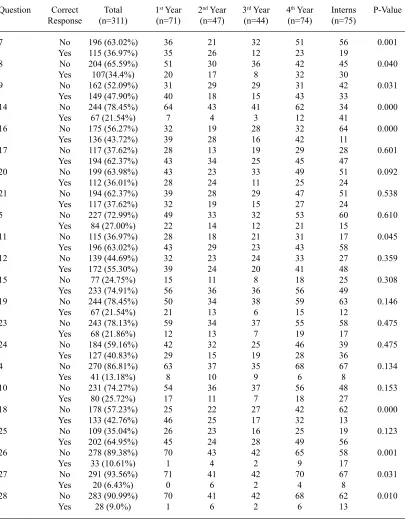
A total of 400 students were surveyed for the purpose of this study. The percentage of “yes” and “no” responses were analysed and tabulated in Table 1 and Table 2 for gender and different years of students respectively
The questions were divided into four categories. Category 1 was oral health attitude. Category 2 was oral hygiene behavior. Self-reported health and smoking were Category 3 and 4 respectively.
Figure 1 is a measure of smoking frequency over the five years. It shows that there is an increase in smokers from first year to internship with a marked increase in internship. The maximum number of persons who had been smokers for more than 1 year was also the maximum in the internship.
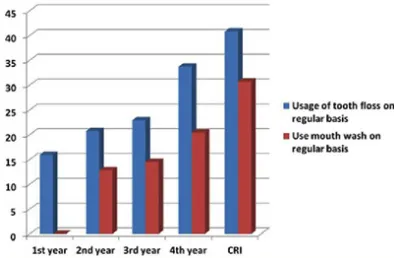
Figure 2 shows the use of mouthwash and flossing among the five years. It shows an increase in use of mouthwash and dental floss from first year to internship. This is indicative of an improvement in dental awareness from first year to internship.
Figure 3 shows brushing habits of students. There is an improvement from year to year of the brushing habits of students. This is seen to be inversely proportional to professional education on correct brushing technique.
Self-reported incidence of plaque deposits, halitosis and gingival bleeding shows a decrease from first year to third year followed by a marked increase in final year and a decrease again in internship (Figure 4).
Figure 5 shows an increase in frequency of visits to dentist from first year to internship. There is also a decrease in visits to dentists’ clinic only in case of emergencies. This shows an increased tendency for more regular check-ups rather than for emergency care only.
Table 1. Percentage of Yes or No responses for the questions among males and females
Item Females X2 P- Males X2
(n=214) Value value (n=97) Value value
No. % No. %
7 I worry about the No 137 64% 16.822 0.000 59 60.8% 4.546 0.033
color of my teeth Yes 77 36% 38 39.2%
8 I am bothered by the No 142 66.4% 22.879 0.000 62 63.9% 7.515 0.006
color of my gums Yes 72 33.6% 35 36.1%
9 I think that I cannot help No 113 52.8% 0.673 0.412 49 50.5% 0.010 0.919
having false teeth when I am old Yes 101 47.2% 48 49.5%
14 I think I can clean my teeth No 175 81.8% 86.430 0.000 69 71.1% 17.330 0.000
well without using toothpaste Yes 39 18.2% 28 28.9%
16 I worry about having No 122 57% 4.206 0.040 53 54.6% 0.835 0.361
bad breath Yes 92 43% 44 45.4%
17 It is impossible to prevent No 82 38.3% 11.682 0.001 35 36.1% 7.515 0.006
gum disease with tooth brushing alone Yes 132 61.7% 62 63.9%
20 I feel I sometimes take too much No 143 66.8% 24.224 0.000 56 57.7% 2.320 0.128
time to brush my teeth Yes 71 33.2% 41 42.3%
21 I don’t feel I’ve brushed well No 132 61.7% 11.682 0.001 62 63.9% 7.515 0.006
unless I brush with strong strokes Yes 82 38.3% 35 36.1%
5 I have noticed some white sticky No 156 72.9% 44.879 0.000 71 73.2% 20.876 0.000
deposits on my teeth Yes 58 27.1% 26 26.8%
11 I brush each of my No 80 37.4% 13.626 0.000 35 36.1% 7.515 0.006
teeth carefully Yes 134 62.6% 62 63.9%
12 I brush my teeth twice No 93 43.5% 3.664 0.056 46 47.4% 0.258 0.612
daily or more Yes 121 56.5% 51 52.6%
15 I often check my teeth No 49 22.9% 62.879 0.000 28 28.9% 16.667 0.000
in mirror after brushing Yes 165 77.1% 68 70.1%
19 I use a toothbrush which No 173 80.8% 81.421 0.000 71 73.2% 20.876 0.000
has hard bristles Yes 41 19.2% 26 26.8%
23 I do use mouth wash No 171 79.9% 76.561 0.000 72 74.2% 22.773 0.000
on regular basis Yes 43 20.1% 25 25.8%
24 I do use tooth floss on No 134 86.4% 13.626 0.000 50 51.5% 0.093 0.761
regular basis Yes 80 13.6% 47 48.5%
4 My gums bleed when No 185 86.4% 113.720 0.000 85 87.6% 54.938 0.000
I brush my teeth Yes 29 13.6% 12 12.4%
10 I think my teeth are No 160 74.8% 52.505 0.000 71 73.2% 20.876 0.000
getting worse despite my Yes 54 25.2% 26 26.8%
daily brushing
18 I put off going to the No 124 57.9% 5.402 0.020 54 55.7% 1.247 0.264
dentist until I have toothache Yes 90 42.1% 43 44.3%
25 I am satisfied with the No 75 35% 19.140 0.000 34 35.1% 8.670 0.003
appearance of my teeth Yes 139 65% 63 64.9%
26 I have been smoking for No 207 96.7% 186.916 0.000 71 73.2% 20.876 0.000
more than one year Yes 7 3.3% 26 26.8%
27 I smoke more than No 213 99.5% 210.019 0.000 78 80.4% 35.887 0.000
10 cigarettes per day Yes 1 0.5% 19 19.6%
28 I am a smoker No 212 99.1% 206.075 0.000 71 73.2% 20.876 0.000
Yes 2 0.9% 26 26.8%
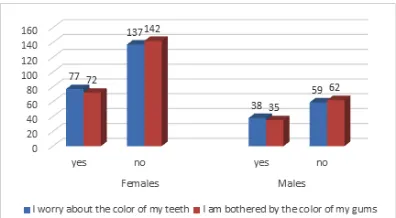
questions. Both males and females showed a marked negative response to oral hygiene questions indicating a highly significant degree of oral hygiene practices. When participants were asked, if they worry about the color of their teeth 64% females and 60.8% answered no. When asked if they worry about the color of their gums 66.4%
females 63.9% males answered no. This was also seen to be highly significant.
Table 2. Percentage of Yes or No responses for the questions among different years of students
Question Correct Total 1st Year 2nd Year 3rd Year 4th Year Interns P-Value
Response (n=311) (n=71) (n=47) (n=44) (n=74) (n=75)
7 No 196 (63.02%) 36 21 32 51 56 0.001
Yes 115 (36.97%) 35 26 12 23 19
8 No 204 (65.59%) 51 30 36 42 45 0.040
Yes 107(34.4%) 20 17 8 32 30
9 No 162 (52.09%) 31 29 29 31 42 0.031
Yes 149 (47.90%) 40 18 15 43 33
14 No 244 (78.45%) 64 43 41 62 34 0.000
Yes 67 (21.54%) 7 4 3 12 41
16 No 175 (56.27%) 32 19 28 32 64 0.000
Yes 136 (43.72%) 39 28 16 42 11
17 No 117 (37.62%) 28 13 19 29 28 0.601
Yes 194 (62.37%) 43 34 25 45 47
20 No 199 (63.98%) 43 23 33 49 51 0.092
Yes 112 (36.01%) 28 24 11 25 24
21 No 194 (62.37%) 39 28 29 47 51 0.538
Yes 117 (37.62%) 32 19 15 27 24
5 No 227 (72.99%) 49 33 32 53 60 0.610
Yes 84 (27.00%) 22 14 12 21 15
11 No 115 (36.97%) 28 18 21 31 17 0.045
Yes 196 (63.02%) 43 29 23 43 58
12 No 139 (44.69%) 32 23 24 33 27 0.359
Yes 172 (55.30%) 39 24 20 41 48
15 No 77 (24.75%) 15 11 8 18 25 0.308
Yes 233 (74.91%) 56 36 36 56 49
19 No 244 (78.45%) 50 34 38 59 63 0.146
Yes 67 (21.54%) 21 13 6 15 12
23 No 243 (78.13%) 59 34 37 55 58 0.475
Yes 68 (21.86%) 12 13 7 19 17
24 No 184 (59.16%) 42 32 25 46 39 0.475
Yes 127 (40.83%) 29 15 19 28 36
4 No 270 (86.81%) 63 37 35 68 67 0.134
Yes 41 (13.18%) 8 10 9 6 8
10 No 231 (74.27%) 54 36 37 56 48 0.153
Yes 80 (25.72%) 17 11 7 18 27
18 No 178 (57.23%) 25 22 27 42 62 0.000
Yes 133 (42.76%) 46 25 17 32 13
25 No 109 (35.04%) 26 23 16 25 19 0.123
Yes 202 (64.95%) 45 24 28 49 56
26 No 278 (89.38%) 70 43 42 65 58 0.001
Yes 33 (10.61%) 1 4 2 9 17
27 No 291 (93.56%) 71 41 42 70 67 0.031
Yes 20 (6.43%) 0 6 2 4 8
28 No 283 (90.99%) 70 41 42 68 62 0.010
Yes 28 (9.0%) 1 6 2 6 13
significantly about having bad breath whereas no such significance existed among males. A majority of males and females reported that they do not floss with this value being highly significant in females.
Fig. 1. Frequency of smoking among different years of students
Fig. 2. Use of floss and mouthwash among different years of students
Fig. 3. Brushing habits Fig. 4. Self-reported incidence of plaque deposits,
halitosis and gingival bleeding
The individual percentages of those who answered no were more in case of females.
The general trends for answering indicate that both males and female dental students showed a high degree of awareness and competence in all four sub sections of the questionnaire, namely oral health attitude, oral hygiene, self-reported oral health and smoking. This result was highly significant for most questions. When the oral health attitude was evaluated, it was seen that males and female answered similarly for most questions such as, worrying about the color of their teeth, (39.2% and 36% respectively) and color of their gums(36.1% and 33.6% respectively).
With regards to oral hygiene practices such as flossing, 13.6% of females said they floss regularly as compared to 48.5% of males who answered positively for this question. This is contrary to the results of other studies which indicate better oral hygiene practices in women. When the students were asked if they smoke
more than ten cigarettes per day only .5% of girls answered “yes” while 19.6% of boys answered this question with a “yes”. Similarly, 0.9% of girls were found to be smokers as compared with 26.8% of boys.
DISCUSSION
The oral health attitude and practices of upcoming dentists can influence the conduct of their relatives and non-dental associates. It is essential that this mentality is developed from the earliest starting point, diverse cultural comparison is imperative as contrasts may exist in the financial status, dental conveyance framework and disposition towards dental wellbeing.11,12.
Fig. 5. Frequency of visits to dentist among different years of students
Fig. 6. Pattern of answering by the males and females for each question
account the change in dental awareness across the different years of study. It will also help assess the differences in dental awareness between males and females. The study has not been done in this cultural setting before.
The study also evaluates the difference in oral hygiene behaviors between males and females. Earlier research has shown that females generally have better oral health practices as compared to males13, 14. With regards to studies of the oral health
behavior of senior dental students15 no gender
differences were observed, probably because of the effect of professional training16. A similar result
was obtained in this current study thereby verifying results from other cultural setting. This result was however contrary to results obtained by Al-Omari et al in Jordan which reported a significant difference between the sexes17. However with
regards to flossing, 13.6% of females said they floss regularly as compared to 48.5% of males who answered positively for this question. This is contrary to the results of other studies which indicate better oral hygiene practices in women.
This study showed an improvement in oral health manifested by an increase in use of mouthwash and dental floss from first year to internship. There is an increase in frequency of visits to dentist from first year to internship. There is also a decrease in visits to dentists’ clinic only in case of emergencies. This shows an increased tendency for more regular check-ups rather than for emergency care only.
Self-reported incidence of plaque deposits, halitosis and gingival bleeding shows a decrease from first year to third year followed by a marked increase in final year and a decrease again
in internship. This may be attributed to an increase in stress level due to the examination pattern and heavy work load associated with final year.
An area of concern is that there is an increase in smokers from first year to internship with a marked increase in internship. The maximum number of persons who had been smokers for more than 1 year was also the maximum in the internship. This is an alarming problem that must be addressed to preserve the oral and general health of our students.
With regards to the differences between the answering patterns of males and females, it was seen that for most questions, with a few exceptions no significant differences existed between the males and females and most answers indicated a high degree of awareness and sound oral hygiene practices among dental students.
Takashi Komabayashi et al’s study comparing the dental students of Britain and China revealed that 29% of Chinese students believed that wearing dentures in old age is inevitable, but only 7% of British students felt so18. In the
current study however, it was seen that 47.2% felt it was inevitable. Furthermore, 80% of Chinese students agreed that it was difficult to counteract gum ailment with tooth brushing alone, while 30% of British students trusted so. The current study revealed 62.37% agreed it was difficult to stay away from gum infection.
be 54% for Chinese students and 13% for British students18. The current study revealed this figure
to be 43% in the Indian population.
In a study conducted among 757 dental students at the Dental Faculty, Istanbul University, only 11% of the total students agreed getting false teeth in old age cannot be avoided. In the current study however, it was seen that 47.2% felt it was inevitable. 67% students reported believed that it is impossible for tooth brushing alone to prevent gum disease19, however 62.37% believed so in the
current study. Only 6% said they were concerned about the color of their gums, in contrast to 52% in the current study.
There is also an age related improvement in oral hygiene from first year to final year. This can be attributed to an increase in awareness and dental education level. This also correlated with results obtained from a study by Dagli et al20.
These findings were in contrary to studies done for Greek, Japanese, Finnish and Chinese dental students21,22,23. A good awareness to self-oral health
in a dental student will directly affect the dental instruction conferred to the patient by them.
CONCLUSION
Dental hygiene and dental hygiene practices among dental students in this South Indian population show an improvement among dental students from year to year. No significant differences were seen between male and female dental student
REFERENCES
1. Nahed Y. Ashri, Assessment of dental treatment needs among Saudi female patients in the dental school clinic, Saudi Dental Journal;11(3), 104-108 (1999).
2. Hayward RA, Meetz HK, Shipiro MF, et al. Utilization of dental services 1986 patterns and trend. J Public Health Dent;49:147-152 (1989). 3. Gilbert GH, Duncan RP, Gandall LH, Heft HW,
et al, Attitudinal and Behavioral characteristics of older Floridans with tooth loss. Community Dent Oral Epidemiol; 21: 384-389 (1993). 4. Lee KL, Schwarz E, Mak KYK, Improving oral
health through understanding the meaning of health and disease in a Chinese culture. Int Dent J ; 43: 2-8 (1993).
5. Gallagher EB, Moody PM, Dentists and the
oral health behavior of patients: a sociological perspective. J Behav Med; 4(3): 283-295 (1981). 6. Frazier PJ, Public health education and promotion
for caries prevention: the role of dental schools.
J Public Health Dent:43(1): 28-42 (1983). 7. Khami MR, Virtanen JI, Jafarian M, Murtomaa
H, Prevention oriented practice of Iranian senior dental students. Eur J dent Educ;11(1): 48-53 (2007).
8. Kawamura M, Dental behavioral science - the relationship between perceptions of oral health and oral status in adults. J Hiroshima Univ Dent Soc ; 20: 273-276 (1988).
9. Kawamura M, Sasahara H, Kawabata K, Iwamoto Y, Konishi K, Wright FAC, Relationship between CPITN and oral health behavior in Japanese adults. Aust Dent J; 38: 381-388 (1993). 10. Kawamura M, Kawabata K, Sasahara H, Fukuda
S, Iwamoto Y, Dental behavioral Sciences Part IX : bilinguals’ response to the dental behavioral inventory (HU-DBI). Hiroshima Daigaku Shigaku Zasshi; 24: 185-191 (1992).
11. Khami MR, Preventive dentistry and dental education in Iran, University of Helsinki, Helsinki; 3-19 (2007).
12. Shea JDC, Jones J, A model for the use of attitude scales across cultures. Int J Psychol, 17: 331-343 (1982).
13. Ostberg AL, Halling A, Lindblad U. Gender differences in knowledge, attitude, behavior and perceived oral health among adolescents. Acta Odontol Scand; 57: 231-236 (1999).
14. Fukai K, Takaesu Y, Maki Y. Gender differences I n oral health behavior and general health habits in adult population. Bull Tokyo Dent Coll;40(4): 187-193 (1999).
15. Tseveenjav B, Vehkalahti M, Murtomaa H. Preventive practice of Mongolian dental students.
Eur J dent Educ;6(2): 74–8 (2002).
16. Tseveenjav B, Vehkalahti M, Murtomaa H. Oral health and its determinants among Mongolian dentists. Acta Odontol Scand; 62: 1–6 (2004). 17. Al-Omari QD, Hamasha AA. Gender specific
oral health attitudes and behavior among dental students in Jordane. J Contemp Dent Pract;1: 107-114 (2005).
18. Komabayashi K, Kwan SYL, Hu DY, Kajiwara K, Sasahara H, Kawamura M. A comparative study of oral health attitudes and behavior using the Hiroshima University – Dental Behavioral Inventory (HU-DBI) between dental students in Britain and China. J Oral Sci; 47(1): 1-7 (2005). 19. Peker K, Uysal O, Bermek G. Dental training and
20. Dagli RJ, Tadakamadla S, Dhanni C, Duraiswamy P, Kulkarni S. Self-reported dental health attitude and behavior of dental students in India. J Oral Sci; 50(3): 267-272 (2008).
21. Polychronopoulou A, Kawamura M, Athanasouli T. Oral self-care behavior among dental school students in Greece. J Oral Sci; 44: 73-78 (2002). 22. Kawamura M, Honkala E, Widstrom E,
Kobayashi T. Cross cultural differences of
self-reported oral health behavior in Japanese and Finnish dental students. Int Dent J; 50: 46-50 (2000).
23. Kawamura M, Yip HK, Hu DY, Kobayashi T. A cross cultural comparison of oral attitudes and behavior among freshman dental students in Japan, Hong Kong, and West China. Int Dent J