CHALLENGES ASSOCIATED AND CUSTOMER’S PERCEPTION ABOUT CHANGES IN FINANCIAL INDUSTRY, PRE AND POST IMPLEMENTATION OF E-FINANCE
Mr. Vinamra Jain (Corresponding Author) Faculty, Amity Business School, Amity University Campus,
F3 Block, Sector 125, Noida 201303 India [email protected]
Mr. Ashok Sharma
Asst. Professor, Amity Business School, Amity University Campus, F3 Block, Sector 125, Noida 201303 India
Mr. Pradeep Narwal
Asst. Professor, Amity Business School, Amity University Campus, F3 Block, Sector 125, Noida 201303 India
Ms. Swati Agarwal
Student – Masters of Business Administration Amity Business School, Amity University Campus,
F3 Block, Sector 125, Noida 201303 India [email protected]
ABSTRACT
This research undertakes the detailed study of the customers’ perception about E-Finance and analyzes the opinion of customers regarding advancement in financial industry post implementation of E-Finance, challenges associated with the implementation of E-Finance, and the challenges that Indian financial industry is still going through to deal electronically efficiently and effectively. The report has been designed after doing detailed secondary research so as to understand the challenges that had been there at the time of implementation of E-Finance, to what extent they have been addressed and the challenges that are still prevailing as obstacles in the successful progress of E-Finance. In order to meet other objective of study i.e. study of customer opinion regarding changes in financial industry, pre-post implementation of E-Finance, Primary Research has been undertaken. To study the same, a sample of 100 customers has been surveyed. Questionnaires have been used as instruments for the survey. The findings of the report say that Lack of Infrastructure, Security, Awareness and knowledge on part of customer as well as employees and skills were the major challenges at the time of implementation but issues like Illiterate population, infrastructure issues like power shortage, low bandwidth, and lack of security are still obstructing the growth of E-Finance. As far as customers are concerned, they are very much easy with the adoption of technology in Finance sector but there are areas in finance which have not been adopted by customers electronically as of now and are still in infant stage like Insurance and Online Stock Dealings. Customers believe that E-Finance has facilitated them and has definitely improved the financial sectors on various parameters. It is recommended that financial sector should undertake certain initiatives to educate the population which is still unaware of same since it constitutes a large part, to implement stricter security checks and stringent cyber laws and regulations so as to provide better services and improve financial sector further. This paper helps to understand the challenges associated with E-Finance and customer’s point of view regarding the services since the development of technology in the financial sector and what relevance they find of technology involvement in the financial industry that helps organizations to improve them on various parameters.
Keywords: Challenges of e-finance, Customer perception, E Finance, India, Online banking
1. INTRODUCTION:
market. Along with the evolvement of the technology over the time, customer has also changed. Now customer is much more quality and time conscious and looks for the quick and convenient services without sacrificing on quality and value. The change is prominently noticeable and hence a new concept of online market or online services is emerging.
Online market is not coupled with the wholesome online firms but also viewed as the priceless form of marketing for conventional firms as well. Online services are not restrained to a particular set of services but incorporate almost every sector of business. Competition in this province is felt by the financial sector as well and now is the time when every financial service firm is endeavoring to maintain a competitive edge in the market with the help of online services. The facilitation of online financial services is coined as E-Finance.
E-Finance is distinctly changing the constitution and nature of markets for financial services. Financial Institutions have emerged from Brick-and-Mortar to Click-and-Mortar. New form of financial services is surfacing across the globe, including online banking, brokerages, trading, and insurance and so on and financial institutions are appearing as virtual financial institutions. The development of E-Finance has major impact on two areas. One is the development in the banking industry and the other one is the renovation of the financial market. The advent of technology in banking industry has restructured the functionality of baking industry completely. Similarly, the financial market has gone global and the need of association with the physical place has reduced to minimum.
Online banking, initiated in late of 19th century has made a significant improvement in the financial industry. But there are innovations which have been developed before the advent of internet in the banking sector which has revolutionized the face of banking sector way back in early 90s i.e. introduction of Automated Teller Machines. Usage of ATM cards, debit card or credit cards have grown dramatically, fueled by speedy interactions technologies that permit vendors to authenticate a person’s credit worthiness in seconds. At present, India has approx 45,000 ATMs installed. Also, another prominent mode of payment in today’s time is cards. Debit cards and credit cards are widely used mode of payment, whether it is a small purchase or a bulky one. The banks have put efforts to popularize the card payments as it facilitates the quick payment, reduces time and transactions cost and also reduces paper transactions to a greater extent. Now, customer needs not to go to bank to withdraw money for the daily usage. However, cards are still not favorable for the heavy payments but as far as daily payments are concerned, customer is finding it convenient and suitable to carry a card instead of carrying cash in bulk.
The technology in financial sector has also enabled the organizations to undertake much more reliable and quick credit decisions with the help of e-computation of large databases. It has significantly declined the cost of lending and has augmented the marketability of loans in banking sector. Also, the payment system has improved drastically in the banking sector. The transfer of huge payments between the banks; introduction of debit and credit cards have reduced the time to minimum for payment and have facilitated the customers to a great extent. The role of e-communication is also tremendous in enlargement of securities market. E-Finance has facilitated the easy exchange and marketing of securities globally. NASDAQ is the early example of the E-Security market, followed by approximately every stock market throughout the globe and has contributed in advancement of foreign exchange market.
However, insurance sector has not been adaptive to the technology. There are no as such improvements in the sector that facilitates the functioning of the industry and convenience for the customers.
2. LITERATURE REVIEW:
Franklin Allen, James McAndrews and Philip Strahan, (2001) E-Finance: An Introduction, Journal of Financial Services Research 22:1/2 5-27 focuses on three main aspects i.e. introduction of E-finance and change in payment mode and development of e-finance around the world, which is addressed in two parts: impact on banking and other financial services and financial services and impact on operations of financial markets. With the advent of internet in finance sector, few services which were provided by the banks initially are being provided by other entities which have changed the face of the finance sector globally. Also, introduction of electronic system in finance has addressed many issues associated with the financial market like no need of physical place to trade the securities and has turned the security exchange into a global matter, more consumer and investor protection, price transparency, sound and safer regulations and globally competitive policies. The advent of technology has enhanced the problems of financial industry. Innovations have facilitated the customers but on the same time, there are developments which have become a concerning issue for the
industry. Anthony F. Herbst, (2001) E-Finance: Promises Kept, Promises Unfulfilled and Implications for
implemented and innovations in e-finance that has facilitated the financial service sector and issues that created hurdles like privacy concerns and bureaucracy, in effective implementation of E-finance, majorly, E-cash. In order to deal with any problem developed with the advent of technology in the financial industry, introducing
changes is the only option for the industry. Claessens, Stijn, Glaessner, Thomas and Klingebiel, Daniela
(2002) Changes needed in Financial Sector Policies, Electronic Finance: A New Approach to Financial Sector Development?, 23-38 undertakes the factors and policies that are supposed to be taken under consideration for the changes and development in a way that facilitates the implementation of e-finance. The paper divides the factors in two parts. First deals with the infrastructure and regulatory environment i.e. factors like telecommunications connectivity, electronic security and infrastructure, information and privacy, financial and market infrastructure and the other part deals with the design of policies so as to manage the risks associated with the consumer protection, investor protection, prudential regulation and the safety net. Such factors represent the challenges which had to be addressed for the effective execution of e-finance. Also, the paper details about the various areas in market that has been facilitated with the introduction of e-finance. With the introduction of e-finance, the financial services turned out to be more specialized making competition policies more feasible, market is changing; defining barriers for entry in the financial service sector, along with the emergence of more of Non Banking Financial Companies, the brand names and distribution networks have been mixed with the financial sector. The successful implementation of E-Finance has facilitated the various
stakeholders whether its company, customer or government. (2002)E-Finance Applications- and Implications
for Government, Electronic Finance: A new Approach to Financial Sector Development?, 39-45 describes that with the availability of e-finance, the need for the intervention of government can be reduced to a great extent. The government intervention in financial sector affects it inversely as in order to reach the underserviced targets, government miss its targets and incur huge fiscal costs. E-finance enables the larger financial sector, regardless country level; larger and readily available information reduces the need of government for providing the financial services and limits it to the enhancement of the enabling environment and enabling better availability of information registered in public documents. Not only facilitation to the customer or government, E-Finance has enabled organizations to have competitive advantage. Most of the organizations are adopting
online services to enhance the marketability of the firms. Louis Minakakis and Bharat Rao(1999),
Competing in Online Markets: Financial Services as a Case in Point, Electronic Markets, 9:4, 263-268
explains that how online services have become an integral part of the traditional firms and has revolutionized the face of the traditional financial service sector. The paper deals with the 5 strategic issues and their broad managerial implications. These issues are: realization of online market, price strategy adoption, expansion and improvement of services, marketing and strategic alliances and acquisitions. The paper defines the approaches that are important to implement an effective e-finance system and can be helpful in gaining competitive advantage over the others in case of financial services. Understanding the competitive forces that are unique to online arena, evaluating the information cost structure, adopting an infrastructure that enables the fast and effective services, differentiating the services that to from competitors, developing a sense of community and belonging to as to create the value for customer are few of the factors that has been detailed in the paper, providing an insight about the competition in the online market.
3. THEORETICAL BACKGROUND:
In an era when competition is so fierce that a company can lose customer not only to a competitor within the industry but also to a company belongs to another industry offering substitute to the customer, it is a significant aspect for companies to learn about the customers’ perception towards the product or services. With the increasing competition, customer attitude is also becoming complex to understand. A customer who is price sensitive while buying a set of commodities spends lavishly on luxurious products. Customers have wide choice; decision making is becoming complex and easier it is getting to lose a customer. In such a case, a strong relationship with the customer is an added advantage for the company to earn edge over the competitors and it is feasible with the better understanding of the customer perceptions. Customer perception is a concept that defines the impression and consciousness of the product in the mindset of the consumers i.e. how a consumer thinks and views the product, services or any change in the organization. Customer perception describes the performance of the company and relationship of the customer with the company. It takes all for the company to build a positive impression in the mindset of the customers. Advertising, reviews, public relations and other factors are important factors that play a major role in building perception but the most important factor that affects the perception most is the personal experience. That’s what makes it utmost important for a company to make it a pleasure for a customer to interact with the company.
4. HYPOTHESES:
H10 = There is no significant difference in Quality post implementation of E-Finance
H2o = There is no significant difference in Convenience post implementation of E-Finance
H21 = There is significant difference in Convenience, post implementation of E-Finance
H3o = There is no significant difference in Delivery Time post implementation of E-Finance
H31 = There is significant difference in Delivery Time, post implementation of E-Finance
H4o = There is no significant difference in Ease of Access (Information and Services) post implementation of
E-Finance
H41 = There is significant difference in Ease of Access (Information and Services), post implementation of
E-Finance
H5o = There is no significant difference in Ease of Comparison Among Various Suppliers, post implementation
of E-Finance
H51 = There is significant difference in Ease of Comparison Among Various Suppliers, post implementation of
E-Finance
H6o = There is no significant difference in More Information, post implementation of E-Finance
H61 = There is significant difference in More Information, post implementation of E-Finance
H7o = There is no significant difference in Personal Interaction, post implementation of E-Finance
H71 = There is significant difference in Personal Interaction, post implementation of E-Finance
H8o = There is no significant difference in Personal Attention, post implementation of E-Finance
H81 = There is significant difference in Personal Attention, post implementation of E-Finance
5. RESEARCH METHODOLOGY: 5.1 Purpose of the Study:
The purpose of the study is to learn about the challenges that India has faced in successful implementation of E-Finance, currently ongoing challenge and to evaluate the customer opinion regarding the change in financial industry with the implementation of E-Finance.
5.2 Research Design: Descriptive Research
The research will involve both primary and secondary research.
5.2.1 Primary Research
Primary Research will be conducted in the form of survey with the help of well-defined questionnaires designed to understand the customer’s perspective towards E-Finance.
5.2.1.1 Sample Size
To understand the customer perspective, the sample size would be 100 customer of the age varying from 25-45 years. The sample has been selected on the basis of Judgmental sampling since respondents have been selected on the following criteria:
Education Level
Knowledge of electronic financial services
Have Used E-Financial services at least a few times.
Aware of availability of E-Finance services
5.2.1.2 Instruments
For Survey- Developed a questionnaire to measure For Data Analysis
o The overall reliability co-efficient of the modified instrument after the pilot survey yielded an
r = 0.618 cronbach alpha showing that the questionnaire was reliable.
5.2.2 Secondary Research:
The sources of secondary data collection are:
Research papers
6. TESTING OF HYPOTHESES:
T-Test (Paired Sample):
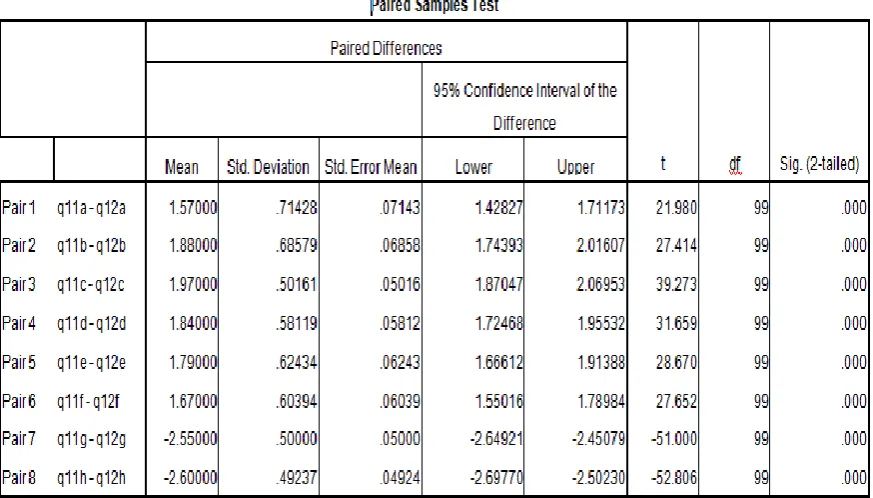
Table 2: Paired Sample T-Test
Hypothesis:
H1o = There is no significant difference in Quality post implementation of E-Finance
H11 = There is significant difference in Quality, post implementation of E-Finance
Result: Since the significance level is .000, there is strong evidence to support Alternate Hypothesis and hence it suggests there is significant difference in Quality after implementation of E-Finance.
H2o = There is no significant difference in Convenience post implementation of E-Finance
H21 = There is significant difference in Convenience, post implementation of E-Finance
Result: Since the significance level is .000, there is strong evidence to support Alternate Hypothesis and hence it suggests there is significant difference in Convenience after implementation of E-Finance.
H3o = There is no significant difference in Delivery Time post implementation of E-Finance
H31 = There is significant difference in Delivery Time, post implementation of E-Finance
Result: Since the significance level is .000, there is strong evidence to support Alternate Hypothesis and hence it suggests there is significant difference in Delivery Time after implementation of E-Finance.
H4o = There is no significant difference in Ease of Access (Information and Services) post implementation of
E-Finance
H41 = There is significant difference in Ease of Access (Information and Services), post implementation of
E-Finance
Result: Since the significance level is .000, there is strong evidence to support Alternate Hypothesis and hence it suggests there is significant difference in Ease of Access (Information and Services) after implementation of E-Finance.
H5o = There is no significant difference in Ease of Comparison Among Various Suppliers, post implementation
H51 = There is significant difference in Ease of Comparison Among Various Suppliers, post implementation of
E-Finance
Result: Since the significance level is .000, there is strong evidence to support Alternate Hypothesis and hence it suggests there is significant difference in Ease of Comparison among Various Suppliers after implementation of E-Finance.
H6o = There is no significant difference in More Information, post implementation of E-Finance
H61 = There is significant difference in More Information, post implementation of E-Finance
Result: Since the significance level is .000, there is strong evidence to support Alternate Hypothesis and hence it suggests there is significant difference in More Information after implementation of E-Finance.
H7o = There is no significant difference in Personal Interaction, post implementation of E-Finance
H71 = There is significant difference in Personal Interaction, post implementation of E-Finance
Result: Since the significance level is .000, there is strong evidence to support Alternate Hypothesis and hence it suggests there is significant difference in Personal Interaction after implementation of E-Finance.
H8o = There is no significant difference in Personal Attention, post implementation of E-Finance
H81 = There is significant difference in Personal Attention, post implementation of E-Finance
Result: Since the significance level is .000, there is strong evidence to support Alternate Hypothesis and hence it suggests there is significant difference in Personal Attention after implementation of E-Finance.
Interpretation: Financial sector has registered improvement on various parameters but is losing on touch points with the customers because of implementation of E-Finance.
7. RESULTS: Objective 1:
To learn about the challenges associated with the implementation of E –Finance and to analyze whether challenges have been addressed or not and to what extent
Infrastructure:
Insufficient net connectivity, lower broadband width, lack of sufficient power, hardware and other such infrastructural problems created hurdles in the execution of E-Finance in India.
The problem of infrastructure has been dealt to a great extent. At present, India is having a good infrastructure base for the successful progress of E-Finance.
Safety of Customer:
Hacking, Virus and other server related issues have put the security of customer’s sensitive information regarding their finances on stake. Because of lack of security, customers had been resistant to E-Finance.
However, financial institutions have taken number of steps to deal with the security issues and have adopted various technologies to stop hacking and virus related issues, there are still many cases which pull down the faith of people to certain extent.
Lack of E-skills on part of Employees:
Sudden onset of technology in finance industry left the employees baffled. As a result, employees lacked knowledge and skills required to deal with the technology enabled services and industry faced huge labor resistance as well.
Since the technology was all there, so there was no escape for people. A proper education has been adopted in every educational institution so as to make student technology enabled and also organizations impart training to employees so as to be well versed with the technology.
Lack of Knowledge on part of Customers:
Technology has become a part of life of people with the help of education and awareness among people but still there is a huge chunk of population which is not versed with the technology and has to be taken care of.
High Cost of infrastructure Development:
There was no infrastructure to support the online services. The basic requirement for online services i.e. telecommunication was not even fully developed at the time of E-Finance implementation. In such a scenario, it was heavy cost bearing for the organizations to implement E-Finance as implementing E-Finance meant to start from the scratch and deal with all basic infrastructural issues. Also, training to labor and awareness among customers were an additional cost on companies.
Since there has been a huge development in infrastructure in India in past decade, slowly, economies of scale have been achieved by the organizations and now it is not that pain for organizations to avail any change in technology. However, rapid change in technology bears a cost on organization of training to employees, but companies are ready to bear such cost so as to be in front with the world and have competitive edge.
Lack of Efficient Cyber Laws:
Safety of customers was a huge problem in front of finance industries. First, they could not handle cases of hacking and virus and secondly, there was lack of efficient cyber laws which was putting the faith of customers in online financial services on edge.
Cyber-crime is a much more grave issue than thought by Indian Judicial System. The judicial system of India has undertaken various laws to deal with the cyber-crimes and introduce implementations in the system regularly but still the system has not been able to stop the cyber-crimes completely and need stricter laws and regulations so as to deal with cyber-crimes.
However, the electronic financial sector has come long way but there are few factors which holds it back. A large chunk of illiterate population; security issues; infrastructural difficulties like shortage of electricity and low bandwidth still are obstacles for the growth of E-Finance in India.
Objective 2:
To evaluate the customer opinion regarding the change in financial industry, prior and post implementation of E- finance in India.
8. FINDINGS:
There is significant improvement in financial industry with the introduction of technology. With the
implementation of services have improved on various parameters.
The most popular E-Finance services are ATMs, Credit and Debit Cards and Online Banking.
Customers do believe that factors like quality, convenience, information access, delivery time have
definitely improved but on the same time, advent of technology in financial services has inversely impacted the personal attention and interaction between customer and company.
Customers are quite positive about online services and are opting electronic services over traditional
method.
As far as security is concerned, banking industry has improved on the same significantly and there is huge
decline in complaints regarding the same.
Customers are quite satisfied with the online services and are able to extract larger information with the
help of respective banking websites.
Customers undertake most of the activities online and visit branches in special cases only like loan
applications, consultancy and other such issues
9. CONCLUSION AND SUGGESTIONS: Conclusion:
The onset of technology in financial sector in India has been a commendable revolution. It has reduced the time requirement to minimum and has facilitated the customer to a great extent. E-finance has changed the structure of finance industry dramatically and has given new horizon to the finance industry. E-Finance has not only facilitated the customer and has added various benefits for them but also has provided financial industry with numerous opportunities.
successfully. But with the continuous development in technology and infrastructure as well, E-Finance made its way through in past 2 decades and now it has been adopted by the customers across India.
E-Finance has been revolutionized over a period of time and it is evolving continuously and consistently. The ability to keep with the technology can bring the greater innovations in the services and led to greater satisfaction on part of customer.
Suggestions:
E-Finance has come long way in last two decades but there are always areas to improve. On the basis of study, there are certain recommendations for finance industry to evolve in coming time.
There is a huge chunk of population which is not aware of E-Finance. Here lies a big potential markets for
the financial companies to look over. So, finance industry should take initiatives to spread awareness among this set of consumers and reach out for the same.
Safety and security of sensitive information of financial information of customers have always been a real
concern for the customers. However, finance industry has taken steps in this direction but still industry needs stricter methods so as to ensure the safety and earn the trust and faith of customers in E-Finance.
In India, infrastructure problems like power, low bandwidth connection, low connectivity is still a problem
to an extent. In order to improvise the E-Finance, these issues are to be considered seriously.
Stricter Cyber laws are required so as to deal with the cyber crimes with more efficiency and reduce the
uncertainty of customers for the adoption of E-Finance.
REFERENCES
1. Allen, F., McAndrews, J. and Strahan, P. (2002). E-Finance: An Introduction. Journal of Financial
Services Research, 22(1/2), 5-27.
2. Herbst, A.F.(2001). E-Finance: Promise Kept, Promise Fulfilled and Implications for Policy and
Research. Global Finance Journal, 12, 205-215.
3. Claessens, S., Glaessner, T. and Klingebiel, D. (2002). Changes needed in Financial Sector Policies,
Electronic Finance: A New Approach to Financial Sector Development? World Bank Discussion
Paper, 23-38.
4. Minakakis , L. and Rao, B. (1999). Competing in Online Markets: Financial Services as a Case in
Point. Electronic Markets, 9(4), 263-268.
5. Allen H., J. Hawkins and S. Sato (2001). Electronic trading and its Implications on Financing Sector.
Working paper, Bank of England.
6. Banks, E. (2001). E Finance: The Electronic Revolution, London John Wiley and Sons.
7. Strahan, P. E. and James P. W. (1998). Small Business Lending and the Changing Structure of the
Banking Industry. Journal of Banking and Finance, 22 , 821-45.
8. Radecki, L. J., John, W. and Daniel, K.O. (1997). Industry Structure: Electronic Delivery’s Potential
Effects On Retail Banking,” Journal Of Retail Banking Services 19(4), 57-63.
9. Mishkin, F. S. and Philip, E. S. (1999). What Will Technology do to the Financial Structure? in the
Effect of Technology on the Financial Sector, Bookings-Wharton Papers on Financial Services, edited by Robert Litan and Anthony Santomero, 249-87.
10. McAndrews, J. J., “Network Issue and Payment Systems” , Business Review, Federal Reserve Bank of
Philadelphia, December.
11. Kenneth, N. K. and McAndrews, J. J. (2001). Personal Online Payments. Federal Reserve Bank of
New York Economic Policy Review, 7(3).
12. McAndrews J. J. (1997). Making Payments on the Internet. Federal Reserve Bank of Philadelphia
Business Review.
13. Humphrey, D. B. L.,Pulley, and Jukka, M. V. (1996). Cash Payments and Electronic Payments: A
Cross Country Analysis. Journal of Money, Credit and Banking, 28(4), 914-939.
14. Bos, J. and Chaum, D. (1990). Smart Cash: A Practical Electronic Payment System, Technical Report.
15. Wayner, P. (1994). Digital Cash, Byte, 19(10), 126.
16. Stefanadis, C. and McAndrews, J. J. (2000). The Emergence of Electronic Communication Netwroks
In U.S. Equity Markets. Federal Reserve Bank of New York Current Issues In Economics and Finance,
6(12).
17. Berger, A. N., Rebecca, S. D. and Philip, E. S. (1999). The Consolidation of the Financial Service
Industry: Causes, Consequences and Implications for the Future. Journal of Banking and Finance, 23,
18. Humphrey, D. B., Setsuya, S., Masayoshi, T. and Jukka, M. V. (1996). The Evolution of Payments In
Europe, Japan and the U.S.: Lessons for Emerging Market Economies: World Bank Policy Research
Working paper, 1976, October.
19. Sheila, O. R. (2008). Research and Development in Financial Services and the Role of Innovation”,
Financial Services Innovation Center, UCC.
20. Stancampiano, B. (2003). Initiating Changes in the Financial Services Industry: Gaining Competitive