ISSN: 2395-3519
www.ijatca.com 1
International Journal of Advanced Trends in
Computer Applications
www.ijatca.com
Routing Scheme to improve Network Lifetime in
Wireless Sensor Network
1
Satvinder Kaur, 2Khushboo Bansal
1,2
Department of Computer Science & Engineering Desh Bhagat University, Mandi Gobindgarh, Punjab, India
1
Abstract:
Wireless Sensor network composed of many low cost tiny sensing devices capable of sensing, processing & transmitting the network data. Due to irreplaceable battery resources these nodes are one time usable & battery usage is the critical issue among these nodes. This limited battery power can be effectively utilized by managing the operation of the network. Extensive research is carried out for utilizing this limited recourse & many improvements are also seen by clustering & aggregating the data. However in proposed work a routing scheme based on clusters in sensing area is proposed. Results obtained are better than existing ones.Keywords:
Routing, Wireless Sensor Networks, Clustering.
I. INTRODUCTION
Wireless Sensor Networks (WSNs) [1, 2] have emerged as research areas with an overwhelming effect on practical application developments. They permit fine grain observation of the ambient environment at an economical cost much lower than currently possible. Sensor networks are designed to transmit data from an array of sensor nodes to a data repository on a server.
Sensors are devices that produce a measurable response to a change in a physical condition like temperature, humidity, pressure etc. WSNs [3] may consist of many different types of sensors such as seismic, magnetic, thermal, visual, infrared, and acoustic radar capable to monitor a wide variety of ambient conditions. Though each individual sensor may have severe resource constraint in terms of energy, memory, communication and computation capabilities; large number of them may collectively monitor the physical world, disseminate information upon critical environmental events and process the information on the fly [4-7].
The sensor nodes consist of sensing, data processing and communicating components. They can be used for continuous sensing, event detection as well as identification, location sensing and control of actuators. The nodes are deployed either inside the phenomenon or very close to it and can operate unattended. They can use their processing abilities to locally carry out simple computations and transmit only required and partially processed data. They may be organized into clusters or collaborate together to complete a task that is issued by
the users. In addition, positions of these nodes do not need to be predefined. These allow their random deployment in inaccessible terrains or disaster relief operations.
The WSN provides an intelligent platform to gather and analyze data without human intervention. As a result, WSNs have a wide range of applications such as military applications. [7]
ISSN: 2395-3519
www.ijatca.com 2
second technique is random deployment in which nodes are deployed anywhere in the network.
II. LITERATURE SURVEY
In [9] authors’ surveys various applications based designing issues in WSNs. Every Sensor has different configurations and working is different in different physical environment. Based on the application the sensors are designed which are deployed to area to get changes in physical environment.
In [10] authors explained the concept of WSNs and its components. The sensor is main component of WSNs which send their sensory data to destination point. Every sensor have own hardware configuration which is basically designed on the basis of application. Authors also discussed about various routing techniques and algorithms which increases the network lifetime.
In [11] authors discussed about the sensors working and its components. We use WSN rather than wired network because in some place we are not able to go and cost of wired networks, cables which make it too costly. So based on this factor the WSNs is used.
In [12] authors undergoes with the comparative analysis of Homogeneous v/s heterogeneous clustered sensor network on the bases of parameters energy loss and hardware cost. In Homogeneous networks all nodes are identical means each node in network have same energy level, transmission range etc. but in heterogeneous network some node have higher energy level and some have lower. Authors also compared the clustering based algorithm LEACH with M-LEACH (multi-hop LEACH) with both homogeneous and heterogeneous network. M-LEACH is more energy efficient than LEACH because in LEACH single-hop transmission is done.
In [13] authors show the comparison of node deployment strategy on the basis of three parameters that are Massage transfer delay, coverage of entire monitoring area, energy consumption. Three types of node deployment strategy uniform random, square grid, THT (Tri-Hexagon Tiling) were discussed in the paper. In [14] authors discussed about static deployment in which nodes have fixed position and another is dynamic deployment in which the position is node fixed to deployed the nodes in target area. The nodes automatically move towards its proper position. Three performance analyses parameters that are coverage area, energy consumption (lifetime) and net connectivity.
In [15] authors survey on the deployment strategies and analysis that which strategy increase or improve the lifetime without increasing the storage requirement and/or resilience sacrificing. In this paper author discuss four deployment schemes that are random deployment, in which sensors nodes deployed in target area randomly.
In [16] authors compare the transmission technique that are single-hop and multi-hop transmission technique. In the single-hop all nodes in the network will transmit their data to BS. But in multi-hop, those nodes that are far from BS will transmit their data to next nearest node until the data reaches to BS.
In [17] authors explain the concept of WSNs and its applications. The WSNs are basically used to monitoring the physical environment which includes temperature, humidity, etc. overall challenge faced in this monitoring area was scalability, remote management.
In [18] author survey on different routing protocols. The three main categories for routing the data are data centric , hierarchical based and location based and each categories have different protocols for routing like in hierarchical category LEACH, PEGASIS protocol are considered. There further routing protocols which are based on QoS- aware and network flow like SPEED, SAR, etc. The main focus of all the routing protocols is how to prolong the network lifetime.
In [19] author proposed the first clustering based routing LEACH (Low Energy Adaptive Clustering Hierarchy) protocol. In this protocol, cluster is formed of the sensor nodes and each cluster has CH which is also called a data aggregation point which removes the redundancy of data. The CH selection is done randomly and that CH gets the data from its member node and transmits directly to BS. This protocol 8 x reductions in energy dissipation as compared the previous protocols that is MTE (Minimum Transmission Energy) and Direction Transmission. This protocol distributes the load of energy dissipation at the time of transmission equally to all nodes and prolongs the network lifetime.
ISSN: 2395-3519
www.ijatca.com 3
CH selection procedure and transmission technique in all enhancements of LEACH. These all are energy efficient techniques whose main aim to use energy efficiently of sensors because of energy constraints.
In [21] author proposed the new version of LEACH that is VLEACH. In this paper firstly survey on the previous clustering based routing protocol LEACH and its enhancements and proposes the new enhancement in LEACH which improves the lifetime of network. In VLEACH (Vice CH LEACH protocol), the cluster setup procedure is same as in LEACH but in cluster there is Vice CH which play a role of CH when CH will die because in LEACH protocol CH is aggregated point who aggregated the data which consume energy and transfer that data to BS which is far from monitoring area so the CH will die quickly. So Vice CH plays a role of CH after die of CH.
In [22] author survey on the various LEACH and its enhancement version Multi-Hop LEACH, Solar aware LEACH, M-LEACH. IN this paper comparison of these protocols are done on the bases of various parameters (scalability, mobility, classification, self-organizing, randomized rotation, distribution, centralized, hop count, energy efficiency, resource awareness, data aggregation and homogeneous). The main parameter in this survey the author concern is energy efficiency and throughput enhancement. They compare the lifetime and packet delivery characteristic and simulate the results. M-LEACH have more uncertainty as compared to other protocols. sLEACH little more energy efficient as compared to others.
In [23] author explain the clustering based routing protocol LEACH in which clusters are formed randomly and CH also select randomly from each cluster and that CH gets the data from member node and transmit to BS. To handle CH position management, centralized control algorithm used called LEACH-C in which the Cluster setup is depending upon the BS. In the setup phase all nodes transfer the data about their position and energy level to BS. In LEACH-C 40% more data delivery per unit energy was observed as compare to LEACH.
In [24] author proposed a flat based routing technique that will form a chain of data to be transmitted to CH in a heterogeneous environment. Efficiency of the heterogeneous network is evaluated &found to be much better than it’s corresponding homogeneous counterpart.
In [25] authors proposed new technique to increase the lifetime of sensors deployed in the network and the technique is called PEGASIS (Power-Efficient GAthering in Sensor Information System). In this technique data was transmitted in the form of chain.
Those node who are far from BS it will send their data to its nearest node which near to BS until the data will not reaches to BS and same node will not repeat until the chain will not formed and transmit to BS. PEGASIS was able to attain observable improvement in the lifetime of network as compared to LEACH and Direct transmission.
III. THE SYSTEM MODEL
A. Network Model
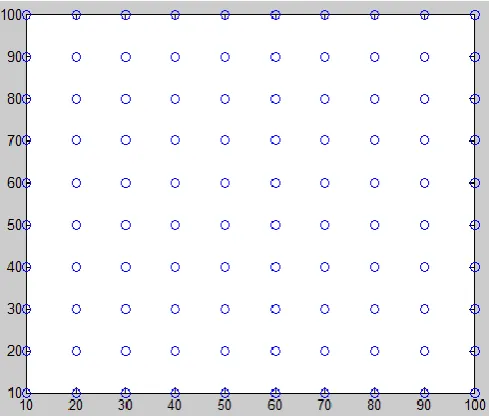
The protocol assumes that 100 sensor nodes are distributed uniformly in the network of area 100m*100m as shown in figure1. In addition to data aggregation at each CH, each node of the network has the capability to transmit data to other sensor nodes as well as to BS. The aim is to transmit the aggregated data to base station with minimum loss of energy which in fact increase system life time in terms of rounds. In this work following network environment is considered:
CHs are point of data aggregation, which aggregates the data, comes from the member nodes.
All sensors nodes are homogeneous in nature means the hardware configuration is same like residual energy or initial energy are same of all nodes in network.
BS doesn’t know the position of sensor nodes.
The position of BS is fixed. No mobility factor is present in sensor nodes and BS.
Figure 1.Uniform 100-node topology for proposed scenario
B. Radio Model
Radio model is referred from [19] which is the first order radio model. In this model, a radio dissipates Eelec
=50 nJ/bit to run the transmitter or receiver circuitry and Eamp =100 pJ/bit/m2 for the transmitter amplifier.
ISSN: 2395-3519
www.ijatca.com 4
recipients. The radios can be turned off to avoid receiving unintended transmissions. An r2 energy loss is used due to channel transmission. The equations used to calculate transmission costs and receiving costs for a k -bit message and a distance d are shown below:
Transmitting
Etr (k,d) = Eelec(k) +Eamp (k,d)
kEelec+kEampd2 with in network
kEelec+kEampd 4
transmission to BS
Receiving
ERx(k) = ERx-elec(k) ERx(k) = Eelec*k
Receiving is also a high cost operation, therefore, the number of receives and transmissions should be minimal. LEACH and PEGASIS use the same constants (Eelec, Eamp, and k) for calculating energy costs; therefore the PEGASIS achieves its energy savings by minimizing d and the number of transmissions and receives for each node, and MSMTP protocol achieves even better results than that of LEACH and Y- Coordinates PEGASIS. In proposed work, packet length
k is of2000 bits.
Figure 2 Radio energy dissipation model [19]
C. Problem Statement
In wireless sensor network, the sensor nodes are scattered or deployed randomly in monitoring/target area which sense the data about physical environment changes occurs and send sensory data to BS (Base Station) or sink but the problem with is the limited capabilities (like battery power, memory capacity) of communication devices on these sensor have and also transmission range which are based on irreplaceable limited battery sources.
The data transmission from sensor node to sink consume more energy in WSNs, so for increasing the survival time of sensor nodes in the network; data transmission technique and the energy-aware techniques becomes
important factors for extending the lifetime of the sensor nodes.
Proposed Technique
Algorithm Set Up Phase
1.Initialize the network parameters like no. of nodes, unique identities, packet size, transmitting and receiving energy, Location of BS etc.
2.Deploy the nodes in the sensing area keeping record of their position either randomly or uniformly over the region of interest.
Execution Phase
1.After setting up the network, proceed with selecting the CH among sensor nodes with equal probability factor (p) on rotation basis.
2.The nodes which satisfy the threshold level are eligible to become CH & they will broadcast packets to rest nodes in the network.
3.Based on the received signal strength non-CH nodes associates themselves with CH nodes.
4.CH’s allot TDMA schedule to all nodes for data transmission so as to save energy.
5.CH after receiving data from its member nodes further transmits the aggregated data to next CH so as to make a chain of data transmission towards BS. 6.Ultimately data is reached at BS. This procedure is repeated until any node is capable of sensing & transmitting data to BS.
IV. RESULT & DISCUSSION
Network Setup
Simulation is been carried out in MATLAB & for testing the performance of the network parameters are kept the same as in [26]. Brief details about the parameters used in network simulation are:
No. of Sensor nodes: 100
BS Position: 50*300
Deployment Area: 100*100
Initial Energy: 0.25, 0.5, 1.0 (Joule)
Packet Size: 2000 bits
CH Election probability: 0.1
Results:
ISSN: 2395-3519
www.ijatca.com 5
optimal solution because it reduces energy dissipation among sensor nodes by clustering & also stabilizes the network by rotating the cluster head nodes.
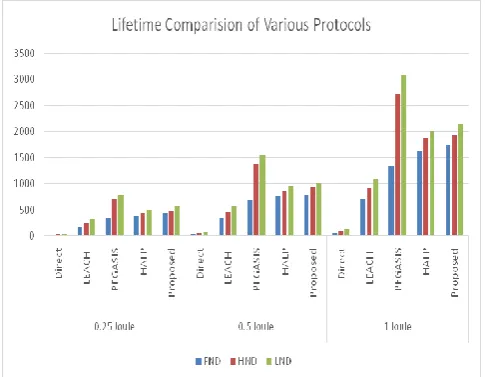
Table shown below summarizes the outcome of the various existing protocols & their comparison with the proposed one. Results of existing protocols are referred from [25]. Only PEGASIS being the flat based routing protocol is able to survive longer than the proposed technique just by compromising the delay in transmitting data to BS as well as in relying on the nodes for reaching data to BS.
Table 1: Network Lifetime comparison of Proposed
Technique with Existing One’s w.r.t. FND, HND, LND
Energy Protocol FND HND LND
0.25
Direct 14 20 30
LEACH 166 232 308
PEGASIS 335 684 779
HALP 359 428 500
Proposed 426 474 558
0.5
Direct 28 40 61
LEACH 339 461 576
PEGASIS 675 1362 1544
HALP 760 851 949
Proposed 775 919 1016
1
Direct 56 80 122
LEACH 690 911 1077
PEGASIS 1346 2720 3076
HALP 1629 1872 2000
Proposed 1747 1929 2131
Based on the table graph is plotted for graphically illustrating the comparison between various existing protocols.
Figure 3: Lifetime Comparison of Routing Protocols
That is easily observable from the graph that proposed technique achieves significant improvement over the existing techniques. Rest despite being having lesser round than PEGASIS protocol proposed technique is better because of less transmission time required & more reliable network.
V. CONCLUSION
In this paper a clustering based routing technique is proposed that divides the network in to certain clusters where one node in each cluster works as a CH node. This role of CH is rotated based on probability so that a node doesn’t drain out its energy so faster. These CH nodes in turn form a chain to transmit data to BS. Rotation of CH after every round & forming a chain between CH’s was the key idea of the proposal which significantly improves the system lifetime.
References
[1] F. Koushanfar, M. Potkonjak, A. Sangiovanni-Vincentelli, “Fault Tolerance inWireless Sensor Networks”, Chapter 36, Handbook of Sensor Networks: CompactWireless and Wired Sensing Systems, CRC Press, 2005.
[2] Q. Wang, H.S. Hassanein and K. Xu, “A practical perspective on wireless sensornetworks”, Chapter 9, Handbook of Sensor Networks: Compact Wireless andWired Sensing Systems, CRCPress, 2005.
[3] S. Megerian and M. Potkonjak, “Wireless Sensor Networks”, Wiley Encyclopediaof Telecommunications. Wiley-Interscience, New York, January 2003.
[4] Akyildiz, I., Su, W., Sankarasubramaniam, Y. and Cayirci, E., “A Survey onSensor Networks,” IEEE Communications Magazine, vol. 40, no. 8, pp. 102– 116,August 2002.
[5] Dharma P. Agrawal, Ratnabali Biswas, Neha Jain, Anindo Mukherjee, SandhyaSekhar and Aditya Gupta, “Sensor Systems: State of the Art and FutureChallenges,” chapter no. 20, “Handbook on Theoretical and Algorithmic Aspects ofSensor, Ad Hoc Networks and Peer-to-Peer Networks, “,Auerbach Publications, pp. 317-346, 2006. [6] Carlos Cordeiro and Dharma P. Agrawal, “Ad hoc & Sensor Networks, Theory andApplications,” World Scientific Publishing, Spring 2006.
[7] C. Jone, K. Sivalingam, P. Agrawal and J. Chen, “A Survey of Energy EfficientNetwork Protocols for Wireless networks,” Journal of Wireless Networks, KluwerAcademic Publishers, vol. 7, no. 4, pp. 343-358, 2001.
[8] Pottie, G. and Kaiser, W., “Wireless integrated network sensors,” Communicationsof the ACM, vol. 43, no. 5, pp. 551–558, May 2000.
[9] Yick, Jennifer, Biswanath Mukherjee, and Dipak Ghosal. "Wireless sensor network survey."Computer networksvol. 52, issue 12 , pp. 2292-2330, 2008.
ISSN: 2395-3519
www.ijatca.com 6 [11] Bischoff, Reinhard, Jonas Meyer, and Glauco Feltrin.
"Wireless sensor network platforms." Encyclopedia of structural health monitoring (2009).
[12] Mhatre, Vivek, and Catherine Rosenberg. "Homogeneous vs heterogeneous clustered sensor networks: a comparative study."Communications, 2004 IEEE International Conference on. Vol. 6. IEEE, pp 3144-3152, 2004.
[13] Poe, Wint Yi, and Jens B. Schmitt. "Node deployment in large wireless sensor networks: coverage, energy consumption, and worst-case delay."Asian Internet Engineering Conference. ACM, pp 234-242, 2009.
[14] Zhang, Haitao, and Cuiping Liu. "A review on node deployment of wireless sensor network."International Journal of Computer Science Issues, vol. 9, issue 6, pp 378-383, 2012.
[15] Rao, G. Sanjiv, and G. Vallikumari. "A beneficial analysis of node deployment schemes for wireless sensor networks."Int J Advanced Smart Sensor Netw Syst (IJASSN)vol 2, issue 2, pp 33-43, 2012.
[16] Pešović, Uroš M., et al. "Single-hop vs. Multi-hop– Energy efficiency analysis in wireless sensor networks."
18th Telecommunications Forum, TELFOR. 2010.
[17] Oliveira, Luís M., and Joel J. Rodrigues. "Wireless sensor networks: a survey on environmental monitoring."Journal of communicationsvol. 6, issue 2, pp. 143-151, 2011.
[18] Akkaya, Kemal, and Mohamed Younis. "A survey on routing protocols for wireless sensor networks." Ad hoc networksvol. 3, issue 3,pp. 325-349,2005.
[19] Heinzelman, Wendi Rabiner, Anantha Chandrakasan, and Hari Balakrishnan. "Energy-efficient communication protocol for wireless microsensor networks."System sciences, 2000. Proceedings of the 33rd annual Hawaii international conference on. IEEE, 2000.
[20] Braman, Alakesh, and G. R. Umapathi. "A Comparative Study on Advances in LEACH Routing Protocol for Wireless Sensor Networks: A survey."International Journal of Advanced Research in Computer and Communication Engineeringvol. 3, issue 2, pp 5684-5690, 2014.
[21] Yassein, Muneer Bani, Yaser Khamayseh, and Wail Mardini. "Improvement on LEACH Protocol of Wireless Sensor Network (VLEACH)", pp. 132-136, 2009.
[22] Aslam, M., et al. "Survey of extended LEACH-Based clustering routing protocols for wireless sensor networks."High Performance Computing and Communication & 2012 IEEE 9th International Conference on Embedded Software and Systems (HPCC-ICESS), 2012 IEEE 14th International Conference on. IEEE, 2012. [23] Heinzelman, Wendi B., Anantha P. Chandrakasan, and Hari Balakrishnan. "An application-specific protocol architecture for wireless microsensor networks."Wireless Communications, IEEE Transactions onvol. 1, issue 4,pp. 660-670, 2002.
[24] Bathla G.,“Minimum Spanning Tree based Protocol for Heterogeneous Wireless Sensor Networks”. I-Manager’s Journal on Wireless Communication Networks. 2013 Jan 1, Vol. 1, issue 4, pp 12-22.
[25] Lindsey, Stephanie, and Cauligi S. Raghavendra. "PEGASIS: Power-efficient gathering in sensor information
systems."Aerospace conference proceedings, Vol. 3, IEEE, 2002.
![Figure 2 Radio energy dissipation model [19]](https://thumb-us.123doks.com/thumbv2/123dok_us/1304187.1637667/4.595.51.288.397.551/figure-radio-energy-dissipation-model.webp)