Original Research Article
Knowledge, attitude and practices about cervical cancer among rural
married women: a cross sectional study
Radha Ramaiah*, Srividya Jayarama
INTRODUCTION
Cervical cancer is the third most common cancer among women and the fourth leading cause of cancer deaths in females worldwide. More than 85% of these cases and deaths occur in developing countries. India, accounts for 15.2% of the total cervical cancer deaths.1
Cervical cancer is a malignant neoplasm arising from cells originating in cervix uteri. It may be completely asymptomatic in early stages.2 In advanced stages it may present as persistent pelvic pain, unexplained weight loss, bleeding between periods, unusual vaginal discharge,
bleeding between periods, unusual vaginal discharge, bleeding and pain after sexual intercourse. 3
Infection with Human Papilloma virus(HPV) types 16 and 18 cause 75% of cervical cancer globally .4 The other risk factors include tobacco consumption, multiple sexual partners, early age of sexual intercourse, increasing parity, prolonged use of oral contraceptive pills, sexually transmitted diseases.5
Most cases of cervical cancer are preventable, with access to HPV vaccine and early detection. Pap smear test has been credited with dramatically reducing the number of
ABSTRACT
Background: Cervical cancer is the third most common cancer among women and the fourth leading cause of cancer
deaths in females worldwide. The objectives of the study were to assess the level of knowledge, attitude and practice related to cervical cancer and its screening among women of reproductive age group in a rural area of Karnataka and to find the association between socio-demographic characters and knowledge, attitude and practice related to cervical cancer.
Methods: A community based cross sectional study was conducted among 200 married women of reproductive age
group residing in Javarnahalli, a rural field practice area of AIMS, Karnataka. Data was collected using predesigned, pretested structured questionnaire. The questionnaire consisted of four parts to gather information regarding socio-demographic characteristics of participants, knowledge, attitude and practice regarding cervical cancer and its screening. Institutional ethical committee approval and informed consent from study participants were taken.
Results: 64% study participants were not aware of the early symptoms of cervical cancer. Around 34.5% had heard of
cervical cancer screening. 76.2% women were willing to screened if offered free of cost. But only 9.5% women had ever been screened for cervical cancer.
Conclusions: Strategic communication targeting eligible women, universal availability of screening facilities in public health facilities may increase the uptake of cervical screening.
Keywords: Cervical cancer, Married women, Rural area
Department of Community Medicine, Adichunchanagiri Institute of Medical Sciences, B.G. Nagara, Bellur,
Karnataka, India
Received: 01 January 2018
Accepted: 12 February 2018
*Correspondence:
Dr. Radha Ramaiah,
E-mail: [email protected]
Copyright: © the author(s), publisher and licensee Medip Academy. This is an open-access article distributed under
the terms of the Creative Commons Attribution Non-Commercial License, which permits unrestricted non-commercial use, distribution, and reproduction in any medium, provided the original work is properly cited.
cases of cervical cancer in developed countries.6 Despite the availability of methods for prevention, >95% of women in India have never been screened for cancer cervix.7 There are several barriers to cervical cancer screening uptake for women in developing countries like India that include low level of awareness and knowledge of risk factors and early signs and symptoms of disease, prevention services, stigma and misconception about cancer and gynecological diseases, socio economic limitations, and an lack of national screening guidelines and policies.8-10
With this background, this study was carried out with the following objectives:
1. To assess the level of knowledge, attitude and
practice related to cervical cancer and its screening among women of reproductive age group in a rural area of Karnataka.
2. To find the association between sociodemographic
characters and knowledge, attitude and practice related to cervical cancer.
METHODS
Studyarea
Javarnahalli, one of the rural field practice area of Department of Community Medicine, AIMS, B.G. Nagara, Karnataka.
Studydesign
Community based, cross-sectional study
Studyperiod
August 2017 to December 2017.
Studysubjects
Married women of reproductive age group (15-49 years) residing in the study area.
Inclusion criteria
Inclusion criteria were married women of age group 15-49 years, living with their husband.
Exclusion criteria
Exclusion criteria were pregnant and lactating women, women with chronic illness, for socio cultural reasons unmarried women and adolescent girls were excluded from the study.
The eligible participants were initially contacted during one of the village health and nutrition day conducted in the local anganwadi centre and were explained about the
study. Out of 212 eligible participants in the study area, 12 refused to give informed consent for the study participation.
So, the study subjects constituted all 200 married women of reproductive age group (15-49 yrs) residing in the study area, who gave written informed consent.
The list of all married women in reproductive age group was obtained from the family folder maintained at PHC.
Methodofdatacollection
Data was collected using predesigned, pretested, structured questionnaire prepared in local language.
Institutional ethical committee approval, informed consent from the study participants was taken and anonymity, confidentiality was ensured.
For study participants, who found difficulty in filling the questionnaire, a face to face interview was conducted with the help of local Anganwadi worker. Their responses were audio recorded and it was re confirmed.
The questionnaire comprised of four sections to gather
information regarding the socio demographic
characteristics of the participants, knowledge, attitude and practice regarding cervical cancer and its screening. The socio-demographic characteristics included age, educational status, occupation, age of marriage, per capita family monthly income.
The knowledge was assessed using a 20 point scale which had dichotomous response that is correct and incorrect. Each correct response was scored as 1 and incorrect as 0. A score 50% (≥10 correct responses) was considered as optimal. Attitude was assessed by 7 statements regarding cervical cancer screening and risk factors responses to which were categorized as 3-point scale (Disagree, neutral, agree). Attitude was considered as favorable for screening if four or more “Agree” responses were obtained. Those who had been screened for cervical cancer through pap smear were regarded as having good practice.
Statistical methods
RESULTS
Out of 212 married women of reproductive age group in the study area, 200 of them gave informed consent for the participation in the study. The socio demographic characteristics of the participants are presented in Table 1. Majority of the study participants had secondary education or higher level of education (65%). About two-thirds (64.8%) women were homemakers.
Table 1: Socio demographic characteristics of participants (n=200).
Characteristics Number (%)
Age (years) (mean±SD) 32±8.6
Educational status
Illiterate 35 (17.5)
Primary 35 (17.5)
Secondary 25 (12.8)
Higher secondary 35 (17.2)
Graduate 67 (33.5)
Professional 3 (1.5)
Occupation
Students 43
Homemaker 129
Employed 28
Age of marriage (years)
(mean±SD) 19.7±3.9
Per capita monthly income (Rs)
(mean±SD) 4905.9±4757.5
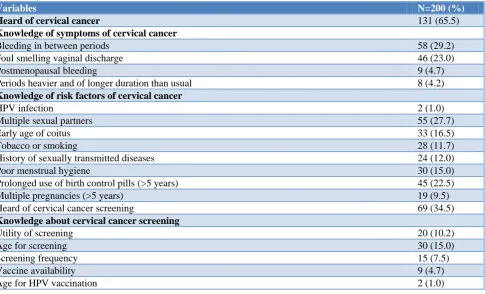
Table 2 shows the distribution of study participants having optimum knowledge score, favorable attitude and practices. Details of responses for knowledge and attitude are shown in Table 3. 64% of the study participants were not aware of the early symptoms of cervical cancer. Only 39% were aware of at least single risk factor. Around 34.5% had heard of cervical cancer screening.
Table 2: Adequacy of knowledge, attitude and practice regarding cervical cancer and its screening.
Variables Number (%)
Knowledgescore
<50% 18 (9.0)
≥50% 182 (91.0)
Attitude
Favorable 162 (80.5)
Not favorable 39 (19.5)
Practices
Ever screened 19 (9.5)
Never screened 181 (90.5)
76.2% women were willing to be screened if offered free of cost. But only 9.5% women had ever been screened for cervical cancer.
Results of binary logistic regression to identify predictors of optimum knowledge, favorable attitude and practice are shown in Table 4. Education, age and income were independent predictors of better knowledge. Education level influences attitude towards screening and actual practice depends on age, income and marital status.
Table 3: Knowledge of cervical cancer among respondents (n=200).
Variables N=200 (%)
Heard of cervical cancer 131 (65.5)
Knowledge of symptoms of cervical cancer
Bleeding in between periods 58 (29.2)
Foul smelling vaginal discharge 46 (23.0)
Postmenopausal bleeding 9 (4.7)
Periods heavier and of longer duration than usual 8 (4.2)
Knowledge of risk factors of cervical cancer
HPV infection 2 (1.0)
Multiple sexual partners 55 (27.7)
Early age of coitus 33 (16.5)
Tobacco or smoking 28 (11.7)
History of sexually transmitted diseases 24 (12.0)
Poor menstrual hygiene 30 (15.0)
Prolonged use of birth control pills (>5 years) 45 (22.5)
Multiple pregnancies (>5 years) 19 (9.5)
Heard of cervical cancer screening 69 (34.5)
Knowledge about cervical cancer screening
Utility of screening 20 (10.2)
Age for screening 30 (15.0)
Screening frequency 15 (7.5)
Vaccine availability 9 (4.7)
Age for HPV vaccination 2 (1.0)
Attitude statements Number agreed (%)
Intermenstrual bleed should be considered as normal 11 (5.5)
A woman should bear her first child by age of 20 years 46 (23.0)
Women should bear 5 or more children in order to increase family strength 11 (5.2)
Women with multiple sex partners are more predisposed to cervical cancer 92 (45.7)
Women should get an internal examination done by a gynecologist once in every 3 years 159 (79.7)
If any lady in the neighborhood is suffering from cervical cancer, you would keep distance from her 45 (22.7)
If you were offered a free cervical cancer screening would you be willing to be screened? 152 (76.2)
Table 4: Binary logistic regression for association of socio-demographic factors with optimal knowledge, favorable attitude and practice
Characteristics Knowledge score >50%
OR (95% CI) P value
Favorable attitude OR (95% CI) P value
Practices (ever screened) OR (95% CI) P value
Age >30 years 2.52 (1.12-5.69) 0.033 0.953 (0.57-1.57) 0.854 4.97 (1.9-13.03) 0.0006
Education (>secondary) 10.33 (2.44-43.69) 0.0002 15.29 (8.12-28.78) <0.001 3.908 (1.49-10.25) 0.005
Married 0.856 (0.38-1.89) 0.86 0.56 (0.288-1.09) 0.115 5.76 (1.35-24.4) 0.013
Age of marriage ≥18 yrs 5.34 (1.23-23.01) 0.023 5.6 (3.15-9.93) <0.001 4.79 (1.43-16.03) 0.0099
Per capita monthly
income ≥2200 8.76 (2.64-29.10) 0.00006 9.14 (4.96-16.84) <0.001 3.4 (1.46-7.94) 0.0048
DISCUSSION
In the present study, 65.5% women had heard about cervical cancer. Similar findings were reported by Tran et aland Shreshta et alin Korea and Nepal respectively.11,12 Only 11% of the study participants had adequate knowledge about carcinoma cervix and screening. Similar findings are seen in studies done in Cameroon by Tebeu et aland in Ethiopia by Yifru and Asheber.13,14 The level of knowledge is higher in case of developed countries. Study done in Kuwait reported that 52% had good knowledge and study done in London reported that
76% had adequate knowledge.15,16 The lack of knowledge
in developing countries is mainly due to lack of population based screening programs, inefficient mass media campaigns, and cultural barriers wherein women feel shy to discuss the diseases affecting the sexual organs.
Intermenstrual bleeding was the most common reported symptom among study participants. Similar findings are reported in studies done in Kerala and Ahmedabad.17 The most common risk factor mentioned in the present study was having multiple sexual partners. Similar findings were seen in dissertation work done by James John and Robin Marie Beining.18,19
The present study reported poor knowledge of cervical cancer screening. Similar findings were seen in studies done by Shreshta et al and Bansal et al.19,20
Majority of women expressed willingness for screening if provided free of cost. 80.5% expressed a positive attitude towards cervical cancer screening. Similar findings are
reported in studies done by Saifari and Mohamed in Kuwait.15
In the present study, 9.5% of women had undergone screening. The results are comparable with the studies done by Shreshta et al and Bansal et al.12,20 Lack of awareness of screening test and absence of symptoms were the most common reasons for not undergoing screening. This is similar to a study done in Kerala.
Further association was found between sociodemographic characteristics and knowledge, attitude and practice. On multivariate analysis, it was found that women with age >30, secondary or higher level of education, who were employed or students were more likely to have adequate knowledge and more likely to execute positive practice of screening for cervical cancer. This may be because women who are employed or students have a greater opportunity for social interaction hence they get to know about the disease, benefits of screening and hence better practice.
CONCLUSION
The present study shows that women had suboptimal level of knowledge regarding cervical cancer but a favorable attitude for screening. However, uptake is low in actual practice. Strategic communication targeting eligible women, universal availability of screening facilities in public health facilities may increase the uptake of screening.
Funding: No funding sources Conflict of interest: None declared
REFERENCES
1. Ferlay J, Shin HR, Bray F, Forman D, Mathers CD,
Parkin D. Globocan 2008, Cancer Incidence and Mortality Worldwide: IARC Cancer Base N0. 10. Lyon, France: International Agency for Research on Cancer, 2010. Available at: http://globocan. iarc.fr.2010. Accessed on 3 November 2017.
2. Kaku M, Mathew A, Rajan B. Impact of
socio-economic factors in delayed reporting and late stage presentation among patients with cervix cancer in a major cancer hospital in South India. Asian Pac J Cancer Prev. 2008;9:589-94.
3. Walboomers JM, Jacobs MV, Manos MM, Bosch
FX, Kummer JA, Shah KV, et al. Human papillomavirus is necessary cause of invasive cervical cancer worldwide. J Pathol. 1999;189:12-9.
4. Gadducci A, Barsotti C, Cosio S, Domenici L,
Riccardo Genazzani A. Smoking habit, immune suppression, oral contraceptive use, and hormone
replacement therapy use and cervical
carcinogenesis: A review of literature. Gynecol Endocrinol. 2011;27:597-604.
5. Canavan TP, Doshi NR. Cervical cancer. Am Fam
Physician. 2000;61:1369-76.
6. Aswathy S, Quereshi MA, Kurian B, Leelamoni K.
Cervical cancer screening: Current knowledge and practice among women in a rural population of Kerala, India. Indian J Med Res. 2012;136:205-10.
7. Fylan F. Screening for cervical cancer: A review of
women’s attitudes, knowledge and behavior. Br J Gen Pract. 1998;48:1509-14.
8. Mosavel M, Simon C, Oakar C, Meyer S. Cervical cancer attitudes and beliefs–a Cape Town community responds on World Cancer Day. J Cancer Educ. 2009;24:114-9.
9. Rajkumar R, Sankaranarayanan R, Esmi A,
Jayaraman R, Cherian J, Parkin DM. Leads to cancer control based on cancer patterns in a rural population in South India. Cancer Causes Control. 2000;11:433-9.
10. International Agency for Research on Cancer.
GLOBOCAN 2012: Estimated cancer incidence, mortality and prevalence worldwide in 2012. Lyon, France: IARC; 2013. Available at: http://www. globocan.iarc.fr/. Accessed on 15 January 2017. 11. Tran NT, Choe SI, Taylor R, Ko WS, Pyo HS, So
HC. Knowledge, attitude and practice (KAP) concerning cervical cancer and screening among rural and urban women in six provinces of the
Democratic People’s Republic of Korea. Asian Pac J Cancer Prev. 2011;12:3029-33.
12. Shreshta J, Saha R, Tripathi N. Knowledge, attitude
and practice regarding cervical cancer screening amongst women visiting tertiary centre in Kathmandu, Nepal. Nepal J Med Sci. 2013;2:85-90.
13. Tebeu PM, Major AL, Rapiti E, Petignat P,
Bouchardy C, Sando Z, et al. The attitude and Knowldege of cervical cancer by Cameroonian women; a clinical survey conducted in Maroua, the capital of Far North Province of Cameroon. Int J Gynecol Cancer. 2008;18:761-5.
14. Yifru T, Asheber G. Knowledge, attitude and
practice of screening for carcinoma of the cervix among reproductive health clients at three teaching hospitals, Addis Abba, Ethiopia. Ethiop J Reprod Health. 2008;2.
15. Al Sairafi M, Mohammed FA. Knowledge, attitudes
and practice related to cervical cancer screening among Kuwaiti women. Med Princ Pract. 2009;18:35-42.
16. Yu CK, Rymer J. Women’s attitudes to and
awareness of smear testing and cervical cancer. Br J Fam Plann. 1998;23:127-33.
17. Goyal A, Gunvant V, Shrivastava A, Verma R,
Modi A. Knowledge, attitude and practices about cervical cancer and screening among nursing staff in a teaching hospital. Int J Med Sci Public Health. 2013;2:249-53.
18. John J. The Knowledge, attitude, practice and
perceived barriers towards screening for
premalignant lesions among women aged 18 years and above in Songea Urban, Ruvama [Dissertation]. Muhimbili Univ Health Allied Sci, 2011.
19. Beining RM. Screening for cervical cancer. An
exploratory study of urban women in Tamil Nadu, India [Dissertation]. University of Lowa, 2012.
20. Bansal AB, Pakhare AP, Kapoor N, Mehrota R,
Kokane AM. Knowledge, attitude and practices related to cervical cancer among adult women: A hospital based cross sectional study. J Nat Sc Biol Med. 2015;6:324-8.
Cite this article as: Ramaiah R, Jayarama S.
Knowledge, attitude and practices about cervical cancer among rural married women: a cross sectional study. Int J Community Med Public Health