Incubation Process and Entrepreneurial Characteristics
: An Interactive Perspective
Msc. Estêvão da Silva Marinho Federal University of Santa Maria
Dr. Italo Fernando Minello Federal University of Santa Maria
Msc. Rafaela Escobar Bürger Federal University of Santa Catarina
Abstract
The following work was performed at the technological incubator in Santa Maria, Brazil (ITSM), aiming to analyze the influence of the incubation process on entrepreneurial characteristics and apprenticeship, in the view of business managers who experience this process at ITSM. To that end, data were collected through semi-structured interviews with eight managers of incubated businesses and documental research. The questions addressed in the interview focused on life story, professional career, incubation process and entrepreneur apprenticeship, the latter, following the propositions by Politis (2005). At the same time, the questionnaire developed by David McClelland (1972) on Entrepreneurial Behavior Characteristics (EBC) was applied. For data analysis, the method of content analysis of interview was used, based on Bardin (2011). The categories of analysis defined a priori were: incubation process, entrepreneurial characteristics, and entrepreneurial apprenticeship. The categories of analysis not defined a priori and based on the reports of interviewees were: perceived demands and interaction needs. The objective of the study was fully achieved, considering that, from the perspective of the incubated subjects, ITSM allowed opportunities for these individuals as well as their businesses to develop, stimulating their learning through an experiential nature. From the results obtained, a plan of action was designed for ITSM aiming to reduce the demands observed by the incubated individuals regarding the incubation process.
Keywords: Technological incubator, entrepreneurial characteristics, entrepreneurship, demands of incubated.
BACKGROUND TO THE STUDY
In a business environment characterized by constant changes, businesses increasingly depend on the ability of their intellectual assets to generate ideas and create innovative goods and services (Quandt et al., 2014). This dependence can be analogue to small-sized and evolving businesses, also relevant for a country’s economy. Such businesses, according to their role in the Brazilian economy, need constant development just like other business segments, mainly in relation to their competitive capacity and the way they are led by managers (Ferreira et al., 2015).
It evidences the need to mobilize tools, especially public policies, capable to offer support to small businesses so that they have proper conditions to develop (Fonseca, 2015). Another relevant aspect is the fact that this support demands the generation and dissemination of knowledge about business management, innovation and entrepreneurship, to stimulate and nourish such improvement conditions. According to Gomes et al. (2014), university-company interactions can be an option, as in the case of business incubators associated to higher education institutions. In this sense, according to Fonseca (2015), business incubators can be considered an instrument to promote growth of small-sized and evolving businesses through the incubation process, while they try to offer opportunities for these businesses to achieve higher performance levels than their sister parties that have not gone through the incubation process.
STATEMENT OF THE PROBLEM
Universities can be an important vector for regional development because they generate demands in addition to qualifying people and attracting researchers, what can help contribute to the economic development of a region. A study performed by Cruz et al. (2010) has shown that every 1% increase of investments in education improves productivity and per capita income levels of 0,47% and 0,27%, respectively, in the region where they are applied.
(Dolabela and Filion, 2013). Actions that promote entrepreneurship, in the scope of universities, add great participation of agents who interact in the process, contributing to the development of entrepreneurial orientation in all education, research and extension levels (Zampieri, 2010; Casado, Siluk and Zampieri, 2013).
STUDY OBJECTIVE
Considering this, this paper is the result of a study performed in the Technological Incubator of Santa Maria (ITSM), aiming to contribute for the development of businesses of technological basis and to stimulate the economy of the region, boosting and promoting entrepreneurship. This occurs through the process of business incubation, promoting the entrepreneurial apprenticeship of managers of the referred businesses (Rosa, 2014). This proposal evidences an aspect that stimulates entrepreneurial activity when the existence of entrepreneurial behavior characteristics in individuals who manage incubated businesses can represent a motivational factor for this subject. This reasoning sustains the possibility of direct association between incubation process (Grimaldi and Grandi, 2005; Etzkowitz, 2009; Stamatovic, 2010; Zampieri, 2010; Damião, 2015) and entrepreneurial behavior (MCclelland, 1972; Minello, 2014). In light of this, this work analyzes the influence of the incubation process on entrepreneurial characteristics in the view of business managers who experience this process in a technological incubator.
LITERATURE REVIEW Business Incubators and Incubation Process
According to Dornelas (2002), business incubators are a tool to accelerate the development of businesses through a scheme of business, services and technical support, in addition to practical and professional orientation. Business incubators, including technological ones, can be maintained by governmental institutions, universities or community groups. In developed countries, they are non-profit organizations that aim to boost development at a local level (Stamatovic, 2010).
According to MCTI (2015), technological incubators are stimulus mechanisms and logistics, managerial and technological support for innovative entrepreneurship and intensive knowledge, aiming to promote new businesses whose main strategy is technological innovation.
These institutions offer entrepreneurs technological, financial and marketing support as well as funding development, among others. Also, during the incubation process, they develop activities such as lectures, seminars, and workshops to create basic structural conditions and motivation, which trigger the construction of an innovation-friendly environment (Damião, 2015). They also offer training, consulting, commercial incentive, sales and marketing advice (Pereira et al., 2014).
Thus, the incubation process is displayed as a path for entrepreneurs, and aims to develop immaterial assets to leverage the value of the organization and its competitive advantage, thus reducing the risk of business failure (Castro Júnior et al., 2015). In these environments, entrepreneurs have access to entrepreneurship workshops offered either by the university or the incubator itself, contributing to their entrepreneurial training (Wolffenbüttel, Fracasso and Bignetti, 2004). Incubators seek to promote this reduction helping business managers to better prepare through administrative, financial and structural support provided to incubated businesses during the incubation process (Raupp and Beuren, 2011). Still according to these authors, during the incubation process, incubators provide subsides to entrepreneurs to strengthen their entrepreneurial characteristics, which is the subject discussed in the next session.
Entrepreneurial Characteristics and Entrepreneurial Behavior
Engelman and Fracasso (2013) highlight that, in relation to the incubation process, considering entrepreneurial characteristics – opportunity-seeking and proactivity, risk tolerance, persistence, demand for quality, commitment, information-seeking, goal setting, planning, persuasion, independence, among other skills and individual characteristics – can contribute to the success of businesses that go through this process, the reason why such characteristics earn relevance, and need to be developed (Raupp and Beuren, 2011). According to these authors, not all individuals have skills to be entrepreneurs. It is understood that some necessary characteristics are innate and others can be learnt. These characteristics allow to convert the efforts of this individual – the entrepreneur – into the development of a new idea, which will culminate in the creation of a business.
Regarding their behaviour, entrepreneurs are not static social actors, but dynamic beings. These individuals do not side-track their goals, they act repeatedly or change their strategy to face challenges and overcome obstacles even though personal sacrifices are needed (Carreira et al., 2015).
Nassif, Hashimoto and Amaral (2014) state that personal characteristics, including capacity of innovation and accumulated experience as well as constant improvement of abilities to create and manage businesses, are the key to successful entrepreneurs. Considering this, and a highly competitive market, it is important to raise some questions related to entrepreneurial characteristics and behavior face to the challenges of the business world (Siqueira et al., 2015). Such characteristics can help individuals face entrepreneurial challenges (MCclelland, 1972), but their absence can hinder the creation of a business.
According to Minello (2014), the behavior of an entrepreneur, in the role of a manager of their own business, is also evidenced in their ability to handle and experience difficulties. Mizumoto et al. (2010) have found out that one of the main reasons for business disruption is the lack of management practices, especially planning and information-seeking. In this sense, the teaching of entrepreneurship can help improve such managing characteristics and abilities, promoting entrepreneurial apprenticeship (Zampier and Takahashi, 2014; Leiva, Alegre and Monge, 2015).
METHOD
To perform this work, qualitative research with an exploratory design based on empirical research was adopted. According to Sampieri et al. (2013), the qualitative approach is used when it is sought to understand the perspective of individuals about the phenomena surrounding them, based on their apprenticeship and experiences, and the way participants become subjectively aware of their reality.
Regarding the exploratory design, Sampieri et al. (2013) argue that this type of study is performed when it is aimed to investigate a subject that is rarely considered and there are several doubts, or that has not been discussed before. In this essay, data were collected about the incubation process at the Technological Incubator of Santa Maria (ITSM), the analysis of the studied field, and the planning for data collection. Such studies are intended to gather information on the possibility to perform more complete research related to a particular context, such as studies in incubators.
Data were collected through semi-structured interviews with eight managers (E1, E2,…,E8), of incubated businesses and through documental research. Questions addressed in the interview followed a guide with 20 open questions, divided into four blocks, which included life story, professional career, incubation process, and entrepreneurial apprenticeship, the latter following the propositions by Politis (2005).
In addition, the questionnaire on EBC (MCclelland, 1972) was applied with the same group, and consisted of 55 items related to 10 behavioral characteristics of an entrepreneur, as previously cited.
The analysis step started after data collection, using the content analysis technique (Bardin, 2011). Interviews were fully transcribed. After fluctuating reading, transcriptions were summarized and categorized. The categories of analysis defined a priori, based on the theoretical approach adopted and the aim of the study were incubation process, entrepreneurial characteristics and entrepreneurial apprenticeship. Also, perceived demands and interaction needs, categories of analysis not defined a priori, were established from the interview reports. Furthermore, data were analyzed from the EBC questionnaire applied to the same group of managers.
FINDINGS AND DISCUSSIONS Incubation process
Environments such as business incubators, which can promote entrepreneurship, are classified by ANPROTEC (2015) as places that aim to shelter businesses, offering a structure that allow the promotion and support to entrepreneurial activities through the incubation process. Such process, which involves structure, environment, and specific services, as shown previously, can be perceived in different ways by the individuals that go through it.
According to Ribeiro (2013), the individual who seeks for this type of environment and for their own development, pursues specific support and assistance that contribute for the prosperity of their business. Some of these aspects are discussed by E3 and E4, who express their insights about the importance of the incubation process:
“…it is important especially because we don’t know where to start, I want to start a business, but how? You know, I think it helps to make things more professional, instead of the immature thought of “I want to have a business”. But today I have the idea that if I was going to start something, I would inevitably search for a system like this, incubator, park, or whatever (E3).”
It is worth mentioning that since they share the physical space of the incubator, entrepreneurs can interact with one another and with incubator managers. According to Xu (2010), the interaction with incubator managers and between incubated managers includes counselling, information, experiences and problems sharing. Such interaction can be found in the statements of E5 and E7:
“It is good but could be better. There isn’t a monthly meeting or anything more casual, I think it is a space for incubation, for co-working, where people should be sharing ideas or difficulties they are going through so that others could avoid them (E5).”
“With the other incubated individuals, it is basically it, hallway chat, only a few times we go to companies and say: ‘ah, I need some help for this’, it was only a few times but sometimes we were walking around in this hallway and people also come and we always met someone there, and tried to solve a doubt, you know, so basically this is our relationship with other businesses (E7).”
For Martins et al. (2014), it is not only infrastructure, concluded businesses, initiative, or actions of the incubator management alone that provide interaction with different audiences, but also the combination of these factors that together promote a favorable scenario that can result in partnerships, cooperation, networking inside and outside the incubator. This perspective can be observed in the statements of E1 and E4, which evidence actions and/or attitudes which benefitted the incubated businesses:
“…we are still looking for supporters, and in Santa Maria we have already looked for the software center with the information, where they really bring us the information, they give support. It is still a partnership, a new partner, but we have already reaped rewards of this partnership, which is an arrangement (E1).”
“…the incubator is helping us a lot with the contacts, as it is a software for… let’s not say for the public domain, but based on public funding, you know, the university is helping a lot (E4).”
The development of these businesses is associated to internal factors such as business assistance provided during the incubation process (Dornelas, 2002), and the interaction with other incubated individuals; and externally through funding and support institutions (Xu, 2010). In this sense, it is evidenced that the incubation process involves several aspects that influence on business management and consequently on the behavior of the entrepreneur who goes through this process.
Entrepreneurial Characteristics
By recapitulating the concept of entrepreneurial characteristics adopted for this study, it is evidenced that, according to Carland, Boulton and Carland (1984), these behavioral features represent a competitive differential in the business world, when they work in a creative way, creating and seeking opportunities. According to MCclelland (1972), opportunity-seeking involves a number of attitudes from the entrepreneur, such as working to expand the business and harnessing unusual opportunities to start a business. These considerations can be observed in excerpts of interviews of E2 and E5.
“Then we developed this research and teaching project and in 2009 we had the opportunity to participate in the entrepreneur profile, a contest promoted by RBS TV. So we participated in the first editions in 2009 with that… we transformed that project in a business plan. We modelled it, and it was already a challenge because the business plan is quite different from the research (E2).”
“So... yeah... one night we had the idea to build a website that centralized several menus and it was possible to improve it because they already had technical knowledge for it and why not build a site where you can bring together several menus and order your food right there, you know? The company would receive the order and you would just wait for your food at home. Then, ah... this way we kind of had the idea for the company x (E5).”
“This was when I started to get really involved with business, which today I am an associate… although I had looked for some initiatives during college, these junior businesses, AIESEC, which are actually more or less the same thing, aren’t they? Then I ended up investing more in this aspect and it is interesting that I started as a trainee in 2009, and in 2010 the business shaped up and I became an associate (E3).”
“Well, we saw that the market today lacks not only engineering but also topography and precision. Because we received several projects to correct, and noticed that people were a little defaulting in the matter of precision (E6).”
The evolution of technology and society has brought more complexity to the entrepreneurial activity and the market, transforming politics, economy, technology, nature and culture. This has been demanding from the entrepreneur a series of abilities not mentioned in the past, such as commitment, for example (Filardi, Barros and Fischmann, 2014). Commitment is expressed through behaviors such as assumption of liability by performance, collaboration with employees to finish a work, dedication and effort to keep clients happy (MCclelland, 1972); such behaviors can be observed in some fragments of the statements of E4 and E8.
“But the main thing of this all is having an idea, doing, seeing if you will make it work, and doing it right. I believe that in any business, it is no use you... ah, I’ll do this, go and do not manage to do at least half of that. Or you end up making yourself look bad, that’s how people say it, isn’t it? It is to have an idea and see if you make it work… (E4).”
“Seriousness, taking seriously what you are doing, don’t play the victim, you know, don’t play the victim ‘oh god, why did this happen, and this is not my fault’, you have to cope with it… if my client wants a cheap beer, I’ll tell them: look, unfortunately our cheapest beer is this, it is pure malt because the company does not allow me to produce a product with low quality, this is the standard quality (E8).”
Based on what has been exposed, it is evidenced that, according to Gomes, Lima and Capelle (2013), researchers generally place the subject of the entrepreneurial action at the center of the entrepreneurship phenomenon; however, it is possible to expand this perspective by citing Oliveira et al. (2015), who say entrepreneurs have and/or develop distinct abilities, attitudes, and behaviors, from several forms of interaction, promoting singularity and characterizing their behavior. In this sense, human beings can, at the same time, be influenced and conditioned by their social environment, as well as by their innate characteristics. This reasoning emphasizes the possibility for this individual to constantly learn from experiencing different situations, characterizing a process of entrepreneurial apprenticeship. For this process to be effective, the incubation process must be directed to the needs and demands of the incubated individuals. Thus, the analysis of demands perceived by these individuals about the incubation process is presented.
Perceived Demands
For Raupp and Beuren (2011), business incubators must represent mechanisms of support, help and promotion for nascent businesses, offering advantages and facilities for business consolidation and development. This way, it is possible to understand that new entrepreneurs look for these institutions aiming to overcome the difficulties faced in the beginning of their activities (Dornelas, 2002).
According to Andrade Júnior (2012), this support from incubators has not been combined with careful procedures to consistently verify the activities performed and the services provided by these institutions, as well as the demands perceived by incubated individuals and the difficulties faced while starting businesses, aiming to subside actions to improve the process.
From this perspective, it is important to consider the views of incubated individuals regarding the services provided by the incubator concerned. Moreover, it is necessary to identify more specifically the demands perceived regarding the incubation process. In this sense, excerpts from E1 and E2 are shown as examples of such demands.
“For us, this incubation part should be more together with the incubator managers, not only the environment or place. The environment is good, has good quality, but it lacks assistance, for us it would be enough, not only for us, I think other companies also have the same thoughts, in conversations we have, you know, there is not much support this way (E1).”
once in these 5 years, I saw it like this. Apart from that, there wasn’t any other initiative. So I think it is a little passive, you know. It could be more well explored, even for the external public (E2).”
In the view of Andrade Júnior (2012), actions developed by incubators must preferably be focused on the reduction of difficulties faced by incubated individuals. To that end, identifying such difficulties can allow a more effective way to face them, while it also allows the support efforts to be directed more appropriately. Some reports of the difficulties faced by managers during the incubation process can be found in the excerpts of E1 and E5:
“We had some problems to register, to seek information, you know, there wasn’t a script, let’s say, a step-by-step plan if everything a business needs, and this is really lacking, there’s a cost, a cost for everything, regularization fees, and all that, and this was even our fault, I think... we didn’t have support for that in the beginning. And this was one of the obstacles we had (E1).”
“This was the difficulty, not getting an investor and we could maybe have looked for an investor because the business was recent and would be much stronger now, you know. The incubator should have some ways to attract investors more frequently and they could come here, you know. Ah... from the offers we’ve already had, was through our own initiative (E5).”
Engelman, Fracasso and Brasil (2011) emphasize that some of the services provided need to adequate to the demands of incubated individuals. It is relevant to consider these demands perceived by managers regarding the services provided by the incubator.
“I miss it here, to promote the businesses that are here. It is lacking here. Santa Maria doesn’t know that there is a business which is known worldwide, and it is not spread. I know because my fellow entrepreneurs are standing out in the international market but no one knows them in Santa Maria (E6).”
“…the idea was that there was going to have a follow-up from the management closer to the businesses, you know. But since we started here, we didn’t have it, we didn’t feel it, then… (E7).”
Incubated individuals also expressed the need to interact with different audiences during the incubation process, and these needs are addressed in the following section.
Interaction with Different Audiences
Among the wide range of resources and benefits that can be provided by incubators, interaction represents an important instrument for the development of the incubator, as well as for the incubated businesses. Interaction with the incubator managers, between incubated individuals, and the assistance to obtain external funding, according to Xu (2010), evidence one of the major gains in the incubation process. The relationship management-incubated individual at ITSM was evidenced by interviewees E2 and E3, as follows:
“We had, we had occasional conflicts not with the direction but with other managers here. Ah, they knew nothing about the incubation process, they knew nothing about what an incubator is and wanted to give orders or do things that weren’t the expected from an incubator (E2).”
“From the direction, it is almost non-existent, we basically interact with them with a knock on the door to ask something or if they want to talk to someone, or if we want to ask something that is not working well, or ask for something, you know, so it is very superficial (E3).”
According to Dornelas (2002), these interaction environments enable the incubated businesses to not only assess all operational expenses but also contribute to exchange information and experiences among entrepreneurs. The interaction between incubated individuals at ITSM was described by E1 and E6:
“We don’t have a bad relationship, but in fact, we don’t have a relationship, you know. Because if you think of it, we always have a good relationship with the companies which have their doors open. We always talk to all the entrepreneurs, but some companies that came in here still keep their doors closed, so we don’t have any contact (E6).”
The following is the qualitative analysis of the questionnaires about entrepreneurial behavior characteristics, applied with the business managers incubated at ITSM.
Analysis of Questionnaires on EBC
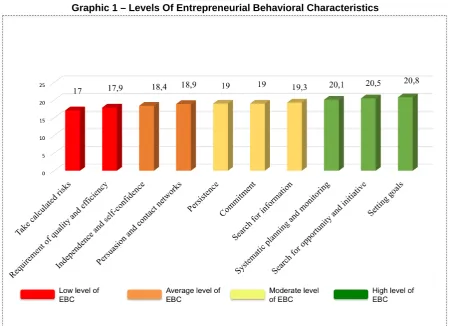
Through the analysis of questionnaires on EBC (MCclelland, 1972), it was observed that managers in general show characteristics of entrepreneurial behavior. The overall average of characteristics was 19,3 points; however, it is worth noting that only characteristics with scores below 15 points indicate the absence of the respective characteristic. To visualize this result, Graph 1 shows the averages obtained by the incubated individuals in each characteristic, organized in ascending order and illustratively. However, even the characteristics in which managers of the incubated businesses obtained the lowest scores, it cannot be said that the group of managers do not have such characteristics. Nevertheless, this fact might indicate that characteristics with the lowest averages are the ones not manifested in these individuals, in the same way that the highest averages indicate a strong presence of the respective characteristics.
Graphic 1 – Levels Of Entrepreneurial Behavioral Characteristics
Source: elaborated by authors based on results of questionnaires on EBC
Columns highlighted in red point out the less usual characteristics, which demand special attention from the actors involved in the incubation process. Simultaneously, the demands perceived by the incubated individuals point out services provided by ITSM that need improvement, on their perspectives. These demands represent only one aspect of the perspective of incubated individuals regarding the incubation process, narrated during the interviews, as shown previously.
Figure 2 – Results From The Research On The Incubation Process At ITSM
Source: elaborated by authors based on interviewees’ reports and the results of the questionnaires on EBC. With the results obtained by the analysis of the questionnaires and the interviews, it was possible to make a combination of the data collected.
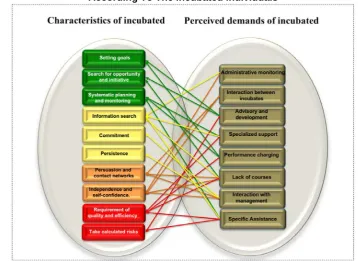
The combination between the characteristics of the incubated individuals and their perceived demands regarding the incubation process allows to suggest actions that aim to meet such demands and contribute to the development of the process of entrepreneurial apprenticeship at ITSM (Figure 3).
Figure 3 – Combination Of Entrepreneurial Characteristics And Demands Of The Incubation Process According To The Incubated Individuals
The combination between the characteristics of entrepreneurial behavior identified in the managers of businesses incubated at ITSM, and their reports on demands perceived regarding the incubation process occurred as follows:
- Goal setting involves certain behaviors such as establishing short and long-term challenging objectives that have a personal meaning to the entrepreneur. Individuals with this characteristic act in an organized way, aware of the necessary steps to achieve such objectives. This characteristic is linked to the demand assistance to development, since this aspect can be associated to the possibility of investments that bring perspectives of growth and business consolidation, which are common purposes for entrepreneurs. Goal setting is also connected to the demand for performance when this imposition from the incubator would serve as a development parameter for businesses.
- Opportunity-seeking and initiative emerge when the entrepreneur anticipates to circumstances and acts to expand their business, harnessing unusual opportunities, including obtaining funding, relating directly to the demand assistance to development. The perception of lack of workshops is also connected since it indicates initiative and willingness to qualification.
- According to MCclelland (1972), the individual who works with systematic planning and monitoring is capable to split bigger tasks into sub-tasks, and reviews their plans continuously, considering results obtained and circumstantial changes. Thus, meeting the need for expert support and specific assistance allows planning to be consistent, since the participation of experts in these activities are important for the business to structure, especially nascent businesses. The demand for performance is also associated to this characteristic since it involves the monitoring of plans and results of incubated businesses.
- Information-seeking can be a differential for the entrepreneur to excel in business. According to McClelland (1972), these individuals endeavor to obtain information from clients, suppliers and competitors. They also research about how to make a product or offer a service, in addition to consulting experts for technical or commercial advice. Therefore, such characteristic is closely related to the search for expert support, specific business assistance and administrative follow-up, demands perceived and mentioned by incubated managers at ITSM. The lack of resources, also mentioned by managers, represents the interests of these entrepreneurs to search for information that help them conduct their businesses.
- According to McClelland (1972), commitment is a characteristic that implies personal effort to perform a task, cooperating with collaborators, and walking in their shoes when necessary. These individuals take responsibility for the business, prioritizing client satisfaction rather than short-term profit. The need to interact with the management, reported by the entrepreneurs, shows the concern to work accordingly to expectations and guidelines of ITSM, among other aspects, evidencing commitment to results of the business and to the incubator.
- Entrepreneurs can frequently face setback situations and financial instability, which are among the particular obstacles of this occupation. To deal with these circumstances, the entrepreneur must be persistent, able to find ways to react to difficulties, acting repeatedly or changing strategies, in order to overcome challenges and problems. The need to interact with the management shows willingness to seek solutions for occasional difficulties or even change of plans oriented by the management.
- Persuasion and contact network allows the use of strategies to influence others, persuading them to act to contribute with their own goals. They aim to expand their contact network to get information, advice, and experiences that can increase their assertiveness as managers. This characteristic is related to the need to interact with other incubated individuals and the incubator managers, as it expands their contact network with key people who can benefit them.
The demand for workshops shows the need of incubated individuals to exchange information and experiences, what can also improve their contact network.
- Independence and self-confidence are the ability to be autonomous in relation to rules and controls, keeping their opinions even face to opposing ideas or disappointing results. They are safe and confident on their ability to face challenges. The demand for administrative follow-up shows the intention to be safe to make decisions, as well as the need for interaction between incubated individuals and the management can represent the need to capture empirical knowledge acquired by other entrepreneurs and by the incubator know-how, which could prop up decisions regarding conducting business. Lack of resources can also influence the perception of their ability as an entrepreneur, decreasing their self-confidence.
- Demand for quality and efficiency means finding ways to do things faster, better and with lower costs, aiming to exceed quality standards. In this sense, the need for expert support, specific assistance and workshops, as well as the demand for performance represents the urge of these entrepreneurs to search for apprenticeship and development, not only personal but also organizational. It evidences the concern with business performance and the offer of goods and services with differentiated quality.
this characteristic for this group, since the external capital can decrease risk perception, allowing a more daring attitude from the entrepreneur. As in the supply of specific support, it can increase the confidence and safety to manage a business, and consequently, increase risk tolerance.
The demands more frequently associated to characteristics of entrepreneurial behaviour with the lowest averages will be prioritized in the elaboration of the plan of action, thus establishing a hierarchy between demands. The reorganization of demands and entrepreneurial characteristics according to the established hierarchy is represented in Figure 4.
Figure 4 – Hierarchization Of Demands
Source: Elaborated by authors.
From the combination of the entrepreneurial characteristics perceived by the researcher, and the demands of the incubation process in the perspective of incubated individuals at ITSM, actions to reduce such demands were suggested (Chart 1).
Source: elaborate by authors based on research results, adapted from Minello (2010, 2014).
CONCLUSION AND FINAL CONSIDERATIONS
By considering the aim of this study – to analyze the influence of the incubation process on entrepreneurial characteristics in the perspective of business managers who experience this process at ITSM – from the view of the researcher, it was fully achieved, because according to the incubated individuals, the incubator has offered opportunities for their development as well as their businesses, stimulating their apprenticeship through an experiential nature.
The results of the questionnaires on EBC have indicated the presence of nearly all characteristics in all managers, with emphasis to the average scores in systematic planning and monitoring; opportunity-seeking and initiative; and goal setting, according to what was presented in the previous section. These attributes are learned in day-to-day routine, in the face of contingencies, experiences, and through the several forms of interaction provided by ITSM.
The data collected from interviews generated the impressions of entrepreneurs in relation to the process, from the application of the technique of content analysis (Bardin, 2011), specifically through adopting the techniques of categorization and enunciation. In this sense, we emphasize the good relationship between the incubated individuals and the incubator management, being this aspect cited by nearly all entrepreneurs interviewed. Regarding the interaction between managers of different businesses, most of them point out a cordial however social relationship, and in most of the cases not involving business interactions. The lack of periodical meetings between the parties involved was frequently mentioned in several interviews, but the interviewees admitted having some responsibility regarding this, informing that whenever there was a meeting schedule there was very low participation of the incubated entrepreneurs.
In general, the incubated individuals affirmed that the incubation process was fundamental for their first steps into business, especially because of infrastructure and low costs. Most of the managers also emphasized the benefits of the workshops provided by the incubator for a certain period, and mentioned the absence of these workshops courses nowadays. However, an aspect that should be mentioned is the difficulty reported by the business managers regarding the need to interact with investors and development agencies, either because of lack of support, or lack of knowledge of means for doing so.
REFERENCES
Andrade Júnior, P. P. (2012). Análise por agrupamento de fatores de desempenho de empresas de base tecnológicas em incubadoras: estudo das incubadoras do estado de Santa Catarina. Revista produção online, Florianópolis, sc, v. 12, n. 1, p. 205-228, jan./mar.
Anprotec. Associação nacional de entidades promotoras de empreendimentos de tecnologias avançadas. Disponível em: http://anprotec. Org.br/site/, acesso em 21 de abril de 2015.
Bardin, l. (2011). Análise de conteúdo. São Paulo: 70 ed.
Carland, J. W., Hoy, f., Boulton, W. R. & Carland, J. A. (1984). Differentiating entrepreneurs from small business owners. The academy of management review. V. 9, p. 2.
Carreira, S. S., Franzoni, A. B., Esper, A. J. F., Pacheco, D. C., Gramkow, F. B. & Carreira, M. F. (2015). Empreendedorismo feminino: um estudo fenomenológico. Navus, revista de gestão e tecnologia. Florianópolis, sc, v. 5, n. 2.
Casado, F. L., Siluk, J. C. M. & Zampieri, N. L. V. (2013). Universidade empreendedora e desenvolvimento regional sustentável: proposta de um modelo. Rev. Adm. Ufsm, Santa Maria, v. 5, edição especial, p. 633-650, dez.
Castro Júnior, D. F. L., Silveira-Martins, E., Miura, M. N. & Silva, M. P. P. (2015). O processo de formulação de estratégias e os recursos intangíveis da empresa: reflexões teóricas sobre esta relação. Revista capital científico – eletrônica (Rcce), issn 2177-4153, v. 13, n.1, jan./mar.
Cruz, A. C., Teixeira, E. C. & Braga, M. J. (2010). O efeito dos gastos públicos em infraestrutura e em capital humano no crescimento econômico e na redução da pobreza no brasil. Economia (Brasília), v. 11, p. 163-185.
Damião, D. (2015). Metodologia para controle da agregação tecnológica durante o processo de incubação. A experiência da incubadora tecnológica agende Guarulhos. Revista de administração e inovação, São Paulo, v. 12, n. 1, p. 227-247.
Dolabela, F. & Filion, l. J. (2013). Fazendo revolução no brasil: a introdução da pedagogia empreendedora nos estágios iniciais da educação. Revista de empreendedorismo e gestão de pequenas empresas, v. 3, n. 2.
Dornelas J. C. A. (2002). Planejando incubadoras de empresas: como desenvolver um plano de negócios para incubadoras. Rio de Janeiro, campus.
Engelman, R. & Fracasso, E. M. (2013). Contribuição das incubadoras tecnológicas na internacionalização das empresas incubadas. R. Adm., São Paulo, v. 48, n. 1, p. 165-178, jan./fev./mar.
Engelman, R., Fracasso, E. M. & Brasil, V. S. (2011). A qualidade percebida nos serviços de incubação de empresas. Read. Rev. Eletrôn. Adm. Porto alegre. V. 17 n. 3 Porto Alegre sept./dec.
Etzkowitz, H. (2009). Hélice tríplice – universidade-indústria-governo, inovação em movimento. Porto alegre. Pucrs.
Ferreira, L. F. F., Oliva, F. L., Santos, S. A., Hildebrand, C. C. & Lima, G. A. C. (2012). Análise quantitativa sobre a mortalidade precoce de micro e pequenas empresas da cidade de São Paulo. Gest. Prod., são carlos, v. 19, n. 4, p. 811-823.
Filardi, F., Barros, F. D. & Fischmann, A. A. (2014). Do homo empreendedor ao empreendedor contemporâneo: evolução das características empreendedoras de 1848 a 2014. Revista ibero-americana de estratégia - Riae. V. 13, n. 3. Fonseca, S. A. (2015). Incubadoras como vetores para a promoção de tecnologias limpas em empreendimentos de
pequeno porte: possibilidades e limites. Ram, Revista de administração Mackenzie, São Paulo, SP. Issn 1518-6776 (impresso), issn 1678-6971 (on-line), v. 16, n. 1, p. 188-212, jan./fev.
Frota, G. B., Brasil, M. V. O. & Fontenele, R. E. S. (2014). Influência das características socioeconômicas, capacidade de gestão e comportamento empreendedor no sucesso dos empreendedores participantes do programa de microcrédito do banco Palmas. Revista de empreendedorismo e gestão de pequenas empresas, v. 3, n. 2, p. 42-69.
Gomes, A. F., Lima, J. B. & Cappelle, M. C. A. (2013). Do empreendedorismo à noção de ações empreendedoras: reflexões teóricas. Revista alcance - eletrônica, v. 20, n. 2, p. 203-220, abr./jun.
Gomes, M. S., Gonçalo, C. R., Pereira, C. D. & Vargas, S. L. (2014). A inovação como conexão para o desenvolvimento de parcerias entre universidade- empresa. Navus - Revista de gestão e tecnologia. Florianópolis, sc, v. 4, n. 2, p. 78-91, jul./dez.
Grimaldi, R. & Grandi, A. (2005). Business incubators and new venture creation: assessment of incubating models. Technovation: elsevier. N. 25, p. 111-121.
Leiva, J. C., Alegre, J. & Monge, R. (2015). The influence of entrepreneurial learning in new firms’ performance: a study in Costa Rica. Rev. Inovar. V. 24, edición especial.
Lorentz, M. H. N. (2015). O comportamento empreendedor de diretores da Ufsm e sua percepção quanto à universidade empreendedora. Dissertação apresentada ao curso de mestrado profissional em gestão de organizações públicas do programa de pós-graduação em administração. UFSM.
Mcclelland, D. C. (1972). A sociedade competitiva: realização & progresso social. Rio de Janeiro: expressão e cultura. Mcti. Ministério da ciência, tecnologia e inovação. Disponível em: http://mcti. Gov.br/. Acesso em: 21 de abril de 2015. Minello, I. F. (2014). Resiliência e insucesso empresarial: o comportamento do empreendedor diante do fracasso nos
negócios. Curitiba, Appris, 288p.
Mizumoto, F.M., Artes, R., Lazarinni, S.G., Hashimoto, M. & Bedé, M.A. (2010). A sobrevivência de empresas nascentes no estado de São Paulo: um estudo sobre capital humano, capital social e práticas gerenciais. Revista de administração (Rausp), São Paulo, v.45, n.4, p.343-355, out./nov./dez.
Oliveira, W. F. M., Aouar, W. A. E., Barreto, L. K. S., Santos, O. S. S. & Oliveira, H. C. (2015). Da teoria clássica à contingencial: contribuições à competitividade das organizações. Revista Raunp, v. 7, n. 2, p. 43-58, fev./maio. Pereira, J. A., David De Souza, M. C., Tatto, L. & Oliveira, J. S. (2014). Estratégia como prática: um estudo em empresas
incubadas de base tecnológica. Raimed - Revista de administração Imed, v. 4, n. 2, p. 161-176, maio/ago.
Politis, D. (2005). The process of entrepreneurial learning: a conceptual framework. Entrepreneurship theory and practice, p. 399-424.
Quandt, C. O., Silva, H. F. N., Ferraresi, A. A. & Frega, J. R. (2014). Programas de gestão de ideias e inovação: as práticas das grandes empresas na região sul do Brasil. Revista de administração e inovação, São Paulo, v. 11, n. 3, p. 176-199, jul./set.
Raupp, F. M. and Beuren, I. M. (2011). Perfil do suporte oferecido pelas incubadoras brasileiras às empresas incubadas. Reajn d. Rev. Eletrôn. Adm. (porto alegre) [online] v.17, n.2, pp. 330-359.
Ribeiro, A. L. (2013). Teorias da administração. 2. Ed. Rev. E atual. São Paulo: Saraiva.
Rosa, l. (2014). Itsm: um caso de sucesso do modelo tríplice hélice. Revista de administração da ufsm, Santa Maria: v. 7, edição especial, p. 55-69.
Sampieri, R. H., Collado, C. F. & Lucio, P. B. (2013). Metodologia da pesquisa. São Paulo: Mcgraw-hill.
Siqueira, W. R., Peghini, P., Souza, L. D. & Oliveira Filho, J. B. (2015). Atitude empreendedora de proprietários e funcionários intraempreendedores: um estudo comparativo entre visionários e visionistas. Revista de empreendedorismo e gestão de pequenas empresas, v. 3, n. 1, p. 84-104.
Souza, E. C. L. (2005). Empreendedorismo: da gênese à contemporaneidade. In: Souza, E. C. L.; Guimarães, T. A. (org.). Empreendedorismo além do plano de negócios. São Paulo: Atlas.
Stamatovic, M. (2010). Business incubator fator of economic growth in serbia. In: Hanic, H. Economic growth and development of Serbia new model. Belgrade: institute of economic sciences, 2010.
Storopoli, J. E., Binder, M. P. & Maccari, E. A. (2013). Incubadoras de empresas e o desenvolvimento de capacidades em empresas incubadas. Rca, v. 15, n. 35.
Wolffenbüttel, A. P., Fracasso, E. M. & Bignetti, L. P. (2004). The university- firms interaction process in a university incubator: the case of the vale do Rio dos Sinos university`s incubator. Read, edição 37, v.10, n.1.
Xu, L. (2010). Business incubation in china: effectiveness and perceived contributions to tenant enterprises. Management research review, Cambridge, v. 33, n. 1, p. 90-99.
Zampier, M. A. & Takahashi, A. R. W. (2014). Aprendizagem e competências empreendedoras: estudo de casos de micro e pequenas empresas do setor educacional. Rgo, Revista gestão organizacional. V. 06, n. 4.