A Study on the Relationship between
Organizational Justice and Organizational
Citizenship Behavior in Hospitals
Mustafa Demirkiran1
Suleyman Demirel University, Isparta, Turkey
Serap Taskaya2
Aksaray University, Aksaray, Turkey
Mehmet Dinc3
Suleyman Demirel University, Isparta, Turkey
Corresponding Author:
Dr. Mustafa Demirkiran
Address: Suleyman Demirel Universitesi, Isparta Meslek Yüksekokulu, Isparta/ TURKEY Contact: +905054396550
Abstract
This study was conducted in order to determine organizational justice and organizational citizenship behavior levels of hospital workers and test the relationship between the perception of organizational justice and organizational citizenship behavior. To that end, Organizational Justice Scale, Organizational Citizenship Behavior Scale and a questionnaire about personality traits of participants were applied to the personnel serving at a public hospital in Turkey. As a result of the study, it was found that general justice perception of the participants is at a high level, while their perception of organizational citizenship behavior is at a moderate level. In the correlation analysis, positive and significant relations were determined between the dimensions of organizational justice and organizational citizenship behavior. Results of the correlation analysis indicated that the variables of procedural justice, distributive justice, interactional justice and informational justice, the dimensions of organizational justice, account for 22.7% of change in organizational citizenship behavior. Furthermore, it was observed that only the dimensions of procedural justice and interactional justice have significant impact on organizational citizenship behavior. The findings that were obtained as a result of the study are evaluated under the literature and necessary recommendations are made for healthcare administrators and researchers.
Keywords: Organizational Justice, Organizational Citizenship Behavior, Hospital Employees 1.INTRODUCTION
In today’s competitive business world, interactions between organizations and their workers are changing, former perceptions and beliefs of organizations on their workers are losing their importance and the idea that primary source that offers competitive advantage is the workers is accepted. The Ministry of Health of Republic of Turkey comprehended that there is a relationship between offering healthcare services in an effective, efficient and equitable way and managing healthcare works in an effective way and thus put the Health Transformation Programme into practice as from 2003. One of the purposes of this programme is to develop a health labor force that is equipped with knowledge and skills and works with high motivation (Ministry of Health, 2007).
Implying a health labor force which acts voluntarily in line with the objectives and goals of the organization, the highly-motivated health labor force should have a high perception of organizational justice to maintain such level of motivation and work effectively and efficiently. Otherwise, workers will not exhibit organizational citizenship behavior when they perceive injustice due to any action (Organ, 1988).
Both organizational justice and organizational citizenship behavior are more important in the healthcare sector, because healthcare sector is a labor-intensive sector. Also, healthcare sector is directly associated with human life. Therefore, low perception of justice in healthcare workers and their failure to exhibit organizational citizenship behavior may have personal and organizational effects and it is inevitable for patients to feel the impact of this situation negatively.
This study was conducted in order to determine organizational justice and organizational citizenship behavior levels of the personnel serving at a public hospital in Turkey and test the relationship between the perception of organizational justice and organizational citizenship behavior. It is believed that results of the study are important for healthcare workers, executives of healthcare institutions, health policy-makers and patients.
2. LITERATURE REVIEW 2.1. Organizational Justice
Organizational justice is one of the issues that are getting increasingly important in the healthcare sector, as in all sectors, to motivate workers around organizational goals and regulate worker-organization relationship (Greenberg & Colquitt, 2005). The concept of justice lies at the bottom of the concept of organizational justice. Defined as fairness, equality, impartiality and getting what you deserve, justice is associated with social justice in the Universal Declaration of Human Rights (Tan, 2006) and the existence of justice at the workplace has been recognized with the adaptation of social justice to work life, an important part of social life, and called as “organizational justice” for the first time by Greenberg (1987).
The concept of organizational justice is substantially influenced from Adam’s (1965) Equity Theory and Homans’ (1958) Social Exchange Theory. The equity theory is based on the process that employees decide if their gains are fair, proportion their contribution to the organization (education, experience, intelligence etc.) to the gains they receive, and compare this proportion with the proportions of other employees (Colquitt et al., 2001). The social exchange theory considers interpersonal social relations as a kind of resource exchange. Accordingly, expectations of parties for being rewarded such as being respected and appreciated play an important role in initiating and maintaining social relations. Individuals evaluate the justice of these changes based on the information they obtain through social interactions (Okumuş & Öztürk, 2015).
Sub-dimensions of organizational justice have taken their latest shape in line with historical development of this concept. Originally, the concept of organizational justice is derived from the “distributive justice” dimension, referring to fair distribution of outputs (Colquitt et al., 2001). Then, the “procedural justice” dimension, which is supplementary to that dimension and covers the decisions taken and procedures applied, was discovered (Esterhuzien, 2008). Procedural justice indicates to what extent the methods or process used in taking decisions regarding the distribution of rewards are fair (Beugre, 2002; Konowsky, 2000). In the 1980s, Bies & Moagen (1986) proposed the “interactional justice” dimension regarding the quality of interpersonal behaviors. Lastly, Greenberg (1993) explained that interactional justice actually consists of two parts and divided interactional justice into two, namely interpersonal justice and informational justice. Interpersonal justice is about to what extend courtesy, value and respect are shown towards the employees. Informational justice is the process of organization management regularly informing the employees about the methods, procedures and policies used in determination and measurement of elements such as wages, promotion, financial facilities, working conditions and performance assessment (Colquitt, 2001).
2.2. Organizational Citizenship Behavior
Another concept which is as important as organizational justice is the organizational citizenship behavior. This concept has various definitions such as positive employee behavior (Borman & Motowidlo, 1993); good soldiers behavior (Hodson, 1991); extra-role behavior (Schnake, 1991); and behaviors that are mostly not obligatory by job descriptions, are mostly based on choices of the individuals and do not need to be punished in case of violation (Podsakoff et al., 2000). Employees who show organizational citizenship behavior are the individuals who have commitment to their organizations, care about organizational goals, follow the instructions of senior management without questioning and make extra effort for their organizations.
Organizational citizenship behavior is necessary for an organization to perform its functions effectively, because such behaviors may influence both individual variables (employee performance, decisions on distribution of awards etc.) and organizational variables (efficiency, effectiveness, cost, customer satisfaction etc.) (Podsakoff et al., 2009; Podsakoff et al., 2000; Organ, 1988). A study found that organizational citizenship behavior increases organizational effectiveness from 18% to 38% (Ehrhart, 2004).
Organizational citizenship behavior is also very important for healthcare institutions and healthcare workers and this importance has certain reasons. It is not always possible to recover poor quality in health services (Freeborn, 2001). Patients need special care and positive behaviors of healthcare workers more. Moreover, today’s healthcare institutions are exposed to competitive conditions, just like in other sectors (Kolade et al., 2014).
Courtesy is the behaviors that are exhibited to warn the members of organization before any problem occurs. Behaviors that fall within the courtesy dimension include taking opinions beforehand of those who may be affected by a decision, informing other employees about important matters within the organization, respecting the rights and privileges of colleagues, and exhibiting reminding and consulting behaviors regarding the general issues. Conscientiousness consists of behaviors that the members of organizations exhibit voluntarily beyond their minimum role requirements. Examples of conscientiousness may include working overtime despite being not obliged, coming to the job despite being sick, not delaying meal and other breaks, regularly attending the meetings which are for the benefit of organization, always observing the rules of organization and his department, and using resources such as water, electricity and fuel economically (Srivastava & Gope, 2015; Kolade et al., 2014; Bedük & Ertürk, 2015; Bukhari, 2008; Farh et al., 2004; Podsakoff et al., 2000; Posdakoff & MacKenzie, 1994; Organ, 1990; Organ, 1988).
2.3. Relationship between Organizational Justice and Organizational Citizenship Behavior
In the literature, there are many studies which focus on the relationship between the perception of organizational justice and organizational citizenship behavior. These studies suggest that employees will show extra-role behavior if they believe that actions and practices in the organization are honest and fair. In this respect, Moorman (1991) found that the perception of justice is an important indicator in the development of citizenship behavior in the study he conducted with 270 employees of two medium scale enterprises. Organ and Moorman (1993) stated that the perception of justice rather than job satisfaction influences citizenship behavior. In his study conducted with 101 employees in a company listed in the Fortune 100, Tansky (1993) found a positively significant relationship between the perception of organizational justice and altruism and conscientiousness, two sub-dimensions of organizational citizenship behavior. Arslan and Pekdemir (2007) conducted a study with 233 blue-collar workers serving at different departments of a production company and found a significant relationship between the perception of organizational justice of workers and the organizational citizenship behavior they exhibit, and determined that distributive and interpersonal justice dimensions are influential in this significant relationship. Chen et al. (2008) collected data from 529 participants consisting of executives and other employees and established as a result of the study that only the perception of distributive justice is influential on individuals who exhibit organizational citizenship behavior. Chegini (2009) evaluated the relationship between the dimensions of justice and organizational citizenship behavior on the basis of five hypotheses and revealed as a result of correlation analysis that all dimensions of justice are correlated with the organizational citizenship behavior. In the study conducted by Poyraz et al. (2009) on workers of 4- and 5-star thermal hotels at the city center of Afyonkarahisar, they concluded that interactional justice is more influential on organizational citizenship behavior than the distributive and procedural justice. Kamani and Namdari (2012) conducted a study on employees of Melat Bank in Iran and found that four dimensions of organizational support and justice show a significant and positive relationship with the organizational citizenship behavior, and procedural justice is more significant compared with other dimensions. In his study conducted on 295 academic personnel serving at eight different faculties in a state university in Ankara, Buluc (2015) found a positive and significant relationship between perception of justice of academic personnel and their organizational citizenship behavior.
3.METHODOLOGY
This study was conducted in order to determine organizational justice and organizational citizenship behavior levels of the personnel of a public hospital in Turkey and test the relationship between the perception of organizational justice and organizational citizenship behavior. To that end, no sample group was selected but it was attempted to reach all permanent employees of the hospital. A total of 212 questionnaire forms were distributed and 151 forms were returned in a completed way. Accordingly, the return rate was around 71.2%.
The data that is needed to achieve the purpose of study was collected using the questionnaire method. Developed by Colquitt (2001) and consisting of 20 items, the Organizational Justice Scale was used in order to measure the perception of organizational justice of employees. This scale consists of four dimensions, namely procedural justice, distributive justice, interpersonal justice and informational justice. Özmen et al. (2007) translated organizational justice scale firstly into Turkish from English and then from Turkish to English and adapted it to Turkish. Also, they made factor analysis, verified four dimensions and found high reliability values for each dimension. The organizational justice scale is graded between “1” (never) and “5” (always).
In order to measure organizational citizenship behaviors of employees, the “Organizational Citizenship Behavior Scale”, which is developed by Basım and Şeşen (2006) based on two different studies (Vey & Campbell, 2004; Williams & Shiaw, 1999), was used. Basım and Şeşen (2006) determined that validity and reliability of this scale is high and it can be successfully applied in studies to be conducted in Turkey. Organizational citizenship behavior scale consists of 19 items and is graded between “1” (never) and “5” (always).
Table 1. Findings on Reliability of Scales Used
Number of Questions Cronbach's Alpha Value
Justice 20 0.90
Procedural Justice 7 0.76
Distributive Justice 4 0.82
Interpersonal Justice 4 0.78
Informational Justice 5 0.81
Citizenship Behavior 19 0.95
Cronbach's alpha values of scales used in the study are given in Table 1. The method of calculation of Cronbach's alpha value is used if measuring instruments are just applied once to the sample group (Jaeger, 1983; Öner, 1997). When the table is examined, it is observed that reliability levels are above 0.70, the acceptability limit.
Statistical package software was used for the analysis of data that was collected and transferred to electronic media. Statistical techniques, such as descriptive analysis correlation analysis and regression analysis, were used in line the purposes of study.
4. FINDINGS
A total of 151 people participated in the study, which was conducted on employees who serve at a public hospital in Turkey. Breakdown of socio-demographics of participants is given in Table 2.
Table 2. Descriptive Information on Participants
Variables n %
Occupation
Health Personnel 102 67.5
Other Personnel 49 32.5
Gender
Male 96 63.6
Female 55 36.4
Marital Status
Married 117 77.5
Unmarried 34 22.5
Educational Status
High School 10 6.7
Associate’s Degree 46 30.9
Bachelor’s Decree 46 30.9
67.5% and 32.5% of the employees who participated in the study consist of health personnel and administrative services personnel, respectively. Majority of such employees are male (63.6%) and great majority of them are married (77.5%). When educational status of the participants is examined, 6.7% of participants are high school graduates, 61.8% have associate’s degree and bachelor’s degree and 31.5% studied postgraduate. General average age of the participants 38 (min: 18 - max: 71).
Table 3. Average, Standard Deviation and Levels of Assessments of Participants on Organizational Justice and Organizational Citizenship Behavior Scales
Variables Score Range M SD Level
Organizational Justice 1-5 3.420 .691 High
Procedural Justice 1-5 3.289 .783 Moderate
Distributive Justice 1-5 3.454 .988 High
Interpersonal Justice 1-5 3.518 .888 High
Informational Justice 1-5 3.498 .894 High
Organizational Citizenship Behavior 1-5 3.198 .812 Moderate
Averages, standard deviations and levels of assessments of participants on organizational justice and organizational citizenship behavior scales are given in Table 3. Accordingly, it can be suggested that general perception of justice of health workers is at a high level (3.420±0.691), while their perception of organizational citizenship behavior is at a moderate level (3.198±0.812).
Some differences are observed when the findings related to dimensions of perception of organizational justice are examined. It is found that perceptions of employees related to the “procedural justice” dimension, which reflects to what extent the methods used in taking organizational decisions are fair, are at a moderate level (3.289±0.783). Besides, it is determined that perception levels of participants are high in the “distributive justice” dimension (3.454±0.988), which reflects the fairness in distribution of outputs; the “interpersonal justice” dimension (3.518±0.888), which refers to open and honest behavior and courtesy of executives towards their employees; and the “informational justice” dimension (3,498±0,894), which indicates the act of executives to inform the employees.
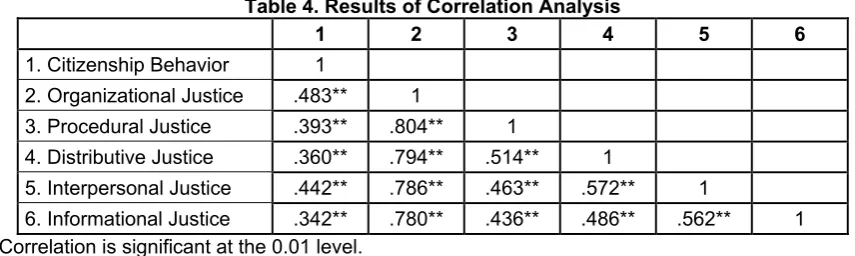
Table 4. Results of Correlation Analysis
1 2 3 4 5 6
1. Citizenship Behavior 1
2. Organizational Justice .483** 1
3. Procedural Justice .393** .804** 1
4. Distributive Justice .360** .794** .514** 1
5. Interpersonal Justice .442** .786** .463** .572** 1
6. Informational Justice .342** .780** .436** .486** .562** 1 **Correlation is significant at the 0.01 level.
Results of the correlation analysis, which was made to determine correlations among main variables of the study, are presented in Table 4. According to results of the analysis, strong and positive relations were identified between general perception of organizational justice and dimensions of organizational justice. Also, there are weak and positive relations between the dimensions of organizational justice and organizational citizenship behavior.
Table 5. Results of Regression Analysis
Dependent Variable: Organizational Citizenship Behavior
Independent Variables Std. β t p VIF
(Constant) 4.115 .000 1.487
Procedural Justice .203 2.316 .022 1.737
Distributive Justice .067 .711 .478 1.810
Interpersonal Justice .271 2.808 .006 1.600
Informational Justice .068 .753 .453 1.487
Regression analysis was also made in order to determine the influence of perception of organizational justice on organizational citizenship behavior (Table 5). In regression analyses, variables which have strong and very strong relations must be removed from the analysis as they cause multicollinearity. Therefore, assessments related to the perception of general justice are not included in the regression analysis.
It is seen that the test which presents significance level of the model as a whole is significant (F=11.990; p=0.000). Durbin Watson coefficient of the model is 1.516. Durbin Watson coefficients, which are between 1.5 and 2.5, show that there is no autocorrelation problem. Also, VIF values of the model vary between 1.487 and 1.810. These values also indicate that there is no multicollinearity between independent variables.
According to results of the analysis, the dimensions of organizational justice, namely procedural justice, distributive justice, interpersonal justice and informational justice, account for 22,7% of the change in organizational citizenship behavior. When the influence of dimensions of organizational justice on organizational citizenship behavior is examined, it is observed that the procedural justice (β=.203) and interpersonal justice (β=.271) dimensions have a positive and significant influence on organizational citizenship behavior. In other words, employees who have positive perceptions of procedural justice and interpersonal justice are expected to have positive assessments regarding the organizational citizenship behavior.
5. DISCUSSION AND CONCLUSION
This study was conducted in order to determine the relationship between organizational justice and organizational citizenship behavior. In line with this purpose, a questionnaire was conducted on 151 health workers who serve at a public hospital in Turkey. Results of correlation and regression analyses performed on the data collected support the relationship between these two variables.
Findings of the study revealed that general perceptions of organizational justice of health workers are at a high level consistently with the results of many studies. According to the findings, perception of health workers of distributive, interpersonal and informational justice dimensions is at a high level, while their perception of procedural justice is at a moderate level. From among the dimensions of justice, interpersonal justice dimension and procedural justice dimension have the highest and lowest scores, respectively. Similar results have also been found in previous studies (Chang, 2014; Laschinger & Heather, 2004; Söyük, 2007). Also, in a study conducted by Cihangiroğlu et al. (2010) at 39 public hospitals in Turkey, by Şahin and Taşkaya (2010) at a public hospital in Turkey, by Cihangiroğlu et al. (2015) at an educational hospital in Turkey, and by Demirkıran et al. (2013) at an administrative healthcare institution in Turkey, it was determined that perception of justice of health workers are at a low/moderate level. In the light of these findings, hospital workers think that their executives show respect, courtesy and sensitivity towards them and their colleagues, inform them on time about organizational actions, and provide them with accurate information about such actions. Also, workers believe that the benefits they deserve as a result of their work, such as remuneration, bonus and performance rates etc., are distributed fairly and equally by the senior management. In addition, the workers defined as fair the methods and policies that the hospital management uses in determination and measurement of elements such as remuneration, promotion, financial facilities and working conditions, but they think that hospital management is not entirely successful on this issue.
Findings of the study pertaining to the organizational citizenship behavior indicated that perception of organizational citizenship behavior of hospital workers is at a moderate level. This finding shows similarities with the results of certain previous studies (Fang & Lim, 2002; Bahrami et al., 2014). As is known, organizational citizenship behavior consists of voluntary behaviors and many positive consequences show up when people do something voluntarily. Findings of this study show that citizenship behaviors of health workers can be developed. Actually, some studies which were conducted at hospitals found that organizational citizenship behavior levels of healthcare personnel are high (Öztürk & Özata, 2013). Therefore, organizational citizenship behaviors of workers should be developed by means of certain structural and cultural changes. Similarly, strategies such as in-service training and increasing leader support will also increase the organizational citizenship behavior.
According to results of the correlation analysis, positive and significant relationships were identified between the dimensions of organizational justice and organizational citizenship behavior and this finding matches up especially with the results of studies conducted within the context of health workers and health institutions (Bahrami et al., 2014; Gilaninia & Abdesonboli, 2011; Yardan et al., 2014; Chang, 2014; Yıldız, 2014). Therefore, health workers will exhibit more organizational citizenship behavior if they consider their organization and executives as just and fair.
In this study, regression analysis was also made in order to determine the influence of perception of organizational justice on organizational citizenship behavior. According to results of this analysis, dimensions of organizational justice account for 22.7% of change in organizational citizenship behavior. Besides, international justice and procedural justice dimensions have a significant influence on organizational citizenship behavior.
future. First of all, healthcare administrators who want to increase citizenship behaviors of health workers and create a positive and attractive organizational environment should pay attention to being fair in their interactions with subordinates, implementation of existing rules and procedures, taking decisions, allocation of resources, distribution of responsibilities, and implementation of organizational policies such as rewards and performance assessments. Moreover, administrators should follow fair and reasonable procedures, establish a good communication system with the workers in the decision-making process and organizational relations by following the principle of organizational justice, include their ideas and rights in the communication process and ensure the participation of workers. Researchers who will conduct studies on organizational justice and organizational citizenship behavior in the future may resort to diversification in instruments measuring these two variables and question in depth the background of this kind of behaviors by using qualitative methods together with quantitative scales. Furthermore, these two concepts can be examined by associating them with narrow and extensive personality structures and cultural and individual characteristics of workers.
REFERENCES
Arslantaş, C.C. & Pekdemir, I. (2007). Dönüşümcü Liderlik, Örgütsel Vatandaşlık Davranışı ve Örgütsel Adalet Arasındaki
İlişkileri Belirlemeye Yönelik Görgül Bir Araştırma. Sosyal Bilimler Dergisi, 1, 261-286.
Bahrami, M.A., Montazeralfaraj, R., Gazar, S.H. & Tafti, A.D. (2014). Relationship Between Organizational Perceived Justice and Organizational Citizenship Behavior among an Iranian Hospital’s Employees. Electronic Physician, 6(2), 838-844.
Basım, H.N. & Şeşen, H. (2006). Örgütsel Vatandaşlık Davranışı Ölçeği Uyarlama ve Karşılaştırma Çalışması. Ankara Üniversitesi Siyasal Bilgiler Fakültesi Dergisi, 61(4), 83-102.
Bedük, A. & Ertürk, E. (2015). Sosyal Mübadele Teorisi Bağlamında Güç Mesafesi ve Örgütsel Adalet Algılamalarının Örgütsel Vatandaşlık Davranışı Üzerindeki Etkisi: Bir Araştırma. İşletme Bilimi Dergisi, 3(1), 1-19.
Beugre, C.D. (2002). Understanding Organizational Justice and Its Impact on Managing Employees: An African Perspective. International Journal of Human Resource Management, 13(7), 1091-1104.
Bies, R.J. & Moag, J.F. (1986). Interactional Justice: Communication Criteria of Fairness. Research on Negotiations in Organizations, 1, 43-55.
Bormann, W.C. & Motowidlo, S.J. (1993). Expanding the Criterion Domain to Include Elements of Contextual Performance. In N. Schmitt & W.C. Bormann (Eds.), Personnel Selection, (p. 71-98). San Francisco, CA: Jossey-Bass.
Bukhari, Z. (2008). Key Antecedents of Organizational Citizenship Behavior (OCB) in the Banking Sector of Pakistan. International Journal of Business and Management, 3(12), 106-115.
Buluc, B. (2015). The Relationship Between Academic Staff’s Perceptions of Organizational Justice and Organizational Citizenship Behaviors. Studia Psychologica, 57(1), 49-62.
Chang, C.S. (2014). Moderating Effects of Nurses’ Organizational Justice Between Organizational Support and Organizational Citizenship Behaviors for Evidence – Based Practice. Worldviews on Evidence – Based Nursing, 11(5), 332-340.
Chegini, M.G. (2009). The Relationship Between Organizational Justice and Organizational Citizenship Behavior. American Journal of Economics and Business Administration, 1(2), 171-174.
Chen, Y.J., Cheng-Chen, L., Yu-Chuan, T. & Yuan-ta, K. (2008). Associations of Organizational Justice and Ingratiation with Organizational Citizenship Behavior: The Beneficiary Perspective. Social Behavior and Personality, 36(3), 289-302. Cihangiroğlu, N., Şahin, B. & Naktiyok, A. (2010). Hekimlerin Örgütsel Adalet Algıları Üzerine Bir Araştırma. ZKÜ Sosyal
Bilimler Dergisi, 6(12), 67-82.
Cihangiroğlu, N., Şahin, B. & Uzuntarla, Y. (2015). Yardımcı Sağlık Personelinin Psikolojik Sözleşmeleri İle Örgütsel Adalet Algıları Arasındaki İlişkinin Analizi. TAF Preventive Medicine Bulletin, 14(4), 293-299.
Colquitt, J.A. (2001). On the Dimensionality of Organizational Justice: A Construct Validation of a Measure. Journal of Applied Psychology, 86(3), 386-400.
Colquitt, J.A., Conlon, D.E., Wesson, M.J., Porter, C.O.L.H. & Ng, K.Y. (2001). Justice at the Millennium: A Meta Review of Years of Organizational Justice Research. Journal of Applied Psychology, 86(3), 425-445.
Demirkıran, M., Yardan, E.D., Yorulmaz, M. (2013). İl Sağlık Müdürlüğü Çalışanlarının Örgütsel Adalet Algılamalarının
İletişim Doyumlarına Olan Etkisi. Sosyal ve Beşeri Bilimler Dergisi, 5(2), 322-334.
Ehrhart, M.G. (2004). Leadership and Procedural Justice Climate as Antecedents of Unit Level Organizational Citizenship Behavior. Personnel Psychology, 57, 61-94.
Esterhuzien, W. (2008). Organizational Justice and Employee Responses to Employement Equity. Master Thesis, University of South Africa, South Africa.
Fang, R. & Lim, V.K.G. (2002). Collectivism, Machiavellianism, Perceived Organizatioanl Justice and Organizational Citizenship Behavior: An Empirical Study of Chinese Employees. The Second International Conference on Electronic Business, Taipei, Taiwan, December 10-13 2002, 1-8.
Farh, J.L., Chen-Bo, Z. & Organ, D.W. (2004). Organizational Citizenship Behavior in the People’s Republic of China. Organization Science, 14(2), 241-253.
Freeborn, D.K. (2001). Satisfaction, Commitment and Psychological Well-Being among HMO Physicans. Western Journal of Medicine, 174(1), 13-18.
Greenberg, J. & Calquitt, J.J. (2005). Handbook of Organizational Justice, Routledge: Lawrance Erlbaum.
Greenberg, J. (1987). A Taxonomy of Organizational Justice Theories. Academy of Management Review, 12, 9-22.
Greenberg, J. (1993). The Social Side of Fairness: Interpersonal and Informational Classes of Organizational Justice. In R. Cropanzano (Ed.), Justice in the Workplace: Approaching Fairness in Human Resource Management, (p, 79-103), Hillsdale, NJ: Lawrance Erlbaum Associates.
Hodson, R. (1991). Workplace Behaviors. Work and Occupations, 18(3), 271-290. Jaeger, R.M. (1983). Statistics. London; Sage Publications.
Kamani, S.M.H. & Namdari, K. (2012). A Study of the Relationship Between Organizational Justice and Support and Organizational Citizenship Behavior. International Journal of Arts & Sciences, 5(6), 355-368.
Kolade, O.J., Oluseye, O.O. & Omotayo, O. (2014). Organizational Citizenship Behaviour, Hospital Corporate Image and Performance. Journal of Competiteveness, 6(1), 36-49.
Konowsky, M.A. (2000). Understanding Procedural Justice and Impacts on Business Organizations. Journal of Management, 26(3), 489-511.
Laschinger, S. & Heather, K. (2004). Hospital Nurses’ Perceptions of Respect and Organizational Justice. Journal of Nursing Administration, 34(7-8), 354-364.
Ministry of Health, (2007). Sağlıkta İnsan Kaynakları Mevcut Durum Analizi, Ankara, Yücel Ofset.
Moorman, R.H. (1991). Relationship Between Organizational Justice and Organizational Citizenship Behaviors: Do Fairness Perceptions Influence Employee Citizenship. Journal of Applied Psychology, 76(2), 845-855.
Moorman, R.H. (1993). The Influence of Cognitive and Affective based Job Satisfaction Measures on the Relations Between Satisfaction and Organizational Citizenship Behavior. Human Relations, 46(6), 759-776.
Okumuş, A. & Öztürk, E. (2015). Sosyal Mübadele Teorisi. İçinde M.İ. Yağcı & S. Çabuk (Eds.), Pazarlama Teorileri, (ss. 13-33), MediaCat Yayınları, 2. Baskı, Ekim, 2015, İstanbul.
Organ, D.W. (1988). Organizational Citizenship Behavior: The Good Soldier Syndrome, Lexington, MA.
Organ, D.W. (1990). The Motivational Basis of Organizational Citizenship Behavior. Research in Organizational Behavior, 12(1), 43-72.
Organ, D.W. & Moorman, R.H. (1993). Fairness and Organizational Citizenship Behavior: What are the Connections?. Social Justice Research, 6(1), 5-18.
Öner, N. (1997). Türkiye’de Kullanılan Psikolojik Testler. Boğaziçi Üniversitesi Yayınları, 3. Basım, İstanbul.
Özmen, N.T.Ö, Arbak, Y. & Özer, P.S. (2007). Adalete Verilen Değerin Adalet Algıları Üzerindeki Etkisinin Sorgulanmasına
İlişkin Bir Araştırma, Ege Akademik Bakış, 7(1), 17-33.
Öztürk, Y.E. & Özata, M. (2013). Hemşirelerde Örgütsel Vatandaşlık Davranışıİle Tıbbi Hataya Eğilim Arasındaki İlişkinin Araştırılması. Süleyman Demirel Üniversitesi İktisadi ve İdari Bilimler Fakültesi Dergisi, 18(3), 365-381.
Podsakoff, P.M. & MacKenzie, S.B. (1994). Organizational Citizenship Behaviors and Sales Unit Effectiveness. Journal of Marketing Research, 31(3), 351-363.
Podsakoff, N.P., Whiting, S.W., Podsakoff, P.M. & Blume, B.D. (2009). Individual and Organizational Level Consequences of Organizational Citizenship Behaviors: A Meta Analysis. Journal of Applied Psychology, 94, 122-141.
Podsakoff, P.M., MacKenzie, S.B., Paine, J.B. & Banchrach, D.G. (2000). Organizational Citizenship Behaviors: A Critical Review of the Theoretical and Empirical Literature and Suggestions for Future Research. Journal of Management, 26(3), 513-563.
Poyraz, K., Kara, H. & Çetin, S.A. (2009). Örgütsel Adalet Algılamalarının Örgütsel Vatandaşlık Davranışlarına Etkisine Yönelik Bir Araştırma. S.D.Ü. Sosyal Bilimler Enstitüsü Dergisi, 1(9), 71-91.
Schnake, M. (1991). Organizational Citizenship: A Review, Propposed Model and Research Agenda. Human Relations, 44, 735-759.
Şahin, B. & Taşkaya, S. (2010). Sağlık Çalışanlarının Örgütsel Adalet Algılarını Etkileyen Faktörlerin Yapısal Eşitlik Modeli
İle İncelenmesi. Hacettepe Sağlık İdaresi Dergisi, 13(2), 85-114.
Söyük, S. (2007). Örgütsel Adaletin İş Tatmini Üzerine Etkisi ve İstanbul İlindeki Özel Hastanelerde Çalışan Hemşirelere Yönelik Bir Çalışma. Yayımlanmamış Doktora Tezi, İstanbul Üniversitesi.
Srivastava, S.K. & Gope, A.K. (2015). The Antecedents and Consequences of Organization Citizenship Behaviour (OCB): A Conceptual Inquiry. Management Insight, 11(2), 51-56.
Tan, Ç. (2006). İlköğretim Okullarında Görev Yapan Öğretmenlerin Örgütsel Adalet Konusundaki Algıları. Yayımlanmamış
Yüksek Lisans Tezi, Fırat Üniversitesi, Elazığ.
Tansky, J.W. (1993). Justice and Organizational Citizenship Behavior: What is the Relationship?. Employee Responsibilities and Rights Journal, 6, 195-208.
Vey, M.A. & Campbell, J.P. (2004). In-Role or Extra-Role Organizational Citizenship Behavior: Which are We Measuring?. Human Performance, 17(1), 119-135.
Williams, S. & Shiav, W.T. (1999). Mood and Organizational Citizenship Behavior: The Effects of Positive Affect on Employee OCB Intentions. The Journal of Psychology, 133(6), 656-668.
Yardan, E.D., Köse, S.D. & Köse, T. (2014). The Effect of Employees’ Perceptions of Organizational Justice on Organizational Citizenship Behavior: An Application in Turkish Public Hospital. Journal of Human Resources Management and Labor Studies, 2(2), 129-148.