Abstract—In soft object modeling, primitive soft objects can be used to construct a complex soft object by performing addition operations only. This is because a primitive soft object is defined as the iso-surface of a field function which is a composition of a potential function and a distance function. In fact, the distance function determines the shape of a soft object. To deform the shape of a primitive soft object, this paper proposes dilation and erosion operations, which can be viewed as distance function operations because they perform on the distance function of a primitive soft object to be deformed and a chosen dilating or eroding distance function. Thus, dilation operation can be used to dilate a primitive soft object through the chosen dilating distance function, and erosion operation can be used to erode a primitive soft object through the chosen eroding distance function. Briefly, these two operations can deform the iso-surface of an existing distance function and then can be applied as a new distance function to define a new field function.
Index Terms—Field functions, distance functions, soft objects.
I. INTRODUCTION
In implicit surfaces, primitive implicit surfaces are defined each as an iso-surface of a defining function. A complex implicit surface is created by smoothly connecting primitive surfaces via blending operations [1], [2]. Among different representations of implicit surfaces [3], [4], [5], soft object modeling especially can blend primitive soft objects easily by soft blending [4], [5] which performs addition operations only. This is because field functions are used as defining functions and the value of a field functionis designed to be decreasing from 1 to 0. More precisely, a field function is defined as a composition of a potential function and a distance function. Potential functions majorly ensure a field function to be decreasing and controls the softness affect of soft blending such as those in [4], [5], [6], [7], and the one in [7] particularly offers blending range control. Distance function controls the shape of a primitive soft object. Existing distance functions include spheres [5], super-ellipsoids [6], [8], super-quadrics [3], generalized distance functions [9], skeletal primitives [10], and sweep objects [11].
Regarding existing distance functions, most of the researches focus directly on developing new distance functions with new shapes of iso-surfaces. However, different from their developing methods, this paper proposes a new method to develop a new distance function by
Manuscript received August 20, 2012; revised September 15, 2012. Pi-Chung Hsu is with the Department. of Information Management, Shu-Te University, Kaohsiung, Taiwan (e-mail: [email protected]).
deforming the iso-surface of a distance function via another distance function via newly developed distance function operations on the above two distance functions. That is, this paper develops distance function operations and then existing distance functions are applied into them to create a new distance function for generating a new field function with deformed iso-surfaces. These distance function operations are described as follows:
Erosion operation to erode the distance function of a soft object by an eroding distance function:
When applied as a new distance function to deform a soft object, it can be used to shrink a soft object with different magnitudes for different directions determined by the eroding distance function, and it also offers a parameter to control the degree to which a soft object can be shrunk.
Dilation operation to dilate the distance function of a soft object by a dilating distance function:
When applied as a new distance function to deform a soft object, it can be used to enlarge a soft object with different magnitudes for different directions controlled by the dilating distance function, and it also offers a parameter to control the degree to which a soft object can be enlarged.
The remainder of this paper is organized as follows. Section II reviews soft object modeling. Section III introduces erosion and dilation operations. Conclusion is given in Section IV.
II. SOFT OBJECT MODELING
This section presents some definitions about soft objects and implicit surfaces.
A. Field Functions
Let a field functionbe denoted as fi(x, y, z):R3R+ where
R+ [0, ]. Then, a primitive soft object is represented as the point set
{(x,y,z)R3| fi(x,y,z)=0.5, i=1,2,…,}
In the following, the symbol fi(x, y, z)=0.5 denotes a soft
object or its surface for short. To enable that fi(x, y, z)=0.5,
i=1, 2,…, can be blended by summation operation, a fi(x, y, z)
is usually defined as (P。di)(x,y,z) and is written by
fi(x,y,z)=(P。di)(x,y,z)= P(di(x,y,z)). (1)
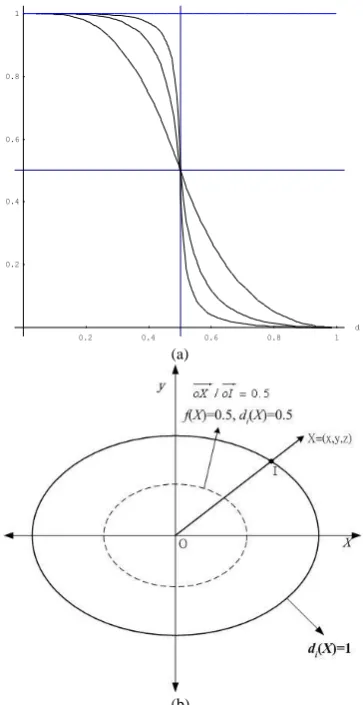
In Eq. (1), P(d), called potential function, must decrease from 1 to 0 as d increases from 0 to 1 and P(0.5)=0.5, such as Eq. (2) in [6]:
P(d)=
1 5 . 0 ) ) 4 5 . 1 ( 75 . 0 /( ) 1 ( 5 . 0 ) ) 4 5 . 4 ( /( ) 3 ( 1 2 2 2 2 2 2 d d s s d d d s s d
, (2)
Distance Function Operations for Developing New Field
Functions in Soft Object Modeling
Pi-Chung Hsu
International Journal of Computer and Communication Engineering, Vol. 2, No. 2, March 2013
where parameter s controls the softness affect. Fig. 1(a) shows the shapeof p=P(d) of Eq. (2) in d-p plane.
As for di(x, y, z), it is called distance function and is
required to map R3 into [0, ]. In fact, it controls the shape and size of a soft object fi(x, y, z)=0.5. In addition, di(x, y, z) is
usually defined by using a closed surface di(x, y, z)=1 as
influential region and is calculated by
di(x,y,z)= r / Rd = oX/oI, (3)
where Rd =oIis called the influential radius of (x, y, z),
which is the distance from the origin to the intersecting point of the vector X=(x, y, z) with the influential region di(x, y,
z)=1 as show=oIn in Fig. 1(b), and r=oX is (x2+y2+z2)0.5. Subscript d symbolizes that Rd is the influential radius of di(x,
y, z)=1 as the influential region. Due to P(0.5)=0.5, the shape of a soft object fi(x, y, z)=(P。di)(x, y, z)=0.5 is like the shape
of di(x, y, z) =0.5, and consequently a soft object fi(x, y, z)=0.5
is viewed as the influential region di(x, y, z)=1 scaled overall
by 0.5. Thus, one can say that the size and shape of di(x, y,
z)=1 determines the shape and size of a soft object fi(x, y,
z)=0.5. Some famous distance functions are listed as follows:
0.2 0.4 0.6 0.8 1
d 0.2
0.4 0.6 0.8 1 P
(a)
(b)
Fig. 1. (a).The shape p=P(d) in Eq. (2), which becomes concave downward and upward gradually as softness parameter s increases. (b). The influential region di(x,y,z) =1, solid line, and the shape fi(x,y,z)=0.5, i.e. di(x,y,z)=0.5,
dotted line.
Superellipsoids:
d(x,y,z)=(|x/a|p+|y/b|p+|z/c|p)1/p . (4) Superquadrics [3]:
d(x,y,z)=((|x/a| p1
+|y/b| p1
) p2/ p1
+|z/c| p2
)1/p2
. (5)
B. Blending Operations
Blending operations play a very important role in creating a complex soft object because they can smoothly connect k
primitive soft objects fi(x, y, z)=0.5, i=1,2,…,k via a blending
operator Bk(x1,...,xk):R+kR+ . Precisely, they are written by {(x, y, z)R3| Bk(f1(x, y, z),...,fk(x, y, z))=0.5}.
Many blending operations have been developed and they include:
Soft blending [4, 5]:
Bk(x1,…,xk)=x1+x2+…+xk,
Super-ellipsoidal union [12]:
Bk(x1,…,xk)=(x1p+…+xkp)1/p ,
Super-ellipsoidal intersection [12]:
Bk(x1,…,xk)=(x1-p +…+xk-p)-1/p.
Besides, sequential blending operations are also allowed and they can be represented as a CSG tree [13]. Fig. 2 displays a wheel created from a union of two cylinders and a toroid.
C. Ray-Linear Functions
As shown in Eq. (3), a distance function is required to be rewritten by using influential radii. This subsection presents a theorem to check to see if a function is able to fulfill this requirement. Now, as stated in [14], the following definition is introduced first.
Fig. 2. A wheel created from a union of two cylinders and a toroid.
Definition 1: A function f(x, y, z):R3R+ is called non-negative ray-linear if f(ax, ay, az)=af(x, y, z) holds for any (x, y, z)R3 and aR+. For compactness, “ray-linear” is used to stand for “non-negative ray-linear”. Based on Definition 1, Theorem 1 was proposed in [1] and is listed below.
Theorem 1:If f(x, y, z):RnR+ is ray-linear, then f(x, y, z) can be reformulated as r/Rf, where r=||(x, y, z)|| and Rf is the
distance from the origin to the intersecting point of the vector (x, y, z) with the influential region f(x, y, z)=1.
According to Theorem 1, we obtain that one can adopt ray-linear f(x, y ,z) as a distance function because it can be rewritten by r/Rf. Thus, based on Theorem 1, Theorem 2 is
described below for helping check to see if a blending operation Bk(f1(x, y, z),..., fk(x, y, z)) can be a distance
function.
Theorem 2:If fi(x, y, z):R3R+, i=1,...,k, all are ray- linear and operator Bk(x1,...,xk):R+kR+ is ray-linear, then operation
Bk(f1(x, y, z),...,fk(x, y, z)) is ray-linear and is a distance
III. EROSION AND DILATION OPERATIONS OF DISTANCE
FUNCTIONS
This section explains why and how erosion and dilation operations can be used to deform a soft object.
A. Erosion Operation
Let d(x, y, z) and T(x, y, z) both be ray-linear distance functions, and surfaces d(x, y, z)=1 and T(x, y, z)=1 both be closed and satisfy the condition:
{(x, y, z)R3|d(x, y, z)=1}{(x, y, z)R3|T(x, y, z)=1}. Thus, an operation of d(x, y, z) an T(x, y, z), denoted as (dT)(x, y, z) and called erosion operation, is given by (dT)(x, y, z) = (d(x, y, z)-n- T(x, y, z)-n)1/-n (6)
= Br2(d(x, y, z), T(x, y, z)),
Br2(x1, x2)=(x1-n - x2-n) 1/-n, where T(x,y,z) is called eroding function and n1. It is trivial to show Br2(x1, x2) in Eq. (6) is ray-linear. Since d(x,y,z),
T(x,y,z) and Br2(x1,x2) all are ray-linear, it follows from
Theorem 2 that (dT)(x,y,z) is ray-linear, too and so (d T)(x,y,z) can be rewritten as (dT)(x,y,z)=r/RdT. This means
that (dT)(x,y,z) in Eq. (6) can be used as a new distance function to define a new soft object by
(P。(dT)) (x, y, z)=0.5
In fact, (P。(dT)) (x, y, z)=0.5 is viewed as (P。d) (x, y,
z)= 0.5 eroded by the influential radii of T(x, y, z)=0.5. This is explained as follows. Due to d(x, y, z)=r/Rd and T(x, y,
z)=r/RT from Theorem 1, putting r/Rd and r/RT intoEq. (6)
yields
(dT)(x, y, z)= r / (Rdn-RTn)1/n, (7)
i.e. (dT)(x, y, z)= d( Rd / (Rdn-RTn)1/n (x, y, z) ).
From Eq. (7), the shape (dT)(x, y, z)=1 can be viewed as the shape d(x, y, z)=1 scaled overall with an individual scaling factor Rd /(Rdn-RTn)1/nfor every point (x, y, z) in all
directions. In fact, scale factor Rd /(Rdn-RTn)1/n is different for
different (x, y, z) and depends on RT of T(x, y, z)=1 and Rdof
d(x, y ,z)=1. Since the value of Rd /(Rdn-RTn)1/n is always
greater than 1, operation (dT) (x, y, z) causes reduction in size on the deformed surface d(X)=1. From Eq. (7), it is also obtained that influential radius RdT becomes (Rdn-RTn)1/n after
(dT)(x, y, z). Depending on parameter n, influential radii
RdT are discussed as follows:
In the case that when n=1, (dT) (x, y, z) becomes r/(Rd
-RT), which means the influential radius is reduced to (Rd-RT).
As a result, the surface (dT) (x, y, z)=1 is like the surface
d(x,y,z)=1 where every point (x, y, z) is moved RT inwards to
the origin along the vector [x, y, z] and every (x, y, z) have different RT. This implies that the surface (dT) (x, y, z)=1 is
like the surface d(x, y, z)=1 eroded (subtracted) by the
influential radii RT of T(x, y, z)=1, which determines the
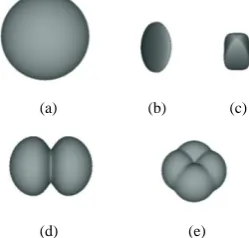
erosion extent. For example, let d(x, y, z) be (|x/35|2+|y/35|2+ |z/35|2)1/2 and a eroding function T(x, y, z) be a super- ellipsoid (|x/5|2 +|y/5|2+|z/15|2)1/2. Then, when n=1, the soft object (P。(dT))(x, y, z)=0.5 in Fig. 3(c) can be viewed as the sphere (P。d) (x, y, z)=0.5 in Fig. 3(a) eroded by the object T(x, y, z)= 0.5 in Fig. 3(b).
As n increases from 1 to , influential radius RdT increases
from (Rd-RT) to Rd. Thus, the erosion effect caused by T(x, y,
z) decreases as n increases. Therefore, the surface (dT)(x, y,
z)=1 dilates from the surface (d(x, y, z)-1-T(x, y, z)-1)-1 =1 to the surface d(x, y, z)=1 while n increases from 1 to . This is demonstrated in Fig. 3(d), which follows the example in Fig. 3. Fig. 3(d) shows the soft objects of (P。(dT)) (x, y, z) =0.5 with n set1, 1.3, 1.7, and 2.5, respectively, for the objects from left to right.
Consider other cases as shown in Fig. (4) that when d(x, y,
z)=(|x/35|2+|y/35|2+|z/35|2)1/2, T1(x, y, z)=(|x/5|2+|y/15|2+|z
/15|2)1/2 and T2(x, y, z)=((|x/10|7+|y/10|7)2/7+|z/25|2)1/2, then the erosions of (P。(dT1)) (x, y, z)=0.5 and (P。(dT2)) (x, y,
z)= 0.5 are shown in Figs. 4(d)-(e).
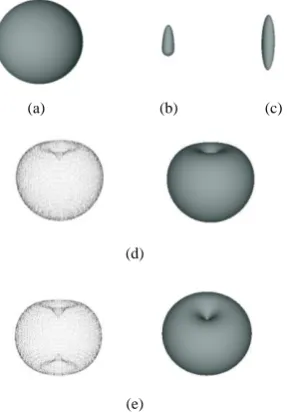
In addition, when the shape of T(x, y, z)=1 is asymmetric, then the shape of (P。(dT)) (x, y, z)=0.5 can be asymmetric. As shown in Fig. 5, the asymmetric super-ellipsoid in Fig. 5(b) is used as T(x, y, z)=1 and the sphere in Fig. 5(a) as d(x, y,
z)=1, so the shape of (P。(dT)) (x, y, z)=0.5 is asymmetric shown in Fig. 5(d). On the contrary, Fig. 5(e) is symmetric in two of the polar areas because the symmetric super-ellipsoid in Fig. 5(c) is used as T(x, y, z)=1 instead.
(a) (b) (c)
(d)
Fig. 3. (a). A soft object (P。d) (x, y, z)=0.5 before erosion. (b). An eroding object T(x, y, z)=1. (c). The erosion of the sphere in (a) by the object in (b) defined by (P。(dT)) (x, y, z)=0.5. (d). The soft objects of that in (c) with n in (dT) (x, y, z) is set 1, 1.3, 1.7, and 2.5, respectively, for the objects from left to right.
(a) (b) (c)
(d) (e)
Fig. 4. The erosions of the sphere in (a) by the disk and the super-ellipsoid in (b) and (c) generate the two-ball object and the four-ball object respectively in (d) and (e).
International Journal of Computer and Communication Engineering, Vol. 2, No. 2, March 2013
(a) (b) (c)
(d)
(e)
Fig. 5. (a). The shape of d(x, y, z)=0.5: a sphere. (b). The shape of T(x, y, z)=0.5: an asymmetric super-ellipsoid. (c). The shape of T(x, y, z)=0.5: a symmetric super-ellipsoid. (d). Soft objects (P。d) (x, y, z)=0.5 with an asymmetric concave shape because the object in (b) is used as T(x, y, z)=1, where the left one’s surface is transparent. (e). Soft objects (P。d) (x, y, z) =0.5 with two symmetric concave polar areas because the object in (c) is used as T(x, y, z)=1, where the left one’s surface is transparent.
B. Dilation Operation
Let d(x, y, z) and T(x, y, z) be ray-linear distance functions, and d(x, y, z)=1 and T(x, y, z) =1 both are closed surfaces. Thus, an operation of d(x, y, z) an T(x, y, z), denoted as (dT) (x, y, z) and called dilation operation, is given by
(dT)(x, y, z)=(d(x, y, z)-n
+T(x, y, z)-n
)1/-n (8) =Br2(d(x, y, z),T(x, y, z))
Br2(x1, x2)=(x1-n + x2-n) 1/-n
where T(x, y, z) is called dilating function and n1. It is trivial to show Br2(x1, x2) in Eq. (8) is ray-linear. It follows from
Theorem 1 that (dT) (x, y, z) is also ray-linear since d(x, y,
z), T(x, y z, z) and Br2(x1, x2) all are ray-linear. As a result, (d
T) (x, y, z) can be reformulated as (dT) (x, y, z)=r/RdT. This
means that (dT) (x, y, z) in Eq. (8) can be used as a new distance function to define a new soft object by
(P。(dT)) (x, y, z)=0.5 Described geometrically, (P。(dT)) (x, y, z)=0.5 is viewed as (P。d) (x, y, z)=0.5 dilated by the influential radii of the surface T(x, y, z)=0.5. This is proved as follows. Substituting r/Rd and r/RT for d(x, y, z)and T(x, y, z) in Eq. (8)
yields
(dT)(x, y, z) = r / (Rdn+RTn)1/n (9)
i.e. (dT)(x, y, z) = d(Rd /(Rdn+ RTn)1/n (x, y, z))
Eq. (9) implies that the shape (dT)(x, y, z)=1 can be viewed as the shape d(x, y, z)=1 scaled overall with an individual scaling factor Rd /(Rdn+RTn)1/nfor every point (x, y,
z) in all directions. In fact, scale factor Rd /(Rdn+RTn)1/n is
different for different (x, y, z) and depends on RT of T(x, y,
z)=1 and Rdof d(x, y, z)=1. Since the value of Rd /(Rdn+RTn)1/n
is always less than 1, (dT)(x, y, z) =1 causes enlargement in size of the deformed object d(x, y, z)=1. Eq. (9) indicates that
RdT=(Rdn+RTn)1/n, that is, the influential radius is raised to
(Rdn+RTn)1/n after (dT)(x, y, z). Some characteristics of (dT)
(x, y, z) are described by varying the parameter n as follows.
n=1, (dT) (x, y, z) becomes r/(Rd+RT). This
means for any (x, y, z)R3, the influential radius raises to (Rd
+RT). Contrary to (dT)(x, y, z)=1, the surface (dT)(x, y,
z)=1 is like the surface d(x, y, z)=1 where every point (x, y, z) is moved RT outwards from the origin along the vector [x, y, z]
and every (x, y, z) in different directions have different RT.
This implies that the surface (dT)(x, y, z)=1 is like the surface d(x, y, z)=1 dilated by the influential radii RT of T(x, y,
z)=1, which determines the dilation extent.
2 n increases from 1 to , the influential radius RdT
decreases from (Rd+RT) to Rd. Consequently, the dilation
effect caused by T(x, y, z) decreases as n increases. Hence, the surface (dT)(x, y, z)=1 shrinks from the surface (d(x, y, z)-1+
T(x, y, z)-1)-1=1 to the surface d(x, y, z)=1, while n increase from 1 to . For example, let d(x, y,
z)=(|x/25|2+|y/25|2+|z/25|2)1/2 and T(x, y,
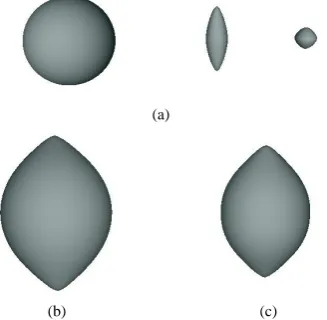
z)=(|x/4|1.1+|y/4|1.1+|z/16|1.1)1/1.1. Thus, the dilation (P 。 (dT))(x, y, z)=0.5 of a sphere by the prism-shaped object in Fig. 6(b) with n=1, 1.4, 1.8, 2.6 and 5.2, is shown in Fig. 6(c), where the last object is almost like the original sphere in Fig. 6(a).
(a) (b)
(c)
Fig. 6. The dilation (P。(dT))(x, y, z)=0.5 of the sphere in (a) by the prism-like object in (b) with n=1, 1.4, 1.8, 2.6, and 5.2, respectively, for the
objects from left to right in (c).
C. Erosion after Dilation Operation
Let d(x, y, z), TE(x, y, z) and TD(x, y, z) be ray-linear
distance functions, then a erosion after dilation operation in Subsections III A-B above is defined by using TE(x, y, z) and
TD(x, y, z) as a eroding and a dilating functions, and is written
by
(P。((dTD)TE))(x,y,z)=0.5.
Consider the example about the latter one where d(x, y, z) is (|x/20|2+|y/20|2+|z/20|2)1/2, and TD(x, y, z) is
((|x/5|2+|y/5|2)1.5/2 +|z/15|1.5)1/1.5 to dilate d(x,y,z) around z-axis. The shapes (P。d)(x, y, z)=0.5 and TD(x,y,z)=0.5 are shown
by the first two object in Fig. 7(a), and the dilation of (P。 (dTD))(x, y, z)= 0.5 is shown in Fig. 7(b), which is larger
than the original one in Fig. 7(a). Thus, to keep unchanged the region (|x/5|2+ |y/5|2)1/2=0.5 around (P。(dTD))(x, y,
z)=0.5, we can use ((|x/5|2+|y/5 |2)1.5/2+|z/5 |1.5)1/1.5 as TE(x, y, z),
the third object in Fig. 12(a), to restore the size of (P。 1) When
(dTD))(x, y, z)=0.5 by (P。((dTD)TE))(x, y, z)=0.5. This
is shown in Fig. 7(c) and the resulting shape of (P。 ((dTD)TE))(x, y, z) =0.5 has more similar size around the
region (|x/5|2+|y/5|2)1/2=0.5 to the original soft object (P。
d)(x, y, z)=0.5 in Fig.7(a) , compared to that in Fig. 7(b).
(a)
(b) (c)
Fig. 7. (a) The shapes of (P。d) (x, y, z)=0.5, TE(x, y, z)=0.5 and TD(x, y,
z)=0.5 from left to right, respectively. (b) The dilation (P。(dTD)) (x, y,
z)=0.5. (c) The erosion after dilation (P。((dTD)TE))(x, y, z)=0.5.
IV. CONCLUSION
In soft object modeling, the distance function of a field function determines the shape and size of primitive soft objects. To develop distance functions with new shapes, unlike most of the existing researches focusing directly on developing new ones with new shapes of iso-surfaces, this paper has developed a new method that creates a new distance function by deforming the iso-surface of the distance function of a soft object via a ray-linear distance function and hence the soft object is also deformed. More precisely, this paper has developed the following distance function operations:
Erosion distance function operation: It is an operation on the distance function of a soft object intended for deformation and an eroding distance function. It can erode the distance function of a soft object with the eroding distance function, which controls the extent to which every point in all direction of the soft object can be shrunk.
Dilation distance function operation: It is an operation on
the distance function of a soft object intended for deformation and a dilating distance function. It can dilate the distance function of a soft object with the dilating distance function, which controls the extent to which every point in all direction of the soft object can be enlarged.
Thus, based on the two operations, one can freely choose two of any existing point-based distance functions and then develop a new distance function and a new field function for a new soft object with a more diverse shape.
ACKNOWLEDGMENT
The author would like to thank National Science Council of Taiwan for the support of Project No. NSC 101-2221-E- 366-012.
REFERENCES
[1] P.-C. Hsu and C. Lee, “The scale method for blending operations in functionally based constructive geometry,” Computer Graphics Forum, vol. 22, no 2, pp. 143-158, 2003.
[2] Q. Li, “Smooth piecewise polynomial blending operations for implicit shaped,” Computer Graphics Forum, vol. 26, no 2, pp. 143-158, 2007. [3] A. H. Barr, “Superquadrics,” IEEE Computer Graphics and
Applications, vol. 1, no 1, pp. 11-23, 1981.
[4] J. F. Blinn, “A generalization of algebraic surface drawing,” ACM Trans. on Graphics, vol. 1, no 3, pp. 235-256, 1982.
[5] G. Wyvill, C. McPheeters, and B. Wyvill, “Data structure for soft objects,” The Visual Computer, vol.2, no 4, pp. 227-234, 1986. [6] C. Blanc and C. Schlick, “Extended field functions for soft objects,” in
Implicit surfaces’95, pp. 21-32, April 1995.
[7] P.-C. Hsu and C. Lee, “Field functions for blending range controls on soft objects,” Computer Graphics Forum, vol. 22, no 3, pp. 233-242, 2003.
[8] C. Blanc and C. Schlick, “Ratioquadrics: An alternative model to superquadrics”, The Visual Computer, vol. 12, pp. 420-428, 1996. [9] E. Akleman and J. Chen, “Generalized distance functions,” in Proc.
Shape Modeling International '99, pp. 72-79, 1999.
[10] J. Bloomenthal and B. Wyvill, “Interactive techniques for implicit modeling,” in SIGGRAPH Computer Graphics, vol. 24, no 2, pp. 109-116, 1990.
[11] B. Crespin, C. Blanc, and C. Schlick, “Implicit sweep objects,” in Eurographics’96, vol.15, no 3, pp. 165-175, 1996.
[12] A. Ricii, “A constructive geometry for computer graphics,” The Computer Journal, vol.16, no 2, pp. 157-160, May 1973.
[13] B. Wyvill, A Guy, and E Galin, “Extending the CSG tree: Warping, blending and boolean operations in an implicit surface modeling systems,” in Proc. Implicit Surfaces’98, pp. 128-136, 1998.
[14] E. Akleman, “Interactive construction of smoothly blended star solids,” in Graphical Interface’96, pp. 159-167, May 1996.
International Journal of Computer and Communication Engineering, Vol. 2, No. 2, March 2013