_____________________________________________________________________________________________________
*Corresponding author: E-mail: [email protected], [email protected];
Insect Pest Complex and Beneficial Insects
Associated with Sweet Potato (Ipomoea batatas)
(Lam.) in Southern Nigeria and Key Pests to
Consider in Control Programmes
Y. I. Uwaidem
1, O. A. Borisade
1*, R. A. Essien
2and E. A. Akpan
21Department of Crop Science, Faculty of Agricultural Sciences, Ekiti State University, Horticulture and
Landscape Design, P.M.B. 5363, Ado-Ekiti, Nigeria.
2
Department of Crop Science, Akwa Ibom State University, Obio-Akpa, Akwa Ibom State Nigeria.
Authors’ contributions
This work was carried out in collaboration between all authors. Authors YIU and OAB designed the experiment and participated in conducting survey of insects and identification in conjunction with authors RAE and EAA. The manuscript was written by authors OAB and YIU. Author OAB analyzed the data and the manuscript was reviewed by all authors. All authors read and approved the final manuscript.
Article Information
DOI: 10.9734/JAERI/2018/44189 Editor(s): (1)Dr. Nhamo Nhamo, Associate Professor, Marondera University of Agricultural Sciences and Technology, Marondera, Zimbabwe. Reviewers: (1)R. K. Mathukia, Junagadh Agricultural University, Junagadh, Gujarat, India. (2)M. Indar Pramudi, Lambung Mangkurat University, Indonesia. Complete Peer review History:http://www.sciencedomain.org/review-history/26993
Received 23 July 2018 Accepted 02 October 2018 Published 01 November 2018
ABSTRACT
Survey of insects on sweet potato, Ipomoea batatas (Lam) was conducted in Southern Nigeria during two cultivation periods within a season, March-July and August-December, to identify key pests and beneficial species that can be exploited in future biocontrol programmes. The recorded insects consisted of thirty four different species and approximately 80% were defoliators. The Order Orthoptera had the highest number of individual species (29.4%), followed by Coleoptera and Lepidoptera pests in equal percentages (23.5%). Members from these Orders were the key pests and they were responsible for the most significant damage to the foliage and the tuber. Specifically, economic damage was caused by sweet potato butterfly (Acraea acerata), leaf folders (Brachmia
Uwaidem et al.; JAERI, 16(2): 1-9, 2018; Article no.JAERI.44189
and Helcystogramma spp), and sweet potato army worms (Spodoptera spp) and white plume moths (Pterophorus pentadactyla) and they are considered as potential targets of control programmes. The beneficial insects (5.9%), comprised of Adonis lady beetle (Hippodamia variegate), Transverse lady beetle (Coccinella transversalis) (Coleoptera: Coccinellidae), Black cockroach-wasp (Dolichurus spp), Cicada killer (Sphecius speciosus) and Praying mantids (Mantis religiosa) (Mantodea: Mantoididae). About 80-100% damage to foliage was recorded, indicating a severe pest pressure on sustainable sweet potato production under organic system in Southern Nigeria and the need to develop ecologically adaptable management approaches.
Keywords: Pests; beneficial insects; sweet potato; defoliators.
1. INTRODUCTION
The sweet potato, Ipomoea batatas
(Convolvulaceae) is cultivated for its tuber that is rich in carbohydrate and dietary fibre. It is one of the most cultivated tubers in West Africa, and Nigeria is the second largest producer after China [1]. Its relatively short cycle of production and the ability to strive on soils with marginal nutrient status are advantages over other cultivated tuberous crops [2]. The leaf is a rich source of protein and is used as foliage to animals [3].
In Southern Nigeria, cultivation is majorly rain-fed, with two cultivation seasons, March-July and August-December due to the bimodal rainfall pattern in the agroecological region. Vegetative propagation using vine-cuttings is the predominant method, but outgrowths from unharvested tubers or field left-overs also serve as planting stock [2].
Entomological pest attacks which occur in succession during the entire production cycle cause damage to leaves, vines and tubers and seriously undermine productivity. Among other causes of production loss, insect pests and diseases [4] are the two major constraints to production. Insect pests which were reported in earlier studies on sweet potato in many parts of Africa consist of foliage and root feeders and those that are responsible for transmission of viral diseases. The severity of attack by some of these pests varies in different agro-ecological regions of Africa and those that assume the status of serious pests, capable of causing economic injury under different cropping systems are diverse. Notable examples are the potato weevil, Cylas puncticollis (Coleoptera: Curculionidae) and sweet potato butterfly,
Acraea acerata (Lepidoptera: Nymphalidae) which have been reported as the major pests of sweet potato in Uganda [5]. The sweet potato butterfly, A. acerata, C. puncticollis and sweet
potato hornworm, Agrius convolvuli (Lepidoptera: Sphingidae) are associated with economic damage to potato in the Sudan Savanna zone of Ghana, with infestation rates of 40-100% [6]. Other reported insect pests associated with economic damage to sweet potato include the tortoise shell beetles, Aspidomorpha species,
Laccoptera species (Coleoptera: Chrysomelidae) and the vectors of viral diseases, particularly
Aphis gossypii (Homoptera: Aphididae) and
Bemisia tabaci (Homoptera: Aleyrodidae) [7].
Climatic differentiations, especially in tempera-ture and relative humidity, cropping systems, cultivated species of sweet potato [8] and the presence of natural enemies often select or determine the status of pest species within an environment, over time. As far as we know, a comprehensive profile of sweet potato pests in Southern Nigeria are few and there is strong evidence that entomological pests constitute a serious constraint to potato production.
Pest profiles of horticultural crops, in general, are expected to increase in Nigeria possibly due to the status of existing quarantine systems, increased cross-border movement of crops, introduction of exotic plant species and climate change [9]. Many parts of Africa, including Nigeria have been predicted as potential hot-spots of climate change, where mean temperatures are likely to increase by up to 1.5°C. Temperature increase is capable of causing significant alterations in pest distribution and fecundity [10], adaptation to crops and breakdown of bio-geographical barriers.
tomatoes [9]. Similarly, the invasive marmorated stink bug (Halyomorpha halys) (Hemiptera: Pentatomidae), originally native to South America, was reported on Amaranthus hybridus
in the Southwestern Nigeria, being the first record of the pest [11]. Entomological pests are expected to get adapted to new hosts in response to loss of natural vegetations caused by industrialisation, expansion of human settlements, encroachment of natural habitats of species and other anthropological perturbations. Thus, it is important to generate data on pest profiles of important horticultural crops as a prelude to the development of sustainable management strategies and policies to mitigate attacks.
The objectives of this study were to record arthropod pests associated with I. batatas, in selected potato producing agroecological area of Southern Nigeria and identify the species which could be potential targets of pest control programmes. The assessment was based on bionomic indices: relative abundance, distribution and crop damage. This kind of data is clearly necessary for planning and developing integrated pest management (IPM) approaches for future management programmes of sweet potato pests.
2. MATERIALS AND METHODS
2.1 Study Site
The study was carried out in March-July and August-December, 2017 in Ibagwa, Abak Local Government Area of Akwa Ibom State, Nigeria. The experimental site was located on latitude 4.98° North and longitude 7.79° East with elevation of 174 m above sea level. The rainfall pattern in this region is bimodal, with the first rain around March/April and peaks in July followed by a short break in August. The second rain peak is usually in October and with mean annual rainfall of 2528 mm, mean temperature of 26.9°C and relative humidity of 70 – 80% have been recorded throughout the year. The site represents one of the highest concentration of sweet potato production in Southern Nigeria.
2.2 Land Preparation and Planting
Three plots of 52 m by 10 m each at three different locations within the study area were cleared and the plant debris was packed and burnt. Thirty beds (Dimension=10 m long and 0.5 m high with an inter-bed spacing of 0.8 m) were made on each plot. Each of these plots was
sub-divided into three subplots containing 10 beds each making a total of 9 sub-plots. The vines for planting were obtained from an established farm, leaves were trimmed off and cut into approximately 30 cm length with at least 2-3 nodes and planted in two rows directly on the beds (60 × 30 cm) apart, making a total of 66 plants per bed (33 plants per row). Weeding was done manually using hoe and handpicking after the crops were fully established. The crops were harvested between 4 – 5 months (140 days) after planting.
2.3 Sampling for Insect Pests, Beneficial Insects and Assessment of Damage
Sampling for insects and assessment of damage commenced when the crops were fully established at exactly 4 weeks after planting. The plots were visited twice daily between 6:30-8:30 am and late evening 5:00-7:00 pm, two times a week during the entire growth cycle. Recovered insects from these plots were identified in Crop Science Department, Akwa Ibom State University, Obio Akpa. The sampling for damage was done using a quadrant (13cm ×13cm) thrown at five different positions within each subplot. Total numbers of leaves within the quadrant were recorded and damaged leaves were counted. Insect perforations on leaves, signs of insect feeding and scrolled leaves containing insect webbings were used as indicators of damage. Sampling for root pests and assessment of damage was done during harvesting. Soil around the roots zone was examined, and collected insects were identified. Their nature of damages on tubers was assessed visually and by dissecting the tubers to reveal internal damage.
Damaged leaves within five quadrat areas were averaged and expressed as the percentage of mean number of leaves within the quadrat area as shown in Equation 1, where NDL is mean number of damaged leaves and NL is mean of counted leaves.
The collected insects were separated into pest species and beneficial insects after identification and they were arranged into Orders. On the basis of occurrence, relative abundance and
severity of damage, species that are potential targets of control programmes were
Uwaidem et al.; JAERI, 16(2): 1-9, 2018; Article no.JAERI.44189
2.4 Statistical Analysis
The identified insects were grouped into different Orders and they were separated into beneficial and pest species. The number of insect species in each Order was expressed as a percentage relative to the total number occurring species in order to determine relative abundance and the results were presented using descriptive statistics.
3. RESULTS
3.1 Occurrence of Insects on Sweet Potato
During the production cycle of approximately four months, thirty four insect species from seven different Orders, which comprised of foliage pests, root pests and beneficial species were recorded on the sweet potato. Six beneficial insect species, the Adonis lady beetle (Hippodamia variegate), Transverse lady beetle (Coccinella transversalis) (Coleoptera: Coccinellidae), Black cockroach-wasp (Dolichurus spp), Cicada killer (Sphecius speciosus) and Praying mantids (Mantis religiosa) (Mantodea: Mantoididae) were recorded (Table 1). Other insects comprised of foliage feeders and three root pests which include the sweet potato weevil (Cylas formicarius) that was responsible for the most significant damage (Fig. 1) to the tuber. Two other root pests were the Common earwig (Forficula auricularia) (Dermaptera: Forfuculidae) and the mole cricket (Gryllotalpa gryllotalpa) (Orthoptera: Gryllotalpidae). Fig. 2 shows relative abundance of insect species in different Orders. Ten species of insects from the Order Orthoptera were recorded, representing the highest number of individual species. This was followed by the Order Coleoptera with eight individual species.
The insect Order with the least number of pest species was the Dermaptera, represented by a single member, F. auricularia while the only occurring member of the Order Mantodea, M. religiosa was insectivorous and beneficial. In terms of relative abundance of individual species,
Acraea acerata (Lepidoptera: Nymphalidae),
Brachmia convolvuli, Helcystogramma convolvuli
(Lepidoptera: Gelechidae), Pterophorus pentadactyla (Lepidoptera: Pterophoridae) and
Spodoptera spp (Lepidoptera: Noctuidae) were the most predominant, considering their occurrence during the entire crop cycle. The Eggs, larvae, pupae and adults of these pests were found in large numbers on the leaves at every sampling period. Their rates of attack on the potato increased as the foliage developed and they were responsible for perforations, ‘skeletonization’ of leaves, leaf scrolling and presence webbings.
3.2 Serious Pest Species to Consider in Control Programmes
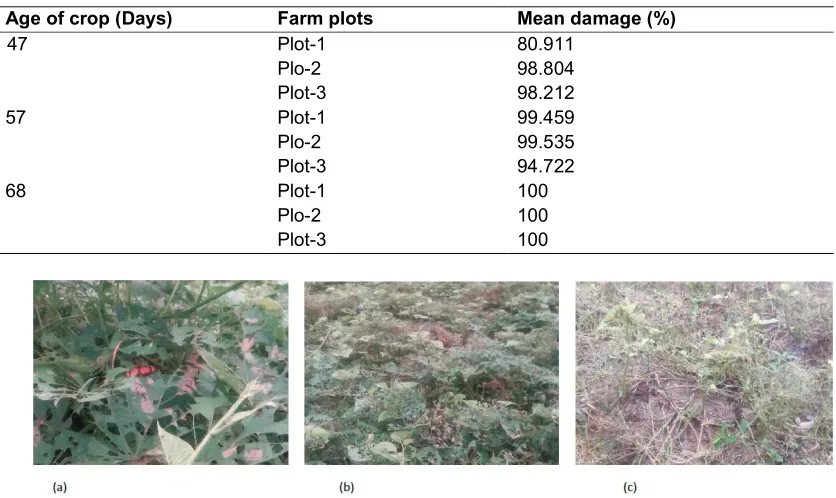
The adults and the larvae of sweet potato butterfly (Acraeae acerata) (Fig. 3 a-c). Were found on leaves and vine of the plant. The Mean percentage damage to foliage ranged between 81 and 100% (Table 2) in the plots. The pestiferous life stage, the larvae fed on leaves and caused perforations, skeletonisation and defoliation and the infestation was severe. Succulent, young leaves were attacked first, followed by the older ones. Aggregation and infestation occurred immediately the plants were established and their populations continued to increase as the plant developed dense foliage. The damage caused by A. acerata and H. convolvuli were severer compared to other insect pests and levels of damage increased progressively over time (Fig. 4 a-c).
Table 1. Occurrence of insects on sweet potato in Southwestern Nigeria
Common name Adonis Lady beetle* Cassid beetles
Click beetles (Wire worms) Darkling beetle
Flea beetle
Sweet potato weevil** Transverse lady beetle* Tortoiseshell beetle Common earwig** Aphids
Leaf hoppers Silverleaf whitefly Black cockroach-wasp* Cicada killer*
Common black ant Army worm
Beet webworm moth Sweet potato butterfly Sweet potato horn worm Sweet potato leaf folder (green) Sweet potato Stem borer Sweet Potato leaf folder (black) White plume moth
Praying mantids* Slant faced grasshopper Green stripped grasshopper Katydids
Angle-Wing Katydid Slant faced grasshopper Variegated grasshopper Locust
Black field cricket Mole cricket** Stick insect
Fig. 2. Relative abundance of insects from different
Table 1. Occurrence of insects on sweet potato in Southwestern Nigeria
Scientific name Order Family
Hippodamia variegate Coleoptera Coccinellidae
Psylliodes luridipennis Coleoptera Chrysomelidae
Pterohelaeus spp Coleoptera Elateridae
Lagria villosa Coleoptera Lagriidae
Epitrix spp Coleoptera Chrysomelidae
Cylas formicarius Coleoptera Curculionidae
Coccinella transversalis Coleoptera Coccinelidae
Aspidomorpha spp Coleoptera Coccinellidae
Forficula auricularia Dermaptera Forficulidae
Aphis gossypii Hemiptera Aphididae
Austroasca spp Hemiptera Cicadellidae
Bemisia tabaci Hemiptera Aleyroididae
Dolichurus spp Hymenoptera Ampulicidae
Sphecius speciosus Hymenoptera Crabronidae
Lasius niger Hymenoptera Formicidae
Spodoptera spp Lepidoptera Noctuidae
Spoladea recurvalis Lepidoptera Crambidae
Acraea acerata Lepidoptera Nymphalidae
Agrius cingulata Lepidoptera Sphingidae
Brachmia convolvuli Lepidoptera Gelechidae
Omphisia anastomosalis Lepidoptera Pyralidae
Helcystogramma convolvuli Lepidoptera Gelechiidae
Pterophorus pentadactyla Lepidoptera Pterophoridae
Mantis religiosa Mantodea Mantoididae
Orphulella speciosa Orthoptera Acrididae
Chortophaga viridifasciata Orthoptera Acrididae
Tettigonia viridissima Orthoptera Acrididae
Microcentrum rhombifolium Orthoptera Tettigoniidae
Orphulella speciosa Orthoptera Acrididae
Zonocerus variagatus Orthoptera Pyrgomorphidae
Austracris guttulosa Orthoptera Acrididae
Teleogryllus commodus Orthoptera Gryllidae
Gryllotalpa spp Orthoptera Gryllotalpidae
Phasmida spp Orthoptera Phasmatodae
Beneficial insects*, Root pests**
2. Relative abundance of insects from different orders recorded on sweet potato Table 1. Occurrence of insects on sweet potato in Southwestern Nigeria
Family Coccinellidae Chrysomelidae Elateridae Lagriidae Chrysomelidae Curculionidae Coccinelidae Coccinellidae Forficulidae Aphididae Cicadellidae Aleyroididae Ampulicidae Crabronidae Formicidae Noctuidae Crambidae Nymphalidae Sphingidae Gelechidae Pyralidae Gelechiidae Pterophoridae Mantoididae Acrididae Acrididae Acrididae Tettigoniidae Acrididae Pyrgomorphidae Acrididae Gryllidae Gryllotalpidae Phasmatodae
Uwaidem et al.; JAERI, 16(2): 1-9, 2018; Article no.JAERI.44189
(a) Pestiferous larvae (b) Pupae (c) Adult and damaged foliage
Fig. 3. Pestiferous larvae, pupae and adult Acraea acerata and damage to sweet potato foliage
Table 2. Damage to foliage at different periods during the growth cycle
Age of crop (Days) Farm plots Mean damage (%)
47 Plot-1 80.911
Plo-2 98.804 Plot-3 98.212
57 Plot-1 99.459
Plo-2 99.535 Plot-3 94.722
68 Plot-1 100
Plo-2 100 Plot-3 100
Fig. 4. Severity of damage to sweet potato foliage at (a) 47 days (b) 57 days and (c) 68 days after cultivation
4. DISCUSSION
The results of this study showed that insect pests severely undermine potato production in Southern Nigeria. Thirty four different insect species were recorded and over 80% of the insects were defoliators. The Order Orthoptera had the highest number of individual species, followed by Coleoptera and Lepidoptera pests. Members from these Orders were responsible for the most significant damage to the foliage and the tuber. However, economic damage was
caused by sweet potato butterfly (Acraea acerata), leaf folders (Brachmia and
interactions, which are capable of modulating occurrence, diversity and relative
abundance.
Adults of A. acerata layed eggs in batches on ventral and abaxial parts of potato leaves, hatched into the pestiferous larvae which caused major damage to the foliage of the plant. Early attacks started on young, succulent leaves and matured leaves were subsequently attacked when the infestation was heavy. The potentials of a horticultural pest species to inflict serious damage to crop are often favoured by its capacity to breed on the host [11]. It was interesting that species whose eggs, larvae and pupae were recorded on the plant were the key pests and they were considered as potential targets of control.
By the end of the growth cycle, the plant’s foliage was totally destroyed. Although correlations between foliage loss and yield components were not examined in this study, it is well known that destruction of foliage in roots and tuber crops affects translocation and exert decisive influence on yield. The activities of leaf folder larvae produced webbings, frass and excrements which made the leaves unfit for human consumption or use as foliage.
Damages by Cylas spp on tubers began with scraping to tunneling by the larvae created entry points for rot bacteria and fungi which made the tubers unfit for consumption. Several studies have reported Cylas spp as a major pest of sweet potato tubers. In some parts of Nigeria, yield loss in the range 90-100% in stored roots has been documented [16]. Infestation by Cylas
species often gets transferred to storage, especially where tubers are stored using an underground pit storage method. In the current study, we consider Cylas spp as the key root pest of sweet potato, considering the relative abundance, its species complex in the field, nature of damage that facilitates root rot and its potential to continue the destruction of tubers in storage. Sharah et al. [17] reported the economic implications of Cylas spp and rot organisms on the marketability of potatoes and difficulties to store Cylas-infested potatoes.
Other notable pests collected around the tubers were Click beetles, Gryllotalpidae, Teleogryllus commodus and Forficular auricularia and their nature of damage to the potato tubers were similar to the attack by Cylas sp. As far as we know, there is no information on the economic
threshold and yield loss due to infestations by these pests but they are species to be kept on watch-list as potential pests. Our observations on pest status of these species agree with earlier studies [18,19] that reported the larvae of potatoes butterfly and Cylas sp. as the key pests of sweet potatoes in different parts of the world.
Few insects, lady beetles, wasps and Mantis religiosa from the Order Coleoptera, Hymenoptera and Mantoididae respectively, were identified as beneficial insects but their populations were relatively lower than the pest species. It may be possible to exploit these beneficial insect species in future inundation biocontrol programmes, but more studies would be required on their bioecology and methods of breeding. It was observed that the population of
A. acerata, Brachmia and Helcystogramma
spp, Spodoptera spp and Pterophorus
pentadactyla, which were important defoliators, were low between August-December. This suggests that proper timing of planting may be important in regulating their population to minimize attacks.
5. CONCLUSION
Sweet potato is a well-adapted staple crop cultivable in all agro-ecological areas of Nigeria, integral to different cultural diets and a potential crop for food security. Minimising pest attacks on sweet potato can be considered a trajectory to sustainable production, but this could be a serious hurdle, as the use of chemical pesticides is being discouraged in Nigerian cropping system in the absence of established ecologically friendly alternative approaches. However, the outcome of this study has shown examples of beneficial insect species that can be exploited in the development of biocontrol programmes, in addition to the appropriate timing of crop production cycle to coincide with the periods in the season when populations of key pests are low or periods when the weather is unfavourable to pest development. The result has provided a comprehensive list of important pests of sweet potato and beneficial species that can be exploited as components of future integrated management approaches.
ACKNOWLEDGEMENT
Uwaidem et al.; JAERI, 16(2): 1-9, 2018; Article no.JAERI.44189
COMPETING INTERESTS
Authors have declared that no competing interests exist.
REFERENCES
1. Food and Agriculture Organization of the United Nations (FAO), Food and agriculture organization statistical data-bases (FAOSTAT); 2015.
Available:http://faostat3.fao.org/browse/Q/ QC/E
2. Mwanja YP, Goler EE, Gugu FM. Assessment of root and vine yields of sweet potato (Ipomoea batatas L.) landraces as influenced by plant popula-tion density in Jos-Plateau, Nigeria. Inter-national Journal of Agricultural Research; 2017.
[ISSN: 1816-4897]
DOI: 10.3923/ijar.2017.88.92
3. Ishida H, Suzuno H, Sugiyama N, Innami S, Tadokoro T, Maekawa A. Nutritive evaluation on chemical components of leaves, stalks and stems of sweet potatoes (Ipomoea batatas Poir). Food Chemistry. 2000;68(3):359-67.
4. Wariboko C, Ogidi IA. Evaluation of the performance of improved sweet potato (Ipomoea batatas L. LAM) varieties in Bayelsa State, Nigeria. African Journal of Environmental Science and Technology. 2014;8(1):48-53.
5. Okonya JS, Kroschel J. Pest status of
Acraea acerata Hew. and Cylas spp. in sweet potato (Ipomoea batatas (L.) Lam) and incidence of natural enemies in the Lake Albert crescent agro-ecological zone of Uganda. International Journal of Insect Science. 2013;IJIS-S13456.
6. Tanzubil PB. Insect pests of sweet potato in the Sudan savanna zone of Ghana. Journal of Entomology and Zoology Studies. 2015;3(2):124-6.
7. Shonga E, Gemu M, Tadesse T, Urage E. Review of entomological research on Sweet potato in Ethiopia. Discourse J. Agric. Food Sci. 2013;1:83-92.
8. Adom M, Wilson DD, Fening KO, Bruce AY, Adofo K. Bionomics of the sweet potato weevil, Cylas puncticollis
(Coleoptera: Brentidae) on four different sweet potato varieties in sub-Saharan Africa. Journal of Agriculture and Rural Development in the Tropics and Subtropics (JARTS). 2018;119(1):55-63.
9. Borisade OA, Kolawole AO, Adebo GM, Uwaidem YI. The tomato leafminer (Tuta absoluta)(Lepidoptera: Gelechiidae) attack in Nigeria: Effect of climate change on over-sighted pest or agro-bioterrorism?. Journal of Agricultural Extension and Rural Development. 2017a;9(8):163-71.
10. Musana P, Okonya JS, Kyamanywa S, Kroschel J. Effect of temperature on the development, reproduction and mortality of the sweetpotato weevil Cylas brunneus
(Fabricius) (Coleoptera: Brentidae). Uganda Journal of Agricultural Sciences. 2013;14(2):77-84.
11. Borisade OA, Uwaidem YI, Ayotunde-Ojo MO. Arthropods associated with
Amaranthus hybridus in southwestern Nigeria and aggregation patterns of
Gasteroclisus rhomboidalis, Hypolixus nubilosus (Coleoptera: Curculionidae) and brown marmorated stink bug,
Halyomorpha halys (Hemiptera: Pentatomidae) in relation to host’s morphology. Asian Journal of Advances in Agricultural Research. 2017b;2(1):1-1. 12. Agbessenou A, Wilson D, Billah M,
Dekoninck W, Vangestel C. Survey on the distribution of the sweet potato weevil,
Cylas species-complex in Ghana (Coleoptera: Brentidae). Bulletin de la Société Royale Belge d’Entomologie. 2016;152:81-8.
13. Ezin V, Quenum F, Bodjrenou RH, Kpanougo CM, Kochoni EM, Chabi BI, Ahanchede A. Assessment of production and marketing constraints and value chain of sweet potato in the municipalities of Dangbo and Bonou. Agriculture & Food Security. 2018;7(1):15.
14. Bale JS, Masters GJ, Hodkinson ID, Awmack C, Bezemer TM, Brown VK, Butterfield J, Buse A, Coulson JC, Farrar J, Good JE. Herbivory in global climate change research: Direct effects of rising temperature on insect herbivores. Global Change Biology. 2002;8(1):1-6.
Province, Eastern DR Congo. Open Agriculture. 2017;2(1):495-530.
17. Okonya JS, Kroschel J. Incidence, abundance and damage by the sweet potato butterfly (Acraea acerata Hew.) and the African sweet potato weevils (Cylas
spp.) across an altitude gradient in Kabale district, Uganda. Int J Agri Science. 2013; 3(11):814-24.
18. Sharah HA, Sodangi BI, Abdurrahaman M. The economic implication of Cylas Spp. and rot organisms infestations on the
marketability of sweet potato (Ipomoea batatas L.) in three markets in Maiduguri metropolis, Borno State, Nigeria. International J of Econ Develop Res & Investment. 2012;3(3):32-8.
19. Bashaasha B, Mwanga RO, Ocitti p’Obwoya C, Ewell PT. Sweet potato in the farming and food systems of Uganda: A farm survey report. International Potato Center (CIP), Nairobi, Kenya and National Agricultural Research Organization (NARO), Kampala, Uganda. 1995;63-45. _________________________________________________________________________________
© 2018 Uwaidem et al.; This is an Open Access article distributed under the terms of the Creative Commons Attribution License (http://creativecommons.org/licenses/by/4.0), which permits unrestricted use, distribution, and reproduction in any medium, provided the original work is properly cited.
Peer-review history: