Reduction of Maximum Flow Network Interdiction
Problem: Step towards the Polynomial Time Solutions
Pawan Tamta,
Department of Mathematics,Kumaun University Nainital, Uttarakhand, India.
Bhagwati Prasad Pande,
Department of InformationTechnology, Kumaun University Nainital,
Uttarakhand, India.
H.S. Dhami,
Department of Mathematics,Kumaun University Nainital, Uttarakhand, India.
ABSTRACT
In the present work an attempt is being made to reduce the Maximum Flow Network Interdiction Problem (MFNIP) in to the Subset Sum Problem so as to get some algorithms solvable in polynomial time. Previously developed algorithms are either applicable to some special cases of MFNIP or they do not have a constant performance guarantee. Our reduction has paved the way towards the development of fully polynomial time approximation schemes for Maximum Flow Network Interdiction Problem.
1. Introduction-
The maximum flow network interdiction problem (MFNIP) takes place on a network with a designated source node and a sink node. The objective is to choose a subset of arcs to delete, without exceeding the budget that minimizes the maximum flow that can be routed through the network induced on the remaining arcs.
Much of the recent work [5, 6, 10, and 13] admits MFNIP as strongly NP-hard problem. MFNIP admits a very simple integer programming formulation [35]. A number of valid inequalities are known for this IP, but the integrality gap is still large [3].
From mid nineties to now efforts have been made to develop some effective algorithms for MFNIP. Initially some naive algorithms were developed for interdiction problem such as a branch- and-bound strategy for general graph [14], and methods of varying quality for inhibition of s-t planar graph ( planer graphs with both the source and sink on the outer face) ([22], [16]).
Later in nineties efforts were made to categorize the problem and some polynomial time algorithms were developed on planner graphs for MFNIP. In 1993 Phillips [26] proved MFNIP as weakly NP Complete for planner graphs. At the same time Wood [35] introduced the Integer Linear Program (ILP) for MFNIP and proved it strongly NP Hard problem. Once MFNIP was proved as NP Hard problem, efforts were made to develop approximation algorithms for MFNIP. Phillips [26] developed a fully-polynomial-time approximation scheme for NIP but on planar networks only. Near 2000 in some articles decomposition method was used to develop approximation algorithms for some sections of MFNIP. A number of authors, for example ([5], [23], [33]) have used the decomposition method to find true approximation algorithms for combinatorial optimization
problems. Others such as [7] have used decomposition to prove structural results about the set of feasible solutions for a combinatorial optimization problem.
For the first time Burch et al. [9] made efforts to provide a polynomial-time algorithm for NIP for the general case, but again the algorithm could not give the constant performance guarantee.
The decomposition method had been used in that algorithm
that either returned a
1
1
-approximate optimal solution ora
1
- pseudo approximation. However that was not known a priori that which solution returned. In this context
is a user-specified error parameter. All of this work used Integer Program for MFNIP as the starting point.After that less attention were paid to develop the linear program and approximation algorithms for MFNIP and much of the work included the study of variants of network interdiction problem ([10],[11],[12],[17], [18],[20] ,[12] ,[31]).
The special case of MFNIP when an interdictor removes exactly k arcs from the network in order to minimize the maximum flow in the resulting network is known as the k -Most Vital Arcs Problem [27], this problem has also been named as the Cardinality Maximum Flow Network Interdiction Problem (CMFNIP) [35].
Recently Altner et al [3], developed two valid inequalities namely Source to Node path inequality and Node to Sink path inequality for linear programming relaxation of CMFNIP. Altner [3] showed that, even when strengthened by valid inequalities the integrality gap of the standard integer program for CMFNIP is not bounded below by a constant.
In this paper an effort is being made to reduce MFNIP in to the Subset Sum Problem. The Subset- Sum Problem has a Fully Polynomial Time Approximation Scheme (FPAS). Therefore our work paves the way towards the development of some algorithms solving the problem in polynomial time.
2. Preliminaries
at node
v
has been denoted as(
u
,
v
)
by him. The s–t cut has been referred by him as either a set of arcs that disconnectss
fromt
upon their removal, or alternatively, as a bipartition of the nodes wheres
andt
are not in the same partition. He has further denoted an undirected graph as)
,
(
V
E
whereV
is the set of vertices andE
is the set of edges, an edge between verticesu
andv
by{
u
,
v
}
and an arc between nodei
andj
as(
i
,
j
)
. The arc capacity of every arc(
i
,
j
)
has been given by Cij.Wood [35] proposed the integer linear program for MFNIP and defined the decision variables as:
v 1, ifv
N
is on the sink side of the cut, it is 0otherwise.
v
N
e 1, ife
A
is in the cut and is interdicted, it is 0 otherwise.
e
N
e 1, ife
A
is in the cut and is not interdicted, it is 0 otherwise.
e
N
Integer linear program for complete formulation of MFNIP has been defined by him as under:
(2.1)
Minimize
e e
c
Subject to the conditions (2.2)
0
) , ( ) , (
u v uv uv(2.3)
1
t s (2.4)R
e e A
e
r
(2.5)N
v
v
[
0
,
1
],
(2.6)A
e
e
[
0
,
1
],
(2.7)A
e
e
[
0
,
1
],
Altner [2] obtained the following natural linear programming relaxation forW
and denoted it as (W-LP), by replacing the binary constraints (2.5), (2.6), (2.7) with non negativity constraintsA
e
N
v
ev
[
0
,
1
]
,
[
0
,
1
]
,
In order to strengthen W-LP for CMFNIP Altner [2] proposed two inequalities named as Node to sink path inequality and Source to node path inequality.
Node to sink path inequality (2.9)
p
P
P
P
P
R t u t u t u e Ae u t
u t u
Nand
R
R
(
)
,
)
(
Where
p
R
t
u denotes the family of all sets of arc-disjoint
t
u
paths that contain more thanR
paths. Source to Node Path Inequality(2.10)
p
P
P
R u s u s A e e u u sNand
P
R
t u
0
,
)
(
)
(
Where
p
R
u
s denotes the family of all sets of arc-disjoint
u
s
paths that contain strictly greater thanR
paths. In this paper we modify the integer program of Wood [35] and Altner [3] to get rid of
variables so that the inequalities turns in to the equalities. For that purpose first we propose a reduction algorithm to reduce any complicated network in to a simple network of disjoint paths in polynomial time.3- Proposition of Reduction Algorithm.
In this section we propose an algorithm namely reduction algorithm to reduce the complicated network in to a simple network of disjoint source to sink paths.
The algorithm was earlier proposed by us in [25], here we present a modified form of that algorithm. A network is defined as
(
N
,
A
)
whereN
is the set of nodes andA
is the set of arcs. All networks have a unique sources
N
and a unique sinkt
N
.
Arc that originates from nodel
and terminates at nodem
is denoted by(
l
,
m
)
. The set of nodes directly connected to source node is defined asl
whereN
l
.We denote the set of different paths originating from any node
l
i
and terminating at sinkt
as -P
ti and paths belonging
to that set
P
ti as
p
,
q
...
ti t
i . .Similarly the set of
different source to sink paths is denoted by
P
ts and pathsdenote the arc capacity of path
p
t
s as
Cp
tsand the arc
capacity of any arc
(
l
,
m
)
asc
ml .
The equation set defining the algorithm is given as under. Equation 3.1 as proposed under determines source to sink path through any node
i
l
by taking all paths from that node to the sink nodet
.(3.1)
P
p
P
p
p
p
ts t
s t
i t
i t
i t
s
(
s
,
i
)
,
and
Equation 3.2 as proposed under considers the arc capacity
Cp
ts of any pathp
t
sas the minimum arc capacity of the
arcs constituting that path. (3.2)
c
p
Cp
m tsl t
s
min
:
(
l
,
m
)
.Equation 3.3 as proposed under states that the arc capacity of any arc appearing in more than one path is the difference of actual arc capacity of that arc and the arc capacities of the previous arcs.
(3.3)
Cp
c
c
q
p
ml tsm
l t
s t
s
m
l
,
)
(
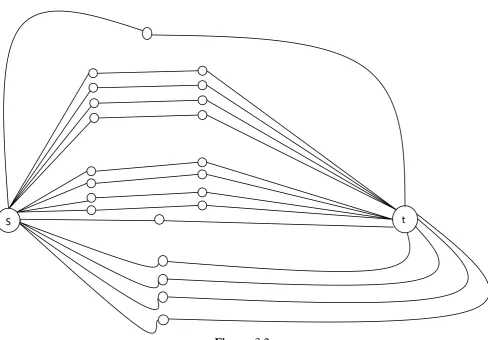
The reduction algorithm consisting of the equation sets 3.1 to 3.3 transforms the complicated network (figure 3.1) in to a simple source to sink path disjoint network (figure 3.2) in polynomial time, as in any directed graph having
N
nodes the maximum number of arcs areN
(
N
1
)
and the algorithm searching out each arc for possible source to sink path, the maximum number of efforts cannot exceed.
.
)
1
(
N
N
N
N
2N
Figure: 3.1
X
Y
Figure
: 3.2
Figure 3.1 and figure 3.2 give the description of the reduction algorithm.
4. Reduction of MFNIP in to the Subset
Sum Problem.
In this section we reduce the Maximum Flow Network Interdiction Problem in to the Subset Sum Problem.
Once we have reduced the network in section 3, we are left with the network of disjoint paths only (figure 3.20). Therefore the Maximum Flow Network Interdiction Problem has been reduced in to the problem of choosing the feasible subset of paths (paths to be interdicted) with maximum amount of flow in them, among the given objects (disjoint paths).
The procedure takes as input a set
}
,...
,
{
x
f1/c1x
f2/c2x
fn/cnS
, wherex
cn fn/
represents the
n
th arc having amount of flow
fn
and theinterdiction
cn
. Here the target valuet
is the interdiction budget. The aim is to find a subset of set}
,...
,
{
x
f1/c1x
f2/c2x
fn/cnS
with maximumamount of flow
fn
so that the total interdiction cost of the subsetci
does not exceed the interdiction budgett
. This is a well known Subset Sum Problem.5. Conclusion
Subset Sum Problem is a well known Np-hard problem which admits a Fully Polynomial Time Approximation Scheme (FPAS). The reduction of MFNIP in to the Subset Sum Problem provides a promising direction towards obtaining the Fully Polynomial Time Approximation Scheme for MFNIP.
6. References
[1] R.K. Ahuja, T.L. Magnanti and J.B. Orlin, Network Flows: Theory, Algorithms and Applications, Prentice Hall, Upper Saddle River (1993).
[2] Douglas.S.Altner, Ozlem Eegun and Nelson A Uhan, The Maximum Flow Network Interdiction Problem, valid inequlities, itregality gaps and approximability, Operations Research Letter 38 (2010),pp 33-38.
[3] N. Assimakopoulos, A network interdiction model for hospital infection control, Computers in Biology and Medicine 17 (1987), pp. 413–422.
[4] Bar-Noy, A., Guha, S., Naor, J., and Schieber, B.(2001). Approximating the throughput of multiple machines in real-time scheduling. SIAM Journal on Computing, 31(2):331–352.
[5] L. Bingol, A Lagrangian heuristic for solving a network interdiction problem, Master’s thesis, Naval Postgraduate
[6] Boyd, S. and Carr, R. (1999). A new bound for the ratio between the 2-matching problem and its linear programming relaxation. Mathematical Programming, Ser A, 86:499–514.
[7] G.G. Brown, M.W. Carlyle, J. Salmerón and R.K. Wood, Defending critical infrastructure, Interfaces 36
(2006), pp. 530–544.
[8] C. Burch, R.D. Carr, M. Marathe, C.A. Phillips and E. Sundberg, A decomposition-based pseudoapproximation algorithm for network flow inhibition. In: D.L. Woodruff, Editor, Network Interdiction and Stochastic Integer Programming, Kluwer Academic Press (2002), pp. 51–68.
[9] R.L. Church, M.P. Scaparra and R.S. Middleton, Identifying critical infrastructure: The median and covering facility interdiction problems, Annals of the Association of American Geographers 94 (2004), pp. 491–502.
[10] Ricardo.A. Collado, David Papp, Network Interdiction-Models, Applications, Unexplored Directions, Rutcor Research Report, RRR 4-2012, January 2012.
[11] K.J. Cormican, D.P. Morton and R.K. Wood, Stochastic network interdiction, Operations Research 46 (1998), pp. 184–197.
[12] D. Du and R. Chandrasekaran, The maximum residual flow problem: NP-hardness with two-arc destruction, Networks 50(2007), pp. 181–182.
[13] Ford, L. R. and Fulkerson, D. R. (1962). Flows in Networks. Princeton University Press, Princeton, NJ. [14] Ghare, P. M., Montgomery, D. C., and Turner, W. C.
(1971). Optimal interdiction policy for a flow network. Naval Research Logistics Quarterly, 18:37–45.
[15] T.E. Harris, F.S. Ross, Fundamentals of a method for evaluating rail network capacities, Research Memorandum RM-1573, The RAND Corporation, Santa Monica, CA.
[16] Helmbold, R. L. (1971). A counter capacity network interdiction model. Technical Report R-611-PR, Rand Corporation, Santa Monica, CA.
[17] E. Israeli and R.K. Wood, Shortest-path network interdiction, Networks 40 (2002), pp. 97–111.
[18] U. Janjarassuk and J.T. Linderoth, Reformulation and sampling to solve a stochastic network interdiction problem, Networks 52 (2008), pp. 120–132.
[19] Krumke, S. O., Noltemeier, H., Ravi, S. S., Marathe, M. V., and Drangmeister, K. U. (1998). Modifying networks to obtain low cost subgraphs. Theoretical Computer Science, 203(1):91–121.
[20] C. Lim and J.C. Smith, Algorithms for discrete and continuous multicommodity flow network interdiction problems, IIE Transactions 39 (2007), pp. 15–26.
[21][Marathe et al., 1998] Marathe, M. V., Ravi, R., Sundaram, R., Ravi, S. S., Rosenkrantz, D. J., and Hunt III, H. B. (1998). Bicriteria network design problems. Journal of Algorithms, 28(1):142–171.
[22] A.W. McMasters and T.M. Mustin, Optimal interdiction of a supply network, Naval Research Logistics Quarterly
17(1970), pp. 261–268.
[23] Naor, J. and Schieber, B. (1997), Improved approximations for shallow-light spanning trees. In Proceedings of the 38th Annual IEEE Symposium on the Foundations of Computer Science, pages 536–541. [24] Nemhauser, G. L. and Wolsey, L. A. (1988), Integer and
Combinatorial Optimization, John Wiley & Sons. [25] Pawan Tamta, Bhagwati Pande, H.S.Dhami International,
Development of an Algorithm for All Type of Network Flow Problems, Journal of Computer Applications (0975 – 8887) Volume 42– No.17, March 2012.
[26] C.A. Phillips, The network inhibition problem, in: Proceedings of the 25th Annual ACM Symposium on the Theory of Computing, 1993 pp. 776–785.
[27] H.D. Ratliff, G.T. Sicilia and S.H. Lubore, Finding the n
most vital links in flow networks, Management Science
21(1975), pp. 531–539.
[28] J.O. Royset and R.K. Wood, Solving the bi-objective maximum-flow network-interdiction problem, INFORMS Journal on Computing 19 (2007), pp. 175– 184.
[29] Schrijver, A. (1986). Theory of Linear and Integer Programming. John Wiley & Sons.
[30] A. Schrijver, On the history of the transportation and the maximum flow problems, Mathematical Programming
91 (2002), pp. 437–445.
[31] Shahram Morowati-Shalilvand, Javad Mehri-Tekmeh, Finding Most Vital Links over Time in a Flow Network. International Journal of Optimization And Control: Theories and Applications (IJOCTA), 2(2012), pp. 173-186.
[32] Shmoys, D. (1997), Personal communication.
[33] Srinivasan, A. (1997), A constant-factor approximation algorithm for packet routing, and balancing local vs global criteria. In Proceedings of the 29th Annual ACM Symposium on the Theory of Computing, pages 636– 643.
[34] A. Uygun, Network interdiction by Lagrangian relaxation and branch-and- bound, Master’s thesis, Naval Postgraduate School, 2002.
[35] R.K. Wood, Deterministic network interdiction, Mathematical and Computer Modelling, 17(1993), pp. 1–18.