N
S
Available online at: www.ijcncs.orgISSN 2308-9830
M
2E
2: A Novel Multi-hop Routing Protocol for Wireless Body
Sensor Networks
Omid Rafatkhah1 and Mina Zolfy Lighvan2
1, 2
Department of Electrical and Computer Engineering, Tabriz University, Tabriz, Iran
E-mail: [email protected] [email protected]
ABSTRACT
Wireless Body Sensor Networks (WBSN) systems will enable people to monitor themselves with devices that give proactive warnings of illness so that they can turn to their doctors earlier, when intervention can be the most effective. In this paper, we propose a reliable, Energy efficient and high throughput routing protocol for heterogeneous Wireless Body Area Networks (WBANs); Mode Energy-Efficient Multi-hop Protocol (M2E2). The proposed routing protocol uses fixed deployment of wireless sensors (nodes) in home and mobility support for sensor nodes on human body. The sensor nodes on human body select the best routing by receiving Home-Signal to minimize energy consumption. Also direct link is used for emergency and real-time data while Multi-hop link is used for normal data transfer. M2E2 is thermal-aware which ability Recognition the link Hot-spot and Replacement the links. So multi-mode and mobility support developed Reducing energy consumption and to overcome the problem due mobility of human body causes disconnection. We do a comprehensive analysis supported by MATLAB simulations to provide for the network lifetime maximization. In simulations, we analyze our protocol in terms of throughput, number of dead nodes over time, total energy of network and number of cluster heads. Simulation results show better performance for the proposed protocol as compared to the existing one.
Keywords: Wireless Body Sensor Networks, Multi Mode, Mobility, Multi-hop, Single-hop.
1 INTRODUCTION
Wireless sensor network technology can affects the way of living with many applications in amusement, travel, retail, industry, remedy, care of the dependent people, and emergency organization and many other areas. Wireless sensors and sensor networks, comprehensive computing, and artificial brains research together have built the interdisciplinary idea of ambient intelligence (AMI) in order to overcome the challenges in our everyday life [1]. One of the main challenges of the world for the most recent decades is the elderly population especially in the developed countries. Therefore the need of delivering quality care to a quickly rising population of elderly while reduction the healthcare costs is a main issue. One of the important applications in this area is providing electronics technologies which enable people to be continually monitored [2]. In-home comprehensive networks may assist inhabitants and their caregivers through providing continuous medical monitoring, memory
improvement, organize of home appliances, medical information access, and emergency statement [3, 4]. Stable monitoring will increase early diagnosis of emergency conditions and diseases for at risk patients and also provide broad range of healthcare services for people with a variety of degrees of cognitive and physical disabilities [5]. Not only the elderly and chronically sick but moreover the families in which both parents have to work will obtain advantage from these systems for delivering high-quality care services for their babies and little children. Researchers in computer, networking, and medical fields are working together in order to create the wide visibility of smart healthcare possible. Sick monitoring is emerging as a vital application of embedded sensors network. Wireless sensors are located on the human body or implanted in the body to supervise vital signs like blood pressure, body temperature, heart rate, glucose level etc.
using for transmitting data from sensor nodes to sink becoming critic. One of the main problems in WBSN is recharging the batteries. Because of that an efficient routing protocol is essential to overcome this subject of recharging batteries. Several energy efficient routing protocols are proposed in WSN technology [6], [7], [8]. But, WSNs and WBSNs have various architectures, applications and operate in various conditions. It is inconceivable to port WSN routing protocols to WBSN. So, energy efficient routing protocol for WBSN is required for sick monitoring in a longer period. A paper WBSNs routing algorithms should support the heterogeneous sensors network.
In this paper a high throughput, reliable and stable routing protocol for WBSN. With a prototype for inserting heterogeneous sensor nodes on human body and home place is presented. A combination single-hop and multi-hop communication is used for energy management in our proposed routing protocol.
The rest of the paper is organized in following order. In section 2, related work is review; Then Section 3 describes Background for this work. Radio model is presented in section 4, while detail of the M2E2 protocol is presented in section 5. Performance metrics and simulation results are presented in section 6 and 7 respectively. Finally, section 8 gives conclusion.
2 RELATEDWORK
In WBSN technology, large numbers of routing schemes are proposed and some of them are explained in this section. In [9] use single-hop communication is used for sending data from sensor nodes to the sink node. This technique has a good timing; but, not energy efficient. In [10] authors use multi-hop communication for data transmission between sensor nodes and the sink node. However, increased delay and more energy consumption of sensor nodes closer to sink are the main disadvantages. Authors in [11] suggest Wireless Autonomous Spanning Tree Protocol (WASP) in which message is broadcasted from parent nodes to child nodes. This plan is used to achieve low delay and high network reliability. Authors in [12] propose Environment Adaptive Routing (EAR) protocol which uses together single-hop and multi-hop communication between sensor nodes and the sink. However, multi-hop communication is not proper for emergency data because it results in delayed data delivery. Authors in [13] make use of priority based tree algorithm for WBSNs. They use proprietary channels for emergency data and as soon as emergency data is
root node directly transmission to sink node and for normal data livery Multi-hop communication is used. This protocol is supported mobility of human body with energy organization in one mode. Also for all environments assumed to be identical.
3 BACKGROUND AND MOTIVATION
Wireless Body Sensors are used to monitor human health with limited energy resources. Different energy efficient routing schemes are used to forward data from body sensors to medical server. It is important that sensed data of patient reliably received to medical specialist for further analysis. The basic aim to design a routing protocol is uniform distribution of load, such that energy consumption at every round is even and network lifetime is increased. Single-hop communication causes increased load on distant nodes and multi-hop communication drains the battery power of nearer nodes quickly. Thus, authors in [21] propose an energy efficient routing algorithm for heterogeneous WBSNs. However, deficiencies are as follows.
i. A moving sensor node requires new parent, the new parent nodes refuses to accept it. ii. If displaced sensor node is apparent.
iii. For all environments assumed to be identical.
iv. Thus, we propose a routing protocol which overcomes the aforementioned deficiencies.
4 M2E2 PROTOCOL
In our proposed method, a sink node is located at the center of human body and the other one is located at the home. Since Wireless Body Sensor Networks (WBSNs) are heterogeneous networks, the communication of sensor nodes on human body becomes a challengeable issue. For overcoming this issue the sensor nodes are arranged on human body based on their data rate. Sensor nodes with high data rates are named parent sensor nodes and are located at less mobile places of human body. These parent sensor nodes are connected to the sink directly. Therefore, the sensor nodes with high data rate, send data directly to the sink node, and can easily forward the received data from low data rate sensors. The sensor nodes directly connected to the
parent sensor nodes are first level child-nodes which generate data. The sensor nodes connected to the first level nodes are second level child-nodes. Parent nodes, first level child-nodes and second level child nodes are placed on human body with keeping their respective topology. Home nodes are able to sending signals called Home-Signal and the nodes placed on human body are able to receive. Problems analyzed in previous work are resolved in the following manner:
(1) When a sensor node moves and the new parent nodes refuse to accept it, for all data delivery of the new sensor node, Single-hop communication is used,
(2) If the displaced sensor node is a parent node, its corresponding child nodes keep their connection to the displaced parent node.
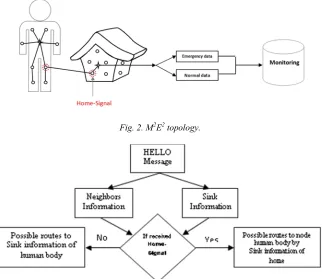
(3) To reduce energy consumption two different environments are used Figure2.
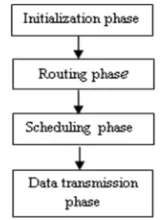
The proposed M2E2 protocol consists of four main phases shown in Figure1.
Fig. 1. Flow diagram M2E2.
4.1 Initialization phase
Fig. 2. M2E2 topology.
Fig. 3. HELLO message and Home-Signal format.
4.2 Routing phase
In this phase, if Home-Signal is received, then one of the sensor nodes on human body will be linked to the routing table of home nodes. In such a case for sending all data the Single-hop communication is used, because there is no energy restriction for home nodes.
If Home-Signal is not received, the routing table will be formed on human body nodes. In this case in order to reduce the energy loss, Multi-hop communication is used for normal data, but for emergency data all the implanted sensor nodes on the body will send that data directly to the base station. Also all nodes can send data directly to sink node when receiving requests of sink.
While sending the data directly, delay is much lower than indirect communication, because in indirect communication each middle sensor node receives processes and then sends data to the next sensor node. Each of the intermediate nodes causes delay. So, direct link is used for reduce this delay. Energy Consumption is calculated based on the used communication type.
4.2.1 Single hope
For single-hop communication, We compute the consumed energy as
ES−HOP = E transmit
Where, the transmission energy is computed as:
E transmit = E Elect + E amp = × (E elec + E amp) × 2
Where, E elec is the energy consumed for
processing data and E amp is energy for transmit
amplifier up to distance d and packet size b.
4.2.2 Multi hop
The energy consumption in Multi-hop communication is calculated as
E M-HOP = × × E transmit + ( − 1) × × E received,
Where n is the number of hops, E transmit is the
reception energy, and we assume that E transmit = E received.
sensors must be verified as a factor where the main considered factor is heating effects of the implanted sensor nodes on human body. For considering the Heating effects of sensor nodes we implemented connection hot-spot detection technique. Sensor nodes implanted nearer to sink node are forwarding data of their follower sensor nodes. Whenever, a temperature threshold is reached, a sensor node breaks its connection with its neighbor for few rounds. As temperature returns to standard, it re-establishes the new path. However, if a sensor node receives a data packet and reaches its temperature threshold it returns packet to previous node. And the previous sensor node introduces this connection as a hot-spot.
4.3 Scheduling phase
In this phase, after route selection in routing phase, the sink node schedule a time slot for communication between sink and the root nodes based on TDMA (Time Division Multiple Access). Sink node assign time-slots to sensor nodes. Sensor Nodes can communicate to sink node in assigned time slot for normal data transmission.
4.4 Data transmission phase
After scheduling phase once the time slots are allocated to root nodes, they send their data to sink node in assigned time slot. After that sink node will receive data, and will take some time to aggregate the received data.
5 SIMULATION RESULTS
We evaluate the performance of our proposed M2E2 protocol with the help of MATLAB simulations, and compare the obtained results with M-ATTEMPT protocol. We took network size of 5m × 5m in which 10 sensor nodes are randomly distributed and the sink node is located in the center of the network. We run 5000 simulation rounds in which sensor nodes have initial energy equal to 0.5J and max radio range equal to 10m.
The time in which all sensor nodes in network are active is called the stability time of network.
Here time is presented in terms of rounds and one round is the time period in which the protocol operation is performed once.
M2E2 has better network life time as compared to M-ATTEMPT protocol. Number of dead sensor nodes is obtainable as function of rounds. The simulation results show that M2E2 has better stability time in comparison to M-ATTEMPT routing as depicted in Fig. 4.b.
In our proposed protocol both Single-hop and Multi-hop methods and also multi-mode concepts are being used. So, Throughput of techniques implemented with mobility support is evaluated, by measuring the successful packets sent to BS. Fig.4.a depicts that throughput of M2E2 is almost better in stable region. M-ATTEMPT is communicating using Single-hop and Multi-hop methods with mobility management. While, M2E2 takes advantages of multi mode and performs better than the M-ATTEMPT. In case of, nodes disconnection because of mobility in multi modes, the M2E2 establishes a new link with another sensor node by examining the hop counts or minimum energy usage source. So, no failures of packets happen in case of link breakage.
Fig. 4.d shows number of selected CH in each round for two protocols. Here, the M2E2 shows the better performance as compared to M-ATTEMPT. Total energy consumption of M2E2 and M-ATTEMPT is depicted in Fig. 4.c. M2E2 utilizes energy usage in multi-mode in comparison to to M-ATTEMPT.
Figure 4: a: Throughput, b: Number of Dead Nodes over Time, c: Total Energy of Network over Varying Rounds d: Number of Cluster Heads per Round.
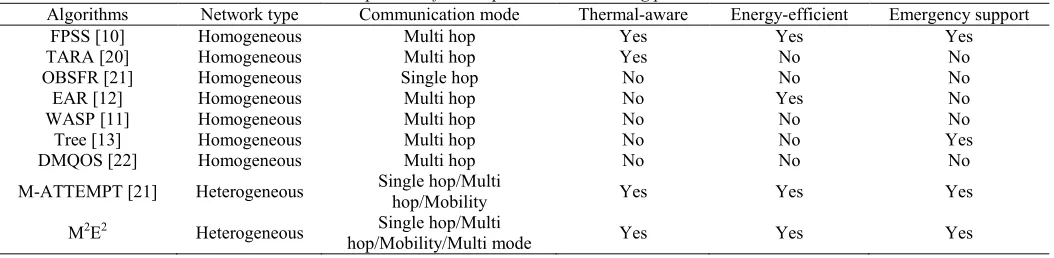
Table1: Comparison of M2E2 protocol with existing protocols.
Algorithms Network type Communication mode Thermal-aware Energy-efficient Emergency support
FPSS [10] Homogeneous Multi hop Yes Yes Yes
TARA [20] Homogeneous Multi hop Yes No No
OBSFR [21] Homogeneous Single hop No No No
EAR [12] Homogeneous Multi hop No Yes No
WASP [11] Homogeneous Multi hop No No No
Tree [13] Homogeneous Multi hop No No Yes
DMQOS [22] Homogeneous Multi hop No No No
M-ATTEMPT [21] Heterogeneous Single hop/Multi
hop/Mobility Yes Yes Yes
M2E2 Heterogeneous Single hop/Multi
hop/Mobility/Multi mode Yes Yes Yes
6 CONCLUSION
In this paper, we presented a mechanism for reducing energy consumption and increase life time network in heterogeneous WBSNs. In order to raise reliability of network, for real-time and Emergency data directly link and for normal data multi-hop link in used. Our proposed routing protocol supports multimode of human body and home for energy management. Also idea multimode for reduction link hot-spot and no reaching the threshold planed. Lifetime and energy consumption
7 REFERENCES
[1] D.J. Cook, J.C. Augusto, V.R. Jakkula, Ambient intelligence: technologies,
applications, and opportunities, Pervasive and Mobile
Computing 5 (August) (2009) 277–298. [2] A. Schmidt, K.V. Laerhoven, How to build
smart appliances?,IEEE Personal Communications 8 (4) (2001) 66–71. [3] V. Stanford, Using pervasive computing to
deliver elder care,IEEE Pervasive Computing 1 (1) (2002) 10–13.
[4] T. Mcfadden, J. Indulska, Context-aware environments for independent living, in: 3rd National Conference of Emerging Researchers in Ageing, 2004, pp. 1–6.
[5] J.A. Stankovic, Q. Cao, T. Doan, L. Fang, Z. He, R. Kiran, S. Lin, S. Son, R. Stoleru, A. Wood, Wireless sensor networks for in-home healthcare: potential and challenges, in: High Confidence Medical Device.
[6] N. Javaid, U. Qasim, Z. A. Khan, M. A. Khan, K. Latif and A. Javaid, “On Energy Efficiency and Delay Minimization in Reactive Protocols in Wireless Multi-hop Network”, 2nd IEEE Saudi nternational Electronics, Communications and Photonics Conference (SIECPC 13), 2013, Riyadh, Saudi Arabia. [7] B. Manzoor, N. Javaid, O. Rehman, M. Akbar,
Q. Nadeem, A. Iqbal, M. Ishfaq, “Q-LEACH: A New Routing Protocol for WSNs”, International Workshop on Body Area Sensor Networks (BASNet-2013) in conjunction with 4th International Conference on Ambient Systems, Networks and Technologies (ANT 2013), 2013, Halifax, Nova Scotia, Canada, Procedia Computer Science, Volume 19, 2013, Pages 926-931, ISSN 1877-0509.
[8] N. Javaid, R. D. Khan, M. Ilahi, L. Ali, Z. A. Khan, U. Qasim, ”Wireless Proactive Routing Protocols under Mobility and Scalability Constraints”, J. Basic. Appl. Sci. Res., 3(1)1187-12001, 2013.
[9] M. Quwaider and S. Biswas, “DTN routing in body sensor networks with dynamic postural partitioning,” Ad Hoc Networks, vol. 8, no. 8, pp. 824–841, 2010.
[10]S.-H. Seo, S. A. Gopalan, S.-M. Chun, K.-J. Seok, J.-W. Nah, and J.-T. Park, “An energy-efficient configuration management for multi-hop wireless body area networks,” in Proceedings of the 3rd IEEE International Conference on Broadband Network and Multimedia Technology (IC-BNMT ’10), pp. 1235–1239, October.
[11]B. Braem, B. Latr´e, I. Moerman, C. Blondia, and P. Demeester, “The wireless autonomous spanning tree protocol for multihop wireless body area networks,” in Proceedings of the 3rd Annual International Conference on Mobile and Ubiquitous Systems (MobiQuitous ’06), IEEE, July 2006.
[12]D. Y. Kim,W. Y. Kim, J. S. Cho, and B. Lee, “Ear: an environment-adaptive routing algorithm for wbans,” in Proceedings of International Symposium on Medical Information and Communication Technology (ISMICT ’10), 2010.
[13]R. Annur,N.Wattanamongkhol,
S.Nakpeerayuth, L.Wuttisittikulkij, and J.-I. Takada, “Appliying the tree algorithm with prioritization for Body Area Networks,” in Proceedings of the 10th International Symposium on Autonomous Decentralized Systems (ISADS ’11), pp. 519–524, March 2011.
[14]N. Ababneh, N. Timmons, J.Morrison, andD. Tracey, “Energy balanced rate assignment and routing protocol for body area networks,” in Proceedings of 26th International Conference on the Advanced Information Networking and Applications Workshops (WAINA ’12), pp. 466–471, IEEE, 2012.
[15]H. Ben Elhadj, L. Chaari, and L. Kamoun, “A survey of routing protocols in wireless body area networks for healthcare applications,” International Journal of E-Health and Medical Communications, vol. 3, no. 2, p. 118, 2012. [16]L. Hughes, X.Wang, and T. Chen, “A review
of protocol implementations and energy efficient cross-layer design for wireless body area networks,” Sensors, vol. 12, no. 11, pp. 14730–14773,2012.
[17]B. Latre, B. Braem, I. Moerman et al., “A low-delay protocol for multihop wireless body area networks,” in Proceedings of the 4th Annual International Conference on Mobile and Ubiquitous Systems (MobiQuitous ’07), pp. 1– 8, August 2007.
[18]N. Javaid, A. BiBi, A. Javaid, Z. A. Khan, K. Latif, andM. Ishfaq, “Investigating quality routing link metrics in Wireless Multihop Networks,” Annals of Telecommunications, 2013.
[19]M.A.Hanson, H. C. Powell Jr., A. T. Barthet al., “Body area sensor networks: challenges and opportunities,” Computer, vol. 42, no. 1, pp. 58–65, 2009.
transmit power adaptation,” in Proceedings of the 5th International Conference on Body Area Networks, pp. 77–83, ACM, 2010.
[21]N. Javaid, Z. Abbas, M. S. Farid, Z. A. Khan and N. Alrajeh, “M-ATTEMPT: A New Energy-Efficient Routing Protocol for Wireless Body Area Sensor Networks”, The 4th International Conference on Ambient Systems, Networks and Technologies (ANT 2013), 2013, Halifax, Nova Scotia, Canada, Procedia Computer Science, Volume 19, 2013, Pages
224-231, ISSN 1877-0509,
http://dx.doi.org/10.1016/j.procs.2013.06.033. Procedia Computer Science
[22]Q. Tang,N. Tummala, S. K. S.Gupta, and L. Schwiebert, “TARA: thermal-aware routing algorithm for implanted sensor networks,”in Proceedings of the 1st IEEE International Conference on stributed Computing in Sensor Systems (DCOSS ’05), pp.206–217, Springer, July 2005.
[23]M. Quwaider and S. Biswas, “On-body packet routing algorithms for body sensor networks,” in Proceedings of the 1st
[24]A. Razzaque, C. S. Hong, and S. Lee, “Data-centric multiobjective QoS-aware routing protocol Procedia Computer Science, Volume 19, 2013, Pages 224-231, ISSN 1877-0509, http://dx.doi.org/10.1016/j.procs.2013.06.033. Procedia Computer Science.
AUTHORPROFILES:
Omid Rafatkhah
received the B.S.c. degree in Computer Engineering (Software) from Azad University, Tabriz, Iran in 2001. He is currently M.Sc. student in Computer Engineering (Software) from Electrical and Computer Engineering faculty of Tabriz University, Iran. Her research interests include network, security, and Intrusion Detection Systems, Object oriented Programming & Design.
Mina Zolfy Lighvan