VOLUME 12 | ISSUE 4 | 2017 | 1153
Dynamic stretching is effective as static stretching
at increasing flexibility
JOHN M. COONS1 , COLLEEN E. GOULD1, JWA K. KIM2, RICHARD S. FARLEY1, JENNIFER L. CAPUTO1
1Exercise Science, Health and Human Performance, Middle Tennessee State University, United States 2Psychology, Middle Tennessee State University, United States
ABSTRACT
This study examined the effect of dynamic and static (standard) stretching on hamstring flexibility. Twenty-five female volleyball players were randomly assigned to dynamic (n = 12) and standard (n = 13) stretching groups. The experimental group trained with repetitive dynamic stretching exercises, while the standard modality group trained with static stretching exercises. The stretching interventions were equivalent in the time at stretch and were performed three days a week for four weeks. Both stretching groups showed significant improvements (P < .001) in range of motion (ROM) during the intervention. However, no difference in gains in the range of motion between stretching groups was observed. It was concluded that both dynamic stretching and standard stretching are effective at increasing ROM. Key words: RANGE OF MOTION, VOLLEYBALL, HAMSTRINGS.
1Corresponding author. Exercise Science, Health and Human Performance, Middle Tennessee State University, 1301 East
Main, Box 96, 37132, Murfreesboro, United States
E-mail: [email protected]
Submitted for publication November 2013 Accepted for publication September 2017 Published December 2017
JOURNAL OF HUMAN SPORT & EXERCISE ISSN 1988-5202 © Faculty of Education. University of Alicante
doi:10.14198/jhse.2017.124.02 Cite this article as:
1154 | 2017 | ISSUE 4 | VOLUME 12 © 2017 University of Alicante
INTRODUCTION
Flexibility is the capacity of a joint to move through its entire ROM (ACSM, 2010). While the topic of flexibility and sports performance has been thoroughly debated (Craib et al., 1996; Gleim & McHugh, 1997; Hunter & Marshall, 2002; Kokkonen, Nelson, Eldredge, & Winchester, 2007; Nelson, Kokkonen, & Arnall, 2005; Shrier, 1999), an optimal ROM for fitness and sports performance has yet to be established. Reasons for improving flexibility in a sports context include decreasing injury (Dodebo, White, & George, 2004; Safran, Garrett, & Seaber, 1988) and increasing performance (Stewart & Sleivert, 1998). Specifically, it has been suggested that the increased muscle-tendon compliance associated with flexibility training may increase elasticity (Nelson & Kokkonen, 2007) and cause an increased force of contraction (Shrier, 1999).
For decades, static stretching has been the standard modality used in training programs, as it has been shown to be more or equally effective at increasing flexibility than other forms of stretching (Vasdeki, 2011). Covert and colleagues (2010) compared the effects of 4-weeks of static or ballistic stretching on hamstring muscle ROM. While this study found that both stretching groups significantly increased flexibility, static stretching also produced significantly more gains in ROM than ballistic stretching. In addition, Bandy and colleagues (1998) reported that both dynamic ROM and static stretching significantly increased hamstring flexibility and that static stretching was two times more effective at increasing hamstring flexibility than dynamic ROM exercises.
Traditionally, static stretching is implemented during the exercise warm-up, as it is believed that exercise stretching prevents injuries during physical training. However, the use of static stretching in pre-exercise warm-ups has been questioned because several studies have demonstrated a negative association between static stretching and performance (Burkett, Phillips, & Ziuraitis, 2005; Fletcher & Jones, 2004; McNeal & Sands, 2003; Nelson et al., 2005; Papadopoulos, Siatras, & Kellis, 2005; Siatras, Papadopoulos, Mameletzi, Gerodimos, & Kellis, 2003; Wallmann, Mercer, & McWhorter, 2005). Since these studies, practitioners have started to use other forms of stretching in pre-exercise warm-up sessions. In this regard, dynamic stretching has been a popular choice to replace static stretching because the acute effects have been shown to improve performance parameters such as agility, endurance, strength, power, and anaerobic capacity (Dalrymple, Davis, Dwyer, & Moir, 2010; A. D. Faigenbaum et al., 2006; Herman & Smith, 2008; Jaggers, Swank, Frost, & Lee, 2008).
A central goal of including stretching in a flexibility program is to increase ROM. While the effectiveness of chronic static stretching on flexibility has been well established, knowledge of the effects of chronic dynamic stretching protocols on flexibility is lacking. Therefore, the purpose of this study was to compare the effects of four weeks of dynamic stretching to an equivalent period of standard (static) stretching on hamstring flexibility during a concurrent plyometric training program in high-school volleyball players. It was hypothesized that the standard stretching group would produce more gains in ROM than the dynamic stretching group.
MATERIALS AND METHODS
Participants
VOLUME 12 | ISSUE 4 | 2017 | 1155
and signed an assent form. The study was approved by an institutional review board for use on human subjects.
Upon gathering informed consent and assent, participants were randomized into either a dynamic stretching group (n = 12) or a standard stretching group (n = 13. A pre-test/post-test randomized groups design was used to examine the effects of dynamic and standard stretching programs on hamstring flexibility. All study participants were concurrently participating in the same plyometric training program. Subjects were randomly assigned to either standard or dynamic stretching groups within each volleyball team. The hamstring stretching programs were performed three days a week for four weeks (Chan, Hong, & Robinson, 2001).
Measures and Procedures
The subjects in this study were recruited from the same plyometric training program that was administered by the primary investigator. All participants were simultaneously participating in a plyometric program that emphasized movement at the ankle joint. All subjects were required to participate in 80% of the flexibility training program in order to be included in the study. Prior to the study, subjects completed a demographic questionnaire created by the primary investigator and supplied information on injury status, age, and playing history. Height was measured with a Model 222 SECA Stadiometer and weight was measured using a Model 770 SECA Scale (SECA; Hanover, MD).
Flexibility measures
Pre-test flexibility of the hamstrings was assessed within three days prior to beginning the flexibility program and post-test flexibility was assessed within three days of completing the flexibility program. Flexibility measures obtained using a Biodex System 3 (Biodex Medical Systems; Shirley, NY) dynamometer and were confirmed by a goniometer. Prior to measuring flexibility, participants performed a 5-minute warm-up on a cycle ergometer at 50 rpm and 0.5kp resistance. Hamstrings flexibility was measured in a supine position and the pelvis was constrained by straps to prevent movement from joints other than the hip. A knee immobilizer was also used to prevent knee flexion and ensure that ROM measures emanated from the hip during the flexibility tests. Before flexibility measures were recorded, subjects practiced the ROM testing procedure three times during which participants were instructed to move the hip until they felt a stretch sensation. Prior to all flexibility measures, the isokinetic dynamometer was zeroed after the participant’s hip
was placed in a neutral position. During testing, each subject was asked to raise the limb as far as she could actively move it and then hold the limb for five seconds at the end ROM, at which time the number of degrees of hip flexion from neutral was recorded. Participants performed three flexibility trials and the greatest amount of hip flexibility registered was used for analysis.
Stretch training
The standard and dynamic stretching programs were identical in amount of time (30 seconds) at stretch. Participants were instructed on proper procedures for each stretching protocol and practiced the stretches prior to implementing the flexibility program. Both stretching programs were overseen by the principal investigator. During the standard stretch protocol, players performed two repetitions of slow, static active modified hurdler stretches, with each stretch held for 30 seconds at the point of maximal stretch with mild discomfort (Yamaguchi & Ishii, 2005). The stretch was performed on the left leg and then on the right leg after a 20-second rest period (Yamaguchi & Ishii, 2005).
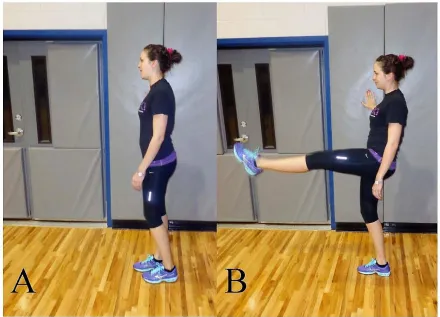
1156 | 2017 | ISSUE 4 | VOLUME 12 © 2017 University of Alicante two seconds. A metronome was used to pace the stretching routines. Stretching was performed five times at a slow rate, followed by 10 quick stretches performed as powerfully as possible without bouncing (Yamaguchi & Ishii, 2005). Stretching was first carried out on the left leg and, after a 20-second rest period, performed on the right leg (Yamaguchi & Ishii, 2005).
Figure 1. Beggining (a) and ending (b) positions for harmstring dynamic stretching exercises. See text for more information
Analyses
SPSS for Windows software was used for all statistical analyses. Due to small group differences in pre-test ROM scores, data was initially analysed using analysis of covariance (ANCOVA) with the pre-test scores as the covariate. A 2 (group; standard vs. dynamic) x 2 (time; before and after 4 weeks of training) analysis of variance (ANOVA) with repeated measures was used to evaluate differences in ROM between stretching protocols (standard and dynamic). The alpha level was set at P < .05.
RESULTS
VOLUME 12 | ISSUE 4 | 2017 | 1157
Table 1. Subject characteristics
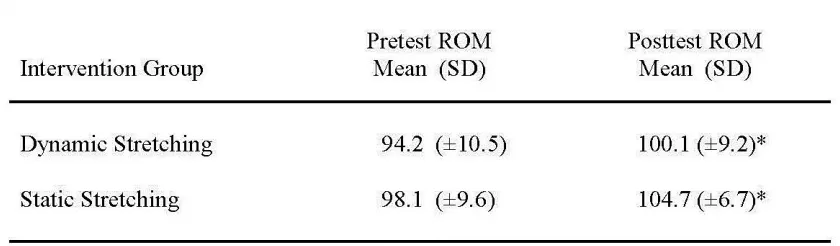
A 2-way ANOVA for repeated measures was used to test the effect of dynamic and standard stretching on hamstring ROM. Pre-test and post-test ROM scores are presented in Table 2. There was a significant main effect for dynamic and standard stretching (P< .001, η2 = .367), indicating a significant increase in ROM in
both groups after the interventions. However, no statistical interaction was observed between stretching groups and time (P = .84, η2 = .001), indicating that there was no significant difference relative to
improvements in ROM between groups.
1158 | 2017 | ISSUE 4 | VOLUME 12 © 2017 University of Alicante
DISCUSSION
This study compared the effects of a 4-week dynamic stretching program to a 4-week standard stretching program on hamstring flexibility in female high-school volleyball players. The main findings of this study showed that both dynamic and standard programs increased hamstring flexibility, but neither group displayed a greater advantage in eliciting flexibility gains.
Effects of Dynamic and Standard Stretching on Flexibility
Several studies have shown that static stretching is effective at increasing ROM (Bandy et al., 1998; Covert, Alexander, Petronis, & Davis, 2010; Davis et al., 2005; LaRoche & Connolly, 2006; Mahieu et al., 2007). However, there is a lack of research investigating the effects of chronic dynamic stretching on flexibility. Our study found no significant difference in hamstring ROM gains between a dynamic stretching program and a standard stretching program. Bandy et al. (1998) compared six weeks of static stretching and dynamic ROM exercises and found significantly greater gains in the static stretching group when compared to the dynamic ROM group. A contributing factor in the divergent findings may include the differing dynamic protocols between the two studies. The training protocol used by Bandy et al. (1998) included a 5-second delay at the end of the range of motion. We found this interesting, insofar as dynamic stretching is cyclic and does not include 5-second pauses (Jaggers et al., 2008). While the dynamic training protocol used by Bandy et al. (1998) was similar to our study, in that they attempted to use equal time at stretch between dynamic and static protocols, their stretching protocol appears to combine static and dynamic concepts rather than being distinctly dynamic in nature. Because cyclic (without pauses) stretching may use different mechanisms to increase range of motion (Mahieu et al., 2007), it is regrettable that a definitively dynamic stretching protocol was not used.
Results of studies comparing cyclic stretching (ballistic and dynamic) to static (standard) stretching have varied. For example, Covert et al. (Covert et al., 2010) found that increases in hamstring flexibility were significantly higher with four weeks of static stretching (11.9°) when compared to 4-weeks ballistic stretching (3.8°). In contrast, LaRoche and Connolly (2006) found that four weeks of static stretching (8.6°) did not significantly differ from 4-weeks of ballistic stretching (9.7°). Also, Bandy et al. (1998) demonstrated that increases in hamstring ROM were significantly higher with chronic static stretching (11.4º) when compared to dynamic ROM exercises (4.3º). In comparison, the current study found no significant difference between the gains in dynamic stretching (5.9°) and the gains of standard stretching (6.6°). A commonality between the studies that demonstrated significantly greater gains in static stretching groups vs. cyclic stretching groups used populations with tight hamstrings. Furthermore, the pre-test ROM values from LaRoche and Connolly (ballistic group: 95.1º; static group: 96.8º) and current study (dynamic group: 94.2º; standard group: 98.1º) were similar. This may mean that static stretching is more effective at increasing flexibility in persons with limited or decreased flexibility.
Mechanisms for Increasing Flexibility
VOLUME 12 | ISSUE 4 | 2017 | 1159
requiring the repetitive stimulus used by ballistic stretching and not the continual stimulus applied by static stretching (Mahieu et al., 2007). If the repetitive stimulus is the mechanism that is responsible for the decreased tendon stiffness, one could consider that dynamic stretching would cause similar findings. Unfortunately, passive tendon stiffness was not measured in this study. Having this information could be important because some believe that decreased tendon stiffness may affect injury prevention and athletic performance (Mahieu et al., 2007).
Effects of Plyometrics on Flexibility
While it is conceivable that the plyometric training program contributed to the increased hamstring flexibility scores registered for both stretching groups, results from previous studies do not lend strong support to this contention. Faigenbaum et al. (2009) examined the effects of a 9-week plyometric training program that did not include stretching. They found that the control group significantly increased sit-and-reach flexibility and the plyometric group did not significantly increase sit-and-reach flexibility. Because the sit-and-reach test primarily measures low back and hamstring flexibility, the target area of intervention in the current study, the findings of Faigenbaum and colleagues (2009) support the assertion that the training that coincided with the intervention of the current study would not contribute to the increased ROM. Faigenbaum et al. (2009) further stressed this point by indicating that if increased flexibility was desired during a plyometric training program, stretching should be included.
CONCLUSIONS
In conclusion, this study revealed that four weeks of dynamic and static stretching that were added to an off-season concurrent plyometric training program improved flexibility. Prior research on static stretching and ballistic stretching indicate that ROM gains are similar, but adaptation in passive tendon stiffness may be different (Mahieu et al., 2007). Unfortunately, the current study did not measure passive tendon stiffness. Further research is needed to compare passive stiffness between static and dynamic stretching before and after training. Also, it should be noted that subjects in this study did not have tight hamstrings. Previous research indicates that when subjects begin a flexibility program with tight hamstrings, static stretching is superior to stretching modes without pauses (ballistic and dynamic). Therefore, tightness of hamstrings should be considered when choosing whether to incorporate static stretching or dynamic stretching into a training regimen. Nevertheless, it appears that both dynamic and standard stretching are effective at increasing flexibility in female high school volleyball players without tight hamstrings.
REFERENCES
1. American College of Sports Medicine. ACSM's Guidelines for Exercise Testing and Prescription, 8th ed. Baltimore, MD: Lippincott, Williams, & Wilkins. 2010.
2. Bandy, W. D., Irion, D., & Briggler, M. The effect of static stretch and dynamic range of motion training on the flexibility of the hamstring muscles. J Orthop Sport Phys. 1998; 27(4), 295-300.
https://doi.org/10.2519/jospt.1998.27.4.295
3. Burkett, L. N., Phillips, W. T., & Ziuraitis, J. (2005). The best warm-up for the vertical jump in college-age athletic men. Journal of Strength and Conditioning Research, 19(3), 673–676.
https://doi.org/10.1519/15204.1
4. Chan, S. P., Hong, Y., & Robinson, P. D. Flexibility and passive resistance of the hamstrings of young adults using two different static stretching protocols. Scand J Med Sci Spor. 2001; 11(2), 81-86.
1160 | 2017 | ISSUE 4 | VOLUME 12 © 2017 University of Alicante 5. Covert, C. A., Alexander, M. P., Petronis, J. J., & Davis, D. S. Comparison of ballistic and static
stretching on hamstring muscle length using equal stretching dose. J Strength Cond Res. 2010; 24(11), 3008-3014. https://doi.org/10.1519/JSC.0b013e3181bf3bb0
6. Craib, M. W., Mitchell, V. A., Fields, K. B., Cooper, T. R., Hopewell, R., & Morgan, D. W. The association between flexibility and running economy in sub-elite male distance runners. Med Sci Sport Exer. 1996; 28(6), 737-743. https://doi.org/10.1097/00005768-199606000-00012
7. Davis, D. S., Ashby, P. E., McCale, K. L., McQuain, J. A., & Wine, J. M. (2005). The effectiveness of 3 stretching techniques on hamstring flexibility using consistent stretching parameters. Journal of Strength and Conditioning Research, 19(1), 27–32. https://doi.org/10.1519/14273.1
8. Dodebo, B., White, J., & George, K. P. A survey of flexibility training protocols and hamstring strains in professional football clubs in England. Brit J Sport Med. 2004; 38(4), 388-394.
https://doi.org/10.1136/bjsm.2002.000044
9. Faigenbaum, A. D., Farrell, A. C., Radler, T., Zbojovsky, D., Chu, D. A., Ratamess, N. A., & Hoffman, J. R. "Plyo Play": A Novel Program of Short Bouts of Moderate and High Intensity Exercise Improves Physical Fitness in Elementary School Children. Phys Educ. 2009; 66(1), 37-44.
10. Fletcher, I. M., & Jones, B. (2004). The effect of different warm-up stretch protocols on 20 meter sprint performance in trained rugby union players. Journal of Strength and Conditioning Research, 18(4), 885–888. https://doi.org/10.1519/14493.1
11. Gleim, G. W., & McHugh, M. P. Flexibility and its effects on sports injury and performance. Sport Med. 1997; 24(5), 289-299. https://doi.org/10.2165/00007256-199724050-00001
12. Herman, S. L., & Smith, D. T. Four-week dynamic stretching warm-up intervention elicits longer-term performance benefits. J Strength Cond Res. 2008; 22(4), 1286-1297.
https://doi.org/10.1519/JSC.0b013e318173da50
13. Hunter, J. P., & Marshall, R. N. Effects of power and flexibility training on vertical jump technique. Med Sci Sport Exer. 2002; 34(3), 478-486. https://doi.org/10.1097/00005768-200203000-00015
14. Jaggers, J. R., Swank, A. M., Frost, K. L., & Lee, C. D. The acute effects of dynamic and ballistic stretching on vertical jump height, force, and power. J Strength Cond Res. 2008; 22(6), 1844-1849.
https://doi.org/10.1519/JSC.0b013e3181854a3d
15. Kokkonen, J., Nelson, A. G., Eldredge, C., & Winchester, J. B. Chronic static stretching improves exercise performance. Med Sci Sport Exer. 2007; 39(10), 1825-1831.
https://doi.org/10.1249/mss.0b013e3181238a2b
16. LaRoche, D. P., & Connolly, D. A. Effects of stretching on passive muscle tension and response to eccentric exercise. Am J Sport Med. 2006; 34(6), 1000-1007.
https://doi.org/10.1177/0363546505284238
17. Mahieu, N. N., McNair, P., De Muynck, M., Stevens, V., Blanckaert, I., Smits, N., & Witvrouw, E. Effect of static and ballistic stretching on the muscle-tendon tissue properties. Med Sci Sport Exer. 2007; 39(3), 494-501. https://doi.org/10.1249/01.mss.0000247004.40212.f7
18. McNeal, J., & Sands, W. Static Stretching Reduces Power Production in Gymnasts. Ped Exer Sci. 2003; 15, 139-145. https://doi.org/10.1123/pes.15.2.139
19. Miller, M. G., Berry, D. C., Bullard, S., & Gilders, R. Comparisons of Land-Based and Aquatic-Based Plyometric Programs During an 8-week training Period. J Sport Rehabil. 2002; 11, 268-283.
https://doi.org/10.1123/jsr.11.4.268
20. Nelson, A. G., Kokkonen, J., & Arnall, D. A. (2005). Acute muscle stretching inhibits muscle strength endurance performance. Journal of Strength and Conditioning Research, 19(2), 338–343.
VOLUME 12 | ISSUE 4 | 2017 | 1161
21. Papadopoulos, G., Siatras, T., & Kellis, S. The Effect of Static and Dynamic Stretching Exercises on the Maximal Isokinetic Strength of the Knee Extensors and Flexors. Isokinet Exerc Sci. 2005; 13(4), 285-291.
22. Safran, M. R., Garrett, W. E., Jr., & Seaber, A. V. The role of warmup in muscular injury prevention. Am J Sport Med. 1988; 16, 123-129. https://doi.org/10.1177/036354658801600206
23. Shrier, I. Stretching before exercise does not reduce the risk of local muscle injury: a critical review of the clinical and basic science literature. Clin J Sport Med. 1999; 9(4), 221-227.
https://doi.org/10.1097/00042752-199910000-00007
24. Siatras, T., Papadopoulos, G., Mameletzi, D., Gerodimos, V., & Kellis, S. Static and Dynamic Acute Stretching Effect on Gymnasts Speed in Vaulting. Ped Exer Sci. 2003; 15(4), 383-391.
https://doi.org/10.1123/pes.15.4.383
25. Stewart, I. B., & Sleivert, G. G. The effect of warm-up intensity on range of motion and anaerobic
performance. J Orthop Sport Phys. 1998; 27(2), 154-161.
https://doi.org/10.2519/jospt.1998.27.2.154
26. Vasdeki, M. Improvement of Hamstring Flexibility Using Different Stretching Methods. Pilot Study-Critical Literature Review. Physiother Iss / Them Fisikother. 2011; 7(1), 33-44.
27. Wallmann, H. W., Mercer, J. A., & McWhorter, J. W. (2005). Surface electromyographic assessment of the effect of static stretching of the gastrocnemius on vertical jump performance. Journal of Strength and Conditioning Research, 19(3), 684–688. https://doi.org/10.1519/R-15904.1
28. Yamaguchi, T., & Ishii, K. (2005). Effects of static stretching for 30 seconds and dynamic stretching on leg extension power. Journal of Strength and Conditioning Research, 19(3), 677–683.
https://doi.org/10.1519/15044.1