A New Method for Load Balancing and QOS in
On demand Protocols–In the MANET’s
Perspective
Dr. B.S Pradeep
Asst. Professor, Department of CSE, RRCE, Bangalore Email: [email protected]
Mrs. Soumya.S,
Student, MTech(IT), KSOU, Mysore Email: [email protected]
---ABSTRACT--- A mobile ad hoc network (MANET) is a collection of mobile nodes where each node is free to move about arbitrarily. The Ad Hoc On-Demand Distance Vector AODV) routing protocol is one of the well-known and efficient on-demand MANET protocols. AODV currently does not support Quality of Service (QoS) and also has no load balancing mechanism. We propose some enhancements to the AODV protocol to provide QoS and load balancing features by adding two extensions to the messages used during route discovery. A detailed packet-layer simulation mo del with media access control (MAC) and physical layer models is used to study the performance of both the AODV and the QoS-AODV protocols. Important performance measures such as average delay, packet delivery fraction and normalized routing load are used in the comparison. Simulations are presented for networks with 50 mobile nodes with different network loads, delay constraints, topological rate of change and mobility speeds.
Keywords: Routing, Performance metrics, packet delivery fraction, Mobility rate & speed
--- Date of Submission: November 11, 2009 Accepted: February 23, 2010
---
1 Introduction
M
obile ad hoc network (MANET) is a collection of mobile nodes where each node is free to move about arbitrarily. Each node logically consists of a router that may have multiple hosts and that also may have multiple wireless communication devices. A MANET is self organizing, adaptive and infrastructure less; AODV currently does not support Quality of Service (QoS) and also has no load balancing mechanism. The QoS routing feature is important in a stand-alone multi hop mobile network for real-time applications and also for a mobile network to interconnect wired networks with QoS support. The first extension (named QoS field) specifies the service requirements (maximum delay is chosen), which must be met by nodes re broadcasting a Route Request or returning a Route Reply for a destination. A detailed packet-layer simulation model with media access control (MAC) and physical layer models is used to study the performance of both the AODV and the QoS-AODV protocols. We extend the ns -2 (network simulator version 2) to include the proposed QoS-AODV protocol, delay constraints, topological rate of change and mobility speeds. Simulation results show the efficiency of the proposed protocol especially in satisfying load balancing and QoS requirements. The rest of the paper is organized asfollows. In the following section, we briefly review the AODV protocol. In Section 2, we present a detailed explanation of the enhancements and extensions added to the protocol. Section 3 describes the simulation environment. Section 4 presents the simulation results followed by their interpretations. Finally we draw our conclusions in Section 5.
2 Modifications to AODV Protocol 2.1 Overview:
RREQ will choose the route with the minimum cost (but satisfying QoS requirements if any) to enable load balancing. When a route to a new destination with QoS is needed, the node has to broadcast a new RREQ message, with QoS flag set to 1, Delay field set to the maximum delay bound, and Cost field set to zero. If, after establishment of such a route, any node along the path detects that the requested QoS parameters can no longer be maintained or the route itself is not available anymore, that node originates a RERR message back to the node which had originally requested the now unavailable QoS parameters.
2.2 Processing and Forwarding Route Requests, Route Replies:
To control dissemination of RREQ with QoS requirements the following enhancements are added to the procedure used for controlling dissemination of RREQ (without QoS requirements):
1. If the NODE_TRAVERSAL_TIME is GREATER than the (remaining) delay in Delay field the intermediate node MUST drop the RREQ.
2. If the NODE_TRAVERSAL_TIME is LESS than the (remaining) delay in message by subtracting from its value the NODE_ TRAVERSAL_TIME, the intermediate node SHOULD send a RREP to the originator with the QoS flag set to 0 and MUST continue broadcasting the RREQ. A node forwarding a RREP with QoS requirements also records the Source IP address in RREP message in the list of source nodes requesting delay guarantees in the corresponding destination’s route table entry. These source nodes are to be notified with a RERR message in case there is a change in NODE_TRAVERSAL_TIME at this node or if the route is not valid any more.
2.3 Route Error Messages :
A node initiates processing for a RERR message in four situations: if it receives a RERR from a neighbor for one or more active routes or if there is a change in its own NODE_TRAVERSAL_TIME affecting a route with QoS requirements. For each one of these destinations, the corresponding routing table entry is updated as follows: 1. The destination sequence number of this routing entry, if it exists and is valid, is incremented for cases (i),(ii) and (iv) above, and copied from the incoming RERR in case (iii) above.
2. The entry is invalidated by marking the route entry as invalid in cases (i), (ii) and (iii) above.
3. The valid QoS flag in the routing table is set to 0 (indicating invalid QoS route) in case (iv).
4. The Lifetime field is updated to current Lifetime plus DELETE_PERIOD. Before this time, the entry should NOT be deleted.
3 Simulation Model 3.1 Network Simulator:
We used ns-2 [24], in order to evaluate the performance of the enhanced QoS-AODV routing protocol with respect to the original AODV protocol. A mobile node has the ability to
move within a given topology, ability to transmit and receive signals to and from a wireless channel.
3.2 Physical and Data Link Layer Model:
Propagation models are used to determine if the data transmitted through the air has been successfully received. These models consider propagation delays, carrier sensing, and capture effects. To accurately model the attenuation of radio waves between antennas close to the ground, radio engineers typically use a model that attenuates the power of a signal as 1 / r2at short distances (r is the distance between the antennas), and as 1 / r4for long distances. The crossover point is called reference distance, and is typically around 100 meters for outdoor low-gain antennas, located 1.5 meters above the ground, and operating in the 1-2 GHz band. If the power level falls below the carrier sense threshold, the packet is discarded as noise. When this event occurs, the protocol may also be used to detect transmission errors. 802.11 is a CSMA/CA protocol, it avoids collisions by checking the channel before using it. Positive acknowledgement requires peers to retransmit data and acknowledge to each other until both are successful.
3.3 Confidence Interval:
We ran different simulations for both protocols (AODV and QoS-AODV) using the same load, but with different simulation times in order to choose the best simulation time. Results are compared for simulation times 400, 600, 800, 1000 and 1200 seconds. There was a large difference for about 20-25% between simulation times 400 seconds and 600 seconds, and also between simulation times 600 and 800 seconds. Most of the results tend to be approximately the same (change in results 3-5%) for simulation times 800, 1000 and 1200 seconds. Therefore, the efficient simulation time for the work is 800 seconds. Taking a safety margin about 10%, we chose the simulation time to be 900 seconds.
3.4 Performance metrics:
The performance measures, which are used for evaluating the performance of the routing protocols, are listed below.
Average end-to-end Delay, in milliseconds -
This is the average end-to-end delay of talking parties in the simulation and it includes all possible delays caused by buffering during route discovery latency, queuing at the interface queue, retransmission delays at the MAC, propagation and transfer times.
identifier i is received. Si: Time at which a packet with
unique identifier i requests a route to be send.
Packet Delivery Fraction, in percentage-
The fraction of successfully received packets, which survive while finding their destination. Successful packet delivery is calculated such that, all data packets with unique identifier leaving the source MAC are counted and defined as originating packets. Received packet identifiers are compared to collected transmission data and each unique packet is counted once to ensure prevention of counting excess receptions, which are mainly caused by multiple paths as a result of mobility. The result is the average of the ratio of uniquely received and all uniquely transmitted packets as seen in the following equation.
F: Fraction of successfully delivered packets. C : Total number of flows, connection. f : Unique flow id. Rf : Count
of unique packets received from flow f . Tf: Count of packets
transmitted to flow f
Normalized Routing Load-
During the route discovery or any other routing related control information flow, a protocol uses the available bandwidth. Control packets may not be consuming a large amount of bandwidth, but they may interfere with the transmissions. The normalized routing load is the number of routing packets “transmitted” per data packet “delivered” at the destination. Each hop-wise transmission of a routing packet is counted as one transmission.
N : Normalized Routing Load. S : Number of successfully received packets. i : Unique packet identifier. Hi : Total
number of hops of the routing packets corresponding to data packet i . The first two metrics are the most important metrics for best effort traffic. The average end-to-end delay evaluates the QoS efficiency of the protocol and show how the delay requirements are achieved.
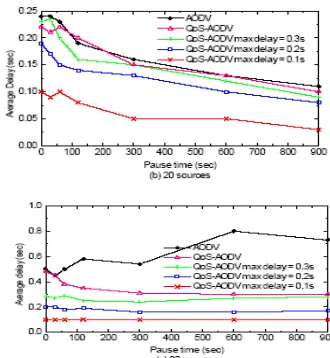
Figure 1 Average data packet delays versus pause time with various numbers of sources
The routing load metric evaluates the scalability of the routing protocol; For example, lower packet delivery fraction means that the delay metric is evaluated with less number of samples. Thus, with a lower delivery fraction, low routing load affects both delivery fraction and delay, as it causes less net congestion and multiple-access interference.
4 Simulation Results
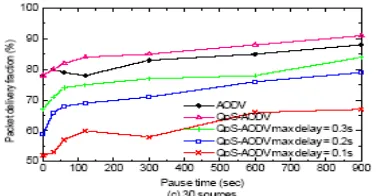
Figure 2 Packet delivery fractions versus pause time with various numbers of sources
For both group of simulation As mentioned before, three levels of workload are defined, namely 10, 20 and 30 sources. The new protocol is introduced with and without QoS delay constraints. Delay constraints were chosen to be 0.1, 0.2 and 0.3 seconds. The AODV is also simulated to be compared with the new protocol.
4.1 Mobi lity Rate Details:
The mobility rate is measured using the concept of pause time. We varied the pause time from 0 to 900 seconds and studied its effect on the performance of the routing protocols. The average node speed in this group of simulations is chosen to be 10 m/s (randomly distributed between 0-20 m/s). Simulation results show that QoSAODV protocol (with no delay constraints) outperforms the AODV protocol when having high network load (30 sources), where the cost extension (load balancing mechanism) has a significant effect. Using delay constraints the QoS-AODV protocol has always better delay than AODV because the
Figure 3 Normalized routing load versus pause time with various numbers of sources
Figure 4 Average data packet delays versus mobility with various numbers of sources
The delay achieved is still better than required for the new protocol with different delay bounds, but the ratio between the required and the achieved delay increases to 3/4. So we need to use a higher scale for the delay in Figure 1(c) compared to Figures 1(a),(b). The AODV protocol has very high delay (Figure 1(c)), on the other side the delay for the QoS-AODV protocol is also increased, but has a much better delay (on the average 40% less) than the AODV protocol. The average delay for 0.1 and 0.2 seconds is exactly 0.1 seconds and 0.2 seconds respectively. That for 0.3 seconds is on the average just 5% below 0.3 seconds. One interesting observation, in Figure 1(c), is that the delay of the AODV protocol increases by low mobility rate.
Figure 5 Packet delivery fractions versus mobility with various numbers of sources
A similar phenomenon was also observed in [16] and [19]. The new protocol overcomes this problem by the cost extension, this extension allows the protocol to choose routes in such a way that load balancing is achieved. The packet delivery fraction are very similar for both QoS-AODV protocol and AODV protocol without delay constraints and with high delay bounds (0.3 seconds) for 10 and 20 sources (Figure 2(a),(b)). For 30 sources, both protocols lose a high percentage of the packet delivery fraction. AODV packet delivery fraction drops to 80%, which is lower than that for 10 and 20 sources by 10- 15%. The QoS-AODV protocol has better packet delivery fraction, where it drops only to 85%. The QoS-AODV protocol with delay constraints has low performance at this point by having a low packet delivery fraction (50-70% for 0.1 seconds delay bound). So in this way more packets are being dropped because the routes available for them do not satisfy the QoS requirements.
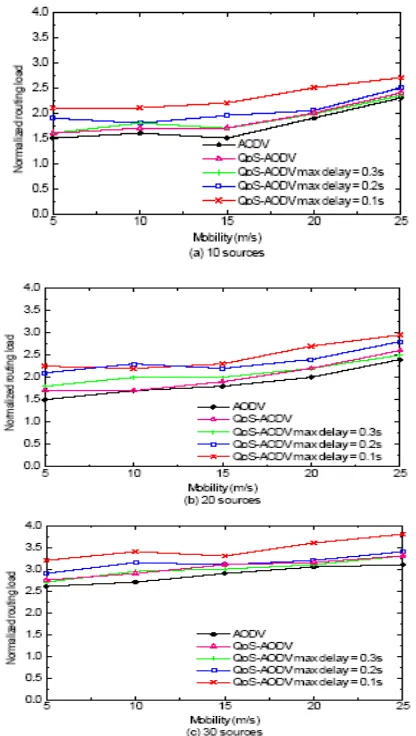
Figure 6 Normalized routing load versus mobility with various numbers of sources
normalized routing load is often similar for both QoS AODV protocol without delay constraints and AODV protocol. Finally, increasing the network load (20 and 30 sources in Figure 3(b),(c)) will increase the normalized routing load because of the need for more routes when having a large number of sources in the network.
4.2 Mobility Speed Details:
In the second group of simulation, we varied the speed of the nodes and studied its effect on the performance of the routing protocols. For each simulation run certain node speed is defined to be used by each node over the simulation. Node speeds are 5, 10, 15, 20 and 25 m/s. The pause time used for this scenarios was 60 seconds, which is chosen to be between high mobility rate (pause time 0 seconds) and no mobility (pause time 900 seconds). Also in this part of simulation the QoS-AODV protocol (with no delay constraints) outperforms the AODV protocol at high network load (30 sources) by having higher packet delivery fraction, and otherwise, for low number of sources has almost the same performance. The average delay for both protocols with no constrains are almost the same (Figure 4) with QoS-AODV slightly better at high network load. For QoS-AODV protocol with delay constraints, the delay is low at low network load (10 sources), and the achieved delay is on the average 75% of that required. The packet delivery fractions for 10 sources (Figure 5) are very similar for both AODV protocol and QoS-AODV protocol without delay constraints. AODV packet delivery fraction drops to less than 70% at high mobility. For the delay bound 0.1 seconds the normalized routing load is greater than that for AODV by a factor of 1.5. As the number of sources increases the normalized routing load also increases, for 30 sources the normalized load is increased by 80% more than that for 10 sources.
5 Conclusions
The area of ad hoc networking has been receiving increasing attention among researchers in recent years, as the available wireless networking and mobile computing hardware bases are now capable of supporting the promise of this technology. Over the past few years, a variety of new routing protocols targeted specifically at the ad hoc networking environment has been proposed. Most of the previous routing solutions for MANET only deal with the best-effort data traffic to provide shortest path routing and achieving a high degree of availability in a dynamic environment where the network topology changes quickly. QoS routing and load balancing features are not supported. This paper contributes in two areas. First, reporting modifications to a well-known and efficient on-demand MANET protocol, namely the AODV routing protocol. The paper proposes some enhancements to the AODV protocol to provide QoS and load balancing features by adding extensions to the messages used during route discovery. The first extension (Delay field) specifies the service requirements, which must be met by nodes rebroadcast a Route Request or returning a Route Reply for a destination.
The second extension (Cost field) provides mobile nodes with sufficient information about different routes to achieve load balancing through the network. Second, using the ns -2 simulation environment, results are presented for a detailed packet-level simulation, comparing the two network routing protocols. The new proposed protocol is tested using different delay bounds to achieve QoS require ments. Each protocol is simulated in ad hoc networks of 50 wireless mobile nodes moving about and communicating with each other over a rectangular (1500m × 300m) flat space for 900 seconds of simulated time and results are presented for a range of node mobility rates and movement speeds. The following three performance metrics are used to compare the performance of the protocols: (a) average end-to-end delay, (b) packet delivery fraction, and (c) normalized routing load. The proposed protocol performs well in supporting the QoS feature. It has high performance for low network loads (low number of sources) by satisfying the QoS requirements with an average end-to-end delay almost half the delay required, in this case packet delivery fraction and normalized routing load are comparable to the original AODV protocol. For high network loads (high number of sources) the QoS requirements are still satisfied, the proposed protocol (with no delay constrains) outperforms the original AODV protocol allowing low end-to-end delay and high packet delivery fraction at points where the original AODV protocol suffers high network congestion and high end-to-end delay (sometimes even with low mobility rate). The delay extension can be used as a bandwidth extension to satisfy minimum bandwidth requirements. In addition, the cost extension can be used to take other parameters into consideration when creating a route to achieve load balancing. The protocol can be used to achieve QoS requirements in mobile ad hoc networks with large number of sources.
References
1. A. Bruce McDonald and Taieb Znati, “A Path Availability Model for Wireless Ad-Hoc Networks”, Proceedings of IEEE WCNC '99., New Orleans, LA.
2. Ali Zahedi and Kevin Pahlavan, “Capacity of a Wireless LAN with Voice and Data Services”, IEEE Transactions on Communications, Vol. 48, No.7, July 2000.
4. C.-K. Toh, Ad Hoc Mobile Wireless Networks Protocols and Systems, Upper Saddle River, NJ: Prentice Hall, December 2001.
5. Charles E. Perkins, Ad hoc Networking, Upper Saddle River, NJ: Addison-Wesley, December 2000.
6. Charles E. Perkins, Elizabeth M. Royer, and Samir R. Das, “Ad hoc On -Demand Distance Vector (AODV) Routing”, IETF MANET Working Group, Internet- Draft,17 February 2003.
7. Charles E. Perkins, Elizabeth M. Royer, and Samir R. Das, “Quality of Service for Ad hoc On-Demand Distance Vector (AODV) Routing”, IETF MANET Working Group, Internet-Draft,14 July 2000.
8. Christian Bornträger, “Simulation der Wegewahl in Ad-hoc Netzen”, Technical University Ilmenau, 17 June 2002.
9. Chunhung Richard Lin and Jain-Shing Liu, “QoS Routing in Ad Hoc Wireless Networks”, IEEE Journal on Selected Areas in Communications, Vol. 17, No. 8, pp. 1426-1438, August 1999. 11. David A. Maltz, Josh Broch, Jorjeta Jetcheva, and David B. Johnson, “The Effects of On-Demand Behavior in Routing Protocols for Multihop Wireless Ad Hoc Networks”, IEEE Journal on Selected Areas in Communications, Vol. 17, No. 8, August 1999.
10. Dmitri D. Perkins and Herman D. Hughes, “Factors Affecting the Performance of Ad Hoc Networks”, Proceedings of the IEEE International Conference on Communications, April 2002.
11. Fall Kevin and Kannan Varadhan, “The ns Manual (formerly ns Notes and Documentation)”, April 14, 2000
12. João L. Sobrinho and A.S. Krishnakumar, “Qualityof- Service in Ad Hoc Carrier Sense Multiple Access Wireless Networks”, IEEE Journal on Selected Areas in Communications, Vol. 17, No. 8, pp. 1353-1368, August 1999.
13. Josh Broch, David A. Maltz, David B. Johnson, Yih- Chun Hu, and Jorjeta Jetcheva, “A Performance Comparison of Multi-Hop Wireless Ad Hoc Network Routing Protocols”, Proceedings of the Fourth Annual ACM/IEEE International Conference on Mobile Computing and Networking, Dallas-Texas, October 1998.
14. M. Scott Corson and Joseph Macker, “Mobile Ad hoc Networking (MANET): Routing Protocol Performance Issues and Evaluation Considerations”, RFC2501, Request for Comments, January 1999.
15. Samir R. Das, Charles E. Perkins, and Elizabeth M. Royer, “Performance Comparison of Two Ondemand
Routing Protocols for Ad Hoc Networks”, Proceedings of the IEEE Conference on ComputerCommunications INFOCOM), pages 3-12, Tel Aviv, Israel, March 2000.
16. Satyabrata Chakrabarti and Amitabh Mishra, “QoS Issues in Ad Hoc Wireless Networks”, IEEE Communications Magazine, February 2001.
17. Shigang Chen and Klara Nahrstedt, “Distributed Quality-of-Service Routing in Ad Hoc Networks”, IEEE Journal on Selected Areas in Communications, Vol. 17, No. 8, pp. 1488-1505, August 1999.
19. Songwu Lu, Vaduvur Bharghavan and R. Srikant, “Fair Scheduling in Wireless Packet Networks”, IEEE/ACM Transactions on Networking, Vol. 7, No. 4, August 1999.
20. T.-W. Chen, J. T. Tsai and M. Gerla, “QoS Routing Performance in Multihop, Wireless Networks”, IEEE 6th ICUPC’97, October 1997.
21. The Network Simulator ns2, http://www.isi.edu/nsnam/ns
Authors Biography
Dr.Pradeep.BS.B.E(CSE).,MTech(N
etworking).,Ph.D(CSE). He is
working as assistant Professor in CSE dept. of RRCE, Bangalore, Karnataka. 8+ years experienced in teaching. His areas of interest are networking, mobile computing, Computer organization, system software.