Cluster head Election for CGSR Routing
Protocol Using Fuzzy Logic Controller for
Mobile
Ad Hoc
Network
K. Venkata Subbaiah
Associate Professor of CSE, K.S.R.M. College of Engineering, Kadapa Email: [email protected]
Dr. M.M. Naidu
Professor Comp. Sci. and Engineering, S.V. University,Tirupati, India
---ABSTRACT---
The nodes in the mobile ad hoc networks act as router and host, the routing protocol is the primary issue and has to be supported before any applications can be deployed for mobile ad hoc networks. In recent many research protocols are proposed for finding an efficient route between the nodes. But most of the protocol’s that uses conventional techniques in routing; CBRP is a routing protocol that has a hierarchical -based design. This protocol divides the network area into several smaller areas called cluster. We propose a fuz zy logic based cluster head election using energy concept for cluster head routing protocol in MANET’S. Selecting an appropriate cluster head can save power for the whole mobile ad hoc network. Generally, Cluster Head election for mobile ad hoc network is based on the distance to the centroid of a cluster, and the closest one is elected as the cluster head'; or pick a node with the maximum battery capacity as the cluster head. In this paper, we present a cluster head election scheme using fuzzy logic system (FLS) for mobile ad hoc networks. Three descriptors are used: distance of a node to the cluster centroid, its remaining battery capacity, and its degree of mobility. The linguistic knowledge of cluster head election based on these three descriptors is obtained from a group of network experts. 27 FLS rules are set up based on the linguistic knowledge. The output of the FLS provides a cluster head possibility, and node with the highest possibility is elected as the cluster head. The performance of fuzzy cluster head selection is evaluated using simulation, and is compared to LEACH protocol with out fuzzy cluster head election procedures and showed the proposed work is efficient than the previous one.
Key Words: Cluster Head election, ad hoc networks, fuzzy logic system, decision making.
--- ---
Date of Submission: November 20, 2009 Revised: December 27, 2009 Accepted: January 10, 2010
--- ---
1. INTRODUCTION
A
mobile ad-hoc network is a self configuring wireless multi-hop collection of mobile hosts that are connected in an arbitrary manner without the support of a fixed networking structure. The ability of network hosts to roam freely lends itself to numerous and erratic changes in topology and consequently paths between nodes are not fixed. Also due to the limited transmission range of wireless network interfaces, multiple network hops may be needed for one node to exchange data with another across the network. In order to facilitate multi-hop communication, nodes must provide routing functionality and support the discovery and maintenance of destination routes. An ad-hoc routing protocol must be distributed as each node should be involved in route discovery making the routing information and link costs more reliable. Dynamically establishing wireless networks and maintaining routes through the network, forwarding packets for each other to facilitate multi-hop communication between nodes not in direct transmission range.CBRP is a routing protocol that has a hierarchical-based design [7], [9]. This protocol divides the network area into several smaller areas called cluster. The clustering algorithm of CBRP is Least Cluster Change or LCC [9] means the node with the lowest ID among its neighbors elects as cluster head. Other nodes lie into radio range of this cluster head will be the ordinary nodes of that cluster. Because of mobility of nodes in ad hoc network this is probable that elected cluster head to be too mobile. In addition, because nodes with cluster head role consume more power than ordinary nodes, mobile node with lower ID discharge soon. Through these reasons cluster head election procedure used in CBRP is not suitable.
Simulation shows that depending upon network configuration a substantial increase in network lifetime can be accomplished as compared to probabilistically selecting the nodes as cluster -heads using only local information.
We compare our approach to a previously proposed popular cluster-head selection technique called LEACH (Low Energy Adaptive Clustering Hierarchy) [1]. LEACH is based on a stochastic model and uses localized clustering. The nodes select themselves as cluster-heads without the base station processing. Other nodes in the vicinity join the closest clusterheads and transmit data to them. Simulation results show that our approach increases the network lifetime considerably as compared to LEACH.
In Section II, we briefly introduce the fuzzy logic system. In Section III, we design a model the rules for cluster head election In Section IV we desgin the rules based on the experiences from a group of network experts. In Section V, we present the computation of the rule-based FLS and generate the decision surface for clust er head election, and compare our scheme against the nearest distance and maximum battery capacity methods based on one example. In section Vi shows results of proposed work. Conclusions are presented in Section VII.
II. OVERVIEW OF FUZZY LOGIC SYSTEMS
Figure 1 shows the structure of a fuzzy logic system (FLS) . When an input is applied to a FLS, the inference engine computes the output set corresponding to each rule. The defuzzifer then computes a crisp output from these rule output sets.
During defuzzification, it finds the point where a vertical line would slice the aggregate set chance into two equal masses. In practice, the COG (Center of Gravity) is calculated and estimated over a sample of points on the aggregate output membership function, using the following formula:
Many proposals have been made to select clusterheads. In the case of LEACH [1], to become a clusterhead, each node n chooses a random number between 0 and 1. If the
number is less than the threshold T(n), the node becomes the cluster-head for the current round. The Threshold is set at:
where, P is the cluster-head probability, r the number of the current round and G the set of nodes that have not been cluster -heads in the last 1/P rounds.
Several disadvantages are there for selecting the cluster-head using only the local information in the nodes. Firstly, since each node probabilistically decides whether or not to become the cluster -head, there might be cases when two cluster-heads are selected in close vicinity of each other increasing the overall energy depleted in the network. Secondly, the number of cluster-head nodes generated is not fixed so in some rounds it may be more or less than the preferred value. Thirdly, the node selected can be located near the edges of the network; wherein the other nodes will expend more energy to transmit data to that cluster-head. Fourthly, each node has to calculate the threshold and generate the random numbers in each round, consuming CPU cycles.
LEACH-C [2] uses a centralized algorithm and provides another approach to form clusters as well as selecting the cluster-heads using the simulated annealing technique.
In [3] each node calculates its distance to the area centroid which will recommend nodes close to the area centroid and not the nodes that is central to a particular cluster, cluster centroid. Thus it leads to overall high energy consumption in the network for other nodes to transmit data through the selected node .
III. System Model
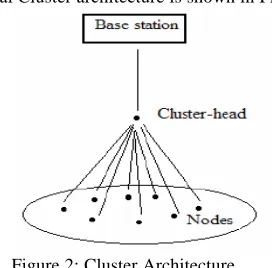
A typical Cluster architecture is shown in Figure 2.
Figure 2: Cluster Architecture
The nodes send data to the respective cluster -heads, which in turn compresses the aggregated data and transmits it to the base station. For a MANET we make the following assumptions:
• The base station is located far from the mobile nodes and is immobile.
• All nodes in the network are homogeneous and energy constrained.
• Symmetric propagation channel.
• Base station performs the cluster-head election. • Nodes have location information that they send to the
base station with respective energy levels during set up phase.
• Nodes have little or no mobility
In our opinion a central control algorithm in the base station will produce better cluster-heads since the base station has the global knowledge about the network. Moreover, base stations are many times more powerful than the mobile nodes, having sufficient memory, power and storage. In this approach energy is spent to transmit the location information of all the nodes to the base station (possibly using a GPS receiver). Considering MANET’S are meant to be deployed over a geographical area with the main purpose of sensing and gathering information, we assume that nodes have minimal mobility, thus sending the location information during the initial setup phase is sufficient.
The cluster -head collects n number of k bit messages from n nodes that joins it and compresses it to cn k bit messages with c =?1 as the compression coefficient. The operation of this fuzzy cluster -head election scheme is divided into two rounds each consisting of a setup and steady state phase similar to LEACH. During the setup phase the cluster-heads are determined by using fuzzy knowledge processing and then the cluster is organized. In the steady state phase the cluster-heads collect the aggregated data and performs signal processing functions to compress the data into a single signal. This composite signal is then sent to the base station.
The radio model we have used is sim ilar to [1] with Eelec = 50 nJ/bit as the energy dissipated by the radio to run the transmitter or receiver circuitry and εamp ?= 100
pJ/bit/m2 as the energy dissipation of the transmission amplifier.
The energy expended during transmission and reception for a k bit message to a distance d between transmitter and receiver node is given by:
IV. EXTRACTING THE KNOWLEDGE FOR CLUSTERHEAD ELECTION
We collect, the knowledge for cluster head election based on the following three descriptors:
1. Distance of a node to the cluster centroid,
2. Its remaining battery capacity, and
3. Its degree of mobility.
We designed questions such as:
IF distance of a node to the cluster centroid is near, and its remaining battery capacity is low, and its degree
of mobility is moderate, THEN the possibility that this node will be elected as a cluster head is.
So we need to set up 33 = 27 (because every antecedent has 3 fuzzy subsets, and there are 3 antecedents) rules for this FLS.
We used rules obtained from the knowledge of 6 network experts. These experts were requested to choose a consequent, using one of the five linguistic variables. Different experts gave different answers to the questions in the survey. Table I summarizes the questions used in this survey. Expert knowledge is represented based on the following three descriptors:
• Node Remaining Energy - energy level available in each node, designated by the fuzzy variable energy
• Node Distance - distance of a node to the cluster centroid, designated by the fuzzy variable Distance • Node Mobility - a value which classifies the nodes
based on how central the node is to the cluster, designated by the fuzzy variable mobility.
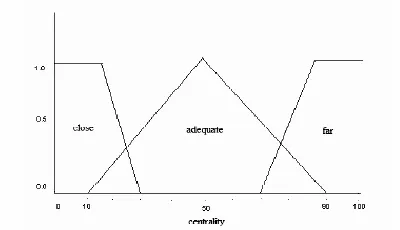
The linguistic variables used to represent the node energy and node concentration, are divided into three levels: low, medium and high, respectively, and there are three levels to represent the node centrality: close,
adequate and far, respectively. The outcome to represent the node cluster-head election chance was divided into seven levels: very small, small, rather small, medium,
rather large, large, and very large. The fuzzy rule base currently includes rules like the following: if the energy
is high and the concentration is high and the centrality is
close then the node’s cluster-head election chance is very large.
Thus we used 33 = 27 rules for the fuzzy rule base. We used triangle membership functions to represent the fuzzy sets medium and adequate and trapezoid membership functions to represent low, high, close and
far fuzzy sets. The membership functions developed and their corresponding linguistic states are represented in Table 1 and Figures 3 through 6.
Table 1: Fuzzy rule base
Energy Distance Mobility Chance
1 Low Low Close Small
2 Low Low adeq small
3 Low Low far vsmall
5 Low med adeq small
6 Low med far small
7 Low high close rsmall
8 Low high adeq Small
9 Low high far vsmall
10 med Low close rlarge
11 med Low adeq med
12 med Low far small
13 med med close large
14 med med adeq rlarge
15 med med far rsmall
16 med high close large
17 med high adeq rlarge
18 med high far rsmall
19 high Low close rlarge
20 high Low adeq med
21 high Low far rsmall
22 high med close large
23 high med adeq rlarge
24 high med far med
25 high high close vlarge
26 high high adeq rlarge
27 High high far med
Legend: adeq=adequate, med = medium, vsmall=very small, rsmall=rather small, vlarge= very large, rlarge= rather large.
All the nodes are compared on the basis of chances and the node with the maximum chance is then elected as the cluster-head. Each node in the cluster associates itself to the cluster-head and starts transmitting data. The data transmission phase is similar to the LEACH steady-state phase.
Fig 3 : fuzzy set for fuzzy variable Energy & Concent ration
V. KNOWLEDGE PROCESSING AND C LUSTERHEADELECTION DECISION
In our approach to forming a rule base, we chose a single consequent for each rule. To do this, we averaged the centroids of all the responses for each rule and used this average in place of the rule consequent centroid. Doing this leads to rules that have the following form:
R' : IF distance of a node to the cluster centroid (xl) is Fl 1', and its remaining battery capacity (x2) is Fl 2, and its degree of mobility (x3) is Fl 3, THEN the possibility that this node will be elected as a clusterhead (y) is cl avg,
VI. RESULTS
To test and analyze the algorithm, experimental studies were performed. The simulator was programmed using Java Foundation Classes and the NRC fuzzy Java Expert System Shell (JESS) toolkit. We modeled the energy consumption in MANET as given in (2, 3). To define the lifetime of the mobile network we used the metric First Node Dies (FND) [9], meant to provide an estimate for the quality of the network.
reference network consisting of 20 randomly generated nodes over an area of 100X100 meters with the cluster-head probability of 0.05. Therefore about 1 node per round becomes cluster-head, making it suitable for us to compare easily.
Both algorithms optimize the intra-cluster energy consumption and thus do not influence the energy required to transmit to the base station. Table 2 shows four simulation runs to calculate the number of rounds taken by LEACH and the fuzzy cluster-head election algorithm for FND.
VII. CONCLUS IONS
Generally, clusterhead election for mobile ad hoc network is based on the distance to the centroid of a cluster, and the closes one is elected as the clusterhead. We present a clusterhead election scheme using fuzzy logic system (FLS) for mobile ad hoc wireless networks. Three descriptors are used: distance of a node to the cluster centroid, its remaining battery capacity, and its degree of mobility. The linguistic knowledge of clusterhead election based on these three descriptors is obtained from a group of network experts. 27 FLS rules are set up based on the linguistic knowledge. The output of the FLS provides a clusterhead possibility, and node with the highest possibility is elected as the clusterhead. Other appropriate rules can be created that optimize routing efficiency (e.g., number of hops, QOS, etc).
References
[1] W. Heinzelman, A. Chandrakasan and H. Balakrishnan “Energy -efficient communication protocol for wireless microsensor networks,” in
Proc. of the 33rd Annual Hawaii International Con ference on System Sciences (HICSS), Maui, HI, Jan. 2000, pp. 3005 – 3014.
[2] W. Heinzelman, A. Chandrakasan and H. Balakrishnan,“An application-specific protocol architecture for wireless microsensor networks,” in
IEEE Transactions on Wireless Communications, Oct. 2002, pp. 660 - 670.
[3] Q. Liang, “Clusterhead election for mobile ad hoc wireless network,” in Proc. 14th IEEE International Symposium on Personal, Indoor and Mobile Radio Communications, (PIMRC), Sept. 2003, pp. 1623 - 1628.
[4] S. Hammadi and C. Tahon, “Special issue on intelligent techniques in flexible manufacturing systems”, in IEEE Transactions on Systems, Man and Cybernetics, May 2003, pp. 157-158.
[5] B. Warneke, M. Last, B. Liebowitz and K.S.J. Pister, “Smart Dust: communicating wit h a cubic-millimeter computer,” IEEE Computer, Jan. 2001, pp. 44 - 51.
[6] E. Cayirci, “Data aggregation and dilution by modulus addressing in wireless sensor networks,”
IEEE Communications Letters, Aug. 2003, pp. 355 – 357.
[7] C. Chee-Yee and S.P. Kumar, “Sensor networks: evolution, opportunities, and challenges,” in Proc of the IEEE, Aug. 2003, pp.1247 - 1256.
[8] M. Negnevitsky, Artificial intelligence: A guide to intelligent systems, Addison-Wesley, Reading, MA, 2001.
[9] M.J. Handy, M. Haase and D. Timmermann, “Low energy adaptive clustering hierarchy with deterministic cluster-head selection,” in Proc. 4th International Workshop on Mobile and Wireless Communications Network, Sept. 2002, pp. 368 -372. [10] A. Safwat, H. Hassanein. and H. Mouftah, "Power-aware fair infrastructure formation for wireless mobile ad hoc communications," Proc. of
GIobecom'2OOl, pp. 2832-?836, San Antonio, TX, Sept 2001.
[11] S. Singh, M. Woo, and C. S. Raghavendra, "Power-aware routing in mobile ad hoc networks," Proc. of
Annual ACM/IEEE International Conf. on Mobile Computing and Networking (MobiCom), Dallas, TX, pp. 181 -190, 1998.
[12] C.K.Toh, "Maximum battery life routing to support ubiquitous mobile computing in wireless ad hoc networks," IEEE Communicolions Magazine, vol. 39, no. 6, pp. 138 -147, July 2000.
[13] V. Rodoplu, and T. Meng, '' Minimum energy mobile wireless networks," IEEE .j. Selected Areas in Communications, vol. 17, no. 8, pp. 1333-1344, Aug 2000.
[14] S.L. Wu, Y.C. Tseng, and .j.P. Sheu. "Intelligent medium access for mobile ad hoc networks with busy tones and power control." IEEE J. Selected
Areas in Communicntions, vol. 18, no. 9, pp. 1647-1657, Sept 2000.
[I5] Y.xue and B. Li, "A location-aided power -aware routing protocol in mobile ad hoc networks," Proc.
Authors Biography
Mr.Venkata Subbaiah Kakumani Pursuing Ph.D in Computer Science and Engineering at S.V. University, Tirupati, A.P. He obtained MCA from Osmania University and M.E., (CSE)from National Institute of Technology, Rourkela. He is having 15 years of experience in teaching. He is currently working as Associate Professor in the Department of CSE, K.S.R.M. College of Engineering, Kadapa. He as Presented and published eight Technical papers in National and International Conferences and One Technical paper in International Journal and one National Journal.