Review Article
Association of social factors with low birth weight:
a narrative review
Yamini Marimuthu
1, Sonali Sarkar
2*, Manikandanesan Sakthivel
2, Yuvaraj K.
2,
Bharathnag N.
2, Gokul Sarveswaran
2INTRODUCTION
Low birth weight (LBW) defined as birth weight less than 2500 grams includes preterm birth and intrauterine growth restriction (IUGR). Globally 20 million infants are born with low birth weight accounting for 15.5 % of all births, of which 95.6% is from developing countries.1 India contributes to 40% of global low birth weight burden with 7.5 million babies born with low birth weight
every year. Among total live births in a year 30% children are born with LBW.2 It was found that LBW children are at 20 times higher risk of dying when compared to children with birth weight more than 2500grams.3 Reducing low birth weight (which includes preterm births) was identified as the key strategy to decrease infant mortality as early as 1985.4 LBW children are also associated with many complications like poor growth in childhood, impaired immune system and other
ABSTRACT
Low birth weight (LBW) is a major cause for neonatal morbidity and mortality. Apart from various medical risk factors, social factors also have an impact on birth weight. The objective of the study were to review the globally available evidences on the association between LBW and social factors like social support, spouse support and spouse abuse experienced by the mothers during the antenatal period. A narrative review was done during 2017 in which various literatures available “PubMed” and “Google Scholar” related to the social factors like social support, spouse support and spouse abuse and low birth weight were reviewed after checking for full text availability and removing duplicates. The antenatal mothers with high perceived social support was associated with 60% lesser odds of having LBW. Mothers with high perceived spouse support had 23% lesser odds of having LBW both of which might act through financial, moral, emotional and behavioral pathways. Various studies have found positive association between LBW and spouse abuse and the OR ranged from 1.3 to 3.8. The definitions and instruments used for the social support, spouse support and spouse abuse are varied making it difficult to interpret varied results in different study settings. With the available few evidences it can be concluded that lack of spouse support and social support and the presence of spousal abuse during antenatal period increases the odds of still birth, preterm birth and low birth weight among children.
Keywords: Determinants, Domestic violence, Etiology, Low birth weight, Social factors, Social support, Spouse abuse, Spouse support
1
Department ofCommunity Medicine, Rajah Mutiah Medical College, Chidambaram, Tamil Nadu, India
2Department of Preventive and Social Medicine, Jawaharlal Institute of Postgraduate Medical Education and Research
(JIPMER), Puducherry, India
Received: 14 May 2018
Revised: 02 July 2018
Accepted: 04 July 2018
*Correspondence:
Dr. Sonali Sarkar,
E-mail: [email protected]
Copyright: © the author(s), publisher and licensee Medip Academy. This is an open-access article distributed under the terms of the Creative Commons Attribution Non-Commercial License, which permits unrestricted non-commercial use, distribution, and reproduction in any medium, provided the original work is properly cited.
adulthood diseases like diabetes mellitus, hypertension, cardiovascular disease, other metabolic diseases and long term neurodevelopmental impairment during childhood.5 Though various medical and socio-demographic factors have been identified as the risk factors for LBW, there are many evidences to show that the social factors like social support, spouse support and spouse abuse during antenatal period also influence the birth weight of the children. But there are limited studies which give a comprehensive overview of the available evidences for the social causes of LBW. So this study was done to review the globally available evidences on the association between LBW and social factors like social support, spouse support and spouse abuse experienced by the mothers during the antenatal period.
METHODS
This review was done between January and December 2017. An extensive literature search on LBW and its risk factors was carried out from the databases “PubMed” and “Google Scholar”. The studies published in English between 1995 and 2017 were considered for inclusion in the study. Search terms used were “Infants, LBW”, “Social support”, “spouse support” “Pregnancy”, “Domestic violence”, “Antenatal domestic violence”. These search terms were used in different combinations in PubMed. Search terms had to be present either in the title or the abstract, for the article to be included in the study. The articles retrieved from this search strategy were then screened for relevance to the study objective. Duplicates were then removed and only those articles with available free full text were selected for the study. Screening of reference lists in the selected articles was done and the articles relevant for our objective were also included in the study after checking for duplication.
RESULTS
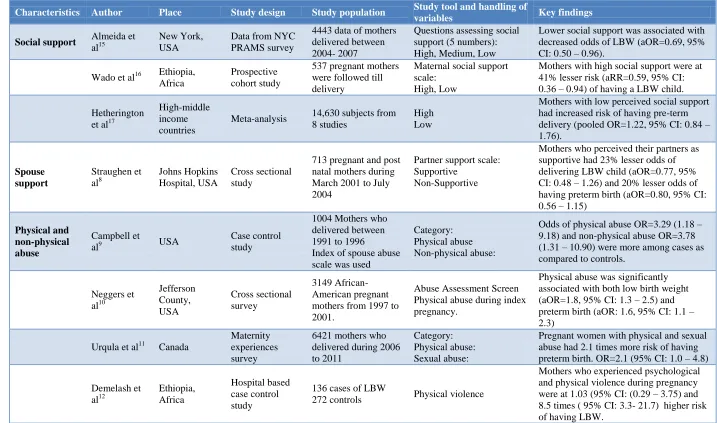
Social factors which can also affect birth weight of the baby are perceived spouse support, perceived social support and spouse abuse. In total eight studies were included in this review, three for social support, one for spouse support, and four for spouse abuse. Out of the three studies included for social support, one study was a meta-analysis which analyses studies from high and middle income countries. A brief description of the studies included and their salient results are given in the Table 1.
Social factors for LBW and still birth
Social support
Limited studies were available from literature which assessed the effect of social support during pregnancy with LBW. Social support had been assessed by different instruments in different studies. Two of them showed that high social support during pregnancy decreased the incidence of LBW by 60%.
Spouse support
Studies which assessed the effect of spouse support on LBW were very limited. One such study was done by Straughen et al in which 713 pregnant mothers who were receiving prenatal care from one of the Johns Hopkins hospital, USA from March 2001 to July 2004 were assessed for partner support and LBW.8 Partner support scale was used to assess the partner support during pregnancy. It was found that women who perceived their partners as supportive were 23% protective for LBW (aOR=0.77, 95% CI: 0.48 - 1.26) and 20% protective for preterm birth (aOR=0.80, 95% CI: 0.56 – 1.15) after adjusting for family resource scale and emotional abuse scale.
Physical and non-physical abuse by spouse
Studies done across the world to find the effect of spouse abuse with LBW used various tools for assessment. Even the terms used by different authors were different e.g. Intimate partner violence, domestic violence, violence by husband, spouse abuse. The definitions they used for spouse abuse were also different. Most of the studies found positive association between LBW and spouse abuse and the OR ranged from 1.3 to 3.8.9-12 Spouse abuse is categorized into physical and non-physical domains. Besides physical abuse, non-physical abuse was also associated with LBW at an increased risk of 280%.9
DISCUSSION
Social support and low birth weight
Table 1: Epidemiological studies reporting the association of antenatal social factors with low birth weight.
Characteristics Author Place Study design Study population Study tool and handling of
variables Key findings
Social support Almeida et
al15
New York, USA
Data from NYC PRAMS survey
4443 data of mothers delivered between 2004- 2007
Questions assessing social support (5 numbers): High, Medium, Low
Lower social support was associated with decreased odds of LBW (aOR=0.69, 95% CI: 0.50 – 0.96).
Wado et al16 Ethiopia, Africa
Prospective cohort study
537 pregnant mothers were followed till delivery
Maternal social support scale:
High, Low
Mothers with high social support were at 41% lesser risk (aRR=0.59, 95% CI: 0.36 – 0.94) of having a LBW child.
Hetherington et al17
High-middle income countries
Meta-analysis 14,630 subjects from 8 studies
High Low
Mothers with low perceived social support had increased risk of having pre-term delivery (pooled OR=1.22, 95% CI: 0.84 – 1.76).
Spouse support
Straughen et al8
Johns Hopkins Hospital, USA
Cross sectional study
713 pregnant and post natal mothers during March 2001 to July 2004
Partner support scale: Supportive
Non-Supportive
Mothers who perceived their partners as supportive had 23% lesser odds of delivering LBW child (aOR=0.77, 95% CI: 0.48 – 1.26) and 20% lesser odds of having preterm birth (aOR=0.80, 95% CI: 0.56 – 1.15)
Physical and non-physical abuse
Campbell et
al9 USA
Case control study
1004 Mothers who delivered between 1991 to 1996
Index of spouse abuse scale was used
Category: Physical abuse Non-physical abuse:
Odds of physical abuse OR=3.29 (1.18 – 9.18) and non-physical abuse OR=3.78 (1.31 – 10.90) were more among cases as compared to controls.
Neggers et al10
Jefferson County, USA
Cross sectional survey
3149 African- American pregnant mothers from 1997 to 2001.
Abuse Assessment Screen Physical abuse during index pregnancy.
Physical abuse was significantly associated with both low birth weight (aOR=1.8, 95% CI: 1.3 – 2.5) and preterm birth (aOR: 1.6, 95% CI: 1.1 – 2.3)
Urqula et al11 Canada
Maternity experiences survey
6421 mothers who delivered during 2006 to 2011
Category: Physical abuse: Sexual abuse:
Pregnant women with physical and sexual abuse had 2.1 times more risk of having preterm birth. OR=2.1 (95% CI: 1.0 – 4.8)
Demelash et al12
Ethiopia, Africa
Hospital based case control study
136 cases of LBW
272 controls Physical violence
Spouse support and low birth weight
Straughen et al study found that high perceived spouse support was protective for both LBW and preterm birth (PTB).8 In addition to the three pathways involved in the association of social support with low birth weight, spouse support involves a fourth pathway in causing adverse pregnancy outcome like LBW and PTB. This pathway works through the absence of financial support. This is more so in countries like India where because of gender discrimination, women are not employed and they are completely dependent on their spouses for financial support. Spouse support also plays important role in antenatal period by providing access to prenatal care. Also, spouses help in positive pregnancy behaviors like decreasing the mental stress by giving moral support, taking the mother outside for relaxation and entertainment and healthy diet.
Physical and non-physical abuse by spouse and low birth weight
Physical abuse is associated with LBW in all the studies included in this review. Physical abuse leads to LBW through direct injury and indirect psychological issues.13 But even non-physical abuse leads to LBW which is evident from the studies done by Campbell et al and Demelash et al.9,12 Non-physical abuse through indirect pathways might lead to low birth weight. The mother might be in emotional distress because of the non-physical abuse. She might not receive adequate prenatal care because of stress and also because of lack of support. Mental stress might decrease the appetite of the mother so her nutrition may get affected. Malnutrition is an established risk factor for low birth weight. Stressed mothers are more prone to substance abuse which is again associated with LBW.14
Strengths for this review
First, it explored the social factors associated with LBW. Apart from the medical causes associated with LBW even social factors causes LBW. Second, multiple social factors are included in this review like social support, Spouse support and spouse abuse. The limitations for this review is that it included less number of studies since studies which assessed the effect of social factors causing LBW are very limited.
CONCLUSION
Apart from the socio-demographic and medical causes of low birth weight the social factors like social support, spouse support and spouse abuse during antenatal period are also associated with LBW. Studies are very limited in finding the association of these social factors with pregnancy outcomes like low birth weight. The definitions used for the social support, spouse support and spouse abuse are also widely varied and the instruments used to measure these social factors were
also different, making it difficult to interpret varied results in different study settings. Studies with better study designs and standard instruments are needed to find the association of these social factors with low birth weight. With the available few evidences it can be concluded that lack of spouse support and social support and the presence of spousal abuse during antenatal period increases the odds of still births and low birth weight among children.
Funding: No funding sources Conflict of interest: None declared Ethical approval: Not required REFERENCES
1. Committing to Child Survival: A Promise Renewed Progress Report 2014. New York: UNICEF; 2014. Available at: http://files.unicef.org/publications/ files/APR_2014_web_15Sept14.pdf. Accessed on 19 June 2017.
2. INAP India Newborn Action Plan. New Delhi:
Ministry of Health and Family Welfare,
Government of India; 2014. Available at: http://nhm.gov.in/images/pdf/programmes/inap-final.pdf. Accessed on 19 June 2017.
3. Low Birthweight Country Regional and Global Estimates. Switzerland: United Nations Children’s Fund and World Health Organization; 2004. Available at: http://apps.who.int/iris/bitstream/ 10665/43184/1/9280638327.pdf. Accessed on 19 June 2017.
4. McCormick MC. The contribution of low birth weight to infant mortality and childhood morbidity. N Engl J Med. 1985;312(2):82–90.
5. Hack M, Klein NK, Taylor HG. Long-term
developmental outcomes of low birth weight infants. Future Child. 1995;5(1):176–96.
6. Berkman LF, Kawachi I, Glymour MM. Social Epidemiology. 2nd edition. Oxford: OUP USA; 2014.
7. Roy-Matton N, Moutquin JM, Brown C, Carrier N, Bell L. The impact of perceived maternal stress and other psychosocial risk factors on pregnancy
complications. J Obstet Gynaecol Can.
2011;33(4):344–52.
8. Straughen J, Caldwell CH, Young AAJ, Misra DP. Partner support in a cohort of African American families and its influence on pregnancy outcomes and prenatal health behaviors. BMC Pregnancy Childbirth. 2013;13:187.
9. Campbell J, Torres S, Ryan J, King C, Campbell DW, Stallings RY, et al. Physical and Nonphysical Partner Abuse and Other Risk Factors for Low Birth Weight among Full Term and Preterm Babies: A Multiethnic Case-Control Study. Am J Epidemiol. 1999;150(7):714–26.
11. Urquia ML, O’Campo PJ, Heaman MI, Janssen PA, Thiessen KR. Experiences of violence before and during pregnancy and adverse pregnancy outcomes: an analysis of the Canadian Maternity Experiences Survey. BMC Pregnancy Childbirth. 2011;11:42. 12. Demelash H, Motbainor A, Nigatu D, Gashaw K,
Melese A. Risk factors for low birth weight in Bale zone hospitals, South-East Ethiopia : a case–control study. BMC Pregnancy Childbirth. 2015;15:264. 13. Bailey BA. Partner violence during pregnancy:
prevalence, effects, screening, and management. Int J Womens Health. 2010;2:183–97.
14. Nkansah-Amankra S, Luchok KJ, Hussey JR, Watkins K, Liu X. Effects of maternal stress on low birth weight and preterm birth outcomes across neighborhoods of South Carolina, 2000-2003. Matern Child Health J. 2010;14(2):215–26.
15. Almeida J, Mulready-Ward C, Bettegowda VR, Ahluwalia IB. Racial/Ethnic and nativity differences in birth outcomes among mothers in New York
City: the role of social ties and social support. Matern Child Health J. 2014;18(1):90–100.
16. Wado YD, Afework MF, Hindin MJ. Effects of maternal pregnancy intention, depressive symptoms and social support on risk of low birth weight: a prospective study from southwestern Ethiopia. PloS One. 2014;9(5):e96304.
17. Hetherington E, Doktorchik C, Premji SS, McDonald SW, Tough SC, Sauve RS. Preterm Birth and Social Support during Pregnancy: a Systematic Review and Meta-Analysis. Paediatr Perinat Epidemiol. 2015;29(6):523–35.
Cite this article as: Marimuthu Y, Sarkar S, Sakthivel M, Yuvaraj K, Bharathnag N, Sarveswaran G.