When Control Exacerbates Distress: A Qualitative
1
Study Exploring the Experiences of Hong Kong
2
Chinese Parents in Caring for a Child with Asthma
3
Yuen-yu Chong 1, Doris Leung 1, 2 , and Yim-wah Mak 1,*
4
1 School of Nursing, The Hong Kong Polytechnic University, Hung Hom, Kowloon, Hong Kong Special
5
Administrative Region
6
2 The Lawrence S. Bloomberg Faculty of Nursing, University of Toronto, 155 College Street, Suite 130,
7
Toronto, ON Canada
8
* Correspondence: [email protected]; Tel.: (852) 2766-6421
9
10
Abstract: Many parents have difficulty managing childhood asthma. In Hong Kong (HK), while
11
medication is the primary form of treatment, traditional Chinese medicine is another favored
12
option. In addition, HK follows a dual-track healthcare system, which may pose unique
13
experiences for Chinese parents in childhood asthma management. This qualitative descriptive
14
study aimed to explore the experiences of HK Chinese parents in caring for their children with
15
asthma. Methods: Fourteen HK Chinese mothers of children (aged 3-10) suffering from asthma
16
were purposively sampled to participate in individual, semi-structured interviews. A realist
17
approach following conventional content analysis was used to interpret the interviews. Results:
18
The mothers expressed feelings of uncertainty, fear of asthma crises, and searching for ways to
19
cope. These feelings triggered various strategies to control their child’s asthma. As long as the
20
child’s asthma symptoms recurred, the mothers’ distress continued. Their distress was sometimes
21
exacerbated by self-doubt and worries about whether they would receive adequate support from
22
their family and healthcare professionals. Conclusion: Helping parents to understand their limits
23
may help them be more open to varied aspects of their caregiving experiences, and thus to cope
24
better. Psychological interventions together traditional educational training may help to alleviate
25
parents’ psychological difficulties.
26
Keywords: Parents; children; asthma; qualitative research; psychological distress; psychological
27
adjustment
28
29
1. Introduction
30
Asthma is the most common chronic respiratory disease affecting over 235 million people
31
worldwide [1]. The International Study of Asthma and Allergies in Childhood (ISACC), involving
32
approximately 1.2 million schoolchildren worldwide, reported a global prevalence of asthma of
33
11.7% for children aged 6-7 years, and 14.1% for children aged 13-14 years, respectively [2]. Globally,
34
as countries industrialize and more people adopt Western lifestyles, the prevalence of childhood
35
asthma has grown by approximately 50% each decade. In China, the growth is even more
36
pronounced [3], particularly in Hong Kong (HK), whereby the highest rate of prevalence occurs in
37
children (10.2%); higher than that of other urban cities such as Beijing (6.3%) and Guangzhou (6.9%)
38
[4].
39
Parents are the crucial caregivers and primarily responsible for managing their young child’s
40
asthma, which is challenging. During the pre-diagnostic phase, the unpredictably of asthma is
41
characterized of its life-threatening nature and triggers distress in parents [5]. Further, parents
42
typically report feelings of uncertainty and powerlessness at this stage [6]. Hence, in attempts to
43
control their child’s symptoms, they engage in a variety of asthma management activities, including
44
complying with medical treatments [7], monitoring their children’s symptoms, and coordinating
45
family routines to avoid environmental triggers [8]. This creates daily routines that may be complex
46
and are burdensome [8-10].
47
Generally, when compared with parents of healthy children, parents of children with asthma
48
experience a greater level of stress [11], anxiety, and depressive symptoms [12]. This is likely because
49
even though some parents learn to strategically gain access to the healthcare system and confirm
50
their children’s diagnoses [6, 13], many still report ongoing fear and anxiety that their child’s asthma
51
may become life-threatening [14-16].
52
Asthma is regarded as effectively treatable when parents and their children are educated about
53
the disease management and have access to high-quality healthcare services [1]. In HK, the
54
healthcare system runs on a dual-track basis. Children who have been diagnosed with asthma
55
receive asthma-related healthcare services on a fee-for-service basis in private clinics and hospitals,
56
and/or on a subsidized basis in general outpatient clinics and public hospitals run by the HK
57
Hospital Authority [17]. Very often parents need to decide which of the abovementioned healthcare
58
services to choose when their child has an acute asthma attack or needs follow-up care.
59
Following the best evidence from the Global Initiative for Asthma, the primary treatment of
60
childhood asthma is medication, including inhaled corticosteroids and short-acting bronchodilators
61
[1]. Meanwhile, in HK, traditional Chinese medicine is another option for which the local population
62
favors. In particular, traditional Chinese medicine is perceived to enable “curing the root of the
63
problem” though slow to demonstrate outcomes, and Western medicine is “more powerful but
64
sometimes too powerful with significant side effects” [18]. Hence, within these social structures of a
65
dual-track healthcare system, and how HK Chinese parents perceive the problem, they may have
66
unique experiences in caring for their children with asthma. Moreover, given the limited
67
understanding of the state of asthma management among families in the Asia-Pacific region, the aim
68
of the present study was to explore the experiences of HK Chinese parents in caring for a child with
69
asthma.
70
2. Methods
71
Authors chose a qualitative descriptive design, deemed appropriate for exploring the
72
experiences of individuals situated in a particular context that have received little attention in the
73
literature [19]. A realist paradigm was employed in order to reveal social representations of truth,
74
apart from what may be actual (including empirical), within the narratives of individuals’ inner
75
experiences [20]. A realist approach explores how individuals experience events as they occur, in the
76
ways they occur; that is, what social structures (e.g., cultural, familial, and institutional) trigger
77
actions [20].
78
The study took place at one Ambulatory Care Centre (ACC) under the Department of Pediatric
79
and Adolescent Medicine in a public hospital in Hong Kong. The ACC is a specialist outpatient clinic
80
where children aged 18 years or below who have been diagnosed with chronic respiratory diseases,
81
such as asthma, allergic rhinitis, pneumonia and obstructive sleep apnea, can access medical
82
consultation services provided by pediatricians, and receive education from an Advanced Practice
83
Nurse. This setting was suitable because in the past six months, the majority of children with
84
asthma, whom were under the care of the ACC, attended the emergency department at least once
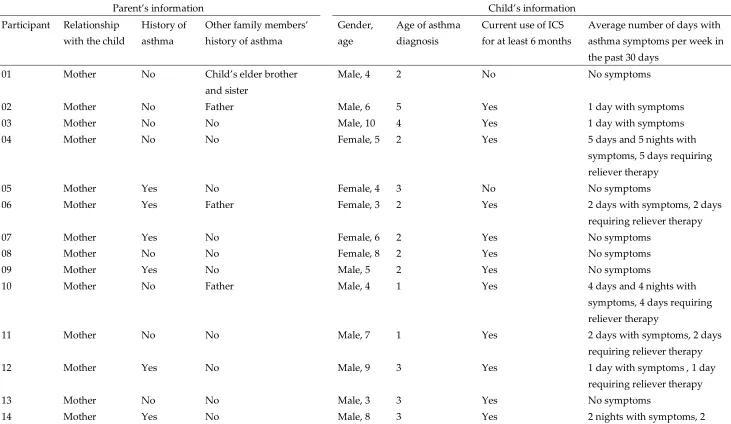
85
due to an asthma attack.
86
To achieve a purposive sample, inclusion criteria were parents living in HK who had children
87
aged three to 12 years, and possessed a physician’s diagnosis of asthma (International Classification
88
Diseases – 10 codes J45, J46) as documented in their electronic medical records. In addition, the
89
parents had to be: (a) between 18 and 65 years old, (b) fathers or mothers who designated themselves
90
index child, (d) able to communicate in Cantonese, and (e) Hong Kong permanent residents.
92
Exclusion criteria included parents of a child with asthma, whom had a mental and/or congenital
93
problem. Purposive sampling was adopted to capture of wide range of experiences, to obtain rich
94
information from parents engaged in childhood asthma management, and to gain in-depth
95
understanding of the phenomenon.
96
2.2. Data collection
97
Participants were invited to complete a short survey to indicate their socio-demographic
98
characteristics, personal and family history of asthma, and their children’s clinical characteristics.
99
Next, data were collected through individual face-to-face interviews in Cantonese. A
100
semi-structured interview guide containing the following open-ended questions was used: (a) “I
101
wish you would share your experiences in taking care of a child with asthma. What experiences do
102
you think are most worthy of sharing? Which were the most memorable to you? And how did you
103
feel at the time?” (b) “As a parent of a child with asthma, what do you do to take care of your child?
104
(c) “What are the most challenging situations you have faced when taking care of a child with
105
asthma?” (d) “What are the issues of most concern to you when taking care of a child with asthma?”
106
This interview guide was designed by the research team and refined after a pilot test involving two
107
parents of children with asthma. Prompts were used where necessary to encourage more detailed
108
responses, such as, “Can you describe this in a bit more detail?” and “Please tell me more about…”
109
Interviews were conducted by the lead author who is a registered nurse with experience in
110
pediatric care and had no affiliation to any of the participants prior to the study. Interviews were
111
held in a private room of the ACC at a time convenient to the participants, and audio-recorded with
112
the participants’ permission. Field notes were taken to capture non-verbal cues within 24 hours of
113
the interview. Each interview lasted between 45 to 75 minutes. Data collection continued until the
114
research team determined that data saturation had been reached after 14 interviews.
115
2.3. Ethical considerations
116
Before the commencement of the study, ethical approval for this study was granted by the New
117
Territories West Cluster Clinical Research Ethics Committee (reference number:
118
NTWC/CREC/15042) and by the Human Subjects Ethics Application Review System of the Hong
119
Kong Polytechnic University (reference number: HSEARS20150109001). The parents were reassured
120
that their participation would not affect the healthcare services that their children received.
121
Informed written consent was obtained from all participants. Childcare services were offered at the
122
request of the parents, so that they could focus on providing interviews. In addition, the parents
123
were informed verbally about the study aim and future publication in the scientific literature. All
124
information was treated confidentially.
125
2.4. Data management and analysis
126
The interviews were recorded and transcribed verbatim in Chinese by two trained student
127
assistants. The lead author further checked the transcripts against the audio-taped data for accuracy.
128
Conventional content analysis was used to detect the manifest and latent meanings from the data
129
[21, 22]. In this process, the audio recordings and transcripts were read several times to obtain a
130
general understanding of the parents’ experiences. Next, different segments of the text were
131
fractured into meaning units and assigned a code. Codes were chosen to retain the core meaning of
132
the participants’ experiences. The codes were then grouped into patterns and labeled under
133
subcategories. The subcategories were grouped into main categories representative of a process of
134
the participants’ experiences over time.
135
Interpretation followed ideas of metaphorical extraction, which means that the codes,
136
more importantly, from the contextual relationship between the text and the context of the whole
138
interview (connotation) [23]. A further comparison of one part of a participant’s story was made
139
with parts of the stories of other participants, and each interview with all interviews as a whole [23].
140
Data analysis software was not adopted. Identified codes with core meaning of the participants’
141
experiences were extracted from the transcripts to an excel file for subsequent levels of analysis.
142
Rigor was achieved through a process of reflexivity and documentation of all analytic decisions
143
in an audit trail. The lead author (Y.Y.C.) is a registered nurse in HK, who sought the help of the
144
research team (all authors) to examine her role and question possible bias throughout analysis of the
145
data. Notably, all team members were nurses with clinical expertise in child and adolescent health.
146
The lead author (Y.Y.C.) and one of the co-authors (Y.W.M.) are bilingual in English and Chinese.
147
For credibility, initial codes from the first three interviews were translated from Chinese to English
148
and independently coded by the lead author (Y.Y.C.) and an experienced qualitative researcher who
149
is a native speaker of English (D.L.). The translation was carried out by a bilingual professional and
150
was double-checked by the lead author (Y.Y.C.) and another qualitative researcher (Y.W.M.). To
151
ensure plausibility, this co-author (Y.W.M.), together with the lead author (Y.Y.C.), independently
152
scrutinized the codes and sub-categorizations from all of the translated transcripts. Regular
153
meetings of the entire research team (Y.Y.C., D.L, and Y.W.M) helped to resolve any differences in
154
coding and to refine the analysis to determine the final categories. Last, transferability was attained
155
by comparing the key findings with existing literature about parents of children with asthma and
156
other similar chronic illnesses. Further, raw excerpts of the data, which exemplify the
157
interpretations, will allow readers to assess how results may be transferable to their contexts.
158
3. Results
159
Despite attempts to recruit fathers, a total of 14 parents were (only) mothers, whom
160
participated. All of the participants identified themselves as their child’s primary caregiver. During
161
the interview period, one mother withdrew from the study due to health problems related to her
162
pregnancy. Among the participants (age range = 30-54 years), two were working mothers and the
163
rest were housewives. Nearly half of the mothers (number of participants (n) = 6) had a personal
164
history of asthma. Four mothers reported that the child’s father (n = 3) or the child’s older brother
165
and sister (n = 1) also had asthma. The children (age range = 3-10 years) were diagnosed with asthma
166
at the preschool age (range = 6 months-5 years). As of the interview period, eight of the children
167
suffered from asthma symptoms at least one day per week (see Table 1).
168
Table 1. The characteristics of the parents interviewed and their children
186
Parent’s information Child’s information
Participant Relationship with the child
History of asthma
Other family members’ history of asthma
Gender, age
Age of asthma diagnosis
Current use of ICS for at least 6 months
Average number of days with asthma symptoms per week in
the past 30 days
01 Mother No Child’s elder brother
and sister
Male, 4 2 No No symptoms
02 Mother No Father Male, 6 5 Yes 1 day with symptoms
03 Mother No No Male, 10 4 Yes 1 day with symptoms
04 Mother No No Female, 5 2 Yes 5 days and 5 nights with
symptoms, 5 days requiring
reliever therapy
05 Mother Yes No Female, 4 3 No No symptoms
06 Mother Yes Father Female, 3 2 Yes 2 days with symptoms, 2 days
requiring reliever therapy
07 Mother Yes No Female, 6 2 Yes No symptoms
08 Mother No No Female, 8 2 Yes No symptoms
09 Mother Yes No Male, 5 2 Yes No symptoms
10 Mother No Father Male, 4 1 Yes 4 days and 4 nights with
symptoms, 4 days requiring
reliever therapy
11 Mother No No Male, 7 1 Yes 2 days with symptoms, 2 days
requiring reliever therapy
12 Mother Yes No Male, 9 3 Yes 1 day with symptoms , 1 day
requiring reliever therapy
13 Mother No No Male, 3 3 Yes No symptoms
Note. ICS = inhaled corticosteroid.
187
Reliever therapy refers to the inhaled short-acting bronchodilators for a quick relief of the child’s asthma symptoms.
188
189
190
191
192
193
194
195
196
197
198
199
200
201
202
203
204
205
206
207
208
209
210
nights requiring reliever
In this study, the parents’ experiences (all mothers) reflected a psycho-social process of five
211
categories: (1) uncertainty and fear in controlling asthma when asthma was diagnosed; (2) the
212
reoccurrence of the asthma, leading to a search for ways to endure the condition; (3) working
213
through the challenges of controlling asthma; (4) ongoing emotional distress as the asthma
214
continues; and (5) learning to manage asthma better after accumulating experience. Note that
215
symbols and numbers represent different participants (M = mother’s interview number, child’s sex
216
and age).
217
218
3.1. Category one: Uncertainty and fear in controlling asthma when asthma was diagnosed
219
220
Participants began to describe the occurrence of asthma attacks when their child was of
221
preschool age (two to three years old), as something that “just happened all of a sudden”. The
222
high-pitched wheezes, which they described as “he he” sounds, together with other flu-like
223
symptoms, recurred with no recognizable patterns. The participants’ uncertainty further intensified
224
when the doctor’s diagnosis was not asthma, as some parents suspected, but “flu” or “bronchial
225
hypersensitivity.” Without a definite diagnosis, the participants found it difficult to make sense of
226
what was happening to their child:
227
228
The doctor said that he [the son] didn’t have asthma, but bronchial hypersensitivity, and just
229
delayed the diagnosis.… Then, was the so-called ‘bronchial hypersensitivity’ that my child
230
previously had just in fact the same as asthma? I really don't know. (M2, son aged 6)
231
232
When children began struggling to breathe, and had difficulty speaking, participants realized
233
that this scenario was a medical emergency. They perceived that their child’s life was in danger:
234
235
She just wheezed so seriously, and her rib cage was just dented in, just like, losing her breath and
236
saying ‘hah mommy, hah mommy…’ when you were holding her. I was definitely in great fear …
237
when we [she and the child’s father] arrived at the hospital. I did not dare to release my arms. (M6,
238
daughter aged 3)
239
240
3.2. Category two: The reoccurrence of the asthma, leading to a search for ways to endure the condition
241
242
Subcategory 1. Enduring suffering during acute asthma attacks
243
244
All participants reported that their child visited the emergency department due to an asthma
245
attack, at least once, during the past six months. Five children required hospitalization for three to
246
five days. According to the hospital’s policy, only one parent, preferably mothers, was allowed to
247
stay with the child during hospital admissions. Some of the participants witnessed the efforts of
248
clinicians to control asthma, such as by administering bronchodilators via aero-chambers or
249
nebulizers, or by using oral suctioning to clear the airway. They reported feelings of being
250
“heartbroken” and “helpless” when witnessing their child’s struggles. One participant became
251
emotional when she described the scenario:
252
253
I was staying outside the curtain and watching how the doctors used the suction tubes to suck
254
the phlegm out and he was shouting ‘Mommy! Mommy! Help me! Help me!’ He was crying so
255
intensely; I was sitting in a chair and just could not stop crying myself. The tears, it was … I
256
indeed felt too heartbroken, it’s a kind of feeling of being stabbed by a knife…. I felt that I was
257
useless, helpless too. (M11, son aged 7)
258
259
Many participants described the experience of staying overnight in hospital wards without
260
adequate facilities for rest as “the toughest experience… to endure”. A few participants perceived
261
could have done themselves at home. As such, they reported reluctance to go to the hospital again
263
unless they perceived that their child “was on the verge of death.”
264
265
Subcategory 2. Enduring suffering whenever asthma recurs
266
267
Given that a child’s asthma attacks could recur unpredictably, the suffering that the
268
participants endured continued. In general, when participants suspected something “different”
269
about the sound of their child’s breathing, they took a series of prompt actions, such as close
270
monitoring of their child’s breathing, giving symptom-relieving medications, and taking him/her to
271
a nearby clinic for immediate medical advice or to a hospital to prevent life-threatening
272
consequences. Their child’s repeated coughing and wheezing prompted some participants to remain
273
awake all night, to monitor their child’s breathing and to administer the inhaler in a timely manner.
274
One participant said that she had not been able to sleep well for years due to her son’s asthma:
275
276
In these three years, when I hear [my child] cough, I will get up at once. I am afraid that he'll have
277
[an attack] again. The last time [he had an attack], I simply watched my child suffering, and with
278
great fear. He just kept on struggling and crying, so that's why I have to take care of him for the
279
whole night, and that's why I cannot sleep well now. Yes, I sleep badly, until now during the night
280
I’ll be in great fear… (M10, son aged four)
281
282
Subcategory 3. Distress from searching for the reasons for their child’s asthma
283
284
Searching for the reason why their child suffered from asthma was important, especially for
285
participants with no family history of asthma. Some of the participants did this by comparing their
286
child with his/her siblings, or reflecting on whether they had paid enough attention to their child’s
287
early development. For one participant, the lack of an explanation for their child’s asthma was the
288
source of great distress:
289
290
I was in great psychological distress; [I] wanted to just cry and cry, because why did I give birth
291
to a child to have this [disease]? (M13, son aged 3)
292
293
3.3. Category three: Working through the challenges of controlling asthma
294
295
Many of the participants gave detailed accounts of what they had done to control the asthma,
296
which was very burdensome.
297
298
Subcategory 1. Staying alert and preventing asthma attacks
299
300
All participants could list several asthma triggers: second-hand smoke, burning incense, fluffy
301
toys, dust, perfume, cold air, and cold food and drinks. Some of them monitored these triggers, and
302
others firmly prevented their children from coming into contact with them. Furthermore, many of
303
the participants believed that the “blue inhaler” was a life-saving bronchodilator that had to be
304
administered regularly overnight to prevent nocturnal asthma attacks. A few of them were very
305
vigilant using the “blue inhaler.” One participant shared her strategy:
306
307
I won’t offer the blue inhaler frequently at one go. First [I’d] try one puff; if he’s okay then I’d
308
stop. If he’s not that okay, then I’d offer him another puff. I mean I try to avoid giving too much
309
medication to my child. Then, after one to two minutes, I’d ask him whether he felt easier to
310
breathe... (M14, son aged 8)
311
312
Subcategory 2. Keep trying different ways to get control of a child’s asthma
A few of the participants explored different kinds of complementary and alternative dietary
315
therapies, such as “boiled crocodile meat soup” (M6, M7, M9, and M14); “boiled gecko soup” (M7);
316
“boiled fritillary bulbs” (M7, M14), and moxibustion therapy (M14) (a non-invasive procedure that
317
involves burning herbal materials on or above the skin at accu-points to alleviate symptoms). All of
318
these soups or herbs were considered effective over the long term at strengthening a child’s health to
319
improve his/her asthma. As one participant stated:
320
321
It’s just like doing homework – you’ve got to do it every single day; otherwise you can’t see the
322
effect on him [the child]. (M11, son aged 7)
323
324
Subcategory 3. Working through frustration due to the unpredictability of asthma
325
326
Despite the strenuous efforts made by participants to control their child’s asthma, many
327
expressed disappointment when asthma recurred after participants had come to believe that it had
328
“disappeared” (remission of symptoms after a year). Repeated hospital admissions led the
329
participants to lose confidence and to feel powerless. One participant stated:
330
331
In the last year I was thinking it should be alright. But then, all of a sudden, it [the asthma] came
332
again… not less than a week later, [she] wheezed and was admitted again. Then, [she] had the oral
333
steroids again… (M4, daughter aged 5)
334
335
Another participant reflected that she had “overlooked” the recurrence of asthma:
336
337
Asthma is something that I can’t control. Why, when he [her child] got an attack, did it come all over
338
again? (M3, son aged 10)
339
340
Subcategory 4. Conflicts with others surrounding daily asthma care
341
342
A few of the participants described their concerns as misunderstood by others. This was
343
particularly common, as their children appeared mostly asymptomatic. They often heard others say:
344
“There’s no need to be that nervous” or “It’s only a cough.”
345
346
Misunderstandings were more worrisome when they involved family members. For instance,
347
some of the participants would be questioned by their spouse for hastily seeking medical advice for
348
their child’s flu-like symptoms. Some fathers, who were smokers, might not comply with
349
instructions to keep their child away from tobacco smoke. Further, extended family members were
350
expected to comply with house rules to avoid potential asthma triggers, such as avoiding fried
351
snacks or cold drinks. When these rules were broken, conflict ensued. One participant expressed her
352
resentment:
353
354
I told them [the extended family members], please don’t let him [her child] have any junk food or soft
355
drinks, okay? But sometimes they just let my child drink and say something like, “Come on,
356
wouldn’t it be too harsh for a kid to not enjoy cold drinks?” But I said, “It’ll be even harsher for me
357
if you attempt to let the child try it once! (M9, son aged 5)
358
359
Subcategory 5. Searching for the best possible healthcare service suitable for the family
360
361
When a child suffered from an acute asthma attack, most of the participants immediately
362
sought medical help from the emergency department of a public hospital. However, they stated that
363
this did not guarantee that their child would receive immediate treatment. As one participant
364
recalled:
365
When the triage nurses spot that your child’s oxygen saturation is fine, they obviously won’t act
367
fast. (M8, daughter aged 8)
368
369
On the other hand, some of the participants appreciated the efficiency and comprehensiveness
370
of the medical investigations provided by private hospitals but were deterred by the cost. One
371
participant stated:
372
373
If it’s financially affordable, I’d rather choose a private hospital for my child. (M6, daughter aged
374
3)
375
376
In addition, finding a pediatric respiratory specialist in HK was challenging. One participant
377
recalled that it was “by luck” that she met a private practitioner who immediately offered inhalation
378
therapy to her child. She further emphasized:
379
380
In fact it is really difficult for the parents. First, I didn’t know where I should find [the specialist];
381
second, who is a good one? (M12, son aged 9)
382
383
Deciding on what was “best” was further complicated by differences in the treatment strategies
384
offered by the public and private sectors. For instance, one participant reported inconsistencies in
385
the method of delivering inhaled bronchodilators between the private clinic (via nebulizers, which
386
she had been taught to use) and the public hospital (via aero-chambers). She said that a nurse
387
working in a clinic of a public hospital once told her the following:
388
389
As you didn't really know how to use it [aero-chamber], this led to the fact that he [the child]
390
couldn't take in all the medication powder.’ But that was not the case. (M10, son aged 4)
391
392
3.4. Category four: Ongoing distress as the asthma continues
393
394
Situations that generated ongoing distress were not at the forefront of participants’ thoughts
395
but became prominent as their stories unfolded.
396
397
Subcategory 1. Worries about the effects on their child’s learning and development
398
399
Most of the participants expressed worry and concern about the potential negative impact of
400
asthma on their child’s learning and development. Specifically, their child’s frequent absence from
401
school was felt to threaten their child’s academic performance and social interactions with peers.
402
Furthermore, many participants were worried about the potential detrimental side effects of the
403
chronic use of inhaled corticosteroids on their child’s development. These include appetite loss,
404
facial puffiness, and impaired growth (M1, M7, M9, M10, M12). In addition, a few participants (M10,
405
M11, M13) questioned whether their child would develop resistance to antibiotics.
406
407
Subcategory 2. Helplessness when losing the fight against asthma
408
409
Another concern that was worth noting was the participants’ strong desire to not only control,
410
but to “just get rid of it [the asthma],” given that the asthma symptoms had recurred throughout the
411
years. Those participants believed that they possessed the gene for asthma, and perceived asthma as
412
“something that you must carry for the rest of your life, carrying over to their child’s next
413
generation.” One participant stated:
414
415
If you had this disease, you dare not to try to have your own family, right? (M5, daughter aged 4)
416
Some of the participants described a few critical moments when they encountered feelings of
417
helplessness and a sense of “being trapped,” or feeling as if “everything was just simply offensive to
418
the child was too small to voice his/her complaints. One participant projected her anger onto her
420
child in the following way:
421
422
Sometimes [I] would project my negative emotions directly to him [the child] and say, ‘Oh! You see,
423
other children are good at all sort of things, but why did this [the asthma] happen to you? (M3, son
424
aged 10)
425
426
Subcategory 3. Despair related to insufficient support
427
428
Of the 14 participants, two recounted feelings of hopelessness and overwhelming distress when
429
living with a child suffering from asthma. Both mothers became emotional and occasionally had to
430
pause during the interview. One of them, who found it difficult to ask for support from others,
431
described her feelings of despair in the following way:
432
433
You seem to have no energy every day, but deep in your heart you wish to share everything with
434
others. But you don’t know who you can talk to, as once you share you don’t know how others would
435
regard you. (M7, daughter aged 6)
436
437
The lack of spousal support triggered another participant to contemplate suicide. She recalled:
438
439
From the beginning till now, his dad wasn’t involved in anything about the care. [He] simply
440
blamed me for not doing well enough. When she [the child] was two to three years old, she just cried
441
for the entire night.… No matter what you did, it just failed. I was not sure what she needed! Every
442
night was the same, and then you ... you definitely had the feeling that [you] wanted to jump from
443
[a] height with the child. (M4, daughter aged 5)
444
445
3.5. Category five: Learning to manage the asthma better after accumulating experience
446
447
Subcategory 1. Asthma care becomes easier when the asthma improves
448
449
Stressful experiences of childhood asthma care was emphasized by most participants.
450
However, some of the participants, whom had at least two years of experience caring for a child with
451
asthma, shared positive experiences. These participants became familiar with the nature of the
452
asthma and learned how to differentiate its symptoms from other illnesses. They shared such
453
thoughts as, “I have full confidence now” and “asthma is not a big deal to me.” In this regard, their
454
emotional distress and the challenges that they faced in caregiving were mitigated by newly formed
455
positive perceptions that came from learning to manage asthma.
456
457
Subcategory 2. Building support with others
458
459
Multiple sources of support within the hospital, including patient support groups and
460
follow-ups by specialist nurses, were highly valued by the majority of participants. When the
461
responsibility for asthma management was eventually shared with their partners, they expressed
462
relief and were less vigilant about monitoring their children. In addition, peer support helped the
463
participants to ventilate their emotions and concerns. One participant expressed her appreciation of
464
this mutual support:
465
466
I felt glad that I have a friend whose son has asthma, as we're all in the same boat. We chat a lot,
467
and we share [our thoughts and feelings] with each other. It's a very good way, as we are all up
468
against the [same] difficulty. (M12, son age 6)
469
470
Subcategory 3. Learning to live a normal life
As the children grew older, their asthma symptoms became less severe. The participants
473
described caring for a child with asthma as being “exactly the same as caring for other ordinary
474
children.” One participant with a 10-year-old son remarked:
475
476
You need to take a long time to understand ... but once you accept the fact that the child has
477
asthma, face it with an open mind and accept it, you’ll feel much happier. (M3, son aged 10)
478
4. Discussion
479
To the best of our knowledge, this is one of a few qualitative studies to reveal the unique
480
experiences of HK Chinese mothers in caring for a child with asthma, revealing that they experience
481
significant psychological distress and managing their children’s asthma in many different ways.
482
Consistent with the findings of other studies [16, 24], the parents of children with asthma in this
483
study expressed feelings of uncertainty and fear when seeking emergency care services, and worried
484
extensively about the recurrence of the asthma attacks. They also worried about the impacts of
485
asthma on their child’s learning and future development [25], the side effects of medications [26],
486
and the risk of drug dependence [26].
487
In this study, the parents stated that a lack of support from their partners exacerbated their
488
distress, which is line with the findings in other studies on HK Chinese families rearing children
489
with chronic and behavioral health problems, such as eczema [27], autism [28], and attention deficit
490
hyperactivity disorder [29]. Moreover, as reported elsewhere, the parents in this study mentioned
491
that conflicts with family members arose over the management of the asthma, such as when family
492
members held different perceptions of how to handle the asthma symptoms, and when there were
493
disagreements over the asthma management routines at home [30, 31].
494
However, in contrast with the findings of other studies, the distress of the HK Chinese mothers
495
in this study was not necessarily resolved with emergency medical care for their child’s asthma
496
attacks [5], nor from being involved in treatment decisions [32]. Rather, some participants reported
497
being heartbroken and continued to express some degree of helplessness and self-blame for long
498
periods of time. This process was marked by a tendency to negatively evaluate their role as parents,
499
the asthma prognosis, the adequacy of family support, and the adequacy of the healthcare system as
500
a whole. In particular, participants’ perceptions of guilt appeared more pronounced than that of
501
parents of children with asthma in other studies, who similarly perceived an inability to safeguard
502
their child’s health [6, 33, 34]. Authors posit that Hong Kong parents may define the problem of
503
asthma differently, and choose multiple behavioral options, due in part, to implicit cultural beliefs
504
that their work may “cure” asthma one day.
505
In the present study, the participants applied various strategies to control asthma, such as
506
searching for the root causes of the asthma; avoiding environmental triggers of the asthma; using a
507
“trial-and-error” approach to finding the most appropriate healthcare service, similar to the “doctor
508
shopping” found in many countries [35]; and maintaining heightened vigilance of their child’s
509
health condition. While these control strategies worked in the short term, the participants often
510
could not fulfill their desire to control asthma permanently due to its unpredictability and
511
recurrence, and perhaps, persistent beliefs that they ought to be able to control or “cure it.” Hence,
512
this desire may have exacerbated their psychological distress and created overwhelming crises,
513
which led a few participants to report a sense of extreme despair with suicidal ideations early on in
514
the process of adapting to their child’s asthma.
515
In fact, the parents in the interviews might had gone through the process of excessively
516
evaluating unwanted emotional experiences and making deliberate efforts to control or escape
517
experiences, which could lead to greater dysfunction (e.g., managing childhood asthma
518
control strategy that allows individuals to avoid difficult thoughts and feelings when a stressful
520
event occurs [36].
521
This study has several limitations. The diversity of the sample of participants was limited as the
522
recruitment was conducted in only one study hospital and no fathers were recruited in this study.
523
Further, the mothers who were interviewed had been recruited in an ACC of one public hospital in
524
HK, so that their child had at least one experience of being treated by emergency care services due to
525
a life-threatening asthma attack. Hence, the caregiving experience reported by the mothers in this
526
study may not be transferable to other parents of children with less severe asthma.
527
Despite these limitations, this study adds an empathetic and detailed understanding of the
528
experiences of HK Chinese parents who are caring for a child with asthma. In particular, this study
529
has implications for clinical practice, revealing that healthcare providers should demonstrate more
530
empathy and attention to parents with young asthmatic children. Structured asthma education
531
programs that offer adequate information on asthma treatment and skills training, in addition to the
532
management of symptoms, might be helpful to parents [37, 38]. More importantly, this study
533
indicates a pressing need for psychological support. Psychological interventions that place a major
534
emphasis on developing acceptance and mindfulness, such as Acceptance and Commitment
535
Therapy [39] and mindfulness-based therapies [40], may be able to support parents. More
536
mixed-method investigations are warranted to understand the accounts of parents, as well as
537
measurements of their psychological processes, when managing their child’s asthma.
538
5. Conclusions
539
In summary, this study highlights the substantial psychological distress experienced by HK
540
Chinese parents in caring for their children suffered from asthma. Such distress was prominent
541
when encountering an asthma crisis or when asthma symptoms recurred; further exacerbating their
542
desire to take control over the asthma. Considering parents’ desire to achieve a cure of their
543
children’s asthma, and the unpredictability of asthmatic crises, helping parents to understand their
544
limits of control may support them to better copes. The findings of this study suggest that
545
addressing parents’ psycho-social needs may facilitate them to better manage their children’s
546
asthma conditions.
547
Author Contributions: Conceptualization, Y.Y.C. and Y.W.M.; Methodology, Y.Y.C.; D.L. and Y.W.M.; Formal
548
Analysis, Y.Y.C.; D.L. and Y.W.M.; Investigation, Y.Y.C.; Data Curation, Y.Y.C; Writing-Original Draft
549
Preparation, Y.Y.C.; Writing-Review & Editing, D.L.; Y.W.M.; Supervision, D.L. and Y.W.M.; Project
550
Administration, Y.Y.C.
551
Funding: This research received no external funding
552
Acknowledgments: The authors sincerely thank the parents who participated in this study and freely shared
553
their experiences. The authors also thank the student helpers for transcribing the interviews, the Advanced
554
Practice Nurse, Ms. Sui Ping Leung, for screening and recruiting eligible parents for the interviews, and the
555
nurses in the Ambulatory Care Centre for providing support in the form of child care services during the
556
interviews.
557
Conflicts of Interest: The authors declare no conflict of interest.
558
References
559
1. Global Strategy for Asthma Management and Prevention. Updated 2017. Available online:
560
http://ginasthma.org/gina-reports/ (accessed on 21May 2018).
561
2. Mallol, J.; Crane, J.; von Mutius, E.; Odhiambo, J.; Keil, U.; Stewart, A.; ISAAC Phase Three Study
562
Group. The International Study of Asthma and Allergies in Childhood (ISAAC) phase three: A global
563
3. Pearce, N.; Aït-Khaled, N.; Beasley, R.; Mallol, J.; Keil, U.; Mitchell, E.; Robertson, C. Worldwide
565
trends in the prevalence of asthma symptoms: Phase III of the International Study of Asthma and
566
Allergies in Childhood (ISAAC). Thorax 2007, 62, 758-766.
567
4. Chen, Y.; Wong, G. W. K.; Li, J. Environmental exposure and genetic predisposition as risk factors for
568
asthma in China. Allergy Asthma Immunol. Res. 2016, 8, 92-100.
569
5. Shaw, M. R.; Oneal, G. Living on the edge of asthma: A grounded theory exploration. J. Spec. Pediatr.
570
Nurs. 2014, 19, 296-307.
571
6. Finnvold, J.E. In their own words: Early childhood asthma and parents' experiences of the diagnostic
572
process. Scand. J. Caring Sci. 2010, 24, 299-306.
573
7. Celano, M.P. Family processes in pediatric asthma. Curr. Opin. Pediatr. 2006, 18, 539-544.
574
8. Fiese, B.; Winter, M.; Anbar, R.; Howell, K.; Poltrock, S. Family climate of routine asthma care:
575
Associating perceived burden and mother-child interaction patterns to child well-being. Fam. Process
576
2008, 47, 63-79.
577
9. Gates, L. B.; Akabas, S. H. Meeting the demands of work and responsibilities of caring for a child with
578
asthma: Consequences for caregiver well-being. J. Soc. Serv. Res. 2012, 38, 656-671.
579
10. Lee, E. J.; Parker, V.; DuBose, L.; Gwinn, J.; Logan, B. N. Demands and resources: Parents of
580
school-age children with asthma. J. Pediatr. Nurs. 2006, 21, 425-433.
581
11. Yamamoto, N.; Nagano. J. Parental stress and the onset and course of childhood asthma. Biopsychosoc.
582
Med. 2015, 9, 1-8.
583
12. Easter, G.; Sharpe, L.; Hunt, J. C. Systematic review and meta-analysis of anxious and depressive
584
symptoms in caregivers of children with asthma. J. Pediatr. Psychol. 2015, 40, 623-632.
585
13. Horner, S.D. Uncertainty in mothers' care for their ill children. J. Adv. Nurs. 1997, 26, 658-663.
586
14. Berg, J.; Anderson, N. L. R.; Tichacek, M. J.; Tomizh, A. C.; Rachelefsky, G. "One gets so afraid": Latino
587
families and asthma management-An exploratory study. J. Pediatr. Health Care 2007, 21, 361-371.
588
15. Jonsson, M.; Egmar, A. C.; Hallner, E.; Kull, I. Experiences of living with asthma-a focus group study
589
with adolescents and parents of children with asthma. J. Asthma 2014, 51, 185-192.
590
16. Arcoleo, K.; Zayas, L. E.; Hawthorne, A.; Begay, R. Illness representations and cultural practices play
591
a role in patient-centered care in childhood asthma: Experiences of Mexican mothers. J. Asthma 2015,
592
52, 699-706.
593
17. Leung, G. M.; Wong, I. O. L.; Chan, W.-S.; Choi, S.; Lo, S.-V. The ecology of health care in Hong Kong.
594
Soc. Sci. Med. 2005, 61, 577-590.
595
18. Lam, T. Strengths and weaknesses of traditional Chinese medicine and Western medicine in the eyes
596
of some Hong Kong Chinese. J. Epidemiol. Community Health 2001, 55, 762-765.
597
19. Sandelowski, M. Whatever happened to qualitative description? Res. Nurs. Health 2000, 23, 334-340.
598
20. Tashakkori, A.; Teddlie, C. Realism as a stance for mixed methods research. In Sage Handbook of Mixed
599
Methods in Social & Behavioural Research, 2nd ed.; Maxwell, J. A.; Mittapalli, K. M. Eds.; Sage
600
Publications: Los Angeles, United States, 2010; pp. 145-168.
601
21. Hsieh, H.-F.; Shannon, S.E. Three approaches to qualitative content analysis. Qual. Health Res. 2005, 15,
602
1277-1288.
603
22. Graneheim, U. H.; Lundman, B. Qualitative content analysis in nursing research: concepts,
604
procedures and measures to achieve trustworthiness. Nurse Educ. Today 2004, 24, 105-112.
605
23. Chenail, R.J. Conducting qualitative data analysis: Qualitative data analysis as a metaphoric process.
606
24. Sampson, N. R.; Parker, E. A.; Cheezum, R. R.; Lewis, T. C.; O'Toole, A.; Patton, J.; Zuniga, A.; Robins,
608
T. G.; Keirns, C. C. A life course perspective on stress and health among caregivers of children with
609
asthma in Detroit. Fam. Community Health 2013, 36, 51-62.
610
25. Cheng, S. C.; Chen, Y. C.; Liou, Y. M.; Wang, K. W. K.; Mu, P. F. Mothers' experience with
611
1st-3rd-grade children with asthma assisting their child's adaptation of school life in Taiwan. J. Clin.
612
Nurs. 2010, 19, 1960-1968.
613
26. Klok, T.; Brand, P. L.; Bomhof-Roordink, H.; Duiverman, E. J.; Kaptein, A. A. Parental illness
614
perceptions and medication perceptions in childhood asthma, a focus group study. Acta Paediatr. 2011,
615
100, 248-252.
616
27. Cheung, W. K.; Lee, R. L. Children and adolescents living with atopic eczema: An interpretive
617
phenomenological study with Chinese mothers. J. Adv. Nurs. 2012, 68, 2247-2255.
618
28. Lam, L. W.; Mackenzie, A. E. Coping with a child with down syndrome: The experiences of mothers
619
in Hong Kong. Qual. Health Res. 2002, 12, 223-237.
620
29. Ma, J. L. C.; Lai, K. Y. C. Family engagement in children with mental health needs in a Chinese
621
context: A dream or reality? J. Ethn. Cult. Divers. Soc. Work 2014, 23, 173-189.
622
30. Kaugars, A. S.; Kilinnert, M. D.; Bender, B. G. Family influences on pediatric asthma. J. Pediatr. Psychol.
623
2004, 29, 475-491.
624
31. Chen, S. H.; Huang, J. L.; Yeh, K. W.; Tsai, Y. F. The stress of caring for children with asthma: A
625
qualitative study of primary Caregivers. J. Nurs. Res. 2015, 23, 298-307.
626
32. Dickinson, A. R.; Dignam, D. Managing it: A mother's perspective of managing a pre-school child's
627
acute asthma episode. J. Child Health Care 2002, 6, 7-18.
628
33. Stepney, C.; Kane, K.; Bruzzese, J.-M. My child is diagnosed with asthma, now what?: Motivating
629
parents to help their children control asthma. J. Sch. Nurs. 2011, 27, 340-347.
630
34. Borhani, F.; Asadi, N.; Mohsenpour, M. The experiences of mothers with asthmatic children: A
631
content analysis. J. Caring Sci. 2012, 1, 115-21.
632
35. Sansone, R. A.; Sansone, L. A. Doctor shopping: A phenomenon of many themes. Innov. Clin. Neurosci.
633
2012, 9, 42-46.
634
36. Karekla, M.; Panayiotou, G. Coping and experiential avoidance: Unique or overlapping constructs? J.
635
Behav. Ther. Exp. Psychiatry 2011, 42, 163-170.
636
37. Clark, N. M.; Valerio, M. A. The role of behavioural theories in educational interventions for
637
paediatric asthma. Paediatr. Respir. Rev. 2003, 4, 325-333.
638
38. Welsh, E. J.; Hasan, M.; Li, P. Home-based educational interventions for children with asthma.
639
Cochrane Database Syst. Rev. 2011, 10, CD008469.
640
39. Hayes, S. C.; Luoma, J. B.; Bond, F. W.; Masuda, A.; Lillis, J. Acceptance and Commitment Therapy:
641
Model, processes and outcomes. Behav. Res. Ther. 2006, 44, 1-25.
642
40. Kabat-Zinn, J. Mindfulness-based interventions in context: Past, present, and future. Clin. Psychol. Sci.
643
Pract. 2003, 10, 144-156.