KEMPE-LOCKING CONFIGURATIONS
JAMES A. TILLEY
Abstract. Existing proofs of the 4-color theorem succeeded by establishing
an unavoidable set of reducible configurations. By this device, their authors showed that a minimum counterexample cannot exist. G.D. Birkhoff proved that a minimum counterexample must satisfy a connectivity property that is referred to in modern parlance asinternal 6-connectivity. We show that a minimum counterexample must also satisfy a coloring property, one that we call Kempe-locking. We define the termsKempe-locking configuration and
fundamental Kempe-locking configuration. We provide a heuristic argument that a fundamental Kempe-locking configuration must be of low order and then perform a systematic search through isomorphism classes for such con-figurations. We describe a methodology for analyzing whether an arbitrary planar triangulation is Kempe-locked; it involves deconstructing the triangu-lation into a stack of configurations with common endpoints and then creating a bipartite graph of coloring possibilities for each configuration in the stack to assess whether certain 2-color paths can be transmitted from the configura-tion’s top boundary to its bottom boundary. All Kempe-locked triangulations we discovered have two features in common: (1) they are Kempe-locked with respect to only a single edge, sayxy, and (2) they have a Birkhoff diamond with endpointsxandyas a proper subgraph. On the strength of our various inves-tigations, we are led to a plausible conjecture that the Birkhoff diamond is the only fundamental Kempe-locking configuration. If true, this would establish that the connectivity and coloring properties of a minimum counterexample to the 4-color theorem are incompatible. It would also point to the singular importance of a particularly elegant 4-connected triangulation of order 9 that consists of a triangle enclosing a pentagon enclosing a single vertex.
1. Introduction
It was almost a hundred years after the well-publicized, but flawed, attempt by Alfred Bray Kempe [7], a barrister and amateur mathematician, that the 4-color theorem was finally proved. In 1976, Kenneth Appel and Wolfgang Haken an-nounced their solution [1, 2]. Whereas they analyzed the 4-color problem in terms of maps, today’s mathematicians analyze graphs, possible because every map has an easily constructeddual graph. In 1997, a highly regarded team of graph theorists— Neil Robertson, Daniel Sanders, Paul Seymour, and Robin Thomas—simplified the Appel-Haken proof in a number of respects, their efforts culminating in an unavoid-able set of 633 reducible configurations [8].
We assume a basic familiarity with the terminology of elementary graph theory— vertex, edge, face, simple graph, planar graph, subgraph, induced subgraph, path, cycle, connectivity, adjacent vertices, order, vertex degree, minimum degree. (Refer to the introductory text by Chartrand and Zhang [6]). We also a assume a basic
1991Mathematics Subject Classification. Primary 05C15.
Key words and phrases. graph coloring, Kempe chain, Kempe-locking, Birkhoff diamond. 1
familiarity with the 4-color problem. In this article we limit ourselves to coloring the vertices of simple, connected, planar graphs, and, as is usual, we consider only proper colorings of such graphs, colorings in which no two adjacent vertices have the same color. In short, the 4-color theorem states that it takes no more than four distinct colors to color any simple planar graph properly. In studying the 4-color problem, we need consider only planar graphs that are triangulations, graphs in which all faces are delineated by three edges. That is because any planar graph that is not a triangulation can be turned into a triangulation by inserting edges until all faces are triangular. After properly coloring the triangulation, the inserted edges can be deleted, leaving the original graph with a proper coloring. If all faces of a planar graph except one are triangular, the graph is referred to as a near-triangulation. Near-triangulations in which the only non-triangular face is four-sided are particularly important in this article; such a near-triangulation can be derived by deleting any edge in a triangulation. As is customary, we use the termconfiguration for a near-triangulation whose non-triangular face is the infinite face.
This article is not about finding an alternative proof to the 4-color theorem; instead, it is an exploratory paper aimed at gaining a deeper understanding ofwhy the 4-color theorem is true, what it is about a planar graph that guarantees that it can be 4-colored. We go about this task by focusing on the properties of a minimum counterexample. The two properties we single out for thorough examination relate toconnectivity andcoloring. These are the subjects of the next two sections.
2. Connectivity property
Every existing proof of the 4-color theorem has been based on showing that a minimum counterexample cannot exist. If a counterexample does exist, then there must be one or more smallest counterexamples, where by “smallest” we mean the counterexample(s) having the lowest order (fewest vertices). In a landmark paper in 1913, Birkhoff [3] showed, among other things, that a minimum counterexample to the 4-color theorem must beinternally 6-connected. That was not a term of his choosing; it arrived on the graph theory scene much later.
Property 1. (Connectivity) A planar triangulation is said to be internally 6-connected if it is minimum degree 5 and has no cycle of length 5 or less for which there are two or more vertices both inside and outside the cycle.
can be 5-cycles with two or more vertices both inside and outside the cycle, but in an internally 6-connected triangulation there cannot.
What Birkhoff showed long before the 4-color theorem was proved is that if a min-imum counterexample exists, it must be internally 6-connected. The Appel-Haken team [1, 2] and the Robertson-Sanders-Seymour-Thomas team [8] each proved the 4-color theorem by constructing a finite set of configurations at least one of which must appear in any internally 6-connected triangulation—this is theunavoidability part of the proof. Each team brought its proof to a successful conclusion by con-structing an unavoidable set such that every configuration in it is reducible. Any planar triangulation containing a reducible configuration is 4-colorable if the graph with that configuration removed is 4-colorable; thus, such a planar triangulation cannot be a minimum counterexample to the 4-color theorem.
3. Coloring property
We follow the standard practice of indicating the color of a vertex by using one of the integers 1, 2, 3, 4, . . . . If the firstkintegers are used to color the vertices of a graph, we say that the graph isk-colored.
It is important to understand what we mean by adistinct coloringofG. Another way to think of a k-coloring of G is that the set of all vertices in G has been partitioned intokindependent sets, each set assigned a distinct color from 1 to k. Anindependent set of vertices is one in which no two vertices are adjacent. What matters is the partition (what vertices belong to what independent set); it does not matter how we assign colors to the various independent sets. Thus, a mere permutation of colors does not lead to a distinctly different coloring ofG.
A useful tool in graph coloring is the Kempe chain, named after the British mathematician whose attempt at proving the 4-color theorem failed [7]. In a given coloring of a graphG, a Kempe chain is a maximal, connected, induced subgraph of Gwhose vertices use only two colors, let us say colors i and j. An i-j Kempe chain is “maximal” in that every vertex adjacent to, but not in, the chain uses a color other than i or j. In figure 2, there is a single 1-2 Kempe chain in each of the four uppermost graphs and two distinct 1-2 Kempe chains in each of the two lowermost graphs. It is customary to consider a vertex coloredi not adjacent to any vertex coloredj ashorti-j chain and likewise a vertex coloredj not adjacent to any vertex coloredi.
Kempe chains are particularly useful in “navigating” among the various distinct 4-colorings of a graph G because interchanging colors on a chain—that is, inter-changing the color labels i andj for all vertices constituting an i-j chain—leaves Gproperly colored. Interchanging colors on ani-j Kempe chain does not lead to a distinctly different coloring ofGif there is only one i-j chain. But, for example, if there are three distincti-j chains, then interchanging colors on any one or on any pair of those chains does lead to a distinctly different coloring ofG.
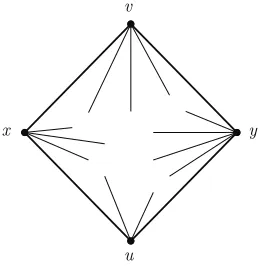
as the infinite (exterior) region oriented as shown in figure 1 and we always label the boundary cycle of the 4-face uxvy with uthe bottom vertex, x the left-hand vertex, v the top vertex, and y the right-hand vertex. Then x and y constitute one pair ofopposite vertices anduandv the other pair. We use the notationGxy to refer to the near-triangulation that results when the edge xy is deleted from a planar triangulationT. Such a near-triangulation can always be drawn as depicted in figure 1.
v
x y
u
Figure 1. Theschematic representation of a near-triangulation with an exterior 4-face. The interior of the graph includes vertices and edges that form triangular faces.
Property 2. (Coloring) A planar triangulation T is Kempe-locked with respect to the edgexy if, in every 4-coloring ofGxy in which the colors ofxandy are the same, there are precisely three distinct Kempe chains that include bothxandy.
If T is Kempe-locked with respect to the edge xy, then given a 4-coloring of Gxy in which xandy are both colored 1, there must be 1-2, 1-3, and 1-4 Kempe chains including both xandy. Interchanging colors on any of those chains leaves xand y sharing the same color. Moreover, for any such 4-coloring, because T is Kempe-locked, interchanging colors on any Kempe chain that does not includex andy must lead to a 4-coloring in which there are 1-2, 1-3, and 1-4 Kempe chains that include both xand y. Thus, if interchanging colors on Kempe chains is the only method of recoloring available,Gxy is “locked into” a state in whichxandy have the same color.
To demonstrate that a minimum counterexample has property 2, we first need to describe the notion of anedge contraction, also known asvertex identification. Adjacent verticesxand y are said to beidentified, or equivalently, the edgexy is said to be contracted, ifxand y are coalesced into a single vertexw, with all the edges formerly incident to xand y now incident to w. The act of contracting xy makes a smaller graph; it decreases the order of the graph by one.
Theorem 1. A minimum counterexample to the 4-color theorem is Kempe-locked with respect to every one of its edges.
Proof. LetT be a minimum counterexample to the 4-color theorem. Contract an arbitrary edge xy by coalescing x and y into w. This edge contraction yields a new triangulationT0 with one fewer vertex thanT. BecauseT is assumed to be a minimum counterexample,T0can be 4-colored. Then, whenwis split apart into the originalxandy, but without replacing the edgexy, we obtain a near-triangulation Gxy in which the colors ofxandy are the same.
Now suppose that T is not Kempe-locked with respect to the edge xy. Then there must be a 4-coloring ofGxy in which xand y are colored the same and in which there is a Kempe chain that includesxbut does not includey. Interchanging colors on such a chain results in a 4-coloredGxywith the color ofxnot the same as the color ofy. In this 4-coloring, the edgexy can be inserted to yield a 4-coloring forT, in contradiction to the assumption thatT is a minimum counterexample.
In contrast to the situation of a minimum counterexample, no 4-colorable planar triangulation can be Kempe-locked with respect to every one of its edges. The proof of that result can be found in the appendix.
The key point of this article is that property 1 and property 2—connectivity and coloring—are likely incompatible. If that could be proved, then the 4-color theorem would be proved because a minimum counterexample, unable to exhibit both properties, could not exist. We capture this idea in the form of a plausible conjecture, one likely to be true but beyond difficult to prove.
Conjecture 1. No planar triangulation that is Kempe-locked with respect to an edge is internally6-connected.
4. Examples of Kempe-locked triangulations
Figure 2 shows the six distinct 4-colorings of a particular near-triangulation Gxy of order 12. These are the only 4-colorings in which x and y (the leftmost and rightmost vertices on the exterior 4-face) are colored the same. In each of the 4-colorings there are 1-2, 1-3, and 1-4 Kempe chains that include both x and y. Thus, the triangulationT formed by joiningxandy is Kempe-locked with respect to the edgexy. T does not contradict conjecture 1 because the bottommost and topmost vertices on the 4-face (uand v, respectively) have degree 4. Indeed, T is 4-connected.
2
3 4
2
4 3
1 1
1
3 2
4
2
3 4
1
2 3
1 1
4
3 2
4
2
3 4
2
4 3
1 1
1
2 4
3
2
3 4
1
4 2
1 1
3
2 4
3
2
3 4
2
4 3
1 1
1
3 4
2
2
3 4
1
4 3
1 1
2
3 4
2
We note that the near-triangulation shown in figure 2 becomes the icosahedron whenuandv, instead ofxandy, are joined. In that situation, we refer to the near-triangulation asGuv because it is the edgeuvthat is deleted from the icosahedron to form the near-triangulation. In neither of the bottom two 4-colorings of Guv in figure 2, in which uandv and both colored 2, are there 2-3 or 2-4 Kempe chains that include both u and v. Because (u, v) can be taken to represent any pair of adjacent vertices in the highly symmetric and regular icosahedron, we conclude that the icosahedron is not Kempe-locked with respect to any of its edges.
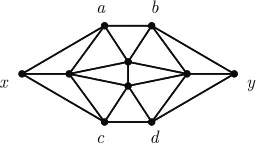
Figure 3 shows a particular induced subgraph of order 10 of the near-triangulation of order 12 in figure 2. That subgraph, a configuration, is known as theBirkhoff diamond, named for the mathematician who first highlighted its importance in the 4-color problem [3]: it was the very first configuration to be proved reducible; its presence in a triangulation guarantees that the triangulation cannot be a minimum counterexample. Ironically, we will see that the Birkhoff diamond makes its ap-pearance in our analysis in an opposite way—namely, that it likely must be present for a triangulation to be Kempe-locked with respect to an edge and thus possi-bly a candidate to be a minimum counterexample. Our systematic search among 4-connected and 5-connected triangulations, which we shall describe in section 6, uncovered a number of Kempe-locked triangulations. All share a common feature: one or more Birkhoff diamond subgraphs with endpointsxandy.
a b
x y
c d
Figure 3. The Birkhoff diamond, a configuration of order 10, with its left- and right-hand endpoints labeledxandy, respectively, and its topmost and bottommost edges labeledabandcd, respectively.
Four additional examples of Kempe-locked triangulations (once x and y are joined) are illustrated in figure 4. By including an arbitrary number of Birkhoff di-amonds with endpointsxandyin an appropriate way in any triangulation Kempe-locked with respect toxy, we can obtain an infinite number of Kempe-locked tri-angulations. However, not all triangulations containing a Birkhoff diamond with endpoints xand y are Kempe-locked—we shall have more to say on this point in the following section 5.
5. Kempe-locking configurations
Figure 4. Each of the four graphs becomes a Kempe-locked trian-gulation when the leftmost and rightmost vertices on the exterior 4-face are joined. Three of the near-triangulations have a single Birkhoff diamond subgraph; the other near-triangulation has two.
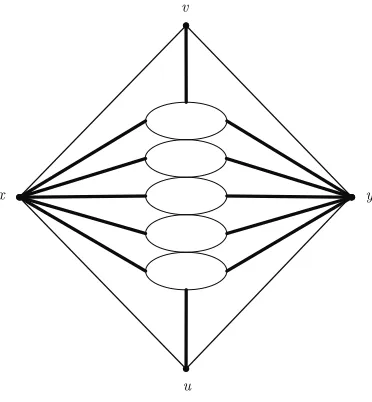
but there can be any (non-negative) number of them. The bottom boundary of eachxy-configuration in the vertical stack always coincides with the top boundary of the next lower xy-configuration, if there is one. Becausexy-configurations can be combined into a single largerxy-configuration or deconstructed into smaller xy-configurations, any givenGxycan be represented in multiple ways as a vertical stack ofxy-configurations. However, there is often a “natural” choice as to how to specify the various configurations. For example, the near-triangulation shown in figure 2 can be exhibited naturally in the form of figure 5 with a singlexy-configuration, a Birkhoff diamond: vis joined to that configuration by two edges and likewise foru and that configuration includes three edges emanating from each of xand y. The near-triangulation in the lower right of figure 4 can be put into the general form of figure 5 naturally by using threexy-configurations, two Birkhoff diamonds with an xy-configuration between them. The middle configuration has order 6—endpoint verticesxand y and four others, two on the top boundary, one adjacent toxand one adjacent toy, and the same for the two on the bottom boundary, one adjacent toxand one adjacent toy.
u x
v
y
Figure 5. The general structure of a near-triangulationGxy.
chains are colored 1-2, 1-3, and 1-4. We are interested in finding an equivalent condition that might be of greater utility in understanding what is necessary to create a Kempe-locked triangulation. We proceed by considering two cases:
(1) If the color ofuis 2, then there cannot be either a 2-3 path or a 2-4 path betweenv andubecause the first would have to intersect the 1-4 Kempe chain that includes bothxandyand the second would have to intersect the 1-3 Kempe chain that includes bothxandy, neither of which is possible. (2) If the color ofuis not 2, we can choose it to be 3 without loss of generality.
There cannot be a 2-3 path between v and ubecause it cannot intersect the 1-4 Kempe chain that includes bothxand y. Obviously there cannot be a 2-4 path betweenv anduwhenvis colored 2 anduis colored 3. We have just shown that the existence of three Kempe chains including both x andy implies the non-existence of any 2-color paths betweenv and uusing colors different from the common color of x and y. The converse is proved in [9], thus establishing the truth of the following theorem 2.
Theorem 2. Let T be a planar triangulation and Gxy the near-triangulation de-rived from it by deleting the edgexy. Letuxvybe the 4-cycle delineating the 4-face ofGxy. ThenT is Kempe-locked with respect to the edgexy if and only if, in every 4-coloring of Gxy in which the colors of xandy are the same, there is no 2-color path betweenv anduthat uses colors different from the common color of xandy.
xy-configuration would have to be able to take the 2-3 path presented to it as input at its top boundary and carry it through to the bottom boundary, that output then passed along as input to the nextxy-configuration. Thus, there might exist certain xy-configurations for which this “passing along” cannot be assured or which make it impossible to “complete” the path at vertex uand achieve a proper coloring of Gxy. Such a configuration potentially enables a Kempe-locked triangulation. The Birkhoff diamond is one of these special configurations.
To understand how the Birkhoff diamond can prevent a 2-color path betweenv andu, we analyze all possible colorings of figure 3 whenxandyare both colored 1. Because the verticesa,b,c, anddare all adjacent to eitherxory, they must take their colors from{2,3,4}. There are six possible pairings of colors for either (a, b) or (c, d): (2,3), (2,4), (3,2), (3,4), (4,2), and (4,3). The various proper colorings of the Birkhoff diamond subject to this constraint are not provided here—they are easily determined. Instead, we summarize the results in terms of the possible transitions from the colors of the (a, b) pair along the top boundary of the Birkhoff diamond to the colors of the (c, d) pair along the bottom boundary. We can represent the permitted transitions between (a, b) and (c, d) as abipartite graph, a graph in which each vertex is assigned to one of two independent sets and the only edges in the graph thus occur between a vertex in one set and a vertex in the other. Figure 6 shows such a graph for the Birkhoff diamond with both x and y constrained to have color 1. The possibilities for (a, b) appear as the top set of six vertices and the possibilities for (c, d) appear as the bottom set of six vertices. An edge exists between a vertex in the top set and a vertex in the bottom set if and only if there exists a proper 4-coloring of the Birkhoff diamond for that pairing of top and bottom vertices. We have depicted the various edges in figure 6 as thin or thick solid lines or as dotted or dashed lines. A thin solid line indicates the presence of both a 2-3 path and a 2-4 path between (a, b) and (c, d); a thick solid line indicates the absence of both a 2-3 path and a 2-4 path; a dotted line the presence of a 2-3 path only; and a dashed line the presence of a 2-4 path only.
(2,3) (2,4) (3,2) (3,4) (4,2) (4,3)
(2,3) (2,4) (3,2) (3,4) (4,2) (4,3)
Figure 6. A bipartite graph that shows for the Birkhoff diamond (see figure 3) the possible transitions from the input pair of colors (a, b) at the top of the graph to the output pair of colors (c, d) at the bottom of the graph.
see that the only possibilities for (c, d) are (2,4), (3,2), and (3,4). (This conclusion is confirmed by inspection of figure 2.) There is only a 2-4 path between (3,4) and (2,4) and it cannot be completed becauseumust then take color 3 for a proper col-oring. There is only a 2-3 path between (3,4) and (3,2) and it cannot be completed because umust then take color 4 for a proper coloring. Finally, there is neither a 2-3 nor a 2-4 path between (3,4) and (3,4). Thus, for the near-triangulationGxy in figure 2, neither a 2-3 nor a 2-4 path betweenv anducan exist if (a, b) is (3,4). Interchanging colors 3 and 4 throughout Gxy leads to the same conclusion when (a, b) is (4,3). The bipartite graph in figure 6 explains the Birkhoff diamond’s abil-ity to enable a Kempe-locked triangulation. With only minor modifications, this methodology can be used to show that each near-triangulation in figure 4 derives from a Kempe-locked triangulation.
Appealing to the bipartite methodology may seem like overkill. Why not just use figure 2 to prove that there is no 2-3 or 2-4 path betweenvandu? For such an un-complicated situation, the bipartite analysis is indeed unnecessary, but it becomes highly useful in more complicated situations in which it is not feasible, either manu-ally or with the aid of a computer, to list all possible distinct 4-colorings in whichx andyare both colored 1. In such situations, representing a near-triangulationGxy as a stack ofxy-configurations and then analyzing each configuration in the stack separately permits us to determine more easily whether a 2-3 or 2-4 path can be transmitted fromvto u. Moreover, figure 5, combined with the bipartite analysis, sheds light on how anxy-configuration can prevent the transmission or completion of a 2-color path, whereas simply analyzing a long list of all distinct colorings of a candidate near-triangulation does not.
In the previous section, we stated that not all triangulations that include a Birkhoff diamond subgraph with endpoints x and y are Kempe-locked. The bi-partite methodology can be used to understand why this statement is true. From figure 6, we see that all coloring states of the top edge (a, b) other than (3,4) and (4,3) can transmit both 2-3 and 2-4 paths through the diamond to its bottom edge (c, d). Thus, many near-triangulations Gxy having a Birkhoff diamond subgraph with endpointsxandywill not be Kempe-locked. The mere presence of a Birkhoff diamond is not sufficient—if there is any chance for the triangulation T of which the Birkhoff diamond is a subgraph to be Kempe-locked, the Birkhoff diamond has to appear in just the right way relative to the otherxy-configurations in the vertical stack. As an example of this, take the graph in the lower right panel of figure 4 and eliminate the middlexy-configuration entirely; squeeze the two Birkhoff diamonds together so that the bottom boundary of the upper diamond coincides with the top boundary of the lower diamond, then apply figure 6 twice to verify that the triangulation withxandy joined is not Kempe-locked with respect toxy.
The foregoing discussion motivates the following definitions of Kempe-locking configurations and fundamental Kempe-locking configurations, those particular xy-configurations that enable a triangulation T to be Kempe-locked with respect to an edgexy.
Definition 2. LetKxy be the Kempe-locking configuration for a planar triangu-lation T (that is at least 4-connected) with an edge xy. Then Kxy is said to be a fundamental Kempe-locking configuration if it contains no proper subgraphKxy0 that is the Kempe-locking configuration for some planar triangulationT0 (that is at least 4-connected) with an edgexy.
On the basis of these definitions, the Kempe-locking configuration for any graph in figure 4 is not fundamental because it has a Birkhoff diamond with endpointsx andy as a proper subgraph and the Birkhoff diamond is the Kempe-locking config-uration for the triangulation obtained by joiningxandy in the near-triangulation shown in figure 2.
6. The search for fundamental Kempe-locking configurations
The approach we adopted in searching for fundamental Kempe-locking configu-rations is analogous to that of experimental physicists in their search for a new elementary particle with specified properties. Physicists confine their explorations to collision events involving total energy in an interval sufficient to bring the sought-after particle into being. Similarly, we explored planar triangulations of orders in whichfundamental Kempe-locking configurations would be expected to be found. The best chance to discover those configurations would seem to occur when there is asmall number of distinct 4-colorings of a near-triangulationGxywithxandythe same color, thus admitting the possibility thatevery oneof those few colorings will feature three Kempe chains that include bothxandy. Equivalently (by means of theorem 2), we note that in aGxyof large order withxandycolored the same there are sufficiently many possibilities for 2-color paths fromvtouusing colors different from the common color ofxandyto render it a virtual certainty that at least one such 2-color path will form part of a proper coloring of Gxy. Quite simply, the combinatorial possibilities for coloring a high-order planar triangulation militate against the existence of a high-order fundamental Kempe-locking configuration.
To assure that we did not miss any low-order triangulations, we generated the full set of 8,044 isomorphism classes for 4-connected triangulations of orders 6-15 and the full set of 9,733 isomorphism classes for 5-connected triangulations of orders 12-24. (See [4] and [5].) We then tested every edge in a triangulation from each of the isomorphism classes to determine if there are any 4-colorings with x and y colored the same but with fewer than three Kempe chains that include both x and y. It turns out to be rare for this not to be the case. The only Kempe-locked triangulations we encountered were 4-connected; there were none at all among 5-connected triangulations (and hence none at all among internally 6-connected triangulations). There are no Kempe-locked triangulations of order less than 12 and a single 4-connected Kempe-locked triangulation of order 12, the one illustrated in figure 2 with the leftmost and rightmost vertices on the 4-face joined. Thus, the Birkhoff diamond is afundamental Kempe-locking configuration. There are no locked triangulations of order 13, and one 4-connected Kempe-locked triangulation for each of orders 14 and 15, each of those featuring a Birkhoff diamond with endpoints x and y and each Kempe-locked with respect to only a single edge.
24,649,284 at order 20—refer to [5]) and because the number of edges in a triangu-lation increases with increasing order (a planar triangutriangu-lation of ordernhas 3n−6 edges), we soon ran into computation-time limitations imposed by our laptop com-puter. After deciding to limit aggregate computer execution time to several weeks instead of several months, we proceeded in the expanded search by examining all 30,926 isomorphism classes of order 16 and all 158,428 isomorphism classes of order 17, but only 100,000 randomly generated non-isomorphic triangulations for each order from 18 through 20.
For orders 16 and 17, we discoveredeight andfourteen non-isomorphic triangu-lations, respectively, that are Kempe-locked, all with respect to a single edge, call it xyin each case. Each of those 4-connected Kempe-locked triangulations features a Birkhoff diamond withxandy as endpoints. Figure 4 shows theGxy derived from two such Kempe-locked triangulations. In the random samples of 100,000 triangula-tions each for orders 18-20, we discovered additional non-isomorphic Kempe-locked triangulations: ten of order 18, eight of order 19, and five of order 20, all locked with respect to a single edgexyand all featuring a Birkhoff diamond configuration withxandyas endpoints. Figure 4 also shows near-triangulationsGxyarising from Kempe-locked triangulations of orders 19 and 20. It is an open question whether there are any triangulations that are at least 4-connected and Kempe-locked with respect to more than a single edge.
Let us take stock of the results of our search for fundamental Kempe-locking configurations. We found no 5-connected (and hence no internally 6-connected) Kempe-locked triangulations of orders 12-24. The only fundamental Kempe-locking configuration we found is the Birkhoff diamond of order 10. We have shown that there are no fundamental Kempe-locking configurations of orders 9 or less or be-tween 11 and 15, inclusive, and a sample of 100,000 non-isomorphic 4-connected triangulations each for orders 18-20 turned up no fundamental Kempe-locking con-figurations of orders 16-18. We conclude that the “experimental” case is strong that the Birkhoff diamond is the only fundamental Kempe-locking configuration.
Conjecture 2. The Birkhoff diamond is the sole fundamental Kempe-locking con-figuration.
Conjecture 2 implies conjecture 1. To see this, refer to the vertex-labeling for the Birkhoff diamond given in figure 3. We observe that a triangulationT that is Kempe-locked with respect to an edgexyby means of a Birkhoff diamond subgraph with endpointsxandyis at most 4-connected because bothxabyandxcdyare sep-arating 4-cycles. Moreover, if conjecture 2 is true, then a minimum counterexample simply cannot be constructed because the verticesxandy serving as endpoints for any edge xy that is Kempe-locked must have degree at least 6. Because the sig-nature feature of a Birkhoff diamond is its four central vertices of degree 5, none of the five edges involving pairs of those four central vertices can be Kempe-locked and, by theorem 1, a counterexample cannot exist. Conjecture 2 alone has sufficient power to imply 4-colorability of planar graphs.
7. An even more fundamental graph
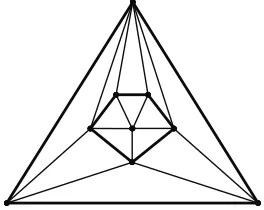
from which the Birkhoff diamond naturally arises. Key to the notion of Kempe-locking with respect to a deleted edge xy is that the vertices x and y have the same color and that they cannot be made to differ in color through any sequence of Kempe exchanges. Consequently, we need to analyze all possible 4-colorings of figure 3 in whichxandy have the same color. That set consists of the six distinct 4-colorings shown in figure 2 as restricted to the Birkhoff diamond subgraph. In turn, we note that that particular set of six distinct 4-colorings is identical to the set of all possible 4-colorings of the triangulation of order 9 formed by coalescing xand y into a single vertex of degree 6. That triangulation can be drawn as de-picted in figure 7—a triangle enclosing a pentagon enclosing a single vertex. It is quite satisfying to think that such an elegant graph might lie at the heart of why a minimum counterexample to the 4-color theorem does not exist, at the heart of why all planar triangulations must be 4-colorable.
Figure 7. This 4-connected triangulation of order 9 is likely the key to why a minimum counterexample to the 4-color theorem does not exist. The Birkhoff diamond of order 10 results when the topmost vertex is split into two vertices, each of degree 3.
8. Final observations and conclusions
It is not clear how to approach proving either conjecture 1 or conjecture 2. Since conjecture 2 implies conjecture 1 and lends itself to an appealing explanation for why a planar graph must be 4-colorable, it is the one on which to focus. Despite the all-but-convincing experimental support for the truth of conjecture 2, that con-jecture is almost surely going to be even harder to prove than was the 4-color theorem. Nonetheless, we have identified two things that have something impor-tant to offer regarding the matter of 4-colorability: (1) the likely incompatibility between the connectivity and coloring properties that a minimum counterexam-ple must exhibit and (2) the likely singular role that the Birkhoff diamond and its progenitor, the single-vertex-within-a-pentagon-within-a-triangle graph, play in Kempe-locking. They both provide fertile ground for new research.
Appendix
Theorem 3. If T is a 4-colorable planar triangulation that is Kempe-locked with respect to the edge xy, then every 4-coloring of T has a 2-color cycle including the edge xy.
Proof. Suppose there is a 4-coloringχ of a planar triangulationT that is Kempe-locked with respect to xy in which there is not a 2-colored cycle including both x and y. Without loss of generality, let the colors of x and y in χ be 1 and 2, respectively. Then, in the near-triangulation Gxy formed by deleting the edgexy, the coloring χ (as it applies to Gxy) can be transformed into a coloring χ0 by performing a 1-2 interchange of colors on the Kempe chain that includesybut does not include x. In χ0, both x and y have color 1. But then, by the statement of property 2,T cannot be Kempe-locked, contrary to our initial supposition.
Lemma 1. Every 2-color cycle in a planar triangulation must enclose at least one vertex.
Proof. Any cycle with a fully-triangulated interior and no interior vertices requires at least three colors for a proper vertex-coloring because any triangle demands three
colors.
Theorem 4. No4-colorable planar triangulation can be Kempe-locked with respect to every one of its edges.
Proof. Suppose thatT is a 4-colorable planar triangulation that is Kempe-locked with respect to every one of its edges. Letxybe one such edge and letT be given a 4-coloring in which, without loss of generality, the colors ofxandy are 1 and 2, respectively. By theorem 3, there is inT a 2-color cycleCusing the colors 1 and 2 that includesxy. By lemma 1,Cmust enclose at least one vertex and becauseT is a triangulation we know that there is such an enclosed vertexuthat is adjacent to both xand y. Without loss of generality, uhas color 3. Any vertex adjacent tou must be have color 1, 2, or 4. If none has color 4, then, without loss of generality, we can consider the cycle C to enclose only u. If there is a vertex v colored 4 adjacent tou, then becauseT is Kempe-locked with respect touv, there must be a 2-color cycle enclosed byC that uses the colors 3 and 4 and includes the edge uv. By lemma 1, this 3-4 cycle must enclose at least one vertex. Because T has finite order and because T is assumed to be Kempe-locked with respect to every one of its edges, such “telescoping” of 2-color cycles must terminate at a 2-color cycle that encloses a single vertex. Thus, without loss of generality, we can assume that such a cycle is, in fact, the starting cycleC colored 1-2 that includesxy and encloses a single vertexucolored 3. We now drop the vertex labelsxandy.
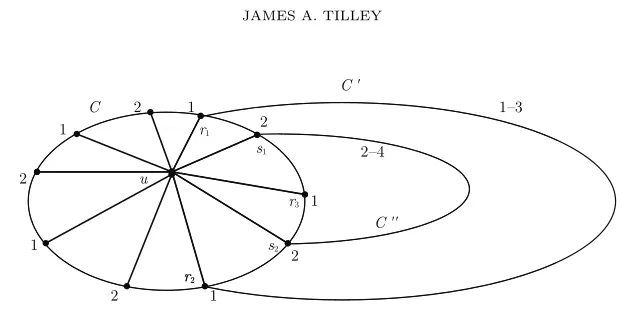
Let r1 be a vertex in C colored 1. By assumption, T is Kempe-locked with respect to the edgeur1. Thus, there must be a vertex r26=r1 in C also colored 1 so that the path r1ur2 is part of a 2-color cycle C0 using the colors 1 and 3. See figure 8. Recolorufrom 3 to 4. Lets1be a vertex colored 2 inC that lies between r1and r2 and is enclosed byC0 and suppose it is the only vertex lying betweenr1 and r2 that is enclosed byC0. Then a 2-color cycle using the colors 2 and 4 that includes the edgeus1cannot exist and T cannot be Kempe-locked with respect to us1. But if there is a vertex s2 6= s1 colored 2 lying between r1 and r2, then a 2-color cycleC00 using the colors 2 and 4 exists and C00 is essentially enclosed by C0, the two cycles touching only atu. Recolorufrom 4 to 3 and letr
r2
C ′
C 2 1 1–3
1 r1 2–4
2 u
r3 1
C ′′
1 s2
2 1
2
2
r2
r r
r2
s1
Figure 8. “Telescoping” process used to prove theorem 4.
is the only vertex lying betweens1 and s2 that is enclosed by C00, then the edge ur3 cannot be Kempe-locked. However, if there is a vertexr46=r3 colored 1 lying betweens1ands2, then there must be a 2-color cycle including the pathr3ur4that uses the colors 1 and 3. Because the order ofT is finite, this “telescoping” process of switching the color ofu between 3 and 4 and finding “nested” cycles touching only at ucannot continue indefinitely; at some point, there will be either a single vertex inCcolored 1 between vertices inCcolored 2 (withucolored 3) or a single vertex inCcolored 2 between vertices inC colored 1 (withucolored 4). In either case, the edge containing uand that single vertex will be one for which T is not
Kempe-locked, contradicting the initial supposition.
References
[1] K. Appel and W. Haken, Every planar map is four colorable, Part I: Discharging. Illinois J. Math.21(1977), no. 3, 429–490.
[2] K. Appel, W. Haken, and J.Koch, Every planar map is four colorable, Part II: Reducibility. Illinois J. Math.21(1977), no. 3, 491–567.
[3] G. Birkhoff, The reducibility of maps. Amer. J. Math.70(1913), 429–490.
[4] G. Brinkmann and B. McKay, Construction of planar triangulations with minimum degree 5. Discrete Math.301(2005), no. 2–3, 147–163.
[5] G. Brinkmann and B. McKay, Fast generation of planar graphs. MATCH Commun. Math. Comput. Chem58(2007), no. 2, 323–357.
[6] G. Chartrand and P. Zhang,A First Course in Graph Theory.Dover Publications, Inc., 2012. [7] A. Kempe, On the geographical problem of four colours. Amer. J. Math. 2(1879), no. 3,
193–200.
[8] N. Robertson, P. Sanders, P. Seymour, and R. Thomas, The four-color theorem. J. Comb. Theory B70(1997), no. 1, 2–44.
[9] J. Tilley, The a-graph coloring problem. Discrete Appl. Math.217(2017), no. 2, 304–317. [10] R. Wilson,Four Colors Suffice.Princeton University Press, 2002.
61 Meeting House Road, Bedford Corners, NY 10549, USA