UCL
University College London Department of Computer Science
EVALUATION OF COMPUTER AIDED INSTRUCTION:
ASSESSING THE VALUE AND EFFECTIVENESS
OF OPERATIONAL SYSTEMS
Arif Mahmud Iqbal
A thesis submitted for the degree o f Master o f Philosophy in the University o f London
ProQuest Number: U642301
All rights reserved
INFORMATION TO ALL USERS
The quality of this reproduction is dependent upon the quality of the copy submitted.
In the unlikely event that the author did not send a complete manuscript and there are missing pages, these will be noted. Also, if material had to be removed,
a note will indicate the deletion.
uest.
ProQuest U642301
Published by ProQuest LLC(2015). Copyright of the Dissertation is held by the Author.
All rights reserved.
This work is protected against unauthorized copying under Title 17, United States Code. Microform Edition © ProQuest LLC.
ProQuest LLC
789 East Eisenhower Parkway P.O. Box 1346
ABSTRACT
DEDICATION
I would like to thank my parents, Muhammad Iqbal and Sharifan Iqbal
for their love and support. I would also like to dedicate this thesis to them,
especially my mother since she was my original teacher and guide (and continues to be).
Arif Iqbal,
September 1996.
ACKNOWLEDGEMENTS
Although my name is the only one on this work there are many other people who directly or indirectly contributed to the creation of this thesis, and just as it takes a team to make a dream come true, so I must acknowledge all my colleagues and seniors who made it possible.
I certainly could not have completed this thesis without the support o f my supervisor. Professor Paul Samet and many thanks are due to him for taking me through both the
agony and ecstasy of the research process. I would also like to thank the following
Kinshuk and Ashok Patel of the Department of Accountancy at De Montfort University for their generosity;
Paul Wernick for introducing me to the Marginal Costing system and Wanderley Lobianeo for his help in proof-reading and advice;
and credit is due to John Cook (at Thames Valley University) and Mark-Elsom Cook (at the Electric Brain Company) for providing help and the loan of their system.
Many thanks for the help given by the students who participated and the permission provided by Julian Lavis of the Faculty of Business, Management and Social Studies at University of Westminster, Ian Potts of the School of Accountancy at Thames Valley University to carry out the study and loan the systems for the study and especially for Andrew Scott of the Management Centre at University College London for helping out with the study.
I am also indebted to my brother for his financial support and encouragement through the
good, bad and ugly periods of my writing up.
I am consistently reminded of that "Fear can hold you prisoner. Hope can set you free." The work carries the warning "Brains are not included - but are necessary".
There are many others, too numerous to mention, including some o f my research colleagues within the Department of Computer Science most notably Kapalandu Pal, David Fulton and Angela Sasse who have bestowed their friendship and advice, I am extremely grateful to these unsung heroes. Three special individuals have had the misfortune to call me their friend during my research work. All of them shared my sorrows and happiness and two other things bound them together - a steadfastness belief in me and a true friendship as well as a first name that began with the letter "K" (i.e. Khurshid, Kinshuk and Kamran). I hope they know how much they mean to me (especially the last person), as the British poet, Alexander Pope reminded us "In every friend we lose a part of ourselves, and the best part".
This research was carried out under a Science and Engineering Research Council studentship.
Arif Iqbal,
September 1996 (revised July 2003).
-CONTENTS
ABSTRACT ... 2
D ED IC A TIO N ... 3
ACKNOWLEDGEMENTS ... 4
CHAPTER O N E ... 14
1.1 The research problem ... 14
1.1.1 The Problem O u tlin e d ... 14
1.1.2 The Gap in the Literature ... 14
1.1.3 Why is it im po rtan t?... 15
1.2 Focus of this research ... 15
1.2.1 Scope of this th e s is ... 15
1.2.2 The Main O bjectives... 17
1.2.3 The Research Approach and its Boundaries ... 19
1.2.4 Significance of this R e s e a rc h ... 22
1.3 Structure of th e s is ... 23
1.4 Author’s n o t e ... 26
1.5 Key P o in ts ... 26
CHAPTER TWO ... 28
2.1 The promise of powerful educational tech n o lo g y ... 28
2.2 Computers in E d u catio n ... 31
2.3 A brief history of CAT ... 33
2.4 Current realities of education and educational so ftw a re ... 36
2.5 Brave new world of CAI - multimedia and the Internet ... 43
2.6 Evaluation of CAI - The Road to Better Software ... 49
2.6.1 Pitfalls in Evaluative Design ... 51
2.6.3 Instructor versus E valuator... 57
2.6.4 Establishing the goals of educational softw are... 63
2.7 Key P o in ts ... 64
CH APTER TH REE ... 66
3.1 What are Intelligent Tutoring Systems? ... 66
3.2 History of I T S s ... 68
3.3 Examples of Classic I T S s ... 75
3.3.1 SCHOLAR ... 75
3.3.2 GUIDON ... 79
3.4 Conceptual and Practical Issues in Intelligent T u to rin g ... 82
3.4.1 Importance of ITS research ... 83
3.4.2 Problems faced by ITS D ev elo p ers... 84
3.5 Why evaluate intelligent tutoring systems? ... 89
3.6 How should ITSs be evaluated?... 91
3.6.1 Mark and Greer’s (1993) Techniques for ITS Evaluation . . . 91
3.6.2 Degree, Gillis and Orey’s (1993) Procedures for Internal and External ITS Evaluation ... 94
3.6.2.1 Process evaluation ... 95
3.6.2.2 Product e v a lu atio n ... 97
3.6.3 Murray’s (1993) Evaluation Methods for Exploratory R ese a rc h ... 99
3.7 Overview of evaluation m e th o d s ... 103
3.8 Key P o in ts ... 106
CH APTER F O U R ... 107
4.1 Intelligent minds or intelligent m ach in es?... 107
4.2 AI hardware, tools and tech n iq u es... 108
4.3 Designing artificial intelligence... 112
4.4 Evaluating intelligent s y ste m s ... 115
4.4.1 How to carry out a "controlled" evaluation... 116
-4.4.2 Informal evaluations - the alternative to "controlled"
e v a lu a tio n ... 123
4.4.3 Cognitive ev a lu a tio n ... 127
4.4.4 Issues in evaluating... 130
4.5 Landscape of evaluation... 139
4.6 Key P o in ts ... 140
CHAPTER FIVE ... 142
5.1 What is Evaluation? ... 142
5.2 Why Evaluate at a l l ? ... 145
5.3 Formative versus Summative Evaluation... 147
5.4 Models of Evaluation... 148
5.5 A Brief History of E valuation... 153
5.6 The Style of Evaluation Chosen for this Study ... 156
5.7 Key P o in ts ... 159
CHAPTER SIX ... 160
6.1 In tro d u ctio n ... 160
6.2 What is Q u ality ?... 162
6.3 Quality versus Productivity... 165
6.4 Total Quality M anagem ent... 168
6.5 Measuring for Q u a lity ... 171
6.5.1 Standards and Benchm arks... 171
6.5.2 Quality Metrics ... 173
6.6 Key P o in ts ... 177
CHAPTER S E V E N ... 178
7.1 In tro d u ctio n ... 178
7.2 Determining the evaluation... 178
7.3 Approaches to Scientific R e se a rc h ... 179
7.3.1 Experim ents... 179
7.3.2.1 Independent Measures Design ... 181
7.3.2.2 Repeated Measures Design ... 183
7.3.2.3 Matched Subjects Design ... 184
7.3.3 Other Experimental D esig n s... 185
7.3.4 Correlational S tu d ie s... 191
7.3.4.1 Naturalistic Observation ... 192
7.3.4.2 Case S t u d y ... 194
7.3.4.3 Survey re se a rc h ... 195
7.3.5 Quasi-experimental designs ... 196
7.4 Benefits and Drawbacks of Experiments and Correlational studies . . 197
7.5 Choice of Research D e s ig n ... 197
CH APTER E I G H T ... 200
8.1 In tro d u ctio n ... 200
8.2 Obtaining a fully-functional tutoring system ... 201
8.3 Learning about marginal (variable) costing and testing the software . 204 8.3.1 Derivation of Attitude Ite m s ... 205
8.3.2 Collection of demographic and background information . . . 207
8.3.3 Piloting the questionnaire... 207
8.3.4. Improvement and refinement of questionnaire appearance and la y o u t... 209
8.4 Investigating assessment tests for marginal c o s tin g ... 210
8.5 Contacting and arranging meetings with accountancy departments . . 212
8.6 Carrying out the study at each s i t e ... 214
CH APTER NINE ... 216
9.1 In tro d u ctio n ... 216
9.2 Descriptive S ta tistic s... 217
9.2.1 Description of the Participants ... 217
9.2.2 Participant’s assessment of the Marginal Costing System . . 219
9.2.3 Responses to the Open Questions ... 234
9.3 Inferential S tatistics... 236
9.3.1 Pearson’s Correlation for inter-rater reliability... 236
-9.3.2 Comparing average scores of the experimental and control
g r o u p ... 237
9.3.3 Independent (Unrelated) t-test to test the difference between groups ... 238
9.3.4 Cronbach’s alpha - reliability of the attitudinal sc a le s 239 9.3.5 Factor Analysis of attitudinal scales... 241
9.4 APT R esu lts... 243
9.4.1 Description of APT P a rticip a n ts... 243
9.4.2 Participant’s assessment of the APT ... 244
9.4.3 Inferential Statistics ... 245
9.5 Sample Size and Statistical P o w e r ... 246
9.6 Conventional Teaching of the Control G ro u p s ... 250
CHAPTER T E N ... 252
10.1 Objectives of this R esearch ... 252
10.2 The research fin d in g s... 256
10.2.1 Marginal Cost Tutor findings ... 256
10.2.2 Replication with Application Program T u t o r ... 258
10.2.3 Previous Marginal Cost Tutor stu d ies... 260
10.2.4 Management Accounting Module... 261
10.3 Conclusions d raw n ... 265
APPENDICES
A Q uestionnaire... 275
B Marginal Costing Tests ... 289
C Frequency Distribution of Questionnaire Responses ... 296
D Summaries of Responses to Open Q u estio n s... 339
E Inter-Rater Reliability o f Scores ... 343
F Comparison of experimental and control differences using Independent T - t e s ts ... 345
G Reliability of the Attitudinal Scale using Cronbach’s Alpha Coefficient of R e liab ility ... 348
H Factor Analysis of Accountancy Knowledge/Teaching, Calculator facility and Comparison with other M e d ia ... 356
I Percentage of participants from the different universities ... 359
J Age distribution of participants (in years) and Order of birth distribution of participants ... 361
K Responses to "The calculator facility was easy to use" ... 363
L Responses to "I found it hard to use the calculator to transfer the answer to the p ro g ram "... 365
M Responses to "Using the calculator is frustrating - it does not do what it’s supposed to do " ... 367
N Scattergram of pretest scores marked by two raters A and K and Scattergram of posttest scores marked by two raters A and K . . . 369
O Average group scores before and after Computer or Classroom Instruction ... 371
P Screen Dumps ... 373
Q APT Frequency Distribution of Questionnaire Responses ... 378
R APT Summaries of Responses to open Q uestions... 412
S APT Inter-Rater Reliability of S c o re s ... 414
T APT Comparison of experimental and control differences using Independent T-tests ... 416
U APT Screen D u m p s... 418
REFERENCES & BIBLIOGRAPHY ... 424
-LIST OF FIGURES
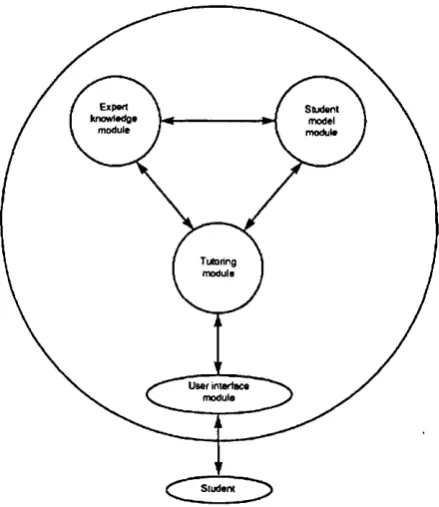
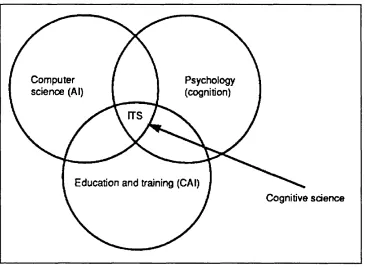
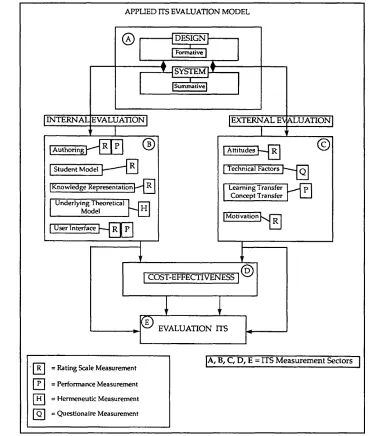
Figure 3.1: General ITS architecture (from Nwana, 1990)... Figure 3.2: Continuum of CAI types (adapted from Yazdani, 1986)... Figure 3.3: A dialogue with SCHOLAR (from Carbonell, 1970)... Figure 3.4: ITS Domains (from Nwana, 1990) ... Figure 3.5: Classification chart of evaluation techniques... Figure 3.6: An applied holistic model for the evaluation of ITSs (from Bento, 1990)... Figure 5.1 : Hierarchy denoting the quality of an expert system (from O’Keefe and
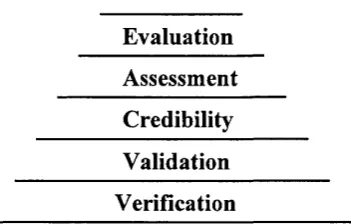
O’Leary, 1993)... Figure 5.2
Figure 6.1 Figure 7.1 Figure 7.2 Figure 7.3 Figure 7.4 Figure 7.5 Figure 8.1 Figure 8.2
Tyler’s curriculum model (from Hopkins, 1989). Quality Control... The Simple Experimental Design... The A-B-A Within-Subjects Design... The Before-after Two-group Design... The Four-group Before-after Design... Example of a Time Design... Representation of the procedure of this study . . Equations defining margin of safety...
LIST OF TABLES
Table 2.1: A history of computers in education (from O’Shea and Self, 1983). . . 36
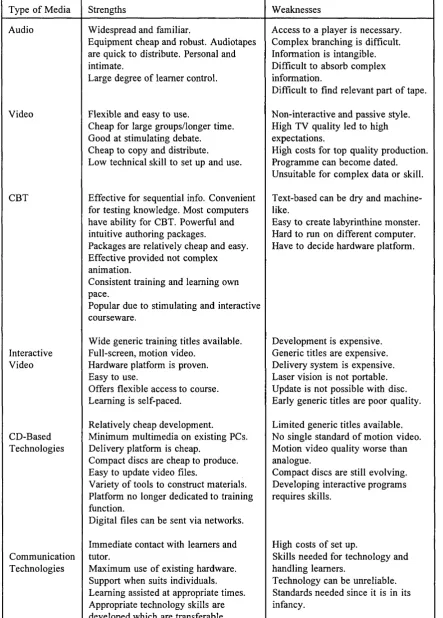
Table 2.2: A comparative summary of educational media (adapted from Faint, 1994)... 48
Table 2.3: Characteristics of Effective CAI (page 23, Hannafln and Peck, 1988). . 49
Table 2.4: Potential pitfalls in evaluative research (from Duncan, 1993 & Ransdell, 1993)... 52
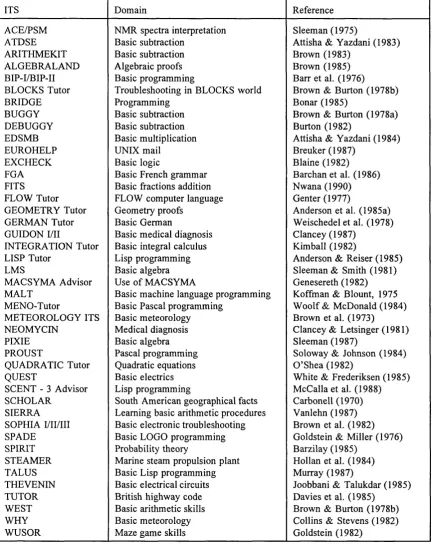
Table 3.1: A reasonably comprehensive list of ITSs and environments (from Nwana, 1990)... 74
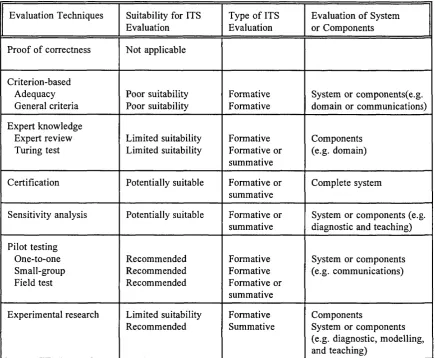
Table 3.2: Suitability of evaluation techniques (from Mark and Greer, 1993) . . . . 92
Table 3.3: Evaluation methods for exploratory ITS research (from Murray, 1993)... 101
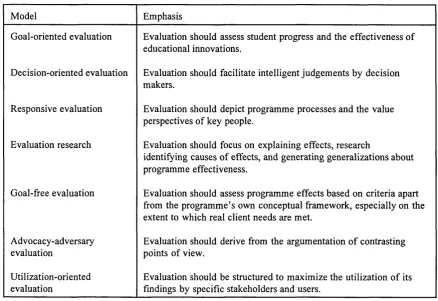
Table 5.1: Some models of programme evaluation (adapted from Herman et al. 1987)... 155
Table 6.1: Quality assurance procedures... 164
Table 7.1: Example of subjects in an independent measures design... 181
Table 7.2: Example of subjects in a repeated measure design... 183
Table 7.3: Example of subjects in a matched subjects design... 184
Table 7.4: Comparison of experimental and correlational studies... 197
Table 9.1: What features did you find contributed to the STRENGTH of this sy stem ?... 234
Table 9.2: What features did you find contributed to the WEAKNESS of this sy stem ?... 235
Table 9.3: If there was ONE outstanding improvement you could recommend to this system, what would it b e ? ... 236
Table 9.4: Improvement in overall group mean s c o r e s ... 238
Table 9.5: Independent t-test... 239
Table 9.6: Cronbach’s alpha o f grouped attitude items from questionnaire... 241
Table 9.7: Improvement in overall group mean scores... 246
-CHAPTER ONE
INTRODUCTION
"So we had better face the question of technology - what does it do and what should it do? Can we develop a technology which really helps us to solve our problems - a technology with a human face?
The primary task of technology, it would seem, is to lighten the burden of work man has to carry in order to stay alive and develop his potential. It is easy enough to see that technology fulfils this purpose when we watch any particular piece o f machinery at work - a computer, for instance, can do in seconds what it would take clerks or even mathematicians a very long time, if they can do it at all. It is more difficult to convince oneself o f the truth of this simple proposition when one looks at whole societies." [Schumacher, 1973] (9;20;9;19;23;9;4;5)
1.1 The research problem
1.1.1 The Problem Outlined
Computer systems are increasingly being designed for the purpose of education. Regrettably however, due to the high turnover rate, an understanding of their contribution to this field has not advanced nearly as rapidly. Consequently, the need for careful and systematic scrutiny of these systems is becoming a critical factor for the evolution o f this area. The overall purpose of this research is to determine a way of judging the merit or value of operational teaching systems as well as assessing their performance.
1.1.2 The Gap in the Literature
obsolescence for much of the valuable investment in teaching systems and a short-sighted approach for the whole field. This has been characterised by the lack of appropriate, or even the absence, of evaluation within this field, which in turn is hampering its progression to a mature research area and has surfaced as a considerable obstacle.
1.1.3 Why is it important?
Thus, we have a landscape of educational computing which suffers from being dominated by application rather than promotion of better practice and developing theory. It means that needs of the end-users are failing to be addressed, the expertise of users, educators and developers are not being properly utilised and not enough priority is being given to developing a learning culture which stresses refinement in design. Instead, there is a tendency to be consumed by the momentum of ever changing technologies. Consequently, this research is being carried out in a climate where there is a great need for progress in conducting evaluation studies which clearly focus on learning about the virtue and properties of current systems and their efficacy. The accumulation of such knowledge will advance the level of development in teaching systems.
1.2 Focus of this research
1.2.1 Scope of this thesis
The terms of reference for this research are defined and constrained by the following parameters
:-• a Computer Science perspective,
• an absence of a common knowledge base on evaluating fully functional teaching systems,
• a framework preventing execution o f long-term or extensive set of studies.
-The basis of this work originates from a Computer Science department. Consequently all the core issues raised are firmly rooted in a purely technological outlook. Our primary mission, in common with our fellow computer scientists, is to improve the current state of systems development in the promise of advancing the study and application of future computer systems, in our particular case teaching systems. This implicitly means using the scientific method and the engineering paradigm. Any contribution of knowledge in a physical science, such as computer science, relies on a variety of techniques from mathematical proof, measurement, statistical modelling to system construction in understanding and replicating physical systems. On the other hand, the role of an information systems engineer (which is comparable with other engineers who build ships, bridges and airframes) is to use their technical knowledge and skill to design and build the best system, ensuring that it is developed on time, within budget and does exactly what it was intended to do.
As a consequence, conducting research in computer science means that our principal focus is restricted to recommending changes in the development o f computer aided learning systems. Thus, we are not interested in suggesting improvements to conventional teaching practice, neither are we concerned in knowing the cognitive processes that take place when using teaching systems (since we are not commissioned to produce any new cognitive model o f learning). Our work solely concentrates on determining whether learning has taken place (not necessarily examining the nature or type o f learning involved) and whether the chosen media was successful in carrying out this purpose (and thereby enabling us to determine in what ways it could be improved). The key point here is that all the issues we have raised are from a computer science perspective, particularly from software engineering stance.
a wide acquisition of knowledge can also be justified by the multidisciplinary nature of automated teaching systems, which even from its earliest origins incorporated ideas from other fields. However, in spite of the inclusion of this mosaic o f literature, our sole focus is still to investigate methods that will lead to improvements in teaching systems from the computer science viewpoint.
While not a central theme of this work, the extensive examination of the multidisciplinary literature review, included a long and hard look at the human-computer interaction (HCI) and the ergonomics field (e.g. McGraw, 1992, Dovmton, 1993, Wilson and Corlett, 1990 and Lindgaard, 1994). This analysis of HCI models, techniques and practices failed to provide any significantly useful or unique concepts over and above those already present in the accumulated literature for this particular teaching system research. In fact, one notable reference, Howard and Murray (1987), only served to provide a confirmatory basis to the wide range of evaluation techniques available to any computer science researcher (e.g. the use o f questionnaire design).
1.2.2 The Main Objectives
The purpose of this work was to investigate a number of measures to assess the value and
effectiveness of operational computer-aided instruction systems with intended users.
To achieve this advanced level of understanding means that our major objectives are
to:-• utilise an already working system.
There are a number of good reasons for selecting a fully functioning (or operational) teaching systems for the subject of the investigation. Legree and Gillis (1991) pointed out that performance evaluations should focus on “extensive systems” since they are designed for actual requirements as well as covering a large amount of course material and as a consequence they have a substantial effect on course attainment. In addition, summative or final system evaluations are the preferred style for assessing external product attributes (see Legree, Gillis and Grey, 1993) whereas, incomplete systems are normally evaluated
-formatively for internal product attributes. An unhelpful consequence o f attempting to use a prototype or limited system is that the investigator can not be sure that a weakness found by using one aspect of the system was the “direct” result of the deficiency or even absence of another module. While an additional benefit of an operational system is that real users and a course are connected to its use. Indeed, Shute and Regian (1993) advocate that teaching systems should only be evaluated with the target population since they are best suited to determining the purpose of the system. So a representative system (as opposed to a working model) is the most suitable subject to use in order to demonstrate overall performance.
• find out if it is effective,
(i.e. is it at least as good as the equivalent conventional method?)
• elicit key properties that define it as valuable system (i.e. discovering lessons for future systems)
Winne (1993) defines an evaluation as the activity that provides key information with which to gauge the worth or value of an instructional enterprise. He argues that the growth o f future work in this field relies on better evaluations and these should be judged aceording to how much they help the user. Underwood and Underwood (1990) suggest that the goal of software in the classroom is to assist with the intellectual development of its user. As a consequence a key aim of evaluation is to discover the major characteristics of the teaching system which facilitate this role. Winne (1993) recommends the selection of these standards of worth or value should be derived from the clients or consumers. The assembled properties benefit the refinement of design as well as the representation of the eurrent teaching system.
• develop a procedure which could accomplish these goals easily and effectively, for evaluators.
Therefore there is no doubt that the preferred evaluation approach should include:- (a) the intended users as participants, (b) use of fully operational system, (c) the requirement to obtain learned outcomes indicating effectiveness, (d) to make comparisons with incumbent forms o f instruction, (e) to acquire user’s characteristics, (f) to elicit system strengths and weakness which provide clear design improvement targets. Not only that but this activity should be earried out in the most systematic and time-efficient manner as possible. The best and only reason for conducting an evaluation is the collection of valuable information which leads to immediate and much needed improvements and certainly not to become a tiresome, long-winded, pedantic exercise.
1.2.3 The Research Approach and its Boundaries
The decision to select the research design for this work was strongly influenced by the current state of the teaching systems literature (in particular the poor state o f evaluation) as well as the research objectives. The largest single criticism levelled at the current state
-of teaching systems is the lack -of “pr-ofessionalism” behind the construction -of systems for teaching. Evidence for great strides in better teaching systems simply turn out to be working models (not even semi-complete systems). It can also be clearly seen in the failure to observe the normal practice of disseminating acquired wisdom to peers and an absence of a coherent strategy to employ any standard tools, techniques and methodologies. As a result, a majority of teaching systems consist of discrete, discontinuous and one-off developments, normally associated with the case study approach to construction and assessment (known in computer science as rapid application development, or RAD).
In addition, this style of research has largely contributed to the poor state of the evaluation in this field, often through idiosyncratic conclusions being drawn from untested assumptions and informal impressions and by the views of a narrow set of users. The legacy of this approach is the abundance of one-off “evaluations” using either loose, implicit and poorly-designed sets of checklists (e.g. Jones and McCormac, 1992 reported that use of user’s opinions on their ovm were not a satisfactory method of evaluating teaching programs, in fact prior experience proved to be better evidence) as well as the use of in-depth descriptive case studies highlighting specific situational factors (e.g. Watson, 1993 found that the positive outcomes of IT measured in longitudinal case studies were related to the teachers who set up the environment). Another nail in the coffin of this style of research is that despite it being a well-trodden path, it still suffers from a low payoff (particularly from the computer science perspective) even though the input is painstakingly laborious (e.g. Perciful, 1993 took “two years” to conduct a study on one computerised component of a nurses course just in order to address the lack of knowledge about planning, implementing and evaluating with computerised teaching programs for nurses).
representativeness) as well as providing real end-users. Accordingly the design could be comparative. The other aspect is related to the nature of evaluation which shares the attributes of the two-headed Roman god Janus, namely reflecting on what has gone on in the past and peering ahead to the future. In our case it must be used to verify what the teaching system can do and at the same time point out areas of improvement. Here we choose to measure the characteristics of worth or value from a computer system point of view. So the chosen design will reflect this balance between confirming actual performance and disclosing future potential. Once these two primary conditions have been met we can acknowledge that the research has been successfully concluded.
The actual details of the research design are discussed in chapter 7, however two main points need to be borne in mind which serve to underline the main approach chosen for this research. Firstly, in a world of ever changing technology, there is a very important requirement for educators to judge between the genuinely innovative technology and the marketing hype and a significant factor in this is decision-making is on the basis of clear effectiveness. This is a reason why comparative studies are not that uncommon in the literature. It is also a way of establishing overall performance and whether the system justifies resources to be spent for its improvement. In fact this is also the premise of benchmarking commonly used in computer science. Additionally, as we shall see, complete and working systems are conventionally evaluated by summatively evaluation i.e. the efficacy of whole system with rigorous and formal methods. While internal components and prototype teaching systems are assessed formatively, in fact Bento (1990) describes this as collecting preliminary data through informal interviews, surveys, and protocol analysis.
Secondly, most of the disappointment faced in this field has been with the lack of continuity in system development and especially the failure to learn from the mistakes of the past. It is crucial, therefore, that this trend be reversed especially since yesterday’s failures can be tomorrow’s overnight successes. Although it is a cliché that we do learn more from our mistakes it is more than often true. Most of the problems arise because the computer systems are so complex to develop that it can be extremely difficult to plan any systematic and thorough evaluation. This is one reason why the inclusion o f a quality
-management approach (from software engineering) is a vital ingredient of this work. The main purpose o f quality is to make sure the system conforms to customer requirements and avoids wasted effort i.e. rework (incidentally this aspect is related to software reuse). It does this by making these requirements explicit (i.e. manifest, tangible and measurable) and then by keeping them under control. In addition, quality methodologies are often developed as products. Typical key issues include: how do existing systems meet customer needs and how to anticipate customer needs of the future and system development in the light o f these needs? Since complex systems will evolve from simple systems much more rapidly if there are stable intermediate forms (than without such forms) because they can be improved and measurement of quality allows us to track that improvement, therefore it is an ideal way of tackling major improvements in teaching systems. We must emphasise that our work is beginning of a new chapter in teaching system evaluation and very far from being a developed area, but there are now a few signs that researchers in other domains are using similar methods, for instance in knowledge based systems evaluation Juristo, Mate and Tovar (1997) have suggested a quality framework.
1.2.4 Significance of this Research
The intended benefits of this research work will be
to:-• permit designers and developers to make “accurate assessments of the contribution” of their technologies on educational performance, thereby enabling the shift away from a technological emphasis towards a more requirement-driven development, through user- participative design;
• encourage more “independent evaluations” of this type for all kinds of systems, permitting educationalists to make a more informed and rational choices in selecting appropriate educational technologies;
• offer “a set of tools and activities” for their own product testing (since other evaluative researchers will find it a useful introduction to a highly complex and multidisciplinary field);
• motivate other evaluators to add and to refine “the properties and the methodology” for their own systems, facilitating the development of a theory-based field dealing with evaluation of teaching systems (hence opening up the debate from a simple teaching and learning functionality).
1.3 Structure of thesis
This thesis consists of a review of several aspects from the three disciplines (i.e. computer science, education and evaluation) and particularly what they have to contribute to the debate about satisfactory evaluation approach and methods. Although this research intention is to tackle a practical problem, but in addition it needed to address the wider issues relating to the critical absence of evaluative theory as applied to this area. To some extent, the computer-aided instruction area can considered analogous to the early automobile industry, namely there are lots of different types of cars (in our case systems) being designed and built but no systematic effort takeing place improving their development. Chapter two until chapter six can be read separately as introductions to this field, nevertheless they are intended to be a cumulative set of arguments in the progress of the evaluation discussion.
In the next chapter we start by describing how computers have been promoted in the education system in spite of failing to live up to the (inflated) expectations that were built up by their early developers. We stress how these lessons should be heeded. A number of such issues are developed, including the problems of introducing computers into the classroom and making the best use of this technology, as well as whether these computers can take over some of the duties of human tutors or even if they are cost-effective. The
-significant point is that whatever educational technology is used there must be careful determination of requirements and evaluation of that technology.
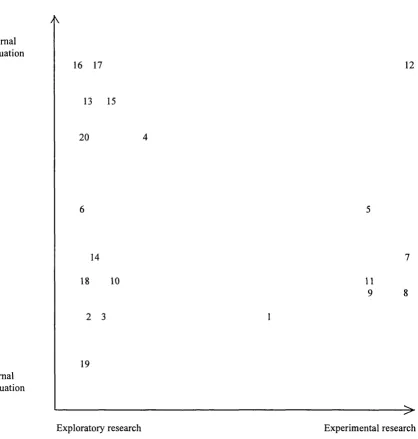
Chapter 3 provides a brief overview of the progression from computer aided instruction to intelligent tutoring systems. We relate the nature of intelligent tutoring systems and how to distinguish them from traditional computer aided instruction. There is a detailed examination of the problems faced by developers of intelligent tutoring systems. At this point we specify why evaluations are so important and the reasons they are rarely carried out. We report a number of methods for evaluating intelligent tutoring systems. Then we conclude by proposing a framework for classifying these methods of evaluation which overcomes some of the difficulties of choosing a suitable method o f evaluation. It involves asking two questions about the evaluative study (i.e. whether it is intended to be an
internal or external evaluation and whether it is an exploratory or experimental type of
research) and on the basis of this a comparable technique is chosen from a chart (representing a number of techniques sorted into four main quadrants - using the two main questions as two dimensions).
We take up the idea of evaluating intelligent tutoring systems in chapter 4 and examine three different strategies how this can be carried out. The evaluation approach taken in this research reflects a mixture of these three types o f evaluation. Then an explanation is given o f how five broad questions help advance a high quality evaluation. Whatever approach is taken, four key guidelines are proposed:
(1) evaluation must gauge worth or value rather than meeting targets;
(2) a variety of data and from as many sources as possible must be collected; (3) there must be an element of theory or model guided evaluation and (4) the evaluation approach must be one that helps the user.
is usually conducted by managers and end users. The significance of evaluation is provided, as well as the two main forms i.e. formative and summative evaluation, and an account of how evaluation relates to education. A brief history of evaluation is outlined with a variety of models (including the style of evaluation chosen for this study).
In Chapter 6 we introduce the philosophy of quality, which in recent years has gained popularity within industry, and is now being applied to software engineering. Despite the fact that quality has a complimentary role, it is often a neglected subject when discussing evaluation. We describe why this approach is significantly better than conventional measures of productivity and why quality is not just an add-on feature of any system but is a key function throughout the entire system life cycle. The main purpose of quality is to make sure the system conforms to customer requirements and is intended to avoid wasted effort (i.e. rework), and it does this by making these requirements explicit and by keeping control of this measurement. Quality metrics is then an ideal means of tackling major improvements in computer aided instruction.
An account of how the design for the research was selected appears in chapter 7. The overall goal of this research is to develop some measures of a fully functioning computer aided instruction within an operational environment and two slightly different aims follow from this. Firstly, whether the system is at least as effective as conventional teaching, and secondly, which features (or criteria) of the system are key in assessing the quality of a teaching system. As a consequence we use two different styles of research design for this work i.e. experimental design and a structured questionnaire. Another major element, which had implications for the choice of research design, was the applied teaching environment in which the study was conducted, the difficult choices are explained.
A personal account is given in chapter 8 of preparations for the study and how the study
was carried out. This included developing and piloting a questionnaire, creating an assessment test and arranging for a study at end-user locations. A number of practical difficulties are depicted including making a change in the structure to the before and after two-group experimental design of the research so that some of students were not deprived of the teaching. It illustrates the kind of obstacles faced by applied researchers conducting
-studies in a proper teaching schedule (i.e. practicality of design). There is also an account of the hurdles faced when attempting to obtain a fully functioning tutoring system.
The results of the practical study are presented in chapter 9. There is profile of the participants describing their demographics and their current and past experience with computers. This is followed by a detailed analysis of both groups performance on the tests and the experimental group’s assessment of the Marginal Costing Tutor.
Chapter 10 outlines a discussion and an interpretation of the results. It also reviews the contribution of this work and the practical lessons to be learnt from this type of investigation. We have provided a number of conclusions and added weight for the need to carry out further work. Evidence of other similar work is highlighted to emphasise the significance of such evaluations to this area. We end by suggesting a number of research awareness that remain unexplored.
1.4 Author’s note
Please note the term we (used throughout this thesis) is simply a writing convention.
The quotation convention we have followed in this thesis is that long quotations from the work of others are enclosed in double quotation marks, while small phrases (usually less than three words) written for emphasis are designated by italics or double quotation marks. The reason for using direct quotations is that the authors’ words and meaning are preserved from the original source (although it is acknowledged that when a reference is out of context readers may take a different meaning from the original). The remainder is to be attributed as the work of the author.
1.5 Key Points
• It has become necessary to establish a new culture based upon successive system development which is user-focused, easily auditable, and ensures large communication of knowledge.
• The basis of this computer science work is to pioneer an alternative evolutionary approach using the best of current evaluation practices and the application o f some ideas in quality management in order that future evaluators are able to build upon this approach to refine teaching system design.
• To demonstrate this approach we intend to assess not only the value but also the effectiveness o f an operational computer aided instruction system on real end-users using an appropriate evaluative methodology.
-CHAPTER TWO
EDUCATION AND CAI
"In the 1960s there was much talk of a generation gap; but that was understood to be a moral and political discrepancy. In the Information Age, the gap is purely technological, a matter of programming talents and keyboard virtuosity. ‘Kids and computers click’, possibly in a way that leaves their parents no option but to stand aside and watch with amazement - but only after they have gone shopping and bought the equipment. Undeniably, some kids click with computers. The emphasis, however, belongs on some - as in the phrase, some kids click with violins, or some
kids click with paintbrushes. But there are no millions being spent to bring violins or paintbrushes into the schools. Initially, there was a simple justification for favouring computers over violins in the budgetary priorities o f the schools. It was embodied in the catchphrase computer literacy - a seemingly undeniable necessity in the Information Age. Lacking that skill, children would grow up to be unemployable." [Roszak, 1986] (12;25;1;3;3;5;16;20)
2.1 The promise of powerful educational technology
stemmed from its ability to provide an individualised self-instruction teaching package, which was also cost-effective.
However, while programmed instruction enjoyed considerable popularity in the late 1950s, the revolution forecast by Skinner and others did not take place. Instead, the drive to develop programmed self-instructional texts continued in many other forms, especially because the principles were so applicable to the newest technology i.e. the computer. In fact, ever since computers came into common usage they seemed ideally suited to education. There is a number of reasons why this should be the case for instance, their capacity to store and retrieve huge amounts data, their fast computing power and infinite patience. Therefore it is not surprising that Guthrie and McPherson (1992) reported that from the earliest "development of computer assisted instruction (CAI) on large mainframe computers in the early 1960’s to its current use on microcomputers, CAI has been heralded as one of the greatest innovations in education". Another set of educational researchers, Underwood and Underwood (1990) have described some o f the remarkable claims that were made, "Patrick Suppes predicted that developments in educational technology, and specifically in computer usage, would change the face o f education in a very short space of time. This prophecy was made in 1966, and was based on his perceptions of the unique capabilities of the computer. He saw it as a tool which can be used interactively, presenting materials in novel ways not easily available through other media, and with the flexibility to adapt to different learning and teaching styles. The second prophet, Seymour Papert, also expresses ambitious aims for classroom computers, suggesting that we can abandon the worksheet curriculum and confidently allow children’s minds to develop through the exploration of computer-simulated ‘microworlds’". (5;4;20;8;1;20;14;15) Unfortunately computers have generally not lived up to these early expectations (see Rich, 1991) and in this chapter we shall explore some o f the reasons for this disillusionment.
One of the reasons for this misplaced optimism was that computers simply came to be used to reproduce books in electronic form or to revive programmed instruction. The original goal of this new educational technology was to construct instructional programs that incorporated well-prepared course material in lessons that were optimized for each
-student. Early programs, however, became electronic "page-turners" that printed prepared text and executed simple, rote drills; and practice monitors, which printed problems and responded to the student’s solutions using pre-stored answers and remedial comments. Another reason for the disenchantment is given by Hawkridge (1991), who argues that many of the problems o f this area, including the lack of any real success, are linked to its theoretical foundations which have to be challenged. Hawkridge (1992) strongly contends that the petrification of educational technology was because its theory had not moved on from the behavioural science tradition of programmed instruction. One solution provided by him is to borrow ideas from cognitive science (in the same way, as we shall see, that intelligent tutoring systems have done).
On the other hand, Atkinson (1983) notes with some surprise that, despite the fact the education industry is renowned for so many curriculum changes, there are few signs of technical innovation. He questions whether this is solely down to higher costs (in comparison to the benefits) of introducing technology or if there are other constraints on the individuals or institutions involved and goes onto say that "The use of educational technology promises higher output and/or lower costs. Greater learning may occur because different, more suitable methods can be used. The methods will vary with the medium, but several of the media such as computer-based learning, allow individualised instruction where students can learn at their own pace. Moreover, if alternative learning methods are available, students can choose that which they find most appropriate. Some of the media may be particularly appropriate to some types of learning". Another benefit of innovation is that, since the material may be better prepared than an individual teacher could manage, it could be carried to a wider audience.
difference is that a media based approach demands a far greater investment of resources before any output is obtained. This is particularly true for computer and distance learning, where the fixed costs are usually very large. This means that the scale of the operation is important. If the fixed costs are large, the approach will only be economical if these can be spread over many students". He concludes that high fixed costs, such as teachers needing to spend many hours producing a tape-slide programme, is one reason why the pace of educational innovation has proceeded so slowly.
2.2 Computers in Education
Before continuing we must tackle one of the contentious issue which afflicts the literature in this field, that is the disagreement between the three main terms which describe the application of computers in education. These three terms are known as Computer-Assisted Learning, Computer-Assisted Instruction and Computer-Managed Instruction and are abbreviated as CAT, CAI and CMI respectively. As Romiszowski (1988) points out, "every author seems to have his own definitions and classifications for the same technical terms. One marked difference is in the use of the terms ‘Instruction’ and ‘Learning’ on either side of the Atlantic. In the USA particularly, the term ‘Instruction’ tends to be used in a more global sense, for any type of teacher/learner interchange, whereas in Britain the term CAI has of late become restricted to ‘programmed instruction’ types of exercises, the preferred generic term being ‘ computer-assisted learning’ (CAL). It seems that Canada, caught between the two influences, cannot make up its mind,". He goes on to suggest that even British authors disagree amongst themselves, although most recognize that CAI is a subset of CAL. On the other hand, CMI is sometimes considered as a variety o f CAL and at other times as a separate category, not part of CAL in the strict sense. To further confuse the picture, there are two versions of CAL, occasionally seen as Computer- Assisted Learning or alternatively as Computer-Aided Learning (the same applies for CAI). For the purpose of this thesis these two versions mean the same thing. The reader should also be aware that the use of computers in education has spawned a variety of other terms such as educational software, instructional software, instructional technology and learning technology as well as computer-based instruction/learning (CBI/L). As for
-the three main terms we give -the following definitions, based on those provided by Romiszowski
(1988):-Computer-Assisted Learning (CAL) - is a global term indicating the variety of ways that computers are being used in education and training; it is taken to include simulations, games, database search/inquiry methods and programming of computers.
Computer-Assisted Instruction (CAI) - is where the computer explicitly delivers a set of instructional programs and is associated with drill-and-practice, dialogue and tutorial forms of computer use.
Computer-Managed Instruction (CMI) - is an umbrella term which includes all the routine data processing tasks that an instructor needs to assess students or to revise materials.
Although it is hard to generalise, the use of the computer as a tutor or teacher can be classified under term CAI, whereas CAL describes the use of the computer as a tool. Computers, however, have come to be used in a variety of ways in education, each of which is related to a distinctive version of computer-assisted
learning:-Simulation - where the properties of a dynamic system or situation are reproduced,
because it may be expensive or dangerous to construct for real;
Drill and Practice - the presentation of questions with immediate feedback, in order to
reinforce simple skills or to practice already learnt skills;
Problem-solving - where the learner is prompted to resolve a dilemma or problem by
systematically acquiring or applying lesson knowledge, and is considered a useful way to impart some elementary skills;
Dialogue - is an approach which enables a two-way conversation between the user and the
Tutorial - is where the learner is provided with explicit instruction so that information is taught, appropriate problems are presented, and informed guidance and feedback is provided during the lesson; it is a relatively more sophisticated form of instruction (since there are remediation and strategies for making the learning more meaningful to the learner).
2.3 A brief history of CAL
Computer assisted learning began in the 1950s with linear programs. They are mainly associated with the psychologist B.F. Skinner and are based on the principle of operant conditioning. They consisted of computer programs which presented students with a series
of frames (or units of information). Each frame would consist of a question and a space
to make a response. The students would then be immediately informed if they were correct, before proceeding to the next frame. Nwana (1990) describes why this instruction was so basic, "The major limitations of linear programs became glaringly apparent: they did not provide individualization, which meant that all students, irrespective of their abilities, background, or previous knowledge of the domain, received exactly the same material in exactly the same sequence; neither did they provide feedback, as the students’ responses were ignored". The last comment means that, apart from being told the answer was right or wrong, there was no additional corrective information. Another flaw of these linear programs was that they were only suitable for an associative level of instruction.
In the 1960s Norman G. Crowder developed a new approach called branching programs,
which improved upon some of the limitations of linear programs. Although they still used a fixed number of frames, they did contain multiple-choice responses, which enabled the student to select an alternative so that they were "branched" to a specific next step based on that response. These programs presented a frame to the student, which was then checked, if the student’s response was correct then the next frame would be presented; however if the student was incorrect then further information would be presented exploring the error and possibly repeating an earlier frame. The idea was to allow bright students to move quickly through the program and the less able students to be given
remedial material when they answered incorrectly. Moreover, unlike linear programs, Crowder presented larger amounts of information to the student (up to a full page) before requiring a response. Although Nwana (1990) does point out "the teaching material became too large to be manageable through straightforward programming and so a special breed of programming languages, called ‘author languages’, were developed for creating CAI material". Research indicated that these programs were effective in teaching many different types of objectives and a wider range of students. Their shortcoming was that the branching decisions were still specified by the author.
Generative systems appeared in the late 1960s and early 1970s and represented a new
level of sophistication in the design of CAI systems. The gains in computer memory and speed meant that teaching material could itself be generated by the computer. Nwana (1990) relates that, "A generative system has the ability both to generate and solve meaningful problems. In some domains like arithmetic, researchers realized they could do away with all the pre-stored teaching material, problems, solutions and associated diagnostics, and actually generate them. The potential advantages, if exploited, were enormous. They included drastically reduced memory usage and the generation and provision of as many problems (to some desired level of difficulty) as the student needed". Generative systems did improve individualization and feedback and are often considered as the first adaptive teaching programs, since the selection of problems varied as a consequence of the student instead of the author. They did, however, suffer from a lack of explicit representation of student knowledge and therefore were unable to question the student. In addition, generative systems did not have the human-like knowledge of the domain they were teaching and therefore were unable to answer serious questions by the student as to why and how the task should be performed.
assisted instruction (CAI) is a mature technology. The use of ‘author languages’ makes construction of such systems reasonably straightforward. The main problem with CAI systems is the shallow representation of knowledge of the domain in which they teach, and the fact that they are suited to teaching specific expertise and not abstract problem-solving activity". Even in generative systems, where the teaching material was produced by the computer itself, there was a limited improvement in the variation o f difficulty o f the task. Generative systems were the precursor to a new type of CAI called intelligent tutoring systems, which will be explored in the next chapter. Lo (1991) has traced this evolution of CAL, from the early days of linear programs to the use of intelligent tutoring systems in the 1990s. During this period, he indicates there has been a shift in the locus o f control from tightly defined program control to increasing student freedom. He observed that such a shift could be seen to mirror a change from a behaviourist-oriented approach to a more cognitive, student-centred perspective to learning. While linear programs were clearly identified with behaviourist theories of learning, generative systems were a movement in the direction of the cognitive approach, i.e. meaningful instruction. We have only managed to give a brief account of the history of CAL, for a comprehensive picture one should refer to O’Shea and Self (1983). Instead, in order to illustrate the haphazard way in which ideas in CAL have developed, we have provided a list of the various CAL programs from their textbook.
-Approach Distinguishing characteristics Illustration Linear programs Derivation from behaviourism; systematic
presentation; reinforcement and self-pacing.
Last (1979)
Branching programs Corrective feedback; adaptive to student response; tutorial dialogues; use o f author languages.
Ayscough (1977)
assisted learning Drill-and-practice; use o f task difficulty measures; answering student questions.
Palmer and Oldehoeft (1975)
Mathematical models o f learning
Use o f statistical learning o f learning theories o f limited applicability; response-sensitivity.
Laubsh and Chiang (1974)
TICCIT Team production o f courseware; "mainline" lessons; use o f television and minicomputers; learner control.
Mitre Corporation (1976)
PLATO Multi-terminal interactive system; visual displays; "open shop" approach; concern over cost.
Bitzer (1976)
Simulation Computer as laboratory; interactive graphics; typically small programs.
McKenzie (1977)
Games Intrinsically motivating; audio-visual effects; often lacking educational aims.
Malone (1980)
Problem-solving Computer as milieu; programming by children; derivation from Piaget’s theory and artificial intelligence.
Papert (1973)
Emancipatory modes Computer as labour-saving device; task-oriented; use o f microcomputers and public information systems.
Lewis and Tagg (1981)
Dialogue systems Tutorial strategies; use o f natural language; mixed initiative; use o f complex knowledge
representations.
Carbonell (1970)
Table 2.1: A history of computers in education (from O’Shea and Self, 1983).
2.4 Current realities of education and educational software
much recognition (often reflected in monetary rewards); an education system which is seen as to blame for an endless list of problems e.g. widespread illiteracy, school bullies and crime. Indeed a recent report {Every Child in Britain) highlighted the current debate about poor standards in simple mathematical and language skills among school children. More underlying reasons are giving rise to this crisis, including tighter controls on education funding, a reduction in the younger population, gaps in technical and vocational teaching and a fragmentation of society. The new age of information technology is imposing its own pressures, most notably through an increasing demand for a better qualified workforce. Consequently it is no surprise that solutions to this crisis are also being sought from this very same technology.
The most significant challenge to education comes from the Information Age. In the forward to the second edition of Papert’s book Mindstorms John Sculley, ex-CEO of Apple Computer, highlights what this means for the USA,
"During the Industrial Age and for most of this century, America stood alone at the top of an economic pyramid, taking resources out of the ground - oil, wheat, and coal - adding its manufacturing know-how to those resources, and selling those goods to the rest of the world. We are no longer in the Industrial Age. We are in an Information Economy where strategic advantage is determined by ideas and information and by the skills of a nation’s work force.
Virtually overnight, America has gone from being resource rich to being resource poor. As a direct consequence, America is perched on the edge of an economic cliff, and unless we make a concerted effort to bring the educational system into sync with the rest of the global economy, we are in danger of supplying the rest of the world with low-wage work and losing out on the high-skill, high-wage economy that the rest of the world has moved toward". (14;5;2;21;20;20;8;5)
His comments are typical and imply that education has to undergo a major reconstruction or even a complete transformation to meet this challenge.
-If we look back to the origins of the present school system this is nothing new, educational institutions have always developed to meet the needs of the country’s social and economic systems. Knirk and Gustafson (1986) describe how the Industrial Revolution introduced the practice of mass education, "Factory schools were established by industries in the United States in the 1800s. They arose because the apprenticeship system did not provide the necessary number of trained people for the factories. Also, because of increasing job specialization workers did not need to be highly skilled at many tasks; they usually had to know how to do only a single operation. Because the workers needed little general education, the training program could be tailored to the specific tasks to be accomplished. During that period, industrial progress was not so rapid that it was necessary to teach principles to permit generalizable understanding and the ability to work in varying or evolving situations." A similar series of events took place in Britain. In fact, some o f the earliest schools were established in the Industrial Revolution to educate the children of the workforce, which had moved from the small farming and craft communities of the countryside into the huge factories of the rapidly growing towns and cities.
the fact that education is no longer constrained to the young and that adults are required to possess a wider education base and regularly update their skills in the pursuit of life long learning.
A related philosophy of education is one in which the learning process is conducted from the student point of view. The modern proponent of this type of learning, known as the
child-centered approach, is Piaget and involves a more individual and variable interaction
between the learner and their environment. The Piagetian heritage acknowledges that at the heart of any good teaching and learning experience is a critical relationship i.e. where teachers and learners alike seek to question each other’s ideas, to reinterpret them, to adapt them, and even to reject them but not to discount them. The most important lesson of Piaget’s view of learning is that it is an active process', the teacher is not a mere explainer or imparter of information instead their main task is to foster conditions under which the student can think freely. It has been argued that the development of information technology will make these styles of learning easier to develop and implement. For instance the Paul Hamlyn Report on Education declared that "IT is playing an increasing role in the delivery of further, higher and adult education and training. It is making learning available to much larger numbers by giving students more choice over the time, location and pace of learning, and by securing a greater commitment to learning". Furthermore the report described a survey which highlighted the need to monitor the quality of IT applications as well as the scale of provision. Another variety o f this kind of learning which is being supported by new technologies is Resource-based learning (see Taylor and Laurillard, 1995), in which the capabilities of a library are provided for a self directed learner.
A question which naturally arises from this is whether a form of technology implementation is more likely to solve this crisis. We discussed this in a previous report Iqbal (1990), with special reference to the American education crisis. For others, however, information technology is capable of generating more radical remedies to this crisis. Most notably Seymour Papert, who has argued that the computer can act as a catalyst to fundamentally transform the way people think, work, learn, and communicate. Indeed Sculley tells us that "Seymour was among the first to see that massive change was needed
-in the education system, particularly math and science education, and to recognize the role that technology could play in learning. Perhaps more significant, though, was how he was one of the first to recognize that technology in the classroom was not a silver bullet that would solve all of education’s ills." It is this last point which will be discussed in this section. While CAL is not a panacea for all the ills of education (indeed it can provide problems it its own), can it provide an effective form of education? This is a crucial question and needs to be asked more frequently.
In the same way that other machines, for instance steam engines, have replaced muscle power so the arrival of the computer persuaded us into thinking that it will assist or even replace our brain power. At a time when there is a shortage of people to do the actual teaching and teaching costs by other means are rising, schools and other educational institutions have become keen to utilise this technology. It is important to say here, however, that while it is tempting to make general comparisons between human and computerised teaching systems it is also clear humans and machines have their separate advantages and limitations. Therefore proper comparisons should be limited to particular situations. Despite this obvious disparity, many computer visionaries continue to advocate that all one has to do is to throw technology at the problem. Consequently there are huge amounts of money being spent on computers in education. In fact in the USA there is a personal computer for every seven pupils, whereas in the UK that figure rises to fifteenh Snyder and Palmer (1986) even described a number of fashionable notions on how computers are being propelled into schools:
Comfy Is As Comfy Does - is to create an ideal children’s bedroom in school in order to
make the computer more accessible (i.e. keep it away from the chaotic classroom).
Face the Music - is to put the computer in the mathematics lab where it belongs (i.e.
maths wizards who want to use it and they are the ones who know how to use it, so don’t fight it).