Utilization of Fly Ash and Bottom Ash from Circulating Fluidized Bed Combustion
(CFBC) Technologies
Yu-Ri Lee
Departments of Chemistry and Chemical Engineering, Inha University, Incheon, Korea 402-751.
Thriveni Thenepalli
Mineral Resources and Research Division, Korea Institute of Geoscience and Mineral Resources(KIGAM), Gwahang-no 124, Yuseong-gu, Daejeon, 305-350 Korea.
Jiwhan Ahn*
Mineral Resources and Research Division, Korea Institute of Geoscience and Mineral Resources (KIGAM), Gwahang-no 124, Yuseong-gu, Daejeon, 305-350 Korea.
Abstract. Energy production from fossil fuel combustion results in the emission of greenhouse gasses, the dominant contributor being CO2. It is well known that greenhouse gas emissions from energy production can be reduced by the use of alternative energy sources such as nuclear power and renewable energy sources. Renewable energy sources are expected to become increasingly important for our future energy demand. The effect of greenhouse gasses on global climate change has been acknowledged by many governments worldwide, and the reduction of the emissions of these gasses is becoming increasingly important. Several technologies are being developed for CO2 capture and sequestration from coal fired plants. Among those, oxy circulating fluidized bed combustion technology is one of the most promising methods to produce a stream of concentrated CO2 ready for sequestration. Use of recycled flue gas/oxygen mixtures for combustion in circulating fluidized bed combustion (CFBC) offers advantages over oxy-fuel combustion with conventional pulverized fuel (PF) firing technology.
Keywords: Recycling, Utilization, Fly Ash, Bottom Ash, circulating fluidized bed combustion (CFBC).
IJITE Vol.03 Issue-10, (October, 2015) ISSN: 2321-1776
International Journal in IT and Engineering, Impact Factor- 4.747
A Monthly Double-Blind Peer Reviewed Refereed Open Access International e-Journal - Included in the International Serial Directories
International Journal in IT and Engineering
http://www.ijmr.net.in email id- [email protected] Page 68
1. Introduction
The National Energy Technology Laboratories proposed the new advanced coal power technologies presented in Figure 1[1]. This study is carried out in the context of the growing use of low rank coal alongside the development of environmentally friendly coal-fired power generation technologies in Korea. It provides an overview of the current situation of power generation in Korea. As Korean researchers are working to develop fluidized bed boilers as a next generation technology with high efficiency, this study compares the characteristics of the fluidized bed boiler and the pulverized bed boiler in order to offer a better understanding of the developments in this field. Finally, the behavioral characteristics and concentrations of heavy metals within the waste products of coal-fired power plants are discussed.
Fig. 1. DOE(NETL) Advanced Coal Power Technologies
South Korea’s future energy goals are outlined in biannual power development plans based on which
generation companies apply for government approvals for power plant construction. The latest
installment of the so-called “Basic Plan of Long-Term Electricity Supply and Demand (BPE)” is the 6th BPE,
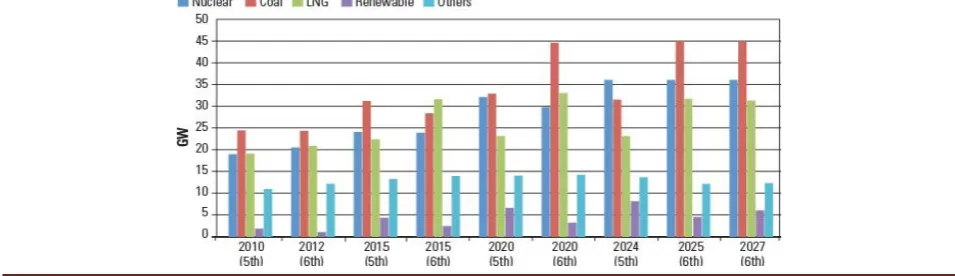
issued this year, which covers a planning period from 2013 to 2027[2]. Figure 2 shows the South Korea’s
future energy sources. Coal power has to date played a particularly marked role, its share in the country’s
electricity mix rising dramatically from 17% in 1990 to 40% in 2010. Gas-fired generation, too, soared
during that period, from 9% to 19%. Though the country’s “green growth” future strategy favours nuclear
A Monthly Double-Blind Peer Reviewed Refereed Open Access International e-Journal - Included in the International Serial Directories
Fig. 2. South Korea’s future energy plan(2010-2024).
South Korea’s energy consumption is still growing and Korea dependent on imports *3](Figure 3). Rising coal consumption in South Korea and a negligible production level have caused the country to rely heavily on imports over the past several years. South Korea held only 139 million short tons (MMst) of recoverable coal reserves in 2010, according to the World Energy Council estimates. The electric power sector accounts for 62% of the country's coal consumption, while the industrial sector accounts for most of the remaining amount, according to KEEI.
Fig. 3. South Korea’s coal imports from overseas-2014.
2. Problem of Coal Power Plants By –products Generation
IJITE Vol.03 Issue-10, (October, 2015) ISSN: 2321-1776
International Journal in IT and Engineering, Impact Factor- 4.747
A Monthly Double-Blind Peer Reviewed Refereed Open Access International e-Journal - Included in the International Serial Directories
International Journal in IT and Engineering
http://www.ijmr.net.in email id- [email protected] Page 70
about the same as all the residential solid waste generated in the US per year. Most coal power waste winds up in landfills, surface impoundments or in mines whereas smaller amounts are used for e.g. cement or concrete production.Rates of coal power waste recycling are high in some European countries, including the Netherlands, Denmark and Belgium, but worryingly low among the three largest consumers of coal, China, the US and India (33 percent, 38 percent and less than 5 percent respectively). Typically, solid waste is stored in landfills, while liquid waste is stored in impoundments. Ideally these disposal sites should be designed to prevent the toxic wastes from entering the environment.
In Korea, based on the demand and policy, it has been plan to expansion new thermal power plants. In developed countries, ash recycling technologies are available to minimize the landfill problems.
Table 1. Overview of Ash production from Coal Power Plants
3. Results and Discussion
3.1. Major and Minor Component of Coal and Coal Ash
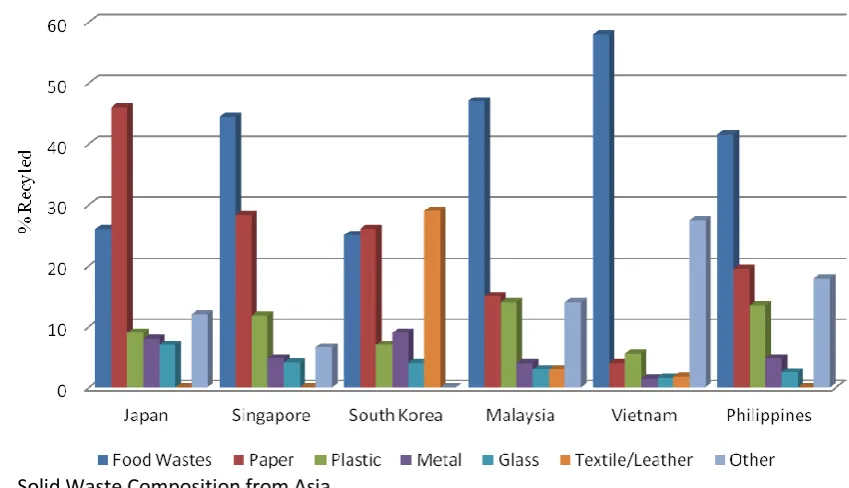
Coal contains about 120 types of different elements, of which 33 are common, and 8 types make up the majority. Results of the XRF content analysis to identify the basic components of coal are compiled in the below Table 2 and solid waste composition mentioned in Table 3.
Table 2. Major and minor chemical composition of samples by XRF (unit: wt.%).
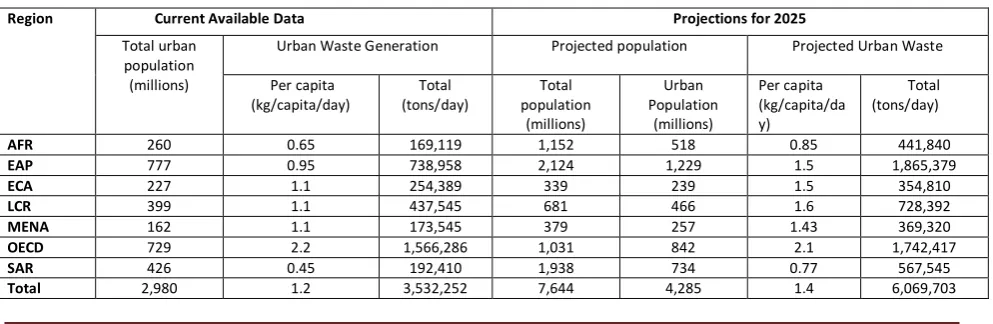
Region Current Available Data Projections for 2025
Total urban population (millions)
Urban Waste Generation Projected population Projected Urban Waste
Per capita (kg/capita/day) Total (tons/day) Total population (millions) Urban Population (millions) Per capita (kg/capita/da y) Total (tons/day)
AFR 260 0.65 169,119 1,152 518 0.85 441,840
EAP 777 0.95 738,958 2,124 1,229 1.5 1,865,379
ECA 227 1.1 254,389 339 239 1.5 354,810
LCR 399 1.1 437,545 681 466 1.6 728,392
MENA 162 1.1 173,545 379 257 1.43 369,320
OECD 729 2.2 1,566,286 1,031 842 2.1 1,742,417
SAR 426 0.45 192,410 1,938 734 0.77 567,545
Total 2,980 1.2 3,532,252 7,644 4,285 1.4 6,069,703
Year Coal Ash
Total imports Consumption
2004 7,210 4,551 515
2006 7,088 5,020 568
2008 9,047 6,279 710
2010 10,610 7,667 867
A Monthly Double-Blind Peer Reviewed Refereed Open Access International e-Journal - Included in the International Serial Directories
Fig.4. Solid Waste Composition from Asia
Table 3. Overview of MSW Management in Asia
3.1.1 Feasibility Studies in Philippine
Under the “Development Cooperation Framework for Islands” GTC-K Korea Waste management planning for sharing the technology in Bantayan, Philippines. The key technologies from Korea institute of Geosceinces and Mineral Resources are collaborates with local governments of Bantayan, Philippines in case of development of new technology for control the green gas emissions and recycling technologies of municipal solid waste(Fig.5). GTC-K provides master planning for Bantayan island waste management and waste- to-energy over carbon free island concepts. Policy and Master Planning for Bantayan is needed for long-term development of the reason.
Region Collection Treatment Disposal
Japan Source Separation, Fixed
time collection
Incineration/WTE A few composting plant for MSW
Sanitary landfill
South Korea Source Separation Incineration/WTE composting plant
Sanitary landfill
China Some cities conducted
source separation. Not sufficient in rural area
Increasing number of incineration/WTE plant in large cities, some composting
Shift to sanitary landfill
Thailand, Malaysia
Some cities conducted source separation.
Limited number of incineration plants
Shift to sanitary landfill
Philippine, Indinesia, Vietnam
Insufficient collection. Some cities conducted
source separation.
No incineration plants Shift to sanitary
IJITE Vol.03 Issue-10, (October, 2015) ISSN: 2321-1776
International Journal in IT and Engineering, Impact Factor- 4.747
A Monthly Double-Blind Peer Reviewed Refereed Open Access International e-Journal - Included in the International Serial Directories
International Journal in IT and Engineering
http://www.ijmr.net.in email id- [email protected] Page 72
Fig.5. GTC-K( including KIGAM R& D institute) collaboration with Bantayan local government, Philippines3.2 Key Technologies from KIGAM: Accelerated Carbonation Technology for Alkaline Waste
Accelerated Carbonation of Municipal Solid Waste
The new technology of accelerated carbonation is widely used in many industries as an alternative method to natural carbonation which proceeds very slowly in Nature.
Natural carbonation
Natural carbonation occurs by the reaction between atmospheric CO2 and alkaline materials, which is called “weathering”. It is well known that the “weathering” depends on the initial chemical composition, the characteristic of minerals in alkaline materials and the amount of CO2 uptake. Natural carbonation generally progresses very slowly over a long term.
Accelerated carbonation
In accelerated carbonation, CO2 in a high purity is artificially injected into solid wastes to make the reaction much faster than that by atmospheric CO2, and the reaction can be finalized within a few minutes or hours. This technology is applied to the treatment of solid wastes in which toxic metals are stabilized by carbonated materials, so that the treated solid wastes can be reutilized in other fields.
A Monthly Double-Blind Peer Reviewed Refereed Open Access International e-Journal - Included in the International Serial Directories
by the decrease in alkalinity, whereas the carbonation at an acidic range can increase the buffering capacity.
Carbonation of heavy metals
In the worldwide trend towards encouraging carbonation treatment of MSWI bottom ash as described above, our research group has also performed carbonation studies using MSWI bottom ash and CO2 in order to increase the recycling percentage of the ash and reduce the concentration of atmospheric CO2 in Korea.
Wastewater Treatment by Accelerated Carbonation
The formation of solid carbonates between aqueous solutions containing divalent cations and CO2 is a complicated and important process in Nature and industrial areas. Compared to the aforementioned studies on the carbonation of MSWI bottom ash, however, aqueous carbonation using wastewater is still poorly known and rarely reported in the literature. In this section, we review two representative studies which have reported on the carbonation of cations or anions in wastewater using CO2. There are several researchers reported the accelerated carbonation of municipal solid waste and alkaline solid waste materials [4-7].
In Korea, Institute of Geoscience and Mineral Resources (KIGAM), Daejeon, established a successful pilot plant for multi-processing of MSWI ash as shown below in the Figure. The capacity of this pilot plant is 200 kg/hour (Fig.6). This pilot plant was the first one in the waste recycling field in Korea and even throughout the Asian countries, and includes multi-processes of particle separation; heavy metal stabilization, chloride removal, and green aggregate/concrete manufacture (Fig.7).
IJITE Vol.03 Issue-10, (October, 2015) ISSN: 2321-1776
International Journal in IT and Engineering, Impact Factor- 4.747
A Monthly Double-Blind Peer Reviewed Refereed Open Access International e-Journal - Included in the International Serial Directories
International Journal in IT and Engineering
http://www.ijmr.net.in email id- [email protected] Page 74
This technology can be also considered as an accelerated carbonation in terms of making the reaction shorter using high purity CO2. One of advantages of this technology compared to other CO2 storage technologies is that CO2 is stably stored in final products such as CaCO3 and MgCO3.
Currently, accelerated carbonation processes have been focused on assessing and maximizing the storage of CO2 by optimizing the operating conditions including pressure, temperature, liquid-to-solid (L/S) ratio, gas humidity, gas flow rate, liquid flow rate, particle size, and solid pre-treatment in numerous experimental investigations. The processes via which the carbonation of the minerals or alkaline solid wastes takes place in a single route step are referred to as directcarbonation.Usually, these processes can be divided into two types: gas-solid (dry) carbonation and aqueous (wet) carbonation; these processes are generally operated at an L/S ratio of less than 0.2 and more than 5, respectively.
3.3 CO2 Solidification of Hazardous Elements from Inorganic Waste(power plants ash)
The accelerated carbonationof hazardous elements from wastes such as MSWI bottom ash, fly ash and power plants waste is a controlled accelerated version of the naturally occurring process. In addition, in many cases, binding of toxic metals may occur as the carbonated product rapidly solidifies. The novel method of the simultaneous calcium hydroxide carbonation with compressed carbon dioxide in order to stabilize the solid material.
4. Conclusions
A Monthly Double-Blind Peer Reviewed Refereed Open Access International e-Journal - Included in the International Serial Directories Acknowledgements
This research was conducted in 2014 with support from the Energy Technology Development Project [20141010101880] of the Korea Institute of Energy Technology Evaluation and Planning, financed by the Ministry of Trade, Industry and Energy.
References
[1] John Wimer, U.S. DOE clean coal research program, 2014, pp.1-43. [2] Sonal Patel, South Korea Walks an Energy Tightrope, Power News, 2013.
[3] Korea Energy Economics Institute, “Monthly Energy Statistics”, August 2015, pp.61-64.
[4] E.E. Chang, S.Y. Pan, L.Yang, Y.H.Chen, H.Kim, P.C.Chiang, “Accelerated carbonation using municipal solid waste incinerator bottom ash and cold-rolling wastewater: Performance evaluation and reaction kinetics”, Waste Management, 43(2015), pp.283-92.
[5] Shu-Yuan Pan, E.E. Chang, Pen-Chi Chiang, “CO2 Capture by Accelerated Carbonation of Alkaline Wastes: A Review on Its Principles and Applications”, Aerosol and Air Quality Research, 12(2012), pp.770–791.
[6] Namil Um, Seong-Young Nam, Thenepalli Thriveni, Ji-Whan Ahn, “Effect of Accelerated Carbonation on the Mineral Phase of Alkaline Inorganic Waste”, 61(2014), pp.39-48.