Data Mining and Privacy Issues
Dr. Jatinder Kumar Assistant Prof. A.S. College, Khanna
Abstract: The era of IT and IT enabled services has brought a revolution in the present day life which
revolves around the data, its use and the interpretation as per the need of the users. Apart from
focusing on issues related to efficient and secure data storage, effective and secure data retrieval is the
key area now a days. Privacy is the buzzword these days in all the companies handling and providing
data to one and all. The customers have now noticed that it is their right to determine which personal
information about him or the organization is to be made available to others. The customers want to be
secure from unauthorized disclosure of information about oneself or the organization. This paper is
emphasizing on hammering on the question that Can data privacy and data mining coexist? The aim is
to explore how exactly data mining can be a threat to privacy, and what type of legislative and technical
steps should be taken to make sure that data mining and data privacy go together a long way.
Keywords: Data Security, Data Privacy, Authentication, Cryptography.
Introduction
One’s life consists of a variety of data. Without any technical devices, we may get much information or
data from others. For example, how they look, what language they speak, and what they eat. Although
what we could get from others is a continuous stream data format, those data, roughly collected, can
tell us many things about them, for instance, their age, race, nationality, food tastes, etc. Today we
consciously or unconsciously diffuse our data somewhere. Whenever we shop, use credit card, rent a
movie, withdraw money from ATM, write a check and log on the Internet, our data go somewhere.
Virtually, every aspect of our life discloses information about us. With the development of computing
and communication technology, now data can be captured, recorded, exchanged, and manipulated
easier than before. Recently, issues about information privacy have emerged with the dramatic growth
of data storage, computer processing power, and networks. Especially, data mining becomes a hot
issues related to data privacy of individuals in the context of the Internet, e-commerce, direct
marketing, and interactive advertising raises potential problems of data mining. “Data mining represents
What is Data Mining?
It is basically the definition of policies stating which information is collected, how it is used and how
customers are informed and involved in this process.
Data mining technology has been developed with the goal of providing tools for automatically &
intelligently transforming large amount of data in knowledge relevant to users.
It’s the science of extracting useful information from large data sets of databases.
Data mining is the process of analyzing data from different perspectives and summarizing it into useful
information - information that can be used to increase revenue, to cut costs, or both.
Data mining is the process of finding correlations or patterns among dozens of fields in large relational
databases.
Data mining is a set of automated techniques used to extract or previously unknown pieces of
information from large databases. Data mining is not a business solution but simply the underlying
technology. In technical terms, data mining is described as the application of artificial intelligence (AI)
and other intelligent techniques such as neural networks, fuzzy logic, genetic algorithms, decision trees,
nearest neighbor method, rule induction, and data visualization, to large quantities of data to discover
hidden trends, patterns, and relationships.
Although data mining is a relatively new term, the technology is not.
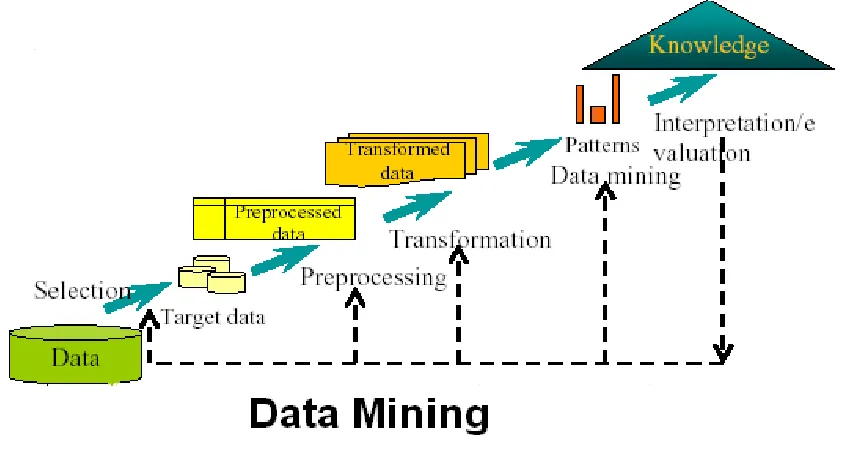
Figure I: Process of Data Mining
Applications of Data Mining
With data mining, a retailer could use point-of-sale records of customer purchases to send targeted
promotions based on an individual's purchase history. By mining demographic data from comment or
warranty cards, the retailer could develop products and promotions to appeal to specific customer
segments WalMart is pioneering massive data mining to transform its supplier relationships. WalMart
captures point-of-sale transactions from over 2,900 stores in 6 countries and continuously transmits this
data to its massive 7.5 terabyte data warehouse. WalMart allows more than 3,500 suppliers, to access
data on their products and perform data analysis. stored data is used to locate data in predetermined
groups. For example, a restaurant chain could mine customer purchase data to determine when
customers visit and what they typically order. This information could be used to increase traffic by
having daily specials.
Likewise, data mining now is considered as basis for new products and for enhancing existing offerings,
Taking another example, not only as a marketing tool, large data mining companies such as HNC
Software and IBM, have used data mining techniques to detect credit card fraud and to evaluate real
estate.
Data mining is primarily used today by companies with a strong consumer focus - retail, financial,
communication, and marketing organizations. It enables these companies to determine relationships
among "internal" factors such as price, product positioning, or staff skills, and "external" factors such
as economic indicators, competition, and customer demographics.
Data mining is usually used for four main purposes:
(1) To improve customer acquisition and retention;
(2) To reduce fraud;
(3) To identify internal inefficiencies and then revamp operations, and
(4) To map the unexplored terrain of the Internet.
Data Mining and Privacy:
Privacy is a loaded issue. In recent years privacy concerns have taken on a more significant role in our
society as merchants, insurance companies, and government agencies amass warehouses containing
personal data. The concerns that people have over the collection of this data will naturally extend to any
analytic capabilities applied to the data. Users of data mining should start thinking about how their use
of this technology will be impacted by legal issues related to privacy. Data mining is the driving force for
lots of businesses. However, these days, privacy concerns of data collection and manipulation are
getting bigger than ever before.
The process of mining the data can also return sensitive information about individuals and
organizations, posing a threat to the individual’s right to privacy. It can also reveal critical information
about business transactions, causing a free competition in a business setting. Therefore a strong need is
being felt to prevent disclosure not only of confidential personal information but also knowledge which
is considered sensitive in a given context. It leads to the need of various privacy preserving algorithms.
The aim of these algorithms is the extraction of relevant information or knowledge from large amount
of data while protecting at the same time the sensitive information. These algorithms allow one to
Privacy of data while extracting information from the data bases is of paramount importance. Privacy
involves a definition of policies among which information is collected, how its used & how customers are
informed & involved in this process. It is the right of a person to determine which personal information
about him or organization may be communicated to others. Privacy is the right of an individual to be
secure from unauthorized disclosure of information about one self that is contained in an electronic
repository.
The information which can be mined from a database by using various data mining algorithms also poses
a threat to the privacy of the individual. The thrust area now is to data and private knowledge remain
private even after the mining process.
As various Privacy Preserving Data Mining Algorithms (PPDM) are available, the crucial issue is to
determine which one among these techniques is better to protect sensitive information and is to find
out a set of criteria’s with respect to which these algorithms can be evaluated and ultimately we may
lead to the standardization in this area. However, apart from protection of sensitive information, it is
also very important to assess the quality of data resulting from the modifications applied by each
algorithm as well as the performance of each algorithm. The need is to find out a comprehensive set of
criteria’s (or a framework) for estimating & comparing Privacy Preserving Data Mining Algorithms and
ultimately to find out whether the algorithm meets the specific requirements. Some of the techniques/
Dimensions which are considered are:-
1. Efficiency-: Ability of privacy preserving algorithm to execute with good performance in terms of all
resources implied by algorithm. Performance is accessed in terms of time & space and in case of
distribution algorithm, in terms of communication costs incurred during information exchange.
2. Scalability: - It is described as the efficiency trends for increasing values in data sizes. It concerns with
increase of both performance & storage requirements together with the cost of communication
required by distributed technology. The less rapid is the decrease in efficiency of Privacy Preserving Data
Mining algorithms for increased data dimensions, better is its scalability.
3. Data Quality: - Quality of data after application of a privacy preserving technique is
again a major area of concern. Because if the quality of data transmitted or shared is not good then it
will be of no use. Quality of data is being checked by comparing it before and after the application of
context. The major parameters which are considered most relevant are: accuracy, completeness and
consistency. The accuracy is closely related to the information loss resulting from the hiding strategy.
4. Hiding failure: - It is the portion of sensitive information that is not hidden by the application of a
privacy preserving technique. Target of Privacy Preserving Data Mining algorithm is to achieve a zero
hiding failure.
5. Privacy level: It estimates the degree of uncertainty according to which sensitive information that has
been hidden can still be predicted. We need to define a unique parameter quantifying privacy level
ensured by these algorithms.
Data Mining and the customer issues:
In order to determine whether personal data currently available to data mining should be restricted,
however, two points should be considered; one is fairness and the other is openness in consent. First,
because data subjects are often “not informed” during the data collection or data mining, sometimes it
is impossible for them to set up a new normatively private situation regarding the data. Secondly,
because the personal data that data subjects may have willingly granted for use in one context is often
subsequently mined for another context different from the original situation. This brings about issues
related to unauthorized consent.
Around the world, virtually all privacy legislation, policies or guidelines have been derived from the set
of principles established in 1980 by the Organization for Economic Co-operation and Development
(OECD) (Cavoukian, 1988). These principles are often called “fair information practices,” and cover eight
specific areas of data protection.
They are: 1) Collection Limitation; 2) Data Quality; 3) Purpose Specification; 4) Use Limitation; 5)
Security Safeguards; 6) Openness; 7) Individual Participation; and, 8)Accountability.
While many European countries have already adopted their own data privacy policy, we are left behind
in policy making for privacy issues. Government should pass laws on how personal information is
collected “What’s going on today is exponentially more threatening to those who want to protect
privacy,” People can’t make informed decisions on the Net because they do not have enough
information. With government’s regime, IBM, along with many other industry leaders, has adopted its
substantial organizations that collect, use, or process data, understands the stake they have in consumer
confidence. Some other trade associations also have privacy principles and guidelines which govern how
their members do business.
In short, self-regulation is a sham. The policies that companies have posted under the pressure from the
government are as vague and confusing as anything … Most sites don’t limit how they or their partners
use consumer information. And Web sites can transfer information to partners without telling their own
customers. Many sites also change their practices at will and without warning. The work is rather going
on to tighten such measures to ensure the right use of the customer data. Indian Government has
taken many serious steps to design and implement cyber laws to protect the data from unauthorised
access. The Department of Information Technology has been directed to hasten the process of
amending the Indian IT Act to ensure that any breach of secrecy and any illegal transfer of commercial
or privileged information is made a punishable offense.
On the technically side, What is needed? … is a machine-to-machine protocol for negotiating privacy
protection. The user sets the preferences once – specifies how they would negotiate privacy and what
she is willing to give up – and from that moment on, when she enters a site, the site and her machine
negotiate. Only if the machines can agree the site will be able to obtain her personal data.
Conclusion: The need of the hour is that privacy policy should be open and fair, but there exists various
privacy-related conflicts between different groups, i.e., consumers vs. businesses, data subjects vs.
data miner, etc. These conflicts should be negotiated in the open and fair environments and the
efficient privacy preserving algorithms should be made available. For this, this paper presents that
users/data subjects should have “informed choices” for collection, mining and exchange of data about
themselves. Despite the rapid growth of privacy concerns, there are no current laws and business
guidelines to sufficiently protect privacy violation in data mining. The need is to design and operate such
an environment and platform which can have all these three areas of legislative, economic, and
technological aspects under one roof. Though all of these approaches are contributable to expand user’s
informed choices for their privacy, each approach is not mutually exclusive but interleaved. A narrow
approach to push only one-sided solution might intensify the tension between data privacy and data
mining. So we believe that the tension can be minimized if and only if privacy policy is built on multiple
approaches because data mining seems a survival strategy for companies in these days and to survive
References:
Vassilios S. Verykios1, Elisa Bertino2, Igor Nai Fovino2, “State-of-the-art in Privacy Preserving Data
Mining”
Elisa Bertino Igor Nai Fovino Loredana Parasiliti Provenza “A Framework for Evaluating Privacy
Preserving Data Mining Algorithms”
“Data Mining” Next Generation Challenges and Future Directions, Hillol Kargupta, Anupam Joshi,
Krishnamoorthy Siva Kumar, Yelena Yesha.
Agarwal.R and Srikant ,R.2000,Privacy preserving Data Mining. In Proceedings of the ACM SIGMOND
International Conference on Management of Data.
H. R. Nemati and C. D. Barko(2003)“Key Factors for Achieving Organizational Data Mining Success”.
Industrial Management and Data Systems, vol. 103, no. 4, pp. 282–292.
Hillol Kargupta, Anupam Joshi, Krishnamoorthy Siva Kumar and Yelena Yesha, Data Mining: Next