IJEDR1602336 International Journal of Engineering Development and Research (www.ijedr.org) 1914
Finite Element Analysis and Experimental Validation
of Lower Control Arm
1
Miss. P. B. Patil, 2Prof. M. V. Kharade 1
Assistant Professor at Vishweshwaraya Technical Campus Degree wing, Patgaon, Miraj2Assistant Professor at Dr. J. J. Magdum College of engineering, Jaysingpur
1
Mechanical Engineering, 2Mechanical Engineering
________________________________________________________________________________________________________ Abstract - It is important to analyze the suspension systems that have been designed to predict the behavior of the system than followed with improvements. In this paper, lower control arm of Indica Vista car is used for analysis. Modal analysis is done on contr ol arm to find its natural frequency. Modes of vibration that lie within the frequency range of the operational forces always represent potential problems. Mode shapes are the dominant motion of a structure at every of its natural or resonant frequencies. Modes are an inherent property of a structure and do not depend upon the forces that act on it. Existing model is taken and optimized by removing material from high stressed region. Modal analysis is carried out in Ansys. This optimized model is fabricated and tested on FFT analyzer for validation.
IndexTerms - FEA, Lower control arm, FFT analyzer.
________________________________________________________________________________________________________
I.INTRODUCTION
The general function of control arms is to keep the wheels of a motor vehicle from uncontrollably swerving when the road conditions are not smooth. The control arm suspension normally consists of upper and lower arms. The upper and lower control arms have different structures based on the model and purpose of the vehicle.
This Control arm is one of the important components in suspension system. In double wishbone suspension system both upper and lower control arm used. But in McPherson strut suspension system only lower control arm is used.
Due to the different functions control arm is important part in components suspension system. As vehicle passes through bump, speed breaker etc different types of forces acting on the wheels which are transmits to control arm via attachments i.e. ball joint assembly etc. to the wheel.
The lower control arm takes most of the impact that the road has on the wheels of the motor vehicle. It either stores that impact or sends it to the coils of the suspension depending on its shape. The present study will contribute in this problem by using finite element analysis approach.
II.LITERATURE SURVEY
The literature review of work includes study of design and analysis lower control arm.
The paper aims at complete FEM analysis of a suspension link for bending vibrations, pitching, bouncing and combined mode dynamic analysis for deformation and stresses [1]. An experimental device has been developed to study fatigue phenomena for nodular cast iron automotive suspension arms. On the base of a detailed fracture analysis, it is shown that the major parameter influencing fatigue failure of casting components are casting defects [2].The study aims to improve dynamic characteristics of a front lower suspension arm and aerodynamic effects of a hand-made hybrid vehicle designed [3].This paper explores the finite element modeling, analysis and fatigue life prediction of lower suspension arm using the strain-life approach. Aluminum alloys are selected as a suspension arm materials. The structural model of the suspension arm was utilizing the Solid works [4]. Fatigue life of automotive lower suspension arm has been studied under variable amplitude loadings. In simulation, the geometry of a sedan car lower suspension arm has been used[5].The prediction of fatigue failure from notches and other stress concentrators is complicated by factors relating to the local notch geometry and stress field[6].Wishbone structure for double wishbone front-independent Suspension for a military truck application is presented. At present, the vehicle is equipped with rigid axle with leaf springs [7].In this research, the shape of upper control arm was determined by applying the optimization technology. This study considers the static strength in the optimization process[8].Based upon studies, we can apply boundary conditions to the model and carry out analysis. Analysis can be done on FEA software to determine the nature of failure caused due to stresses developed.
III.FINITE ELEMENT ANALYSIS ON LOWER CONTROL ARM:
IJEDR1602336 International Journal of Engineering Development and Research (www.ijedr.org) 1915
Boundary condition calculation: Loads on Transverse link
Road bump case Braking case
Car wheel designation: Indica vista
Weight distribution = 54:46 (As engine is in front side) Gross vehicle weight (GVW) = 1080 kg
Therefore, weight on rear side = 496.8 kg
Weight on one side of wheel = 496.8/2 = 248.4 kg
Road bump case
The speed of the vehicle on speed breaker was taken as 14 km/hr. Speed of vehicle = 14km/hr (3.8m/s)
U= X
twhere, U = velocity, x = displacement, t = time
t = 1
3.8 = 0.25 sec
U vertical =x vertical time =
0.25
0.25 = 1m/s
A vertical = U vertical
time = 4 m/sec2
Wheel acceleration force (inertia force) = mass Χ acceleration
= 248.4 X 4 ≈1000 N
Braking case
Vehicle de accelerates (i.e. braking) at a constant 0.5 G
Braking force = mass X acceleration X0.5 G = 248.4 X 9.81X 0.5
≈1250 N
Boundary conditions are the reference points for calculating the results of analysis.
IJEDR1602336 International Journal of Engineering Development and Research (www.ijedr.org) 1916 Meshing details:
Type of element: tetra-hedra No. of nodes: 14664 No. of elements: 62151
Table 2: Material properties of MS
Property Value
Young’s Modulus, E 210 GPa
Poisson’s Ratio ,ν 0.29
Density, ρ 7850 kg/m3
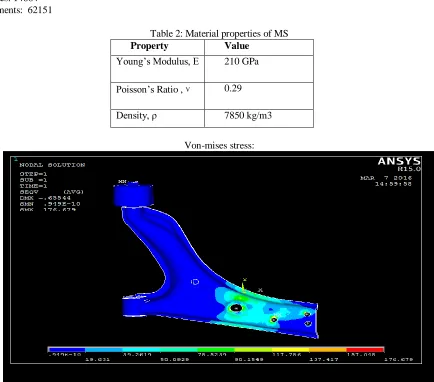
Von-mises stress:
Fig: Stress Plot of Existing Lower Control Arm
From results of finite element analysis it is observed that stress value is coming out to be 176.67 N/mm2 which is within the safety limit. There is a great potential to optimize this safety limit which can be done by removing material at the region where the stress concentration is less, thus optimizing its weight without effecting its structural behavior. The maximum displacement value is 0.65 mm which is also very less.
IJEDR1602336 International Journal of Engineering Development and Research (www.ijedr.org) 1917 Fig: Modal analysis of existing lower control arm in Ansys
Modal analysis results for mode 1 to mode 6 are 61.24 Hz, 173.28 Hz, 220.49 Hz, 760.09 Hz, 878.38 Hz, and 1393.29 Hz respectively.
IV.FINITE ELEMENT ANALYSIS ON OPTIMIZED LOWER CONTROL ARM:
Topology optimization has been performed based on stress results of existing lower control arm. Changes are made in CAD model as shown in below figure.
IJEDR1602336 International Journal of Engineering Development and Research (www.ijedr.org) 1918 Fig: Meshed Model and Boundary Condition Application on optimized arm
Meshing details: No. of nodes: 74360 No. of elements: 336771
Post-processing:
Fig: Von-mises Stress for optimized Lower Control Arm
Stress value for lower control arm is 154.5 N/mm2 which is well below the critical value. Hence, design is safe.
IJEDR1602336 International Journal of Engineering Development and Research (www.ijedr.org) 1919
1st mode: 90.13 Hz 2nd mode: 284.62 Hz
3rd mode: 319.42 Hz 4th mode: 814.25 Hz
5th mode: 1042.96 Hz 6th mode: 1230.2 Hz
Fig: Modal analysis of optimized lower control arm in Ansys
Modal analysis results for mode 1 to mode 6 are 90.13 Hz, 284.62 Hz, 319.42 Hz, 814.25 Hz, 1042.96 Hz, and 1230.2 Hz respectively.
Table: Comparison of natural frequencies of existing lower control arm and optimized lower control arm
Mode Frequency Lower control arm Optimized Lower control arm
1 61.24 Hz 90.131 Hz
2 173.28 Hz 284.62 Hz
3 220.49 Hz 319.42 Hz
4 760.09 Hz 814.25 Hz
5 878.38 Hz 1042.96 Hz
IJEDR1602336 International Journal of Engineering Development and Research (www.ijedr.org) 1920
V.TESTING ON LOWER CONTROL ARM
Fabricated model of optimized control arm:
Fig: Fabricated model of optimized control arm
Below are the steps for testing
1. The lower control arm is hinged on the supports as shown below.
2. The FFT analyzer is connected to top data acquisition system which records the results. 3. The FFT analyzer is connected to a sensor which reads the response of the system.
4. The lower control arm is first hammered at three different point and corresponding readings are noted down. 5. The hammer test is initiated by slightly hammering the free end of the Lower control arm.
6. Then the response of the system is recorded by the FFT analyzer. Below figure shows testing setup:
IJEDR1602336 International Journal of Engineering Development and Research (www.ijedr.org) 1921 Experimental response:
Response at point 1
The frequency obtained from above graph at point 1 is 100Hz. Response at point 2
The frequency obtained from above graph at point 2 is 300Hz. Response at point 3
IJEDR1602336 International Journal of Engineering Development and Research (www.ijedr.org) 1922
VI.CONCLUSION
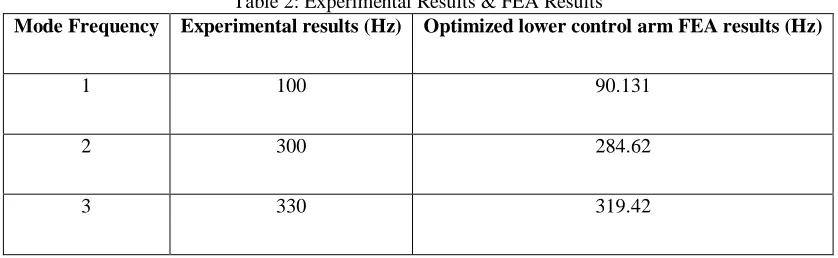
Table 2: Experimental Results & FEA Results
Mode Frequency Experimental results (Hz) Optimized lower control arm FEA results (Hz)
1 100 90.131
2 300 284.62
3 330 319.42
The above data show closure values of optimized lower control arm FEA results and Experimental outcomes.
In this particular research work we carried out FEA analysis of existing lower control arm. According to this work we found that there is a scope for optimization.
Lower control arm is meshed in Hypermesh and solver deck for modal analysis is prepared. Then this total data was incorporated into Ansys software which gives the natural frequencies of exciting lower control arm.
By using the topology optimization technique, lower control arm is optimized & natural frequencies are extracted.
After that the comparative study of existing and optimized lower control arm is undergone. Then optimized lower control arm is fabricated and tested using FFT analyzer.
The experimental outcomes & FEA results shows a closure resemblance.
REFERENCES
[1] Pratik S. Awati, Prof. L.M.Judulkar, “Modal and Stress Analysis of Lower Wishbone Arm Along With Topology”, International Journal of Application or Innovation in Engineering & Management (IJAIEM) Volume 3, Issue 5, May 2014 ISSN 2319 - 4847 [2] Y. Nadota, V. Denierb, “Fatigue failure of suspension arm: experimental analysis and multiaxial criterion”, Elsevier, Engineering
Failure Analysis 11 (2004) 485–499
[3] Guebum Han1,2, Kang-Min Lee1,2, and SeongKeol Kim, “A Study on Improving Dynamic Characteristics of a Front Lower Suspension Arm and Aerodynamic Effects of a Hand-Made Hybrid Vehicle”, international journal of precision engineering and manufacturing vol. 15, no. 9, pp. 1897-1908
[4] M. M. Rahman1, M. M. Noor1, K. Kadirgama1, Rosli A. Bakar1, M.R.M. Rejab, “finite element modeling, analysis and fatigue life prediction of lower suspension arm, Malaysian Technical Universities Conference on Engineering and Technology June 20-22, 2009
[5] N.A. Kadhim1, S. Abdullah2, A.K. Ariffin and S.M. Beden, “Fatigue Failure Behaviour Study of Automotive Lower Suspension Arm”, Key Engineering Materials Vols. 462-463 (2011) pp 796-800
[6] D. Taylor a,*, P. Bologna b, K. BelKnani b, “Prediction of fatigue failure location on a component using a critical distance method”, Elsevier, International Journal of Fatigue 22 (2000) 735–742
[7] G. Fourlaris a, R. Ellwood a, T.B. Jones b, “The reliability of test results from simple test samples in predicting the fatigue performance of automotive components”, science direct, Materials and Design 28 (2007) 1198–1210