P18
Evaluation of Hedgehog Signaling in Human Transitional Carcinoma Cell Lines
Clay W. Mechlin1, Matt Tanner2, Badar Mian3, Ralph Buttyan2 1Albany Medical Center, Albany, NY, US, 2Ordway Research Center,
Albany, NY, US, 3Albany Medical Center, Stratton VA Medical Center,
Albany, NY, US
Introduction and Objective: Hedgehog (Hh) is a ligand-driven
signal-ing pathway that is involved in embryonic tissue growth and morpho-genesis. Hh activates Gli transcription and increases cell proliferation and invasiveness. Aberrant Hh signaling is involved in human tumori-genesis and drugs related to cyclopamine, that block Hh signaling, are being tested as anti-cancer agents. Here, we describe efforts to charac-terize a potential role of Hh signaling in bladder cancer by quantifying expression of Hh signaling components in human transitional carcino-ma cell (TCC) lines and by evaluating the effects of cyclopamine, on the growth of these cells.
Materials and Methods:Human TCC lines, RT4,253JP and 253BV, UMUC
3 and 6, were characterized for their relative growth rate and invasive-ness by cell counts and with a Matrigel invasion assay. Cells were test-ed for relative growth inhibition by cyclopamine (5 mM) over 5 days. RNAs were extracted for quantitative RT-PCR evaluation of Sonic Hedgehog, Gli1/2, Smoothened and Patched gene expression.
Results: The different TCC lines were distinguished by a hierarchy of
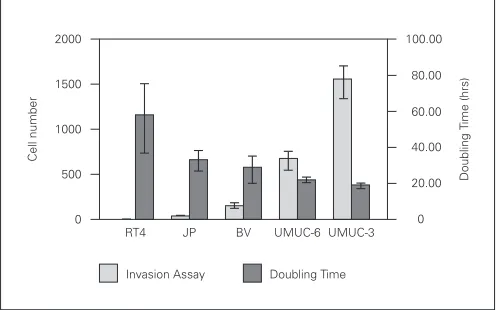
diminishing relative doubling times (DTs) that was inversely correlated with relative invasive behavior (Fig. 1). The cells with the shortest DTs and highest invasive behavior had the highest relative Gli2 expression (Fig. 2). Finally, cyclopamine had greater growth suppressive effects on the lines with the lowest DTs, highest invasion rates and higher Gli2 expression levels (Fig. 3).
Conclusion: The Sonic hedgehog pathway is active in bladder cancer. The invasive behavior of these cells correlates with basal Gli2 expression (Fig. 1, Fig. 2, Fig. 3).
P19
Effect of Neoplasia in the Urinary Tract on Urine Levels of CC Chemokines: A Cross-Sectional Study
Bruce L. Jacobs1, Yoram Vodovotz1, Vikas Tyagi1, Derek Barclay1, Stephen
V. Jackman1, Wendy W. Leng1, Pradeep Tyagi2
1University of Pittsburgh, Pittsburgh, PA, US, 2William Beaumont, Royal
Oak, MI, US
Introduction and Objective: Inflammation plays a key role in diseases
emanating from the upper or lower urinary tract. The chemotaxis of mono-cytes, eosinophils, lymphocytes and mast cells to the disease site is the key aspect of any grade of inflammation. Chemotaxis is mostly attributa-ble to the activity of different members from CC class of chemokines produced by both immune and non-immune cells. We hypothesized that distinct members of the CC family orchestrate cancer-associated inflam-mation and inflaminflam-mation associated with non-cancerous diseases.
Materials and Methods:Urine samples were obtained from 53 patients
with either non-diseased urinary tracts (n=11) or with various urologic
Moderated Poster Session II: Basic Research
Thursday, October 8, 11:00 a.m. – noon
2000 100.00
80.00
60.00
40.00
20.00
0 1500
1000
500
RT4
Invasion Assay
JP BV UMUC-6 UMUC-3 0
C
e
ll
n
u
m
b
e
r
D
o
u
b
lin
g
T
im
e
(
h
rs
)
Doubling Time
F
Cell Line
RT4 253 J 253 BV UMUC 6 UMUC 3 0
0.0002 0.0004 0.0006 0.0008 0.001 0.0012 0.0014
R
a
ti
o
(
G
il2
/G
A
D
P
H
)
Cyclopamine 5+M
Cell Line
RT4 253 J 253 BV UMUC 6 UMUC 3 0
20 40 60 80 100
P
e
rc
e
n
t
In
h
ib
it
io
n
Fig. 1.Characteristics of invasiveness and growth of bladder cancer cell lines.
Fig. 2.Gli2 expression.
conditions, including active bladder cancer (CaB; n=4), interstitial cystitis/painful bladder syndrome (IC/PBS; n=8), neurogenic overactive bladder (NOAB; n=13), prostate cancer (CaP; n=7), status-post robot-assisted laparoscopic prostatectomy (RALP; n=6), and nephrolithiasis (n=4). The Luminex 100™IS multiple antigen bead assay (MiraiBio,
Alameda, CA) was used to measure 5 CC chemokines (MIP-1 , MIP-1 , MCP-1, RANTES and Eotaxin), 1 CXC chemokine (IP-10), and 7 cytokines (IL-1ra, IL-2R, IL-5, IL-6, IL-8, IL-10, IL-12p70/p40 ). Chemokine levels were normalized to the creatinine (Cr) in urine and compared pairwise to healthy controls using Bonferroni correction for multiple compar-isons.
Results:The presence of neoplasia in the bladder of CaB patients was
associated with distinguishing elevation of MIP-1 in urine, whereas absence of neoplasia in pathology of IC/PBS and NOAB was remarked by a rise of MIP-1b(p<0.005). Urine elevation of MCP-1 levels distin-guished IC/PBS from other diseases and a distinct elevation of another CC chemokine RANTES was noticed only in CaP patients (p<0.005). The CaB and CaP patients also showed an elevation of IL-12p70/p40 and IL-10 (p=0.006), respectively, and rise of IL-5 was seen in NOAB (p<0.005). There was a universal elevation of IL-6 and IL-12p70/p40 (p=0.006) in all patients and none were significantly elevated in the RALP group.
Conclusion: Lack or presence of cancer-associated, urine-detectable
inflammation was characterized by elevation of distinct members of the same CC chemokine gene family. RANTES, MIP-1α and MCP-1 were distinctly associated with patients of CaP, CaB and IC/PBS, respective-ly. These 3 CC chemokines bind to the same CCR5 receptor and their genes are encoded on the same chromosome 17q12, which could explain the underlying reasons for very subtle differences in inflammation linked to cancer or visceral pain.
P20
Cannabinoid Receptors in Human Urothelial Carcinoma
Ruthie Su, Vikas Tyagi, Brian Phillips, Pradeep Tyagi, Naoki Yoshimura
University of Pittsburgh, Pittsburgh, PA, US
Introduction and Objective: The endocannabinoid system may serve
as new therapeutic targets for various genitourinary diseases including overactive bladder and interstitial cystitis, or be used as prognostic mark-ers for cancer severity and outcome. To date, cannabinoid receptors have yet to be characterized in human bladder cancer.
Materials and Methods:Under IRB protocol, human bladder tissue from
organ donors (n=7) or from patients with bladder cancer (n=14) under-going cystectomy were collected for PCR analysis and/or muscle strip studies. qRT-PCR with CB1 and CB2 primers (SAbioscience) was per-formed using an ABI 7300 RT-PCR (Applied Biosystems). The copy num-ber per mg RNA was determined according to standard curves generat-ed by CB1 or CB2 plasmids and representgenerat-ed as means.
For muscle strip studies, tissue sections were mounted using stainless steel hooks between two electrodes in organ baths containing 25 mL Krebs buffer, gassed continuously with carbogen. Changes in isometric force were detected by Grass FT03c transducers and recorded using Chart5 software. Electrical field stimulation (EFS) was delivered at frequency of 5Hz and 10Hz. CB1 or CB2 agonists, GP 1a or ACEA, (100nM or 1µM) were added to the baths and the effect on the EFS-induced muscle strip contraction was measured. Vehicle only (ethanol) served as negative con-trol. The percent inhibition from baseline or control EFS was calculated.
Results: CB1 receptor copy number in normal bladder detrusor and
urothelium (n=7) (mean 20,000 and 10,000 copies) was approximately 3-fold higher compared to tissue from cystectomy patients (n=14) (mean 6,000 and 3,000 copies, respectively). CB2 receptor expression was also higher in normal detrusor and urothelium compared to the dis-eased group (mean of 30,000 and 55,000 copies versus 20,000 and 5,000 copies). At 100 nM, GP1a markedly inhibited EFS- induced con-tractions in normal bladder (n=3) at 5hz and 10hz (average reduction: 63% and 62%, respectively) compared to the cancer group (n=6) (aver-age reduction: 12% and 17%, respectively). ACEA also inhibited nor-mal bladder contractions at 5 and 10 Hz (average reduction: 57% and 56% respectively), but not those in the cancer group (average
reduc-tion: 12% and 3%, respectively). A similar effect was observed at 1µM.
Conclusion: CB1 and CB2 agonists inhibit neurally-evoked human
detru-sor contractions. This effect is diminished in bladder cancer tissue, cor-relating with the downregulation of cannabinoid receptor expression in bladder tissue from bladder cancer patients. This further supports that the endocannabinoid system plays a role in cancer biology and may serve as a diagnostic tool for invasive urothelial bladder cancer.
P21
Prostate Cancer Progression through the Fer Kinase, a Potent Regulator of Androgen Receptor Signaling
Joice Rocha, Amina Zoubeidi, Fatima Zouanat, Lucie Hamel, Eleonora
Scarlata, Armen Aprikian, Simone Chevalier McGill University, Montréal, QC, Canada
Introduction and Objective: Several mechanisms involving the androgen
receptor (AR) were proposed to explain the transitory response of prostate cancer (PCa) patients to endocrine therapy and progression of the disease. Our earlier results and recent reports suggest a new form of AR activation via tyrosine (Y) phosphorylation in response to diverse growth promoting factors, including interleukin-6 (IL-6). In this study, we aimed to investi-gate if the Fer kinase, which is overexpressed in PCa and controls STAT3 activation in response to IL-6, may also control AR activation.
Materials and Methods:LNCaP cells were transfected with: siRNA (fer
and AR), wild-type and double mutant fer cDNA, and a reporter con-struct of the PSA promoter (gift: Dr M. Sadar, B.C.). Transactivation of the PSA gene was tested using luciferase assays. Survival/growth in response to IL-6 and the synthetic androgen, R1881 was monitored by MTT. Proteins (Fer, AR, STAT3) and their extent of Y-phosphorylation were analyzed by immuno -fluorescence, -precipitation (IP) & Western blotting (WB). Pull-down assays were performed using the Fer-SH2 domain fused to GST (vs. control GST). The Fer kinase domain was used for in vitro phos-phorylation of recombinant AR. PCa specimens were immunostained for Fer and AR expression.
Results:AR was rapidly Y-phosphorylated in response to IL-6 and R1881.
Under these stimuli, AR was found to localize with Fer in the nucleus within 30 min. In contrast, STAT3 was only translocated into the nucle-us under IL6 where it was found activated and in close proximity with both AR and Fer. Complexes between Fer, AR and STAT3 as well as AR and STAT3 were observed. Interestingly, Fer expression and activation regulated IL-6 induced AR Y-phosphorylation, nuclear translocation, transactivation of the PSA promoter and growth. Moreover the Fer kinase phosphorylates the AR and AR was pulled-down by the Fer-SH2 domain, supporting direct activation and interaction. However Fer and AR knock down revealed a strict requirement of Fer and only partial of AR for IL-6 growth response, whereas the converse was observed for R1881. Clinical relevance was shown by Fer and AR expression and similar distribution in the cytoplasm and nucleus of the same subsets of tumor cells.
Conclusion:The overexpression of Fer in PCa together with its ability
to activate AR and control its nuclear translocation under IL-6 may explain, at least in part, how tumor cells adapt and grow despite endocrine therapy.
P22
Effect of Combined EGFR Inhibition and PPAR Gamma-Agonist in Bladder Cancer Therapy
Jose J. Mansure, Konrad Szymanski, Roland Nassim, Joice Rocha, Saad
AldoUSri, Simone Chevalier, Wassim Kassouf
McGill University Health Centre, Montréal, QC, Canada
Introduction and Objective: Bladder cancer is one of the most
Materials and Methods:The effect of EGFR inhibitor (Gefitinib) and PPARg
-agonist C-DIM, on cell growth, were screened in a panel of 9 human urothelial carcinoma cell lines derived from well-differentiated superfi-cial bladder tumors as well as from high-grade invasive tumors. Cell pro-liferation was determined, by using MTT assay, after incubation with varying concentrations of the targeted agents (10-3to 102µm) for 72 hs.
Antiproliferative effects of combined therapy (Gefitinib and C-DIM) com-pared to each drug alone were also monitored in vitro, by MTT assays and in vivo, on nude mice inoculated with the more resistant cell lines (KU-7 and UM-UC13). Baseline levels of expression of EGFR and PPARg
were evaluated by Western Blot analysis as well as after of pre-treatment with EGFR inhibitor (Gefitinib). Immunofluorescence was then used to determine PPARgnuclear accumulation mediated by Gefitinib.
Results: Gefitinib and C-DIM inhibit growth of bladder cancer cell lines
in a dose-dependent manner but with variable sensitivity. Induction of PPARg expression was observed in response to different concentrations of Gefitinib for 24 h. Moreover, nuclear accumulation of PPARgwas observed followed its upregulation. MTT assay shows that maximum inhibition of cell proliferation was observed when cells were pre-treat-ed with Gefitinib for 24 h followpre-treat-ed by C-DIM as comparpre-treat-ed to C-DIM followed by Gefitinib or each treatment alone. Tumors weight from mice treated with combined therapy were significantly reduced versus each treatment alone compared to control (p<0.02).
Conclusion: Preliminary results suggest that PPARg-agonist C-DIM can
render bladder tumor sensitive to EGFR inhibition and combination effi-cacy might be achieved in a schedule-specific manner.
P23
The FGFR3 Mutation is Related to Favorable pT1 Bladder Cancer
Bas W. G. van Rhijn1,
Bharati Bapat2, Theo H. van der Kwast1, Liyang
Liu3, Neil E. Fleshner1, Madelon N. M. van der Aa4, Rati Vajpeyi5, Chris
H. Bangma4, Ellen C. Zwarthoff6, Michael A. S. Jewett1, Alexandre R. Zlotta7 1University of Toronto, University Health Network, Toronto, ON, Canada, 2University of Toronto and Mount Sinai Hospital, Toronto, ON, Canada, 3Mount Sinai Hospital, Toronto, ON, Canada, 4Josephine Nefkens Institute,
Erasmus MC, Rotterdam, Netherlands, 5University Health Network,
Toronto, ON, Canada, 6Josephine Nefkens Institute, Erasmus MC,,
Rotterdam, Netherlands, 7University of Toronto, University Health Network
and Mount Sinai Hospital, Toronto, ON, Canada
Introduction and Objective: Fibroblast growth factor receptor 3 (FGFR3)
mutations have been recently reported at a very high frequency in pTa bladder cancer (BC) whereas these mutations are rare in high grade muscle-invasive BC. pT1-BC comprises a heterogeneous group of tumors for which different management options are advocated depending on the risk of progression to muscle-invasive disease. We have determined the frequency of FGFR3 mutations in a group of primary pT1-BC and correlated the FGFR3 mutation to various histo-pathological variables.
Materials and Methods:We included 132 patients from two academic
centers (n=60 in Rotterdam / 72 in Toronto) with primary (first diagno-sis) pT1-BC. Mean age was 68.7 years (SD: 9.9 y). An experienced uro-pathologist reviewed the slides for grade (1973 and 2004 classification systems) and determined if the tumor was micro-invasive (<0.5 mm; pT1m) or extensive invasive (multiple spots with invasion and/or >0.5 mm; pT1e). The FGFR3 mutation status was examined by SNaPshot analysis and correlated to pathological parameters.
Results:FGFR3 mutations were detected in 37/132 (28%) pT1-BC. The
most frequent mutation in the FGFR3 gene (S249C) was observed 24 times whereas other FGFR3 mutations, R248C, G372C, Y375C, G382R were observed 5, 2, 5 and 1 time(s), respectively. Table 1 shows that presence of a FGFR3 mutation was highly correlated with favorable dis-ease characteristics in pT1-BC.
Conclusion:The FGFR3 mutation selectively identifies pT1-BC patients
with favorable disease characteristics. Further study may confirm that this molecular marker is able to select patients who will benefit from a conservative approach to their disease.
P24
Role of NF-kB in Bladder Carcinogenesis in the Rat
Ching Wang1, Katsumi Imaida2, Taro Iguchi3, Gabriel P. Haas1 1SUNY Upstate Medical University, Syracuse, NY, US, 2Kagawa University
Medical School, Kagawa, Japan, 3Osaka City University Medical School,
Osaka, Japan
Introduction and Objective: NF-kB regulates anti-apoptotic genes and
cell cycle regulators. Evidence has been presented that suggests an impor-tant role of NF-kB in the carcinogenesis of several human neoplasms. NF-kB was activated in 80% of human urothelial carcinomas and it has been hypothesized that activation of this gene may be involved in the promotion/progression of this neoplasm. The objective of the present study was to test this hypothesis in an animal model.
Materials and Methods:Male Fischer rats which had been implanted with a heterotopic bladder were instilled once a week for 20 weeks with 0.5 ml PBS or this solution containing 1mmol N-hydroxy-2-aminofluo-rene (N-OH-N-Gl-AF) or the N’-glucuronide of N’-hydroxy-N-acetyl-benezidine (N’-OH-N-ABZ) into this bladder. The heterotopic bladders were then instilled with PBS once a week for an additional 30 weeks. The experiment was terminated at the end of 50 weeks. Formalin-fixed normal bladders from the control group and urothelial carcinomas from the treated groups were sectioned for immunohistochemical staining with an antibody against NF-kB p105/50.
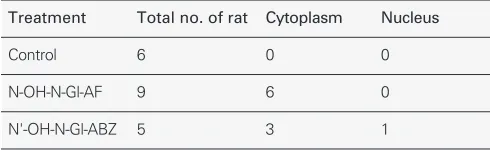
Results: The results of NF-kB staining are presented in Table 1. The staining of normal bladders in the control group was very weak at best and it was interpreted as negative. NF-kB was activated only in one urothelial carcinoma which had positive staining in both cytopasm and nucleus. Normal and hyperplastic urothelial cells in the treated group were not stained.
Conclusion: Since the activation of NF-kB is induced by inflammation and oxidative stress, we conclude that these two processes and NF-kB activation are not involved in bladder carcinogenesis in the rat model.
No. of rat with positive NF-kB staining
FGFR3 mutant
FGFR3 wild type
P-value (chi-square)
Grade 1973
G2 25 31
<0.001
G3 12 64
Grade 2004
Low-grade 15 11
<0.001
High-grade 22 84
Sub-stage
pT1m 18 22
=0.004
pT1e 19 73
Total 37 95
Table 1. Correlation of a FGFR3 Mutation
Table 1. No. of rat with positive NF-kB staining
Treatment Total no. of rat Cytoplasm Nucleus
Control 6 0 0
N-OH-N-Gl-AF 9 6 0
P25
Soy Isoflavone G-2535 and Bladder Cancer: Molecular Effects in Tumor Tissue and Urine
Edward Messing1, KyungMann Kim2, Jason Gee2, Daniel Saltzstein3,
Robert Weiss4, Jorge Yao1, P. Anthony di’SantAgnese1, Howard Bailey2 1University of Rochester, Rochester, NY, US, 2University of Wisconsin
-Madison, -Madison, WI, US, 3Urology San Antonio, San Antonio, TX,
US, 4Yale University School of Medicine, New Haven, CT, US
Introduction and Objective: Isoflavones, phytoestrogens present in soy beans, are known to have anti-growth factor, anti-proliferative and proapoptotic effects in various cancer cell targets including human blad-der cancer (BC). To assess whether G-2535, an oral preparation of uncon-jugated genistein (62%), daidzein (33%) and glycitein (5%) had similar effects in BC in vivo, patients scheduled to undergo BC surgery were randomized to receive none (placebo), 300 mg/day or 600 mg/day of G-2535 for 14-21 days immediately before surgery.
Materials and Methods:Patients were stratified according to suspected depth of tumor invasion (< T1, > T2). The primary endpoint was reduc-tion in activareduc-tion of the epidermal growth factor receptor (EGF-R) as determined by reduced phosphorylated (p) EGF-R on tyr 992 and tyr 1068 using a pair of monoclonal antibodies to these epitopes and grad-ing with the quantitative German immunoreactive score (IHS) which accounts for percentage positively stained cells and intensity of stain-ing. Secondary endpoints included changes in expression of Ki67, Caspase 3, Survivin, AKT, pAKT and COX-2 in tissue (using IHS), and urinary Survivin. In addition, toxicities were monitored throughout the trial.
Results:60 patients were randomized from 7 sites: 52 men, 8 women; median age of 70.5 years; 80% stage < T1. No toxicities could be attrib-uted to G-2535, which was well tolerated. 300 mg/day of G-2535 (n=17) reduced pEGF-R in BC tissue compared to placebo (n=15) (p=0.02), and 300 or 600 mg of G-2535’s (n=34) reduction of pEGF-R approached statistical significance (p=0.078). Results were similar for < T1 and > T2 BCs. G-2535 also effected a non-significant reduction in urinary Survivin from baseline levels compared with placebo after 8 (p=0.10) and 14-21 (p=0.18) days. The other parameters were not affected by G-2535.
Conclusion:300 mg/day G-2535 is well tolerated and reduces EGF-R activity in BC tissue. This natural compound warrants further testing, alone or in combination with other interventions, as a preventive and/or therapeutic agent.
P26
Reconstruction of an Autologous Urethral Model by Tissue Engineering
Gabrielle Ouellet, Geneviève Bernard, Stéphane Bolduc
Labortoire d’Organogénèse Expérimentale (LOEX), Québec, QC, Canada
Introduction and Objective: Several diseases, like hypospadias and
stric-tures, cause urethral disorders. To correct these anomalies, acellular bio-materials or non-urologic tissues are used when necessary, but it often leads to post-surgical complications. Our objective is to reconstruct, by tissue engineering and self-assembly method, an autologous urethral model that can be grafted and is viable. For our test, a porcine model was used because of its similarity to the human urinary tract. But the biggest challenge of the model is the production of a porcine fibroblasts sheet, because it is difficult to obtain extracellular matrix from animal fibroblastic cells and no research teams have been able to produce one.
Materials and Methods:We develop a tubular model composed of fibro
-blasts, extracted from the dermal layer of the skin and urothelial cells stem from the bladder. The fibroblasts are cultured four weeks to allow secretion of their extracellular matrix and to obtain an easy-to-handle sheet. This sheet is rolled around a mandrel to obtain a tubular form and then it matures for three weeks to gain superior adhesion between the fibroblasts layers. Urothelial cells are seeded inside the tubular model and placed under perfusion in a bioreactor for one week to promote proliferation and maturation of the urothelial cells. To compare the ure-thral equivalent with a native urethra, we characterized our model by
histology, immunofluorescence (IF), Western Blot (WB) and we also performed a viability test.
Results: Our tubular model, macroscopically uniformly assembled,
pro-vided suture resistance and was easily handled. Histologically, we obtained a thick layer of fibroblasts in an abundant extracellular matrix and the urothelium was similar to a native urethra. The urethral model character-ization with IF and WB confirmed the presence of a well-differentiated and pseudostratified urothelium.
Conclusion: Our porcine autologous urethral equivalent is a first of its
kind in tissue engineering and will allow us, in a near future, in vivo implantation on the pig. It will also help us to go further with human urological researches. Furthermore, the great advantage of our model will be the use of the patient’s cells, which would decrease the inflam-matory reaction and post-surgical complications.
P27
Effect of Varicocelectomy on Sperm Chromatin and DNA Integrity
Raed Azhar, Abdulaziz Baazeem, Maria San Gabriel, Armand Zini
McGill University, Montréal, QC, Canada
Introduction and Objective: The effect of adult varicocelectomy on male
fertility remains controversial largely because of the paucity of random-ized and controlled trials. As well, using the improvement in conven-tional semen parameters as an outcome measure after varicocelectomy is limited by virtue of the high degree of biological variability of these parameters. An improvement in sperm DNA integrity would provide more credibility as to the therapeutic effect of varicocelectomy because compared to standard semen parameters, measures of sperm DNA dam-age exhibit a lower degree of biologic variability and may be better pre-dictors of male fertility potential. We sought to further evaluate the effect of varicocelectomy on sperm chromatin and DNA integrity.
Materials and Methods:All data were collected in a prospective
man-ner. Twenty consecutive infertile men with clinical varicocele were included in the study. Preoperative and postoperative semen samples were obtained and analyzed for conventional and sperm chromatin param-eters. Sperm chromatin integrity was assessed using a flow cytometry-based assay with the results expressed as (i) % DFI (DNA fragmentation index — an index of DNA fragmentation) and (ii) %HDS (high DNA stainability — an index of chromatin compaction), and, by sperm nuclear single-stranded (ss) DNA immunostaining (with the results expressed as the % of cells with diffuse ssDNA stain). All men signed an informed consent before participation in the study.
Results:Varicocelectomy resulted in a significant improvement in sperm
concentration (43 ± 37 to 106 ± 122 million sperm per ml, p=0.013) and progressive motility (25 ± 15 to 41 ± 23%, p=0.0009). As well, sperm DNA integrity and sperm chromatin compaction improved sig-nificantly after surgery (%DFI decreased from 19 ± 11 to 12 ± 6%, and %HDS decreased from 10 ± 6 to 6 ± 5%, respectively, p<0.01). Furthermore, ssDNA immunocytochemistry studies demonstrated that varicocelectomy was associated with a decrease in the proportion of spermatozoa exhibiting diffuse ssDNA (10 ± 6 to 5 ± 5, respectively,
p=0.02).
Conclusion: These data show that varicocelectomy is associated with
P28
Pilot Study on WST11 Safety and Efficacy for Vascular Targeted Photodynamic Therapy in the Dog Prostate
Maurice Anidjar1, Eleonora Scarlata1, Lucie Hamel1, Sabri Moussa1,
Konrad Szymanski1, Mostafa Elhilali1, Avigdor Scherz2, Herve Ficheux3,
Simone Chevalier1
1McGill University Health Centre-Research Institute, Montréal, QC,
Canada, 2Weizmann Institute, Rehovot, Israel, 3STEBA, Paris, France
Introduction and Objective: Vascular targeted photodynamic therapy (VTP) with the bacteriochlorophyll derivative WST09 as the photo-sensitizer was proven efficient for the treatment of localized prostate cancer (PCa). However solubility in aqueous solutions limits the scope of clinical applications. The aim of this study was to assess safety and efficacy of the water soluble bacteriochlorophyll, WST11, for VTP in the dog prostate model.
Materials and Methods:WST11-VTP was done at laparotomy on 25
dogs: 1 to 2 optic fibers of 1cm were inserted in each prostate lobe. WST11 (1-15mg/kg) was infused i.v. for 10 min. The light (laser power: 150-250mW/cm) was turned on at 5-10min to deliver energy at doses of 100-400J/cm/fiber. Blood pressure was recorded. Blood was with-drawn to assay diverse biochemical or hematological parameters and WST11 kinetics. Dogs were followed for 8 days. The prostate, lung, and liver were harvested for pathology.
Results: The VTP-procedure was well tolerated with no change in blood
pressure and biochemical or hematological parameters. Blood levels of WST11 increased in parallel with infusion and declined rapidly to unde-tectable levels by 60 min. Subjects experienced only mild lower uri-nary tract symptoms, resolved within 1-2 days. There was neither macro-nor microscopic changes in the liver and lung, but hemorrhages were detected in all prostates. Necrosis was consistently associated with endothe-lial cell damages in blood vessels. It was optimal at 5.0 mg/kg WST11 and 400J/cm. The average destroyed area per section of a lobe was 2.24cm2. This represented significant volumes of treated lobes (50-80%),
according to the prostate size.
Conclusion: These pre-clinical findings support the assessment of WST11-VTP in patients with localized PCa.
P29
Regulation of Apoptosis in Renal Epithelial Cells by Annexin A1 During Mechanical Stress
Gavin M. Langillle, Binyou Zheng, Dawn L. MacLellan
Dalhousie University, Halifax, NS, Canada
Introduction and Objective: Obstruction of the urinary tract subjects
renal epithelium to forces of mechanical trauma. Epithelial cells under-going such stress may undergo apoptosis in a highly regulated fashion, with the protein Annexin A1 (AnxA1) thought to play a central role. We have previously demonstrated through an in vivo rodent model for uri-nary tract obstruction that uriuri-nary AnxA1 is increased. The apoptotic response of renal epithelium to mechanically induced cellular stretch can be recreated in vitro. This work attempts to further define the role for AnxA1 in the regulation of apoptosis in renal epithelial cells sub-jected to external mechanical stresses.
Materials and Methods:NRK-52E renal epithelial cells were grown to
95% confluence and exposed to 25% maximal radial stretch, for 12 hours at 0.25 Hz. Cells were exposed to stretch in the presence or absence of an AnxA1 mimetic (Ac2-26). A cell death detection ELISA kit was used to quantify apoptosis.
Results: Cells treated with Ac2-26 showed a 3.0 fold higher apoptotic rate than unstretched cells, compared with a 1.8 fold higher for stretched cells with no AnxA1 mimetic. The addition of Ac2-26 alone without stretch showed no significant difference in apoptosis compared to controls.
Conclusion: Apoptosis of renal epithelial cells exposed to an AnxA1 analogue is greatly increased when exposed to mechanical stretch forces. This indicates that AnxA1 may function as a key regulator in the apop-totic cascade in renal epithelium during urinary tract obstruction. Further studies to elucidate the effect of transcriptional regulators of AnxA1 or the associated binding partners of this protein would be of great
inter-est. Numerous avenues of investigation are readily available to help elucidate the key components of apoptosis using this in vivo model of urinary tract obstruction.
P30
Specific NADP(H) Oxidase Inhibition Abrogates HIF Transactivation and the Tumorigenic Phenotype of Renal Cancer Cells
Guimin Chang, Zheng Hu, Jodi K. Maranchie
University of Pittsburgh Medical Center, Pittsburgh, PA, US
Introduction and Objective: Inactivation of the von Hippel Lindau tumor
suppressor (VHL) is an early event in sporadic clear cell kidney cancer. VHL targets hypoxia-inducible factor alpha (HIF-α) for ubiquitin-mediated degradation, and VHL loss results in accumulation and acti-vation of HIF. We previously reported that generation of reactive oxy-gen species (ROS) by the Nox4 NADPH oxidase is critical for expres-sion and activity of HIF2-α. Nox4 knockdown results in dramatic reduction of HIF transcription even in the absence of VHL. Further, Nox4 silenc-ing abrogated branchsilenc-ing morphogenesis and invasion, and completely inhibited RCC xenograft growth. GenKyoTex compound GKT136901 is a novel Nox inhibitor with activity against Nox4. To determine the anti-tumor activity of GKT136901, we exposed 786-0 human kidney cancer cells to the compound and assayed for HIF activity, branching morpho-genesis and invasion.
Materials and Methods:786-0 cells with stable expression of
non-spe-cific shRNA (NS) were plated in DMEM with 10% FBS with serial dilu-tions of GKT136901 ranging from 10 µM to 0.1 nM. Cells expressing Nox4 shRNA (KD) served as a positive control for Nox4 inhibition. A luciferase reporter construct containing the minimal promotor region of VEGF was used to measure HIF-transactivation. To assay branching mor-phogenesis, the same cells were suspended in matrigel and incubated with recombinant HGF-SF at 37C° for 72 hours. Triplicate wells were evaluated by measuring the percentage of branching cells in 3 wells. Invasive potential was quantitated by measuring the mean number of cells to cross an 8 mm pore filter membrane coated with basement mem-brane matrix toward an HGF-SF gradient, in triplicate. Significance was determined by a Mann-Whitney Rank Sum Test. Cell viability was meas-ured in parallel cultures with CellTitre Blue (Promega).
Results: VEGF-luciferase expression was decreased 53% in untreated
KD relative to untreated NS cells (p=0.01), whereas GKT136901 demon-strated a dose-dependent inhibition of VEGF-luciferase to a maximum of 56% at 1 µM (p=0.004). Branching morphogenesis was inhibited by GKT136901 in a dose-dependent fashion, and the inhibitor significant-ly reduced the mean number of cells to invade through a basement membrane at 1 µM relative to no drug (48 vs. 156, p=0.02). No cyto-toxicity was seen at any concentration of GKT136901.
Conclusion: GKT136901 Nox inhibition mimics the anti-RCC impact of
Nox4 silencing, suggesting a role for GKT136901 in the treatment of RCC. Ongoing studies are measuring the efficacy of GKT136901 for suppression of RCC xenograft growth.
Funding: NIDDK064887, ACS RSG-09-023-01-CNE and The Pittsburgh
Foundation
P31
Frequency Dependent Pudendal Neuromodulation and Opiate Receptor Involvement in the Pudendal-to-Bladder Reflex in Cats
Mang L. Chen1, Bing Shen2, Jicheng Wang1, Hailong Liu1, James R. Roppolo2,
William C. de Groat2, Changfeng Tai2
1Department of Urology, University of Pittsburgh, Pittsburgh, PA, US, 2Department of Pharmacology, University of Pittsburgh, Pittsburgh, PA, US
Introduction and Objective: Different frequencies of pudendal nerve
stim-ulation can evoke bladder contraction (20-40Hz) or promote bladder relaxation (0.5-10Hz) in spinal intact and spinal transected cats. However, the neurotransmitters involved in pudendal neuromodulation have not been determined. This study investigates the role of opiate receptors in the pudendal-to-bladder pathway utilized by pudendal neuromodulation.
alpha-chloralose were tested by unilateral pudendal nerve neuromodulation (0.5-40Hz) via cuff electrodes. At volumes of 100-120% of bladder capac-ity, different stimulation frequencies were applied to either inhibit or facilitate isovolumetric contractions. The optimal inhibitory and excita-tory frequencies were subsequently tested during cystometrograms (CMG) to change bladder capacity. Burst stimulation (duration 30 seconds) at the optimal excitatory frequency was also assessed during CMG (saline infusion rate 1-2ml/min). Incremental doses of naloxone, an opiate recep-tor antagonist (0.01, 0.03, 0.1, 0.3, and 1.0mg/kg), were then intra-venously administered with repeat CMGs, isovolumetric conditions, and stimulation of the pudendal nerve.
Results:Maximal inhibition was seen at 3-10Hz during isovolumetric
contractions. The strongest bladder contractions (50-70cmH2O) were
observed at 20-30Hz stimulation with bladder volumes above 60% capac-ity (p<0.05). Bladder capaccapac-ity increased to 142 +/- 6.5% (p<0.01) of control capacity with 3-10 Hz continuous stimulation during CMG, but it was not significantly changed with 20-30Hz continuous stimulation. Administration of naloxone enhanced isovolumetric bladder contrac-tions and decreased bladder capacity by 53 +/- 15% (p<0.01). Stimulation frequencies between 5 to 10Hz in naloxone-treated cats suppressed bladder activity and increased bladder capacity by 220%. Higher fre-quency (20-40Hz) and lower frefre-quency (0.5-3Hz) stimulation enhanced bladder contractions.
Conclusion:This study reveals the frequency dependence of pudendal
nerve stimulation on bladder activity: 3-10Hz can promote storage and increase bladder capacity, and 20-30Hz can enhance bladder contrac-tions. Furthermore, pudendal neuromodulation was not altered by nalox-one, indicating that opiate receptors have a minor role in the pudendal-to-bladder reflex.
P32
Early Induction of Erectile Dysfunction by Angiotensin II in the Rat
Robert L. Segal1, Frederic Mampouma2, Taben M. Hale2, Serge Carrier1,
Denis deBlois2
1McGill University, Montréal, QC, Canada, 2University of Montréal,
Montréal, QC, Canada
Introduction and Objective: Erectile dysfunction (ED) is an early
indi-cator of cardiovascular disease, of which a major contributing factor is hypertension. Furthermore, there is evidence to suggest that angiotensin II (AngII) receptor (AT1) blockers improve erectile function in hyperten-sive patients. The aim of this study is to determine whether the devel-opment of ED precedes systemic cardiovascular damage after a contin-uous infusion of AngII in rats.
Materials and Methods:Sprague-Dawley rats (250g) were randomized
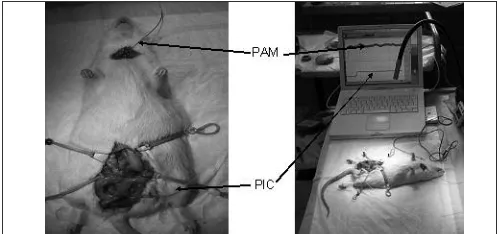
to receive a continuous infusion of either AngII (200 ng/kg/min s.c., n=5) or saline (n= 6) by osmotic minipumps implanted subcutaneously for a total of 7 days (Fig.1). The mean arterial pressure (MAP) and intracav-ernous pressure (ICP) were measured simultaneously, and erectile func-tion was estimated by the ICP/MAP ratio measured in response to
elec-trical stimulation of the cavernosal nerve (1 - 5.5 volts) in the anesthetized rats. At the end of this procedure, the rats were sacrificed, the hearts excised and the ventricles separated and weighed. The aorta and penis were also excised and cleaned, and a section of each was fixed in for-malin for histological analysis. Aortic rings were used to evaluate vascu-lar relaxations induced by acetylcholine or sodium nitroprussiate (SNP).
Results:A continuous infusion of Ang II for 7 days did not significantly
affect the MAP (saline 97±9mmHg vs. AngII 86±4mmHg, (NS) prior to stimulations and 118±7mmHg vs. 109±10mmHg (NS), after) heart/body weight ratio (saline 1,94±0,07 mg/g vs. AngII 1,95±0,22 mg/g, NS), aor-tic cross-sectional area (saline 0.47±0.020 mm2vs. AngII: 0.48±0.061
mm2, NS) or aortic cell number (saline: 174±32.4 cells/m vs. AngII:
177±38.9cells/m, NS) (Fig. 2). The ratio ICP/MAP, on the other hand, was significantly diminished in the group treated with AngII in a volt-age-dependent manner (at 5.5 volts, saline 26+9 vs. AngII 57+6, p = 0.003). Functional studies showed no evidence of endothelial dysfunc-tion in the aorta.
Conclusion:This study, the first to examine the impact of chronic AngII
administration on erectile function, suggests than ED precedes the devel-opment of arterial hypertension and left ventricular hypertrophy at 7 days of infusion. Our results support the hypothesis that erectile func-tion is an early gauge of cardiovascular complicafunc-tions.
P33
Peroxiredoxins: Novel Antioxidant Enzymes of Human Spermatozoa
Angela Souza, Cristian O’Flaherty
McGill University Health Centre, Montréal, QC, Canada
Introduction and Objective: Peroxiredoxins (PRDXs) are a recently
dis-covered family of thiol peroxidases. They play an important role in cell peroxide and peroxynitrite detoxification and in the regulation of hydro-gen peroxide (H2O2) signaling. They are acidic proteins with one or two
cysteine (Cys) residues required for their activity. The aim of this study was to characterize PRDXs and whether oxidative stress modifies their expression in human spermatozoa.
Materials and Methods:Semen samples were obtained from healthy
volunteers. Localization of PRDXs in spermatozoa was done by immuno-cytochemistry using anti-PRDX antibodies. Sperm proteins from Triton X100-treated and non-treated sperm and from spermatozoa challenged with a mild (0.05 and 0.1 mM H2O2) or a strong (0.35-5 mM H2O2)
oxida-tive stress for 30 min at 37oC were electrophoresed under non- and
reducing conditions.
Results: PRDX 1, 2, 5 and 6 were immunolocalized in the sperm head
and in the tail. PRDX 3 was found in the post-acrosomal region and in the principal piece. PRDX 4 was highly expressed in the acrosome region. PRDX 1, 4 (secreted form), and 6 were found in human spermatozoa and seminal plasma. The membrane bound form of PRDX 4 was also found in spermatozoa. PRDX 1 and 6 were present as protein doublets under non-reducing conditions. PRDX 4, 5 and 6 were found in both Triton-soluble and -insoluble sperm fractions, while PRDX 1 was found
7 days, p<0.0001
Saline (n=11)xxx AngII (n=10)
volts
Saline (n=3)xxx AngII (n=4)
volts
Fig. 2.Continuous Angll infusion caused a significant decrease in ICP/MAP ratio.
only in the Triton-insoluble fraction. Under non-reducing conditions, PRDX 1 and 6 were found as bands of high molecular weight (>170 kDa) in spermatozoa incubated with 0.35-5 mM H2O2(strong oxidative
stress). PRDX 6 became a strong single band due to a mild oxidative stress (0.05 mM H2O2, a condition that promotes sperm capacitation).
H2O2(0.35-5 mM) caused a decrease of the signal for PRDX 4 and 5
compared to non-treated cells.
Conclusion: PRDXs are present in human spermatozoa and
differential-ly modified by oxidative stress. These results suggest a role of PRDXs as antioxidants and as potential modulators of H2O2action in human
sper-matozoa.
P34
Androgen Receptor (AR) and Bladder Cancer: A Large Bi-Institutional Study on 473 Patients
Carmen Mic1, Shahrokh Shariat2, Theodorus Van der Kwast3, Raheela
Ashfaq4, Yair Lotan4, Sean Skeldon3, Sally Hanna3, Sultan AlKhateeb3,
Juan Morote1, Bas Van Rhijn3, Neil Fleshner3, Michael Jewett3, Alexandre
R. Zlotta3
1Hospital Clinic, Barcelona, Spain, 2Memorial Sloan-Kettering Cancer
Center, New York,, NY, US, 3University of Toronto, University Health
Network, Toronto, ON, Canada, 4University of Texas, Southwestern
Medical Center, Dallas, TX, US
Introduction and Objective: Bladder cancer is approximately three times
more common in men than in women but the reasons behind this observed difference in incidence is largely unknown. A role for androgen recep-tor (AR) signaling has been suggested. Data on very limited number of patients showed that loss of androgen receptor expression was associat-ed with invasive bladder cancer. We decidassociat-ed to further investigate the AR expression in a large series of bladder cancer patients.
Materials and Methods:A total of 473 patients have been analyzed.
The study included specimens from the University of Toronto/University Health Network, Canada (n= 120) and the University of Texas Southwestern Medical Center, Dallas, Texas, US. Tissue microarrays comprising both non-muscle invasive (n=126) and invasive bladder (n=347) tumors have been accrued and immunohistochemical staining for AR was performed on tissue microarrays using a monoclonal mouse anti-AR antibody. We used bright field microscopy imaging coupled with advanced color detection software (Automated Cellular Imaging System, ChromaVision Medical Systems Inc., San Juan Capistrano, CA) to detect, classify, and count stained cellular objects based on predetermined color morphology. Results obtained in Dallas were blindly reviewed and validated by one uro-pathologist in Toronto in a manual non-automated fashion.
Results: Androgen receptor was positively expressed in a total of 60/473
(12.6%) patients, 13/120 (10.8%) in Toronto and 47/353 (13.3%) in Dallas (p>0.05, NS). There was not statistically significant difference between AR expression in men and women. Overall, 8.7% of superfi-cial tumors (pTa + pT1 + carcinoma in situ) expressed the AR compared with 16.3% of invasive tumors (pT2 + pT3+ pT4; P < 0.05). The highest percentage of AR (28.8% of cases) was found in T2 tumors.
Conclusion: In contrast with previous reports on limited number of patients,
based on our large bladder cancer series, we did not observe a decrease in AR protein expression in tumors with increased pathologic stage and our data do not suggest that the loss of AR expression is associated with invasive bladder cancer. AR positivity remains a rare event in bladder cancer (12.6%) and is not gender-related.
P35
A Multi-Centre Randomized Trial Comparing Bipolar vs. Monopolar Transurethral Resection of the Prostate
Carlos E. Mendez Probst, Linda Nott, Hassan Razvi
Schulich School of Medicine and Dentistry, London, ON, Canada
Introduction and Objective: Monopolar transurethral resection of the prostate (TURP) is the gold standard therapy for men with lower urinary tract symptoms (LUTS) due to benign prostatic hyperplasia (BPH). Inherent with the use of monopolar transurethral electrosurgery however, are the risks of bleeding, tissue burns, dilutional hyponatremia and irrigant tox-icity. Although generally considered safer, the experience with bipolar electrosurgery for TURP application is limited. The objective of this trial was to evaluate both monopolar and bipolar (Gyrus-VISTA platform) TURP outcomes in a multicentre, single-blinded trial.
Materials and Methods: Forty-four patients from four Canadian sites
were randomized to undergo TURP with either the bipolar or monopo-lar devices. All patients underwent baseline determinations of AUA symptom score, peak urinary flow rate, post void residual bladder vol-ume and transrectal ultrasound prostate volvol-ume. The primary outcome measure was improvement in AUA symptom score (AUA SS), quality of life assessment (AUA QOL) and bother assessment (AUA B) question-naires and secondary measures included procedural times, duration of urethral catheterization, length of hospitalization, complications and the degree of thermal artifact in the tissue specimens. Patients were fol-lowed for six months after surgery.
Results: 22 patients were randomized to each treatment arm,
pre-operative demographic data were not statistically different between the groups. AUA SS, AUA QOL, AUA B and sexual function assessments at all data collections times were no different for either group. The only differences observed were in the procedure time (60.7 for bipolar vs. 47.4 min for monopolar, p=0.042) and the duration of urethral catheter-ization (1.5 for bipolar vs. 1.1 days for monopolar, p=0.03). There was no statistically significant difference in the pathological degree of ther-mal artifact or the rate of complications between groups. There was no difference in the change of post operative hemoglobin among groups, and no patient required blood transfusion
Conclusion: This trial suggests equivalent short term outcomes for men
undergoing monopolar or bipolar TURP. Although admittedly monopolar TURP is associated with a relatively low risk of complications, eliminating the need for a return electrode pad and the risk of dilutional hyponatremia would appear to be added safety features favoring the bipolar technology.
P36
Development and External Validation of a Highly Accurate Nomogram for the Prediction of Perioperative Mortality After Transurethral Resection of the Prostate for Benign Prostatic Hyperplasia
Claudio Jeldres1, Hendrik Isbarn2, Umberto Capitanio3, Laurent Zini4,
Naeem Bhojani5, Shahrokh F. Shariat5, Vincent Cloutier4, Jean-Baptiste
Lattouf5, Alain Duclos5, Martine Jolivet-Tremblay5, Luc Valiquette5, Fred