R E S E A R C H
Open Access
The roles of maturation delay and
vaccination on the spread of Dengue virus
and optimal control
Lin-Fei Nie
*and Ya-Nan Xue
*Correspondence: [email protected] College of Mathematics and Systems Science, Xinjiang University, Urumqi, 830046, P.R. China
Abstract
A mathematical model of Dengue virus transmission between mosquitoes and humans, incorporating a control strategy of imperfect vaccination and vector maturation delay, is proposed in this paper. By using some analytical skills, we obtain the threshold conditions for the global attractiveness of two disease-free equilibria and prove the existence of a positive equilibrium for this model. Further, we investigate the sensitivity analysis of threshold conditions. Additionally, using the Pontryagin maximum principle, we obtain the optimal control strategy for the disease. Finally, numerical simulations are delivered to verify the correctness of the theoretical results, the feasibility of a vaccination control strategy, and the influences of the controlling parameters on the control and elimination of this disease.
Theoretical results and numerical simulations show that the vaccination rate and effectiveness of vaccines are two key factors for the control of Dengue spread, and the manufacture of the Dengue vaccine is also architecturally significant.
Keywords: Dengue vaccination; maturation delay; disease-free equilibrium and endemic equilibrium; attractiveness and bifurcation; sensitivity and optimal control
1 Introduction
Dengue is a vector-borne disease which transcends international borders as the most im-portant arbovirus disease currently threatening human populations. In the light of evolu-tion, at least approximately - million people are affected by the Dengue virus each year []. The Dengue virus is transmitted to humans by mosquitos, mostly theAedes ae-gyptiandAedes albopictus. As far back as , Jousset [] published geographic loca-tions ofAedes aegyptistrains and the Dengue virus. To better describe the influences of the Dengue virus, many scholars have investigated Dengue transmission in mathe-matical models (see [–] and the references therein). Particularly, Estevaet al.[] pro-posed a Dengue virus transmission model and analyzed the global stability of equilib-ria, and the control measures of the vector population are also discussed in terms of threshold conditions. Further, Wanget al. [] proposed a nonlocal and time-delayed reaction-diffusion model of the Dengue virus, and established threshold dynamics in terms of the basic reproduction number. In addition, Garbaet al.[] proposed a deter-ministic model for the transmission dynamics of a strain of Dengue, which allows for
transmission by exposed humans and mosquitoes. They proved the existence and lo-cal asymptotilo-cal stability of the disease-free equilibrium if the basic reproduction num-ber is less than unity. The authors also examined the phenomenon of backward bifurca-tion.
How to control and eliminate the Dengue virus has always been a hot topic. Until now, the available strategy that controls the spread of Dengue virus only controls the vector. De-spite combined community participation and vector control, together with active disease surveillance and insecticides, the examples of successful Dengue prevention and control on a national scale are few []. Besides, with the increase of vector resistance, the intervals between treatments are shorter. Moreover, as a result of the high costs of development and registration and low gains, only few insecticide products are offered on the market []. Considering these realities, vaccination could be more effective to protect against the Dengue virus [].
It is a well-known fact that vaccination has already been successfully applied to control and eliminate various infectious diseases. Particularly, in , the Swiss mathematician Daniel Bernoulli published an investigation on the impact of immunization with cowpox. Then, the means of protecting people from infection through immunization began to be widely used. In addition, the method has already successfully decreased both mortality and morbidity [–]. In fact, during the s, Dengue vaccines were under develop-ment. In recent years, however, with the increase in Dengue infections and a serious need for faster development of a vaccine [], the progress in Dengue vaccines development has amazingly accelerated. To guide public support for vaccine development in both in-dustrialized and developing countries, economic analysis has been conducted, including previous cost-effectiveness studies of Dengue [–]. The cost of the disease burden is compared with the possibility of making a vaccination campaign, by the authors of this analytical work; finally, they consider that Dengue vaccines, as a means of intervention, have a potential economic benefit.
On the other hand, there are three successive aquatic juvenile phases (egg, larva and pupa) and one adult pupa of the life cycle of mosquitoes []. The duration of the develop-ment from egg to adult (- weeks) is often compared to the average life span of an adult mosquito (about weeks). The size of the mosquito population is strongly affected by temperature, and the number of female mosquitoes changes accordingly due to seasonal variations [, ]. Therefore, it is vital to consider the maturation time of mosquitoes [], the length of the larval phase from egg to adult mosquitoes, and the impact on the spread of the Dengue virus.
we give numerical simulations in Section , and present some concluding comments in Section .
2 Model formulation
In this section, we present a mathematical model to study the transmission dynamics of the Dengue virus. The model is based on a susceptible, infectious, recovered and vaccinated structure and explains the transmission process of humans and mosquitoes. LetSh(t),Ih(t),Rh(t) andVh(t) denote the numbers of susceptible (individuals who can contract the disease), infectious (individuals who are capable of transmitting the dis-ease), resistant (individuals who have recovered and acquired immunity) and vaccinated (individuals who were vaccinated and are now immune) individuals at time t, respec-tively. Similarly,Sm(t) andIm(t) represent the numbers of susceptible (mosquitoes able to contract the disease) and infectious (mosquitoes capable of transmitting the disease to humans) adult female mosquitoes at timet. Here the total numbers of humans and mosquitoes are denoted byNh(t) =Sh(t) +Ih(t) +Vh(t) +Rh(t) andNm(t) =Sm(t) +Im(t), respectively.
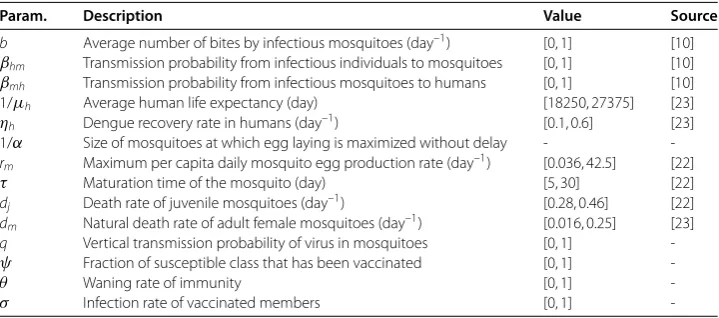
Since the development of mosquitoes from eggs to adults is density dependent, a Ricker type function is taken to ensure the birth rate into the adult mosquitoes. Additionally, let the positive constantτ be the maturation time of the mosquito, that is, the average time needed for an egg to develop into an adult mosquito. Therefore, the birth rate function of mosquitoes is taken asrmNm(t–τ)e–djτe–αNm(t), where the meanings of the parameters can be found in Table . For more biological explanation, we refer to [].
Additionally, for some potentially human infections (such as measles, hepatitis B, fluenza, polio, etc.), there has been considerable focus on vaccinating newborns or in-fected individuals. Therefore, Dengue can be a serious candidate for this type of vacci-nation. Further, we suppose that a mass vaccination program may be initiated whenever there is an increase of the risk of an epidemic, and the vaccination may reduce but not completely eliminate susceptibility to infection, or the immunity, which is obtained by the vaccination process, is temporary. The new model for the transmission between humans and mosquitoes is given in the flowchart (Figure ).
Table 1 Parameter interpretations, value ranges and sources of model (1)
Param. Description Value Source
b Average number of bites by infectious mosquitoes (day–1) [0, 1] [10]
βhm Transmission probability from infectious individuals to mosquitoes [0, 1] [10]
βmh Transmission probability from infectious mosquitoes to humans [0, 1] [10]
1/μh Average human life expectancy (day) [18250, 27375] [23]
ηh Dengue recovery rate in humans (day–1) [0.1, 0.6] [23]
1/α Size of mosquitoes at which egg laying is maximized without delay -
-rm Maximum per capita daily mosquito egg production rate (day–1) [0.036, 42.5] [22]
τ Maturation time of the mosquito (day) [5, 30] [22]
dj Death rate of juvenile mosquitoes (day–1) [0.28, 0.46] [22]
dm Natural death rate of adult female mosquitoes (day–1) [0.016, 0.25] [23]
q Vertical transmission probability of virus in mosquitoes [0, 1]
-ψ Fraction of susceptible class that has been vaccinated [0, 1]
-θ Waning rate of immunity [0, 1]
-Figure 1 Flowchart of the transmission of Dengue virus transmission between mosquitoes and humans.
Based on these considerations, a mathematical model with maturation and imperfect vaccination can be described as
⎧
The meanings of parameters of model () are shown in Table . The initial conditions of model () are given as
Sh() > , Vh()≥, Ih()≥, Rh()≥,
Sm(θ) =φs(θ) > , Im(θ) =φi(θ) > ,
()
whereφs(θ) andφi(θ) are positive continuous functions forθ∈[–τ, ].
3 Basic properties
Letting
Nm∗ =
αln
rme–djτ
dm
,
it follows thatNm∗ is a unique positive equilibrium of equation (), and it exists if and only ifrme–djτ >dm.
Now, we define a threshold condition for the mosquito population
R=
rme–djτ dm
.
In fact,Ris the threshold condition of the existence of a positive equilibrium with model
().
The following theorem describes the global dynamical behavior of model ().
Theorem Solution Nm(t)of model()with the initial condition()is positive for any finite time t≥.Further,
(i) ifR≤,then solutionNm(t)is bounded and the trivial equilibriumNm= is
globally asymptotically stable;
(ii) ifR> ,thenh<Nm(t) <Hfor anyt≥,where
h= min
min
θ∈[–τ,] φs(θ) +φi(θ)
,Nm∗
, H= +max
Nm∗, max
θ∈[–τ,] φs(θ) +φi(θ)
.
Moreover,model()has a unique positive equilibriumNm∗ which is globally asymptotically stable.
Proof Noting thatNm(θ) > for anyθ∈[–τ, ], if there is at∗> such thatNm(t∗) = andNm(t) > for allt<t∗, then dNm(t∗)/dt≤. It follows from () that
dNm(t∗) dt =rmNm
t∗–τe–djτ> ,
which leads to a contradiction with dNm(t∗)/dt≤. HenceNm(t) > for any finite time t≥.
Now we prove (i). Assume thatR≤. We claim thatNm(t)≤H. Otherwise, there is
at> such thatNm(t) =HandNm(t) <Hfor anyt<t. Then we have dNm(t)/dt≥.
From (), we have
dNm(t)
dt =rmNm(t–τ)e
–djτe–αH–d
mH≤H
rme–djτe–αH–dm
<Hrme–djτ–dm
≤,
which leads to a contradiction. HenceNm(t)≤Hfor anyt≥.
Next we turn to (ii). Assume thatR> . We claim thath<Nm(t) <H for anyt≥.
Otherwise, there is at> such thatNm(t) =HandNm(t) <Hfor anyt<t. From (),
we have
dNm(t)
dt =rmNm(t–τ)e
–djτe–αH–d
mH<H
rme–djτe–αH–dm
The last inequality is true sinceH>Nm∗. But the definition oftimplies that dNm(t)/dt≥
In order to prove that the global stability of equilibriaNm= andNm∗, we denote the right hand side of () as functionsf(Nm(t) andNm(t–τ)). Since∂f(x,y)/∂y> , it follows that () generates an eventually strongly monotone semiflow on the spaceCof a continuous function on [–τ, ] with the usual pointwise ordering (see Smith []). IfR≤, there is
only a single trivial equilibriumNm= . By Theorem .. in [], the equilibriumNm= is globally asymptotically stable. IfR> , there are two equilibriaNm= andNm∗. By Theorem .. in [], solutions of () converge to one of two equilibria. To eliminate the possibility ofNm= as an attractor, we linearize the system aboutNm= and use Theorem A in [] to conclude that it is unstable whenR> . HenceNm(t)→Nm∗ as
t→ ∞.
4 Existence and attractiveness of equilibria
We define, firstly, a threshold condition for the full model () as follows:
R=
(θ+σ ψ+μh)bβmhβhmNm∗ dm( –q)(μh+ηh)(θ+ψ+μh)Nh
.
In fact, the value ofRdetermines the existence of a positive equilibrium of model ().
For model (), we get two nontrivial disease-free equilibria, that is, the disease-free equilibrium without mosquitoesEforR≤, and the disease-free equilibrium with
andIh∗(,)is obtained by the solutionsIhof the following equation: are two positive roots of equation (); ifC< , there is a unique positive root of equation (). According to the above-mentioned discussion, we have a conclusion as follows.
Theorem If R≤,then model () has a unique disease-free equilibrium without
mosquitoes E;ifR> andR< ,then model()has a unique disease-free equilibrium
with mosquitoes E.Furthermore,ifR> ,the following statements are valid: (i) ifC≤,then model()has a unique endemic equilibrium;
(ii) ifB< andB– AC> ,then model()has two endemic equilibria; (iii) ifB> andC≥,then model()has no endemic equilibrium.
Noting thatC≤ if and only ifR≥. It is clear from Theorem (Case (i)) that the
model has a unique endemic equilibrium ifR≥ andR> . Further, Case (ii) indicates
the possibility of backward bifurcation (where a local asymptotically stable disease-free equilibrium co-exists with a locally asymptotically stable endemic equilibrium) in model () forR≥ andR< . To check for this, the discriminantB– ACis set to zero and
solved for the critical value ofR, denoted byRc. Thus, backward bifurcation would
occur for values ofRsuch thatR≥ andRc<R< .
where
a= –
bβmh
Im∗ Nh
+ψ+μh
, a= –
σbβmh Im∗ Nh
+θ+μh
,
a=rme–(djτ+αN
∗
m)( –q)e–λτ–αN∗
m+αqIm∗
,
a=bβhm Ih(t)
Nh
–αqIm∗(t–τ)e–(djτ+αN∗m,
a=rme–(djτ+αN
∗ m)e–λτ
–αNm∗+αqIm∗–dm,
a=qrme–(djτ+αN
∗
m)e–λτ–αI∗
m
–dm,
andλis an eigenvalue. We obtain the characteristic equation aboutEaccording to the
Jacobian matrix of model ()
F(λ) = (λ+ηh+μh)
λ+ (θ+ψ+ μh)λ+ (θ+ψ+μh)μh
×λ+dm–qrme–(dj+λ)τ
λ+dm–rme–(dj+λ)τ
.
To continue, we recall Theorem . in [], which states thatλ=A+Be–λτhas a root with
positive real part ifA+B> , and has no roots with nonnegative real parts ifA+B< andB≥A. By this theorem, we see that all roots of the above characteristic equation have negative real parts forR< . Therefore,Eis asymptotically stable.
Now, on the globally asymptotically stable disease-free equilibrium without mosquitoes Eof model (), we have Theorem .
Theorem If R< ,then model ()has a unique disease-free equilibrium without
mosquitoes E,which is globally asymptotically stable.
Proof It obvious thatlimt→∞Sm(t) =limt→∞Im(t) = forR< depending on
Theo-rem . So we merely prove that
lim
t→∞Sh(t) =
(θ+μh)Nh
(ψ+θ+μh), tlim→∞Vh(t) =
ψNh
(ψ+θ+μh), ()
and
lim
t→∞Ih(t) =tlim→∞Rh(t) = .
Due tolimt→∞Im(t) = , for a small enough positive constant, there is a constantT> such thatIm(t) <, for allt>T. Then, from the third equation of model (), we have
dIh(t)
dt <bβmh– (μh+ηh)Ih(t), for allt>T.
By the comparison theorem and the arbitrariness of, we havelimt→∞Ih(t) = . Further,
From the first and second equations of model (), we have
μhNh+θVh(t) –
bβmh
Nh
+ψ+μh
Sh(t)
≤dSh(t)
dt ≤μhNh+θVh(t) – (ψ+μh)Sh(t)
and
ψSh(t) –
σbβmh
Nh
+θ+μh
Vh(t)≤dVh(t)
dt ≤ψSh(t) – (θ+μh)Vh(t).
Then it is easy to see that () is valid, that is,Eis globally attractive. This completes the
proof.
Finally, we give a conclusion on the global attractiveness of the disease-free equilibrium with mosquitoesEof model ().
Theorem Supposing thatR> .If
R∗
:=
bβ
mhβhmNm∗ dm( –qedmτ)(μh+ηh)Nh
< ,
then model()has a unique disease-free equilibrium with mosquitoes E,which is globally
attractive.
Proof From the expressions ofRandR∗, we getR< forR∗< . Therefore, model
() has a unique disease-free equilibrium with mosquitoesEforR∗< andR> .
From the sixth equation of model () we get
dIm(t)
dt ≥–dmIm(t).
By integrating the above inequality fromt–τ tot, we obtainIm(t–τ)≤edmτIm(t). Then ⎧
⎨ ⎩
dIm(t)
dt ≤dm(qedm
τ– )Im(t) +bβ
hmN
∗ m
NhIh(t), dIh(t)
dt ≤bβmhIm(t) – (ηh+μh)Ih(t).
Consider the following auxiliary system:
⎧ ⎨ ⎩
du(t)
dt =dm(qe
dmτ– )u(t) +bβ
hmN
∗ m
Nhv(t), dv(t)
dt =bβmhu(t) – (ηh+μh)v(t).
()
It is obvious that the equilibrium (, ) always exists. The characteristic equation of model () about (, ) is
where a =dm(qedmτ – ), a=bβhmNm∗/Nh,b =bβmh andb=ηh+μh. To obtain two negative solutions about (), it is required that
λ+λ=a–b< , λ·λ= –(ba+ab) > .
So we see that the equilibrium (, ) of model () is globally asymptotically stable for R∗
< .
According to the above discussion and the comparison theorem of differential equa-tions, we know thatlimt→∞Im(t) = andlimt→∞Ih(t) = forR> andR∗< . Finally,
in the light of Theorem , we get limt→∞(Sh(t),Ih(t),Vh(t),Rh(t),Sm(t),Im(t)) =E. This
completes the proof.
Remark Obviously,qedmτ ≈qdue to the small vertical transmission probabilityq
ac-cording to existing literature, thereforeR≈R∗.
To discuss the stability of the endemic equilibriumE∗, we write the corresponding char-acteristic equation forE∗as follows:
H(λ) =λ+dm
Nevertheless, the study of solving this transcendental equation () is very difficult. And though we get the conditions by math software, it is not difficult to imagine that the con-ditions are very complex. Of course, it is very difficult to make a rational interpretation on biology. So the solving of () is insignificant, and we omit it.
5 Description of sensitivity analysis
Sensitivity indices enable us to measure the relative change in a state variable when a model parameter changes. The normalized forward sensitivity index of a variable to a model parameter is the ratio of the relative change in the variable to the relative change in the parameter. When the variable is a differentiable function of the parameter, the sensitivity index may be alternatively defined using partial derivatives.
Definition (Sensitivity index []) The normalized forward sensitivity index of a vari-able,u, that depends differentiably on a parameter,p, is defined as
γpu:=∂u
∂p× p
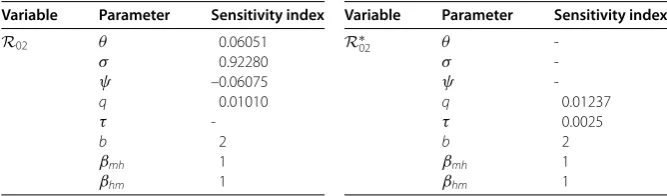
Table 2 Sensitivity indices ofR02andR∗02to the parameter values for model (1)
Variable Parameter Sensitivity index
R02 θ 0.06051
σ 0.92280
ψ –0.06075
q 0.01010
τ
-b 2
βmh 1
βhm 1
Variable Parameter Sensitivity index
R∗
02 θ
-σ
-ψ
-q 0.01237
τ 0.0025
b 2
βmh 1
βhm 1
Table represents sensitivity indices of model parameters toRandR∗, as the values
of parameters for model () are fixed as:b= .,βmh=βhm= .,μh= .,ηh= .,
τ = ,dm= .,q= .,σ= .,θ= . andψ= ..
Note from Table thatRandR∗all show the greatest sensitivities to the biting rateb,
followed by the transmission probabilitiesβmhandβhm. Accordingly, a reduction of %in the biting ratebdecreasesRby %, which equals the decrease inR∗when identically
varying the biting rate parameterb; further, a reduction of %in the transmitting rate
βmhorβhm decreasesRandR∗ both by %. Next, a reduction of %in the waning
rateθ decreasesRby .%, a reduction of %in the infection rate of vaccinated
membersσdecreasesRby .%, and a reduction of %of the vaccinated fraction
of the susceptible classψ increasesR by .%. Lastly, a reduction of %in the
vertical transmission probabilityq decreasesRandR∗ by .%and .%,
respectively; a reduction of %in the maturation time of the mosquitoτ decreasesR∗ by .%.
Obviously, the sensitivity index of the infection rate of vaccinated membersσ exceeds that of the fractionψ of the susceptible class that was vaccinated, though the value ofσ
(σ= .) is smaller than the value ofψ(ψ= .). The sensitivity index of the fractionψ
of the susceptible class that was vaccinated is substantial near the sensitivity index of the waning rateθ for the values above. Then the sensitivity index of the vertical transmission probabilityqis very small. This is perhaps related to the small value ofq(q= .). The sensitivity level ofτ is the smallest, that is, the maturation time of the mosquito has less effect on the variation ofR∗.
6 Analysis of optimal vaccination
Optimal control techniques are of great use in developing the optimal strategies to prevent the spread of the Dengue virus. To face the challenges of obtaining an optimal control strat-egy, we make the following notational conventions. Supposetf and are given constants and define an admissible control set U={ψ(t) is measurable, ≤ψ(t)≤ ,t∈[,tf]}. Hereψ(t) is called a control variable, to reduce or even eradicate the disease, and to find a suitable compromise between minimal number of the infected individuals and the costs of the campaign. The objective function is given by
minJ[ψ] = tf
γDIh(t)+γVψ(t)
subject to
with the initial condition (). Here, positive constantsγD andγV represent the weights of the costs of treatment of infected individuals and vaccination, respectively. Since the state variables are continuous, the solutions of the control system are bounded. Also, the objective function is convex in the controlψ(t). Hence, the existence of the optimal control comes as a direct result from the Filippove-Cesari theorem [–]. We, therefore, have the following result.
Theorem There is an optimal controlψ∗(t)such that J(ψ∗(t)) =minJ(ψ(t)),subject to the control system()with the initial condition().
In order to find the optimal solution, we find that the Lagrangian and Hamiltonian meth-ods serve for the optimal control problem () with (). In fact, the Lagrangian of the optimal problem is given by
L(Ih,ψ) =γDIh(t)+γVψ(t).
Now, let us derive a necessary condition for the optimal control strategy by means of the Pontryagin maximum principle []. Similar proof methods can also be found in [–] and the references therein.
Theorem Given an optimal control variable ψ∗(t) and the corresponding solution (Sh(·),Vh(·),Ih(·),Rh(·),Sm(·),Im(·))of state system (),there are adjoint functions λi(·),
Proof To determine the adjoint equations and transversality conditions, we use the Hamil-tonian (). We obtain the adjoint system as follows:
dλ(t)
It follows that
ψ∗(t) =min
,max
,(λ–λ)Sh(t) γV
.
Considering the feature of the admissible control setU, we obtain (). Thus we complete
the proof.
7 Numerical simulation and discussion
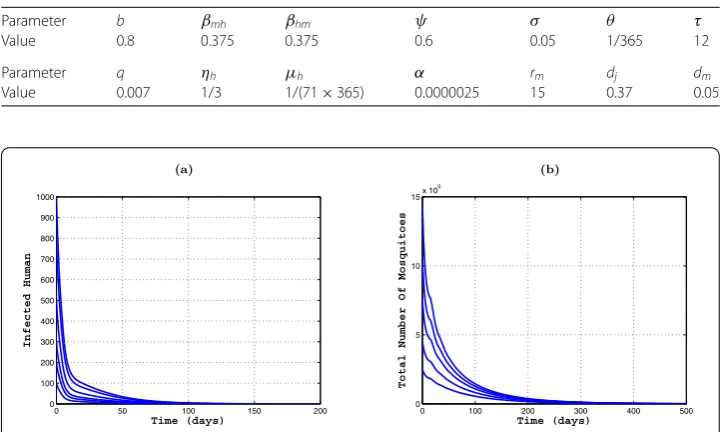
We perform some numerical simulations to illustrate the main theoretical results above for stability of equilibria using the Runge-Kutta method with the software MATLAB. Ac-cording to the possible values of model () from Table , the values of the model parameters are listed in Table . We choose the parametersNm∗ ≈ andNh≈.
First, from the values of the parameters in Table , it is easy to see thatR≈. < .
Thus from the theoretical conclusion of Theorem , we know that the disease-free equi-librium without mosquitoEof model () is globally attractive. That is, infectious
individ-uals and the total number of mosquitoes are all decreasing to zero eventually for any initial value. The plots in Figures (a) and (b) coincide with the theoretical result. We choose, however, model parametersτ = ,b= .,βmh= . andβhm= ., and other parame-ters are fixed as in Table . It is easy to calculateR≈. > andR∗≈. < .
Then the conditions of Theorem are valid. Therefore, the disease-free equilibrium with mosquitoesEis globally attractive. Theoretical result and numerical simulations in
Fig-ures (a) and (b) imply that infectious individuals and infectious mosquitoes are decreas-ing to zero eventually, whereas the number of susceptible mosquitoes are not decreasdecreas-ing to zero.
Further, lettingτ= ,b= andθ= ., while other parameters are fixed as in Table , we getR≈. > andR≈. > by direct calculation. The plots in
Fig-Table 3 The parameter values for model (1)
Parameter b βmh βhm ψ σ θ τ
Value 0.8 0.375 0.375 0.6 0.05 1/365 12
Parameter q ηh μh α rm dj dm
Value 0.007 1/3 1/(71×365) 0.0000025 15 0.37 0.05
Figure 2 The global attractiveness of the disease-free equilibrium without mosquitoesE01of model
Figure 3 The global attractiveness of the disease-free equilibrium without mosquitoesE01of model
(1), whereR01≈0.9330 < 1.
Figure 4 The global attractiveness of the disease-free equilibrium with mosquitoesE02of model (1),
whereR01≈5.9336 > 1 andR∗02≈0.4591 < 1.
ures (a) and (b) show that the infected classes (including individuals and mosquitoes) have an obvious explosion in the early phase. Additionally, from Figure (a), we also notice the fact that the number of susceptible individuals directly determines the strength and time of Dengue outbreaks, as more susceptible individuals correspond to more violent and earlier outbreaks. Similar results also can be found in Figure (b). It really shows that immunization of susceptible individuals is an effective strategy to control outbreaks of the Dengue virus.
Next, we consider how the maturation delayτand vaccinated fractionψaffect the pre-vention and control of the Dengue virus. We fixb= andτto be , , , and , and other parameters are fixed as in Table . Obviously, the plots in Figure (a) show that the maturation time directly determines the scale of the mosquito population. This confirms that the change of weather plays an important role in the spread of mosquito-transmitted infectious diseases. Further, to study the effects of the vaccinated fraction ofψ, we fix
Figure 5 The influences of the maturation delay and the vaccinated fraction to eliminate Dengue: (a)b= 1,τ= 25, 20, 15, 12, and 10; (b)τ= 5,b= 1,ψ= 0.1, 0.2, 0.3, 0.4, 0.5, and 0.6.
Figure 6 The influences of the waning rateθand the infection rate of vaccinated membersσon the elimination of Dengue, whereτ= 5,b= 1, and other parameters are fixed as in Table 3: (a)θ= 1/20, 1/50, 1/100, 1/200, and 1/300; (b)σ= 0.05, 0.1, 0.15, 0.2, and 0.25.
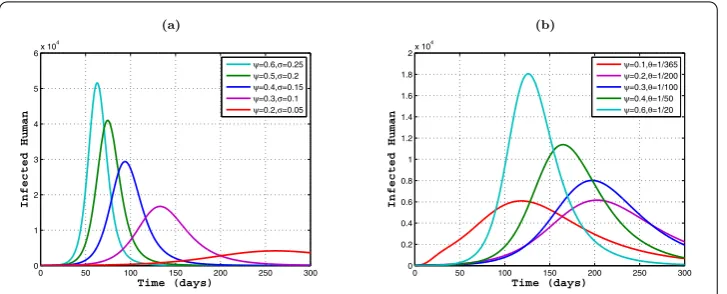
Next, we simulate the effects of the waning rateθ and the infection rate of vaccinated membersσfor eliminating Dengue. We chooseτ= ,b= , and other parameters are fixed as in Table . From the plots in Figure (a), we clearly see that the number of infected hu-mans reaches a peak at day≈, and the amplitude of the peak is large. Further, both the amplitude and the peaking time vary with the waning rate of immunityθ. That is, the peaking time decreases and the amplitude of the peak decreases asθ reduces. In addi-tion, as the infection rate of vaccinated membersσ increases, the peaking time decreases and the amplitude of the peak decreases. This is shown in Figure (b). Numerical simula-tions demonstrate that the validity period and the effectiveness of vaccination are two key factors to control the spread of the Dengue virus.
Figure 7 The relationships ofψandσ, andψandθ: (a)ψ= 0.6 andσ= 0.25,ψ= 0.5 andσ= 0.2, ψ= 0.4 andσ= 0.15,ψ= 0.3 andσ= 0.1,ψ= 0.2 andσ= 0.05; (b)ψ= 0.1 andθ= 1/365,ψ= 0.2 andθ= 1/200,ψ= 0.3 andθ= 1/100,ψ= 0.4 andθ= 1/50,ψ= 0.5 andθ= 1/20.
implicates that the improvement of the period of validity of the vaccine is more effective than the improvement of the vaccination rate for controlling Dengue. Theoretical results and numerical simulations show that the development of highly effective vaccines is the most effective method to control the spread of the disease.
8 Concluding remarks
In this paper, we propose a mathematical model to describe Dengue virus transmission be-tween mosquitoes and humans, where imperfect vaccination and vector maturation delay are introduced. The notation used in our mathematical model includes the compartment Vh, which represents the group of human population that is vaccinated, in order to dis-tinguish the resistance obtained through vaccination and the one achieved by disease re-covery. By using some analytical skills, the dynamical behavior of this model is discussed. This includes the global attractiveness of two disease-free equilibria, the existence of a positive equilibrium, the sensitivity analysis of threshold conditions, and the optimal con-trol strategy for the disease. In addition, numerical simulations are also carried out to verify the correctness of the theoretical results and the feasibility of the vaccination con-trol strategy. Theoretical results and numerical simulations show that the vaccination rate and effectiveness of the vaccine are two key factors for control of the spread of Dengue.
It is well known that there are four distinct serotypes of Dengue virus (DEN, DEN, DEN and DEN), according to clinical data collected during the past years. Therefore, one person in an endemic area can suffer from four Dengue infections during his life-time, one with each serotype. Epidemiological studies [] support the hypothesis that recovered people can be re-infected with a different serotype, and face an increased risk of developing Dengue hemorrhagic fever and Dengue shock syndrome. In recent publi-cations, some multi-strain Dengue fever transmission models have been discussed (see [–] and the references therein). However, all individuals who are capable of transmit-ting the disease are in one class in our model for the purpose of mathematical analysis. Therefore, for a more detailed understanding of the transmission of four Dengue virus strains between mosquitoes and humans, we intend to study the influences of vaccination and maturation delay for a multi-strain Dengue model in the future.
a novel method to fight mosquitoes is using a bacterium calledWolbachia, which exists in spiders and up to % of the insects, including ticks and mites. StableWolbachiastrains in Aedes aegyptihave also been established. And subsequent studies have shown that, very importantly,Wolbachiablocks the replication of Dengue viruses in mosquitoes. Thence, an increasing number of people realize that replacing the wild mosquitoes withWolbachia infected mosquitoes is safer, and more feasible than vaccination to some extent. Based on this, there are many mathematical models (including discrete-time and continuous-time models) that are used to investigated the spread ofWolbachiainfection (see [–] and the references therein). As future work we intend to compare the advantages and disadvantages of the two control strategies (Wolbachiaand vaccination). It would also be interesting to investigate what happens if two control strategies are taken at the same time.
Acknowledgements
This research is supported by the Natural Science Foundation of Xinjiang (Grant No. 2016D01C046).
Competing interests
The authors declare that they have no competing interests.
Authors’ contributions
The authors declare that the study was realized in collaboration with the same responsibility. All authors read and approved the manuscript.
Publisher’s Note
Springer Nature remains neutral with regard to jurisdictional claims in published maps and institutional affiliations.
Received: 7 June 2017 Accepted: 19 August 2017 References
1. Dengue and dengue haemorrhagic fever. WHO factsheets No. 117 (2009)
2. Jousset, FX: GeographicAedes aegyptistrains and dengue-2 virus: susceptibility, ability to transmit to vertebrate and transovarial transmission. Ann. Inst. Pasteur., Virol.132, 357-370 (1981)
3. Aldila, D, Götz, T, Soewono, E: An optimal control problem arising from a dengue disease transmission model. Math. Biosci.242, 9-16 (2013)
4. Kooi, BW, Maira, A, Nico, S: Analysis of an asymmetric two-strain dengue model. Math. Biosci.248, 128-139 (2014) 5. Coutinho, FAB, Burattini, MN, Lopez, LF, Massad, E: Threshold conditions for a non-autonomous epidemic system
describing the population dynamics of dengue. Bull. Math. Biol.68, 2263-2282 (2006)
6. Esteva, L, Vargas, C: Analysis of a dengue disease transmission model. Math. Biosci.150, 131-151 (1998)
7. Wang, WD, Zhao, XQ: A nonlocal and time-delayed reaction-diffusion model of dengue transmission. SIAM J. Appl. Math.71, 147-168 (2011)
8. Garba, SM, Gumel, AB, Bakar, MRA: Backward bifurcations in dengue transmission dynamics. Math. Biosci.215, 11-25 (2008)
9. Keeling, MJ, Rohani, P: Modeling Infectious Diseases in Humans and Animals p. 415. Princeton University Press, Princeton (2008)
10. Rodrigues, HS, Monteiro, MTT, Torres, DFM: Vaccination models and optimal control strategies to dengue. Math. Biosci.247, 1-12 (2014)
11. Scherer, A, McLean, A: Mathematical models of vaccination. Br. Med. Bull.62, 187-199 (2002)
12. Kar, TK, Jana, S: Application of three controls optimally in a vector-borne disease: a mathematical study. Commun. Nonlinear Sci. Numer. Simul.18, 2868-2884 (2013)
13. Nelson, OO: Determination of optimal vaccination strategies using an orbital stability threshold from periodically driven systems. J. Math. Biol.68, 763-784 (2014)
14. Murrel, S, Butler, SCW: Review of dengue virus and the development of a vaccine. Biotechnol. Adv.29, 239-247 (2011) 15. Clark, DV, Mammen, MPJ, Nisalak, A, Puthimethee, V, Endy, TP: Economic impact of dengue fever/dengue
hemorrhagic fever in Thailand at the family and population levels. Am. J. Trop. Med. Hyg.72, 786-791 (2005) 16. Shepard, DS, et al.: Cost-effectiveness of a pediatric dengue vaccine. Vaccine22, 1275-1280 (2004)
17. Suaya, JA, et al.: Cost of dengue cases in eight countries in the Americas and Asia: a prospective study. Am. J. Trop. Med. Hyg.80, 846-855 (2009)
18. http://www.cdc.gov/ncidod/dvbid/westnile/
19. Bayoh, MN, Lindsay, SW: Effect of temperature on the development of the aquatic stages ofAnopheles gambiae
sensu stricto (Diptera: Culicidae). Bull. Entomol. Res.93, 375-381 (2003)
20. Shaman, J, Spiegelman, M, Cane, M, Stieglitz, M: A hydrologically driven model of swamp water mosquito population dynamics. Ecol. Model.194, 395-404 (2006)
21. Zhao, XQ, Zou, XF: Threshold dynamics in a delayed SIS epidemic model. J. Math. Anal. Appl.257, 282-291 (2001) 22. Fan, GH, Wu, JH, Zhu, HP: The impact of maturation delay of mosquitoes on the transmission of West Nile virus. Math.
23. Tridip, S, Sourav, R, Joydev, C: A mathematical model of dengue transmission with memory. Commun. Nonlinear Sci. Numer. Simul.22, 511-525 (2015)
24. Smith, HJ: Monotone Dynamical Systems: An Introduction to the Theory of Competitive and Cooperative Systems. Mathematical Surveys and Monographs, vol. 41. Am. Math. Soc., Providence (1995)
25. Cooke, KL, Driessche, P: Analysis of an SEIRS epidemic model with two delays. J. Math. Biol.32, 240-260 (1996) 26. Smith, HL: An Introduction to Delay Differential Equations with Applications to the Life Sciences, vol. 57. Springer,
New York (2011)
27. Nakul, C, James, MH, Jim, MC: Determining important parameters in the spread of malaria through the sensitivity analysis of a mathematical model. Bull. Math. Biol.70, 1272-1296 (2008)
28. Cesari, L: Optimization-Theory and Applications, Problems with Ordinary Differential Equations. Applications and Mathematics, vol. 17. Springer, New York (1983)
29. Kamien, MI, Schwartz, NL: Dynamics Optimization: The Calculus of Variations and Optimal Control in Economics and Management. Elsevier, Amsterdam (2000)
30. Nababan, S: A Filippov-type lemma for functions involving delays and its application to time-delayed optimal control problems. J. Optim. Theory Appl.27(3), 357-376 (1979)
31. Seierstad, A, Sydsaeter, K: Optimal Control Theory with Economic Applications. Elsevier, Amsterdam (1975) 32. Fleming, WH, Rishel, RW: Deterministic and Stochastic Optimal Control. Springer, New York (1975)
33. Bashier, EBM, Patidar, KC: Optimal control of an epidemiological model with multiple time delays. Appl. Math. Comput.292, 47-56 (2017)
34. Chen, LJ, Hattaf, K, Sun, JT: Optimal control of a delayed SLBS computer virus model. Physica A427, 244-250 (2015) 35. Zhu, QY, Yang, XF, Yang, LX, Zhang, CM: Optimal control of computer virus under a delayed model. Appl. Math.
Comput.218, 11613-11619 (2012)
36. Stech, H, Williams, M: Alternate hypothesis on the pathogenesis of dengue hemorrhagic fever (DHF)/dengue shock syndrome (DSS) in dengue virus infection. Exp. Biol. Med.233(4), 401-408 (2008)
37. Chung, KW, Lui, R: Dynamics of two-strain influenza model with cross-immunity and no quarantine class. J. Math. Biol.
73(6), 1-23 (2016)
38. Esteva, L, Vargas, C: Coexistence of different serotypes of dengue virus. J. Math. Biol.46(1), 31-47 (2003) 39. Feng, Z, Velasco-Hernández, JX: Competitive exclusion in a vector-host model for the dengue fever. J. Math. Biol.
35(5), 523-544 (1997)
40. Hartley, LM, Donnelly, CA, Garnett, GP: The seasonal pattern of dengue in endemic areas: mathematical models of mechanisms. Trans. R. Soc. Trop. Med. Hyg.96, 387-397 (2002)
41. Zheng, B, Tang, MX, Yu, JS: Modeling Wolbachia spread in mosquitoes through delay differential equations. SIAM J. Appl. Math.74(3), 743-770 (2014)
42. Zheng, B, Tang, MX, Yu, JS, Qiu, JX: Wolbachia spreading dynamics in mosquitoes with imperfect maternal transmission. J. Math. Biol.2017(2017, in press). doi:10.1007/s00285-017-1142-5
43. Huang, MG, Tang, MX, Yu, JS: Wolbachia infection dynamics by reaction-diffusion equations. Sci. China Math.58(1), 77-96 (2015)
44. Huang, MG, Yu, JS, Hu, LC, Zhang, B: Qualitative analysis for a Wolbachia infection model with diffusion. Sci. China Math.59(7), 1249-1266 (2016)
45. Hu, LC, Huang, MG, Tang, MX, Yu, JS, Zheng, B: Wolbachia spread dynamics in stochastic environments. Theor. Popul. Biol.106, 32-34 (2015)