R E S E A R C H
Open Access
Global dynamics of a general diffusive
HBV infection model with capsids
and adaptive immune response
A.M. Elaiw
1*and A.D. Al Agha
1*Correspondence: [email protected] 1Department of Mathematics,
Faculty of Science, King Abdulaziz University, Jeddah, Saudi Arabia
Abstract
This paper studies the global dynamics of a general diffusive hepatitis B virus (HBV) infection model. The model includes both enveloped viruses and DNA containing capsids. Two immune responses are recruited to attack the virus and infected hepatocytes. These are the cytotoxic T-lymphocytes (CTL) which kill the infected liver cells, and B cells which send antibodies to attack the virus. The non-negativity and boundedness of the solutions are discussed. The existence of spatially homogeneous equilibrium points is examined. The global stability of all possible equilibrium points is proved by choosing suitable Lyapunov functionals. Some numerical simulations are performed to enhance the theoretical results and present the behavior of solutions in space and time.
Keywords: HBV infection; Capsids; Adaptive immune response; Diffusion; Global stability; Lyapunov function
1 Introduction
Liver plays a central role in many functions of the body. Hepatitis B virus (HBV) is a hep-adnavirus that infects hepatocytes (liver cells) and leads to acute or chronic infections [1]. The chronic hepatitis B can develop into cirrhosis and hepatocellular carcinoma, which may lead to death [2,3]. According to the global hepatitis report from the World Health Organization [2], chronic HBV caused about 884,400 deaths in 2015 and approximately 257 million people are infected with the virus. During the life cycle of the virus, HBV DNA containing capsid has important functions in virus formation and replication [3–5]. The capsid can be enveloped and released from the infected cell as virus particles. The adaptive immune system has a crucial role in fighting the virus. It sends cytotoxic T cells (known as cytotoxic T-lymphocytes (CTL)) to kill the infected liver cells, and B cells that generate antibodies to attack the virus [1,6].
Mathematical models have been used to understand the HBV dynamics and test the hypotheses that are difficult to apply in laboratory. The basic virus dynamics model was proposed by Nowak and Bangham in 1996 [7]. However, in this model and many other ex-tended models (see, for example, [8–19]) it was assumed that cells and viruses are equally distributed in the domain. Also, their ability to move was ignored despite the fact that
their motion may have a critical role in biological systems [20]. After that, many works have started to incorporate spatial diffusion into the biological models in order to make them more realistic. For example, Wang and Wang [21] assumed that the movement of the HBV follows the Fickian diffusion [22] and studied the following model:
⎧ ⎪ ⎪ ⎨ ⎪ ⎪ ⎩
∂U(x,t)
∂t =λ–dU(x,t) –γU(x,t)V(x,t),
∂I(x,t)
∂t =γU(x,t)V(x,t) –αI(x,t),
∂V(x,t)
∂t =dVV(x,t) +kI(x,t) –mV(x,t),
(1)
whereU(x,t),I(x,t), andV(x,t) represent the densities of uninfected hepatocytes, infected hepatocytes, and free HBV at positionxand timet, respectively. The target cells are pro-duced at rateλ, die at ratedU, and are converted into infected cells at rateγUV. The infected cells die at rateαI, while the viruses die at ratemV. The viruses diffuse with a dif-fusion coefficientdVand are generated from infected cells at ratekI. In the diffusion term,
V=∂∂2xV2 is the Laplacian operator. Xu and Ma [23] studied a diffusive HBV model with time delay and saturation infection rate. Shaoli et al. [24] investigated an HBV infection model with virus diffusion and nonlinear infection rate. Zhang and Xu [25] considered a delayed HBV model with Beddington–DeAngelis infection rate and diffusion. Miao et al. [6] developed an infection model consisting of five partial differential equations, time delays, and adaptive immunity. In a very recent work, Bellomo and Tao [26] studied a vi-ral infection model with diffusion induced by chemotaxis dynamics. More recently, many works have added an explicit equation for HBV nucleocapsids to some HBV infection models. For example, Geng et al. [27] considered the mobility of capsids and viruses and applied the nonstandard finite difference (NSFD) scheme to discretize a continuous HBV infection model with capsids. Their work was an extension to the work of Manna and Chakrabarty [28]. Guo et al. [29] studied an HBV infection model which contains three time delays, capsids, general incidence rate, and allows the movement of viruses by diffu-sion. Manna [30] investigated the role of the CTL immune response in a reaction-diffusion model of HBV with capsids. Notably, none of the aforementioned models considered both capsids and adaptive immune response.
equilibrium points. In Sect.5, we perform some numerical simulations to support the obtained theoretical results. The conclusion is stated in Sect.6.
2 A diffusive HBV dynamics model with capsids and adaptive immune response
Motivated by the work of [6,13,30,31], we study the following general HBV infection model with capsids and two forms of adaptive immune response:
⎧ ⎪ ⎪ ⎪ ⎪ ⎪ ⎪ ⎪ ⎪ ⎪ ⎪ ⎪ ⎨ ⎪ ⎪ ⎪ ⎪ ⎪ ⎪ ⎪ ⎪ ⎪ ⎪ ⎪ ⎩
∂U(x,t)
∂t =Θ(U(x,t)) –Π(U(x,t),V(x,t)),
∂I(x,t)
∂t =Π(U(x,t),V(x,t)) –αΦ1(I(x,t)) –δΦ1(I(x,t))Φ4(Z(x,t)),
∂C(x,t)
∂t =dCC(x,t) +bΦ1(I(x,t)) – (α+β)Φ2(C(x,t)),
∂V(x,t)
∂t =dVV(x,t) +βΦ2(C(x,t)) –mΦ3(V(x,t)) –rΦ3(V(x,t))Φ5(W(x,t)),
∂Z(x,t)
∂t =pΦ1(I(x,t))Φ4(Z(x,t)) –σ Φ4(Z(x,t)),
∂W(x,t)
∂t =qΦ3(V(x,t))Φ5(W(x,t)) –μΦ5(W(x,t)),
(2)
where U(x,t),I(x,t),C(x,t),V(x,t),Z(x,t), andW(x,t) stand for the densities of unin-fected hepatocytes, inunin-fected hepatocytes, HBV nucleocapsids, HBV particles, CTLs, and B cells at locationxand timet, respectively. The functionΘ(U) is the intrinsic growth rate including both the production and death rates of hepatocytes. The functionΠ(U,V) gives the rate at which the uninfected hepatocytes become infected. The infected cells are killed by CTLs at rateδΦ1(I)Φ4(Z) and die at rateαΦ1(I). The coefficientdCis the
diffu-sion coefficient of capsids. The virus capsids are produced from infected liver cells at rate
bΦ1(I) and used to form enveloped virus particles at rateβΦ2(C). The capsids and viruses
die at ratesαΦ2(C) andmΦ3(V), respectively. Viruses are neutralized by antibodies at rate
rΦ3(V)Φ5(W). CTLs are stimulated in response to antigens at ratepΦ1(I)Φ4(Z), while B
cells are stimulated to produce antibodies at rateqΦ3(V)Φ5(W). The CTL and B immune
cells die at ratesσ Φ4(Z) andμΦ5(W), respectively.
For model (2), we consider the following initial conditions:
U(x, 0) =ψ1(x)≥0, I(x, 0) =ψ2(x)≥0, C(x, 0) =ψ3(x)≥0,
V(x, 0) =ψ4(x)≥0, Z(x, 0) =ψ5(x)≥0, W(x, 0) =ψ6(x)≥0, x∈ ¯Ω,
(3)
and homogeneous Neumann boundary conditions
∂C
∂n = 0,
∂V
∂n = 0, fort> 0,x∈∂Ω. (4)
The functionsψi(i= 1, . . . , 6) are Hölder continuous inΩ¯. The domainΩis connected
and bounded with a smooth boundary∂Ω. In addition,∂∂nrepresents differentiation in the direction of the outward normal to the boundary∂Ω. The Neumann boundary conditions imply that no virus particles or capsids pass through or exit the boundary.
The general functionsΘ,Π, andΦi(i= 1, . . . , 5) are continuous, differentiable and meet
the following requirements: [Q1] (i) Θ(U) < 0for allU> 0,
(iii) there are two parametersκ1> 0andκ2> 0such thatΘ(U)≤κ1–κ2Ufor all
This section discusses some fundamental properties of the solutions of model (2)–(4) to be biologically valid. These properties include the existence, positivity, and boundedness of the solutions. Also, we show that model (2) has five equilibrium points under some threshold conditions.
Theorem 1 Assume that requirements[Q1]–[Q3]are met,then there exists a unique so-lution of model (2)defined on[0, +∞)for any initial data satisfying(3).Moreover, this solution is nonnegative and bounded for t≥0.
Proof LetX=BUC(Ω¯,R6) be the set of all bounded and uniformly continuous functions
It follows from [25,34,35] that, for anyψ∈X+, system (2)–(4) has a unique non-negative
mild solution on [0,Tl), where [0,Tl) is the maximal existence time interval.
Now, we show the boundedness of the solutions. Take
B1(x,t) =U(x,t) +I(x,t) + δ
pZ(x,t).
Using requirements [Q1] and [Q3] with model (2) leads to
∂B1(x,t) ∂t =Θ
U(x,t)–αΦ1
I(x,t)–σ δ
p Φ4
Z(x,t)
≤κ1–κ2U(x,t) –αρ1I(x,t) – σ δρ4
p Z(x,t)
≤κ1–s1B1(x,t),
wheres1=min{κ2,αρ1,σρ4}. Thus,
B1(x,t)≤max
κ1
s1
,max
x∈ ¯Ω
ψ1(x) +ψ2(x) + δ
pψ5(x)
:=ζ1,
which implies thatU(x,t),I(x,t), andZ(x,t) are bounded. Moreover, from the bounded-ness ofI(x,t), the third equation of (2) and [Q3], we get
⎧ ⎪ ⎪ ⎨ ⎪ ⎪ ⎩
∂C
∂t –dCC(x,t)≤bΦ1(ζ1) – (α+β)ρ2C(x,t),
∂C
∂n= 0,
C(x, 0) =ψ3(x)≥0.
LetC(t) be a solution to the following ordinary differential equation:
⎧ ⎨ ⎩
dC
dt =bΦ1(ζ1) – (α+β)ρ2C,
C(0) =maxx∈ ¯Ωψ3(x).
Hence, it follows thatC(t)≤max{bΦ1(ζ1)
(α+β)ρ2,maxx∈ ¯Ωψ3(x)}. According to the comparison principle [36],C(x,t)≤C(t). So,
C(x,t)≤max
bΦ1(ζ1)
(α+β)ρ2,maxx∈ ¯Ω
ψ3(x) :=ζ2.
Finally, we prove the boundedness ofV(x,t) andW(x,t). Using the boundedness ofC(x,t) and from model (2)–(4), we find thatV(x,t) satisfies the following system:
⎧ ⎪ ⎪ ⎨ ⎪ ⎪ ⎩
∂V
∂t –dVV(x,t)≤βΦ2(ζ2) –mΦ3(V(x,t)) –rΦ3(V(x,t))Φ5(W(x,t)),
∂V
∂n = 0,
LetV(t) be a solution to the following system: ⎧
⎨ ⎩
dV
dt =βΦ2(ζ2) –mΦ3(V) –rΦ3(V)Φ5(W(x,t)),
V(0) =maxx∈ ¯Ωψ4(x).
The comparison principle givesV(x,t)≤V(t). Denote
B2(x,t) =V(t) +
r qW(x,t),
then using [Q3], we obtain
∂B2(x,t)
∂t =βΦ2(ζ2) –mΦ3(V) –
μr q Φ5
W(x,t)
≤βΦ2(ζ2) –mρ3V– μρ5r
q W(x,t)
≤βΦ2(ζ2) –s2B2(x,t),
wheres2=min{mρ3,μρ5}. This implies thatV(t)≤max{βΦs22(ζ2),maxx∈ ¯Ω{ψ4(x) +rqψ6(x)}}.
Then we get
V(x,t)≤max
βΦ2(ζ2)
s2
,max
x∈ ¯Ω
ψ4(x) +
r qψ6(x)
:=ζ3,
W(x,t)≤q
rζ3.
Thus, the above discussion assures the boundedness of U(x,t), I(x,t), C(x,t), V(x,t),
Z(x,t), andW(x,t) onΩ¯×[0,Tl). Then the boundedness of the solutions onΩ¯×[0, +∞)
follows from the standard theory for semi-linear parabolic systems [37] whereTl= +∞.
Theorem 2 Suppose that all requirements[Q1]–[Q4]are met,then there are five threshold parameters which determine the existence of five possible equilibrium points of model(2)
as follows:
(i) the model has an infection-free equilibriumM0ifR0≤1,
(ii) the model has an immune-free equilibriumM1ifR1≤1 <R0andR2≤1 <R0,
(iii) the model has an infection equilibriumM2with only antibody immune response if
R1> 1andR3≤1,
(iv) the model has an infection equilibriumM3with only CTL immune response ifR2> 1
and R1
R3 ≤1,
(v) the model has an infection equilibriumM4with both antibody and CTL immune
responses ifR1>R3> 1.
Proof Any equilibrium pointM= (U,I,C,V,Z,W) of system (2) satisfies the following equilibrium conditions:
Θ(U) –Π(U,V) = 0, (5)
bΦ1(I) – (α+β)Φ2(C) = 0, (7)
βΦ2(C) –mΦ3(V) –rΦ3(V)Φ5(W) = 0, (8)
pΦ1(I)Φ4(Z) –σ Φ4(Z) = 0, (9)
qΦ3(V)Φ5(W) –μΦ5(W) = 0. (10)
From Eq. (9) we get (pΦ1(I) –σ)Φ4(Z) = 0, which gives two possible options
Φ1(I) =σ
p or Φ4(Z) = 0. (11)
Also, from Eq. (10) we have (qΦ3(V) –μ)Φ5(W) = 0, which gives two possible options
Φ3(V) = μ
q or Φ5(W) = 0. (12)
Then, according to (11) and (12), there are four cases:
Case 1.IfΦ4(Z) = 0 andΦ5(W) = 0, then by [Q3] we getZ= 0 andW= 0.
Thus, equilibrium conditions (5)–(10) are reduced to
Θ(U) –Π(U,V) = 0, (13)
Π(U,V) –αΦ1(I) = 0, (14)
bΦ1(I) – (α+β)Φ2(C) = 0, (15)
βΦ2(C) –mΦ3(V) = 0. (16)
From Eqs. (13)–(16) we obtain the following relations:
Π(U,V) =Θ(U), (17)
and
Φ1(I) =
1
αΘ(U), Φ2(C) =
b
α(α+β)Θ(U), Φ3(V) =
bβ
mα(α+β)Θ(U). (18)
We can conclude from [Q3] thatΦi–1(i= 1, . . . , 5) exist, strictly increasing andΦi–1(0) = 0. Then we define
Γ1(U) =Φ1–1
1
αΘ(U)
, Γ2(U) =Φ2–1
b
α(α+β)Θ(U)
,
Γ3(U) =Φ3–1
bβ
mα(α+β)Θ(U)
.
(19)
Hence, it follows from (18) and (19) that
I=Γ1(U), C=Γ2(U), V=Γ3(U). (20)
We note from [Q1] thatΓ1(U0) =Γ2(U0) =Γ3(U0) = 0. Equations (17)–(20) give
ΠU,Γ3(U)
–mα(α+β)
bβ Φ3
Γ3(U)
Using Eq. (20) along with requirements [Q1]–[Q3], we can see that Eq. (21) admits a so-lutionU=U0, and this gives the disease-free equilibriumM0= (U0, 0, 0, 0, 0, 0).
Denote
χ1(U) =Π
U,Γ3(U)
–mα(α+β)
bβ Φ3
Γ3(U)
= 0. (22)
Based on [Q1]–[Q3], we find
χ1(0) = –
mα(α+β)
bβ Φ3
Γ3(0)
< 0,
χ1(U0) = 0.
Now, in order to have a root in the interval (0,U0), we need to show thatχ1(U0) < 0.
χ1(U0) =
∂Π(U0, 0) ∂U +
∂Π(U0, 0) ∂V Γ
3(U0) –
mα(α+β)
bβ Φ
3(0)Γ3(U0).
Since∂Π(U0,0)
∂U = 0 by [Q2], then from (18) and (20) we get
χ1(U0) =
mα(α+β)
bβ Φ
3(0)Γ3(U0)
bβ
mα(α+β)Φ3(0)
∂Π(U0, 0) ∂V – 1
=Θ(U0)
bβ
mα(α+β)Φ3(0)
∂Π(U0, 0) ∂V – 1
=Θ(U0)(R0– 1),
whereR0is the basic reproduction number and is given by
R0=
bβ
mα(α+β)Φ3(0)
∂Π(U0, 0) ∂V .
AsΘ(U0) < 0 by [Q1], thenχ1(U0) < 0 ifR0> 1. Therefore, whenR0> 1, there exists a
rootU1∈(0,U0) such thatχ1(U1) = 0. From Eq. (20) and requirements [Q1]–[Q3], the
corresponding components are
I1=Γ1(U1) > 0, C1=Γ2(U1) > 0, V1=Γ3(U1) > 0.
Thus, the immune-free equilibrium M1 = (U1,I1,C1,V1, 0, 0) exists if R0> 1. In other
words, the threshold conditionR0> 1 is needed for the infection pointM1to exist in the
absence of immune responses.
Case 2.IfΦ3(V) =μq andΦ4(Z) = 0, then the third requirement [Q3] implies that
V2=Φ3–1
μ
q
> 0 and Z2= 0.
SubstitutingV=V2in (5) givesΘ(U) –Π(U,V2) = 0.
Let
Then, with the aid of [Q1] and [Q2] we get
χ2(0) =Θ(0) > 0,
χ2(U0) = –Π(U0,V2) < 0,
χ2(U) =Θ(U) –∂Π(U,V2)
∂U < 0.
Accordingly, there exists a unique root U2∈(0,U0) of (23) such thatχ2(U2) = 0. From
Eq. (20) and [Q1]–[Q3], we get
I2=Γ1(U2) > 0, C2=Γ2(U2) > 0.
Finally, from Eqs. (5)–(8) we obtain
W2=Φ5–1
bβ
rα(α+β)
Π(U2,V2) Φ3(V2)
–m
r
=Φ5–1
m
r
bβ
mα(α+β)
Π(U2,V2) Φ3(V2)
– 1
=Φ5–1
m
r(R1– 1)
> 0 ifR1> 1,
whereR1is defined as
R1=
bβ
mα(α+β)
Π(U2,V2) Φ3(V2)
.
R1is the threshold number needed for activating the antibody immune response against
viruses. Hence, the infection equilibrium with only antibody immune defense M2 =
(U2,I2,C2,V2, 0,W2) exists ifR1> 1.
Using [Q2]–[Q4], we can note that
R1≤
bβ
mα(α+β)Vlim→0+
Π(U2,V) Φ3(V)
= bβ
mα(α+β)Φ3(0)
∂Π(U2, 0) ∂V
< bβ
mα(α+β)Φ3(0)
∂Π(U0, 0) ∂V =R0.
Case 3.IfΦ1(I) =σp andΦ5(W) = 0, we get
I3=Φ1–1
σ
p
> 0 and W3= 0.
Then Eqs. (7) and (8) give
C3=Φ2–1
bσ
p(α+β)
> 0 and V3=Φ3–1
bβσ
mp(α+β)
> 0.
Denote
χ3(U) =Θ(U) –Π(U,V3) = 0.
According to requirements [Q1] and [Q2],χ3(U) is strictly decreasing and
χ3(0) =Θ(0) > 0,
χ3(U0) = –Π(U0,V3) < 0.
Thus,χ3(U) has a unique rootU3∈(0,U0) such thatχ3(U3) = 0. From Eqs. (5)–(8), we
have
Z3=Φ4–1
bβ
mδ(α+β)
Π(U3,V3) Φ3(V3)
–α
δ
=Φ4–1
α δ
bβ
mα(α+β)
Π(U3,V3) Φ3(V3)
– 1
=Φ4–1
α δ(R2– 1)
> 0 ifR2> 1,
whereR2is given by
R2=
bβ
mα(α+β)
Π(U3,V3) Φ3(V3)
.
Here,R2represents the activation number for CTL immune defense. Thus, the infection
equilibrium without antibody immune responseM3= (U3,I3,C3,V3,Z3, 0) exists ifR2> 1.
According to [Q2]–[Q4], it is easy to note that
R2≤
bβ
mα(α+β)Vlim→0+
Π(U3,V) Φ3(V)
= bβ
mα(α+β)Φ3(0)
∂Π(U3, 0) ∂V
< bβ
mα(α+β)Φ3(0)
∂Π(U0, 0) ∂V =R0.
Case 4.IfΦ1(I) =σp andΦ3(V) =μq, then we get
I4=Φ1–1
σ
p
> 0 and V4=Φ3–1
μ
q
> 0.
Then Eq. (7) gives
C4=Φ2–1
bσ
p(α+β)
> 0.
ReplaceV byV4in Eq. (5) and define
Using [Q1] and [Q2], we can see thatχ4(U) is strictly decreasing,χ4(0) > 0 andχ4(U0) < 0.
Thus, there exists a unique rootU4∈(0,U0) such thatχ4(U4) = 0.
Eq. (6) is used to obtain
Z4=Φ4–1
α δ
Π(U4,V4) αΦ1(I4)
– 1
=Φ4–1
α δ
pμ ασq
Π(U4,V4) Φ3(V4)
– 1
=Φ4–1
α δ(R3– 1)
> 0 ifR3> 1,
whereR3is a threshold parameter defined by
R3=
pμ ασq
Π(U4,V4) Φ3(V4)
.
Finally, Eq. (8) is used to get
W4=Φ5–1
bβσq pμr(α+β)–
m r
.
SinceV2=V4, thenU2=U4. Hence, we have
W4=Φ5–1
m
r
R1
R3
– 1
> 0 ifR1>R3,
where R1
R3 is given by
R1
R3
= bβσq
mpμ(α+β).
Thus, the infection equilibrium with CTL and antibody immune defenseM4= (U4,I4,C4,
V4,Z4,W4) exists ifR1>R3> 1. That is, the two immune responses work together to fight
the virus whenR1>R3> 1.
4 Global stability
In this section we study the global stability of the five equilibrium pointsM0,M1,M2,M3,
andM4of system (2) by using the Lyapunov method.
Theorem 3 Let requirements[Q1]–[Q4] be satisfied, then the disease-free equilibrium M0= (U0, 0, 0, 0, 0, 0)is globally asymptotically stable if R0≤1.
Proof Define
Λ0(t) =
Ω
Λ0x(x,t) dx,
where
Λ0x(x,t) =U–U0–
U U0
lim
V→0+
Π(U0,V) Π(ϕ,V) dϕ+I+
α
bC+
α(α+β)
bβ V+
δ
pZ+
rα(α+β)
–δσ
From the divergence theorem and (4), we have
In addition, we deduce from [Q1] and [Q2] that
Accordingly, Eq. (24) is reduced to
dΛ0
It follows from system (2) thatI= 0 andC= 0. Accordingly, the largest invariant set in {(U,I,C,V,Z,W) :dΛ0
dt = 0}is the singleton{M0}. Thus, by LaSalle’s invariance principle
[38], the infection-free equilibriumM0is globally asymptotically stable whenR0≤1.
Lemma 1 Suppose that R0> 1and[Q1]–[Q4]are valid,then
sgn(U2–U1) =sgn(V1–V2) =sgn(R1– 1).
Proof From [Q1], [Q2], and [Q4], we can conclude the following relations:
Consequently, from (26)–(28) we havesgn(U1–U2) =sgn(U2–U1), which is a
contradic-tion. This implies that
sgn(U2–U1) =sgn(V1–V2).
Moreover, using (17) and (18) with the definition ofR1gives
R1– 1 =
bβ
mα(α+β)
Π(U2,V2) Φ3(V2)
– bβ
mα(α+β)
Π(U1,V1) Φ3(V1)
= bβ
mα(α+β)
Π(U2,V2) Φ3(V2)
–Π(U1,V1)
Φ3(V1)
= bβ
mα(α+β)
1
Φ3(V2)
Π(U2,V2) –Π(U1,V2)
+Π(U1,V2)
Φ3(V2)
–Π(U1,V1)
Φ3(V1)
.
Thus, from (27)–(29) we have
sgn(V1–V2) =sgn(R1– 1).
Lemma 2 If R0> 1and[Q1]–[Q4]hold,then
sgn(U3–U1) =sgn(V1–V3) =sgn(I1–I3) =sgn(R2– 1).
Proof From [Q1], [Q2], and [Q4], we have
(U1–U3)
Θ(U3) –Θ(U1)
> 0, (30)
(U3–U1)
Π(U3,V3) –Π(U1,V3)
> 0, (31)
(V3–V1)
Π(U1,V3) –Π(U1,V1)
> 0, (32)
(V1–V3)
Π(U1,V3) Φ3(V3)
–Π(U1,V1)
Φ3(V1)
> 0 (33)
forU1,U3,V1,V3> 0. From the equilibrium conditions ofM1andM3, we get
Φ1(I1) =
m(α+β)
bβ Φ3(V1),
Φ1(I3) =
m(α+β)
bβ Φ3(V3),
which implies that sgn(V1–V3) =sgn(I1–I3). Using (30)–(33) and following the same
strategies used for proving Lemma1, we can show that
sgn(U3–U1) =sgn(V1–V3)
and
Theorem 4 Assume that requirements[Q1]–[Q4]are met,then the infection equilibrium
without immune responses M1= (U1,I1,C1,V1, 0, 0)is globally asymptotically stable if R1≤
1 <R0and R2≤1 <R0.
Proof Introduce a Lyapunov functional
At the equilibrium pointM1, we have
Thus, (34) can be rewritten as follows:
+
We can deduce from the divergence theorem and Neumann boundary conditions that
0 =
Rearranging and using [Q3], we get
Using Lemma1and2and [Q3], we have
Φ1(I1) –Φ1(I3)≤0 ifR2≤1,
Φ3(V1) –Φ3(V2)≤0 ifR1≤1.
Using the relation between geometrical and arithmetical means, we have
5≤Π(U1,V1)
The above arguments imply thatdΛ1
dt ≤0 ifR1≤1 andR2≤1. It is easy to check that
principle [38] assures its global asymptotic stability.
Theorem 5 The infection equilibrium with only antibody immune response M2= (U2,I2,
C2,V2, 0,W2)is globally asymptotically stable if R1> 1,R3≤1and whenever [Q1]–[Q4]
are satisfied.
Proof Consider a Lyapunov functional
+δ
From the equilibrium conditions ofM2, we observe
Θ(U2) =Π(U2,V2),
Using the equilibrium pointsM2andM4, we have
SinceV2=V4, then by Theorem2we haveU2=U4. This implies that
Theorem 6 Suppose that[Q1]–[Q4]are valid,then the infection equilibrium with only CTL immune response M3= (U3,I3,C3,V3,Z3, 0) is globally asymptotically stable when
R2> 1andRR13 ≤1.
Proof Take a Lyapunov functional as
+1
By using the equilibrium conditions atM3
Θ(U3) =Π(U3,V3),
and collecting terms of (42), we have
+r(α+β)(α+δΦ4(Z3))
Using the equilibrium pointsM3andM4, we have
Φ3(V3) =
The other terms are less than or equal to zero for the same reasons given in (38) and (39), therefore dΛ3
dt = 0}. By LaSalle’s invariance principle [38], the equilibrium point
M3is defined and globally asymptotically stable ifR2> 1 andRR13 ≤1. Theorem 7 Assume that requirements[Q1]–[Q4]are met,then the infection equilibrium with CTL and antibody immune responses M4= (U4,I4,C4,V4,Z4,W4)is globally
asymp-totically stable when R1>R3> 1.
Proof Define a Lyapunov functional
Then we obtain
By using the equilibrium conditions atM4
Θ(U4) =Π(U4,V4),
and collecting terms of (43), we have
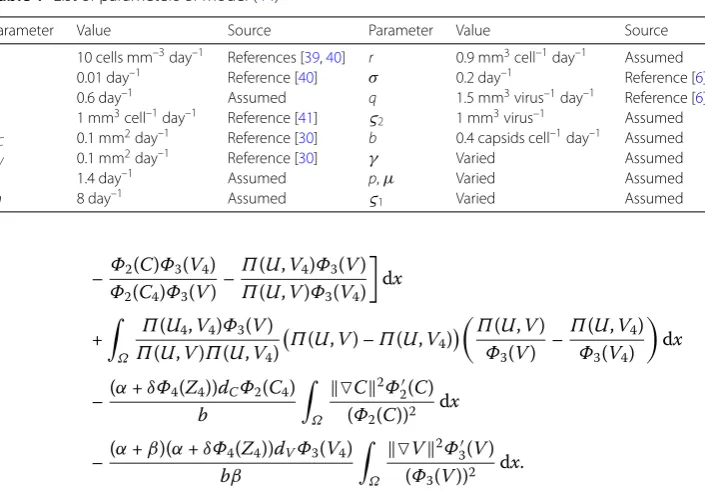
Table 1 List of parameters of model (44)
Parameter Value Source Parameter Value Source
λ 10 cells mm–3day–1 References [39,40] r 0.9 mm3cell–1day–1 Assumed
m 8 day–1 Assumed ς1 Varied Assumed
–Φ2(C)Φ3(V4)
M4is globally asymptotically stable by LaSalle’s invariance principle [38], where the point
exists ifR1>R3> 1.
5 Numerical simulations
Our goal in this section is to carry out some numerical simulations which exhibit the global stability of all equilibrium points of the model. We consider the following special case of model (2):
where the infection rateΠ(U,V) is the Beddington–DeAngelis functional response [25,
42,43]. It is straightforward to check that all requirements [Q1]–[Q4] are satisfied. We assume the following initial conditions:
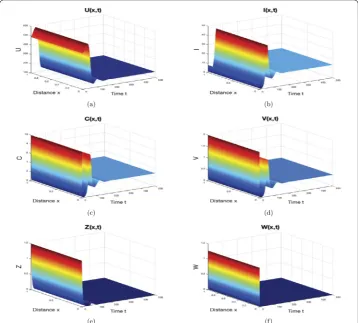
Figure 1The numerical simulations of system (44)–(46) whenR0≤1. The infection-free equilibriumM0is
globally asymptotically stable. The sub-figures show the spatiotemporal behaviors of (a) uninfected hepatocytes, (b) infected hepatocytes, (c) capsids, (d) viruses, (e) CTLs, and (f) B cells
C(x, 0) = 10 capsids mm–3, V(x, 0) = 2 virions mm–3, (45)
Z(x, 0) = 1.5 cells mm–3, W(x, 0) = 1 cells mm–3, x∈[0, 1],
and homogeneous Neumann boundary conditions
∂C
∂n = 0,
∂V
∂n = 0, fort∈[0, 500],x= 0, 1. (46)
The initial values are arbitrarily chosen as the global stability of the equilibrium points guarantees the convergence regardless of the selected initial conditions. The threshold parametersR0,R1,R2, andR3are given by
R0=
bβγ λ
mα(α+β)(d+ς1λ),
R1=
bβqγU2
mα(α+β)(q+qς1U2+ς2μ)
,
R2=
bβpγU3
mpα(α+β)(1 +ς1U3) +ας2bβσ
,
R3=
pμγU4 ασ(q+qς1U4+ς2μ)
Figure 2The numerical simulations of system (44)–(46) whenR1≤1 <R0andR2≤1 <R0. The immune-free
equilibriumM1is globally asymptotically stable. The sub-figures show the spatiotemporal behaviors of
(a) uninfected hepatocytes, (b) infected hepatocytes, (c) capsids, (d) viruses, (e) CTLs, and (f) B cells
where
U2=U4= 1 2ς1dq
ς1λq–ς2dμ–γ μ–dq+
(ς1λq–ς2dμ–γ μ–dq)2+ 4ς1dq(ς2λμ+λq)
,
U3=
mp(α+β)(ς1λ–d) –bβσ(ς2d+γ) 2ς1dmp(α+β)
+
(mp(α+β)(ς1λ–d) –bβσ(ς2d+γ))2+ 4ς1dmp(α+β)(αλmp+βλmp+bβς2λσ)
2ς1dmp(α+β) .
For the numerical simulations of system (44)–(46), the values ofγ,p,μ, andς1are changed
as they have the most important effects on the global stability of equilibrium points. The values of all other parameters are fixed in Table1. We have chosen the parameters of the model to perform the numerical simulations. This is because of the difficulty of getting real data from HBV infected patients; however, if one has real data, then the parameters of the model can be estimated and the validity of the model can be established.
The results can be divided into the following categories:
(i) Whenγ = 0.9mm3virus–1day–1,p= 0.2mm3cell–1day–1,μ= 0.1day–1and ς1= 1mm3cell–1, then we getR0= 0.0524 < 1. In this case, the solutions of system
Figure 3The numerical simulations of system (44)–(46) whenR1> 1 andR3≤1. The infection equilibrium
M2is globally asymptotically stable. The sub-figures show the spatiotemporal behaviors of (a) uninfected
hepatocytes, (b) infected hepatocytes, (c) capsids, (d) viruses, (e) CTLs, and (f) B cells
Actually, this result supports Theorem3and represents the case when the liver cells are completely uninfected and the infection is finished out.
(ii) Whenγ = 0.5mm3virus–1day–1,p= 0.01mm3cell–1day–1,μ= 1.5day–1and ς1= 0.02mm3cell–1, then we find0.5482 =R1< 1 <R0= 1.3889and
0.7569 =R2< 1 <R0= 1.3889. For this set of parameters and according to
Theorem4, the solutions of system (44) converge to the immune-free equilibrium
M1= (162.3944, 13.9603, 2.7921, 0.4886, 0, 0)as shown in Fig.2. The number of
uninfected hepatocytes drops sharply when the HBV infection is chronic and the immune responses are not active.
(iii) We takeγ = 0.5mm3virus–1day–1,p= 0.01mm3cell–1day–1,μ= 0.5day–1and ς1= 0.02mm3cell–1. These values giveR0= 1.3889 > 1,R1= 1.2023 > 1, and
R3= 0.5725 < 1. In agreement with the result of Theorem5, the infection
equilibriumM2= (313.1212, 11.4516, 2.2903, 0.3334, 0, 1.7987)is globally
Figure 4The numerical simulations of system (44)–(46) whenR2> 1 andRR13≤1. The infection equilibrium M3is globally asymptotically stable. The sub-figures show the spatiotemporal behaviors of (a) uninfected
hepatocytes, (b) infected hepatocytes, (c) capsids, (d) viruses, (e) CTLs, and (f) B cells
(iv) Ifγ= 0.5mm3virus–1day–1
,p= 0.07mm3cell–1
day–1,μ= 0.5day–1and
ς1= 0.01mm3cell–1, then we obtainR0= 2.6515 > 1,R2= 2.4515 > 1, and
R1
R3 = 0.3 < 1. For this choice of parameter values, the solutions of system (44) converge to the infection equilibrium
M3= (579.4083, 2.775, 0.5546, 0.097, 0.8672, 0), which supports Theorem6. The
results are shown in Fig.4. In this situation, CTL immune response works alone to kill the infected cells which are the source of the virus.
(v) Whenγ = 0.7mm3virus–1day–1,p= 0.15mm3cell–1day–1,μ= 0.06day–1and ς1= 0.01mm3cell–1, then we getR0= 3.7121 > 1,R3= 3.0757 > 1, RR13 = 1.1667 > 1.
In agreement with Theorem7, we can see from Fig.5that the equilibrium
M4= (753.4535, 1.3449, 0.2708, 0.0406, 1.2688, 1.5117)is globally asymptotically
stable. Here, CTL and antibody immune responses work in parallel to kill the infected hepatocytes and attack the HBV, respectively. As a result, the number of healthy liver cells increases while the numbers of infected cells, capsids, and viruses decrease.
6 Conclusion
Figure 5The numerical simulations of system (44)–(46) whenR3> 1 andR1>R3> 1. The equilibrium with
two immune responsesM4is globally asymptotically stable. The sub-figures show the spatiotemporal
behaviors of (a) uninfected hepatocytes, (b) infected hepatocytes, (c) capsids, (d) viruses, (e) CTLs, and (f) B cells
model has five equilibrium points which are given by the disease-free equilibriumM0,
the immune-free equilibriumM1, the infection equilibrium with only antibody immune
responseM2, the infection point with only CTL immune responseM3, and the
equilib-rium with both types of adaptive immunityM4. The conditions for existence and global
stability of these equilibrium points have produced four threshold parametersR0,R1,R2,
andR3. The equilibrium pointM0is globally asymptotically stable ifR0≤1, which
indi-cates that the liver cells are totally healthy and there is no infection. The equilibriumM1
exists and is globally asymptotically stable ifR1≤1 <R0 andR2≤1 <R0, and it reflects
the situation when the immune responses have not been activated yet to counter the in-fection. The infection equilibriumM2exists and is globally asymptotically stable ifR1> 1
andR3≤1, where only B lymphocytes work to defeat the virus. On the other hand,M3
exists and is globally asymptotically stable equilibrium point ifR2> 1 and RR13 ≤1. In this
case, only CTLs try to clear the infection by killing the infected hepatocytes. Finally, B and T immune cells work together to eliminate HBV infection at the equilibriumM4that
exists and is globally asymptotically stable ifR1>R3> 1. The provided numerical
It is commonly observed that in viral infection processes, time delay is inevitable (see, e.g., [8–11,44–47]). Extending model (2) to include the effect of treatments and time de-lays will give a deeper insight into HBV infection. Another extension of model (2) is to incorporate stochastic interactions (see [48]). We leave these points as future works.
Acknowledgements
This project funded by the Deanship of Scientific Research (DSR), King Abdulaziz University, Jeddah, under grant No. (DF-005-130-1441). The authors, therefore, gratefully acknowledge DSR technical and financial support.
Funding
Not applicable.
Availability of data and materials
Not applicable.
Competing interests
The authors declare that they have no competing interests.
Authors’ contributions
All authors contributed equally to the writing of this paper. All authors read and approved the final manuscript.
Publisher’s Note
Springer Nature remains neutral with regard to jurisdictional claims in published maps and institutional affiliations.
Received: 26 April 2019 Accepted: 3 December 2019
References
1. Nowak, M.A., May, R.M.: Virus Dynamics: Mathematical Principles of Immunology and Virology. Oxford University Press, Oxford (2000)
2. World Health Organization: Global Hepatitis Report 2017. World Health Organization, Geneva (2017). License: CCBY-NC-SA 3.0 IGO
3. Pairan, A., Bruss, V.: Functional surfaces of the hepatitis B virus capsid. J. Virol.83, 11616–11623 (2009) 4. Bruss, V.: Envelopment of the hepatitis B virus nucleocapsid. Virus Res.106, 199–209 (2004)
5. Grimm, D., Thimme, R., Blum, H.E.: HBV life cycle and novel drug targets. Hepatol. Int.5(2), 644–653 (2011)
6. Miao, H., Teng, Z., Abdurahman, X., Li, Z.: Global stability of a diffusive and delayed virus infection model with general incidence function and adaptive immune response. Comput. Appl. Math.37(3), 3780–3805 (2018)
7. Nowak, M.A., Bangham, C.R.M.: Population dynamics of immune responses to persistent viruses. Science272, 74–79 (1996)
8. Huang, G., Takeuchi, Y., Ma, W.: Lyapunov functionals for delay differential equations model of viral infections. SIAM J. Appl. Math.70(7), 2693–2708 (2010)
9. Elaiw, A.M., Elnahary, E.Kh., Raezah, A.A.: Effect of cellular reservoirs and delays on the global dynamics of HIV. Adv. Differ. Equ.2018, Article ID 85 (2018)
10. Hobiny, A.D., Elaiw, A.M., Almatrafi, A.: Stability of delayed pathogen dynamics models with latency and two routes of infection. Adv. Differ. Equ.2018, Article ID 276 (2018)
11. Elaiw, A.M., Raezah, A.A., Azoz, S.A.: Stability of delayed HIV dynamics models with two latent reservoirs and immune impairment. Adv. Differ. Equ.2018, Article ID 414 (2018)
12. Hattaf, K., Yousfi, N.: A generalized virus dynamics model with cell-to-cell transmission and cure rate. Adv. Differ. Equ. 2016, Article ID 174 (2016)
13. Elaiw, A.M., AlShamrani, N.H.: Stability of an adaptive immunity pathogen dynamics model with latency and multiple delays. Math. Methods Appl. Sci.41(16), 6645–6672 (2018)
14. Shu, H., Wang, L., Watmough, J.: Global stability of a nonlinear viral infection model with infinitely distributed intracellular delays and CTL immune responses. SIAM J. Appl. Math.73(3), 1280–1302 (2013)
15. Carvalho, A.R.M., Pinto, C.M.A., Baleanu, D.: HIV/HCV coinfection model: a fractional-order perspective for the effect of the HIV viral load. Adv. Differ. Equ.2018, Article ID 2 (2018)
16. Elaiw, A.M., Almuallem, N.A.: Global properties of delayed-HIV dynamics models with differential drug efficacy in cocirculating target cells. Appl. Math. Comput.265, 1067–1089 (2015)
17. Elaiw, A.M., AlShamrani, N.H.: Stability of a general adaptive immunity virus dynamics model with multi-stages of infected cells and two routes of infection. Math. Methods Appl. Sci. (2019).https://doi.org/10.1002/mma.5923
18. Elaiw, A.M., Alshaikh, M.A.: Stability analysis of a general discrete-time pathogen infection model with humoral immunity. J. Differ. Equ. Appl. (2019).https://doi.org/10.1080/10236198.2019.1662411
19. Huang, G., Ma, W., Takeuchi, Y.: Global properties for virus dynamics model with Beddington–DeAngelis functional response. Appl. Math. Lett.22(11), 1690–1693 (2009)
20. Britton, N.F.: Essential Mathematical Biology. Springer, London (2003)
21. Wang, K., Wang, W.: Propagation of HBV with spatial dependence. Math. Biosci.210, 78–95 (2007)
22. Gourley, S.A., So, J.W.H.: Dynamics of a food-limited population model incorporating nonlocal delays on a finite domain. J. Math. Biol.44, 49–78 (2002)
24. Shaoli, W., Xinlong, F., Yinnian, H.: Global asymptotical properties for a diffused HBV infection model with CTL immune response and nonlinear incidence. Acta Math. Sci.31B(5), 1959–1967 (2011)
25. Zhang, Y., Xu, Z.: Dynamics of a diffusive HBV model with delayed Beddington–DeAngelis response. Nonlinear Anal., Real World Appl.15, 118–139 (2014)
26. Bellomo, N., Tao, Y.: Stabilization in a chemotaxis model for virus infection. Discrete Contin. Dyn. Syst., Ser. S13(2), 105–117 (2020)
27. Geng, Y., Xu, J., Hou, J.: Discretization and dynamic consistency of a delayed and diffusive viral infection model. Appl. Math. Comput.316, 282–295 (2018)
28. Manna, K., Chakrabarty, S.P.: Global stability and a non-standard finite difference scheme for a diffusion driven HBV model with capsids. J. Differ. Equ. Appl.21(10), 918–933 (2015)
29. Guo, T., Liu, H., Xu, C., Yan, F.: Global stability of a diffusive and delayed HBV infection model with HBV DNA-containing capsids and general incidence rate. Discrete Contin. Dyn. Syst., Ser. B23, 4223–4242 (2018)
30. Manna, K.: Dynamics of a delayed diffusive HBV infection model with capsids and CTL immune response. Int. J. Appl. Comput. Math.4, Article ID 116 (2018).https://doi.org/10.1007/s40819-018-0552-4
31. Danane, J., Allali, K.: Mathematical analysis and treatment for a delayed hepatitis B viral infection model with the adaptive immune response and DNA-containing capsids. High-Throughput7, Article ID 35 (2018).
https://doi.org/10.3390/ht7040035
32. Xu, J., Geng, Y.: Threshold dynamics of a delayed virus infection model with cellular immunity and general nonlinear incidence. Math. Methods Appl. Sci.42(3), 892–906 (2018)
33. Min, L., Su, Y., Kuang, Y.: Mathematical analysis of a basic virus infection model with application to HBV infection. Rocky Mt. J. Math.38(5), 1573–1585 (2008)
34. Xu, Z., Xu, Y.: Stability of a CD4+T cell viral infection model with diffusion. Int. J. Biomath.11(5), Article ID 1850071 (2018)
35. Smith, H.L.: Monotone Dynamical Systems: An Introduction to the Theory of Competitive and Cooperative Systems. Am. Math. Soc., Providence (1995)
36. Protter, M.H., Weinberger, H.F.: Maximum Principles in Differential Equations. Prentice Hall, Englewood Cliffs (1967) 37. Henry, D.: Geometric Theory of Semilinear Parabolic Equations. Springer, New York (1993)
38. Hale, J.K., Verduyn Lunel, S.M.: Introduction to Functional Differential Equations. Springer, New York (1993) 39. Perelson, A., Kirschner, D., De Boer, R.: Dynamics of HIV infection of CD4+ T cells. Math. Biosci.114(1), 81–125 (1993) 40. Culshaw, R., Ruan, S., Spiteri, R.: Optimal HIV treatment by maximising immune response. J. Math. Biol.48(5), 545–562
(2004)
41. Pawelek, K., Liu, S., Pahlevani, F., Rong, L.: A model of HIV-1 infection with two time delays: mathematical analysis and comparison with patient data. Math. Biosci.235(1), 98–109 (2012)
42. Beddington, J.R.: Mutual interference between parasites or predators and its effect on searching efficiency. J. Anim. Ecol.44, 331–340 (1975)
43. DeAngelis, D.L., Goldstein, R.A., O’Neill, R.V.: A model for tropic interaction. Ecology56, 881–892 (1975)
44. Elaiw, A.M., Elnahary, E.Kh.: Analysis of general humoral immunity HIV dynamics model with HAART and distributed delays. Mathematics7, Article ID 157 (2019)
45. Elaiw, A.M., Almatrafi, A., Hobiny, A.D., Hattaf, K.: Global properties of a general latent pathogen dynamics model with delayed pathogenic and cellular infections. Discrete Dyn. Nat. Soc.2019, Article ID 9585497 (2019)
46. Elaiw, A.M., Raezah, A.A.: Stability of general virus dynamics models with both cellular and viral infections and delays. Math. Methods Appl. Sci.40(16), 5863–5880 (2017)
47. Elaiw, A.M., Alshehaiween, S.F., Hobiny, A.D.: Global properties of delay-distributed HIV dynamics model including impairment of B-cell functions. Mathematics7, Article ID 837 (2019)