Volume 2008, Article ID 362897,12pages doi:10.1155/2008/362897
Research Article
New Technique for Improving Performance of LDPC Codes in
the Presence of Trapping Sets
Esa Alghonaim,1Aiman El-Maleh,1and Mohamed Adnan Landolsi2
1Computer Engineering Department, King Fahd University of Petroleum & Minerals, Dhahran 31261, Kingdom of Saudi Arabia 2Electrical Engineering Department, King Fahd University of Petroleum & Minerals, Dhahran 31261, Kingdom of Saudi Arabia
Correspondence should be addressed to Esa Alghonaim,[email protected]
Received 2 December 2007; Revised 18 February 2008; Accepted 21 April 2008
Recommended by Yonghui Li
Trapping sets are considered the primary factor for degrading the performance of low-density parity-check (LDPC) codes in the
error-floor region. The effect of trapping sets on the performance of an LDPC code becomes worse as the code size decreases.
One approach to tackle this problem is to minimize trapping sets during LDPC code design. However, while trapping sets can be reduced, their complete elimination is infeasible due to the presence of cycles in the underlying LDPC code bipartite graph.
In this work, we introduce a new technique based ontrapping sets neutralizationto minimize the negative effect of trapping sets
under belief propagation (BP) decoding. Simulation results for random, progressive edge growth (PEG) and MacKay LDPC codes
demonstrate the effectiveness of the proposed technique. The hardware cost of the proposed technique is also shown to be minimal.
Copyright © 2008 Esa Alghonaim et al. This is an open access article distributed under the Creative Commons Attribution License, which permits unrestricted use, distribution, and reproduction in any medium, provided the original work is properly cited.
1. INTRODUCTION
Forward error correcting (FEC) codes are an essential com-ponent of modern state-of-the-art digital communication and storage systems. Indeed, in many of the recently devel-oped standards, FEC codes play a crucial role for improving the error performance capability of digital transmission over noisy and interference-impaired communication channels.
Low-density parity-check codes (LDPCs), originally introduced in [1], have recently been undergoing a lot of active research and are now widely considered to be one of the leading families of FEC codes. LDPC codes demonstrate performance very close to the information-theoretic bounds predicted by Shannon theory, while at the same time having the distinct advantage of low-complexity, near-optimal iterative decoding.
As with other types of codes decoded by iterative decod-ing algorithms (such as turbo codes), LDPC codes can suffer from the presence of undesirable error floors at increasing SNR levels (although these are found to be relatively lower than the error floors encountered with turbo codes [2]). In the case of LDPC codes, trapping sets [2–4] have been identified as one of the main factors causing error floors at high SNR values. The analysis of trapping sets and their impact on LDPC codes has been addressed in [3,5–9]. The
main approaches for mitigating the impact of trapping sets on LDPC codes are based on either introducing algorithms to minimize their presence during code design as in [5,7,9] or by enhancing decoder performance in the presence of trapping sets as in [3,6,8]. The main disadvantage of the first approach, in addition to putting tight constraints on code design, is that trapping sets cannot be totally eliminated at the end due to the “unavoidable” existence of cycles in their underlying bipartite Tanner graphs especially for relatively short block length codes (which is the focus of this work). In addition, LDPC codes designed to reduce trapping sets may result in large interconnect complexity increasing hardware implementation overhead. The second approach is therefore considered to be more applicable for our purpose and is the basis of the contributions presented in this paper.
suffers from the following disadvantages: (1) the decoder has to exactly specify the trapping sets variable nodes in order to flip them; (2) extra time is needed to search the lookup table for a trapping set; (3) the technique is not amenable to practical hardware implementation.
In [6,8], the concept of averaging partial results is used to overcome the negative effect of trapping sets in the error floor region. Variable node messages update in the conventional BP decoder are modified in order to make it less sensitive to oscillations in messages received from check nodes. The variable node equation is modified to be the average of current and previous signals values received from check nodes. While this approach is effective in handling oscillating error patterns, it does not improve decoder performance in the case of constant error patterns.
In this paper, we propose a novel approach for enhanc-ing decoder performance in presence of trappenhanc-ing sets by introducing a new concept calledtrapping sets neutralization. The effect of a trapping set can be eliminated by setting its variable nodes intrinsic and extrinsic values to zero, that is, neutralizing them. After a trapping set is neutralized, the estimated values of variable nodes are affected only by external messages from nodes outside the trapping set.
Most harmful trapping sets are identified by means of simulation. To be able to neutralize identified trapping sets, a simple algorithm is introduced to store trapping sets configuration information in variable and check nodes.
The remainder of this paper is organized as follows:
In Section 2, we give an overview of LDPC codes and BP
algorithm. Trapping sets identification and neutralization are introduced inSection 3.Section 4presents the algorithm of trapping sets neutralization based on learning. Experimental results are given inSection 5. InSection 6, we conclude the paper.
2. OVERVIEW OF LDPC CODES
LDPC codes are a class of linear block codes that use a sparse, random-like parity-check matrixH[1,10]. An LDPC code defined by the parity-check matrixH represents the parity equations in a linear form, where any given codeword u satisfies the set of parity equations such thatu×H=0. Each column in the matrix represents a codeword bit while each row represents a parity-check equation.
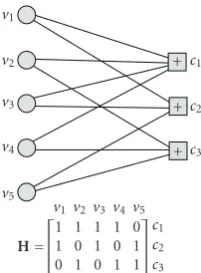
LDPC codes can also be represented by bipartite graphs, usually called Tanner graphs, having two types of nodes:
variable nodes and check nodes interconnected by edges whenever a given information bit appears in the parity-check equation of the corresponding parity-check bit, as shown in
Figure 1.
The properties for an (N,K) LDPC code specified by an
M×NHmatrix can be summarized as follows.
–Block size:number of columns (N) in theHmatrix.
– Number of information bits: given byK=N−M. – Rate: the rate of the information bits to the block
size. It equals 1−M/N, given that there are no linear dependent rows in theHmatrix.
v1
Figure1: The two representations of LDPC codes: graph form and matrix form.
–Check node degree:number of 1’s in the correspond-ing row in theHmatrix. Degree of a check nodecjis referred to asd(cj).
–Variable node degree: number of 1’s in the corre-sponding column in the H matrix. Degree of a variable nodeviis referred to asd(vi).
–Regularity: an LDPC code is said to be regular if
d(vi)=pfor 1≤i≤Nandd(cj)=qfor 1≤j≤M. In this case, the code is (p,q) regular LDPC code. Otherwise, the code is considered irregular.
–Code girth:the minimum cycle length in the Tanner graph of the code.
The iterative message-passing belief propagation algorithm (BP) [1,10] is commonly used for decoding LDPC codes and is shown to achieve optimum performance when the underlying code graph is cycle-free. In the following, a brief summary of the BP algorithm is given. Following the notation and terminology used in [11], we define the following:
(i)ui: transmitted bit in a codeword,ui∈ {0, 1}. (ii)xi: a transmitted channel symbol, with a value given
by is zero-mean additive white Gaussian noise (AWGN) random variable with varianceσ2.
(iv) For the jth row in an H matrix, the set of column locations having 1’s is given byRj= {i:hji=1}. The set of column locations having 1’s, excluding location
I, is given byRj\i= {i:hji=1} \ {i}.
(v) For the ith column in anH matrix, the set of row locations having 1’s is given byCi= {j:hji=1}. The set of row locations having 1’s, excluding the location
cj
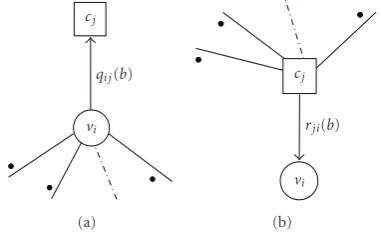
Figure 2: (a) Variable-to-check message, (b) check-to-variable message.
(vi)qi j(b): message (extrinsic information) to be passed from variable node vi to check node cj regarding the probability ofui = b,b ∈ {0, 1}, as shown in
Figure 2(a). It equals the probability thatui=bgiven
extrinsic information from all check nodes, except nodecj.
(vii)rji(b): message to be passed from check node cj to variable nodevi, which is the probability that thejth check equation is satisfied given that bitui = band the other bits have separable (independent) distribu-tion given by{qi j}
where L(ui) is usually referred to as the intrinsic information for nodevi.
(x)
The BP algorithm involves one initialization step and three iterative steps as shown below.
Initialization step
Set the initial value of each variable node signal as follows:
L(qi j)≡L(ui)=2yi/σ2, whereσ2is the variance of noise in the AWGN channel.
Iterative steps
The three iterative steps are as follows.
(i) Update check nodes as follows:
Lrji (ii) Update variable nodes as follows:
L(qi j)=L(ui) +
j∈Ci\j
Lrji. (7)
(iii) Compute estimated variable nodes as follows:
L(Qi)=L
During LDPC decoding, the iterative steps (i) to (iii) are repeated until one of the following two events occurs:
(i) the estimated vector u = (u1,. . .,un) satisfies the check equations, that is,u·H=0;
(ii) maximum iterations number is reached.
3. TRAPPING SETS
In BP decoding of LDPC codes, dominant decoding failures are, in general, caused by a combination of multiple cycles [4]. In [2], the combination of error bits that leads to a decoder failure is defined as trapping sets. In [3], it is shown that the dominant trapping sets are formed by a combination of short cycles present in the bipartite graph.
In the following, we adopt the terminology and notation related to trapping sets as originally introduced in [8]. Let Hbe the parity-check matrix of (N,K) LDPC code, and let
G(H) denote its corresponding Tanner graph.
Definition 1. A (z,w) trapping set T is a set of z variable nodes, for which the subgraph of thezvariable nodes and the check nodes that are directly connected to them contains exactlywodd-degree check nodes.
The next example illustrates the behavior of trapping sets and how they are harmful.
Example 2. Consider a regular (N, K) LDPC code with degree (3,6).Figure 3shows a trapping setT(4, 2) in the code graph. Assume that an all-zero codeword (u = 0) is sent through an AWGN channel, and all bits are received correctly (i.e., have positive intrinsic values) except the 4 bits in the trapping setT(4, 2), that is,L(ui) < 0 for 1 ≤ i ≤ 4 and
v1
v2 v3 v4
c1 c2
c3
c4 c5
c6
c7
Figure3: Trapping set example ofT(4, 2).
Based on (8), the estimated value of a variable node is the sum of its intrinsic information and messages received from the neighboring three check nodes. Therefore, the estimation equation for each variable node contains four summation terms: the intrinsic information and three information messages. In this case, the estimated values forv1 (andv3) will be incorrect because all of the four summation terms of its estimation equation are negative. For v2 (and v4), three out of the four summation terms in its estimation equation have negative values. Therefore, v2 (and v4) has high probability to be incorrectly estimated. In this case, the decoder becomes intrap and will continue in the trap unless positive signals fromc1and/orc2 are strong enough to change the polarities of the estimated values ofv2and/or
v4. This example illustrates a trapping set causing aconstant error pattern.
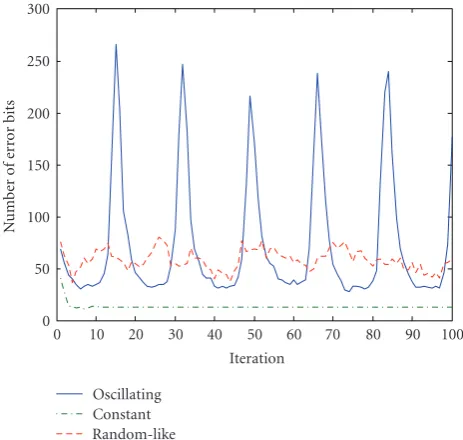
As a first step to investigate the effect of trapping sets on LDPC codes performance, extensive simulations for LDPC codes over AWGN channels with various SNR values have been performed. A frame is considered to be in error if the maximum decoding iteration is reached without satisfying the check equations, that is, the syndromeu×His nonzero. Error frames are classified based on observing the behavior of the LDPC decoder at each decoding iteration. At the end of each iteration, bits in error are counted. Based on this, error frames are classified into three patterns described as follows.
(i)Constant error pattern: where the bit error count becomes constant after only a few decoding itera-tions.
(ii)Oscillating error pattern: where the bit error count follows a nearly periodic change between maximum and minimum values. An important feature of this error pattern is the high variation in bit error count as a function of decoding iteration number.
(iii)Random-like error pattern:where the bit error count evolution follows a random shape, characterized by low variation range.
Figure 4shows one example for each of the three error
pat-terns. In a constant error pattern, bit errors count becomes constant after several decoding iterations (10 iterations in the
300 250 200 150 100 50 0
N
u
mb
er
of
er
ro
r
b
its
0 10 20 30 40 50 60 70 80 90 100 Iteration
Oscillating Constant Random-like
Figure4: Illustration of the three types of error patterns.
Table1: Percentages of error patterns at error-floor region.
Code Size Constant Oscillating Random-like
HE(1024,512) 59% 38% 3%
RND(1024,512) 95% 4% 1%
PEG(100,50) 90% 5% 5%
example ofFigure 4). In this case, the decoder becomes stuck due to the presence of a tapping setT(z,w), and the number of bits in error equals z and all check nodes are satisfied exceptwcheck nodes.
The major difference between a trapping set T(z, w) causing a constant error pattern and a trapping setT(e,f) causing other patterns is the number of odd-degree check nodes. Based on extensive simulations, it is found thatw ≤
f. This result is interpreted logically as follows: if variable nodes of a trapping set are in error, only odd-degree check nodes are sending correct messages to the variable nodes of the trapping set. Therefore, as the number of odd-degree check nodes decreases, the probability of breaking the trap decreases. As an extreme example, a trapping set with no odd-degree check nodes results in a decoder convergence to a codeword other than the transmitted one and thus causes undetected decoder failure.
Table 1shows examples of percentages of the three error
This observation motivates the need for developing a technique for enhancing decoder performance due to trapping sets of constant error patterns type. For trapping sets that cause constant error patterns, when a trap occurs, values of check equations do not change in subsequent iterations. Thus, a decoder trap is detected based on check equations results. The unsatisfied check nodes are used to reach the trapping set variable nodes.
3.1. BP decoder trapping sets detection
In order to eliminate the effect of trapping sets during the iterations of BP decoder, a mechanism is needed to detect the presence of a trapping set. The proposed trapping sets detection technique is based on monitoring the state of the check equations vector u×H. At the end of each decoding iteration, a new value of u ×H is computed. If the u × H value is nonzero and remains unchanged (stable) for a predetermined number of iterations, then a decoder trap is detected. We call this number the stability parameter(d), and it is normally set to a small value. Based on experimental results, it is found that d = 3 is a good choice. The implementation of trap detection is similar to the implementation of valid codeword detection with some extra logic in each check node.Figure 5shows an implementation of trapping sets detection for a decoder withMcheck nodes. The outputsifor a check nodeci is logic zero if the check equation result is equivalent to the check equation result in the previous iteration, that is, no change in the check equation result. The output Sis zero if there is no change in all check equations between the current and the previous iteration numbers.
3.2. Trapping sets neutralization
In this section, we introduce a new technique to overcome the detrimental effect of trapping sets during BP decoding. To overcome the negative impact of a trapping setT(z,w), the basic idea is to neutralize the z variable nodes in the trapping set. Neutralizing a variable node involves setting its intrinsic value and extrinsic message values to zero. Specifically, neutralizing a variable node vi involves the following two steps:
(1)L(ui)=0,
(2)L(qi j)=0, 1≤j≤d(vi).
The neutralization concept is illustrated by the following example.
Example 3. For the trapping setT(4, 2) inExample 2, it has been shown that when all code bits are received correctly exceptT(4, 2) bits, the decoder fails to correct the codeword resulting in an error pattern of constant type.
Now, consider neutralizing the trapping set variable nodes by setting its intrinsic and extrinsic values tozero. After neutralization, the decoder converges to a valid codeword within two iterations, as follows. In the first iteration after
neutralization, forv2andv4, two extrinsic messages become positive due to positive messages from nodes c1 and c2, which shifts estimated values of v2 andv4 to the positive correct values. For nodes v1 andv3, all extrinsic values are zeros and their estimated values remain zero. In the second iteration after neutralization, for v1 and v3, two extrinsic messages become positive due to positive extrinsic messages from nodesv2andv4, which shifts estimated values ofv1and
v3to the positive correct values.
The proposed neutralization technique has three impor-tant characteristics. (1) It is not necessary to exactly deter-mine the variable nodes in a trapping set, such as the trapping set bits flipping technique used in [3]. In the previous example, if only 3 out of the 4 trapping sets variables are neutralized, the decoder will still be able to recover from the trap. (2) If some nodes outside a trapping set are neutralized (due to inexact identification of the trapping set), their extrinsic messages are expected to quickly recover their estimation function to correct values due to correct messages from neighbouring nodes. This is because most of the extrinsic messages are correct in the error-floor regions. (3) Neutralization is performed during BP decoding iterations as soon as a trapping set is detected, which makes the decoder able to converge to a valid codeword within the allowed maximum number of iterations.
As an example, for the near-constant error pattern in
Figure 4, a trap occurs at iteration 10 and is detected at
iteration 13 (assuming d = 3). In this case, the decoder has a plenty of time to neutralize the trapping set before reaching the maximum 100 iterations. In general, based on our simulations, a decoder trap is detected during early decoding iterations.
4. BP DECODER WITH TRAPPING SETS NEUTRALIZATION BASED ON LEARNING
In this section, we introduce an algorithm to correct constant error pattern types (causing error floors) associated with LDPC BP decoding. The proposed algorithm involves two parts: (1) a preprocessing phase called learning phase and (2) actual decoding phase. The learning phase is an offline computation process in which trapping sets are identified. Then, variable and check nodes are configured according to the identified trapping sets. In the actual decoding phase, the proposed decoder runs as a standard BP decoder with the ability to detect and neutralize trapping sets using variable and check nodes configuration information obtained during the learning phase. When a trapping set is detected, the decoder stops running BP iterations and switches to a neutralization process, in which the detected trapping set is neutralized. Upon completion of the neutralization process, the decoder resumes to normal running of BP iterations. The neutralization process involves forwarding messages between the trapping sets check and variable nodes.
Control logic Counter
Trap detection S
s2 c1
c2
cM
s2 c2
u1
u2
ud(c2)
Figure5: Decoder trap detection circuit.
v1 v2
v3 v4
c1 c2
c3 c4
c5
c6 c7
1
1 2
3
4 5
Figure6: Tree structure for the trapping setT(4, 2).
Example 4. Given the trapping set T(4, 2) of the previous example, we show the following: (a) how the nodes of this trapping set are configured, (b) how the neutralization process is performed during the actual decoding phase.
(a) In the learning phase, the trapping set nodes {c1,
c2,c3,c4,c5,c6,c7,v1,v2,v3,v4}are configured for neutraliza-tion. First, a tree is built corresponding to the trapping set starting with odd-degree check nodes as the first level of the tree, as shown inFigure 6. The reason for starting from odd-degree check nodes is because they are the only gates leading to a trapping set when the decoder is in a trap. When the decoder is stuck due to a trapping set, all check nodes are satisfied except the odd-degree check nodes of the trapping set. Therefore, odd-degree check nodes in trapping sets are the keys for the neutralization process.
Degree one check nodes in the trapping set (c1 and
c2 in this example) are configured to initiate messages to their neighboring variable nodes requesting them to perform neutralization. We call these messages:neutralization initia-tion messages. InFigure 6, arrows pointing out from a node indicate that the node is configured to forward a neutral-ization message to its neighbor. The task of neutralneutral-ization message forwarding in a trapping set is to send neutralization message to every variable node in the trapping set. In our example,c1andc2are configured for neutralization message initiation, while v2, c3, and c6 are configured for neutral-ization messages forwarding. This configuration is enough
to forward neutralization messages to all variable nodes in the trapping set. Another possible configuration is that c1 andc2 are configured for neutralization message initiation whilev4,c4, andc7are configured for neutralization messages forwarding. Thus, in general, there is no need to configure all trapping set nodes.
(b) Now, assume that the proposed decoder is running BP iterations and falls in a trap due to T(4, 2). Next, we show how the preconfigured nodes are able to neutralize the trapping setT(4, 2) in this example. First, the decoder detects a trap event and then it stops running BP iterations and switches to a neutralization process. The decoder runs the neutralization process for a fixed number of cycles and then resumes running the BP iterations. In the first cycle of the neutralization process, the unsatisfied check nodes initiate a neutralization message according to the configuration stored in them during the learning phase. Because the decoder failure is due toT(4, 2), all check nodes in the decoder are satisfied except the two check nodes c1 andc2. Therefore, only c1 and c2 initiate neutralization messages to nodes
v2 andv4, respectively. In the second neutralization cycle, variable nodesv2andv4receive neutralization messages and perform neutralization, andv2 forwards the neutralization message to c3 andc6. In the third neutralization cycle, c3 andc6 receive and forward the neutralization messages to
v1andv3, respectively, which in turn perform neutralization but do not forward neutralization messages. After that, no message forwarding is possible until neutralization cycles end. After the neutralization process, the decoder resumes running BP iterations. The proposed decoder converges to a valid codeword within two iterations after resuming running BP iterations, as previously shown inExample 3.
Before discussing the neutralization algorithm, a descrip-tion for the configuradescrip-tion parameters used in variable and check nodes is given followed by an illustrative example. Each variable nodeviis assigned a bitγi, and each check nodecj is assigned a bitβqjand a wordα
q
jfor each of its linksq. The following is a description for these parameters.
γi: message forwarding configuration bit assigned for a variable nodevi. When a variable nodevireceives a neutral-ization message, it acts as follows. Ifγi=1, thenviforwards the received neutralization message to all neighboring check nodes except the one that sent the message; otherwise it does not forward the received message.
Inputs: LDPC code, (γi,βqj,α
q
j): nodes configuration,
Result of the check equation in each check nodecj,
nt cycles: number of neutralization cycles
Output: Some variable nodes are neutralized
1. For each check nodecjwith unsatisfied equation do
for 1≤q≤d(cj), ifβqj=1 then initiate
a neutralization message through linkq
2.l=1 // Current number of neutralization cycle
3. Whilel≤nt cycles do
For each variable nodevithat received a
neutralization message do the following:
– perform node neutralization onvi
– ifγi=1 then forward the message to all neighbors
For every check nodecjthat received a
neutralization message through linkpdo the
following:
– for 1≤q≤d(cj), if the bitαqj(p) is set then
forward the message through linkq
l=l+ 1
Algorithm1: Trapping sets neutralization algorithm.
αqj: message forwarding configuration word assigned for a link indexedq in a check nodecj, where 1 ≤ q ≤d(cj). The size ofαqj in bits equalsd(cj). If a check nodecj has to forward a neutralization message received at link indexed p
through a link indexedq, thenαqj is configured by setting the bit number p to 1, that is, the bit αqj(p) is set to 1. For example, if a degree 6 check node cj has to forward a neutralization message received at the link indexed 2 through the link indexed 3, α3
j is configured to (000010)2, that is,
α3 j(2)=1.
The following example illustrates variable and check nodes configuration values for a given trapping set.
Example 5. Assume that the trapping setT(4, 2) inFigure 6 is identified in a regular (3,6) LDPC code. Check nodes links indices are indicated on the links, for example, inc1, (c1,v2) link has index 5. The configuration for this trapping set is shown inTable 2.
Algorithm 1lists the proposed trapping set
neutraliza-tion algorithm. Since the decoder does not know how many cycles are needed to neutralize a trapping set, it performs neutralization and message forwarding cycles for a preset number (nt cycles). For example, two neutralization cycles are needed to neutralize the trapping set shown inFigure 6. The number of neutralization cycles is preset during the learning phase to the maximum number of neutralization cycles required for all trapping sets. Based on simulation results, it is found that a small number of neutralization cycles are often required. For example, 5 neutralization cycles are found sufficient to neutralize trapping sets of 20 variable nodes.
Inputs: LDPC code,
no failures: number of processed decoder failures
Output: TS List
1. TS List=∅, failures=0
2. While failures≤no failures do
u=0,x=+1,y=x+n// transmit a codeword
Decodeyusing standard BP decoder.
Ifu·H=0then goto 2 // Valid codeword
failures=failures + 1
Re-decodeyobserving trap detection indicator
If a decoder trap is not detected then goto 2 TS=List of variable nodesviin errorui=1) and unsatisfied check nodes.
If TS∈TS List then increment TS weight
Else add TS to TS List and set its weight to 1
Algorithm2: Trapping sets identification algorithm.
4.1. Trapping sets learning phase
The trapping sets learning phase involves two steps. First, the trapping sets of a given LDPC code are identified. Then, variable and check nodes are configured based on the identified trapping sets.
4.1.1. Trapping sets identification
Trapping sets can be identified based on two approaches. (1) By performing decoding simulations and observing decoder failures [2]. (2) By using graph search methods [3]. The first approach is adopted in this work as it provides information on the frequency of occurrence of each trapping set, considered as its weight. This weight is computed based on how many decoder failures occur due to that trapping set and is used to measure its negative impact compared to other trapping sets. The priority of configuring nodes for a trapping set is assigned according to its weight; more harmful trapping sets are given higher configuration priority.
Algorithm 2 lists the proposed trapping sets
Table2: Nodes configuration forT(4, 2).
Configuration Meaning
β5
1=1 c1initiates a message through link 5 (i.e., initiates message tov2).
β3
2=1 c2initiates a message through link 3 (i.e., initiates message tov4).
γ2=1 v2forwards incoming messages to all neighbors.
α2
3=(000001)2 c3forwards incoming messages from link 1 to link 2 (i.e., fromv2tov1).
α1
6=(001000)2 c6forwards incoming messages from link 4 to link 1 (i.e., fromv2tov3).
Inputs: TS List, LDPC code of size (N,K)
Outputs:γi, 1≤i≤N βqj,α
q
j, 1≤j≤N−K, 1≤q≤d(cj)
1.γi=0 for 1≤i≤N
βqj =0 andα q
j=0, for 1≤j≤N−Kand
1≤q≤d(cj)
2. Sort TS List according to trapping sets weights in a descending order.
3.k=1
4. While (k≤size of TS List) do
Update configuration so that it includes TSk
Computeωjfor 1≤j≤k
Ifωj≤Tfor 1≤j≤kthen
accept configuration update
Else reject TSkand reject configuration update
k=k+ 1
Algorithm3: Nodes configuration algorithm.
4.1.2. Nodes configuration
The second step in the trapping sets learning phase is to configure variable and check nodes in order for the decoder to be able to neutralize identified trapping sets during decoding iterations.
Before discussing the configuration algorithm, we discuss the case when two trapping sets have common nodes and its impact on the neutralization process. Then, we propose a solution to overcome this problem. This is illustrated through the following example.
Example 6. Figure 7shows partial nodes of two trapping sets TS1and TS2in a regular (3,6) LDPC code.{v1,v3,v5} ∈TS1, and{v2,v3,v4} ∈ TS2. v3is a common node between TS1 and TS2. Configuration values after configuring nodes for TS1and TS2are as follows:
α31=(000011)2(Link 3 inc1forwards messages received from link 1 or link 2);
γ3=1 (v3forwards messages to neighbors);
α2
2=(000001)2(Link 2 inc2forwards messages received from link 1);
α2
3=(000001)2(Link 2 inc3forwards messages received from link 1).
Therefore, when the decoder performs a neutralization process due to TS1, nodev4will be neutralized although it is not a subset of TS1. Similarly, performing neutralization
v1 v2
v3
v4 v5
c1
c2 c3
1 2
3
1 1
2 2
TS1 TS2
Figure7: Example of common nodes between two trapping sets.
process due to TS2 causes nodev5 (which is not a subset of TS2) to be neutralized. Fortunately, as mentioned in
Section 3.1, when the decoder is in a trap due to a trapping
set TS, the decoder converges to a valid codeword even if some variable nodes outside TS have been unnecessarily neu-tralized. However, based on simulation results, neutralizing a large number of variable nodes other than the desired nodes leads to a decoder failure.
Having introduced the trapping sets common nodes problem, we next show the proposed solution for this problem. Defineωjfor each trapping set TSjas follows.
ωj: ratio of neutralized variable nodes outside the set TSj to the total number of variable nodes (N).
Define T as the maximum allowed value for ωj. The proposed solution is as follows: after configuring a trapping set TSk, we compute ωj for 1 ≤ j ≤ k. If ωj ≤ T for 1≤j≤k, then we accept the new configuration, otherwise, TSk is rejected and the configuration is restored to its state before configuring TSk.
Algorithm 3 lists nodes configuration algorithm.
Ini-tially, configurations of all variable and check nodes are set to zero, step 1. This means that no node is allowed to initiate or forward a neutralization message. Sorting in step 2 is important to give more harmful trapping sets (with greater weight) configuration priority over less harmful trapping sets. Step 4 processes trapping sets in TS List one by one. For each trapping set TSk, update nodes configuration by setting nodes configuration parameters (γi,βqj,α
q
Inputs: LDPC code,
Nodes configuration (γi,βqj,α q j), data received from channel, max iter: maximum iterations,
nt cycles: number of neutralization cycles
Output: decoded codeword
1. iter=0, nt done=0
2. iter=iter + 1
3. Run a normal BP decoding iteration.
4. Ifu·H=0then stop // valid codeword
5. If iter=max iter then stop // decoder failure
6. If decoder trap is not detected then goto step 2 7. If (iter + nt cycles<max iter) and
(nt done=0) then do:
– Perform neutralization //Algorithm 1
– iter=iter + nt cycles
– nt done=1
8. Goto step 2
Algorithm4: The proposed learning-based decoder.
configured trapping set TSj, 1≤ j≤k, we computeωj. The parameterωjfor a trapping set TSj is computed as follows: check equations for all check nodes of the decoder are set as satisfied (i.e., assigned zero values) except odd-degree check nodes in TSj, and then a neutralization process is performed as inAlgorithm 1. The actual number of neutralized variable nodes outside the trapping set variable nodes is divided byN
(code size) to getωj. If theωj parameter for all previously configured trapping sets is less than or equal to the threshold
T, then the new configuration is accepted, otherwise TSk is rejected (ignored) and nodes configuration is restored to the state before the last update.
4.2. The proposed learning-based decoder
The algorithm of the proposed learning-based decoder is listed in Algorithm 4. The algorithm is similar to the conventional BP decoding algorithm with the addition of trapping sets detection and neutralization. Note that if a trapping set is not detected during decoding iterations, then the proposed algorithm becomes identical to the conventional BP decoder. After each decoding iteration, the trap detection flag is checked, step 6. If a trap is detected, then normal decoding iterations are paused, the decoder performs a neutralization process based onAlgorithm 1, the iteration number is increased by the number of neutralization cycles to compensate for the time spent in the neutralization process, and finally the decoder resumes conventional BP iterations. In step 7, before performing a neutralization process, the decoder checks nt done to make sure that no neutralization process has been performed in the previous iterations. This condition guarantees that the decoder will not keep running into the same trap and perform the neutralization process repeatedly. This may happen when a trap is redetected before the decoder is able to get out of
it. Upon trap detection and before deciding to perform a neutralization process, the decoder must check another con-dition. It must ensure that the decoding iterations left before reaching maximum iterations are enough to perform a neu-tralization process, step 7. For example, consider a decoder with 64 maximum decoding iterations and 5 neutralization cycles. If a trapping set is detected at iteration number 62, the decoder will not have enough time to complete neutralization process.
4.3. Hardware cost
The hardware cost for the proposed algorithm is considered low. For trapping sets storage, we need to assign one bit for each variable node (message forwarding bit). For each check nodeci, we need to assign one bit for message initiating and one word of sized(ci) for message forwarding. Fortunately, the communication links needed to forward neutralization messages between check and variable nodes of the trapping sets already exist as part of the BP decoding. Therefore, no extra hardware cost is added for the communication between trapping sets nodes. What is needed is a simple control logic to decide to perform message initiation and forwarding based on the stored forwarding information. The decoder trap detection, shown inFigure 5, is implemented as a logic tree similar to the tree of the valid codeword detection implementation. The cost is low, as it mainly consists of a simple logic circuit within the check nodes, in the addition to an OR gate tree combining logic outputs from check nodes. Using a simple multiplexer, valid code word detection logic and trap detection logic can share most of their components. It is worth emphasizing that it is not necessary to store configuration information for all variable and check nodes. Only a subset included in the learned trapping sets is used, which further reduces the required overhead.
5. EXPERIMENTAL RESULTS
In order to demonstrate the effectiveness of the proposed technique, extensive simulations have been performed on several LDPC code types and sizes over BPSK modulated AWGN channel. The maximum number of iterations is set to 64. Due to the required CPU-intensive simulations, espe-cially at high SNR, a parallel computing simulation platform was developed to run the LDPC decoding simulations on 170 nodes on a departmental LAN network [13].
The following is a brief description for the LDPC codes used in the simulation.
-HE(1024,512): a near regular LDPC code of size (1024, 512) constructed to be interconnect efficient for fully parallel hardware implementation [12].
-RND(1024,512): regular (3,6) LDPC code of size (1024, 512) randomly generated with the avoidance of cycles of size 4.
10−3
Proposed algorithm on top of average decoding Figure8: Performance results for RND(1024,512) LDPC code.
-PEG(100,50): similar to the previous code, but its size is (100,50).
MacKay(204,102): a regular LDPC code of size (204,102) on MacKay’s website [14] labeled as 204.33.484.txt.
In each of the five codes, we compare performance results for the proposed algorithm with conventional BP decoding and the average decoding algorithm proposed in [8]. The average decoding algorithm is a modified version of the BP algorithm in which messages are averaged over several decoding iterations in order to prevent sudden magnitude changes in the values of variable nodes messages. We also add another curve showing the performance of the proposed algorithm on top of average decoding algorithm. Using the proposed algorithm on top of averaging algorithm is identical to the proposed algorithm listed in Algorithm 4, except that in step 3 average decoding algorithm iteration is taking place instead of normal BP decoding iteration. In the learning phase of each LDPC code, we set trapping sets detection parameter (d) to 3 and we set the threshold value (T) to 10%.
Figure 8shows the performance results for RND(1024,
512). It is evident that the performance of the proposed learning-based algorithm outperforms that of the average decoder in the error-floor region. At low SNR region, average decoding algorithm is better than the proposed algorithm. The reason is due to the few occurrences of constant trapping sets in the low SNR region. As SNR increases, constant error frames increase until they become dominant in error-floor region. The proposed algorithm on top of average decoding shows the best results in all SNR regions. This is because it combines the advantages of the two algorithms: learning-based and average decoding as it improves both constant and nonconstant type of patterns.
Figures 9 and 10 show the performance results for the two LDPC codes, PEG(100,50) and PEG(1024,512).
10−4
Proposed algorithm on top of average decoding Figure9: Performance results for PEG(100,50) LDPC code.
10−3
Proposed algorithm on top of average decoding Figure10: Performance results for PEG(1024,512) LDPC code.
10−3
10−4
10−5
10−6
10−7
F
rame
er
ror
ra
te
(FER)
2.5 2.75 3 3.25
SNR (dB) Conventional BP decoding algorithm Average decoding algorithm Proposed algorithm
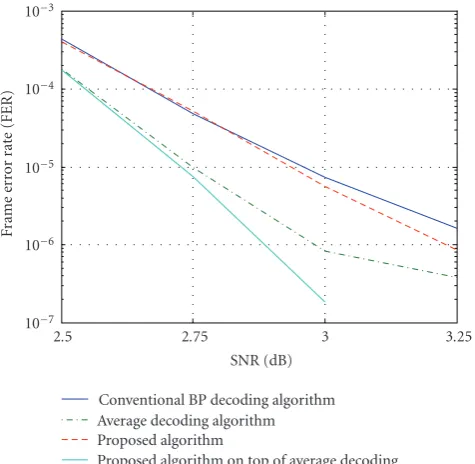
Proposed algorithm on top of average decoding Figure11: Performance results for HE(1024,512) LDPC code.
Table3: Results after the learning phase of HE(1024,512) LDPC code.
i TSisize TSiweight ωj
1 (8,2) 106 0%
2 (8,2) 49 0%
3 (12,2) 13 0%
4 (10,3) 9 1%
5 (8,3) 8 2%
6 (10,2) 7 0%
7 (7,3) 5 2%
8 (7,3) 5 3%
9 (7,3) 4 0%
10 (15,2) 3 0%
Table4: Identified trapping sets and configuration percentages for
different LDPC codes.
CODE #TS %V %C
HE(1024,512) 55 27.15% 13.46%
RND(1024,512) 50 18.46% 9.9%
PEG(1024,512) 8 6.74% 3.42%
PEG(100,50) 57 60% 31.67%
MacKay(204,102) 40 50% 27.94%
from the variable node. This results in interconnections even denser than pure random construction methods.
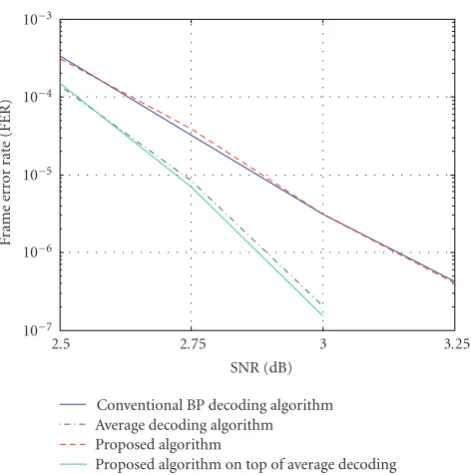
Figure 11 shows the performance for an interconnect
efficient LDPC code, HE(1024,512) [12], that has been implemented in a fully parallel hardware architecture. This LDPC code is designed to have a balance between decoder throughput and error performance. The figure shows that the
10−1
10−2
10−3
10−4
10−5
10−6
10−7
10−8
Fr
am
e
er
ro
r
ra
te
(F
E
R
)
3 4 5 6
SNR (dB) Conventional BP decoding algorithm Average decoding algorithm Proposed algorithm
Proposed algorithm on top of average decoding
Figure12: Performance results for MacKay(204,102) LDPC code.
best performance is obtained using the proposed algorithm on top of the average decoding algorithm. The performance at 3.25B is not drawn due to the excessive simulation time needed at this point.
Based on the results of all simulated codes, it is clearly demonstrated that the application of the proposed algorithm on top of average decoding achieves significant performance improvements in comparison with conventional LDPC decoding. In particular, one can observe that performance improvements are highlighted for LDPC codes with relatively low performance using conventional LDPC decoder. This allows LDPC code design techniques to relax some of the design constraints and focus on reducing hardware complexity such as creating interconnect-efficient codes.
Table 3lists part of the trapping sets that are identified
during the learning phase of the HE(1024,512) LDPC code. The complete number of identified trapping sets is 55. One may note that trapping sets with the highest weights have small number of variable and odd-degree check nodes.Table 4shows the number of identified trapping sets and percentage of check and variable nodes configured to perform neutralization messages forwarding. It is clear that only a subset of the variable and check nodes is configured, which further decreases hardware cost.
6. CONCLUSION
simulations on different LDPC code designs and sizes, it is shown that the proposed technique achieves significant performance improvements for: (1) short LDPC codes, (2) LDPC codes designed under additional constraints such as interconnect-efficient codes. It is also demonstrated that the application of the proposed technique on top of average decoding achieves significant performance improvements over conventional LDPC decoding for all of the investigated codes. This makes LDPC codes even more attractive for adoption in various applications and enables the design of codes that optimize hardware implementation without compromising the required performance.
ACKNOWLEDGMENT
The authors would like to thank King Fahd University of Petroleum & Minerals for supporting this work under Project no. IN070376.
REFERENCES
[1] R. G. Gallager,Low Density Parity-Check Codes, MIT Press,
Cambridge, Mass, USA, 1963.
[2] T. Richardson, “Error floors of LDPC codes,” inProceedings
of The 41st Annual Allerton Conference on Communication, Control, and Computing, Monticello, Ill, USA, October 2003. [3] E. Cavus and B. Daneshrad, “A performance improvement
and error floor avoidance technique for belief propagation
decoding of LDPC codes,” in Proceedings of the 16th IEEE
International Symposium on Personal, Indoor and Mobile Radio Communications (PIMRC ’05), vol. 4, pp. 2386–2390, Berlin, Germany, September 2005.
[4] T. Tian, C. Jones, J. D. Villasenor, and R. D. Wesel, “Con-struction of irregular LDPC codes with low error floors,” in
Proceedings of the IEEE International Conference on Commu-nications (ICC ’03), vol. 5, pp. 3125–3129, Anchorage, Alaska, USA, May 2003.
[5] T. Tian, C. R. Jones, J. D. Villasenor, and R. D. Wesel, “Selective avoidance of cycles in irregular LDPC code construction,”
IEEE Transactions on Communications, vol. 52, no. 8, pp. 1242– 1247, 2004.
[6] S. Gounai, T. Ohtsuki, and T. Kaneko, “Modified belief propagation decoding algorithm for low-density parity check
code based on oscillation,” inProceedings of the 63rd IEEE
Vehicular Technology Conference (VTC ’06), vol. 3, pp. 1467– 1471, Melbourne, Australia, May 2006.
[7] X.-Y. Hu, E. Eleftheriou, and D.-M. Arnold, “Progressive
edge-growth Tanner graphs,” in Proceedings of the IEEE Global
Telecommunicatins Conference (GLOBECOM ’01), vol. 2, pp. 995–1001, San Antonio, Tex, USA, November 2001.
[8] S. L¨andner and O. Milenkovic, “Algorithmic and combinato-rial analysis of trapping sets in structured LDPC codes,” in
Proceedings of the IEEE International Conference on Wireless Networks, Communications and Mobile Computing (Wirless-Com ’05), vol. 1, pp. 630–635, Maui, Hawaii, USA, June 2005. [9] G. Richter and A. Hof, “On a construction method of irregular
LDPC codes without small stopping sets,” inProceedings of the
IEEE International Conference on Communications (ICC ’06), vol. 3, pp. 1119–1124, Istanbul, Turkey, June 2006.
[10] D. J. C. MacKay, “Good error-correcting codes based on very
sparse matrices,”IEEE Transactions on Information Theory, vol.
45, no. 2, pp. 399–431, 1999.
[11] W. Ryan, “A Low-Density Parity-Check Code Tutorial, Part II—the Iterative Decoder,” Electrical and Computer Engineer-ing Department, The University of Arizona, Tucson, Ariz, USA, April 2002.
[12] M. Mohiyuddin, A. Prakash, A. Aziz, and W. Wolf,
“Synthesiz-ing interconnect-efficient low density parity check codes,” in
Proceedings of the 41st Annual Design Automation Conference (DAC ’04), pp. 488–491, San Diego, Calif, USA, June 2004. [13] E. Alghonaim, A. El-Maleh, and M. Adnan Al-Andalusi,
“Parallel computing platform for evaluating LDPC codes
per-formance,” inProceedings of the IEEE International Conference
on Signal Processing and Communications (ICSPC ’07), pp. 157–160, Dubai, United Arab Emirates, November 2007.
[14] D. C. Mackay codes, http://www.inference.phy.cam.ac.uk/