TOCOTRIENOL OPPOSES THE EFFECT OF LIGHT TO MODERATE ETHANOL EXPOSURES IN
ELEVATED PLUS MAZE PERFORMANCE OF RATS
PITCHAIAH DASARI, ANANDAMURALI R, PRASUNPRIYA NAYAK*
Department of Physiology, NRI Medical College & General Hospital, Chinakakani, Mangalagiri Mandal, Guntur - 522 503, Andhra Pradesh, India. Email: [email protected]
Received: 18 March 2016, Revised and Accepted: 24 April 2016 ABSTRACT
Objective: Tocotrienol is a naturally rare isoform of vitamin E. Consumption of ethanol is a common problem. Ethanol acts as an anxiolytic, but hastens cognitive problems. The current study is aimed to evaluate the effect of tocotrienol against ethanol-induced cognitive and anxiolytic behavior.
Methods: Male albino Wistar rats were divided into two sets; one set of rats were exposed with low-to-moderate doses of ethanol for 4 weeks, while another set was exposed to tocotrienol orally (10 mg/day) plus low-to-moderate doses of ethanol for 4 weeks. Performances of rats on elevated plus maze were carried out at the end of the treatment protocol for 3 days. Video recordings were analyzed for acquisition time, retention time, and number of entries to open arms and closed arms. Numbers of protected stretch attend posture, unprotected stretch attend posture, protected head dipping, unprotected head dipping, grooming, rearing, paw licking, immobile sniffing, and fecal boli were also counted from the video recording.
Results: Statistically significant influences of tocotrienol and ethanol exposures have been observed in aquisition time and retention time after 24 hrs and 48 hrs, respectively. Number of exits from the closed arms and grooming and rearing behaviors also found to be significantly influenced by tocotrienol treatment.
Conclusion: From the current study, it can be concluded that tocotrienol facilitates the explorative behaviors of control rats. In addition, the current protocol of tocotrienol treatment opposes the ethanol-induced cognitive impairment as well as ethanol-induced anxiolytic activity in rats.
Keywords: Tocotrienol, Ethanol, Elevated plus maze, Acquisition time, Retention time, Protected stretch attend posture, Unprotected stretch attend posture, Protected head dipping, Unprotected head dipping, Grooming, Rearing, Paw licking, Immobile sniffing.
INTRODUCTION
Tocotrienol (T3) is a naturally rare isoform of vitamin E. Considerable amount of T3 is available in barley, oat, palm oil, red annatto, rice bran, and wheat germ, whereas regular edible oils have only nominal amount of T3. Thus, very little amount of T3 is taken in regular diet. Multiple health benefits of T3 ranging from anticancer, anti-inflammatory, antioxidant, cardioprotective, and neuroprotective are reported, and the suggested mechanisms include a myriad of molecular targets [1].
Both tocopherol and T3 are antioxidants; however, T3 is reported to be more potent antioxidant compared to tocopherol. T3 has been shown to protect brain from ethanol-induced cognitive deficits by suppressing the nitrosative stress and by maintaining the tumor necrosis factor-alpha and interleukin-1 beta levels low in hippocampus and cerebral cortex [2]. Cognitive impairments because of alcohol abuse is a well-known fact [3,4]. The neurotoxic effects of ethanol are often studied with “heavy” consumption either subjects with chronic abuses or subjects who had already developed dependency. On the other hand, “light-to-moderate” drinking is suggested to be beneficial for cognitive functions, especially for middle-aged and older adults [5]. Even though the involvement of Apo E4 allele and retinoic acid pathways was suggested to be involved in this “light-to-moderate” alcohol-induced cognitive improvement [5], recent publication has contradicted and nullified the claim [6].
Supplementation with T3 during prenatal and early postnatal life improves the development of cognitive function [7], as well as protects the brain from cognitive impairment because of ethanol exposure [8]. Because of its unique neuroprotective property, independent of antioxidant property [9,10], T3 has been suggested to be effective against neurodegenerative disorders of central nervous system [11] and ischemic stroke [12]. However, accepting limited
knowledge about the impacts of tocotrienol in nervous system, Jung
et al. [13] demonstrated the effectiveness of T3 against kainic acid-induced neurotoxicity in organotypic hippocampal slice cultures. Similarly, T3-rich fraction has been also found to be effective against fenitrothion-induced brain damage in vivo [14]. On the contrary, the effectiveness of T3-rich fraction against stress-induced changes in dentate gyrus has been also demonstrated [15].
In this background, the current study evaluates the alterations in elevated plus maze (EPM) performance of rats exposed with light-to-moderate doses of ethanol exposure and role of tocotrienol to prevent those alterations.
METHODS Materials
Oryza tocotrienol©-90 was donated by the Oryza Oil and Fat Chemical
Co., Ltd., Japan. All the other reagents were of analytical grade and procured from Sigma, SRL, SDS, Merck, and HiMedia.
Animal maintenance and treatment
The experimental protocol was approved by the Institutional Animal Ethics Committee. Two sets of male albino Wistar rats (T30: 20
animals without tocotrienol supplementation and T3+: 20 animals
with tocotrienol supplementation) weighing 100-120 g were obtained, maintained, and treated in the Central Animal House of NRI Medical College and General Hospital, and the procedures were performed according to the guidelines of the Committee for the Purpose of Control and Supervision of Experiments on Animals (CPCSEA, India) [16]. After 1 week of acclimatization, the rats were randomly divided (with the help of Random Allocation Software Version 1.0, May 2004) into Et-0, Et-I, Et-II, and Et-III groups (containing 5 animals in each group) and exposed to ethanol (at doses of 0.0, 0.2, 0.4, and 0.6 g/kg body weight, respectively)
daily through oral gavage for 4 weeks. In another set of experiments, all these groups were exposed to Oryza-tocotrienol©-90 supplementation
(10 mg/day) for 4 weeks in addition to ethanol exposures. Both ethanol and Oryza-tocotrienol©-90 treatments were carried out through oral
feeding. Ethanol or distilled water was given in the morning session while Oryza-tocotrienol©-90 was given in the evening session daily.
The doses of ethanol exposures were selected considering the ethanol content of accepted “moderate” drinking [5] and previous publications where these doses had been proven to induce pro-oxidant status in rat brain [16,17]. On the other hand, the dose for Oryza-tocotrienol©-90
was selected on the basis of results obtained from preceding dose-dependent study in rat.
Behavioral study
At the end of the treatment protocol, all groups of animals were subjected to behavioral study in EPM. The behavioral recordings were carried out in 3 consecutive days.
EPM
This behavioral test was carried out as described earlier [18] with some modifications. The maze consists of two closed and two open arms of size 50 cm length, 30 cm elevated from the base height. The rat was dropped gently at the open arm facing toward the open end of the open arm. Time required to enter any of the closed arms with its four legs inside the closed arm area was noted as transfer latency. Then,
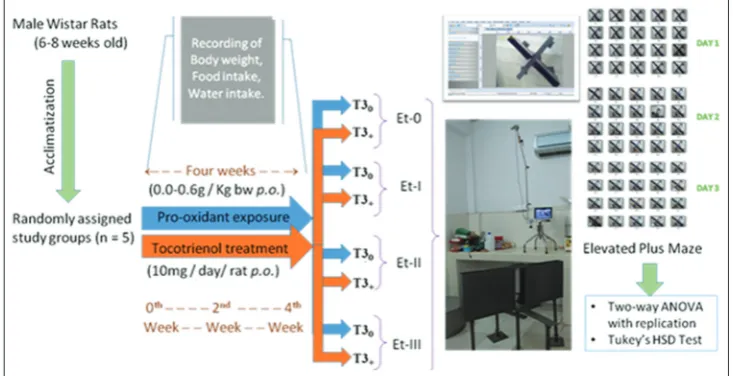
the animal was allowed to explore the EPM freely for 2 minutes. Video recording of the whole process was done as shown in the setup (Fig. 1). Time spent in different parts of the EPM, number of entries into the closed arms, number of exits from closed arms, and other behavioral parameters such as number of protected stretch attend posture (pSAP), unprotected stretch attend posture (uSAP), protected head dipping (pHD), unprotected head dipping (uHD), grooming, rearing, paw licking, immobile sniffing, and fecal boli are counted from the video recording. To understand the spatial memory, exploration and anxiety of rats, its entries to the first reached closed arm (Closed arm 1) and the other closed arm (Closed arm 2) are differentially noted [19].
Statistical analyses
Five individual data were collected from each group and were processed for statistical analysis using two-way ANOVA with replication to get the F value. The differences between individual means were analyzed by Tukey’s HSD test. Statistical significance for two-way ANOVA with replication and
Tukey’s HSD test was collected from the tables accepting p≤0.05.
RESULTS
The time required to find out the closed arm on the first day of EPM study is accepted as acquisition time, while the time required to find out the closed arm on the second day (after 24 hrs of first exposure) and third day (after 48 hrs of first exposure) is accepted as retention time. Fig. 2 depicts the acquisition time (a) and retention time (b and c) of all
Fig. 1: Schematic representation of experimental protocol and methods employed. T3: Tocotrienol, Et: Ethanol
Fig. 2: (a-g) Cognitive performances of rats on elevated plus maze. T3: Tocotrienol, Et-: Groups of ethanol exposure, *Significant against T30, #Significant against day 1, $Significant F (ANOVA)
d
c
g f
a
e
the groups. Significant influence of interaction between T3 and ethanol treatment is observed in terms of acquisition time with a significant difference between T30 and T3+ animals in Et-I group only. In case of
retention times, though none of the groups demonstrates significant difference between T30 and T3+ animals, influences of T3 are statistically
significant on retention times of both days. When the retention times have been plotted as percentage change of requisition time (Fig. 2d-g), T30 and T3+ animals of Et-III group only have demonstrated a
significant difference between their retention times on day 2 and day 3. Interestingly, the retention times of T30 animals of Et-III group only are
significant differing from their acquisition time in terms of percentage alterations (Fig. 2g). However, significant F values are noted for ethanol and T3 treatment as well as for their interactions for both days.
Numbers of exits out of closed arms during 2 minutes of exploration of the maze are presented in Fig. 3a-c. Two-way ANOVA with replication has revealed a significant influence of interactions of ethanol and T3 treatment on the numbers of exits during the exploration period on days 2 and 3, with significant differences between T30 and T3+ animals
on day 2. Like that of exits from closed arm on day 1 (Fig. 3a), influence
of neither ethanol nor T3 is significant on day 1 in terms of entries into closed arm 1 (Fig. 3d) as well as closed arm 2 (Fig. 3g). However, Similarly, numbers of entries into the closed arm 1 during 2 minutes of exploration of the maze have been identified of statistical significance by two-way ANOVA with replication on days 2 and 3. Influence of ethanol exposure, T3 treatment as well as their interactions are significant on day 2 for entries into closed arm 1 (Fig. 3e); while influence of T3 only is significant on day 3 for entries into closed arm 1 (Fig. 3f). Likewise, influence of T3 only is significant on day 3 for entries into closed arm 2 (Fig. 3i); however, interaction of T3 and ethanol treatment is only found significant by two-way ANOVA with replication on day 2 for entries into closed arm 2 (Fig. 3h). Notably, significant differences between T30
and T3+ animals has been observed only on day 2 for entries into both
closed arms.
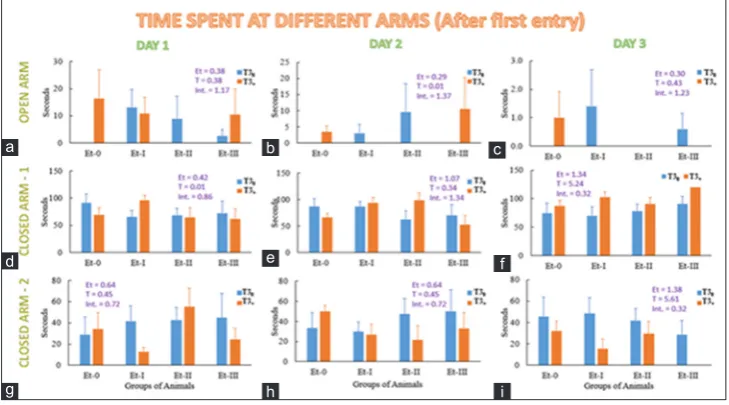
Two-way ANOVA with replication has revealed a significant influence of T3 treatment on time spent in closed arms during the exploration period on day 3 only. However, no significant difference between T30
and T3+ animals is observed for time spent inside the closed arms
(1 and 2) and on the open arms on any day of experimentation (Fig. 4).
Fig. 3: (a-i) Explorative behaviors of rats on elevated plus maze. T3: Tocotrienol, Et-: Groups of ethanol exposure,
*Significant against T30, #Significant against respective Et-0; ANOVA: $Significant F, Influences of ethanol, tocotrienol, and their interactions
represented by Et, T, and Int, respectively d
i h
c
g
b
f a
e
Fig. 4: (a-i) Time spent by rats at different parts of EPM. T3: Tocotrienol, Et-: Groups of Ethanol exposure, ANOVA: Influences of ethanol, tocotrienol, and their interactions represented by Et, T, and Int, respectively
d
h i
c
g
b
f a
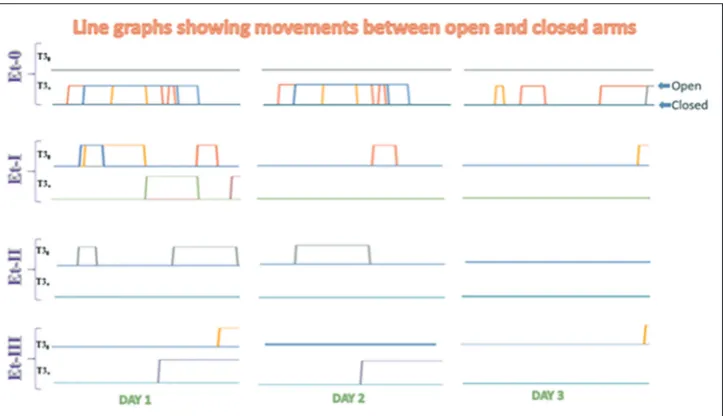
The time spent by individual animals indicated by line diagrams and compared between T30 and T3+ animals for each groups of ethanol
exposure on different days of experimentation has been depicted in Figs. 5 and 6. Fig. 5 shows comparison between open arms and closed arms, while Fig. 6 shows comparison between two closed arms – first entered one and the other.
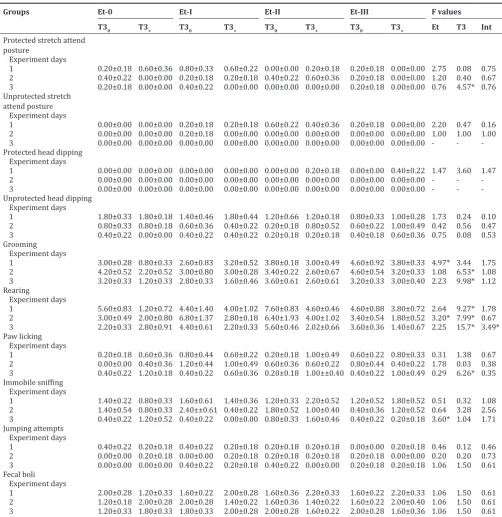
Counts of behavioral parameters such as numbers of pSAP, uSAP, pHD, uHD, grooming, rearing, paw licking, immobile sniffing, fecal boli for ethanol groups, and T3 subgroups are shown in Table 1 along with the statistical results. Only rearing behavior is found to be influenced significantly by T3 treatment for all the 3 days of experimentation. T3 treatment influences the grooming behavior on the last 2 days whereas paw licking behavior only on the last day. Influence of ethanol exposure is found to be significant on the first day for grooming, second day for rearing, and third day for immobile sniffing while significant influence of its interaction with T3 treatment is found on the third day for rearing behavior only. Significant influence of T3 treatment is also noticed in pSAP on third day.
DISCUSSION
Hazardous effects of alcohol abuse are global health burden. India found its place as lowest third among the OECD countries in terms of liters per capita consumption of alcohol, nevertheless, recorded a whopping 55% increase during 1992-2012 [20]. Ethanol has its physiological origin from pyruvate via acetaldehyde even in mammalian system [21], though in small quantities. More than 60 clinical conditions, encompassing nearly whole body, have been associated with ethanol consumption, despite taken in moderate measures [22]. The consequences of ethylism include pathophysiological and psychological distresses and in turn induce sociological distresses. Good number of studies, human and animal, on ethylism has been already published; however, divergences in outcomes have been attributed to methodological issues [21].
Whether it is social, legal, or otherwise, consumption of alcohol is always associated with anticipation of pleasure. However, it is inevitably engaging self-made harm to one’s health. Even though ethanol is generally regarded as anxiolytic, results from experimental studies are not convincing [19].
Fig. 5: Line diagram representing explorative behaviors of rats (open vs. closed arms). Each color line indicates the movement of individual rats. T3: Tocotrienol, Et-: Groups of ethanol exposures
EPM is normally used to evaluate the anxiety-like behavior in rodents. It is a modified procedure originally proposed by Montgomery [23]. The method is widely used to evaluate anxiolytic and anxiogenic compounds [24]. Inherent aversive behavior of rats toward heights and open spaces is the major determination of the behavioral test used in EPM [19]. However, aversion to the open arms seems to be influenced by many factors such as gender, pre-exposure to the maze, raised edges in the open arms, type of floor, time of day at which testing occurs, environmental levels of illumination, and extent of social isolation adds to the aversiveness of the open arms [24]. Having equal opportunity to explore the open arms and closed arms, this behavioral test measures the ratio of activity in those two options; however, often the activities and pattern of activities in those areas are overlooked. In addition, by
Table 1: Counts of different behaviors of rats from different ethanol treatment groups and tocotrienol sets during the exploration of EPM
Groups Et-0 Et-I Et-II Et-III F values
T30 T3+ T30 T3+ T30 T3+ T30 T3+ Et T3 Int
Protected stretch attend posture
Experiment days
1 0.20±0.18 0.60±0.36 0.80±0.33 0.60±0.22 0.00±0.00 0.20±0.18 0.20±0.18 0.00±0.00 2.75 0.08 0.75 2 0.40±0.22 0.00±0.00 0.20±0.18 0.20±0.18 0.40±0.22 0.60±0.36 0.20±0.18 0.00±0.00 1.20 0.40 0.67 3 0.20±0.18 0.00±0.00 0.40±0.22 0.00±0.00 0.00±0.00 0.00±0.00 0.20±0.18 0.00±0.00 0.76 4.57* 0.76 Unprotected stretch
attend posture Experiment days
1 0.00±0.00 0.00±0.00 0.20±0.18 0.20±0.18 0.60±0.22 0.40±0.36 0.20±0.18 0.00±0.00 2.20 0.47 0.16 2 0.00±0.00 0.00±0.00 0.20±0.18 0.00±0.00 0.00±0.00 0.00±0.00 0.00±0.00 0.00±0.00 1.00 1.00 1.00 3 0.00±0.00 0.00±0.00 0.00±0.00 0.00±0.00 0.00±0.00 0.00±0.00 0.00±0.00 0.00±0.00 - - -Protected head dipping
Experiment days
1 0.00±0.00 0.00±0.00 0.00±0.00 0.00±0.00 0.00±0.00 0.20±0.18 0.00±0.00 0.40±0.22 1.47 3.60 1.47 2 0.00±0.00 0.00±0.00 0.00±0.00 0.00±0.00 0.00±0.00 0.00±0.00 0.00±0.00 0.00±0.00 - - -3 0.00±0.00 0.00±0.00 0.00±0.00 0.00±0.00 0.00±0.00 0.00±0.00 0.00±0.00 0.00±0.00 - - -Unprotected head dipping
Experiment days
1 1.80±0.33 1.80±0.18 1.40±0.46 1.80±0.44 1.20±0.66 1.20±0.18 0.80±0.33 1.00±0.28 1.73 0.24 0.10 2 0.80±0.33 0.80±0.18 0.60±0.36 0.40±0.22 0.20±0.18 0.80±0.52 0.60±0.22 1.00±0.49 0.42 0.56 0.47 3 0.40±0.22 0.00±0.00 0.40±0.22 0.40±0.22 0.20±0.18 0.20±0.18 0.40±0.18 0.60±0.36 0.75 0.08 0.53 Grooming
Experiment days
1 3.00±0.28 0.80±0.33 2.60±0.83 3.20±0.52 3.80±0.18 3.00±0.49 4.60±0.92 3.80±0.33 4.97* 3.44 1.75 2 4.20±0.52 2.20±0.52 3.00±0.80 3.00±0.28 3.40±0.22 2.60±0.67 4.60±0.54 3.20±0.33 1.08 6.53* 1.08 3 3.20±0.33 1.20±0.33 2.80±0.33 1.60±0.46 3.60±0.61 2.60±0.61 3.20±0.33 3.00±0.40 2.23 9.98* 1.12 Rearing
Experiment days
1 5.60±0.83 1.20±0.72 4.40±1.40 4.00±1.02 7.60±0.83 4.60±0.46 4.60±0.88 3.80±0.72 2.64 9.27* 1.78 2 3.00±0.49 2.00±0.80 6.80±1.37 2.80±0.18 6.40±1.93 4.00±1.02 3.40±0.54 1.80±0.52 3.20* 7.99* 0.67 3 2.20±0.33 2.80±0.91 4.40±0.61 2.20±0.33 5.60±0.46 2.02±0.66 3.60±0.36 1.40±0.67 2.25 15.7* 3.49* Paw licking
Experiment days
1 0.20±0.18 0.60±0.36 0.80±0.44 0.60±0.22 0.20±0.18 1.00±0.49 0.60±0.22 0.80±0.33 0.31 1.38 0.67 2 0.00±0.00 0.40±0.36 1.20±0.44 1.00±0.49 0.60±0.36 0.60±0.22 0.80±0.44 0.40±0.22 1.78 0.03 0.38 3 0.40±0.22 1.20±0.18 0.40±0.22 0.60±0.36 0.20±0.18 1.00±±0.40 0.40±0.22 1.00±0.49 0.29 6.26* 0.35 Immobile sniffing
Experiment days
1 1.40±0.22 0.80±0.33 1.60±0.61 1.40±0.36 1.20±0.33 2.20±0.52 1.20±0.52 1.80±0.52 0.51 0.32 1.08 2 1.40±0.54 0.80±0.33 2.40±±0.61 0.40±0.22 1.80±0.52 1.00±0.40 0.40±0.36 1.20±0.52 0.64 3.28 2.56 3 0.40±0.22 1.20±0.52 0.40±0.22 0.00±0.00 0.80±0.33 1.60±0.46 0.40±0.22 0.20±0.18 3.60* 1.04 1.71 Jumping attempts
Experiment days
1 0.40±0.22 0.20±0.18 0.40±0.22 0.20±0.18 0.20±0.18 0.20±0.18 0.00±0.00 0.20±0.18 0.46 0.12 0.46 2 0.00±0.00 0.20±0.18 0.00±0.00 0.20±0.18 0.20±0.18 0.20±0.18 0.20±0.18 0.00±0.00 0.20 0.20 0.73 3 0.00±0.00 0.00±0.00 0.40±0.22 0.20±0.18 0.40±0.22 0.00±0.00 0.20±0.18 0.20±0.18 1.06 1.50 0.61 Fecal boli
Experiment days
1 2.00±0.28 1.20±0.33 1.60±0.22 2.00±0.28 1.60±0.36 2.20±0.33 1.60±0.22 2.20±0.33 1.06 1.50 0.61 2 1.20±0.18 2.00±0.28 2.00±0.28 1.40±0.22 1.60±0.36 1.40±0.22 1.60±0.22 2.00±0.40 1.06 1.50 0.61 3 1.20±0.33 1.80±0.33 1.80±0.33 2.00±0.28 2.00±0.28 1.60±0.22 2.00±0.28 1.60±0.36 1.06 1.50 0.61
T3: Tocotrienol, Et-: Groups of ethanol exposures. Influences of ethanol, tocotrienol, and their interactions in two-way ANOVA with replication represented by Et, T, and Int, respectively. *Significant F value (p<0.05). EPM: Elevated plus maze
measuring acquisition time and retention time on the following 2 days, the EPM allows the assessment of cognitive function of animals [18]. As suggested already, EPM can be used as an exteroceptive behavioral tool to evaluate learning and memory in rats [25].
The present study demonstrates the significant influence of T3 on the Et-I group of rats in terms of acquisition time. Although the interaction between ethanol and T3 treatments was significant, less acquisition time (though, statistically insignificant) for Et-II and Et-III groups may be related to the anxiolytic behavior of ethanol exposure. In retention time for the next 24 hrs and 48 hrs, T3+ animals demonstrate relatively
lesser time than their T30 counterparts. Although the difference between
T3 on both these days were statistically significant. The percentage change in time required to find the closed arm after 24 hrs and 48 hrs of acquisition clearly demonstrates significant negative influences of ethanol exposures and positive influences of T3 treatment.
Anxiolytic effect of ethanol is evidenced by more number of exits from the closed arms in Et-I, II, and III groups. In Et-0 group, the T3 treatment showed increased numbers of exits from closed arm along with increased number of entries to both closed arms. This indicates that T3 has facilitated the explorative behavior of rats. However, in the presence of ethanol exposure, that explorative behavior is not evidenced in either of the animal groups. Notably, there is a significant alteration in the time spent in either of the closed arms or in the open arm. This explorative behavior is also supported by the line diagram, which indicates that substantial difference of T3 impacts in the presence of ethanol exposure and in the absence of ethanol exposure.
From the current study, it can be concluded that T3 facilitates the explorative behaviors of rats in control rats. In addition, current protocol of T3 treatment opposes the ethanol-induced cognitive impairment as well as ethanol-induced anxiolytic activity in rats.
ACKNOWLEDGMENT
This work is financially supported (No. ERIP/ER/1204652/M01/1496) by the Directorate of Extramural Research & Intellectual Property Rights (ER & IPR), Defence Research & Development Organization (DRDO), Government of India. Oryza Oil & Fat Chemical Co. Ltd., Japan, has provided the Tocotrienol©-90 sample to carry out this work. The
authors wish to thankfully acknowledge the support received from the Management of NRI Academy of Sciences to carry out the work.
REFERENCES
1. Aggarwal BB, Sundaram C, Prasad S, Kannappan R. Tocotrienols, the Vitamin E of the 21st century: Its potential against cancer and other
chronic diseases. Biochem Pharmacol 2010;80(11):1613-31.
2. Chopra K, Tiwari V. Tocotrienol and cognitive dysfunction induced by alcohol. In: Watson RR, Preddy VR, Zibadi S, editors. Alcohol, Nutrition and Health Consequences. Nutrition and Health. New York: Springer Science +Business Media; 2013. p. 181-202.
3. Gupta S, Warner J. Alcohol-related dementia: A 21st-century silent
epidemic? Br J Psychiatry 2008;193(5):351-3.
4. Bernardin F, Maheut-Bosser A, Paille F. Cognitive impairments in alcohol-dependent subjects. Front Psychiatry 2014;5:78.
5. Ellison RC, Martinic M. The harms and benefits of moderate drinking: Summary of findings of an International Symposium. Ann Epidemiol 2007;Suppl 1:1-12.
6. Andréasson S, Chikritzhs T, Dangardt F, Holder H, Naimi T, Stockwell T. Evidence about health effects of Moderate alcohol consumption: Reasons for scepticism and public health implications. In: Alcohol and Society. Stockholm: IOGT-NTO and the Swedish Society of Medicine; 2014.
7. Nagapan G, Meng Goh Y, Shameha Abdul Razak I, Nesaretnam K, Ebrahimi M. The effects of prenatal and early postnatal tocotrienol-rich fraction supplementation on cognitive function development in male
offspring rats. BMC Neurosci 2013;14:77.
8. Tiwari V, Arora V, Chopra K. Attenuation of NF-?ß mediated apoptotic signaling by tocotrienol ameliorates cognitive deficits in rats postnatally exposed to ethanol. Neurochem Int 2012;61(3):310-20.
9. Khanna S, Roy S, Parinandi NL, Maurer M, Sen CK. Characterization of the potent neuroprotective properties of the natural vitamin E alpha-tocotrienol. J Neurochem 2006;98(5):1474-86.
10. Ling S. Tocomin tocotrienols complex – A potent natural neuroprotective Vitamin. Asia-Pac Biotech News 2009;13(9):22-7.
11. Sen CK, Rink C, Khanna S. Palm oil-derived natural Vitamin E α-tocopherol in brain health and disease. J Am Coll Nutr 2010;293 Suppl:314S-23.
12. Patel V, Rink C, Khanna S, Sen CK. Tocotrienols: The lesser known form of natural vitamin E. Indian J Exp Biol 2011;49(10):732-8. 13. Jung NY, Lee KH, Won R, Lee BH. Neuroprotective effects of
α-tocotrienol on kainic acid-induced neurotoxicity in organotypic hippocampal slice cultures. Int J Mol Sci 2013;14(9):18256-68. 14. Budin SK, Taib IS, Jayusman PA, Chiang HH, Ramalingam A,
Ghazali AR, et al. Ameliorative effect of palm oil tocotrienol rich fraction on brain oxidative stress in fenitrothion-administered rats. Sains Malays 2014;43(7):1031-6.
15. Talip SB, Asari MA, Khan AA, Sirajudeen KN. Evaluation of the protective effects of tocotrienol-rich fraction from palm oil on the dentate gyrus following chronic restraint stress in rats. Braz J Pharm Sci 2013;49(2):374-80.
16. Nayak P, Sharma SB, Chowdary NV. Thalamic superoxide and peroxide handling capacity (SPHC): An experimental study with aluminum, ethanol and tocopherol in rats. Indian J Exp Biol 2015;53(9):568-73. 17. Nayak P, Sharma SB, Chowdary NV. Aluminum and ethanol
induce alterations in superoxide and peroxide handling capacity (SPHC) in frontal and temporal cortex. Indian J Biochem Biophys 2013;50(5):402-10.
18. Chaitanya TV, Mallipeddi K, Bondili JS, Nayak P. Effect of aluminum exposure on superoxide and peroxide handling capacities by liver, kidney, testis and temporal cortex in rat. Indian J Biochem Biophys 2012;49(5):395-8.
19. Sandbak T, Murison R. Behavioural responses to elevated plus-maze and defensive burying testing: Effects on subsequent ethanol intake and effect of ethanol on retention of the burying response. Alcohol Alcohol 2001;36(1):48-58.
20. Devaux M, Sassi F. Alcohol Consumption and Harmful Drinking: Trends and Social Disparities Across OECD Countries. OECD Health Working Papers, No. 79. Paris: OECD Publishing; 2015.
21. Comporti M, Signorini C, Leoncini S, Gardi C, Ciccoli L, Giardini A,
et al. Ethanol-induced oxidative stress: Basic knowledge. Genes Nutr 2010;5(2):101-9.
22. Alatalo P. Markers of liver function and oxidative stress in alcohol consumers with or without overweight. Finland: Academic Dissertation, University of Tampere; 2011.
23. Montgomery KC. The relation between fear induced by novel stimulation and exploratory behavior. J Comp Physiol Psychol 1955;48(4):254-60.
24. Morato S, Brandão ML. Paradoxical increase of exploratory behavior in the elevated plus-maze by rats exposed to two kinds of aversive stimuli. Braz J Med Biol Res 1997;30(9):1113-20.
25. Sujith K, Darwin CR, Suba SV. Memory-enhancing activity of