R E S E A R C H
Open Access
The extinction and persistence of a
stochastic SIR model
Chunyan Ji
1,2*and Daqing Jiang
3,4*Correspondence: [email protected] 1School of Mathematics and Statistics, Changshu Institute of Technology, Changshu, Jiangsu 215500, P.R. China
2School of Mathematics and Statistics, Northeast Normal University, Changchun, Jilin 130024, P.R. China
Full list of author information is available at the end of the article
Abstract
The objective of this paper is to explore the long time behavior of a stochastic SIR model. We establish a threshold condition called the basic reproduction number under stochastic perturbation for persistence or extinction of the disease. Especially, some numerical simulations are applied to support our theoretical results.
MSC: 49K15; 60H10; 93E15
Keywords: a stochastic SIR model; extinction; persistence; threshold; basic reproduction number
1 Introduction
Epidemiology is the study of the spread of diseases with the objective to trace factors that are responsible for or contribute to their occurrence. Significant progress has been made in the theory and application by mathematical research [–].
Recently, we discussed the dynamic of a susceptible-infected-recovered (SIR) epidemic model with stochastic perturbation [], that is,
⎧ ⎪ ⎪ ⎨ ⎪ ⎪ ⎩
dS(t) = [–μS(t) –βS(t)I(t)]dt–σS(t)I(t)dB(t),
dI(t) = [βS(t)I(t) – (μ+γ +)I(t)]dt+σS(t)I(t)dB(t),
dR(t) = [γI(t) –μR(t)]dt,
(.)
whereS, I,R, andB(t) are the susceptible, the infective, the recovered, and a standard
Brown motion, respectively. The parameters (all positive constants) have the following
meaning:is the birth rate,μis the death rate,βis the average number of contacts per
infective per day,γis the recovery rate,is the death rate of infective caused by the disease,
andσis the intensity of the white noise. We investigated the persistence and extinction
of the disease, and so we gave the threshold of this stochastic model, which is affected by white noise and is less than the basic reproduction number of the corresponding deter-ministic system. However, considering stochastic perturbations to have different patterns, it is interesting to investigate whether the threshold of this model with other stochastic perturbations has a relation with white noise [–].
We devote this paper to the study of the following stochastic system:
⎧ ⎪ ⎪ ⎨ ⎪ ⎪ ⎩
dS(t) = [–μS(t) –βS(t)I(t)]dt+σS(t)dB(t),
dI(t) = [βS(t)I(t) – (μ+γ +)I(t)]dt+σI(t)dB(t),
dR(t) = [γI(t) –μR(t)]dt+σR(t)dB(t),
(.)
where B(t), B(t), B(t) are mutually independent Brown motions with intensities
σ, σ, σ, respectively. For any initial value (S(),I(),R())∈R
+, there is a solution
(S(t),I(t),R(t))∈R
+of system (.) (see []). In this paper, we also intend to give the
ba-sic reproduction number of this system through discussing the long time behavior of the model, which will be given in the next section. In Section , we illustrate results through simulations. At the end, a discussion is given to conclude this paper.
Throughout this paper, unless otherwise specified, let (,F,{Ft}t≥,P) be a complete
probability space with a filtration{Ft}t≥satisfying the usual conditions (i.e.it is right
con-tinuous andFcontains all P-null sets), and letB(t) be a scalar Brownian motion defined
on the probability space.
2 The long time behavior of system (1.2)
In this section, we deduce when the disease will die out and when the disease will prevail. And so the basic reproduction number of system (.) is given. As the proof in [], we can conclude to the following lemmas.
Lemma . Let (S(t),I(t),R(t)) be the solution of system (.) with any initial value (S(),I(),R())∈R
+.Then
lim
t→∞
S(t) +I(t) +R(t)
t = a.s. (.)
Remark . In fact, together with the positivity of the solution and (.), we have
lim
t→∞ S(t)
t = , tlim→∞ I(t)
t = , tlim→∞ R(t)
t = a.s. (.)
Lemma . Assumeμ> (σ
∨σ∨σ).Let(S(t),I(t),R(t))be the solution of system(.)
with any initial value(S(),I(),R())∈R+,then
lim
t→∞
t
S(r)dB(r)
t = , tlim→∞
t
I(r)dB(r)
t = ,
lim
t→∞
t
R(r)dB(r)
t = a.s.
(.)
Let
˜
R=
β
μ(μ+γ ++σ )
=R–
β
μ(μ+γ +)(μ+γ ++σ )
σ,
whereR=μ(μβ+γ+) is the basic reproduction of the corresponding deterministic system
Theorem . Assumeμ> (σ
namely,I(t)tends to zero exponentially a.s.In other words,the disease dies out with prob-ability one.
Proof Note that
S(t) –S()
whereϕ(t) has the property that
lim
t→∞ϕ(t) = (.)
according to (.) and (.). Then
and
as required.
Theorem . Assumeμ> (σ∨σ∨σ).Let(S(t),I(t),R(t))be the solution of system
t→∞I(t)≤ a.s., which together with the positivity of the
solution implies
lim
t→∞I(t) = a.s. (.)
Therefore, from (.), (.), and the third equations of (.), it is easy to obtain
lim
The proof of this result is completed.
In the previous, we show the extinction of the disease. Now, we investigate conditions for the prevalence of the disease.
Proof IfR˜> , then from the last equality of (.) and Lemmas ., . in [], we have
Together with (.), this yields
lim
Moreover, from the third equation of system (.), we obtain
R(t) –R()
which together with (.) and (.) implies
lim
Remark . Although there is no endemic equilibrium of system (.), Theorem . tells us the solution of it tends to a point in time on average whose value is less than the value of (S∗,I∗,R∗) [], and we consider it is stable in time on average.
Furthermore, from the results of Theorem . and Theorem ., we see that the value of
˜
Rmainly determines the extinction and persistence of the disease. As deterministic
epi-demic models,R˜can be called the basic reproduction of the stochastic epidemic system
(.).
3 Simulations
In this section, using the method mentioned in [], we give simulations to support our results. The discretized equation is
⎧
uation,R= > , then the solution of the corresponding deterministic system will tend
to (S∗,I∗,R∗) = (,,) and the disease will prevail (see the black real lines in Figures
and ). Choosing different values ofσ,σ,σ, we get two cases.
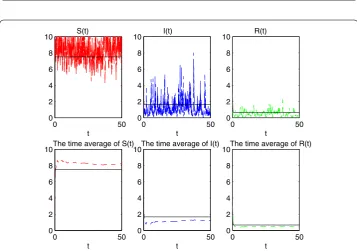
Case Assumeσ= .,σ= ,σ= ., thenμ>(σ∨σ∨σ) andR˜=< . As
expected, the infected populationI(t) will tend to very quickly and the disease will die
out. The susceptible populationS(t) will tend to
μ = in time average (see the second
picture in Figure ).
Case Letσ= .,σ= .,σ= . such thatμ> (σ∨σ∨σ) and R˜= > .
As Theorem . said, the disease will prevail and the solution is fluctuating around the
endemic equilibrium (S∗,I∗,R∗) of the corresponding deterministic system (see the upper
re-Figure 1 Simulation of the pathS(t),1t0tS(s)ds,I(t) andR(t) for the stochastic system (1.2) and the corresponding deterministic system withR0> 1 andR˜0< 1.
Figure 2 Simulation of the pathS(t),I(t),R(t), and1t0tS(s)ds,1t0tI(s)ds,1t0tR(s)dsfor the stochastic system (1.2) and the corresponding deterministic system withR0> 1 andR˜0> 1.
covered population will tend to a positive value in time on average, respectively, in detail,
lim
t→∞ t
t
S(s)ds=
, tlim→∞
t
t
I(s)ds=
, tlim→∞
t
t
R(s)ds=
a.s.
4 Discussions
In this paper, by qualitative analysis we have studied the global behavior of an SIR model with stochastic perturbation. As the deterministic epidemic models, we give a basic
re-production numberR˜of system (.), which is also less than the value of the basic
repro-duction number in the corresponding deterministic system. From the discussion, we can think white noise can make the value of the basic reproduction number lower, and so it is beneficial for controlling the disease.
In fact, for a stochastic SIRS epidemic model,
⎧
we can obtain the following properties through a similar analysis. • Ifμ>
The authors declare that they have no competing interests.
Authors’ contributions
CJ contributed to Sections 1, 2, 3, and 4. Daqing Jiang contributed to Sections 2 and 4.
Author details
1School of Mathematics and Statistics, Changshu Institute of Technology, Changshu, Jiangsu 215500, P.R. China.2School of Mathematics and Statistics, Northeast Normal University, Changchun, Jilin 130024, P.R. China.3College of Science, China University of Petroleum (East China), Qingdao, 266580, P.R. China.4Nonlinear Analysis and Applied Mathematics (NAAM)-Research Group, Department of Mathematics, King Abdulaziz University, Jeddah, Saudi Arabia.
Acknowledgements
The work was supported by the National Natural Science Foundation of China (No. 11601043), the National Science Foundation for Post-doctoral Scientists of China (No. 2016M590243) and sponsored by Qing Lan Project of Jiangsu Province (2016).
Received: 29 July 2016 Accepted: 26 December 2016
References
1. Anderson, RM, May, RM: Population biology of infectious diseases, part I. Nature280, 361-367 (1979)
3. Beretta, E, Hara, T, Ma, W, Takeuchi, Y: Global asymptotic stability of an SIR epidemic model with distributed time delay. Nonlinear Anal.47, 4107-4115 (2001)
4. Franceschetti, A, Pugliese, A: Threshold behaviour of a SIR epidemic model with age structure and immigration. J. Math. Biol.57, 1-27 (2008)
5. Jana, S, Haldar, P, Kar, TK: Mathematical analysis of an epidemic model with isolation and optimal controls. Int. J. Comput. Math. 1-22 (2016)
6. Zaman, G, Kang, YH, Jung, IH: Stability analysis and optimal vaccination of an SIR epidemic model. Biosystems93, 240-249 (2008)
7. Ji, CY, Jiang, DQ: Threshold behaviour of a stochastic SIR model. Appl. Math. Model.38, 5067-5079 (2014) 8. Lin, YG, Jiang, DQ, Xia, PY: Long-time behavior of a stochastic SIR model. Appl. Math. Comput.236, 1-9 (2014) 9. Zhao, DL: Study on the threshold of a stochastic SIR epidemic model and its extensions. Commun. Nonlinear Sci.
Numer. Simul.38, 172-177 (2016)
10. Zhou, YL, Zhang, WG: Threshold of a stochastic SIR epidemic model with Lévy jumps. Physica A446, 204-216 (2016) 11. Ji, CY, Jiang, DQ, Yang, QS, Shi, NZ: Dynamics of a multigroup SIR epidemic model with stochastic perturbation.
Automatica48, 121-131 (2012)
12. Zhao, YN, Jiang, DQ: The threshold of a stochastic SIS epidemic model with vaccination. Appl. Math. Comput.243, 718-727 (2014)
13. Hethcote, HW: Qualitative analyses of communicable disease models. Math. Biosci.7, 335-356 (1976)