Volume 2010, Article ID 375410,20pages doi:10.1155/2010/375410
Research Article
A Dynamic Utility Adaptation Framework for Efficient
Multimedia Service Support in CDMA Wireless Networks
Timotheos Kastrinogiannis and Symeon Papavassiliou
Network Management and Optimal Design Laboratory (NETMODE), Institute of Communications and Computer Systems (ICCS), School of Electrical and Computer Engineering, National Technical University of Athens (NTUA), 9 Iroon Polytechniou Street, Zografou 157 73, Athens, Greece
Correspondence should be addressed to Symeon Papavassiliou,[email protected]
Received 30 March 2010; Revised 14 July 2010; Accepted 24 August 2010 Academic Editor: Liang Zhou
Copyright © 2010 T. Kastrinogiannis and S. Papavassiliou. This is an open access article distributed under the Creative Commons Attribution License, which permits unrestricted use, distribution, and reproduction in any medium, provided the original work is properly cited.
In this paper, the problem of channel-aware opportunistic resource allocation for the downlink in code division multiple access wireless networks supporting simultaneously real-time multimedia and non-real-time data services is addressed. In order to treat different types of services with diverse QoS prerequisites through common optimization formulation a utility-based power and rate allocation framework is adopted. Emphasis is placed on real-time services’ strict short-term QoS prerequisites, the fulfillment of which requires a significantly more different treatment than the use of static utility functions, traditionally used to address long-term QoS or fairness prerequisites of delay-tolerant data services. To that end, we introduce a novel generic framework that enables the dynamic adaptation of real-time multimedia users’ utilities as the system evolves, with respect to the corresponding short-term throughput service performance variations. The corresponding nonconvex network utility maximization (NUM) problem is then formulated and solved to obtain optimal downlink power and rate allocation. Via simulation and analysis, it is demonstrated that significant performance improvements are achieved in terms of real-time user’s short-term throughput requirement satisfaction, without any considerable loss in the total system throughput. Finally, an essential tradeoffbetween efficiently fulfilling real-time services’ short-term QoS prerequisites and maximizing overall system performance, under an opportunistic scheduling wireless environment, is revealed and quantified.
1. Introduction
With the growing demand for high data rate and support of multiple services with various quality of service (QoS) requirements, the scheduling policy plays a key role in the efficient resource allocation process in future wireless networks. Moreover, users’ time and location-dependent channel conditions limit the system’s available resources and hence its ability to satisfy their QoS properties. Therefore, a flexible power and rate allocation scheme is essential for optimizing the system’s performance.
Considerable research efforts have been devoted to the combined problem of power and rate allocation for the downlink of a code division multiple access (CDMA) system (e.g., [1–3]) aiming at the exploitation of multiuser diver-sity (i.e., users’ time-varying channel conditions) towards
optimizing the system’s performance, while satisfying vari-ous QoS constraints [4–9]. Moreover, due to the heterogene-ity of the wireless environment and the need for the support of diverse QoS requirements, the concept of utilities from the field of economics has been adopted for devising profi-cient opportunistic resource allocation algorithms. A utility function reflects a users’ degree of satisfaction with respect to their service performance in a normalized and transparent way, allowing services with assorted QoS prerequisites to be represented, by forming appropriate utilities [10–15], under a common utility-based optimization framework. Hence, Network Utility Maximization (NUM) theory provides the foundations and mathematical tools for setting and treating such problems.
service classes, emphasizing mainly on the support of non-real-time users’ long-term requirements. Therefore, users’ utilities mainly define a continuous relationship between their service performance and their actual achieved through-put (i.e., goodthrough-put that reflects the number of reliable bits transmitted) over the wireless opportunistic CDMA paradigm, while considering long-term user’s fairness issues [16], minimum performance requirements [17] and/or appropriate constraints imposed by the devices’ physical limitations [18].
On the other hand, the delay-sensitive nature of real-time multimedia services poses additional demands on accessing the system resourses within short time intervals. Therefore, the adoption of probabilistic short-term delay [19,20] or throughput [21,22] constraints have been proposed towards efficiently expressing real-time services’ QoS prerequisites over a time-varying wireless environment. However, the conventional use of static predefined users utilities does not permit the efficient integration of the latter probabilistic short-term constraints within a NUM problem formulation and thus in the system’s resource scheduling policy.
In this paper, we study the problem of jointly scheduling multiple services, that is, delay-sensitive, real-time, and delay-tolerant high-throughput non-real-time services, over a heterogeneous CDMA wireless system via NUM opti-mization. Towards achieving our goal, this paper makes the following contributions.
(a) We design real-time users’ utilities that dynamically adjust with respect to users’ service short-term QoS satisfaction levels fulfillment, enabling them to effi -ciently reflect real-time services strict, instantaneous resource demands at the scheduling policy. We refer to the above novel approach as Dynamic Utility Adaptation (DUA) framework. DUA serves as an extension to current NUM theory in order to mainly treat and overcome issues that arise from the use of static utilities, when aiming at introducing users’ short-term goals or prerequisites under a NUM optimization setting.
(b) We adopt and exploit probabilistic short-term throughput constraints, instead of myopic proba-bilistic delay constraints, in order to introduce the essential requirements of real-time users (requesting multimedia services) in the resource allocation pro-cess of a CDMA wireless network.
(c) Through the proper use of static and dynamic utilities according to the respective service types, we aim at:(a) meeting various types of user services’ QoS requirements, namely, real-time and non-real-time, under a common optimization framework and (b) exploiting the benefits emerging by the scheduler’s opportunistic character, not only individually per type of users but also in a collaborative manner as well. In this way, a scheduling policy is devised that avoids the problem where the optimization of the performance of users of a specific type of service leads to the corresponding degradation of the performance of other types of services. Thus, several
inherent system and users’ limitations in satisfying services’ short-term QoS requirements, caused by the corresponding physical hardware constraints, under an interference limited opportunistic wireless environment are highlighted and discussed.
(d) Finally, two simple iterative algorithms are proposed. The first one, residing at the base station, attains an asymptotically optimal (in the number of users) power and rate allocation of systems’ non-convex optimization problem, which is continuously reset at the beginning of each time slot with respect to users’ utilities adaptation. The second one, residing at the mobile node, dynamically adapts a real-time user’s utility by realizing a control loop which: (a) constantly monitors a user’s service performance, (b) analyzes its current status with respect to QoS requirements, and (c) reacts to QoS triggering events via the dynamic alteration of the user’s utility. It is demonstrated via modeling and simulation that our proposed scheme achieves to the fulfillment of real-time users’ short-term prerequisites without any considerable loss in the system’s total achieved throughput. The obtained results allow to reveal and quantify the inherent tradeoffbetween efficiently fulfilling real-time services’ demanding short-term QoS prerequisites and maximizing overall system performance, under an opportunistic wireless envi-ronment.
The rest of the paper is organized as follows. InSection 2, the system model and definitions are presented. InSection 3, the proposed dynamic users’ utility adaptation framework is first analyzed, and its application on real-time services is presented. Then, the corresponding utility-based opti-mization problem is formulated, and its solution is derived.
InSection 4, real-time users’ self-adaptation mechanism in
QoS-triggered events is described, and an enhanced power and rate allocation scheme is proposed. Numerical results and relevant discussions are provided in Section 5, while
Section 6concludes the paper.
2. System Model and Definitions
In this paper, we consider the downlink of a single cell time-slotted CDMA wireless system with N continuously backlogged users at time slott. A time slot is a fixed interval of time and could consist of one or several packets. User-channel conditions, which are affected by shadow fading and long-time scale variations, are assumed to be fixed within the duration of a time slot. The scheduler is assumed to resign at the base station, and hence it can make decisions on users’ power and rate allocation at the beginning of each time slot. Let us denote byRi(t) the downlink transmission
rate at which the base station transmits to useriin the slot under consideration and byRmaxi the maximum rate at which
they can receive data (due to physical hardware limitations).
Let us also denote byγi(t) = Eb(t)/Io(t) the bit
mobile useri, and byPi(t) the transmission power allocated
at a given slot to useri, which, however, is limited by the base station’s maximum downlink powerPmax. The receivedγi(t)
for each useriis given [16–18] by
γi
Ri(t),P(t)
= W
Ri(t)
Gi(t)Pi(t)
θGi(t)
N
j=1Pj(t)−θGi(t)Pi(t) +Ii(t)
= W
Ri(t)
Pi(t)
θNj=1Pj(t)−θPi(t) +Ai(t)
,
(1)
where θ denotes the orthogonality factor, W is the sys-tem’s spreading bandwidth, P(t) denotes the users’ power allocation vector, Ii(t) includes the background noise and
intercell interference at useri, Gi(t)
N
j=1Pj(t)−Gi(t)Pi(t)
determines the intracell interference at user iand Ai(t) = Ii(t)/Gi(t) denotes the transmission environment between
useriand the base station.
In our system, we consider two basic types of users, namely, non-real-time users (NRT) requesting delay-tolerant high-throughput services and real-time (RT) users with strict short-term QoS constraints. Throughout the rest of the paper we denote by NNRT(NRT) the number of
non-real-time users (non-real-time users) and by SNRT (SRT) the
corresponding set. Due to the variety of the supported services’ QoS prerequisites, each mobile user is associated with a proper utility functionUi∗which represents his degree
of satisfaction in accordance to his actual expected downlink throughput and can be expressed as
Ui∗
Ri(t),P(t),ai,bi
=Ri(t)fi
γi(t),ai,bi
,
i=1, 2,..., N, (2)
where fi represents a function for the probability of a
successful packet transmission for useriand is an increasing function of their bit energy to interference ratio γi(t) at
any time slot. A user’s function for the probability of a successful packet transmission at fixed data rates depends on the transmission scheme (modulation and coding) being used and can be represented by a sigmoidal-like function of their power allocation for various modulation schemes [18]. Therefore, a useri efficiency function fi has the following
properties.
(1) fiis an increasing function ofγi(t).
(2) fi is a continuous, twice differentiable sigmoidal
function with respect toγi(t).
(3) fi(0)=0 to ensure thatUi = 0 whenPi(t)=0.
(4) fi(∞)=1.
Moreover, we define as ai, bi the two tunable
parameters of the sigmoidal function fithat determine
function’s fisteepness and unique inflection point,
respectively [24] (generic definition: f(γ,a,b) = c{1/(1 +
e−a(γ−b))−d}, where c=(1 +eab)/eab andd =1/(1 +eab).
Intuitively, since parameter a controls the slope of the
sigmoidal function, it determines a user’s tolerance in power deviations (in the region of functions f inflection point), while parameterb, controls the relative place of the inflection point of function f (at the access ofP), and thus the power level upon which a user’s successful packet receive probability increases rapidly (for small deviations of the allocated power), following a concave form [18,23]). Without loss of generality, we assume that all users have the same value for their parameterai,(i.e.,ai = afori = 1,. . .,N).The
validity of the above properties has been demonstrated in several practical scenarios with reasonably large packet sizes
M(i.e.,M≥100 bits) [25,26].
Observing a user’s utility as defined in (2), we can point out that the main factors that affect its values are a user’s transmission environment (Ai), transmission rate
(Ri) and transmission scheme (parameterbiof function fi).
For delay-tolerant non-real-time users, the maximization of their utility corresponds to their desired goodput maximiza-tion, and as a result, the corresponding utility is suitable for reflecting their desired throughput maximization at the system’s resource allocation optimization problem. On the other hand, real-time users’ degree of satisfaction does not increase in a linear or concave way along with their throughput maximization (as in the case of NRT users), but according to their fixed data rate expectation fulfillment, as well as their short-term QoS requirements satisfaction due to their delay sensitive nature (e.g., sigmoidal form).
2.1. Real-Time Services’ QoS Requirements. A real-time user’s
requirements consist mainly of a constant downlink rate and short-term delay and throughput guaranties [21, 22]. Therefore, we consider as a real-time user’s performance indicator, the achieved probability of receiving an amount of service, in terms of data units, smaller than a predefined threshold within successive short observation time intervals, which is expressed as follows:
PrβRT,i(t)≤BRT,i W
i ∀t(slot)∀i∈SRT, (3)
whereWidenotes a RT user iobservation time interval in
terms of slots,BRT,i his predefined data units threshold, and
βRT,i(t) the amount of data they received within a specific
time interval from slot (t−Wi+ 1) to slot t. The smaller
the achieved value of an RT user’s short-term throughput probability (3), the greater is their degree of satisfaction. Given a real-time user irequiring downlink rate, RRT,i, we
can estimate their data units threshold as
BRT,i=RRT,i·Wi·ts, (4)
where tsdenotes the duration of a time slot. It has been
channel conditions and variations, leading to their service QoS-aware performance degradation.
The previous RT users’ QoS quarantines, as defined in (3) and (4), are suitable for Constant Bit Rate (CBR) real-time traffic (e.g., video conferencing, telephony (voice services), etc.). To incorporate the QoS prerequisites of other types of real-time services such as real-time Variable Bit Rate (VBR) traffic (e.g., compressed video streams) in the proposed probabilistic short-term throughput framework, the ability to dynamically adjust the requested downlink data rate,RRT,i(t), and thus their data units thresholdBRT,i(t),at
the corresponding RT userishould be provided. Therefore, in this case, we defineBRT,i(t)=RRT,i(t)·Wi·ts. The adopted
short-term throughout prerequisites inherent attribute of fulfilling the requested data rate of an RT user within short-term time intervals, instead of converging to it within long-term intervals (as in [16–18]), allows the efficient support of both CBR and VBR traffic.
In order to guarantee short-term throughput require-ments satisfaction for all RT users (i.e., achieve small values for their probabilities defined in (3)), we aim at providing them with the flexibility of dynamically affecting the priorities of being selected for receiving service according to their corresponding short-term throughput performance, through the introduction of an appropriate user-centric dynamic behavior which drives their ability to dynamically adapt their utility functions, as detailed in the following section.
3. Dynamic Utility Adaptation (DUA) Frame
Work—Problem Formulation and Solution
In this section, we first detail and analyze a novel framework for reflecting users’ short-term QoS requirements at their utility functions under a NUM problem formulation. This is achieved via the dynamic alteration of the utilities’ properties in accordance to generic short-term time-varying QoS performance metrics—we refer to this framework as Dynamic Utility Adaptation (DUA). Emphasizing on mul-timedia services and their corresponding QoS prerequisites, a methodology for dynamically adapting RT users’ utility parameters in accordance to their short-term throughput requirements is examined. Then, the overall utility-based optimization problem is formulated, considering both NRT and RT users’ performance expectations, and its solution is derived. Finally, following a pure optimization theoretic analysis, the design properties of the proposed DUA frame-work are examined by determining the way users’ utilities parameters deviations affect their priority of accessing system resources.
3.1. Dynamic Utility Adaptation Framework. Towards
opti-mizing system’s performance, a scheduling policy should allocate wireless network resources, in terms of transmission powers and corresponding rates, in a way that not only max-imizes users’ utilities and hence their degree of satisfaction in each time slot, but also satisfies their QoS prerequisites. The use of fixed predefined utility functions enables the reflection of users’ long-term performance expectations at
the scheduler and is in line with its opportunistic channel-aware nature [24]. On the other hand, RT users’ short-term QoS demands require the scheduler’s response within short-time intervals in the light of short-term QoS violations; therefore, the latter should also be reflected in their utilities.
With respect to the previous discussion and analysis, we introduce the dynamic adaptation of RT users’ utilities
Ui∗(Ri(t),P(t),a,bi) for alli ∈ SRT by allowing them to
properly and dynamically adjust the values of their utility parameterbifor alli∈SRT. Moreover, we redefine RT users’
utility function as follows:
Ui∗
Ri(t),P(t),a,bRT,i(t)
∀i∈SRT, (5)
wherebRT,i(t) denotes a user’s utility tunable parameterbiat
time slottand is defined as
bRT,i(t)=bRT,i+bRT,i(t) ∀i∈SRT
bRT,i(t)∈
bmin,i(t),bmax,i(t)
,
where 0≤bmin,i(t)≤bRT,i≤bmax,i(t)≤ ∞,
(6)
where bRT,iis RT user iproper parameter in accordance
to his transmission scheme (i.e., function’s fiinitial fixed biparameter) and bRT,i(t) is the factor that dynamically
adjusts parameter’s bi overall value in accordance to user’s
short-term performance. Thus, bRT,i(t) is fixed within the
duration of a time-slot. Let us underline that when RT users adjust theirbRT,i(t) parameter does not actually select a
different modulation scheme, defined only by the fixed part of (6) (i.e.,bRT,i), but aim at reflecting in the scheduling
policy (via their utility function) their expectations in system resources with respect to their current short-term QoS performance and thus, affecting their priority in accessing system’s resources. In general, as bRT,i(t) decreases a user’s
lack of resources is mirrored to his utility and consequently their need for having high priority in accessing system resources is revealed, a desirable property that justifies its selection, as it is shown via the solution of the corresponding utility-based system optimization problem.
Parametersbmin,i(t) andbmax,i(t) are the upper and lower
bounds of a RT user’s parameter bRT,i(t) in each time
slot t, respectively. As it is analyzed later in this paper
(Appendix A), the existence of these bounding parameters
restricts a user’s ability to self-optimize their QoS perfor-mance over a time-varying wireless environment, due to the potentially bad channel conditions or lack of available system radio resources.
3.2. Adjusting the Properties of Real-Time Users’ Utilities .
In order real-time users to efficiently adjust their utility parameter bRT,i(t) for all i ∈ SRT at the beginning of
each time slot t, according to their short-term throughput requirements, the introduction of their actual short-term throughput performance information into the tuning proce-dure of their utilitybRT,i(t) parameter is essential. Therefore,
userireceived within his observation time interval Wi, from
actual amount of data that a real-time usersireceived at time slottandRi(t),Pi(t) denote his corresponding transmission
rate and power allocation at the under consideration time slot, respectively. By using the above information and comparing it with a portion of his predefined short-term data units thresholdBRT,i,an RT users can adjust their utility
are two normalized indicators that reflect a real-time user’s need for accessing the system resources at time slot t, when they have shortage or excess of data units received within their current short observation time interval, respectively. Furthermore, parameter Tr (Tr ≥ 0), referred as the system’s triggering parameter, determines the system’s degree of preemption. Large values for the system’s triggering parameter will make the scheduling policy react in a more preemptive way to real-time users’ short-term throughput performance deviations, and therefore the achieved probabilities of not satisfying their short-term QoS requirements values will decrease.
In accordance to (8), when a real-time userihas received till time slot (t−1) less amount of data units than his predefined threshold, then in order to accomplish his short-term throughput QoS requirements satisfaction, the value of his utility bRT,i(t) parameter decreases and thus, his
probability of being selected at current slot t increases. Furthermore, the reduction of a real-time user’siutility
bRT,i(t) parameter from its corresponding value bRT,i is
determined by his normalized indicatorIRT,i(t) at that time
slot. A RT user’s IRT,i(t) indicator reflects his need of
accessing the system resources, according to the weighted distribution of his received data within his observation time interval, and therefore is defined as
IRT,i(t)=1−
each time slot within the last (Wi−1) successive slots of
an RT user iobservation intervalWithat determines the
importance of the userireceived amount of service at that slot (i.e., time slott−k) on his estimated indicator. Moreover, the values of an RT user slots weights, as well as the impor-tance of his information, are linearly inversely proportional to his distancekfrom the current slot t, since we want the information of the most distant slots to play a more important role on the degree of his need in accessing the system’s resources. For instance, even if two real-time users
iandj have received the same amount of data within the same observation time intervals (i.e.,BWi−1
RT,i (t) = B Wj−1
RT,j (t)
whenWi=Wj, BRT,i=BRT,j, bRT,i=bRT,j andbmin,i(t)= bmin,j (t)), but userihas received service in slots more recent
to the current than user j, then their indicator’sIRT,i(t)
value will be smaller than user j indicator value IRT,j(t)
according to his slots’ weights, since his tolerance for not accessing the system’s resources is greater. Thus, user jutility
bRT,j(t) parameter will be smaller than usericorresponding
parameter, and therefore they will have higher priority on accessing the system’s resources at the current slot.
On the other hand, when a real-time user has received a larger amount of data units than the predefined threshold within the last (Wi − 1) successive time slots of his
observation intervalWi, then their utilitybRT,i(t) parameter
increases according to (8), and their priority in being served decreases. The larger RT user i received amount of data within their observation intervalWiis, the lower their
selection priority should be, and therefore their normalized indicator can be defined as follows:
GRT,i(t)=
maximum weighted amount of data units an RT userican receive within any time interval of (Wi−1) time slots, due to
their downlink rate limitationRmaxi . Such a design attribute
allows the reallocation of excess system resources to NRT users towards the desirable optimization of their throughput performance [21,22].
Concluding this section’s analysis, let us underline that the methodology expressed via (8), (9), and (10) applies in the most demanding case where the objective is to minimize RT users’ probabilistic throughput constraints (i.e., minPr[βRT,i(t)≤BRT,i]Wi for alli∈SRT). Moreover, in
GRT,i(t)=1−
towards reflecting RT user’s need for accessing the system resources at time slott, when they are accomplishing or not the requested boundqRT,i, respectively, under the assumption
of the system’s feasibility (i.e., there always exists at least one power and rate vector that leads to the satisfaction of all RT users’ probabilistic throughput constraints).
3.3. Problem’s Formulation, Transformation, and Solution. In
order to optimize the overall system performance as well as users’ degree of satisfaction, the following utility-based power and rate allocation optimization problem must be solved at the scheduler at every time slot
max
where bNRT,i denotes NRT users’ fixed parameter of
their fifunction in accordance to the used modulation and
coding scheme and bRT,i(t) is obtained via (8). Intuitively,
(13) aims at jointly fulfilling and optimizing both NRT and RT users’ QoS-aware degree of satisfaction, via maximizing the actual achieved throughput of the first (i.e., expressed via utility (2)) and via fulfilling the probabilistic short-term throughput prerequisites of the second (i.e., expressed via utility (5) and (6)). In the rest of the paper, for simplicity in the presentation, we omit the notation of the specific slottin the notations of the system’s and users’ variables that remain fixed within the duration of a time slot.
Following the approach in [24], the optimal solution of the above problem is achieved when the base station transmits with its maximum power levelPmax (i.e.,
N i=1Pi= Pmax), and hence a useriutility defined in (2) or (5) is
adjusted according to the following expression:
UR∗i
i is a convex function
of Piand for PiLIM(γi∗,Ai) < Pi ≤ Pmax is a sigmoidal
function. Therefore, UR∗i
i is a sigmoidal function of Pi at
his maximum transmission rateRmaxi , with inflection point
denoted asP0
0). Furthermore, the optimization problem (13) can be transformed to the following:
max
Towards solving the non-convex optimization (15), a pricing-based algorithm was developed in [18], and its asymptotic optimality, when the number of users is large, has been proven. Initially, the scheduler selects users to which nonzero power will be allocated by using the information of their parameters’ λmaxi values. Parameterλmaxi represents
userimaximum willingness to pay per unit power
λmaxi =min
In other words,λmax
i is the priceλthat maximizes userinet
utilityP(λ) = argmax0≤P≤Pmax{UR∗i
i (P,a,bi)−λP}(i.e., the
utility minus the cost) and can be calculated as follows:
λmaxi
function andP∗exists otherwise,
(17)
whereP∗i is the unique solution of
UR∗i
likely to be selected than userj.Hence, the scheduler selects users in a decreasing order of their maximum willingness to pay from 1 toTsatisfying
Finally, for the selected users the base station updates and broadcasts λmaxT till finding a unique equilibrium price λ∗
that satisfiesTi=1Pi(λ∗)=Pmax[18]. Knowingλ∗, selected
users’ transmission powers and rates can be easily derived. In accordance to the previous analysis, the price of a users’ willingness to pay λmax
i plays a key role in their
selection priority and, moreover, in the portion of total system’s resources a user will finally occupy in the subsequent time slot. The following proposition shows that by allowing RT user to adapt their utility properties via adjusting hisbi
parameter, they gain the enhanced flexibility of controlling the priority of being selected in accessing system resources among the others, towards optimizing their service perfor-mance.
Proposition 1. If Ai = Aj andRmaxi = Rmaxj , then ifbi <
bjλmaxi > λmaxj .
Proof. seeAppendix B.
Proposition 1 asserts that if all other conditions are
equivalent, a useriwith smaller parameter bihas a higher
priority in being selected than a userjwith larger value for his parameterbj. Moreover, if smaller values of an RT user’s
expected throughput within their observation time interval are observed, then lower values of hisbiparameter will result
to higher probability in being selected, and vise versa. Essen-tially, the above proposition can be generalized for more than two users, revealing not only a relational dependency among users’ utilities properties and his allocated resources, when the latter are derived through the solution of the system’s utility-based optimization problem, defined in (13), but also the validity of the proposed DUA methodology expressed via (8), (9), and (10).
4. Proposed Scheduling Policy—Towards
Node’s QoS-Aware Self-Optimization
Nodes’ QoS-aware self-optimization refers to the ability of sensing his service performance variations as well as his environment changes, and then reacting to QoS triggering events towards optimizing his service performance. Such a behavior is revealed through the solution of the corre-sponding power and rate allocation optimization problem in CDMA networks when both NRT and RT services require access at system resources. Users requesting real-time services can monitor his services’ performance, analyze and compute their resource expectations in a normalized way according to their short-term QoS prerequisites, and then adapt their utility functions’ properties in order to affect their selection priority in the scheduling policy as well as the amount of anticipated resources. Moreover, at the base station, the system scheduler interacts with the mobile nodes towards solving the corresponding optimization problem, as defined in (13).
In the rest of this section, we present a Dynamic Utility Adaptation-based Users’ Power and Rate Allocation (DUA UPRA) scheme, which is realized by the efficient collaboration of two low complexity algorithms residing at
the mobile nodes and base station, respectively. From mobile nodes perspective, DUA UPRA introduces a control loop towards enabling their QoS-aware self-optimization, while at the base station, DUA UPRA realizes a flexible algorithm, executed at the end of each time slot, to obtain optimal users’ power and rate vectors for the subsequent time slot via obtaining the solution of (13).
DUA UPRA Scheme
At Mobile Nodes [A Control Loop]
Step 1 (Information Monitoring). A user computes the
actual amount of data units that has received within his current observation timeinterval according to (7).
Step 2 (Information Analysis). Determines his need for
accessing system resources with respect to his QoS prereq-uisites (3), in accordance to (9) or (10).
Step 3 (Decision Making Towards Self-Optimization).
Reflects his QoS requirements and resources expectation at the scheduler by adjusting his utility function following (8) and then, disseminates this information at the base station.
At Base Station (A Resource Scheduler)
Step 1. The scheduler requests users’ utility functions.
Step 2. The non-convex power and rate optimization
problem (13) is redefined with respect to the current users’ utilities (i.e., URT,∗ i(P,a,bRT,i) for alli,∈,SRT, and UNRT,∗ j(P,a,bNRT,j) for all j∈SNRT.
Step 3. Users’ selection is performed for the current
opti-mization problem, according to the mobile selection proce-dure in (17)–(19).
Step 4. Users’ downlink allocated paower and
through-put are estimated for non-real-time users from RR∗i
NRT,i =
UR∗i
NRT,i(Pi,a,bNRT,i) for alli ∈ SNRT and for real-time users
fromRR∗i
RT,i = U R∗
i
RT,i(Pi,a,bRT,i) for alli ∈ SRT, according to
the power and rate allocation algorithm (PAA) in [18]. Let us underline, that a real-time useriactual downlink power and rate estimation is a function only ofbRT,iparameter in
Step 4and hence of his corresponding transmission scheme.
In the following, the complexity of DUA UPRA scheme is discussed. We initially place emphasis on DUA UPRA scheme at the mobile node, due to the low computational power of mobile devices. Specifically, the proposed control loop needs to perform the following computations to obtain: (a) a finite summation (7), (b) one normalized real number via (9) or (10) (a summation and a deviation), and then (c) an additional sum in (8). The latter requires the computation of the upper and lower bounds ofbRT,ivia the
bounds is also justified inAppendix A. Apart from the time complexity, due to mobile devise hardware limitations, space considerations are also important. For the implementation of our proposed approach, the mobile device needs to store 2∗Wi + 1 (i.e., maintained on its memory) real numbers in
order DUA UPRA scheme at the mobile node to operate (i.e.,
Wireal numbers for computing its short-term throughput
performance (7), Wireal numbers for the corresponding
slots weights and 1 for maintaining the value of bRT,i).
Finally, concerning DUA UPRA scheme at the base station, we adopt the low complexity algorithms provided in [18] towards obtaining the solution of non-convex optimization problem (14) (a simple shorting and a simple bisection algorithms with overall upper-bounded number of iterations to convergence).
5. Numerical Results and Discussions
In this section, the operation and performance of the proposed dynamic utility adaptation-based users’ power and rate allocation scheme DUA UPRA is evaluated via modeling and simulation. In order to better illustrate the performance and the efficacy of the proposed scheme, in terms of average achieved actual downlink throughput and RT users’ short-term throughput constraints satisfaction, we compare it against the performance of a fundamental utility-based power and rate allocation scheme [24] (in the following, we refer to it as UPRA algorithm) which only aims at optimizing users’ actual throughput performance, without considering RT users’ QoS prerequisites; therefore serving the purpose of system’s performance benchmark.
Throughout our study, we considered a single cell time-slotted CDMA system. The duration of a slot is assumed to be 1.67 msec and the simulation lasts for 10,000slots. We assume that the base station is located at the cell’s center and that its maximum transmission power isPmax=10 (Watts).
We model the path gain from the base station to useri, Gi
asGi=Ki/da
i (Rayleigh channels), wherediis the distance of
userifrom the base station,ais the distance loss exponent (a = 4), andKiis the log-normal distributed random
variable with mean 0 and varianceσ2 = 8 (dB), which
represents the shadowing [27].
We assumed that the system’s spreading bandwidth is
W =108and that the maximum downlink rate for all users
is Rmax
i = 2·103Kbps. The total number of continuously
backlogged users in the system isN=30, and we considered two types of users, namely, non-real-time users (NNRT) and
real-time users (NRT). Unless otherwise explicitly indicated,
in the following, we consider that real-time users require constant downlink rates ofRRT,i = 512 kbps for alli ∈ SRT (i.e., CBR real-time traffic) while their corresponding
observation time intervals were set toWi = 20 slots for all i ∈ SRT, and therefore an RT user’s short-term data units
threshold is set equal toBRT,i = 17002 bits. We consider
saturated NRT users requesting best effort NRT services, aiming at maximizing the achieved actual downlink through-put. The system’s triggering parameter is Tr = 0.3. Both types of users are assumed to have the same transmission scheme. Therefore, we considered that their fi(γ) functions’
parameters area=2 [18] andbNRT,j =bRT,i=3 for alli∈ SRT, for all j ∈ SNRT. In order to compute real-time users’
minimum and maximum values for their parameterbRT,i(t)
in each time slott, according to the algorithms proposed in
Appendix A, we considered thatε = 10−5andL
max=105.
With the objective of better evaluating the performance of the proposed DUA UPRA scheme, we considered four basic scheduling scenarios. In the first scenario, referred to as SC1, in order to explore our scheme’s behavior in terms of satisfying RT and NRT service QoS requirements and to gratify that the proposed dynamic users’ utilities adaptation framework DUA reflects correctly their corresponding degree of satisfaction, we assumed that all users have the same average channel conditions. In the second and the third scenarios (SC2 and SC3), we evaluate the performance of our proposed scheduler when users with different average channel conditions are served, considering, respectively, only RT users (SC2) and both NRT and RT users (SC3) at the system in order to demonstrate our schemes’ flexibility in adapting the resource allocation process according not only to users’ various QoS requirements but also to their average channel conditions, aiming at reducing the drawbacks emerging from the users’ “near-far” effect. Finally, the fourth scheduling scenario (SC4) aims at demonstrating and revealing DUA UPRA algorithms efficacy in supporting variable rate real-time traffic users.
5.1. Scheduling Scenario 1 (SC1). Figure 1illustrates the total system’s actual average throughput as a function of the num-ber of RT users in the system (i.e.,NRT =5, 10,. . ., 30, and
therefore RT users’ percentage in the system ranges from 16.67% to 100%, resp.), while Figure 2 presents RT users’ probabilities of not satisfying their short-term throughput requirements (i.e., Pr[βRT,i(t)≤BRT,i]Wi) as a function of
their number in the system under UPRA algorithm (black columns) and DUA UPRA scheme (blue columns). All users average channel conditions are similar (i.e., are placed at same distances from the cell’s center), therefore, only their fast fading attribute affects their instantaneous values.
0
Number of RT users
20 25 30
Figure1: System’s average throughput in SC1.
0
Number of RT users
20 25 30
Figure2: RT users’ short-term throughput failure probabilities in SC1.
(leading to better overall system throughput), at the expense of high RT user’s short-term throughput failure probabilities (i.e., high RT users’ performance degradation). The latter tradeoffis revealed in more detail in the following scenarios as well.
Moreover, by closely observing the allocation of system resources, in terms of actual average throughput for each one of the considered types of users individually, we can further see our scheme’s property of exploiting the opportunistic nature individually for each type of users in order to optimize their diverse QoS requirements. Therefore,Figure 3 illustrates RT (NRT) users’ actual average throughput as a function of their number in the system under DUA UPRA. Specifically, it can be observed that an RT user’s average received throughput remains almost constant, independent of their number in the system, due to DUA UPRA scheme’s property of allocating system resources to RT users up to the point where their required streaming throughput is satisfied. It is noted that, as observed in Figure 3, RT users’ average achieved throughput is slightly larger than
0
Number of RT users
20 25 30
Figure3: RT and NRT user’s actual average received throughput under DUA UPRA scheme in SC1.
their predefined fixed downlink transmission rate, due to the system’s preemptive nature when supporting RT services (determined by the values of triggering parameter Tr). On the other hand, an NRT user’s average received throughput increases as the number of NRT users in the system decreases because the degree of competition among them for the excess system resources decreases as well, which is an inherent characteristic of any opportunistic scheduler.
With the presentation of the following two figures (Figures 4 and 5), we focus on DUA UPRA scheme’s performance under the most demanding case in SC1, in terms of RT users’ short-term throughput QoS requirements satisfaction, where all the users in the system are RT users (i.e., NRT = N = 30). We aim at demonstrating that
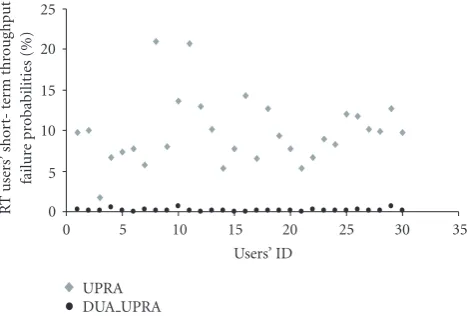
DUA UPRA scheme’s enhanced performance, with respect to RT services QoS properties, asserts and affects all RT users and not only a portion of them, despite the large fluctuations on their channel conditions (due to fast fading). Specifically in Figure 4, we present each RT user’s average actual achieved throughput, for all thirty users in the system, while inFigure 5their corresponding short-term throughput failure probabilities under DUA UPRA scheme (black dots) and UPRA algorithm (gray square) are depicted.
We observe that all users’ probabilities of not satisfying their short-term throughput constraints are very small (max-imum value: 0.7% average: 0.19%) under DUA UPRA, while under UPRA they are high and diverse (maximum value: 20.7% average: 9.8%). Furthermore, under DUA UPRA real-time users’ average achieved throughput remains very high compared to the one achieved under UPRA that exploits optimally system’s throughput abilities without, however, providing short-term throughput constraints. Thus, all real-time users’ average actual received throughput is almost the same under DUA UPRA.
5.2. Scheduling Scenario 2 (SC2). In the second scheduling
50
Figure 4: RT users’ average throughput under UPRA and DUA UPRA algorithms in SC1 (whenN=NRT=30).
Figure 5: RT users’ short-term throughput constraints failure probabilities under UPRA and DUA UPRA algorithms in SC1 (whenN=NRT=30).
two classes: good users and bad users with good and bad average channel conditions, respectively. Good users’ average channel conditions are assumed to be7dB larger than bad users. For each type of users in the system, we evaluate their average probabilities of not satisfying their short-term throughput constraints (illustrated in Figure 6), as well as their throughput performance (presented inFigure 7), as a function of the number of RT bad users in the system, under DUA UPRA (blue columns, solid for bad users and stripes for good users) and UPRA (black columns, solid for bad users and stripes for good users) algorithms.
The corresponding results demonstrate that under UPRA algorithm (black solid columns) bad users are strongly unfavored, not only in terms of their short-term throughput constraints dissatisfaction (Figure 6) but also due to their low throughput performance (Figure 7), especially when their number in the system is low. This mainly occurs due to UPRA goal of maximizing the system’s total utility. Bad users’ contribution to the maximization of the system’s total utility is very low (i.e., they practically contribute only when their
0
Number of RT bad users
20 25 30
Figure6: Users’ average short-term throughput failure probabili-ties in SC2.
Number of RT bad users
20 25 30
Figure7: Users’ average achieved throughput in SC2.
channels are very good compared to good users’ average channel conditions), and therefore they are rarely selected by UPRA algorithm, which leads to their throughput perfor-mance degradation. On the other hand, under DUA UPRA scheme bad users’ short-term throughput performance is highly improved (Figure 7, solid blue columns). Especially, when their number in the system is small, the percentage of their short-term throughput dissatisfaction decreases even 75% compared with the corresponding one achieved under UPRA (solid black columns). Moreover, we observe that bad users’ average downlink throughput takes the same values independently of their number in the system under DUA UPRA scheme (Figure 7, solid blue columns).
Base station
d0=150 m d=50 m Case 1
Case 2
Real time users Non real time users
Figure8: Network varying topology (perCase#) under Scenario 3 (SC3).
(i.e., always smaller than 0.18%), especially when their number in the system is high (number of bad users is small). On the other hand, under UPRA algorithm, due to the high competition, their short-term throughput constraints are still not satisfied (Figure 6 striped black columns). Finally, the downlink throughput performance reduction of good RT users under DUA UPRA scheme, when compared to the one achieved under UPRA algorithm, is not only harmless
(Figure 7 striped blue and black columns) since good RT
users’ required downlink rate is still achieved and satisfied, but rather desired since the excess system resources can be efficiently allocated to bad RT users in order to improve their short-term throughput requirements, as well as to other NRT users.
5.3. Scheduling Scenario 3 (SC3). With this scenario (SC3),
we aim at studying DUA UPRA scheme’s ability to efficiently treat “near-far” effect in a more pragmatic wireless setting, as well as quantifying the tradeoffbetween RT users short-term throughput satisfaction fulfillment and system’s overall achieved throughout. To that end, we considerN=30 active users in the system, where five (NRT = 5) request real-time
traffic (RRT,i =512 Kbps,Wi =20 slots, BRT,i =17002 bits)
for alli ∈ SRT, while the rest are considered as NRT users
(NNRT =25). NRT users constantly maintain their position
with respect to cell’s center, placed in groups of five NRT users in the following distancesd0 =150 (m)dp+1 = dp +
50 (m) forp = 0,. . ., 3 (Figure 8). On the other hand, the set of RT users in the system is gradually moving away from cell’s center (per case), as shown in Figure 8, in order to better simulate the fact that RT users experience Rayleigh fast fading channels with various average quality conditions, due to their corresponding distance to cell’s base station. Thus, RT users’ distances from cell’s centre per case are provided in
Table 1.
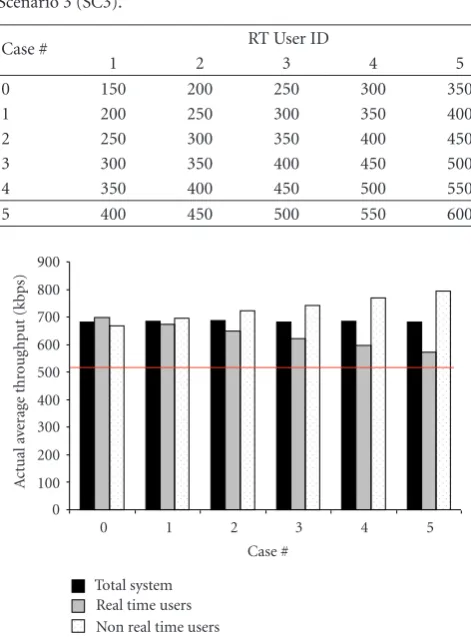
Figure 9, illustrates overall system downlink average
throughput (black columns), as well RT and NRT users’ average throughput (gray and dotted columns, resp.) for each one of the simulated cases (horizontal axis). Furthermore, the corresponding RT users’ average short-term throughput failure probabilities are presented inFigure 10. The results show that the proposed DUA UPRA scheme efficiently over-comes the problem of “near-far” effect, since RT users QoS
Table1: RT users’ distances in(m)for cell’ center perCase# under Scenario 3 (SC3).
Case # RT User ID
1 2 3 4 5
0 150 200 250 300 350
1 200 250 300 350 400
2 250 300 350 400 450
3 300 350 400 450 500
4 350 400 450 500 550
5 400 450 500 550 600
0 100 200
A
ctual
av
er
age
thr
oug
h
put
(kbps)
300 400 500 600 700 900 800
0
Total system Real time users Non real time users
1 2
Case #
3 4 5
Figure9: Total systems, RT and NRT users’ average achieved actual throughput in SC3.
prerequisites are fulfilled, in terms of achieved average actual throughout larger than512kbps and short-term throughput failure probabilities less than 0.8%, even under the most demanding scenario that is,Case = 5. On the other hand, a significant tradeoff is revealed. As the average channel quality of RT users decreases (i.e., RT users are moving away from cell’s center) then, the system increases the number of slots allocated to them, in order to balance between their short-term throughput requirements fulfillment and their inevitable actual throughput degradation (due to their bad channel quality). Therefore, RT users’ average throughput deceases (Figure 9, grey columns) but their short-term throughput failure probabilities remain very low (Figure 10). At the end, RT users QoS prerequisites are preserved, but, at the cost of low NRT users’ throughput as well as overall system throughout. That is due to the small number of system slots allocated to NRT users. The latter, leads only to a small increment of NRT users’ average throughput (as RT users are moving away from cell’s center), even if their instantaneous achieved rates are increased, due to their good channel conditions (Figure 9, dotted columns).
5.4. Scheduling Scenario 4 (SC4). In this final set of
0
Figure10: RT users’ average short-term throughput failure proba-bilities in SC3.
Figure11: Actual achieved throughput as the system evolves in SC4 for a user with variable rate real-time traffic.
DUA UPRA scheme, as the system evolves. To that end, we consider a scenario with N = NRT = 30 real-time
users, with the same average channel conditions (with fast-fading Rayleigh channels). All users except one user (userj) are assumed to have the same QoS prerequisites (i.e., CBR traffic ofRRT,i = 512 Kbps, Wi = 20 slots, BRT,i =
Figure 11illustrates the variable rate RT user’s
instan-taneous actual throughput as a function of time, while
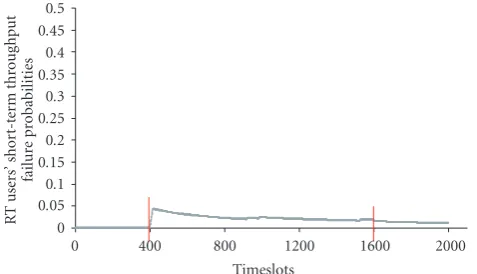
Figure 12their corresponding short-term throughput
prob-ability (i.e., Pr[βRT,i(t)≤BRT,i]Wi, at timeslott) as a function
of time, under DUA UPRA scheme. In both figures, the timeslots at which user j required throughput alters are marked with vertical red lines, while the corresponding requested rates are presented with gray horizontal lines in
Figure 11. The results show that the dynamic adaptation of
the under consideration user’s requested actual throughput is fulfilled under DUA UPRA, and thus the timeframe required to complete a new request is less than 50 timeslots (i.e., less than 8.3 msec). Moreover, during the latter transition period (i.e., after a change of the requested throughput), the RT user’s short-term throughput failure probabilities
0
Figure12: Short-term throughput failure probability (%) as the system evolves in SC4 for a user with variable rate real-time traffic.
slightly increases (maximum value 0.04 = 4%) and then starts dropping again, due to algorithms adaptation to the new request (Figure 12). Finally, we can observe that the user’s actual throughput always remains slightly higher that the required (Figure 11), since in order to always fulfill their short-term throughput requirements (per time slot), the system slightly overprovides them with resources.
6. Concluding Remarks
In this paper, we studied the combined problem of allocating system resources, in terms of power assignment and trans-mission rate, in the downlink of a CDMA wireless system, where multiple services with various QoS requirements are simultaneously requested. We expressed users’ degree of sat-isfaction with respect to their QoS demands fulfillment (non-real-time and (non-real-time services) through a common utility-based framework which provides us with the enhanced flex-ibility of effectively influencing the opportunistic scheduler to meet their various QoS prerequisites.
Emphasis was placed on RT users’ probabilistic short-term throughput requirements satisfaction. Specifically, in order to dynamically and accurately affect their selection priority with respect to their QoS prerequisites satisfaction, we introduced the information of their short-term received data distribution into the proposed methodology of tun-ing their utility functions’ properties. Through modeltun-ing and simulation under various scheduling scenarios, we demonstrated that significant performance improvements are achieved in terms of real-time user’s short-term through-put requirement satisfaction and non-real-time users actual throughput maximization, without any considerable loss in the total system throughput.
step towards the realization of autonomic wireless network where hybrid data flows are simultaneously supported, and therefore is an issue of a great importance and part of our current research work.
Appendices
A. Limitations on Controlling Users’
Selection Priorities
In the following, we rigorously define the lower and upper bounds of real-time users’ bRT,ifor alli ∈ SRT parameter
(i.e.,bi,minandbi,max, resp.) and justify their role in the
pro-posed scheduling policy as well as the way they restrict users’ ability to self-optimize their services’ QoS performance. It is shown that even if RT users’ introduced self-optimization behavior enhances their ability to self-optimize their QoS-aware performance, mobile nodes’ potential bad channel conditions, the system’s lack of available resources, as well as their physical limitations may prevent the fulfillment of their short-term QoS requirements. Moreover, we provide low complexity algorithms for computing the above boundary values.
As analyzed in the previous sections, a real-time user’s utility function parameter bRT,i plays a key role in the
selection priority of accessing system’s resources at each time slot, since it affects the corresponding value of their willingness to pay λmaxi . On the other hand, the
appro-priate values forbmin,iandbmax,ishould be such that for
any further decrement or increment in the value of bRT,i
(with respect to these bounds) the corresponding value of parameterλmaxi is not affected. Consequently, parameterbRT,i
should be bounded among them. Therefore, we use the following condition for identifying an RT useribounds of theirbRT,iparameter
∂λmaxi (bRT,i)
willingness as a function of his parameterbRT,i.
Definitions of bmin,iandbmax,ifor alli ∈ SRT. Following a
pure functions theoretic analysis, the lower bound of an RT user’s utility function parameterbRT,ican be formally defined
as follows.
Proposition 2 (Definition of bmin,ifor alli ∈ SRT). We
defines asbmin,i for alli ∈ SRT the maximum value of a RT
useriutility function parameterbRT,iat slot t, such that
bmin,i=max
Proof. SeeAppendix C.
The existence of such a lower bound reveals an inherent users’ limitation on controlling their services’ short-term QoS requirements when operating over a time-varying wireless environment; the reason is twofold. On the one hand, due to its opportunistic nature, the scheduler in the sight of low available resources may potentially unfavor some user’s towards optimizing overall system’s welfare. On the other hand, even when plethora of system resources is available, RT users’ potential bad instantaneous channel condition and their physical limitations may make the goal of their short-term QoS prerequisites fulfillment unreachable.
The following proposition defines an RT user’s utility function parameterbRT,iupper bound.
Proposition 3 (Definition of bmax,i for alli ∈ SRT). One defines asbmax,ifor alli∈SRT the maximum value of a real-time useriutility function parameterbRT,iat time slot t such that
Proof. SeeAppendix D.
From the definition of BMAX,i(Ai) we can observe that
the worse RT user’s channel conditions are (i.e., parameter
Ai increases), the smaller is our ability of influencing their
selection priority, since the range of their utility function parameterbRT,idecreases as well.
Algorithms for Computingbmin,i andbmax,i. We conclude this
bounds at each time slot. Initially, by using Proposition 2, we provide a “divide and conquer”-based algorithm for computing a real-time user’s parameter bRT,i lower bound
bmin,i.
Algorithm for Computing (bmin,ifor alli ∈ SRT). Let us
refer toPLIM
i (γ∗i,Ai)|bRT,i(t)=bmin,i(t)(ν) > P
0
i|bRT,i(t)=bmin,i(t)(ν) and
[UR∗i
i (P,bRT,i)−P(∂UR
∗
i
i (P,bRT,i)/∂P)]P=PLIM
i (γ∗i,Ai)|bRT,i=bmin,i(ν)>
0 as conditions A and B, respectively.
(i) Setν=1,l(ν)=0,r(ν)=b
RT,iandbmin,i(ν)=bRT,i. (ii) If A AND B are true then l(ν+1) = (l(ν) +r(ν))/2,
r(ν+1) = r(ν) andb
min,i(ν+1) = l(ν+1) elsel(ν+1) = l(ν),
r(ν+1)=(l(ν)+r(ν))/2 andb
min,i(ν+1)= r(ν+1). (iii) If|l(ν+1)−l(ν)|> εOR|r(ν+1)−r(ν)|> εthenv=v+ 1,
go to (ii).
(iv) If NOT (AANDB) is true thenbmin,i(ν+1)=bmin,i(ν+1)−
ε.
The maximum number of algorithm’s iterationsν∗ isv∗ ≤ log2(bRT,i/ε) + 1, whereεis a small positive constant. Finally,
with respect toProposition 3, we propose the adoption of a “Steepest Descent”-based algorithm for computing at every time slott,a real-time useriparameterbRT,i upper bound,
bmax,i.
Algorithm for Computing (bmax,ifor alli∈SRT).
(i) LetLmaxbe a large positive constant.
(ii)n= 0,bmax,i(n=0)=bRT,i.
(iii) Forn > 0 then bmax,i(n+1) = bmax,i(n) + 10D
(n)−1 where:D(n)=∂b
RT,i/∂λmaxi |bRT,i=b(n)max,i.
(iv) If∂bRT,i/∂λmaxi |bRT,i=b(n+1)max,i<−Lmax, go to (vii)
(iv) Ifbmax,i(n+1)> BMAX,i(Ai), then go to (vii)
(vi)n = n + 1 and go to (iii). (vii) Stop.
The previous algorithm is a modified “Steepest Descent”-based algorithm, adapted to the needs of our problem
(Proposition 3). Specifically, in our case, we are not
inter-ested in finding the minimum of the function bRT,i(λmaxi ),
but in accordance to (A.1), in finding a large value ofbat which the absolute values of gradient|∂bRT,i/∂λmaxi |bRT,i=bmax,i|
are very large (for practical considerations, we approximate infinite with a large numberLmax).Therefore, to improve
convergence time, we use as a step the corresponding power of 10 (in step iii). It is easy to show, considering the complexity of the “Steepest Descent” [28], that the maximum number of iterations required for convergence areν∗∗, wherev∗∗≤ (1/2) ln(Lmax).
Finally, the total maximum number of iterations required to compute the minimum and the maximum values ofbRT,iisv≤log2(bRT,i/ε)+1+(1/2) ln(Lmax), whereεand Lmaxare a small and a large positive constants, respectively.
B. Proof of
Proposition 1
From (14), we can observe that when for two users
i, j, Ai = AjandRmaxi = Rmaxj , then the only
param-eters that are affected by variations in the value of parametersbi, bj, and hence determine the properties of
their utility functionsUR∗i
i (P,a,bi) andU R∗j
j (P,a,bj) areγ∗i , γ∗j and the corresponding values of theirfiand fj functions,
respectively. Therefore, we first provide the following two lemmas that determine the way that a useri, parameterbi
affects his fifunction and hisγ∗i parameter.
Lemma 4. If bi < bjthen fi(γ, a, bi) > fj(γ, a, bj)for allγ∈(0,∞).
Proof. If one sets asxi = eabi in the generic definition of a
sigmoidal function:
fi
γi
Ri,P
,a,bi
=ci
& 1
1 +e−a(γi−bi)−di
'
, (B.1)
where ci = (1 +eabi)/eabi anddi = 1/(1 +eabi), one can
rewrite itas fi(γ,a,bi) = (1 − e−aγ)/(1 + xie−aγ). Thus,
ifbi < bj then 1 +xie−aγ <1 +xje−aγ and fi(γ, a, bi)>
fj(γ, a, bj) for allγ∈(0,∞).
Lemma 5. IfAi = Aj andRmaxi =Rmaxj , ifbi < bj, then γ∗i < γ∗j.
Proof. From (14), one can compute a user i, parameter
γ∗i value as follows: γi∗ = maxγ≥1{(1/γ)fi(γ,a,bi)} =
maxγ≥1{(1/γ)(eaγ−1)/(eaγ+xi)}, wherexi = eabi. Let one
defines asg(xi,γ)=(1/γ)(eaγ−1)/(eaγ+xi) and ash(xi,γ)= ∂g(xi,γ)/∂γ=eaγ(aγxi−eaγ−xi+ 1 +aγ) +xi/(eaγ+x)2γ2.
Whenγi = γ∗i, then∂g(xi,γ)/∂γ =0 sinceγi∗is maximum
and
hxi,γ
>0 ∀γ < γ∗i ,
hxi,γ
<0 ∀γ > γ∗i .
(B.2)
Thus, ifxi> xj, thenh(xi,γ)> h(xj,γ) since
∂hxi,γ
∂xi =
eaγaγ(eaγ−1)
(eaγ+x i)3γ2
>0 ∀a≥0, γ≥0, bi≥0.
(B.3)
If there existsxi,γ∗i such thath(xi,γ∗i)=0, andxj,γ∗j such
that h(xj,γ∗j) = 0, then if xj > xi, from (B.3), one has
h(xj,γ∗i)> h(xi,γi∗)b, and henceh(xj,γi∗)>0. Thus, since
h(xj,γ∗j)=0 andh(xj,γ∗i )>0, from (B.2) one hasγi∗< γ∗j.
Finally, since if xj > xithen γ∗i < γ∗j, and when xj >
xithenbi< bj, one concludes that ifbi < bj thenγ∗i < γ∗j.
Finally, based on Lemmas4and5one provesProposition 1. From Remark 1 (Proposition 3, [24]) one has seen that if for any two usersi, jUR∗i
i (P,a,bi)> U
R∗j
j (P,a,bj) for 0 ≤P ≤ Pmax, thenλmaxi > λmaxj . Therefore one has to prove that if
bi < bj, thenUR
∗
i
i (P,a,bi)> U
R∗j
By the definition of a useriutility in (14), andLemma 5, let
Furthermore, there are three possible cases for the value of parameterP, when 0≤P≤Pmax.
C. Proof of
Proposition 2
In order to determine a lower bound of an RT user’s parameterbRT,i, we first identify some of the main properties
of his utility function with respect to bRT,i ∈ [0,bRT,i).
The following lemma defines the relationship between the inflection point of a user’s sigmoidal-like utility function and its parameterbRT,i.
are the inflection points of their corresponding utilitiesUR∗i
i (Pi,bRT,i)andU R∗i
i (Pi,bRT,i), respectively.
Proof. SeeAppendix E.
Furthermore, we can also prove that whenbRT,i=0, then
a user’s utility function inflection point has always smaller value than his utility separation point,PLIM
i (γ∗i,Ai).
Lemma 7. WhenbRT,i=0,P0i|bRT,i=0< P
LIM
i (γ∗i ,Ai)|bRT,i=0.
Proof. SeeAppendix F.
Based on the two previous lemmas, we can see that there always exists a valueb∗RT,i for a useriutility function
parameterbRT,iwhenbRT,i ∈[0,bRT,i), such that for smaller
Proposition 8. There always exists a value of a real-time user i utility function parameterbRT,iwhenbRT,i∈[0,bRT,i), denoted
Proof. SeeAppendix H.
We can now proceed to prove that whenbRT,i∈[0,b∗RT,i),
there always exists a value for a useriutility function parameterbRT,i denoted asbmin,isuch that when bRT,i < bmin,i then their maximum willingness to pay is calculated
by the second part of (17), because Pi∗in (18) does not exist
and hence, condition (A.1) is fulfilled. Towards that, we first provide the following proposition.
Proposition 9. There always exists a value for a real-time useriutility function parameterbRT,iwhenbRT,i ∈[0,b∗RT,i),
Proof. SeeAppendix I.
According toProposition 8, there always exists a value for a real-time useriutility function parameterbRT,i(i.e.,b∗RT,i)
and in accordance to Proposition 9, there always exists a value for a real-time useriutility function parameterbRT,i
(i.e.,bRT,∗∗i) whenbRT,i ∈ [0,bRT,i) such that for 0 ≤ bRT,i <