R E S E A R C H
Open Access
Dynamic behaviors of a modified
predator-prey model with state-dependent
impulsive effects
Shulin Sun
1*, Cuihua Guo
2and Chao Qin
1*Correspondence:
1School of Mathematics and
Computer Science, Shanxi Normal University, Linfen, Shanxi 041004, China
Full list of author information is available at the end of the article
Abstract
In this paper, we formulate a two-dimensional autonomous predator-prey model with state-dependent impulsive effects and square root response function. The square root response function indicates that the prey population gather together for self-defense purposes. Firstly, we prove that the system has semitrivial periodic solution under some conditions. Furthermore, by the Poincaré map and the theory of impulsive differential equations, the existence and stability of positive order-1 or order-2 periodic solution of the system are investigated in detail. The validity of all results is illustrated by numerical simulations.
Keywords: state-dependent impulse; predator-prey system; periodic solution; square root response function
1 Introduction
Many evolutionary processes in nature are subjected to short temporary perturbations and experience abrupt changes at certain moments of time. The duration of the changes is very short and negligible in comparison with the duration of the process considered. These short-time perturbations are often assumed to be momentary changes or impulses. Therefore, it is realistic that impulsive differential equations model such processes. In the recent ten years, the theory of impulsive differential equations has been extensively used to model many real processes in biology, physics, chemistry, engineering, and other sciences. Particularly, some impulsive differential equations have been introduced successfully in population dynamics (such as fishing or agriculture) and epidemic dynamics; see [–] and references therein. In most of the cases, scholars investigate the population dynam-ical systems with impulsive perturbation at fixed times. However, in practdynam-ical ecologdynam-ical systems, the implementations of some control strategy (by catching, poisoning or releas-ing the natural enemy,etc.) depend on the state of target species, which is a more realistic project. This is known as impulsive state feedback control strategy, which is widely used in many biological systems. Recently, a few studies on state-dependent impulse effects were made in [–]. In particular, Jianget al.[, ], Nieet al.[–] and Zhanget al.[] investigated some predator-prey systems by using the Poincaré map and theory of impul-sive differential equations, the sufficient conditions of existence and stability of semitrivial solution and positive periodic solution were obtained. Guo and Chen [] and Tianet al.
[] studied the existence and stability of the positive period- solution of the system with impulsive state feedback control. The abundant dynamic behaviors of the systems were obtained.
These predator-prey systems with prey group defense ability have more abundant and interesting dynamic characteristics and attract attention of many scholars. A recent novel contribution models the fact that it is the individuals at the edge of the herd that generally suffer the heaviest consequences of the predators’ attacks. Recently, some predator-prey models [–] in which the prey exhibits herd behavior were considered. In these models, the predator interacts with the prey along the outer corridor of the herd of prey. As a mathematical consequence of the herd behavior, the interaction terms in systems use the square root of the prey population rather than simply the prey population. The use of the square root properly accounts for the assumption that the interactions occur along the boundary of the population. For example, for drifting herbivores in the savannas, moving in very large herds and subject to individual attacks of predators, the likelihood that they are hunted in the way we describe here is evident [].
Braza [] analyzed the following predator-prey model with square root functional re-sponses: tor, andcis the biomass conversion or consumption rate.
Basing on these reasons mentioned, we will consider the dynamic behaviors for system (.) with state-dependent impulse effects; in other words, when the amount of the her-bivores reaches a threshold value, we will release predators and capture some herher-bivores, helping this way to preserve natural balance. The system is modeled by the following equa-tions: system (.). When the amount of the prey reaches the thresholdhat timeth, a control strategy is taken, and the amount of prey and predator abruptly turn to ( –p)hand ( +
q)y(th) +α, respectively.
2 Preliminaries
By the biological background of system (.) we only consider system (.) in the region
D=R
+. Obviously, the global existence and uniqueness of solutions of system (.) are
guaranteed by the smoothness properties off, which is the mapping defined by the right-hand side of system (.); for details, see [, ].
DenoteR= (–∞,∞). First, we give the notion of the distance between a point and a
set. LetS⊂R={(x,y) :x∈R,y∈R}be an arbitrary set, andP∈Rbe an arbitrary point.
Then the distance between the pointPand the setSis denoted by
d(P,S) = inf P∈S
P–P ,
where P–P =
(x–x)+ (y–y)for pointsP(x,y)∈RandP(x,y)∈S.
Letz(t) = (x(t),y(t)) be a solution of (.), and letz(t;t,z) denote the solution of (.)
for whichz(t+;t,z) =z. Next, we define the positive orbit through the pointz∈R+=
{(x,y) :x≥,y≥}fort≥tas
O+(z,t) = z∈R+:z=z(t),t≥t,z(t) =z
.
In the rest of this paper, we will use the following definitions.
Definition .[] The solutionz(t) of system (.) is said to be:
() Orbitally stable if∀ε> ,∃δ> such that for anyz∗(t) = (x∗,y∗)¯∈ {h} ×[y∗, +∞) satisfying z∗(t) –z(t) <δ, we haved(z(t;t,z∗(t)),O+(z,t)) <εfort>t. () Orbitally attractive if∀ε> ,∃δ> andT˜ > such that for any
z∗(t) = (x∗,y∗)¯∈ {h} ×[y∗, +∞)satisfying z∗(t) –z(t) <δ, we have
d(z(t;t,z∗(t)),O+(z,t)) <εfor anyt>t+T˜.
To discuss the dynamics of system (.), we define two cross-sections of the vector field (.) byp={(x,y) :x= ( –p)h,y> }andh={(x,y) :x=h,y> }. Denote byPt the
point representing the state of the system at timet. Suppose that the pointSn(h,yn) is on
the sectionh; then the pointPt jumps from the positionSn(h,yn) to the pointS+n(( – p)h, ( +q)yn+α) on the sectionpdue to the impulse effects. The pointPtcontinues its motion along the solution curve of system (.) and reaches the pointSn+(h,yn+) on the
sectionhagain, whereyn+is decided byynand the parametersqandα. Therefore, we
defined the Poincaré map ofhas follows:
yn+=P(q,α,yn). (.)
Next, we consider the autonomous system with impulse effects
dx
dt =P(x,y), dy
dt =Q(x,y), ϕ(x,y)= ,
x=ξ(x,y), y=η(x,y), ϕ(x,y) = , (.)
whereP(x,y) andQ(x,y) are continuous differential functions defined onR, andϕ(x,y)
Lemma .(Analogue of Poincaré’s criterion) If the Floquet multiplierμsatisfies the
con-moves along the solution curvez(t), then it first intersects the section h at the point
F(h,y), and, next, the pointFis transferred to the pointE(( –p)h,y) on the section
3.1 Existence of semitrivial periodic solution with
α
= 0Lety(t) = fort∈[,∞). Then from system (.) we have
This means that system (.) withα= has the following semitrivial periodic solution
3.2 Existence and stability of positive periodic solutions
In this subsection, we give sufficient conditions for the existence and stability of positive periodic solutions in the casesh≤x∗andh>x∗, respectively.
CaseI:h≤x∗.
On the existence of positive periodic solution of system (.), we have the following theorem.
initial pointEintersects the section
h q<q∗. However, on account of the pointEon the isoclineLand the phase portrait of
system (.), we find that the pointFis under the pointFfor anyq∈(–,q∗)∪(q∗,∞).
From this analysis we have that
(i) ify=y, then system (.) has a positive order- periodic solution; (ii) ify>y, then
y–P(q,α,y) =y–y> . (.)
By (.) and (.) it follows that the Poincaré map (.) has a fixed point, that is, system (.) has a positive order- periodic solution. This completes the proof.
where
Then(φ(t),ψ(t))is orbitally asymptotically stable.
Proof Suppose that the periodic solution (φ(t),ψ(t)) intersects the sectionspandh at the pointsE+(( –p)h, ( +q)γ +α) andE(h,γ), respectively. Comparing with system
Therefore, by Lemma ., provided that condition (.) is satisfied, the order- periodic solution (φ(t),ψ(t)) of system (.) is orbitally asymptotically stable. This completes the
proof.
Case II:h>x∗.
On the existence and stability of positive periodic solution of system (.), we have the following theorem.
Theorem . For h>x∗,there is a positive constantα∗=α(h) > such that for any q> –
andα>α∗,system(.)only has a orbitally asymptotically stable positive order-or
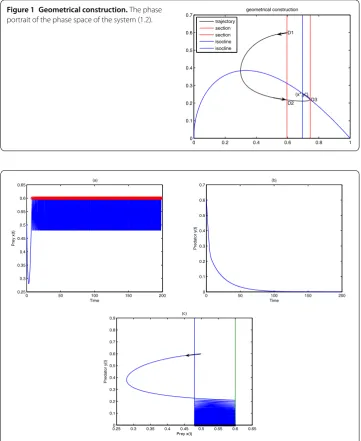
Figure 1 Geometrical construction.The phase portrait of the phase space of the system (1.2).
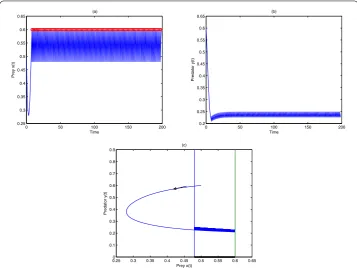
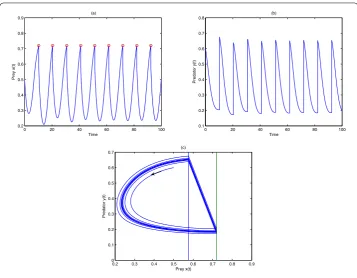
Figure 2 A stable semitrivial periodic solution.x(0) = 0.5,y(0) = 0.6.(a)Time series graph for preyx(t);
(b)Time series graph for predatory(t);(c)Phase space graph for preyx(t) and predatory(t).
Proof In view of the phase portrait of system (.), there is a trajectorythat begins from the pointD((–p)h,y˜), crosses
p
at the pointD((–p)h,y˜) (˜y<y˜), and then tangents
to the sectionhat the pointD(h, ( –h)
√
h). So, the trajectory of system (.) that starts from the point (( –p)h,y) withy∈(y˜,y˜) will not meet
h, and tends to the equilibrium
point (x∗,y∗). (See Figure .) Let α∗ =y˜ + ( –h)
√
h. The trajectory of system (.) that starts from the point
E(( –p)h,˜y) (˜y∈(,y˜)∪(y˜, +∞)) will intersect with
h infinitely many times due to
the impulse effects withα>α∗andh>x∗. Suppose that the orbitO+(E,t
) intersects
h
at the point (h,y); theny∈(, ( –h)
√
h). Further, from the Poincaré map (.) of the sectionhit follows thaty=P(q,α,y) andy=P(q,α,y). Repeating this process, we
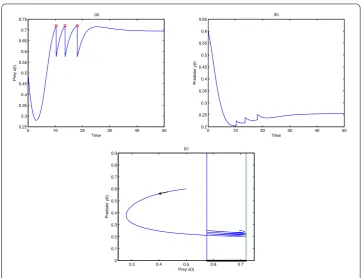
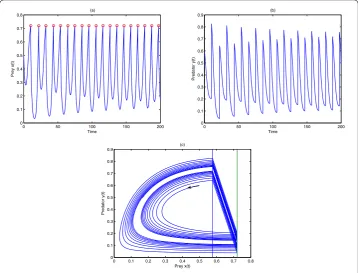
Figure 3 A unstable semitrivial periodic solution.x(0) = 0.5,y(0) = 0.6.(a)Time series graph for preyx(t);
(b)Time series graph for predatory(t);(c)Phase space graph for preyx(t) and predatory(t).
Aj(h,yj) onh, whereyi,yj∈(, ( –h)√h) andyi<yj, the pointsA+i(( –p)h, ( +q)yi+α) andA+j(( –p)h, ( +q)yj+α) are above the pointD for the impulse effects. Therefore,
from the phase portrait of the system (.) we have
<yj+<yi+< ( –h)
√
h (.)
forα>α∗.
Now, suppose that the trajectory of system (.) that starts from the pointE(( –p)h,y)
(y∈[˜y,∞)) intersects with
h
at the pointE(h,y) for the fist time; theny∈(, ( – h)√h]. Ify= ( –h)
√
handy= ( +q)y+α, then system (.) has a positive order-
periodic solution. Otherwise, from the Poincaré map (.) of the sectionhit follows that
y=P(q,α,y) andy=P(q,α,y); and so forth, we haveyn+=P(q,α,yn) (n= , , . . .).
In particular, ify=y, then system (.) has a positive order- periodic solution, and if y=yandy=y, then system (.) has a positive order- periodic solution.
Next, similarly to [, , ], we discuss the general circumstance, that is,y=y=y=
· · · =yn(n> ).
(a) Ify<y, then from (.) we obtain thaty>y. Consequently, the relation ofy,y,
andyis one of the following cases: (i) y<y<y.
Ify<y<y, theny>y>y>yby (.). Repeating the process, we have
<· · ·<yn<· · ·<y<y<y<· · ·<yn+<· · ·< ( –h)
√
h.
Figure 4 A unstable semitrivial periodic solution.x(0) = 0.5,y(0) = 0.6.(a)Time series graph for preyx(t);
(b)Time series graph for predatory(t);(c)Phase space graph for preyx(t) and predatory(t).
Ify<y<y, then similarly to (i) we have
y<y<· · ·<yn<· · ·<yn+<· · ·<y<y< ( –h)
√
h.
(b) Ify>y, from (.) we obtain thaty<y. Consequently, the relation ofy,y, and yis one of the following cases:
(i) y<y<y.
Ify<y<y, theny>y>y>yby (.). Repeating the process, we have
<· · ·<yn+<· · ·<y<y<y<· · ·<yn<· · ·< ( –h)
√
h.
(ii) y<y<y.
Ify<y<y, then similarly to (i) we have
<y<· · ·<yn+<· · ·<yn<· · ·<y<y< ( –h)
√
h.
From this analysis, in case (i) of (a), it follows from the monotone bounded theorem thatlimn→∞yn=θandlimn→∞yn+=θ; in addition, <θ<y<θ< (r–h)
√
h. Thus, we getθ=P(q,α,θ) andθ=P(q,α,θ). This means that system (.) has an orbitally
asymptotically stable positive order- periodic solution. Similarly, in case (i) of (b), system (.) has also an orbitally asymptotically stable positive order- periodic solution. In cases (ii) of (a) and (ii) of (b), it follows from the Poincaré map and the closed interval theorem that system (.) has an orbitally asymptotically stable positive order- periodic solution.
Figure 5 A stable order-1 positive periodic solution.x(0) = 0.5,y(0) = 0.6.(a)Time series graph for prey
x(t);(b)Time series graph for predatory(t);(c)Phase space graph for preyx(t) and predatory(t).
Remark From the proof of Theorem . we note that the trajectory of system (.) passing through the point (( –p)h,y) (y∈(˜y,y˜)) will not intersect with
h
as time increases and will tend to the focus (x∗,y∗). Therefore,α>y+ ( –h)
√
his a sufficient condition ensuring that the trajectory of system (.) intersects withhinfinitely many times in view of the impulse effects.
4 Numerical simulation
We have obtained analytical results on dynamical behaviors of a predator-prey model with state-dependent impulse effects in front sections. Now we will illustrate the validity of these results through numerical simulation.
In system (.), let s= . and c= .. Then the positive equilibrium point (x∗,y∗) = (., .) is globally asymptotically stable.
For the semitrivial periodic solution (.) of system (.), we set the parameters as fol-lows:
() s= .,c= .,p= .,α= ,h= . <x∗,q= ..
Under this choice of parameters, we find that the trajectory of system (.) intersects the sectionh infinitely many times and tends to the semitrivialT-periodic solution (.), whereT= ., so the semitrivialT-periodic solution (.) is stable (see Figure ).
() s= .,c= .,p= .,α= ,h= . <x∗,q= ..
Figure 6 A stable order-1 positive periodic solution.x(0) = 0.5,y(0) = 0.6.(a)Time series graph for prey
x(t);(b)Time series graph for predatory(t);(c)Phase space graph for preyx(t) and predatory(t).
() s= .,c= .,p= .,α= ,h= . >x∗,q= ..
Under this choice of parameters, we find that the trajectory of system (.) intersects the sectionhfinitely many times and tends to the positive equilibrium point (x∗,y∗), so the semitrivialT-periodic solution (.), whereT= ., is unstable (see Figure ).
For the positive periodic solution of system (.), we set the parameters as follows:
() s= .,c= .,p= .,α= .,h= . <x∗,q= ..
Under this choice of parameters, the conditions of Theorem . are established, so we get a stable order- positive periodic solution (see Figure ).
() s= .,c= .,p= .,α= .,h= . >x∗,q= ..
Under this choice of parameters, the conditions of Theorem . are established, so we also get a stable order- positive periodic solution (see Figure ).
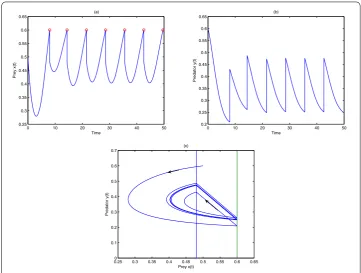
() s= .,c= .,p= .,α= .,h= . >x∗,q= ..
Under this choice of parameters, the conditions of Theorem . are established, so we obtain a stable order- positive periodic solution (see Figure ).
5 Conclusion
On the basis of the predator-prey model (.) with square root functional responses, we formulate a new model (.) with state impulsive control strategy. In spite of the simplicity of the model, which is composed of two ordinary differential equations together with rela-tions defining the impulsive condition, it is very significant and has interesting dynamical behaviors.
Figure 7 A stable order-2 positive periodic solution.x(0) = 0.5,y(0) = 0.6.(a)Time series graph for prey
x(t);(b)Time series graph for predatory(t);(c)Phase space graph for preyx(t) and predatory(t).
behavior makes their predators difficult to get food (such as lions on the vast grassland). If this situation continues for a long time in this way, then the predator will be in peril of extinction (see Figure ). In order to prevent the predator from dying out, we must take some control strategy to ensure that this result does not happen. In this paper, we investigate theoretically the state impulsive control strategy of protecting the predator. Furthermore, we have obtained some interesting results (see Figures , , , ), which show that h,q, andα are important control parameters. Unfortunately, we cannot currently prove the stability of the semitrivial periodic solution (.).
Competing interests
The authors declare that they have no competing interests.
Authors’ contributions
All authors contributed equally to the writing of this paper. All authors read and approved the final manuscript.
Author details
1School of Mathematics and Computer Science, Shanxi Normal University, Linfen, Shanxi 041004, China.2School of
Mathematical Science, Shanxi University, Taiyuan, Shanxi 030006, China.
Acknowledgements
The authors would like to thank the Journal editors and the anonymous reviewers for their valuable and insightful suggestions that contributed to a significant improvement of the paper. This work is supported by the Natural Science Foundation of Shanxi Province (2013011002-2).
Received: 23 May 2015 Accepted: 23 December 2015 References
1. Tang, SY, Chen, LS: Density-dependent birth rate birth pulses and their population dynamic consequences. J. Math. Biol.44, 185-199 (2002)
3. Simeonov, PS, Bainov, DD: Orbital stability of periodic solutions of autonomous systems with impulse effect. Int. J. Syst. Sci.19, 2561-2585 (1988)
4. Zeng, GZ, Chen, LS, Sun, LH: Existence of periodic solution of order one of planar impulsive autonomous system. J. Comput. Appl. Math.186, 466-481 (2006)
5. Gao, SJ, Chen, LS, Teng, ZD: Impulsive vaccination of an SEIRS model with time delay and varying total population size. Bull. Math. Biol.69, 731-745 (2007)
6. Gao, SJ, Teng, ZD, Nieto, JJ, Torres, A: Analysis of an SIR epidemic model with pulse vaccination and distributed time delay. J. Biomed. Biotechnol. (2007). doi:10.1155/2007/64870
7. Wang, WB, Shen, JH, Nieto, JJ: Permanence and periodic solution of predator-prey system with Holling type functional response and impulses. Discrete Dyn. Nat. Soc. (2007). doi:10.1155/2007/81756
8. Ahmad, S, Stamova, IM: Asymptotic stability of competitive systems with delays and impulsive perturbations. J. Math. Anal. Appl.334, 686-700 (2007)
9. D’Onofrio, A: Stability properties of pulse vaccination strategy in SEIR epidemic model. Math. Biosci.179, 57-72 (2002) 10. Jiang, GR, Lu, QS: Impulsive state feedback control of a predator-prey model. J. Comput. Appl. Math.200, 193-207
(2007)
11. Jiang, GR, Lu, QS, Qian, LN: Complex dynamics of a Holling type II prey-predator system with state feedback control. Chaos Solitons Fractals31, 448-461 (2007)
12. Nie, LF, Peng, JG, Teng, ZD, Hu, L: Existence and stability of periodic solution of a Lotka-Volterra predator-prey model with state dependent impulsive effects. J. Comput. Appl. Math.224, 544-555 (2009)
13. Nie, LF, Teng, ZD, Hu, L, Peng, JG: Qualitative analysis of a modified Leslie-Gower and Holling-type II predator-prey model with state dependent impulsive effects. Nonlinear Anal., Real World Appl.11, 1364-1373 (2010)
14. Nie, LF, Teng, ZD, Hu, L, Peng, JG: The dynamics of a Lotka-Volterra predator-prey model with state dependent impulsive harvest for predator. Biosystems98, 67-72 (2009)
15. Wang, FY, Pang, GP, Chen, LS: Qualitative analysis and applications of a kind of state-dependent impulsive differential equations. J. Comput. Appl. Math.216, 279-296 (2008)
16. Guo, HJ, Chen, LS: Periodic solution of a chemostat model with Monod growth rate and impulsive state feedback control. J. Theor. Biol.260, 502-509 (2009)
17. Tian, Y, Sun, KB, Chen, LS, Kasperski, A: Studies on the dynamics of a continuous bioprocess with impulsive state feedback control. Chem. Eng. J.157, 558-567 (2010)
18. Zhang, H, Georgescu, P, Zhang, L: Periodic patterns and Pareto efficiency of state dependent impulsive controls regulating interactions between wild and transgenic mosquito populations. Commun. Nonlinear Sci. Numer. Simul.
31, 83-107 (2016)
19. Braza, PA: Predator-prey dynamics with square root functional responses. Nonlinear Anal., Real World Appl.13, 1837-1843 (2012)
20. Ajraldi, V, Pittavino, M, Venturino, E: Modeling herd behavior in population systems. Nonlinear Anal., Real World Appl.
12, 2319-2338 (2011)
21. Matia, SN, Alam, S: Prey-predator dynamics under herd behavior of prey. Univers. J. Appl. Math.1, 251-257 (2013) 22. Venturino, E, Petrovskii, S: Spatiotemporal behavior of a prey-predator system with a group defense for prey. Ecol.
Complex.14, 37-47 (2013)
23. Gimmelli, G, Kooi, BW, Venturino, E: Ecoepidemic models with prey group defense and feeding saturation. Ecol. Complex.22, 50-58 (2015)
24. Lakshmikantham, V, Bainov, DD, Simeonov, PS: Theory of Impulsive Differential Equations. World Scientific, Singapore (1989)