R E S E A R C H
Open Access
Stability analysis of HIV-1 model with
multiple delays
Nigar Ali
1, Gul Zaman
1*and Obaid Algahtani
2*Correspondence:
[email protected] 1Department of Mathematics,
University of Malakand, Chakdara Dir (Lower), Khyber Pukhtoonkhwa, Pakistan
Full list of author information is available at the end of the article
Abstract
A mathematical model for HIV-1 infection with multiple delays is proposed. These delays account for (i) the delay in contact process between the uninfected cells virus, (ii) a latent period between the time target cells which are contacted by the virus particles and the time the virions enter the cells, and (iii) a virus production period for new virions to be produced within and released from the infected cells. For this model, the basic reproductive number is identified and its threshold property is discussed. The uninfected and infected steady states are shown to be locally as well as globally asymptotically stable. The value of the basic reproductive number shows that increasing any one of these delays will decrease this number. This may suggest a new direction for new drugs that can prolong the infection process and spreading of virus. The proved results have potential applications in HIV-1 therapy.
1 Introduction
Mathematical modeling in epidemiology provides understanding of the mechanisms that influence the spread of a disease and suggests control strategies. Human immunodefi-ciency virus (HIV-) is a lentivirus that causes acquired immunodefiimmunodefi-ciency syndrome (AIDS). The HIV infection is characterized by three different phases, namely, the primary infection, a clinically asymptomatic stage (chronic infection), and acquired immunodefi-ciency syndrome (AIDS). In recent years the population dynamics of infectious diseases have been extensively studied [–]. Clinical research combined with mathematical mod-eling has enhanced progress in the understanding of the HIV- infection []. This is be-cause mathematical models can offer a way to study the dynamics of viral loadin vivoand can be very useful in understanding the interaction between virus and host cell.
In the last decade, the HIV-infection models with time delays have been studied by many authors, and time delays of one type or another have been incorporated into biological models by many authors (e.g., [–, –] and the references cited therein). The re-sults presented in [–] have shown that larger intercellular delay may help eradicate the virus, while the activation of CTLs can only help reduce the virus load and increase the healthy CD+ cells in the long term sense. Paweleket al.[] have studied that models of HIV- infection incorporating intracellular delays are more accurate representations of the biology, and that they can change the estimated values of the kinetic parameters when compared to models without delays. Therefore, we incorporate time delay terms in the model in the interaction of different cells.
This research extends the work in [] by incorporating delays in the contact process between the uninfected cells and virus. By introducing these multiple delay terms, the proposed model becomes
˙
x(t) =N–dx(t) –βe–mτx(t–τ
)v(t–τ),
˙
y(t) =βe–mτx(t–τ
)v(t–τ) –ay(t) –py(t)z(t),
˙
v(t) =ky(t) –uv(t),
˙
z(t) =cy(t–τ)z(t–τ) –bz(t),
()
wherex(t),y(t), andv(t) are the densities of uninfected target cells, infected target cells and free virus, respectively, at timet.βis the infection rate of uninfected cells by the virus. The healthy cell is assumed to be produced at a constant rateN. It is also assumed that, once cells are infected, they may die at rateaeither due to the action of the virus or the immune system, in the meantime each producing HIV- virus particles at a ratekduring their life with an average length /a. The densityzrepresents CTL response cells. Here,τcan be
regarded as the average time for a viral particle to go through the eclipse phase (or average latent period) andτ may be treated as the average time between the entry of a virion
into a cell and the creation and release of new virions from this cell. Realistically,τmay
differ fromτ.e–mτis the probability of surviving of cells in the time period fromτtot,
wheremis assumed to be the constant death rate of infected CD+ T cells. The novelty of the proposed model is that it considers a delay in the process of infection of healthy T cells, and in virus production. In the previous research the rate of contact of targeted cells and virus was ignored. This work considers the whole process of infection of healthy cells. In eliminating or controlling the disease after human body was infected by the virus, the immune response plays an important role. Antigenic stimulation in generating CTLs may need a period of timeτ, that is, the CTL response at timetmay depend on the population
of antigen at a period time (t–τ) [].
We study the dynamical behavior of the proposed model and show how delays influence the stability. We discuss the well-posedness of the solution of equilibria and their stability. In order to properly define biologically meaningful equilibria, we find the basic reproduc-tion number. It will be shown that an infecreproduc-tion-free equilibrium,E, is locally as well as
globally asymptotically stable. We also show that the single-infection equilibrium,E, is
locally as well as globally asymptotically stable, and the double-infection equilibrium,E,
is also globally asymptotically stable.
The rest of this paper is organized as follows. The next section is devoted to the well-posedness and positivity of the solution. In Section , local and global stabilities of the infection-free equilibrium,E, are discussed, and in Section we discuss the
infection-free equilibrium,E, and the double-infection equilibrium,E. A numerical simulation
and conclusion are discussed in Section .
2 Positivity and well-posedness of the solution and basic reproductive number In this section, first we discuss the positivity and well-posedness of the solution.
Proof LetX=C([–τ, ];R) be the Banach space of continuous mapping from [–τ, ] toR
equipped with the sup-norm. It is biologically reasonable to consider the following initial conditions for the system ():
x(φ)≥, y(φ)≥, z(φ)≥, v(φ)≥, φ∈[–τ, ], ()
where (x(φ),y(φ),v(φ),z(φ))∈Xandτ =max{τ,τ}. By the fundamental theory of
func-tional differential equations (see,e.g., [, ]), we know that there exists a unique solution x(t),y(t),z(t), andv(t) for the given initial conditions in (). By using the constant of the variation formulas, we get the following solution of the system ():
x(t) =x()e– t
(d)dζ+
t
N–x(t–τ)v(t–τ)βe–mτ
e–
t
(d)dζdη,
y(t) =y()e–t(a+pz(ζ))dζ+
t
βe–mτx(t–τ
)v(t–τ)
e–
t
η(a+pv(ζ))dζdη,
z(t) =z()e–bt+ t
cy(t–τ)z(t–τ)e–b(t–η)dη,
v(t) =v()e–ut+ t
ky(η)e–u(t–η)dη,
which clearly indicates that all the solutions are positive. In order to show the boundedness of the solutionx(t),y(t),z(t), andv(t), we define
B(t) =x(t) +y(t) + a kv(t) +
p
cz(t+τ). ()
Calculating the derivative of equation () and using system () yield
dB(t)
dt =N–dx(t) –βe
–mτx(t–τ
)v(t–τ) +βe–mτx(t–τ)v(t–τ)
–ay(t) –py(t)z(t) + a k
ky(t) –uv(t)+bk
cz(t) –qw(t)
=N–
dx(t) +a y(t) +u
a kv(t) +b
p cz(t+τ)
≤N–δB(t).
Hereδ=min(d,a,u,b). This implies thatB(t) is bounded for larget. Sox(t),y(t),v(t), and z(t) are ultimately bounded.
Now we discuss the equilibria of the system () which has three possible biological meaningful equilibria. We have the disease-free equilibrium,E(x,y,v,z), the
single-infection equilibrium, E(x,y,v,z), and the double-infection equilibrium, E(x,y,
v,z), which are given by
E=
N
d, , , ,
,
E=
au
βke–mτ,
ud(R– )
βke–mτ ,
d(R– )
βe–mτ ,
E=
Nuc
βkbe–mτ+ucd,
b c,
bk uc,
βkNcae–mτ–a(cdu+bkβe–mτ)
p(cdu+kbβe–mτ)
.
From the biological meaning of the basic reproduction number (see []), we define
R=
kβNe–mτ
adu ,
where N
d is the average number of healthy cells available for infection, βe–mτ
a is the av-erage number of host cells that each HIV- virus infects and uk is the average number of virons that an infected cell produces. IfR< , thenEis the only biologically meaningful
equilibrium. IfR> , there are other biologically meaningful equilibria,EandE.
3 Stability of the disease-free equilibriumE0
In this section, we show the dynamical behavior of the system () atE.
Theorem . When R< ,then the disease-free equilibrium Eis locally asymptotically
stable while for R> ,E becomes unstable and the single-infection equilibrium E
oc-curs.
Proof The characteristic equation of the Jacobian matrix corresponding to the linearized system () atEis given by
detγI–J(E) =det
⎛ ⎜ ⎜ ⎜ ⎝
γ +d βxe–τ(γ+m)
γ +a –βxe–τ(γ+m) p
–k γ +u
γ+b
⎞ ⎟ ⎟ ⎟
⎠= , ()
whereJ(E) denotes the Jacobian matrix atE.
After some simplification, equation () takes the form
detγI–J(E) = (b+γ)(d+γ)
(a+γ)(u+γ) –N dβke
–τ(γ+m)
= . ()
The two roots of the characteristic equation () areγ= –bandγ= –dand the remaining
roots can be obtained from the following equation:
(a+γ)(u+γ) =N dβke
–τ(γ+m). ()
Ifγ has a non-negative real part then the modulus of the left-hand side of equation () satisfies
(a+γ)(u+γ)≥au.
The modulus of the right-hand side of equation () satisfies
N dβke
–τ(γ+m)=|auR
which is contradiction. Hence, the real part of γ has no non-negative part and the infection-free stateEis locally asymptotically stable whenR< . ForR> , we have
h(γ) = (a+γ)(u+γ) –N
at least one positive root ofh(γ) = . Thus, the infection-free equilibrium,E, is unstable
ifR> (see []).
Theorem . If R< ,then the disease-free equilibrium Eis globally asymptotically
sta-ble.
Proof Let us consider the following Lyapunov functional:
L(t) =x
By taking the derivative of equation () and by using the system (), we have
˙
After some simplification equation () yields
˙
above equation () becomes
˙
4 Stability of single- and double-infection equilibria In this section, we discuss the single-infection-free equilibrium,E.
Theorem . E is locally asymptotically stable if <R< + bβke
–mτ
cdu , provided that τ,τ≥,otherwise Eis unstable.
Proof The characteristic equation of the Jacobian matrix corresponding to the linearized system () atEis given by
detγI–J(E)
=det
⎛ ⎜ ⎜ ⎜ ⎝
γ +d+βve–τ(m+γ) βxe–τ(γ+m)
–βve–τ(m+γ) γ +a –βxe–τ(γ+m) p
–k γ+u
γ+b–cye–γ τ
⎞ ⎟ ⎟ ⎟ ⎠= .
After some fundamental calculation, we get the above characteristic equation in the fol-lowing form:
γ +b–cye–γ τ
γ+aγ+aγ +a+
bγ+bγ+b
e–τγ = , ()
where
a=a+u+d, a= (a+u)d+au, a=aud,
b=βve–mτ, b= (a+u)βve–mτ–kβxe–mτ, b=auβve–mτ.
First, we discuss the following factor of equation ():
γ+aγ+aγ +a+
bγ+bγ+b
e–τγ= . ()
Now, we present possible cases of delay termτ. Whenτ= , then equation () becomes
γ+cγ+cγ+c= , ()
where
c=a+b=a+u+d+d(R– ) > ,
c=a+b= (a+u)d+ (a+u)d(R– ) > ,
c=a+b=aud+aud(R– ) > ,
c–cc=dR
a+ (a+u)(u+dR)
>c=aud+aud(R– ).
Thus, by using the Routh-Hurtwitz criterion in [] one has no positive roots whenτ= .
Next, we consider the root distribution of equation () whenτ= . Ifiκ (κ> ) is a
solution of equation (), then, separating real and imaginary parts, we get the following equations:
aκ–κ=
b–bκ
sinκτ–bκcosκτ,
aκ–a=
b–bκ
By squaring and adding the above equations, we get
κ+mκ+mκ+m= , ()
where
m=a– a–b,
m=a– aa+ bb–b,
m=a–b.
Let us suppose thatσ=κ> , then equation () becomes
σ+mσ+mσ+m= , ()
where
m=a– a–b=a+u+d– (R– )d>a+u,
m=a– aa+ bb–b
= (ad)+ (ud)+ aud(R– )
+ (a+u)d(R– )
au– (a+u)d(R– )
> (ad)+ (ud)+ au(a+u)d(R– ),
m= (aud)–
aud(R– )
> (aud)(R– ).
Hence, ifR> , then equation () has no positive roots. It is to be noted that the
equilib-riumEis locally asymptotically stable by the general theory on characteristic equations
of delay differential equations [].
To find the other root, we consider the second factor of equation () to be given by
γ +b–cye–γ τ= . ()
Ifτ= , then for <R< +bβke
–mτ
cdu , we have
γ =cy–b=
c kβe–mτ
R–
+bβke
–mτ
cdu
< .
This shows that the root of equation () is negative forτ= . To discuss the roots in the
caseτ> , we assumeγ=κi(κ> ) to be a pure imaginary root of equation (), to get
κ=c
βNke–mτ–aud
aβke–mτ
sinκτ,
b=c
βNke–mτ–aud
aβke–mτ
cosκτ,
which implies that
κ=
c
βNke–mτ–aud
aβke–mτ
–b.
However, for <R< +bβke
–mτ
Thus, we conclude that all the roots of equation () have a negative real part when
τ≥. Therefore, the equilibriumE is locally asymptotically stable, when <R< +
bβke–mτ
cdu andτ,τ≥.
Theorem . The single-infection-free equilibrium,E,is globally asymptotically stable,
if <R< +bβke
By taking the derivative of the equation (), we obtain
˙
UsingEin the system () yields the following identities:
λ=dx+βxve–mτ,
ay=βe–mτxv,
ky=uv.
Using the above identities in equation (), we get
To show thatL˙(t) < , we need to prove that the following inequalities hold:
cdu , then equation () implies that dL
dt ≤. Moreover, the equality holds whenx=xandy=y,v=v, andz=z. Thus, by LaSalle’s invariance principle [], we conclude thatE is globally asymptotically stable.
Theorem . Ifτ= andτ= and R> +bβke
–mτ
cdu ,then the double-infection
equilib-rium,E,is globally asymptotically stable.
Proof Let us construct the Lyapunov functional given by
L(t) =xf
UsingEin the system (), we get the following identities:
N–dx=βxve–mτ,
βxve–mτ=ay+pyz,
ky=uv,
by=c.
By taking the derivative of equation () and using the above identities, we get
The following inequalities hold:
e–mτ
–x
x –
x x
≤,
–x
x –
yv
yv
–yx(t–τ)v(t–τ) xvy
–ln
xt(t)v(t) x(t–τ)v(t–τ)
≤.
Therefore, equation () implies thatdL
dt ≤, whenR< + bβke–mτ
auc . Moreover, the equal-ity holds whenx=xandy=y,v=v, andz=z. Thus by LaSalle’s invariance principle
[], we conclude thatEis globally asymptotically stable.
5 Numerical simulation and discussion
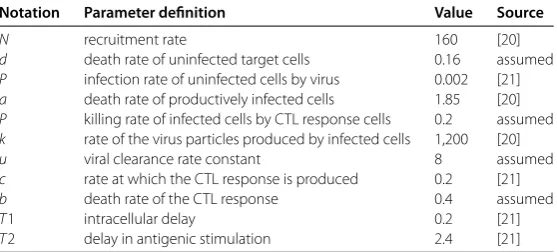
In the previous sections, we studied dynamical behaviors of the system () and obtained some important results. For a numerical simulation of the proposed model, we used the parameter values given in Table .
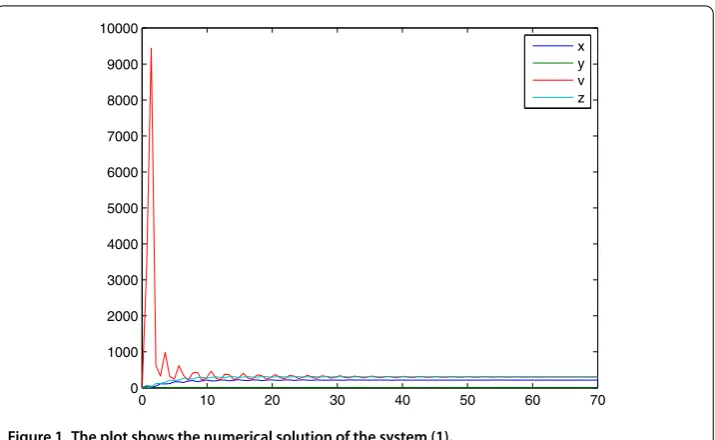
Figure represents the dynamical behavior of the densities of uninfected target cells x(t), the infected target cellsy(t), the free virusv(t), and the densityzrepresents the CTL response cells at timet. Our results show that by incorporating the delay term in the model one increases the number of CDT positive cells and decreases the uninfected cells.
In this paper we discuss a HIV-infection model by introducing delay terms in different interaction terms. Dynamical analysis of the system () shows that delays play an impor-tant role in the stability of the equilibrium. The detailed analytic study has shown that the extended model with delays, like the model with no delay, also has three equilibrium solutions. The disease-free equilibriumE, the single-infection equilibrium,E, and the
double-infection equilibrium,E, and a series of bifurcations occur as the basic
repro-duction number is increased. One has shown thatEis globally asymptotically stable for
R∈(, ) and becomes unstable at the transcritical bifurcation pointR= and bifurcates
intoE, which is globally asymptotically stable forR> . However, it loses it stability at
another bifurcation pointR> +bβke
–mτ
cdu andEoccurs. Also, it has been shown thatE is globally asymptotically stable.
From the reproductive numberR(τ) =kβNe
–mτ
adp , which is a function ofτ, we see that it is decreasing in delayτ withR(∞) = , which means that the intracellular delayτ
plays a positive role in preventing the virus. Because the largerτcan bringRto a level
lower than one. When the delay is chosen as the bifurcation parameter, it is shown that the delay plays an important role in determining the dynamical behavior of the system.
Table 1 Parameters used for numerical simulation
Notation Parameter definition Value Source
N recruitment rate 160 [20]
d death rate of uninfected target cells 0.16 assumed
P infection rate of uninfected cells by virus 0.002 [21]
a death rate of productively infected cells 1.85 [20]
P killing rate of infected cells by CTL response cells 0.2 assumed
k rate of the virus particles produced by infected cells 1,200 [20]
u viral clearance rate constant 8 assumed
c rate at which the CTL response is produced 0.2 [21]
b death rate of the CTL response 0.4 assumed
T1 intracellular delay 0.2 [21]
Figure 1 The plot shows the numerical solution of the system (1).
This indeed suggests that delay is a very important fact which should not be missed in HIV- modeling. Finally, through numerical simulations, it can be concluded that delays in the infection process and virus production period play an important role in the disease control.
Competing interests
The authors declare that they have no competing interests.
Authors’ contributions
All authors contributed to the expression of the model, the discussion of results, and they wrote and approved the paper.
Author details
1Department of Mathematics, University of Malakand, Chakdara Dir (Lower), Khyber Pukhtoonkhwa, Pakistan. 2Department of Mathematics, Science College, King Saud University, Riyadh, Saudi Arabia.
Acknowledgements
We would like to thank the anonymous referees for their careful reading of the original manuscript and their many valuable comments and suggestions that greatly improved the presentation of this study. This work has been partially supported by King Saud University, Saudi Arabia.
Received: 2 November 2015 Accepted: 10 March 2016
References
1. Culshaw, RV, Ruan, S, Webb, G: A mathematical model of cell-to-cell spread of HIV-1 that includes a time delay. J. Math. Biol.46(5), 425-444 (2003)
2. Culshaw, RV, Ruan, S: A delay-differential equation model of HIV-1 infection ofCD4+ T-cells. Math. Biosci.165(1), 27-39 (2000)
3. Nelson, PW, Murray, JD, Perelson, AS: A model of HIV-1 pathogenesis that includes an intracellular delay. Math. Biosci.
163(2), 201-215 (2000)
4. Zhu, H, Zou, X: Impact of delays in cell infection and virus production on HIV-1 dynamics. Math. Med. Biol.25(2), 99-112 (2008)
5. Canabarro, AA: Periodic solutions and chaos in a non-linear model for the delayed cellular immune response. Physica A342(1-2), 234-241 (2004)
6. Wang, K, Wang, W, Pang, H, Liu, X: Complex dynamic behavior in a viral model with delayed immune response. Physica D226(2), 197-208 (2007)
7. Pawelek, KA, Liu, S, Pahlevani, F, Rong, L: A model of HIV-1 infection with two time delays, mathematical analysis and comparison with patient data. Math. Biosci.235(1), 98-109 (2012)
8. Lashari, AA, Hattaf, K, Zaman, G: A delay differential equation model of a vector borne disease with direct transmission. Int. J. Ecol. Econ. Stat.27, 25-35 (2012)
10. Wang, X, Elaiw, A, Song, X: Global properties of a delayed HIV infection model with CTL immune response. Appl. Math. Comput.218(18), 9405-9414 (2012)
11. Zhu, H, Luo, Y, Chen, M: Stability and Hopf bifurcation of a HIV infection model with CTL-response delay. Comput. Math. Appl.62(8), 3091-3102 (2011)
12. Beretta, E, Kuang, Y: Geometric stability switch criteria in delay differential systems with delay dependent parameters. SIAM J. Math. Anal.33(5), 1144-1165 (2002)
13. Zaman, G, Kang, YH, Jung, IH: Optimal control in the SIR epidemic model with time delay. Biosystems98, 43-50 (2009)
14. Zhang, T, Liu, J, Teng, Z: Stability of Hopf bifurcation of a delayed SIRS epidemic model with stage structure. Nonlinear Anal., Real World Appl.11(1), 293-306 (2010)
15. Song, X, Zhou, X, Zhao, X: Properties of stability and Hopf bifurcation for a HIV infection model with time delay. Appl. Math. Model.34(6), 1511-1523 (2010)
16. Miao, H, Abdurahman, X, Muhammadhaji, A: Global stability of HIV-1 infection model with two time delays. Abstr. Appl. Anal.2013, Article ID 163484 (2013)
17. Wang, J, Wang, K, Jiang, Z: Dynamical behaviors of an HTLV-I infection model with intracellular delay and immune activation delay. Adv. Differ. Equ.2015, 243 (2015)
18. Wang, J, Zhang, R, Kuniya, T: Mathematical analysis for an age-structured HIV infection model with saturation infection rate. Electron. J. Differ. Equ.2015, 33 (2015)
19. Wang, J, Liu, S: The stability analysis of a general viral infection model with distributed delays and multi-staged infected progression. Commun. Nonlinear Sci. Numer. Simul.20(1), 263-272 (2015)
20. Janeway, CA, Travers, P, Walport, M, Schlomchik, MJ: Immunobiology, 6th edn. Garland, New York (2005)
21. Kuang, Y: Delay Differential Equations with Applications in Population Dynamics. Academic Press, San Diego (1993) 22. LaSalle, J: The Stability of Dynamical Systems. SIAM, Philadelphia (1976)