International Journal of Scientific Research in Computer Science, Engineering and Information Technology © 2017 IJSRCSEIT | Volume 2 | Issue 2 | ISSN : 2456-3307
Enhanced Hybrid Approach for Load Balancing Algorithms in
Cloud Computing
S. Subalakshmi,
N. Malarvizhi
Computer Science and Engineering, Anna University/IFET College of Engineering, Villupuram, Tamil Nadu, India
ABSTRACT
In Cloud Computing, the biggest challenge is how to handle and service the millions of requests that are arriving very frequently from end users efficiently and correctly. Load balancing is one of the tactics to overcome this challenge. It is the mechanism of redistributing the workload among the nodes so that no single node is overloaded or under loaded. Load balancing can be achieved using suitable algorithms. Enhanced hybrid approach using Throttled and Equally Spread Current Execution load balancing algorithm has been proposed. This enhanced approach is used to minimize the response time, avoid the bottleneck problem, maximize the services and reduce the machine cost.
Keywords : Load Balancing , Throttled algorithm , Cloud Computing.
I.
INTRODUCTION
Cloud Computing isa manner to increasethe capabilities dynamically without investing in new infrastructure. [2]Cloud computing is an emerging technology and has attracted a lot of attention in both commercial and academic spheres. Cloud computing is a developing computing paradigm that has inclined every other entity in the digital industry, it may be government sector or the private sector.[6] Taking into account the mounting significance of cloud, finding new ways to advance cloud services is an area of concern and research center. [5]Usually clouds have powerful data centers to handle large number of users. Cloud is a platform providing dynamic pool of resources. It is growing very fast and provides an alternative to conventional computing. It is considered as an internet evolution and will be support for future internet development. [4]It is the latest trend in computing where the intention is to facilitate cheap, utility type Cloud Computing defined by NIST as, "A Model for enabling ubiquitous, convenient, on-demand network access to a share pool of configurable computing resources (Ex. Network, Servers, Storage, Applications and services) that can be rapidly provisioned and released with minimal effort or
Service provider interaction”.[1] Any enterprise can easily provision, manage and sustain (keep up-to- date and scale) their entire operations on a compute cloud for a fraction of the cost of owning the resources. [6]In essence, cloud computing results in commoditization of typicalcomputing resources which are now, via compute clouds, available as services. Services are no longer tied to dedicated hardware and platform, instead, virtualized resources- servers, network devices and storage-are abstracted from the hardware [8].
II.
METHODS AND MATERIAL
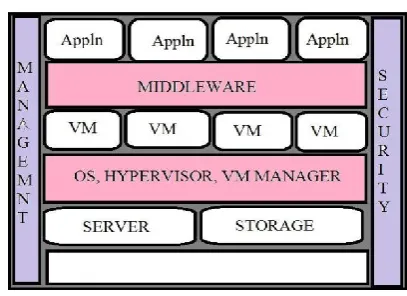
A. Cloud Architecture
B. Load Balancing
Load balancing is the main requirement for growing the cloud performance and for completely utilizing the resources. Cloud platform can be quickly scaled up and down at any point of time. So the numbers of user's requests can join to and leave from the cloud during the execution of the applications.[9] In this dynamic environment an efficient load balancing is required to minimize the response time, lower network congestion, avoid the interruption of services, limited energy consumption and provides high availability which means continuity of services when components becomes non-responsive. [3]Load Balancing is used to implement failover mechanism across different datacenters to improve response time, turnaround time and maintains the system stability and performance.
It is the process of improving the performance of the system by shifting of workload among the processors. Workload of a machine means the total processing time it requires to execute all the tasks assigned to the machine.[1]Load balancing is done so that every virtual machine in the cloud system does the same amountof work throughout therefore increasing the throughput and minimizing the response time. Load balancing is one of the important factors to heighten the working performance of the cloud service provider.[7] Balancing the load of virtual machines uniformly means that anyone of the available machine is not idle or partially loaded while others are heavily loaded. One of the crucial issue of cloud computing is to divide the workload dynamically.[6] The benefits of distributing the workload includes increased resource utilization ratio which further leads to enhancing the overall performance thereby achieving maximum client satisfaction.
A. Goals of Load Balancing
The goals of load balancing are:
To improve the performance substantially
To have a backup plan in case the system fails even partially
To maintain the system stability
To accommodate future modification in the system
C. Load Balancing Algorithm
Load balancing algorithm deals with balancing the load on server nodes. The main responsibility of the load balancing algorithms is how to select next server node and to transfer new request to that particular node. Load balancing algorithms are classified as static and dynamic algorithms.[5] Static algorithms are mostly suitable for Homogeneous and stable environments and can produce very good results in these environments. However, they are usually not flexible and cannot match the dynamic changes to the attributes during the execution time. Dynamic algorithms are more flexible and take into consideration different types of attributes in the system both prior to and during run-time.[3] These algorithms can adapt to changes and provide better
results in heterogeneous and dynamic environments. However, as the distribution attributes become more complex and dynamic.[1] As a result some of these algorithms could become inefficient and cause more overhead than necessary resulting in an overall degradation of the services performance.
D. Literature Survey
Load Balancing Techniques: Major Challenge in Cloud Computing – A Systematic Review[1] Authors: Velagapudi Sreenivas, Prathap. M, Mohammed Kemal
Load balancing is one of the main challenges in cloud computing. The goal of load balancing is to minimize the resource consumption which will further reduce energy consumption and carbon emission rate that is the dire need of cloud computing. This determines the need of new metrics or parameters like performance, scalability, associated overhead etc.,
Cloud Computing: Performance Analysis of Load Balancing Algorithms inCloud Heterogeneous Environment [2] Authors: VeerawaliBehal, Anil Kumar
performance analysis of load balancing policies which are taken in a combination with service broker policy. In Fact, this study addresses that there can be reduction in response time and data center request processing time by using efficient load balancing policies.
Hybrid Approach Using Throttled and ESCE Load Balancing Algorithms in Cloud Computing [3] Authors: Vishwas Bagwaiya, Sandeepk
Raghuwanshi
Cloud is a platform providing dynamic pool of resources and virtualization. To properly manage the resources of the service contributor, load balancing is required for the jobs that are submitted to the service contributor. Load balancing is a tactic to share out workload across many virtual machines in a Server over the network to achieve optimal resource consumption, least data processing time, least average response time, and avoid overload. The objective of this paper is to propose efficient and enhanced Hybrid scheduling algorithm that can maintain the load and provides modified resource allocation techniques. In this paper Hybrid approach is applied for load balancing using Throttled and Equally Spread Current Execution (ESCE) algorithms.
A Load Balancing Strategy for Cloud Computing Environment [4] Authors: Raza Abbas Haidri C. P. Katti, P. C. Saxena
The main goal of cloud service provider is to establish an efficient load balancing algorithm which ensures a fair distribution of loads among virtual machines and better resource utilization. In this paper a heuristic based load balanced scheduling model for efficient execution of tasks. The proposed model balances the loads coming from several users among datacenters and hence it offers better resource utilization and high availability in the form of improved response time and turnaround time. The proposed algorithm is implemented using CloudSim simulator and the result shows that the proposed algorithm outperforms to existing algorithms on similar objectives.
Load Balancing with Optimal Cost Scheduling Algorithm [5] Authors: Nagamani H. Shahapure, Dr. Jayarekha P
The commonly used load balancing objectives in a cloud computing environment are related to the tasks completion time and resource utilization. InLoad Balancing with Optimal Cost Scheduling Algorithm. The user selects a list of services available from the service pack. The scheduler processes these tasks to the virtual machine (VM) based on the configuration and computing power of the VM. This task is achieved with minimum execution cost which is a profit for the service provider and minimum execution time which is an advantage for both service provider and the user..
PerformanceEvaluation of Load Balancing Policies across Virtual
Machines in a Data Center [6] Authors: VasudhaArora, S. S. Tyagi
A cloud service provider provides services on the basis of client's requests. Client's requests are processed in the virtualized data centers where a physical machine runs a number of virtual machines on it. An important issue in cloud is scheduling of virtual machines in a data center in this paper, we are going to evaluate the performance of three load balancing policies round robin, throttled and equally spread execution load, across virtual machines in a single data center.
vii). A Cooperative Game Method for Load Balancing in Cloud Based on Cost- Efficiency [7] Authors: Shaoyi Song, TingjieLv, Xia Chen
The algorithm proposed in this paper formulates the load balancing problem as cooperative game among clusters that each cluster making load balancing decisions by cooperating with the other clusters to make the costs for processing is minimized. Then the jobs received by a cluster are allocated to processors using cooperative game among processors.
A Novel Approach for Dual-Direction Load Balancing and Storage Optimization in Cloud Services [8] Authors: Klaithem Al Nuaimi, Nader Mohamed, Mariam Al Nuaimi, and JameelaAl-Jaroodi.
optimization to the cloud storage usage. Partial replication is used in this algorithm to ensure the reliability and availability of the data. Our focus is to improve the performance and optimize the storage usage in providing the DaaS service of the cloud. This algorithm solves the problem of having to fully replicate very large data sets, which uses up a lot of precious space on the cloud servers. Reducing the space needed will help reduce the cost of providing such space.
Load Balancing Task Scheduling based on Genetic Algorithm in Cloud Computing [9] Authors: Tingting Wang, ZhaobinLiu. , Yi Chen, YujieXu, Xiaoming Dai
Task scheduling is one of the most critical issues on cloud platform. The number of users is huge and data volume is tremendous. Requests of asset sharing and reuse become more and more imperative. Efficient task scheduling mechanism should meet users’ requirements and improve the resource utilization, so as to enhance the overall performance of the cloud computing environment. In order to solve this problem, considering the new characteristics of cloud computing and original adaptive genetic algorithm (AGA), a new scheduling algorithm based on double-fitness adaptive algorithm-job spanning time and load balancing genetic algorithm (JLGA) is established. This strategy not only works out a tasks schedulingsequence with shorter job and average job make span, but also satisfies inter-nodes load balancing.
B. Existing System
Hybrid approach contains the excellence of both Throttled and Equally Spread Current Execution (ESCE) load balancing algorithms. In ESCE technique, the load balancer gets number of virtual machines by maintaining an index table and queue of requests currently assigned to the virtual machine. The balancer continuously scans the queue and the index list of virtual machines. If there is a VM available, the VM is allocated to that request. If on the other hand there is a VM that is free and there is another VM that needs to befreed of the load, then the balancer distributes some of the tasks of that VM to the free one so as to reduce the overhead of the former VM. Throttled algorithm maintains an index list of all virtual machines as well as their states (Available or Busy). Whenever a request
comes to the data center the load balancer scans the index list from top until the first available VM is found or the index list is scanned fully. If a match is found, the load balancer allocates the VM to the client.
Hybrid approach utilizes main features of both the algorithms. Hybrid algorithm maintains index list of VM allocation status as well as list to count the allocated request. First of all allocated request list is compared with the index list of VMs. If VMs index list is greater than allocated request list it means that VMs are available to take request else request has been queued until VM is been available.
C. Existing Load Balancing Algorithm
EQUALLY SPREAD CURRENT EXECUTION ALGORITHM (ESCE).In this algorithm an index table of virtual machines as well as number of requests to the virtual machine is maintained by the load balancer. In case the request for the allocation of new virtual machine from the data center is received, then the index table is scanned for the virtual machine which is least loaded. If more than one virtual machine is found then the first identified virtual machine is allocated for request handling which was given by the user and the virtual machine id is return to the datacenter controller (DCC). The data center converses the request to the virtual machine using the received id. The index table is altered every time by increasing the allocation count of the virtual machine identified which is done by the data center. When the allocated task of the virtual machine is completed, a request to data center is made which is again notified by the load balancer. Again the index table is revised every time by decreasing the allocation count for the virtual machine identified. The disadvantage of this algorithm is additional computation overhead byscanning the queue again and again.
D. Throttled Algorithm
set to available mode. The data center controller searches balancer for next virtual machine allocation, when it receives a new request. The balancer start the checking the table thoroughly until the relevant match of virtual machine is found. If possible virtual machine is found then the load balancer return the id of that virtual machine to the data center controller. Instantly datacenter controller sends request to virtual machine by particular id. After that, data center controller sends notification to load balancer of new allocation so that it can update the table. If there exists a case, when virtual machine is not found then the load balancer returns -1 value and datacenter queues the request. As soon as virtual machine finishes with the processing of the assigned requests, the data center controller receives a response cloudlet later.
III.
RESULTS AND DISCUSSION
A. Enhanced Hybrid Algorithm
Enhanced hybrid approach is the advancement of hybrid algorithm which contains both Throttled and Equally Spread Current Execution algorithm. Enhanced Hybrid algorithm maintains an index list of VM allocation status as well as list to count the allocated request. The allocated request list is compared with the VMs index list. If VMs index list is greater than allocated request list it means that VMs areavailable to take request else request has been queued until VM is been available. If the VM has been queued, it has to wait in the queue itself. So new host has been created using host create function.In case of availability of VM, the jobs are allocated to that particular VM. And both the index list and hash list are updated. The job in queue need not wait for long time for the virtual machine to become available. Maximize the resource utilization than the existing system. Minimize the response time and negligible idle time.
B. Algorithm For Enhanced Hybrid Approach
Step 1: Initialize the allocation status of all VMs as AVAILABLE in the state list ofVM.
Step 2: Initialize Hash map without any entries.
Step 3: A new request has been sent to the DataCenterController (DCC).
Step 4: For next allocation new load balancer has been queried by theDataCenterController.
Step 5: If Hash map list size less than VM state list size then allocate VM.
Step 6: Else call host create function using which new physical machine configuration has .
Step 7: After finishing the processing of request by VM DataCenterController receives cloudlet response and VM de-allocation is noticed.
Step 8: The status of VM in VMs state list and Hash map list is updated by the load balancer.
C. Proposed System
Module Description
1. Cloudletcreation:
Cloudlet is the user request that tends to create virtual machine. It stores, despite all the information encapsulated in the Cloudlet, the ID of the VM running it. Cloudlet is a class that models thecloud base application services in cloud computing environment. It is the representation oftask.
2. Datacentercreation
Datacenters are the service providers in cloud computing. Datacentercontains:Architecture, OS, List of Machines, Allocation policy, Time zone and itsprice. The physical hardware details include the Storage, Memory, Processor speed, Available processors, Available Bandwidth. DataCenter is a centralized repository, either physical or virtual, for the storage, management and dissemination of data, information.
3. Virtual Machine Creation:
For each cloudlet, create an individual and independent virtual machine to process the job request. Virtual machine is created along with its Id, broker Id, MIPS, Bandwidth, VMM, RAM memory, Image size.
4. Load Balancing Policy:
D. Implementation
The initial process in this Enhanced hybrid algorithm is to configure the user base such that name, region, request per user per hour, data size per request, peak hours start, average peak users and average off-peak hours. Moreover, the duration of the simulation is fixed your requirement and the service broker policy(optimal response time) is also selected. These are all done in the main configuration in cloud analyst. Using data center configuration in cloud analyst we add few data centers with its region, architecture, OS,virtual machine manager, cost per VM, memory cost, storage cost, data transfer cost and physical hardware units. The advanced configuration such as user grouping factor in user bases, request grouping factor in data centers and executable instruction length per request are done. The proposed algorithm is selected as the load balancing policy across VM’s in a single data center.
IV.CONCLUSION
Enhanced hybrid approach load balancing algorithm is proposed and implemented in cloud computing environment using CloudSim toolkit, in java language. This work involves the combination of Throttled,
Equally Spread Current Execution (ESCE) and the advancement of hybrid load balancing algorithms. Intermediate deliverables included studying the existing VM load balancing algorithms, proposing an efficient algorithm for VM load balancing, implementing the algorithm on Cloud Analyst, and comparing the proposed algorithm with the existing algorithms on identified parameters. By analyzing the parameters in graphs and tables we came to know that the overall response time, data processing time is
relatively minimized as well as data transfer cost is reduced.
V.
REFERENCES
[1]. Velagapudi Sreenivas, Prathap. M, Mohammed Kemae, "Load Balancing Techniques: Major Challenge in Cloud Computing – A Systematic Review". Proceedings of 5th IEEE International Joint Conference on INC, IMS and IDC, Seoul, Korea, August 2009, pages 44-5l.
[2]. Veerawali Behal, Anil Kumar, "Cloud Computing: Performance Analysis of Load Balancing Algorithms in Cloud Heterogeneous Environment", IEEE 2014.
[3]. Klaithem Al Nuaimi1, Nader Mohamed1, Mariam Al Nuaimi1, and Jameela Al-Jaroodi2, "A Novel Approach for Dual-Direction Load Balancing and Storage Optimization in Cloud Services", 2014 IEEE 13th International Symposium on Network Computing and Applications.
[4]. Raza Abbas Haidri, C. P. Katti, P. C. Saxena, " A Load Balancing Strategy for Cloud Computing Environment", International Conference on Signal Propagation and Computer Technology (ICSPCT), 2014.
[5]. Vasudha Arora, S. S. Tyagi, "Performance Evaluation of Load Balancing Policies across Virtual Machines in a Data Center", 2014 International Conference on Reliability, Optimization and Information Technology - ICROIT 2014.
[6]. Nagamani H. Shahapure, Jayarekha P, "Load Balancing With Optimal Cost Scheduling Algorithm", International Conference On Computation of Power, Energy, Information and Communication (ICCPEIC), 2014.
inCloud Based on Cost-Efficiency", ICUFN 2014.
[8]. Tingting Wang, ZhaobinLiu. , Yi Chen, YujieXu, "Load Balancing Task Scheduling based on Genetic Algorithm in Cloud Computing", 12th International Conference on Dependable, Autonomic and Secure Computing, IEEE 2014. [9]. Vishwas Bagwaiya1, Sandeep k. Raghuwanshi,