Dynamical patterning modules
in plant development and evolution
VALERIA HERNÁNDEZ-HERNÁNDEZ
1, KARL J. NIKLAS
2, STUART A. NEWMAN
3and MARIANA BENÍTEZ*
,1,4,51Centro de Ciencias de la Complejidad, C3, Universidad Nacional Autónoma de México, Mexico, 2Department of Plant Biology, Cornell University, Ithaca, NY, USA,
3Department of Cell Biology and Anatomy, New York Medical College, Valhalla, NY, USA and
4Department of Functional Genomics and Proteomics, CEITEC-Central European Institute of Technology, Brno, Czech Republic, 5Departamento de Ecología de la Biodiversidad, Instituto de Ecología, Universidad Nacional Autónoma de México, México.
ABSTRACT Broad comparative studies at the level of developmental processes are necessary to fully understand the evolution of development and phenotypes. The concept of dynamical pattern-ing modules (DPMs) provides a framework for studypattern-ing developmental processes in the context of wide comparative analyses. DPMs are defined as sets of ancient, conserved gene products and molecular networks, in conjunction with the physical morphogenetic and patterning processes they mobilize in the context of multicellularity. The theoretical framework based on DPMs originally pos-tulated that each module generates a key morphological motif of the basic animal body plans and organ forms. Here, we use a previous definition of the plant multicellular body plan and describe the basic DPMs underlying the main features of plant development. For each DPM, we identify characteristic molecules and molecular networks, and when possible, the physical processes they mobilize. We then briefly review the phyletic distribution of these molecules across the various plant lineages. Although many of the basic plant DPMs are significantly different from those of animals, the framework established by a DPM perspective on plant development is essential for comparative analyses aiming to provide a truly mechanistic explanation for organic development across all plant and animal lineages.
KEY WORDS:
dynamical patterning module, plant evo-devo, epigenetics
Introduction
The dynamic characterization of developmental processes is central to our understanding of the origin and transformation of form, and thus the evolution of phenotypes (Müller, 2007). Since multicellularity in plants and animals appears to have independent origins (Meyerowitz, 2002), studying the dynamics of developmen-tal processes in these two vastly different and diverse kingdoms enables broad comparative studies to discern both generic and particular aspects of development (Meyerowitz, 2002).
Newman and Bhat (2008, 2009; see also Newman, 2011) pro-posed a useful conceptual framework to characterize and compare basic developmental processes in all multicellular organisms includ-ing plants, here broadly defined as all lineages of photosynthetic eukaryotes, including the various polyphyletic algal clades and the monophyletic land plant clade, the embryophytes (see Niklas, 2000; Fig. 1). This framework identifies what are called dynamical
www.intjdevbiol.com
*Address correspondence to: Mariana Benítez. Departamento de Ecología de la Biodiversidad, Instituto de Ecología, Universidad Nacional Autónoma de México,
Mexico. e-mail: [email protected]
Accepted: 13 August 2012. Final, author-corrected PDF published online: 8 November 2012. Edited by: Mieke Van Lijsebettens.
ISSN: Online 1696-3547, Print 0214-6282 © 2012 UBC Press
Printed in Spain
Abbreviations used in this paper: DIF, differentiation; DPM, dynamical patterning module; DTF, developmental transcription factors; FCW, future cell wall; GRN, gene regulatory network; LLS, leaf-like structure; POL, polarity.
patterning modules (DPMs), which are sets of ancient, conserved
state, though they typically originate by the co-option of genes and regulatory systems already present in the unicellular ancestors of animals (Newman and Bhat, 2009), fungi and plants (see below). In addition, DPMs can act alone or in combination, giving rise to a “pattern language” for the generation of the basic organismic forms of animals and plants (Newman and Bhat, 2008, 2009).
DPMs are assumed to have been uniquely efficacious in the origination of multicellular form, as the generic nature of the DPM-associated physical processes makes it plausible that an assortment of stereotypical forms emerged with relative ease with the rise of multicellularity (Newman, 1994). In present-day developmental systems, the body plan- and organ form-generating DPMs may also continue to operate; however, processes of canalization (Waddington, 1957), stabilizing selection (Schmalhausen, 1949) and developmental systems drift (True and Haag, 2001), may have led to their becoming integrated into more complex pathways.
In conjunction with DPMs, Newman and Bhat (2009) considered the complementary roles of developmental transcription factors (DTFs), which are the products of a different subset of ancient conserved genes from the ones involved in DPMs. The DTFs and their cognate cis-acting elements comprise gene regulatory networks (GRNs), which determine cell fate choice and cell differ-entiation (Davidson and Erwin, 2006), mainly in a cell-autonomous manner. Together, the DTFs and the DPM-associated molecules and pathways constitute what Carroll (2001) has called the ”de-velopmental toolkit”. In the case of animals, the gene products enabling the DPMs are an ”interaction toolkit” (Newman, 2011), which includes molecules such as cadherins, collagen, Notch, Wnt, Hedgehog and BMP. In postulating a framework in which the interplay between DPMs and DTF-associated GRNs provided the
Alveolates
Fig. 1. Redacted schematic of the phylogenetic relationships among the two prokaryotic domains (Archaea and Bacteria) and the five major eukaryotic photoautotrophs, collectively referred to as ”plants” (euglenoids, dinoflagellates, rhodophytes, chlorobionta and stramenopiles).
physico-chemical mechanisms, and organ-ism-environment interactions, are necessary for the generation and variation of plant forms (e.g., Perry et al., 2007; Peaucelle et al., 2011; Niklas and Kutschera, 2012; Uyttewaal et al., 2012). Hence, in order to fully understand the development of plant phenotypes, and therefore their evolution, it will be useful to extend the current comparative strategies to include those that allow comparing non-linear and multifactorial modules. Defining a basic set of plant DPMs is an important starting point in this challenging undertaking.
We frame our analysis in terms of the
multicellular plant body plan, as defined by
Niklas and Kutschera (Niklas, 2000; Niklas and Kutschera, 2009). This body plan is dis-tinguished from the unicellular (e.g.,
Chlam-ydomonas), colonial (e.g., Phaeocystis), and
siphonous (e.g., Caulerpa) plant body plans by virtue of having symplastic intercellular connections that pass through the walls of some or all adjoining cells. The multicellular body plan has in turn four tissue construc-tion variants: (1) unbranched filaments (e.g.,
Spirogyra), (2) branched filaments that can
be interweaving to give rise to a (3) pseudo-parenchymatous tissue construction (e.g.,
Ralfsia), and (4) a parenchymatous tissue
raw material for the evolution of the metazoans, Newman and Bhat (2009) also suggested that the evolution of multicellular organ-isms in other taxonomic groups followed an analogous trajectory (Newman et al., 2006).
Although the evolutionary history and the origin of multicellular-ity in plants are not as well-described as in animals, our intention here is to outline a DPM catalog for plants. We recognize that this catalog is preliminary and that it will undoubtedly be modified as new insights into plant development become available. Our goal is to inform as best as we can future experimental and theoretical work.
Given that plants and animals are different developmentally in many ways, the nature and role of any DPM operating in plants likely differ from those described for animals by Newman and Bhat (Newman and Bhat, 2009; Newman, 2011). In particular, plant DPMs must incorporate physical limitations on plant development that differ from those that prevail during animal development.
construction, which permits the formation of all other body plan types (characteristic of all land plants) (e.g., Fritschiella).
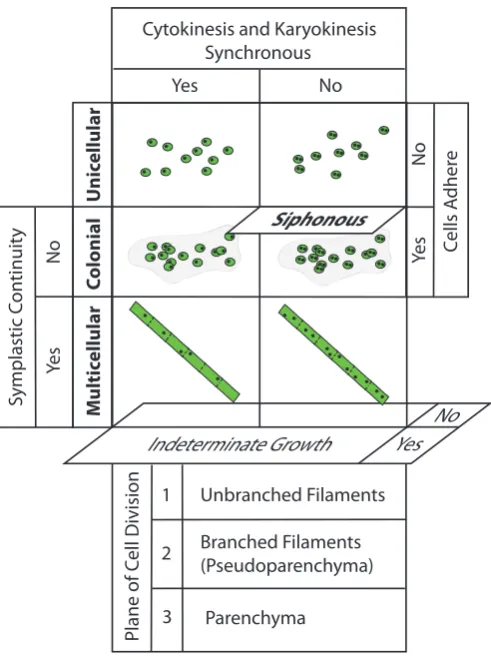
Although plants, when broadly defined, constitute a polyphyletic group (Schlegel, 1994; Graham and Wilcox, 2000; Niklas, 2000), many of the overall shapes and growth forms observed for plants are strikingly similar among the different lineages, suggesting an important degree of convergence. For these and other reasons, the basic plant body plans, in addition to the common and disparate molecular components employed during their development, can be distinguished on the basis of how they achieve their organized growth (Niklas, 2000). It is in this regard that the DPM concept is particularly relevant in terms of the key developmental processes that produce the different plant body plans: (1) the synchronicity of cytokinesis and karyokinesis, (2) cell-cell adhesion, (3) the es-tablishment of symplastic continuity among adjoining cells, and (4) the plane of cell division (Niklas, 2000; Fig. 2). Our identification of plant DPMs further extends and elaborates on these four processes.
In the following sections we will describe basic features of plant organization and development that in certain aspects set them apart from the animals. We then present a basic preliminary set of DPMs, which in recognition of the tremendous diversity observed across the algal and land plant lineages, is based primarily on the experimental and developmental information available for the widely studied annual vascular plant Arabidopsis thaliana. However, in order to explore the evolutionary origin of these modules, we track as far as currently possible the presence of certain DPM- and
GRN-associated genes and molecules within and across different plant lineages. Next, we compare our proposal with other, comple-mentary, attempts to explain the evolution of plant forms, e.g., in terms of the evolution of certain gene families. Finally, we discuss the novel aspects of plant DPMs relative to those of animals, and draw some conclusions about general principles of multicellular development and its evolution.
Characteristics of plant development and organization
Even though the DPM framework proposed by Newman and Bhat (Newman and Bhat, 2009; Newman, 2011) is in principle applicable to all multicellular organisms, plant development has features that suggest the presence of additional or different sets of DPMs and perhaps even a different DPM-GRN relationship. In particular, we note that many plants are characterized by having open, indeterminate development during which new tissues and organs are added continuously over the course of their life times. This mode of development reflects the presence of meristems, which are composed of pluripotent cells. Among embryophytes, these stem cells give rise to primary and secondary tissues, as well as generating new organs.Another distinguishing feature is that plant growth and devel-opment are profoundly influenced by environmental cues and factors, such as changes in light, nutrient and water availability, temperature, ecological interactions, etc. The result is a high degree of developmental plasticity which can produce different morpholo-gies among conspecifics (and even among the same organs of a single individual). Nevertheless, several developmental features help to characterize recurrent plant structures that are outcomes of potentially generic patterning and morphogenetic processes.
In addition to its indeterminate and highly plastic nature, we note two other fundamental features of plant development. The first is that plant cells have relatively rigid cell walls such that morphogenesis must occur in the absence of cell migration to generate spatiotemporal patterns. Therefore, programmed cell death and differential asymmetric cell division and growth (e.g., De Smet and Beeckman, 2011), as well as the dynamic emer-gence and regeneration of spatial boundaries and regions take on particular importance in plant development (Scheres, 2001; Kim and Zambryski, 2005). In this context, ”spatially dependent differentiation” refers to the generation of distributions of cell types associated with heterogeneous patterns of signals. These patterns are not necessarily instructive chemical fields passively interpreted by cell arrays (Wolpert, 1996), but may self-organize during development by complex interactions among genetic and epigenetic elements (Salazar-Ciudad et al., 2003; Benítez et al., 2011; Balaskas et al., 2012).
Second, phytohormones such as auxins, cytokinins, ethylene, abscisic acid, gibberellins, brassinosteroids, jasmonic acid, etc., play a central role in the formation of temporal and spatial patterns during development. Although major aspects of their synthesis, degradation, transport and cross-regulation have long been known (see Taiz and Zeiger, 2002), plant hormones and their signaling systems have only been intensively studied from a genetic and molecular perspective in recent years. In particular, the developmental role and the molecular mechanisms associated with auxin have been extensively characterized (Leyser, 2011; Wabnik et al., 2011). It is now clear that auxin, in conjunction with
Cytokinesis and Karyokinesis Synchronous
Cells A
dher
e
Yes No
Multic
ellular C
olonial Unic
ellular
Yes No
Yes No
Symplastic C
on
tinuit
y
Indeterminate Growth
Yes
No
Unbranched Filaments
Branched Filaments (Pseudoparenchyma)
Plane of C
ell Division
Parenchyma 1
2
3
Siphonous
other phytohormones, participates in the regulation of manifold developmental transitions and participates in defining regions that correspond to particular structures and cell types (Niklas and Kutschera, 2012).
Another key feature of plant development is also closely related to the non-migrating nature of plant cells and to the dynamics of spatially dependent differentiation. In the case of animal develop-ment, it is relatively easy to distinguish between gene products and molecules belonging to an interaction toolkit involved in global DPM-mediated morphogenesis and pattern formation from those (primarily DTFs) involved in intracellular developmental events, such as cell-fate determination (Newman and Bhat, 2009). How-ever, in many of the best-studied developmental systems of the plant model A. thaliana, it is commonly observed that transcrip-tion factors involved in cell-fate determinatranscrip-tion are also involved in global patterning processes, e.g., flower organ determination (Urbanus et al., 2010), epidermal cell patterning (Kurata et al., 2005) and meristem subspecification in the root (Cui et al., 2007). Indeed, it has been shown that the mobilization of transcription factors and other molecules through plasmodesmata (channels traversing cell walls and enabling transport and communication between cells), plays a central role during plant developmental processes (Kim and Zambryski, 2005). Although intercellular transport of developmental transcription factors is not unknown in animal systems, it is extremely rare (Prochiantz, 2011).
In addition to being a continuum relative to the action of devel-opmental transcription factors, plant tissues are permissive to the direct cell-cell transport of soluble signaling factors such as auxins and other phytohormones. In contrast to animal morphogens, these molecules can act intracellularly as transcriptional modulators and determinants of the differentiated state (see, for example, Garrett et al., 2012). Nevertheless, unlike animal morphogens, phytohormones exert a more direct transcriptional regulation and have a strong morphological impact during the whole life cycle of the organism. The direct transcriptional roles of morphogens, like the aforementioned cell-to-cell transport of transcription factors, blur the functional separation of GRNs (single-cell determinants of cell differentiation) and DPMs (multicell determinants of pat-tern formation and morphogenesis) seen in animal development (Newman and Bhat, 2008, 2009).
Basic dynamical patterning modules (DPMs) in plants
Herein, we present each of the postulated DPMs in the context of what we consider key developmental events and processes in plants. We also discuss the possible origin of these modules in the light of the presence of the characteristic molecules they deploy in different plant lineages. Some of these modules have been studied by other authors (e.g., Green, 1962; Lindenmayer, 1975; Sachs, 1991), and have been postulated as important mechanisms in plant development and evolution. In this contri-bution, we present these mechanisms in the context of recent experimental evidence and integrate them within the theoretical framework of dynamical patterning modules.Future cell wall (FCW)
A critical developmental module in plant evolution is a system that defines the orientation and location of the cell wall during cell division, which in turn results in the formation of different types
of tissue construction (Niklas, 2000). Among the charophycean algae and the embryophytes, the location of the future cell wall is prefigured by the appearance of the preprophase band and the phragmoplast (Brown and Lemmon, 2011). The mechanisms un-derlying the orientation and location of these cytological features are under investigation but not well understood (see for example Gibson and Gibson, 2012). However, early in the 20th century, workers reported that the application of pressure to a dividing cell forced the mitotic figure into the position in which the longitudinal axis was oriented at right angles to the applied pressure such that the future cell wall was oriented parallel to this direction (Kny, 1902; see also Lynch and Lintilhac, 1997). Likewise, Steward and cowork-ers (1958) noted that cells in free suspension have highly irregular and unpredictable planes of division, perhaps because they are not restricted peripherally as they would when cells normally grow within the plant body. Among certain colonial cyanobacteria, flagellates, and pollen sporocyctes wherein cell divisions are simultaneous, the planes of successive division tend to be at right angles to one another such that regular patterns of two, four, eight, etc. form, all in one plane (Geitler, 1951). A complementary geometric view of this process is known as Errera’s rule and has recently been explored as a modeling approach (Besson and Dumais, 2011).
That biomechanically induced mechanical stresses may be in-volved in cell wall orientation is consistent with many observations (e.g., Corson et al., 2009, although see Mirabet et al., 2011). The simplest plant cells are parenchyma cells, which have thin primary walls and are therefore hydrostatic. The turgor pressure exerted against the walls of these cells is more or less uniform. However, at the vertices created by adjoining cells, opposing tensile stresses are resolved into additional stresses acting in the radial direction on the angle of each vertex according to its size. In theory, the tensile stresses in walls at 180º should be equal and opposite and thus this angle experiences no additional radial stress from the resolution of the opposing tensile stresses in the two intersecting walls. However, these tensile stresses are resolved into progres-sively larger radial stresses as the angle of a vertex decreases, reaching their maxima as the angle approaches 0º. Because these additional radial stresses are correlated directly to the size of the angle, a cell reaches mechanical equilibrium at equiangular vertices. Consequently, the observation that the vertices in the region of isodiametrical expansion can act as cellular pivots for wall rotation between successive divisions (so as to coincide with cellular mechanical equilibria) provides some evidence for the biomechanical regulation of cell shape (Niklas and Spatz, 2012).
This biomechanical scenario is vastly different from that op-erating in an elongating cell (e.g., xylem fiber), wherein existing walls rotate around their vertices to align either perpendicular or parallel to the longitudinal axis and future cell walls are generally oriented perpendicular to the growth axis. Here, the principal stress trajectories likely resolve the global stress patterns into orthogonal components and are thus likely to be oriented parallel and perpendicular to the growth axis. In this condition, cell walls may be oriented so as to minimize shear stresses.
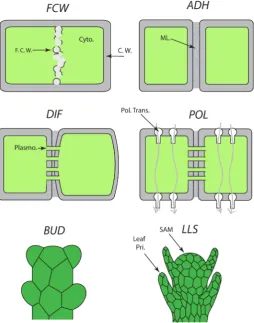
mechanical stresses operating in preexisting cell walls resulting from hydrostatic pressures (Table 1; Fig. 3).
The effects on multicellular organization of intracellular pat-terning processes in a founder cell such as an egg or stem cell have been discussed for animal systems under the rubric of ”au-tonomous” patterning mechanisms (Salazar-Ciudad et al., 2003). Because DPMs only come into play in animal embryos when a critical number of cells have been generated (e.g., at the morula or blastula stage), it has been suggested that disparate autonomous patterning processes that may occur in the eggs of subphylum taxa serve mainly to set the initial and boundary conditions for DPM implementation, with conservation of DPM-determined ”phylotypic” body plans (Newman, 2011). However, because of the immobility of plant cells, an autonomous patterning mechanism like FCW would be expected to have more profound consequences for plant body plan organization, placing it more in the DPM category. The biological differences between plants and animals are thus manifest even at this most basic level.
Cell-cell adhesion (ADH)
One of the requisites for multicellularity is the presence of mechanisms and molecules that enable cell-cell adhesion (ADH), which is achieved in different ways in plants, animals and fungi (Knox, 1992; Abedin and King, 2010; Wolf et al., 2012). Among the land plants, cells remain together mainly due to the presence of pectin polysaccharides in the middle lamella associated with the primary cell walls of adjoining cells, which constitute the so-called pectic matrix in which other structural cell-wall components, such as cellulose, hemicellulose and lignin are embedded (Knox, 1992; Willats et al., 2001; Jarvis et al., 2003) (Fig. 3).
The cell wall constitutes one of the characteristic features of plant cells and, arguably, its presence has significantly affected the evolution of plant development. As noted, the cell wall restricts cell mobility, precluding a role for cell migration in plant development. Indeed, the cell wall begins to be formed from cell plates during cytokinesis, such that cell adhesion is the default state (Knox, 1992; Jarvis et al., 2003), which confers mechanical strength by virtue of an ”endoskeleton” in the multicellular plant body plan (Niklas, 1992). Additionally, the proportion and chemical state (e.g., level of esterification) of each of the cell wall components is spatiotempo-rally regulated over the course of development, locally as well as globally, adjusting the mechanical properties of cells and tissues, and contributing to the regulation of cell and organ growth, as well as to organogenesis (Jarvis et al., 2003; Peaucelle et al., 2011). Moreover, diverse mechanisms for pattern formation have evolved in the presence of the plant cell wall.
The original proposal of dynamical patterning modules maintains that modules typically have their origin in the co-option of genes and regulatory systems already present in the unicellular
ances-tors of animals, and potentially plants and fungi (Newman and Bhat, 2009). The evolution of cell adhesion can then be studied in plants by exploring the evolution of the cell wall, and particularly, by investigating the presence of pectin polysaccharides and other components of the wall in different plant lineages, including the algae, as well as in groups of unicellular organisms that are closely related to plants. For example, embryophytes and charophycean algae share a common unicellular ancestor that undoubtedly had cell walls (Graham, 1996; Niklas and Kutschera, 2012). However, the question of whether the unicellular ancestors of land plants had the cell-wall molecules that enable cell-cell adhesion remains open, as the composition of the cell wall considerably differs among extant orders of the charophycean algae (Sørensen et al., 2011). Some cell wall components have ancient origins while others have emerged with specific plant taxa or plant tissues (Sørensen
et al., 2011). Primary cell walls are mainly conformed by cellulose
microfibrils bound together by cross-linking hemicelluloses that include xyloglucans (XyG), xylans, arabinoxylans, mannans and mixed-linkage (1→3), (1→4)-b-D-glucan (MLG). In turn, the pri-mary cell wall is embedded in a matrix of pectin polysaccharides that include homogalacturonan (HG), rhamnogalacturonan I (RGI) and ramnogalacturonan II (RGII), as well as some proteins and proteoglycans (Ridley et al., 2001). The secondary wall of vascular plants contains more hemicelluloses than pectins and is reinforced by the phenylpropanoid polymer lignin (Boerjan et al., 2003).
The cellulose synthase genes (CesA) are widespread among eukaryotes and prokaryotes (Popper et al., 2011). Remarkable molecular homologies exist among the functionally non-redundant
CesA genes across diverse clades, and the presence of these genes
in diverse lineages (including animals) may be the result of lateral gene transfers during the origins of eukaryotic lineages (Niklas, 2004). Ultrastructural comparisons of the trans-membrane com-plexes containing CesA proteins support this hypothesis (Delmer, 1999; Richmond and Somerville, 2000; Nobles et al., 2001; Roberts
et al., 2002). All members of the CesA gene family isolated from
embryophytes encode for integral membrane proteins with one or two transmembrane helices in the N-terminal protein region, three to six transmembrane helices in the C-terminal region, and an N-terminal domain structure that includes a cytoplasmic loop of four conserved regions (U1–U4), each of which contains a D residue or the QXXRW sequence, which is predicted to code for glycosyltransferase functionality (Richmond and Somerville, 2000). Three additional shared features are a CR-P region between the U1 and U2 conserved regions, an N-terminal LIM-like zinc-binding domain, and a region between U2 and U3 (Delmer, 1999) that is conserved within specific clades (Vergara and Carpita, 2001).
Molecular comparisons indicate that the CR-P insertion and the D-D-D-QXXRW motif evolved before the appearance of the embryophytes – indeed, before that of eukaryotes – because both
DPM Characteristic molecules Physical processes Evo-devo role
FCW Cell wall components, possible mechanosensitive elements Mechanical stress Defines the orientation and location of the cell wall
ADH Cell wall components, mainly pectin polysaccharides Adhesion Formation of multicellular organisms
DIF Plasmodesmata components Diffusion, reaction-diffusion-like mechanisms Pattern formation and cell type specification
POL Auxin, auxin polar transporters, and cell wall components Mechanical stress Polarity, axis formation and elongation
BUD Auxins, auxin polar transporters, expansins, and cell wall components Lateral inhibition and buckling, deformation Periodic formation of buds and lateral roots
LLS Cell wall components Buckling, compression-expansion Formation and shaping of leaf-like structures
TABLE 1
features have been identified in CesA proteins from the green alga
Mesotaenium caldariorum (Roberts et al., 2002) and in CesA-like
proteins from cyanobacteria (Nobles et al., 2001). Thus, the genome for cellulose biosynthesis may be traceable to the endosymbiotic origins of chloroplasts, a key event in the history of life. Subsequent gene duplication and functional divergence occurred after ancient
CesA-like genes were integrated within eukaryote genomes,
be-cause eukaryotic CesA proteins are functionally non-redundant and are arranged in structurally well defined transmembrane structures, called terminal complexes, which are invariably involved in cellulose assembly and deposition into the cell walls of the Phaeophyta, Chrysophyta, Chlorophyta, and Embryophyta (Kutschera, 2008). Among other cell wall components, XyG epitopes have been found in Netrium digitus, Chara coralina, Coleochaete nitellarum and Cosmarium turpiniand and to a lesser extent in Spirogyra sp. (Sørensen et al., 2011). A XyG endotransglucosylase activity and a putative XyG endotransglucosylase/hydrolase enzyme were detected in Chara vulgaris (Van Sandt et al., 2007). RGII has not been found in charophycean green algae, but it is possible that they are capable of synthesizing the backbone of RG. Two rare 2-keto sugars 2-keto-3deoxyoctonate (KDO) and 3-deoxy-2heptulosaric acid (DHA) that are present in RGII also occur in the elaborate scales of some prasinophyte algae (Becker et al., 1998) and DHA occurs in Mesostigma viride (Domozych et al., 1991). This indicates
the early evolution of an RGII-like core structure and its posterior diversification during the evolution of embryophytes (Sørensen
et al., 2011).
Xylans seem to be present in vascular plants, hornworts and red algae (Popper et al., 2011; Sørensen et al., 2011). Also,
Os-treococcus, the smallest known eukaryote and a member of the
charophycean green algae, contains several glycosyl transferases that differ from those found in land plants, but which might have a role in xylan biosynthesis (Popper et al., 2011). Other cell wall components that could have been an inheritance from algal an-cestor are mannans, HG and arabinogalactans (Sørensen et al., 2011). HG has been detected in the walls of the unicellular desmid
Penium margaritaceum and in the charalean species C. coralina
(Sørensen et al., 2011). This supports the hypothesis that many cell wall features of land plants evolved prior to terrestrialization (Sørensen et al., 2011; Popper et al., 2011).
Overall, these studies suggest that plant unicellular ancestors had at least some of the cell-wall components that underlie cell-cell adhesion and that these were co-opted in the transition to multicel-lularity. The production of an external envelope of mucoids, or of a composite of calcium pectate and hemicelluloses, is widespread in the cyanobacteria and in the brown, red, and green algal lineages. In addition to protecting cells from herbivores, these materials function as an attachment mechanism to substrata and in the fertilization of water suspended gametes (Graham and Wilcox, 2000). That these components could have been recruited to the organization of multicellular tissues can be inferred from the behavior of an analogous fungal system: certain genotypes of the generally unicel-lular yeast Saccharomyces cerevisiae can aggregate (Smukalla et
al., 2008) or remain attached postmitotically (Ratcliff et al., 2012)
under various genetic or environmental conditions.
Spatially dependent differentiation (DIF)
Embryophytes, and many algal lineages with a multicellular body plan (sensu Niklas, 2000), exhibit cell differentiation. Indeed, most of them have meristematic regions, either apical or intercalary, in which proliferation and differentiation zones are maintained in a steady, yet dynamic balance. An important mechanism for the maintenance of zones with a particular cell identity is the inheritance of a cellular fate through cell lineages (Scheres, 2001). This is es-pecially evident in the root of A. thaliana, where cells of a particular type are arranged in lines of cells belonging to the same lineage (Scheres, 2001). However, the de novo specification of cellular identities and regions within the plant body seems to rely mostly on asymmetric cell division (De Smet and Beeckman, 2011) and on the generation of spatiotemporal patterns that distinguish a cell or a region from its neighbors (Scheres, 2001).
For this DPM, we focus on the spatially dependent differentiation and patterns that underlie key events in cell-fate determination and organogenesis. We term this the spatially dependent
differentia-tion (DIF) DPM (Table 1; Fig. 3). In contrast to animal embryos in
which cell differentiation is mediated mainly by intracellular GRNs (not DPMs), and pattern formation controlled by several distinct DPMs involving cell rearrangement (Newman and Bhat, 2008, 2009), plant cells walls preclude local rearrangement. Significantly, however, such walls have channels that allow symplastic move-ment of molecules between cells (Kim and Zambryski, 2005). In this manner, rather than cells, molecules such as transcription factors, peptides, RNA, auxins and other morphogens, migrate or
translocate during plant development. Symplastic communication relying on the presence of these channels (plasmodesmata) (Raven
et al., 2005) has been identified by Niklas (2000) as a diagnostic
characteristic of the multicellular plant body plan. By enabling fluxes of molecules across cell boundaries, plasmodesmata inter-connect intracellular regulatory networks and play a central role in the formation of spatiotemporal patterns of gene expression at the whole organism level (Kim and Zambryski, 2005; Lucas et al., 2009; Lehesranta et al., 2010).
Although membrane transporters are not involved, the plasmo-desmata-mediated movement of molecules appears to be tightly regulated and to depend on the type and size of the mobile molecule, as well as on the particular tissue, and developmental stage (Kim and Zambryski, 2005). Although the details of this type of regulation are only starting to be uncovered, an important aspect of spatially dependent differentiation through cell-cell communication is that it constitutes a dynamic process in which differentiating cells and developing tissues play an active role in setting up the signaling system that pattern them – in contrast to the dissociation between these roles suggested by cells ”reading” or ”interpreting” positional information (Wolpert, 1996). As noted, unlike animal development, transcription factors and the GRNs in which they participate may act transcellularly during plant development, whereas globally transported morphogens can act at the transcriptional level (e.g., Garrett et al., 2012). Insofar as this is true, cell fate determination and multicellular patterning are inseparable, justifying the desig-nation of a plant-specific spatially dependent differentiation DPM. Some of the best-studied plant developmental systems involve the movement of molecules through plasmodesmata (see reviews in Kim and Zambryski, 2005; Benítez et al., 2011; Tusscher and Scheres, 2011). For example, symplastic cell-to-cell communication is necessary for the establishment and maintenance of meristems, which are fundamental for the continuous growth and patterning of multicellular plants. In the root apical meristem and in the vascular meristem of A. thaliana the establishment of the regions harboring pluripotential cells, as well as the regulation of proliferation and differentiation in these regions during post-embryonic development, require the cell-to-cell movement of transcription factors or other regulatory molecules through plasmodesmata (e.g., Tusscher and Scheres, 2011; Perilli et al., 2012).
In principle, the presence of symplastic channels can mobilize physical processes that have been shown to contribute to pattern formation and that are thus part of the DIF DPM (Table 1). The most obvious of these processes is simple passive diffusion. In turn, intercellular concentration gradients generated by diffusion can contribute to the regulation of gene expression, the cell cycle, and other intracellular processes. Moreover, it has been proposed that in some plant developmental systems, plasmodesmata enable a type of generic physico-chemical patterning mechanism known as reaction-diffusion (Pesch and Hülskamp, 2004; Jönsson et al., 2005; Benítez et al., 2011), which also includes lateral inhibition mechanisms (see below).
Reaction-diffusion systems (RD), as originally proposed by Turing (1952), consist of two or more chemicals that react with each other and that are able to diffuse. Depending on its diffusion and reaction rates, the chemical system can produce complex concentration patterns, ranging from spaced-out dots to fringes and labyrinths. Examples in plant development exist in which complex patterns of cell types seem to emerge, at least in part, from RD-like
mechanisms (Benítez et al., 2011). However, as is the case with the utilization of this mechanism in animal patterning (Kondo and Miura, 2010; Zhu et al., 2010), in these systems, there seems to be sets of genes and gene products, and tissue-scale transport processes in addition to diffusion collectively behaving like a RD system, rather than a simple pair of reacting and diffusing chemi-cals. Indeed, regulatory processes underlying pattern formation in plants may be dynamically richer than RD systems, e.g., they may exhibit redundancy at the gene or at the ”circuit” level in ways that confer the patterning systems with dynamic properties that are atypical of simple RD systems (Benítez et al., 2011).
Plasmodesmata are present in embryophytes and the cha-rophycean algae (collectively called the streptophytes), since current evidence suggests that these intercellular connections are homologous (Graham et al., 2000). This homology, however, does not address the origins of these symplastic connections in terms of the last common unicellular ancestor of this large lineage. The origin of plasmodesmata and plasmodesmata-like structures among the various plant lineages may be the result of lateral gene transfer during primary or secondary endosymbiotic events (Niklas, 2000). Multicellularity has evolved in some cyanobacteria (photosynthetic bacteria), which possess small channels that cross walls of neighboring cells. Since chloroplasts likely evolved from a symbiotic event with cyanobacteria, it is possible that part of the genetic toolkit for constructing symplastic conduits in the various algal lineages trace their evolutionary origins to the cyanobacteria. Whether or not this is the case, it will be important to study the evolution of particular molecules involved not only in plasmodesmata structure, but also those involved in the regulation of molecular trafficking through plasmodesmata (Lucas et al., 2009).
Polarity and the determination of the apical-basal axis (POL) Among multicellular plants, the polarization of the body axis relies to a great extent on cell-level polarization processes. These can change in response to internal and external cues, making the establishment and maintenance of cell polarity, and concomitant organ polarity, a plastic process during plant development. Here, we describe the POL dynamical patterning module that appears to underlie short and long-range polarization, as well as the specification of an apical-basal growth axis. This DPM involves the phytohormone auxin and the mechanical forces generated in the plant cell-wall (Table 1; Fig. 3).
is no overall polarity in the central and peripheral zone). The de-tailed mechanisms responsible for establishing, maintaining, and changing PIN arrangement are just beginning to be uncovered. It appears, however, that they may involve the regulation of traffick-ing of intracellular vesicles, the regulation of cytoskeleton align-ment, or other signaling events (for a recent review, see Niklas and Kutchera, 2012).
The plant cell wall is another important factor in determining cell polarity because the rate and direction of cell growth involves the disposition and arrangement of the cell wall components (Cosgrove, 2005), and it occurs in the direction dictated by a set of physical forces. From a mechanical perspective, the mature cell wall is a rigid composite that exerts a hydrostatic compressive force when the protoplast it surrounds is turgid. Any permanent increase in the volume of the protoplast (i.e., growth) requires the loosening of the cell wall, which permits the influx of water and an increase in cell volume (Cosgrove, 2005). Cell wall loosening allows for wall stress relaxation (i.e., a reduction in cell wall me-chanical stresses) (Niklas, 1992; Cosgrove, 2005; Mirabet et al., 2011). Consequently, when the cell wall is relaxed, turgor pressure provides the mechanical energy that is required to expand the cell (Cosgrove, 2005; Boudaoud, 2010; Mirabet et al., 2011). However, the direction of cell growth depends on the extent to which cell wall constituents (primarily, cellulose microfibrils) are uniformly or asymmetrically distributed in the cell wall. If stress-resisting constituents are homogeneously distributed, cell expansion is more or less uniform (isotropic growth). If these constituents are heterogeneously distributed, cell expansion is anisotropic. Polar cell growth, therefore, requires a prefigured deposition of cell wall stress-resisting constituents (Niklas and Spatz, 2012).
Experimental evidence in A. thaliana and other plant models indicates that auxin flow and cell-wall forces reciprocally interact during the emergence of polarity. Auxin promotes polar expansion through cell wall loosening, probably by means of the acidification of the apoplast and the concomitant disruption of non-covalent bonds among cell wall polysaccharides (Cosgrove, 2005). In turn, the preferential localization of PINs (or their transporting vesicles), which determines auxin fluxes, may target where cell wall loosen-ing occurs (Heisler et al., 2010).
We propose that auxin mobilization and the effects of auxin on the mechanical properties of the cell wall provide a DPM that establishes the polarity of the body axis throughout the multicel-lular plants. It is likely that elements of this module were present in unicellular plants since the cell walls of unicellular algae are not mechanically isotropic and manifest morphologies that are distinctly non-spherical. In addition, endogenous auxin has been identified in some multicellular algae (Boot et al., 2012), even in lineages that are not related to the green algal and land plant clade (e.g., the brown alga Ectocarpus siliculosus, in which auxin might play a crucial role in the elongation of the filamentous thallus; Le Bail et al., 2010). Likewise, the effects of auxins on the dynamics of the cytoskeleton of unicellular charophycean algae appear to be similar to those observed for embryophytes (Jin et al., 2008).
Innovations in auxin biosynthesis and metabolism have led to more precise regulation of auxin levels (Cooke et al., 2002; Křeček
et al., 2009) and the origination and diversification of the auxin
transporters (e.g., plasma membrane PINs) have contributed to the diversification of land plant body plans (Zažímalová et al., 2010). However, although Fujita and collaborators (2008) detected auxin
fluxes in the sporophyte of three species of mosses,
Physcomi-trella patens, Funaria hygrometrica and Polytrichum commune,
they found no evidence for auxin fluxes in gametophytic “shoots” nor did they find any putative orthologs of plasma membrane PIN transporters. Additionally, De Smet and coworkers (2011) con-cluded that mosses do not posses plasma membrane PINs but may have putative orthologs for PINs localized in the membrane of the endoplasmic reticulum. These and other lines of evidence indicate that some type of anisotropic auxin mobilization (sensu Wabnik et al., 2011) or some other, still-unknown transporters may be involved in the formation of auxin fluxes in algae and mosses (e.g., Boot et al., 2012). If true, the potentially generic POL module may have evolved from some form of anisotropic auxin mobiliza-tion that did not necessarily involve plasma membrane PINs but instead involved cell wall mechanical stresses.
That the POL DPM may draw on ancient physiological proper-ties of the plant cell can be inferred from the studies of Jaffe and coworkers on rhizoid formation during the embryogenesis of the brown alga, Fucus (Jaffe, 1969; Peng and Jaffe, 1976). All eukary-otic cells are capable of generating intracellular spatiotemporal transients in calcium ion concentration. In Fucus, the position of the rhizoid, a morphological protuberance of the cell that is the first sign of developmental polarity, is not predetermined, but is induced in the fertilized egg by an asymmetric calcium flux from the cell elicited by a light gradient or any of a number of differ-ent biochemical manipulations which mobilize and organize this generic unicellular functionality (see also discussion in Smith and Grierson, 1982).
Periodic formation of buds (BUD)
As noted, auxin participates in the DIF and POL dynamical pat-terning modules. Here, we propose a third module in which auxin plays a significant role, but in which the key physical process is lateral inhibition. This is the periodic formation of buds and lateral
roots (BUD) DPM (Table 1; Fig. 3).
After germination, the typical vascular land plant continues to grow and develop new roots, stems, and leaves. New roots are added as a result of the endogenous development of new root apical meristems. In contrast, new stems and leaves are the result of the exogenous development of leaf primordia, which develop into a variety of leaf-types (e.g., bracts, foliage leaves, and petals) and axillary buds, which can develop into new shoots. The shoot apical meristem produces leaf primordia in a highly regulated process that gives rise to different arrangements of leaves, e.g., different phyllotactic patterns (Douady and Couder, 1996; Rein-hardt, 2005; Besnard et al., 2011). The stereotypical phyllotactic patterns (alternate, opposite, whorled or spiral), which are found in almost all vascular land plants (Reinhardt, 2005), can change during plant development. For example, many plants transit from an initial decussate phyllotaxis to a spiral pattern, during repro-ductive development, and finally to whorled phyllotaxis during floral development (Reinhardt, 2005). These transitions suggest the existence of a potentially common organogenic mechanism behind all phyllotactic patterns (Reinhardt, 2005; Jönsson et al., 2005; Newell et al., 2008) that can be studied, at least partially, by investigating the mechanisms that specify the positions of leaf primordia (Jönsson et al., 2005; Besnard et al., 2011).
2010). This phenomenology was the basis for the hypothesis that the formation of new primordia is mediated by the diffusion of an inhibitory molecule that blocks the emergence of primordia next to each other (see review in Reinhardt, 2005). According to this hypothesis, each primordium is an auxin sink and the distance between newly formed primordia depends on the concentration of a negative regulator that peaks in the position of an emerging primordium and decreases with increasing distance from this site. At some threshold level, the inhibitor ceases to prevent the forma-tion of other primordia.
In the general case, this hypothesis invokes a lateral inhibi-tion mechanism that, theoretically, suffices to generate observed phyllotactic patterns rigorously conforming to the mathematical Fibonacci series. As Douady and Couder (1996) showed theoreti-cally, and experimentally, using a nonliving system of sequentially deposited magnetic droplets, a generic self-organizing process depending on the successive appearance of new elements that are repelled from each other gives rise to periodic patterns simi-lar to the phyllotactic ones. Moreover, this mechanism provides a physical system in which comparatively small changes in one or few parameters give rise to transitions in phyllotactic patterns (Douady and Couder, 1996).
The processes that underlie this kind of a lateral inhibition mechanism in living plants remain unknown. Recently, however, the development of molecular-genetic tools has provided the means to test whether such a mechanism exists in model organisms like A.
thaliana (Reinhardt, 2005). For example, mutants in auxin
trans-port, synthesis or perception fail to produce normal phyllotactic arrangements and often develop leafless shoots (Bohn-Courseau, 2010; Besnard et al., 2011). These and other mutants indicate that auxin plays an important role during the formation and position-ing of new organs (Benková et al., 2003; Reinhardt et al., 2003; Reinhardt, 2005). The lateral inhibition mechanism is consistent with the observation that organ initiation sites are loci of high levels of auxin activity (Benková et al., 2003; Reinhardt, 2005; Bohn-Courseau, 2010), the observation that organ removal or ablation affects subsequent organ positioning (Reinhardt, 2005), and that the loss of function mutation of the auxin transporter PIN1 results in a shoot that produces leaves but (almost) no flowers (Reinhardt et
al., 2003). These and other data support the proposition that auxin
constitutes or contributes to the generation of patterns necessary for organ arrangement in vascular plants and possibly also in other plant lineages (Benková et al., 2003; Křeček et al., 2009; Bohn-Courseau, 2010; Zazímalová et al., 2010; Wabnik et al., 2011).
The role of polar auxin transport in the generation of phyllotactic patterns is further supported by in silico experiments that reproduce observed patterns based on the assumption that auxin maxima initiate organ formation (e.g., Jönsson et al., 2005). However, instead of requiring the diffusion of an inhibitor molecule, these computer models indicate that phyllotaxis may be determined by the formation of auxin peaks and valleys (Bohn-Courseau, 2010) in a manner that is similar to the ”canalization” mechanism put forward by Sachs some decades ago (Sachs, 1991). (Canaliza-tion sensu Sachs involves a self-sustained concentra(Canaliza-tion of auxin in particular sites, in contrast to canalization sensu Waddington (1957), which refers to a developing organism’s ability to produce the same phenotype despite variation in genotype or environment). In addition to auxin, expansins have been suggested to act as primordia initiators (Reinhardt et al., 1998; Fleming, 2006). As
discussed in the context of the POL DPM, there appears to be a relation between the local mechanical properties of the wall and the localization of auxin transporters. Indeed, it has been proposed that the effects of physical forces acting on the cell wall might play a key role in primordia formation and phyllotactic patterning (Newell
et al., 2008; Kierzkowski et al., 2012; for a review see Besnard et al., 2011). For instance, it has been suggested that the rapid
growth of hypodermal cells in the shoot apical meristem exerts forces on the tunica, such that when outer cell walls are loosened, these compressive forces give rise to buckling patterns that closely resemble the pattern of emerging primordia (Green et al., 1996; Newell et al., 2008; Kierzkowski et al., 2012). In this scenario, lateral inhibition between primordia is mediated or reinforced by mechanical forces.
Liquid deformations, involving, e.g., viscous flow and surface tension (Manning et al., 2010), are part of some of the proposed animal DPMs (Newman and Bhat, 2008, 2009). The liquidity of animal tissues, however, relies on the individual mobility of cells, which is not observed in developing plant tissues. Instead, plastic deformation, which in physics refers to the non-reversible changes of a material in response to applied forces, seems to play an im-portant role in plant growth.
Even though most plant tissues are viscoelastic solids, and many are truly rigid solids (Niklas, 1992) the growth of plant cells requires that cell walls become locally plastic, by means of cell wall loosening, and deform under the force of turgor pressure, and subsequently rigidify. Indeed, this deformation allows the cell to increase its size permanently. Even if it is embedded in relatively rigid tissue, or in rapidly growing tissues, the cell walls of groups of cells can remain in phase, going through episodes of coordinating softening and hardening. Expansins have been associated with both elastic (i.e., reversible) and plastic (i.e., irreversible) changes in the plant cell wall (Cosgrove, 2000). These effects reinforce auxin patterns and thus contribute to the process by which different types of mechanical forces contribute to the specification of new buds (BUD DPM) (see Kierzkowski et al., 2012).
Expansins have been found or predicted to be present in several lineages of embryophytes (Cosgrove, 2000; Carey and Cosgrove, 2007) and recent investigations suggest that these proteins are also present in Micrasterias denticulata (Vannerum et al., 2011), a green algae belonging to closest extant unicellular relatives of land plants. This, along with the phyletic distribution patterns of auxin and auxin transport (see discussion for POL DPM), suggest that co-option of molecular mechanisms already present in unicellular plants may have provided the basis for the BUD DPM.
Formation and shaping of leaf-like structures (LLS)
outer tissues impose mechanical constraints and restrict the cell expansion and organ growth (Fleming, 2006; Kutschera and Niklas, 2007). This proposal has been called epidermal-growth control; just as the cell wall is a rigid structure that keeps the cell contents under compression, restricts cell expansion and prevents the cell from exploding, the epidermis and cuticle confines the expansion of internal tissues during the growth of leaves and stems (Kutschera and Niklas, 2007).
As described for the BUD DPM, the maturation of leaves may involve interactions among the mechanical forces generated by the epidermis and hypodermal cells. The balancing of these me-chanical forces postulated to occur in leaf-like organs (Kutschera, 1989) may generate buckling phenomena that determine organ curvatures and other aspects of leaf morphogenesis (Moulia, 2000; Dumais, 2007). Another component of the LLS DPM may be the action of morphogens controlling the oriented growth and tissue deformation during leaf growth, as suggested by a recent study using time-lapse imaging, clonal analysis and computational modeling (Kuchen et al., 2012).
Besides growth, leaf structure and physiology are influenced by polarization patterns that establish the future distribution of cell
types (Moon and Hake, 2011). For example, cells in the adaxial surface of the lamina are more important for light harvesting than cells above the abaxial side, which play a more important role in gas exchange. In this regard, Fleming (2006) has suggested that changes in patterns of cell division respond to and induce mechani-cal signals that participate in subsequent developmental events (see FCW DPM). The resulting new patterns of cell division may in turn establish patterns of plasmodesmatal connections, ensuring that ”groups of cells entering a particular developmental pathway share relevant transcriptional information” in a way that they con-stitute ”separate entities” (Fleming, 2006). This could explain how specific families of transcription factors are expressed by groups of cells in the specification of leaf axes such as HD-ZIPIII family and KANADI in the adaxial and abaxial sides, respectively (Braybrook and Kuhlemeier, 2010; Moon and Hake, 2011). Another, non-exclusive explanation relies on the local production and apoplastic transport of ligands or other types of signals that contribute to the emergence of different expression profiles and the specification of ”plasmodesmatal domains” within an organ.
Finally, leaf shape and vasculature differentiation are intimately connected (Tsukaya, 2006). For example, auxin gradients gener-ated by polar transport and canalization sensu Sachs (POL DPM) determine the location of procambial cells that will subsequently differentiate into the xylem and phloem (Sachs, 1991; Fujita and Mochizuki, 2006) in ways that link the LLS and POL modules.
As is the case for other DPMs, the evolution of the LLS DPM is also tightly associated with the evolution of the cell wall compo-nents, many of which could have been co-opted during the early evolution of multicellular plants from pre-existing molecules and processes. While, to the best of our knowledge, the information required to situate the LLS module outside embryophtes (e.g., for the laminar structures of bryophyte gametophytes) is still scarce, this module offers a working hypothesis to continue studying this process in other plant lineages.
Discussion
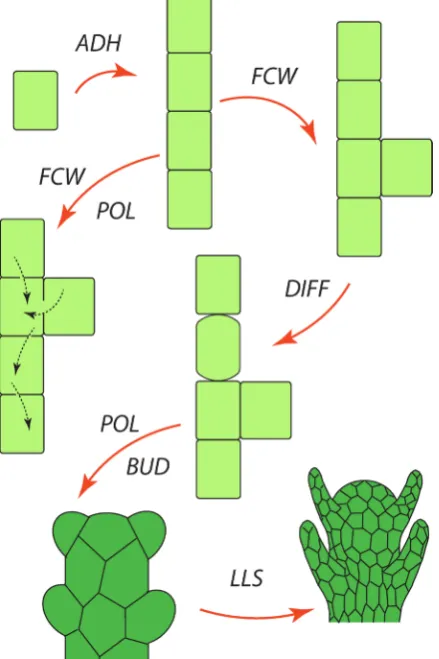
We have presented a preliminary set of dynamical patterning modules (DPMs) associated with critical plant developmental events (Table 1) and have specified some of the physical and mo-lecular components of these modules. On the basis of the phyletic distribution of the molecular elements of the DPMs, we have also hypothesized that, as in animal systems, these modules originated from co-option of cell-molecular mechanisms that had first evolved in association with single-cell functions in the unicellular ancestors of the various plant lineages which mobilized, in the multicellular context, novel physical processes such as the internal mechanical stresses generated as cells or tissues expand and grow. One of our central conclusions is that not all of the information required for plant development needs to be encoded genetically. Once devel-opment is set into operation, much of it becomes self-organizing. Additionally, we suggest that the combination of different DPMs at different places and developmental stages may be sufficient for the generation of the basic features of the multicellular plant body plan (Fig. 4).
We have assumed (as suggested by the ”module” nomencla-ture) that DPMs are semi-autonomous, which allows them to be defined and studied separately. However, the proposed DPMs have been shown to interact with one another, sometimes establishing
negative and positive feedback systems. Indeed, it is the dynamic combination and changing links among DPMs that could contribute to the striking plasticity of plant development. For instance, it has been observed that the relative positions of cell walls change with cell growth and that the FCW module may also depend on cell polarity (Dhonukshe et al., 2012).
DPMs provide a framework for comparing developmental processes at a dynamic, epigenetic level, utilizing processes not encoded directly in the DNA sequence. The methods to systemati-cally perform such comparative analyses and infer evolutionary relations are still relatively primitive. However, mathematical and computational models will be extremely useful as tools to study the collective action of a set of interacting molecules and physi-cal processes constituting a DPM, as well as to test the behavior of potential modifications of these modules with changes due to mutation of DPM-enabling genes, or geometric context. For ex-ample, Zhu and coworkers (2010) have developed a model for the system of DPMs associated with limb development in vertebrates and have modeled modified versions that may correspond to the alteration of relevant biological parameters, offering a mechanistic explanation for the development and evolution of vertebrate limbs. Additionally, DPMs serve as new evolutionary hypotheses that are testable at many levels. The original DPM proposal suggests that the combination of DPMs had an important role in the evolu-tionary origin of animal body plans and their early diversification (Newman and Bhat, 2008, 2009). Specifically, this proposal sug-gests that early multicellular organisms were phenotypically plastic, which permitted them to rapidly explore morphospace. In turn, the relatively stable developmental trajectories and morphologi-cal phenotypes of modern organisms are a result of canalization (e.g., via gene duplication and subspecialization) and stabilizing selection. Indeed, it has been hypothesized that the collective action of animal DPMs could have underlain the diversification of bilaterian animal forms during the so-called Cambrian explosion (Newman, 2012).
Here we speculate that, as suggested for animal systems, the combined action of relatively flexible DPMs had a central role in the evolution and diversification of plant body plans. This view contrasts with the hypothesis that land plant diversification resulted mainly from the expansion of particular gene families, such as PINs (Zažímalová et al., 2010), or that the evolution of the embryophytes was predominantly the result of hormonal dynamics (Cooke et al., 2003). Certainly, while these molecules are central for plant devel-opment and, most probably also for plant morphological evolution, we argue that the notion that diversification of certain gene families or molecules classes can be the main cause of morphological evolution is likely insufficient if not fundamentally flawed (Niklas and Kutschera, 2012). In light of inconclusive searches for ”master” molecules of animal embryogenesis (e.g., attempts to identify the molecular basis of the vertebrate ”organizer”; Slack, 2002), we believe that plant development is the result of a set of dynamical systems that act synergistically in complex ways. In this picture, gene products do not have fixed developmental roles over the course of evolution, but take on new functions in different contexts.
More broadly, the DPM concept may help overcome the limita-tions of comparing and studying the evolution of genes or gene families. For example, PINs do not seem to be expressed in moss gametophytes. Nevertheless, the DPM formalism supports the in-vestigation of cellular and organ polarity on the basis of interactions
between analogous ancient physiological and cell-wall properties that do not rely on PINs.
As was the case in the evolution of animal development (Newman and Bhat, 2009), generic physical effects were mobilized during the early evolution of multicellular plants by particular gene products and pathways. During this phase of evolution, some molecules (an ”interaction toolkit” very different from that of the metazoans) assumed critical importance in the development and continue to do so among present-day plants. For example, auxin, which is involved in regulating embryo and postembryonic development in modern vascular plants, and is thus an important molecule in two of the DPMs described here (Table 1), played a crucial role in the diversification of land plant phenotypes during the Late Silurian to Early Devonian Periods (Cooke et al., 2003; Niklas and Kutschera 2009, 2012). Additionally, our current knowledge of auxin action and regulation suggests that major changes in auxin action oc-curred in the earliest land plants before the Late Silurian (Cooke et
al., 2003). However, the central role of auxin in plant development
and evolution cannot be understood without considering equally ancient cell wall components, auxin transporters, etc. (Niklas and Kutschera, 2012) as well as the physical processes collectively mobilized by these molecules and their respective DPMs (Table 1).
Like auxin, cell wall components are involved in all of the proposed DPMs, suggesting that the presence of a cell wall played a pivotal role in determining and influencing the types of physical processes that predominate during plant development. The mechanical forces generated within and by plant cell walls stand in contrast to those postulated for animal DPMs, which permit cell rearrangement and deformations in a physical system that is largely defined by fluid as opposed to solid mechanics (Newman and Bhat, 2008, 2009). This difference suggests to us that the DPMs of multicellular fungi might be more similar to those of plants than animals despite the biochemical differences between the cell walls of fungi and plants and the phylogenetic affinities of the fungi and the metazoans (Shalcchian-Tabrizi et al., 2008).
Another difference between plant and animal DPMs concerns the extent to which they are developmentally ‘flexible’ in evolu-tionarily more derived lineages. The original proposal concerning animal DPMs postulated that these modules were initially flexible in terms of phenotypic outcome but that they became integrated into more robust and less plastic developmental processes, pos-sibly via canalization (sensu Waddington) and selection. This may have also been the case for plant development and evolution but to a lesser degree for lineages in which sessile multicellular or-ganisms evolved. In these lineages, it is reasonable to conjecture that natural selection would have favored plants that retained implementation of more plastic DPMs, particularly those with an open indeterminate growth pattern in which new tissues or organs are added indefinitely over the course of a life-time. Less rigidly integrated systems of DPMs would permit development to track changes in ambient environmental conditions, which can change sometimes dramatically over the course of long-lived species such as trees. This conjecture is amenable experimentally to fal-sification by means of broad developmental comparisons among unicellular versus multicellular organisms and determinate versus indeterminate species.
and plant biology it has always been somewhat paradoxical that multicellular plants, with their ”solid” tissue structure, are actually more variable ecophenotypically and more capable of regenerating lost parts, propagating vegetatively, morphologically accommodat-ing grafts across species lines, and even formaccommodat-ing new species by hybridization, than their largely soft-tissued animal counterparts. Considering plant development from the viewpoint of the DPMs described above, it becomes clear that plant development, much more so than animal embryogenesis, organizes matter that is dy-namic over large scales, utilizing inherently multicellular systems of multifunctional hormones/morphogens/transcription factors which are unrestricted by cell boundaries in many of their func-tions. Under such conditions, the repurposing of adult tissues for development, and the capacity to assume novel, ecologically adaptive, morphological phenotypes within individual lifetimes, becomes less enigmatic.
Acknowledgements
The authors would like to thank Elena R. Alvarez-Buylla, Alma Piñeyro-Nelson, Mario A. Pacheco, Ricardo Chávez, Eugenio Azpeitia, the members of the De Folter (LANGEBIO) group, the members of the Theoretical Biology Seminar at the Centro de Ciencias de la Complejidad C3, an anonymous reviewer, as well as the participants in the Summer School on Evolutionary Developmental Biology (Venice, 2011) for valuable discussions and com-ments regarding the ideas presented in this review. M.B. was supported by the ‘‘CEITEC – Central European Institute of Technology’’ project (CZ.1.05/1.1.00/02.0068) from the European Regional Development Fund.
References
ABEDIN M, KING N (2010) Diverse evolutionary paths to cell adhesion. Trends Cell Biol 20: 734-742.
BALASKAS N, RIBEIRO A, PANOVSKA J, DESSAUD E, SASAI N, PAGE KM, BRIS-COE J, RIBES V. (2012). Gene regulatory logic for reading the Sonic Hedgehog signaling gradient in the vertebrate neural tube. Cell 148: 273-284.
BECKER B, MELKONIAN M, KAMERLING JP (1998). The cell wall (theca) of Tetra-selmis striata (Chlorophyta): macromolecular composition and structural elements of the complex polysaccharides. J. Phycol 34: 779–787.
BENÍTEZ M, MONK N, ALVAREZ-BUYLLA ER (2011). Epidermal patterning in Ara-bidopsis: models make a difference. J Exp Zool B Mol Dev Evol 316: 241-253. BENKOVÁ E, MICHNIEWICZ M, SAUER E, TEICHMANN T, SEIFERTOVÁ D,
JÜR-GENS G, FRIML J. (2003). Local, efflux-dependent auxin gradients as a common module for plant organ formation. Cell 115: 591-602.
BESNARD F, VERNOUX T, HAMANT O (2011). Organogenesis from stem cells in planta: multiple feedback loops integrating molecular and mechanical signals. Cell Mol Life Sci: CMLS 2885-2906. doi:10.1007/s00018-011-0732-4
BESSON S, DUMAIS J (2011). Universal rule for the symmetric division of plant cells. Proc Nat Acad Sci USA 108: 6294–6299.
BOERJAN W, RALPH J, BAUCHER M (2003). Lignin biosynthesis. Annu Rev Plant Biol 54: 519-546.
BOHN-COURSEAU I (2010). Auxin: a major regulator of organogenesis. CR Biolo-gies 333: 290-296.
BOOT KJ, LIBBENGA KR, HILLE SC, OFFRINGA R, VAN DUIJN B (2012). Polar auxin transport: an early invention. J Exp Bot 63:4213-4218.
BOUDAOUD A (2010). An introduction to the mechanics of morphogenesis for plant biologists. Trends Plant Sci 15: 353-360.
BRAYBROOK S, KUHLEMEIER C (2010). How a plant builds leaves. Plant Cell 22: 1006-1018.
BROWN RC, LEMMON BE (2011). Dividing without centrioles: innovative plant micro-tubule organizing centres organize mitotic spindles in bryophytes, the earliest extant lineages of land plants. AoB PLANTS 2011: plr028; doi:10.1093/aobpla/plr028. CAREY RE, COSGROVE DJ (2007). Portrait of the expansin superfamily in Physcomi-trella patens: comparisons with angiosperm expansins. Ann Bot 99: 1131-1141.
CARROLL SB (2001). Chance and necessity: the evolution of morphological complex-ity and diverscomplex-ity. Nature 409: 1102-1109.
COOKE TJ, POLI D, COHEN JD (2003). Did auxin play a crucial role in the evolution of novel body plans during the Late Silurian--Early Devonian radiation of land plants? In The evolution of plant physiology: from whole plants to ecosystems (Eds Alan R. Hemsley, Imogen Poole). Linnean Society of London, London, pp. 85-107. COOKE TJ, POLI D, SZTEIN AE, COHEN JD (2002). Evolutionary patterns in auxin
action. Plant Mol Biol 49: 319-338.
CORSON F, HAMANT O, BOHN S, TRAAS J, BOUDAOUD A, COUDER Y (2009). Turning a plant tissue into a living cell froth through isotropic growth. Proc Nat Acad Sci USA 106: 8453–8458.
COSGROVE DJ (2000). Expansive growth of plant cell walls. Plant Physiol Biochem 38: 109-124.
COSGROVE DJ (2005). Growth of the plant cell wall. Nature Rev Mol Cell Biology 6: 850-861.
CUI H, LEVESQUE MP, VERNOUX T, JUNG JW, PAQUETTE AJ, GALLAGHER KL, WANG JY, BLILOU I, SCHERES B, BENFEY PN (2007). An evolutionarily conserved mechanism delimiting SHR movement defines a single layer of endo-dermis in plants. Science 316: 421-425.
DAVIDSON EH, ERWIN DH (2006). Gene regulatory networks and the evolution of animal body plans. Science 311: 796-800.
DE SMET I, BEECKMAN T (2011). Asymmetric cell division in land plants and algae: the driving force for differentiation. Nat Rev Mol Cell Biol 12: 177-188. DE SMET I, VOB U, LAU S, WILSON M, SHAO N, TIMME RE, SWARUP R, KERR
I, HODGMAN C, BOCK R, BENNETT M, JÜRGENS G, BEECKMAN T (2011). Unraveling the evolution of auxin signaling. Plant Physiol 155: 209-211. DELMER DP (1999). Cellulose biosynthesis: Exciting times for a difficult field. Ann
Rev Plant Phys Plant Mol Biol 50: 245-276.
DHONUKSHE P, WEITS DA, CRUZ-RAMÍREZ A, DEINUM E, TINDEMANS SH, KA-KAR K, PRASAD K, MÄHÖNEN AP, AMBROSE C, SASABE M, WACHSMANNG, LUIJTEN M, BENNETT T, MACHIDA Y, HEIDSTRA R, WASTENEYS G, MULDER BM, SCHERES B. (2012). A PLETHORA-Auxin trasncription module controls cell division plane rotation through MAP65 and CLASP. Cell 149: 383-396. DOMOZYCH DS, WELLS B, SHAW PJ (1991). Basket scales of the green alga
Mesostigma viride: chemistry and ultrastructure. J. Cell Sci 100: 397–407. DOUADY S, COUDER Y (1996). Phyllotaxis as a dynamical self-organizing process
Part I: The spiral modes resulting from time-periodic iterations. J Theor Biol 178: 255-274.
DUMAIS J (2007). Can mechanics control pattern formation in plants? Curr Opin Plant Biol 10: 58-62.
FLEMING AJ (2006). Leaf initiation: the integration of growth and cell division. Plant Mol Biol 60: 905-914.
FUJITA H, MOCHIZUKI A (2006). The origin of the diversity of leaf venation pattern. Dev Dynn 235: 2710 -2721.
FUJITA T, SKAGUCHI H, HIWATASHI Y, WAGSTAFF SJ, ITO M, DEGUCHI H, SATO T, HASEBE M (2008). Convergent evolution of shoot in land plants: lack of auxin polar transport in moss shoots. Evol Dev 10: 176-186.
GARRETT JJ, MEENTS MJ, BLACKSHAW MT, BLACKSHAW LC, HOU H, STYRANKO DM, KOHALMI SE, SCHULTZ EA (2012). A novel, semi-dominant allele of MO-NOPTEROS provide insight into leaf initiation and vein pattern formation. Planta 236: 297-312.
GEITLER L (1951). Über rechtwinkelige Schneidung von Scheidewänden und dreidimensionale Zellverbände. Osterr. Bot Zeitschr 98: 171–186.
GIBSON WT, GIBSON MC (2012). Growing cells push back under pressure. Cell 149: 259-261.
GOETHE JW (1790). Versuch die metamorphose der pflanzen zu erklären. CW Ettinger, Gotha.
GRAHAM LE (1996). Green algae to land plants: An evolutionary transition. J Plant Res 109: 241–251.
GRAHAM LE, COOK ME, BUSSE JS (2000). The origin of plants: Body plan changes contributing to a major evolutionary radiation. Proc Nat Acad Sci USA 97: 4535-4540. GRAHAM LE, WILCOX LW (2000). Algae. Prentice Hall, Upper Saddle River, NJ. GREEN PB (1962). Mechanism for plant cellular morphogenesis. Science 28: