R E S E A R C H
Open Access
Outer synchronization of stochastic
complex networks with time-varying delay
Tao Jin
1*, Wenxue Li
2and Junyan Feng
2*Correspondence: [email protected] 1School of Information Science and Engineering, Harbin Institute of Technology (Weihai), Weihai, 264209, P.R. China
Full list of author information is available at the end of the article
Abstract
In this paper, the outer synchronization of stochastic complex networks with time-varying delay is investigated. A systematic method that allows one to construct global Lyapunov functions for these systems is provided by employing results from graph theory and Lyapunov method. By the construction of the Lyapunov function, some sufficient conditions ofpth moment exponential outer synchronization are given. The theoretic result is also applied to an investigation of the outer
synchronization of stochastic time-varying delayed coupled oscillators on networks. Finally, a numerical example is examined to illustrate the effectiveness of the results developed.
MSC: Primary 99Z99; secondary 00A00
Keywords: stochastic complex networks; time-varying delay; outer synchronization
1 Introduction
In the real world, the structure of many coupled systems can be described by complex networks [, ]. The complex networks, as a fundamental tool in understanding dynami-cal behavior of real systems, have been gaining increasing recognition. Networks exhibit complexities in the overall topological properties and dynamical properties of the network nodes. A series of important research problems have resulted from the complex nature of networks. Synchronization is one of the typical problems of complex networks, which has attracted lots of attention. Synchronization of complex networks is widely applied to many fields, such as neural networks, biological systems, and so on [–].
In fact, there are two kinds of network synchronization. One network synchronization is concerned with the synchronization among the nodes within a network, which is called inner synchronization. The other is outer synchronization, which is a synchronization between two or more complex networks. Liet al.were first to study the complete outer synchronization problem for two complex networks with identical topological structure []. Then in [], the outer synchronization for two complex networks was extended to the discrete time case. Later on, an increasing number of researchers devoted themselves to the work about outer synchronization. It is noticed that the outer synchronization be-tween two nonidentical networks with circumstance noise was investigated in [], which analyzed both the inner and the outer synchronization between two coupled discrete-time networks with discrete-time delays. In [], the finite-discrete-time stochastic outer synchronization
between two complex dynamical networks with different topological structure was stud-ied. The authors of [] studied the effect of noise on the outer synchronization of two unidirectionally coupled complex dynamical networks. Reference [] obtained several sufficient conditions for the generalized outer synchronization between complex dynam-ical networks. More research on outer synchronization can be found in [–] and the references therein.
In real networks, time delays cannot be neglected due to the finite information trans-mission and processing speeds among the network nodes. Hence, it is reasonable and necessary to study the effect of time delays which may affect the dynamical behavior of complex networks. For instance, in [], outer synchronization of uncertain complex de-layed networks with adaptive coupling was studied. References [] and [] investigated mixed outer synchronization and finite-time outer synchronization of complex networks with coupling time-varying delay, respectively. On the other hand, another addition which exists in nature and man-made systems should also be considered, that is, noise, which is commonly regarded as a random and persistent disturbance obscuring or reducing the clarity of the signal. Hence, noise is another important factor affecting the behavior for dynamical networks. For this reason, synchronization criteria for stochastic systems have been obtained in the literature [, , , ] by various approaches. Furthermore, it is a significant task to understand how noise influences the dynamics of complex networks. For example, [] studied the synchronization between two coupled chaotic systems de-termined by the distribution of white noise and analytically proved that synchronizability of coupled chaotic systems could be promoted by white noise. In [], the synchronization criteria have been established for two nonidentical networks with circumstance noise.
Over the years, lots of efficient synchronization methods for complex networks have been developed by many researchers. In most of the studies above, the criteria ensuring synchronization on networks have been derived mainly based on the Lyapunov method. However, how to construct a global Lyapunov function for the system on networks by means of the Lyapunov method is a challenge for researchers. Fortunately, [] provided a systematic method which is on the base of graph theory, which allows us to construct a global Lyapunov function for large-scale coupled systems. Based on graph theory, a net-work can be mathematically described by a directed graph consisting of vertices and di-rected arcs connecting them.
Motivated by the above discussion, outer synchronization of stochastic complex net-works with time-varying delay (SCNVD) is studied in this paper. Based on graph theory, SCNVD can be described as a directed graph in which a system of stochastic time-varying delayed differential equations is assigned at each vertex, and the directed arcs indicate interconnections and interactions among vertex systems. A systematic method to con-struct a global Lyapunov function for the SCNVD is provided. Then several sufficient cri-teria forpth moment exponential outer synchronization of SCNVD will be established by constructing a global Lyapunov function and utilizing stochastic stability theory. More-over, the theoretic result will be applied to an investigation of the outer synchronization of stochastic time-varying delayed coupled oscillators on networks.
sufficient criteria for the outer synchronization are derived. In Section , we will introduce stochastic time-varying delayed coupled oscillators on networks and present the sufficient conditions of the outer synchronization. In Section , a numerical simulation is given to show the effectiveness of the theoretical results.
Notation Throughout the paper, unless otherwise specified, we will employ the follow-ing notations. Let R andRnbe the set of real numbers and n-dimensional Euclidean
space, respectively. We haveR
+= [, +∞),L={, , . . . ,L}. Let (,F,F,P) be a complete probability space with filtrationF=Ft≥satisfying the usual conditions, andB(·) be the one-dimensional Brownian motion defined on the space. The mathematical expectation with respect to the given probability measurePis denotedE(·). Let| · |denote the Eu-clidean norm for vectors or the trace norm for matrices. Denote by C([–τ, ],Rn) the
space of continuous functions x: [–τ, ]→Rnwith norm|x|=sup
–τ≤t≤|x(t)|. Write C,(Rn×R
+;R+) for the family of all nonnegative functionsV(x,t) onRn×R+that are continuously twice differentiable inxand once int. IfAis a vector or matrix, its transpose is denoted byAT.Istands for the identity matrix of appropriate dimensions.
2 Preliminaries
In this section, we will give some useful preliminaries and a model description.
2.1 Basic concepts on graph theory
Since the complex network considered in this paper is built on a directed graph, it is nec-essary to recall some concepts and results on graph theory in this subsection.
A directed graphG= (V,E) contains a setV={, , . . . ,N}of vertices and a set ofEof arcs (i,j) leading from initial vertexito terminal vertexj. A subgraphHofGis said to be spanning ifHandGhave the same vertex set. A graphGis weighted if each arc (j,i) is assigned a positive weightaij. In our convention,aij> if and only if there exists an arc
from vertexjto vertexiinG, and we callA= (aij)N×N as the weight matrix. The weight
W(G) ofGis the product of the weights on all its arcs. A directed pathPinGis a subgraph with distinct vertices{i,i, . . . ,is}such that its set of arcs is{(ik,ik+) :k= , , . . . ,s– }.
Ifis=i, we callP a directed cycle. A connected subgraphT is a tree if it contains no
cycles. A treeT is rooted at vertexi, called the root, ifiis not a terminal vertex of any arcs, and each of the remaining vertices is a terminal vertex of exactly one arc. A subgraph Qis unicyclic if it is a disjoint union of rooted trees whose roots form a directed cycle. A digraphGis strongly connected if, for any pair of distinct vertices, there exists a directed path from one to the other. Denote the digraph with weight matrixAas (G,A). A weighted digraph (G,A) is said to be balanced ifW(C) =W(–C) for all directed cyclesC. Here, –C denotes the reverse ofCand is constructed by reversing the direction of all arcs inC. For a unicyclic graphQwith cycleCQ, letQ˜be the unicyclic graph obtained by replacingCQ
with –CQ. Suppose that (G,A) is balanced, thenW(Q) =W(Q˜).
Here we show a lemma which will be used in the proofs of our main results.
Lemma .[] Assume N≥.Let cidenote the cofactor of the ith diagonal element of L.
Then the following identity holds:
N
i,j=
ciaijFij(xi,xj) =
Q∈Q
w(Q) (s,r)∈E(CQ)
where Fij(xi,xj), ≤i,j≤N,are arbitrary functions,Qis the set of all spanning unicyclic individual networks and describe them on a digraphG.
We first assume that dynamical system in thekth vertex is described by
dxk(t) =
Second, consider the dispersal factor and the time delays result from dispersal. The dis-persal from thehth vertex to thekth vertex is represented by the functionHkh:Rmk×
R
+→Rmk. HereHkh≡ if and only if there exists no dispersal from thehth vertex to the
kth vertex inG. Also,τ(kh)(t) :R
+→[,τ] reflects the transmissible time from vertexhto vertexk. Thus time-varying delayed complex networks can be described as follows:
dxk(t) =
To realize the outer synchronization between two complex networks, we refer to the sys-tem (.) as the drive network, and the response network is given by the following:
dyk(t) =
one gets the following error system:
Here the functionsfk,gk, andHkhsatisfy the global Lipschitz condition. Based on the
the-ory of stochastic differential equation, the error system (.) possesses a unique solution. Assume that, for any initial conditionek() =yk() –xk(), the error system (.) has a
unique solutionek(t,ek()) =φ(t), whereφ(t) is a continuous function on [–τ, ].
Obvi-ously,ek(t, )≡ is a trivial solution for the error system (.). Throughout this paper, the
following hypothesis and definitions are needed to derive our main results.
Assumption . Assume that functionsτk(t) andτ(kh)(t),k,h∈Lare differentiable and
theirs derivative are bounded by a constantτ¯∈[, ).
Definition . The network (.) is said to reachpth moment exponentially outer syn-chronization (ME-synsyn-chronization) with network (.), if for any initial stateφ, we have
lim sup
t→∞
tln
Ee(t,φ)p< , i∈L. (.)
Definition . FunctionVk(ek,t)∈C,(Rmk×R+;R+) is called vertex-Lyapunov function for the system (.), if the following assumptions hold:
(A) There exist positive constantsp≥,αk,βk, such that
αk|ek|p≤Vk(ek,t)≤βk|ek|p. (.)
(A) There exist positive constantsσk,ηk, kh,akh, and a functionFkh(ek,eh) such that
LVk(ek,t)≤–σk|ek|p+ηkek
t–τk(t) p
+
L
h=
khek
t–τ(hk)(t)p
+
L
h= akhFkh
ek
t–τ(hk)(t),eh
t–τ(kh)(t), (.)
where the differential operatorLVk(ek,t) associated with thekth vertex system is defined
by
LVk(ek,t) =
∂Vk(ek,t)
∂t +
∂Vk(ek,t)
∂ek
fk
yk(t),t
–fk
xk(t),t
+gk
yk
t–τk(t)
,t–gk
xk
t–τk(t)
,t
+
L
h=
Hkh
yh
t–τ(kh)(t),t–Hkh
xh
t–τ(kh)(t),t
+ trace
σek(t)
T
Veeσek(t). (.)
(A) Along each directed cycleCQof the weighted digraph (G,A), we have
(h,k)∈E(CQ)
Fkh(ek,eh)≤ (.)
3 Main results
We investigate outer synchronization of SCNVD in this section, and our main results for the outer synchronization criteria of SCNVD are presented.
3.1 Lyapunov-type theorem
Theorem . Suppose that the error system (.) admits vertex-Lyapunov functions Vk(ek,t),and digraph(G,A)is strongly connected,in which A= (akh)L×L.If
ηk+ L
h=
kh<σk( –τ¯), (.)
then the network(.)and(.)will reach ME-synchronization.
Proof Let the construction of the Lyapunov function for the error system (.) be in the form of
V(e,t) =
L
k=
ckVk(ek,t), (.)
in which ck is the cofactor of thekth diagonal element of Laplacian matrix of digraph
(G,A). It is obvious from Lemma . thatck> , because the digraph (G,A) is strongly
connected.
Using (.), we obtain
V(e,t) =
L
k=
ckVk(ek,t)≤ L
k=
ckβk|ek|p≤
L
k= ckβk
|e|p
and
V(e,t)≥
L
k=
ckαk|ek|p
=
L
j= cjαj
L
k=
ckαk
L
i=ciαi
|ek|
p
≥
L
j= cjαj
L
k= ckαk
L
i=ciαi
|ek|
p
≥
L
k= ckαk
–p
min
≤k≤L{ckαk}
p
|e|p.
Denoteβ=Lk=ckβkandα= (
L
k=ckαk)–
p
(mink∈L{ckαk})
p
, then we have
By (.), (.), (.), and Lemma ., we can see that
It is not difficult to see from (.) that there exists a constantγ > which is sufficiently small, such that
Using the Itô formula and the condition (A), one shows that
By virtue of an integration by substitution and (.), one can obtain
So, we can easily compute that
Ee(t)p≤
That is, the trivial solution of (.) is ME-stable and thepth moment Lyapunov expo-nent is not greater than –γ, which means the networks (.) and (.) will reach
ME-synchronization.
Remark . Theorem . shows that the Lyapunov functionV(e,t) for the system (.) can be obtained by the weighted sum ofVk(ek,t). Hence finding the vertex-Lyapunov
func-tionVk(ek,t) is a key point in the study of the stability for the system (.). In the practical
applications, complex networks are coupled together in regular ways by the simple and nearly identical dynamical systems whose Lyapunov functions have been obtained. The Lyapunov function of these systems can be chosen as the Lyapunov function of vertex systems.
In this case, the condition (A) is replaced by the following:
(h,k)∈E(CQ)
Fkh(ek,eh) +Fhk(eh,ek
≤. (.)
Consequently, we get the following corollary.
Corollary . Suppose that digraph(G,A)is balanced.Then the conclusion of Theorem. holds if(.)is replaced by(.).
3.2 Coefficients-type theorem
In this subsection, based on the Lyapunov method, a sufficient criterion of exponential outer synchronization which is easily verifiable is established in the form of coefficients.
Theorem . Suppose that the following conditions hold:
(B)Let p≥and the digraph(G,A)is strongly connected.Suppose there are positive constantsαk,βk,such that
eTkfk
yk(t)
–fk
xk(t)
≤–αkek(t)
(.)
and
gk
yk
t–τk(t)
–gk(xk
t–τk(t)≤βkek
t–τk(t). (.)
(B)There are constants Akh,such that
Hkh
yk
t–τ(kh)(t)–Hkh
xk
t–τ(kh)(t)≤Akheh
t–τ(kh)(t). (.)
(B)Suppose that
βk+ L
h=
Akh<σk( –τ¯) (.)
holds,whereσk=pαk– (p– )βk– (p– )Lh=Akh–p(p– )|σ|.
Then the networks(.)and(.)can reach ME-synchronization.
Proof Take the following function as the Lyapunov function of thekth vertex:
Vk(ek) =|ek|p. (.)
Then it follows easily by (.) and the condition (B) that
LVk(ek)
=pek(t)p
– eTk(t)fk
yk(t),t
–fk
xk(t),t
+gk
yk
t–τk(t)
,t
–gk
xk
t–τk(t)
,t+pek(t) p–
×
By using the Young inequality
|a|p|b|q≤ε|a|p+q+ q
and combining with (.), the following can be obtained:
Denoteηk=βk, kh=Akh,akh= , and
Fkh
ek
t–τ(hk)(t),eh
t–τ(kh)(t)
=
L
h= Akheh
t–τ(kh)(t)p–eh
t–τ(hk)(t)p.
It is easy to see that the conditions in Definition . are satisfied, which meansVk(ek,t)
is the vertex-Lyapunov function. Therefore, by Theorem ., the networks (.) and (.)
will reach ME-synchronization.
4 Synchronization of stochastic time-varying delayed coupled oscillators on networks
The phenomenon of synchronization of oscillatory dynamics is observed in a wide variety of natural systems. In some physical and biological applications, the system of coupling oscillators with time-varying delay will be studied in this part by the analytical results established in the previous section.
Now, we give a digraph withLvertices. In thekth vertex there is assigned an oscillator with time-varying delay described by
¨
xk(t) +αkx˙k(t) +xk(t) +εkxk
t–τk(t)
= . (.)
Suppose thatHkh:R×R+→R,k,h∈L, represents the influence of vertexhon vertexk. We haveHkh≡ if and only if there exists no dispersal from vertexhto vertexkinG.
Hence, we get the following system:
¨
xk(t) +αkx˙k(t) +xk(t) +εkxk
t–τk(t)
+
L
k= Hkh
xh
t–τ(kh)(t),t= , (.)
which is called the drive system. The response system is described by
¨
yk(t) +αky˙(t) +yk(t) +εkyk
t–τk(t)
+
L
h= Hkh
yh
t–τ(kh)(t),t
=σyk(t) –xk(t)
˙
B(t). (.)
For the convenience of analysis and calculation, letx¯k(t) =x˙k(t) +ηkxk(t), whereηk> .
Then the system (.) can be rewritten in the form of a first order system:
˙
xk(t) =x¯k(t) –ηkxk(t),
˙¯
xk(t) = (–αk+ηk)¯xk(t) +
αkηk–ηk–
xk(t) –εkxk
t–τ(t)
–
L
k= Hkh
xh
t–τ(kh)(t),t.
DenoteXk(t) = (xk(t),x¯k(t))T,Xk(t–τk(t)) = (xk(t–τk(t)), )T,Fk(Xk(t)) = (¯xk(t) –ηxk(t),
(, –Hkh(xh(t–τ(kh)(t)),t))T. Then the system (.) is rewritten as
Theorem . Let the digraph(G,A)be strongly connected.Suppose that the following
con-ditions hold:
(C)There are constants Akh> ,such that
Hkh
(C)The drive system(.)and the response system(.)satisfy
ηk(αk–ηk)≤, ηk≥
Then the drive system(.)and the response system(.)will reach ME-synchronization.
Proof LetEk(t) =Yk(t) –Xk(t) = (yk(t) –xk(t),y¯k(t) –x¯k(t))T= (ek(t),e¯k(t))T. Then the error
system of the drive system (.) and the response system (.) can be rewritten as
dEk(t) dt=
Then we will verify that the error system satisfies Theorem .. From the condition (C), we obtain
≤–
From this, it is obvious that (.) holds. Also we have
which means (.) holds.
Hence, from Theorem ., the drive system (.), and the response system (.) we
ob-tain ME-synchronization.
5 Numerical test
The response system under the effect of white noise can be represented as
⎧ ⎪ ⎪ ⎪ ⎪ ⎪ ⎪ ⎪ ⎪ ⎪ ⎪ ⎪ ⎪ ⎪ ⎨ ⎪ ⎪ ⎪ ⎪ ⎪ ⎪ ⎪ ⎪ ⎪ ⎪ ⎪ ⎪ ⎪ ⎩
¨
y(t) +αy˙(t) +y(t) +εy(t– .(sint+ )) +θy(t– .arctant) =σ(y(t) –x(t))B˙(t),
¨
y(t) +αy˙(t) +y(t) +εy(t– .(cost+ )) +θy(t– .arctant) =σ(y(t) –x(t))˙B(t),
¨
y(t) +αy˙(t) +y(t) +εy(t– .(sint+ )) +θy(t– .arctant) =σ(y(t) –x(t))B˙(t),
¨
y(t) +α˙y(t) +y(t) +εy(t– .(cost+ )) +θy(t– .arctant) =σ(y(t) –x(t))˙B(t),
(.)
whereεkandαk(k= , , , ) are the same as the parameters in the drive system.σ= . is
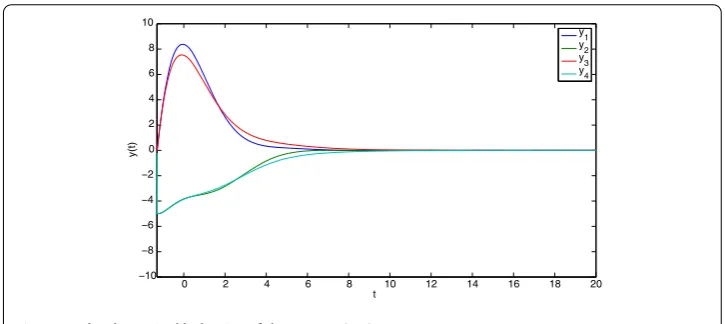
the strength of the coupling. To get a feeling of what is going on, the dynamical behaviors of the systems (.) and (.) can be seen Figures and .
Figure 1 The dynamical behavior of the system (5.2).
Figure 3 The dynamical behavior of the system (5.4).
Letek=yk–xk,k= , , , . Then the error system is
⎧ ⎪ ⎪ ⎪ ⎪ ⎪ ⎪ ⎪ ⎪ ⎪ ⎪ ⎪ ⎪ ⎪ ⎨ ⎪ ⎪ ⎪ ⎪ ⎪ ⎪ ⎪ ⎪ ⎪ ⎪ ⎪ ⎪ ⎪ ⎩
¨
e(t) + .˙e(t) +e(t) + .e(t– .(sint+ )) +θe(t– .arctant) = .e(t)B˙(t),
¨
e(t) + .e˙(t) +e(t) + .e(t– .(cost+ )) +θe(t– .arctant) = .e(t)B˙(t),
¨
e(t) + .˙e(t) +e(t) + .e(t– .(sint+ )) +θe(t– .arctant) = .e(t)B˙(t),
¨
e(t) + .˙e(t) +e(t) + .e(t– .(cost+ )) +θe(t– .arctant) = .e(t)B˙(t).
(.)
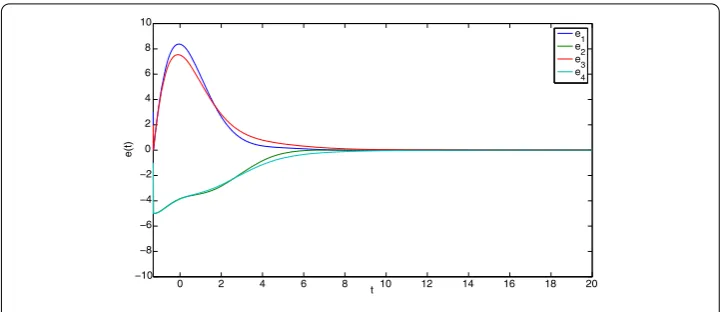
The trivial solution of the system (.) is presented in Figure . In fact, we can see clearly from Figure that the trivial solution of the system (.) is exponentially stable. The nu-merical results show the effectiveness and feasibility of the developed results.
Competing interests
The authors declare that they have no competing interests.
Authors’ contributions
WL proposed the model and completed the main part of this manuscript, TJ checked all the theorems and polished the language, and JF enhanced the revised version. All the authors read and approved the manuscript.
Author details
1School of Information Science and Engineering, Harbin Institute of Technology (Weihai), Weihai, 264209, P.R. China. 2Harbin Institute of Technology (Weihai), Weihai, 264209, P.R. China.
Acknowledgements
This research was supported by the NNSF of China (Nos. 11301112, 11171081, and 11171056), by the NNSF of Shandong Province (No. ZR2013AQ003), by the China Postdoctoral Science Foundation funded project (Nos. 2013M541352, 2014T70313), by HIT.IBRSEM.A.2014014 and HIT.NSRIF.2016103, and by the Key Project of Science and Technology of Weihai (No. 2013DXGJ04). The authors really appreciate the reviewers’ valuable comments.
Received: 20 March 2015 Accepted: 10 November 2015 References
1. Strogatz, SH: Exploring complex networks. Nature410, 268-276 (2001)
2. Boccaletti, S, Latora, V, Mereno, Y, et al.: Complex networks: structure and dynamics. Phys. Rep.424, 175-308 (2006) 3. Alex, A, Albert, D, Jurgen, K, Yamir, M, Zhou, C: Synchronization in complex networks. Phys. Rep.469, 93-153 (2008) 4. Deng, Y, Ding, M, Feng, J: Synchronization in stochastic coupled systems: theoretical results. J. Phys. A, Math. Gen.37,
2163-2173 (2004)
6. Li, H, Nin, Z, Yin, Y, Tang, Y: Synchronization and state estimation for singular complex dynamical networks with time-varying delays. Commun. Nonlinear Sci. Numer. Simul.18, 194-208 (2013)
7. Li, C, Sun, W, Kurths, J: Synchronization between two coupled complex networks. Phys. Rev. E76, 046204 (2007) 8. Li, C, Xu, C, Sun, W, Xu, J, Kurths, J: Outer synchronization of coupled discrete-time networks. Chaos19, 013106 (2009) 9. Wang, G, Cao, J, Lu, J: Outer synchronization between two nonidentical networks with circumstance noise. Physica A
389, 1480-1488 (2010)
10. Sun, Y, Li, W, Zhao, D: Finite-time stochastic outer synchronization between two complex dynamical networks with different topologies. Chaos22, 023152 (2012)
11. Sun, Y, Zhao, D: Effects of noise on the outer synchronization of two unidirectionally coupled complex dynamical networks. Chaos22, 023131 (2012)
12. Wu, X, Zheng, W, Zhou, J: Generalized outer synchronization between complex dynamical networks. Chaos19, 013109 (2009)
13. Wu, X, Lu, H: Outer synchronization of uncertain general complex delayed networks with adaptive coupling. Neurocomputing82, 157-166 (2012)
14. Sun, Y, Li, W, Ruan, J: Generalized outer synchronization between complex dynamical networks with time delay and noise perturbation. Commun. Nonlinear Sci. Numer. Simul.18, 989-998 (2013)
15. Li, Z, Xue, X: Outer synchronization of coupled networks using arbitrary coupling strength. Chaos20, 023106 (2010) 16. Wang, J, Ma, Q, Zeng, L, Abd-Elouahab, MS: Mixed outer synchronization of coupled complex networks with time
varying coupling delay. Chaos21, 013121 (2011)
17. He, P, Ma, S, Fan, T: Finite-time mixed outer synchronization of complex networks with coupling time-varying delay. Chaos22, 043151 (2012)
18. Wang, G, Cao, J, Lu, J: Outer synchronization between two nonidentical networks with circumstance noise. Physica A
389, 1480-1488 (2010)
19. Li, W, Chen, G: Using white noise to enhance synchronization of coupled chaotic systems. Chaos16, 013134 (2006) 20. Li, MY, Shuai, Z: Global-stability problem for coupled systems of differential equations on networks. J. Differ. Equ.248,