R E S E A R C H
Open Access
Robust stability analysis for discrete and
distributed time-delays Markovian jumping
reaction-diffusion integro-differential
equations with uncertain parameters
Xiaogang Yang
1, Xiongrui Wang
2, Shouming Zhong
3and Ruofeng Rao
1,2**Correspondence: [email protected] 1Department of Mathematics, Chengdu Normal University, Chengdu, Sichuan 611130, China 2Institution of Mathematics, Yibin University, Yibin, Sichuan 644007, China
Full list of author information is available at the end of the article
Abstract
In this paper, the authors employ Lyapunov stability theory, and theM-matrix,
H-matrix, and linear matrix inequality (LMI) techniques and variational methods to obtain the LMI-based stochastically exponential robust stability criterion for discrete and distributed time-delays Markovian jumping reaction-diffusion integro-differential equations with uncertain parameters, whose background of physics and engineering is bidirecional associative memory (BAM) neural networks. It is worth mentioning that an LMI-based stability criterion can easily be computed by the Matlab toolbox which has high efficiency and other advantages in large-scale engineering calculations. Since using theM-matrix andH-matrix methods is not easy in obtaining the LMI criterion conditions, the methods employed in this paper improve those of previous related literature to some extent. Moreover, a numerical example is presented to illustrate the effectiveness of the proposed methods.
Keywords: exponential stability; Laplace diffusion; distributed time-delays;
M-matrix; Lyapunov functional
1 Introduction and preliminaries
The time stability analysis of reaction-diffusion time-delays neural networks has attached more and more interests ([–] and the references therein) due to the practical importance and successful applications of neural networks in many areas, such as image processing, combinatorial optimization, signal processing, pattern recognition. Generally, an impor-tant precondition of the above applications is that the equilibrium of the neural networks should be stable. Hence, the stability analysis of neural networks has always been an im-portant research topic. Many methods have been proposed to reduce the conservatism of the stability criteria, such as the model transformation method, the free-weighting-matrix approach, constructing novel Lyapunov functionals method, the delay decomposi-tion technique, and the weighting-matrix decomposidecomposi-tion method. For example, by using a Lyapunov functional, a modified stability condition for neural networks with discrete and distributed delays has been obtained in []; by constructing a general Lyapunov functional and convex combination approach, the stability criterion for neural networks with mixed delays has been obtained in []; by partitioning the time delay and using the Jensen integral
inequalities, the stability condition on delayed neural networks with both discrete and dis-tributed delays has been obtained in [], by employing homomorphic mapping theory and M-matrix theory, the stability criterion for neural networks with discrete and distributed time-delays has been derived in []. However, the above methods seem to become less ef-fective in studying the stability of reaction-diffusion integro-differential equations. Some variational methods should be added (see,e.g., [, , ]). In the actual operations, diffusion effects cannot be avoided in neural networks when electrons are moving in asymmetric electromagnetic fields. Strictly speaking, all the neural networks models should have been reaction-diffusion partial differential equations. Recently, Lyapunov functionals method and the Poincaré inequality were employed to investigate the stability of discrete and dis-tributed time-delays reaction-diffusion integro-differential equations in []. But it should be noted that parameter uncertainties cannot be inevitable as usual. Besides, the neural networks are often disturbed by environmental noise in the real world. The noise may in-fluence the stability of the equilibrium and vary some structure parameters, which usually correspond to the Markov process. Systems with Markovian jumping parameters are fre-quently dominated by discrete-state homogeneous Markov processes, and each state of the parameters represents a mode of the system. During the recent decade, bidirectional associative memory (BAM) neural networks, neural networks with Markovian jumping parameters, have been extensively studied ([–] and the references therein) due to the fact that systems with Markovian jumping parameters are useful in modeling abrupt phe-nomena, such as random failures, changing in the interconnections of subsystems, and op-erating in different points of a nonlinear plant. So, in this paper, we are to employ Lyapunov stability theory and theM-matrix,H-matrix, and linear matrix equality (LMI) techniques and variational methods to investigate the stochastically robust exponential stability of a class of discrete and distributed time-delays Markovian jumping reaction-diffusion un-certain parameter integro-differential equations (BAM neural networks) as follows:
⎧ ⎪ ⎪ ⎪ ⎪ ⎪ ⎪ ⎪ ⎪ ⎪ ⎪ ⎪ ⎪ ⎪ ⎨ ⎪ ⎪ ⎪ ⎪ ⎪ ⎪ ⎪ ⎪ ⎪ ⎪ ⎪ ⎪ ⎪ ⎩
∂u
∂t =∇ ·(◦ ∇u) –A(r(t))u+ (C(r(t)) +C(r(t)))f(v) + (E(r(t)) +E(r(t)))f(v(t–τ(t),x)) + (L(r(t)) +L(r(t)))tt–f(v(s,x))ds, t≥,x∈,
∂v
∂t =∇ ·(◦ ∇v) –B(r(t))v+ (D(r(t)) +D(r(t)))g(u) + (H(r(t)) +H(r(t)))g(u(t–γ(t),x)) + (W(r(t)) +W(r(t)))tt–ρg(u(s,x))ds, t≥,x∈,
u(s,x) =φ(s,x), v(s,x) =ψ(s,x), (s,x)∈[–τ, ]×, u(t,x) =v(t,x) = ∈Rn, (t,x)∈[, +∞)×∂,
(.)
where x ∈, and is a bounded domain in Rm with a smooth boundary ∂ of class C by (see, e.g., []). u=u(t,x) = (u
(t,x),u(t,x), . . . ,un(t,x))T, v=v(t,x) =
(v(t,x),v(t,x), . . . ,vn(t,x))T∈Rn, andui(t,x) andvj(t,x) are state variables of theith
neu-ron and thejth neuron at timetand in space variablex.f(v) =f(v(t,x)) = (f(v(t,x)), . . . ,
fn(vn(t,x)))T,g(u) =g(u(t,x)) = (g(u(t,x)), . . . ,gn(un(t,x)))T, andfj(uj(t,x)),gj(uj(t,x)) are neuron activation functions of thejth unit at timetand in space variablex.f(v(t–τ(t),x)) = (f(v(t–τ(t),x)), . . . ,fj(vj(t–τj(t),x)), . . . ,fn(vn(t–τn(t),x)))T,g(u(t–γ(t),x)) = (g(u(t– γ(t),x)), . . . ,gj(uj(t–γj(t),x)), . . . ,gn(un(t–γn(t),x)))T,τj(t) andγj(t) are discrete delays, and andρare distributed time-delays.τis the constant, satisfying ≤max{τj(t),γj(t),,ρ} ≤
(ik∂∂xuki)n×m are the Hadamard products of matrix= (ik)n×mand∇u, and of matrix
= (ik)n×mand∇u, respectively (see []). The smooth functionsik=ik(t,x,u)≥ andik=ik(t,x,v)≥ are diffusion operators. (∗,ϒ,P) is the given probability space where∗is the sample space,ϒis theσ-algebra of the subset of the sample space, andP is the probability measure defined onϒ. LetS={, , . . . ,N}and the random form process
{r(t) : [, +∞)→S}be a homogeneous, finite-state Markovian process with right contin-uous trajectories with generator= (πij)N×N and transition probability from modeiat timetto modejat timet+t,i,j∈S,
Pr(t+δ) =j|r(t) =i= πijδ+o(δ), j=i, +πijδ+o(δ), j=i,
whereπij≥ is the transition probability rate fromitoj(j=i) andπii= –
N
j=,j=iπij,δ> , andlimδ→o(δ)/δ= .
Define the norm · for vectoru∈Rnand matrixC= (cij)n
×nas follows:
u=
n
i=
ui, C=
λmax
CCT.
Denote|u|= (|u|,|u|, . . . ,|un|)T for the vectoru= (u, . . . ,un)T∈Rn, and|C|= (|cij|)n×n for the matrixC= (cij)n×n.
Definition . For symmetric matricesA,B, we denoteA<BorB>Aif matrixB–Ais a positive definite matrix. Particularly,A> if a symmetric matrixAis a positive definite matrix.
In this paper, we denote byλmaxCandλminCthe maximum and minimum eigenvalue of
matrixC. For any moder(t) =r∈S, we denoteAr=A(r(t)) for convenience. So doBr,Cr, Dr,Er,Hr,Lr, andWr. In the real world, the parameter uncertainties are inevitable. We assume that
Cr∈–C∗r,Cr∗, Dr∈–Dr∗,D∗r, Er∈–Er∗,E∗r,
Hr∈–Hr∗,Hr∗, Lr∈–Lr∗,L∗r, Wr∈–Wr∗,Wr∗,
(.)
whereCr∗,D∗r,E∗r,Hr∗,L∗r,Wr∗are nonnegative matrices.Ar,Brare diagonal matrices. There are positive definite diagonal matricesAr,Br,Ar, andBrsuch that
<Ar≤Ar≤Ar, <Br≤Br≤Br, r∈S. (.)
There exist positive definite diagonal matricesFandGsuch that
f(u) –f(v)≤F|u–v|, g(u) –g(v)≤G|u–v|, ∀u,v∈Rn. (.)
Letu(t,x;φ,ψ,i),v(t,x;φ,ψ,i) denote the state trajectory from the initial condition
r() =i, u(t+θ,x;φ,ψ,i) =φ(θ,x), v(t+θ,x;φ,ψ,i) =ψ(θ,x) on –τ ≤θ ≤ in
L
F([–τ, ]×;R
n). (Remark:t
= .) Here,LF([–τ, ]×;Rn) denotes the family of all F-measurableC([–τ, ]×;Rn)-value random variablesξ={ξ(θ,x) : –τ≤θ≤,x∈}
such thatsup–τ≤θ≤Eξ(θ)
<∞, whereE{·}stands for the mathematical expectation
operator with respect to the given probability measureP.
Definition . The system (.) is said to be globally stochastically exponentially ro-bust stability if for every initial condition φ,ψ ∈L
F([–τ, ]×;R
n), r() =i
, there
exist scalars c> , c > ,β > , and γ > such that for any solution u(t,x;φ,ψ,i),
v(t,x;φ,ψ,i),
Eu(t,x;φ,ψ,i)
+Ev(t,x;φ,ψ,i)
≤γe–βt
c sup –τ≤θ≤E
φ(θ,x)+c sup –τ≤θ≤E
ψ(θ,x),
t≥t, for all admissible uncertainties satisfying (.), where the normu= (
n i=
u
i(t, x)dx) foru= (u(t,x), . . . ,un(t,x))T∈Rn.
Definition .[] A matrixA= (aij)n×nis anH-matrix if its comparison matrixM(A) = (mij)n×nis anM-matrix, where
mij= |aii|, i=j, –|aij|, i=j.
Lemma .[] A,B∈zn{A= (aij)n×n∈Rn×n:aij≤,i=j},if A is a M-matrix,A,B satisfy aij≤bij,i,j= , , . . . ,n,then B is a M-matrix.
Lemma .[] For given constants kand ksatisfying k>k> ,V(t)is a nonnegative
continuous function on[t–τ,t],if the following inequality holds:
D+V(t)≤kV(t) +kV(t),
where
D+V(t) =lim sup t→+
V(t+t) –V(t)
t ,
V(t) =lim sup
t–τ≤s≤t V(s),
τ> is a constant.Then,as t≥t,we have
V(t)≤V(t)e–λ(t–t),
whereλis the unique positive solution of the following equation:
Lemma .(Schur complement []) Given matricesQ(t),S(t),andR(t)with
appropri-Proof Sinceu,vis a solution of system (.), it follows by the Gauss formula and the Dirich-let boundary condition that
Throughout this paper, we define,,, andas follows:
=
α
λαr∗I+ PrAr–βCr(λmaxF)I–PrCrCrTPr–G
–βDr(λmaxG)I–β|Er|I
–PrErETrPr–β|Lr|I–PrLrLTrPr– N
j= πrjPj
,
=
α
λαr∗I+ PrBr–F–βCr(λmaxF)I
–βDr(λmaxG)I–PrDrDTrPr–β|Hr|I
–PrHrHrTPr–ρβ|Wr|I–ρPrWrWrTPr– N
j= πrjPj
,
=
α
λαr∗I+ PrAr–βCr(λmaxF)I–PrCr∗C∗rTPr–G–βDr(λmaxG)I
–β|Er|I–PrE∗rE∗rTPr–β|Lr|I–PrL∗rL∗rTPr– N
j= πrjPj
,
=
α
λαr∗I+ PrBr–F–βCr(λmaxF)I
–βDr(λmaxG)I–PrDr∗D∗rTPr–β|Hr|
I
–PrHr∗Hr∗ T
Pr–ρβ|Wr|
I–ρPrWr∗Wr∗ T
Pr– N
j= πrjPj
.
Lemma . If the following two inequalities hold:
–( +β)(τ+ )max{(λmaxF)
, (λ maxG)}
α I> , ∀r∈S, (.)
and
–( +β)(τ+ )max{(λmaxF)
, (λ maxG)}
α I> , ∀r∈S, (.)
we have
–( +β)(τ+ )max{(λmaxF)
, (λ maxG)}
α I> , ∀r∈S, (.)
and
–( +β)(τ+ )max{(λmaxF)
, (λ maxG)}
α I> , ∀r∈S, (.)
Proof Let
U=
α
PrCr∗Cr∗TPr+PrE∗rE∗rTPr+PrL∗rL∗rTPr. (.)
SinceC∗,E∗,L∗all are nonnegative matrices,Uis also a nonnegative matrix.
Then (+U – (+β)(τ+)max{(λmaxα F),(λmaxG)}I) is a positive diagonal matrix, and (– M-matrix. According to Definition .,is aH-matrix with positive diagonal elements, it is to say> . Hence we have proved (.) by way of (.). Similarly, we can also derive
(.) from the condition (.). The proof is completed.
Pr≤βI, r∈S, (.)
then the system(.)is stochastically global exponential robust stability,where
Qr
α
λαr∗I+ PrAr–βCr(λmaxF)I–G–βDr(λmaxG)I
–β|Er|I–β|Lr|I– N
j= πrjPj
–( +β)(τ+ )max{(λmaxF)
, (λ maxG)}
α I,
Qr
α
λαr∗I+ PrBr–βCr(λmaxF)I–F–βDr(λmaxG)I–β|Hr|I
–β|Wr|I– N
j= πrjPj
–( +β)(τ+ )max{(λmaxF)
, (λ maxG)}
α I,
andαis a positive scalar withα<αrfor all r∈S.
Proof LetPr=diag(pr, . . . ,prn) be a positive definite matrix for moder∈S, we consider
the following Lyapunov-Krasovskii functional:
V(t) =
uT(t,x)Pru(t,x) +vT(t,x)Prv(t,x)dx, r∈S.
It follows from Lemma . that
uTPr∇ ·(◦ ∇u)dx≤–λ
uTαr∗Iu dx, and
vTPr∇ ·(◦ ∇v)dx≤–λ
vTαr∗Iv dx.
(.)
Obviously, we can get by (.)
–uTPrAru dx≤
–uTPrAru dx, and
–vTPrBrv dx≤
–vTPrBrv dx.
(.)
Besides, we can derive the following inequalities by the assumptions onf,g,β, andCr, Dr,Er,Hr,Lr,Wr:
uTPr(Cr+Cr)f(v)dx
≤
≤
Moreover, we can conclude from the restrictions ofα,βthat
Then we can conclude from (.)-(.) and the weak infinitesimal operatorLthat
= lim
α . Moreover, the
condi-tions (.) and (.) are satisfied owing to (.)-(.) and Schur complement theorem (Lemma .), and we can conclude from Lemma . thatkandksatisfy all the
that
Moreover, (.) and (.) yield
)
from which one derives
Eu+Ev≤ β
According to Definition ., we know that the system (.) is stochastically global
expo-nential robust stability. The proof is completed.
Remark . In , [], Theorem . offered a stability criterion for the following neural networks ([], ()) with discrete and distributed time-delays by way ofM-matrix and H-matrix methods:
However, using the M-matrix andH-matrix methods is not easy in obtaining the LMI criterion conditions. Motivated by some methods of [], we employ the Schur complement technique to derive the LMI-based stability criterion - Theorem ..
3 Example
For Mode ,
A=
.
, B=
. .
,
C=
. . . .
=D=E=H=L=W,
C∗=E∗=L∗=
. . . .
, D∗=H∗=W∗=
. . . .
.
Let u= (u,u)T,v= (v,v)T ∈R, x= (x,x)∈(, )×(, )⊂R, and thenλ=
.π= . (see [], Remark .). Assume that= .,ρ= .,τ= ., and
F=
.
.
, G=
.
.
,
=
. . . .
, =
. . . .
.
So∗= .,∗= .. Letπ= –.,π= .;π= .,π= –.. Letα= , then
we use the Matlab LMI toolbox to solve the linear matrices inequalities (.)-(.), and then the feasibility data follows:
P=
.
.
, P=
.
.
,
andα = .,α= .,β = .. Hence,α= <α andα= <α. According
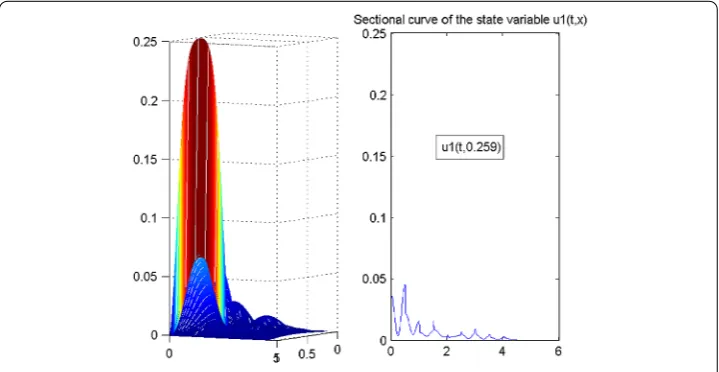
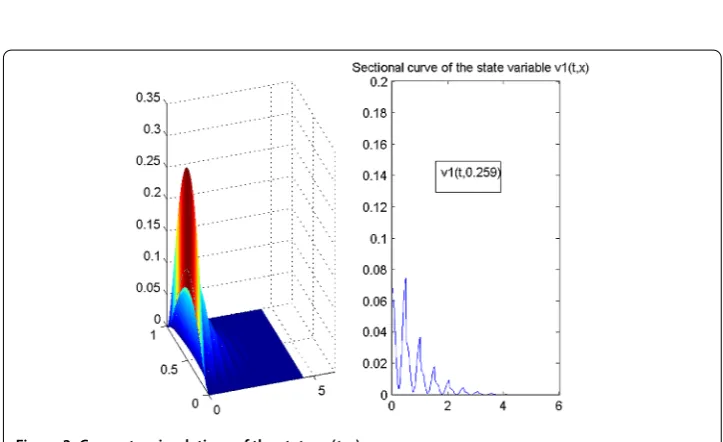
to Theorem ., we know that the system (.) is stochastically global exponential robust stability (see Figures -).
Figure 2 Computer simulations of the stateu2(t,x).
Figure 3 Computer simulations of the statev1(t,x).
4 Conclusions
Figure 4 Computer simulations of the statev2(t,x).
Competing interests
The authors declare that they have no competing interests.
Authors’ contributions
XY wrote the original manuscript, carrying out the main part of this work. SZ examined the original manuscript in detail before submission. XW and RR are in charge of the correspondence. All authors typed, read, and approved the final manuscript.
Author details
1Department of Mathematics, Chengdu Normal University, Chengdu, Sichuan 611130, China.2Institution of Mathematics, Yibin University, Yibin, Sichuan 644007, China. 3School of Science Mathematics, University of Electronic Science and Technology of China, Chengdu, 610054, China.
Acknowledgements
We thank the anonymous reviewers very much for their suggestions, which improved the quality of this paper. This work is supported by the Scientific Research Fund of Science Technology Department of Sichuan Province (2012JYZ010), and by the Scientific Research Fund of Sichuan Provincial Education Department (14ZA0274, 12ZB349).
Received: 26 January 2015 Accepted: 2 June 2015
References
1. Zhu, Q, Li, X, Yang, X: Exponential stability for stochastic reaction-diffusion BAM neural networks with time-varying and distributed delays. Appl. Math. Comput.217(13), 6078-6091 (2011)
2. Zhang, Z, Yang, Y, Huang, Y: Global exponential stability of interval general BAM neural networks with reaction-diffusion terms and multiple time-varying delays. Neural Netw.24(5), 457-465 (2011)
3. Quan, Z, Huang, L, Yu, S, Zhang, Z: Novel LMI-based condition on global asymptotic stability for BAM neural networks with reaction-diffusion terms and distributed delays. Neurocomputing136(20), 213-223 (2014)
4. Rao, R, Zhong, S, Wang, X: Delay-dependent exponential stability for Markovian jumping stochastic Cohen-Grossberg neural networks withp-Laplace diffusion and partially known transition rates via a differential inequality. Adv. Differ. Equ.2013, 183 (2013)
5. Zhao, K: Global robust exponential synchronization of BAM recurrent FNNs with infinite distributed delays and diffusion terms on time scales. Adv. Differ. Equ.2014, 317 (2014)
6. Zhu, X, Wang, Y: Delay-dependent exponential stability for neural networks with discrete and distributed time-varying delays. Phys. Lett. A373(44), 4066-4072 (2009)
7. Tian, JK, Zhong, SM: New delay-dependent exponential stability criteria for neural networks with discrete and distributed time-varying delays. Neurocomputing74(17), 3365-3375 (2011)
8. Shi, L, Zhu, H, Zhong, SM, Hou, LY: Globally exponential stability for neural networks with time-varying delays. Appl. Math. Comput.219(21), 10487-10498 (2013)
9. Chen, H, Zhong, S, Shao, J: Exponential stability criterion for interval neural networks with discrete and distributed delays. Appl. Math. Comput.250(1), 121-130 (2015)
10. Du, Y, Zhong, S, Zhou, N: Global asymptotic stability of Markovian jumping stochastic Cohen-Grossberg BAM neural networks with discrete and distributed time-varying delays. Appl. Math. Comput.243(15), 624-636 (2014) 11. Zhu, Q, Rakkiyappan, R, Chandrasekar, A: Stochastic stability of Markovian jump BAM neural networks with leakage
delays and impulse control. Neurocomputing136(20), 136-151 (2014)
13. Rao, R, Zhong, S, Wang, X: Stochastic stability criteria with LMI conditions for Markovian jumping impulsive BAM neural networks with mode-dependent time-varying delays and nonlinear reaction-diffusion. Commun. Nonlinear Sci. Numer. Simul.19(1), 258-273 (2014)
14. Vadivel, P, Sakthivel, R, Mathiyalagan, K, Thangaraj, P: New passivity criteria for fuzzy BAM neural networks with Markovian jumping parameters and time-varying delays. Rep. Math. Phys.71(1), 69-91 (2013)
15. Maz’ya, V, Shaposhnikova, TO: Sobolev Spaces: With Applications to Elliptic Partial Differential Equations, 2nd, augmented edn. Springer, Berlin (2011)
16. Wang, L, Zhang, Z, Wang, Y: Stochastic exponential stability of the delayed reaction-diffusion recurrent neural networks with Markovian jumping parameters. Phys. Lett. A372(18), 3201-3209 (2008)
17. Horn, RA, Johnson, CR: Topics in Matrix Analysis. Cambridge University Press, Cambridge (1991)
18. Shao, JL, Huang, TZ: A new result on global exponential robust stability of neural networks with time-varying delays. J. Control Theory Appl.7(3), 315-320 (2009)
19. Boyd, SP, Ghaoui, LF, Feron, F, Balakrishnan, V: Linear Matrix Inequalities in Systems and Control Theory. SIAM, Philadelphia (1994)
20. Drábek, P, Manásevich, R: On the closed solution to some nonhomogeneous eigenvalue problems withp-Laplacian. Differ. Integral Equ.12(6), 773-788 (1999)
21. Lindqvise, P: On the equation div(|∇u|p–2∇u) +λ|u|p–2u= 0. Proc. Am. Math. Soc.109, 159-164 (1990) 22. Pan, J, Zhong, S: Dynamic analysis of stochastic reaction-diffusion Cohen-Grossberg neural networks with delays.