R E S E A R C H
Open Access
Sleep/wake scheduling scheme for minimizing
end-to-end delay in multi-hop wireless sensor
networks
Babar Nazir
1*, Halabi Hasbullah
1and Sajjad A Madani
2Abstract
We present a sleep/wake schedule protocol for minimizing end-to-end delay for event driven multi-hop wireless sensor networks. In contrast to generic sleep/wake scheduling schemes, our proposed algorithm performs scheduling that is dependent on traffic loads. Nodes adapt their sleep/wake schedule based on traffic loads in response to three important factors, (a) the distance of the node from the sink node, (b) the importance of the node’s location from connectivity’s perspective, and (c) if the node is in the proximity where an event occurs. Using these heuristics, the proposed scheme reduces end-to-end delay and maximizes the throughput by minimizing the congestion at nodes having heavy traffic load. Simulations are carried out to evaluate the performance of the proposed protocol, by comparing its performance with S-MAC and Anycast protocols. Simulation results demonstrate that the proposed protocol has significantly reduced the end-to-end delay, as well as has improved the other QoS parameters, like average energy per packet, average delay, packet loss ratio, throughput, and coverage lifetime.
Keywords:wireless sensor network, sleep/wake scheduling, MAC, duty cycle, energy efficiency; routing
1. Introduction
The latest advances in distributed computing and micro electro mechanical systems have enabled in the past few years the emergence of a variety of wireless sensor net-work applications comprising military [1], disaster man-agement [2], building, health [3], environment, industry, and domains. Wireless sensor network is a network of spatially distributed sensor nodes equipped with sensing, computing, power, and communication modules to monitor a certain phenomenon such as environmental data or object tracking [4,5]. The nodes in such networks are characterized by limited power, processing, and memory resources. As the sensor nodes are powered by batteries, it is difficult to replace or recharge these bat-teries because of cost (e.g., cost of batbat-teries and labor) or geographic (e.g., difficult or unfriendly terrain) reasons.
A sensor node consumes battery power in the follow-ing four operations: sensfollow-ing data, receivfollow-ing data, sendfollow-ing
data, and processing data. Generally, the most energy consuming component is the RF module that provides wireless communications. Consequently, out of all the sensor node operations, sending/receiving data con-sumes more energy than any other operations. The energy consumption for transmitting 1 bit of data on the wireless channel is equivalent to the energy required to execute thousands of cycles of CPU instructions [5]. Therefore, efficient use of energy in WSN communica-tion protocols extends the network lifetime. Hence, any MAC, network, and transport layer protocols designed for WSN should give due consideration to the efficient use of RF module by minimizing MAC collision, control message overhead in routing, efficient sleep/wake sche-duling and so on. In addition, during protocol design, the limited resources of sensor nodes should also be considered, which includes low processing power, less memory, short-range communication, and low sensing power.
Generally, WSNs operate for a long time in idle mode and only occasionally send data. The energy consump-tion of listening to the idle channel is equivalent to its
* Correspondence: [email protected]
1
Department of Computer and Information Sciences, Universiti Teknologi PETRONAS, Bandar Seri Iskandar, 31750 Tronoh, Perak, Malaysia Full list of author information is available at the end of the article
energy consumption when sending or receiving, and much larger than the energy consumption of the sleep mode [4]. To receive data, the receiver must be in high power state, for example, active/listen state; as in sleep state, the radio is in low power mode with the receiving circuitry switched off [6,7]. If the receiver operates at 100% duty cycle, that is, its transceiver is always on; then it would be able to receive the data at the cost of high energy consumption. To reduce the power con-sumption low duty cycle operations are required. This fact is exploited by sleep-wake scheduling techniques and effort is made to reduce this energy wastage in idle mode by designing low duty cycle operations.
Variety of sleep/wake scheduling protocols has been proposed in the literature. Most of them use a period sleep/wake interval (see Figure 1) and provide effective energy conservation at the cost of delay and throughput. For example, for a source node to transmit data, it has to know the sleep/wakeup schedule of the neighbor node and has to wait for the neighbor to come into the active state. The same is repeated until the data reaches the final destination thus resulting in unprecedented delays. This increase in delay is equal to the product of the number of intermediate forwarders times the length of the wakeup interval [8]. Such increase in end-to-end delay incurred due to latency-energy trade off has the potential to become major problem in many emerging delay-sensitive WSN applications, which require fast response and real-time control.
In most of the WSN sleep/wake protocols, energy awareness is considered as a key design issue to maximize the network lifetime at the cost of latency, delay, and throughput; thus making such design inapplicable in delay sensitive applications. In this article, the delay-minimiza-tion problem in sleep/wake scheduling is investigated for event-driven sensor networks in delay-sensitive appli-cations. A distributed and low-complexity solution is pre-sented. The scheme is based on developing schedules based on traffic load requirements of nodes to reduce latency and enhance energy efficiency at the same time. To reduce delay, the proposed protocol does not use a generic sleep/wake schedule for all the nodes, rather it uses a heuristic which maximizes the active duration of the nodes according to their expected traffic load at three different levels. Firstly, the nodes’ wake interval is increased as the distance of the node from the BS
decreases as such nodes send their own data as well as act as relay nodes for those away from the BS. Secondly, the wake interval of nodes may also be increased due to their topological importance. Topological importance can be determined by the node’s role in the network connectivity. For instance, a node which happens to be cut vertex (e.g., the only node to connect two parts of the network), expects to have greater traffic load as compared with the normal nodes, because the traffic of two sub-network will be forwarded through this node. Such nodes need to have longer wake intervals. Thirdly and lastly, in case of occur-rence of an event at a node; the wake interval of that parti-cular node as well as that of its neighbors is also increased in anticipation that more events may occur at the same node or the nearby vicinity.
The main contributions of this paper can be summar-ized as follows:
•Firstly, the importance of delay minimization pro-blem is discussed and use of variable sleep/wake schedule for different nodes according to their traffic load requirement is advocated, in contrast to general sleep/wake approach.
•Secondly, Sleep/Wake Scheduling Scheme for Mini-mizing End-to-end Delay (SMED) in Multi-hop Wireless Sensor Network is introduced to address delay minimization problem. To reduce delay, SMED identifies nodes for different sleep/wake according to their traffic load at three different levels based on (a) node’s distance from BS, (b) topological importance of node, and (c) handling traffic bursts in the proxi-mity of event occurrence.
•Thirdly and lastly, extensive simulations are carried out to evaluate the performance of the proposed pro-tocol, by comparing its performance with Anycast and S-MAC protocols. The results demonstrated that SMED has successfully minimized the end-to-end delay, as well as has improved the other QoS routing parameters like average energy per packet, packet loss ratio, throughput, and networks lifetime.
•The rest of the article is organized as follows. In Section 2, related work is summarized. In Section 3, Sleep/Wake Scheduling Scheme for Minimizing End-to-end Delay (SMED) in Multi-hop Wireless Sensor Network is proposed. Simulation results are
Listen Sleep Listen Sleep Listen Sleep Listen Sleep
Time ……. …….
SN-1 SN-2 SN-3 SN-n
presented in Section 4, and conclusions and future work are offered in Section 5.
2. Related work
Over the years, energy efficiency is regarded as one of the critical design issues in WSN. To achieve energy effi-ciency, many Power Conservation Mechanisms (PCMs) have been proposed [9,10]. Research by Nikolaos [11] gives a comprehensive survey of different energy conser-vation protocols. It divided PCMs into two main types: active and passive. Active schemes enhance energy effi-ciency at protocol level (MAC, network, and transport layers). Passive schemes on the other hand rely on energy aware hardware, for example, low power radio and pro-cessor [12-15]. When nodes are idle, they go into low power sleep mode (turn off their transceiver) and wakeup (turn on their transceiver) using self timer. Depending upon the decision when to turn on or off the transceiver, the PCM schemes are divided into two categories [11]: fine grain and coarse grain schemes. In fine grain schemes, node turn off their transceiver for one transmis-sion frame, when there is no frame destined to that node. Power-aware multi-access with signaling (PAMAS) [16] is an example of fine grained scheme. In PAMAS, when a node is receiving data from any other node; it sends a busy tone on its control channel to tell the neighbor node when to turn off. A sensor node turns off its trans-ceiver when it does not have data to send and its neigh-bor starts communication with other nodes. Contrary to this, in the coarse-grain power conservation mechanism, the decision when to turn on or turn off the transceiver is done by a dedicated service above the MAC layer [9]. Coarse-grain mechanism is further divided into two cate-gories: distributed and backbone-based. In the distributed mechanism, the decision when to turn on or turn off the transceiver is taken by the node itself considering its local information and sleeping schedule information of its neighbor. S-MAC [17] is an example of distributed coarse-grain passive protocol and is one of the first MAC layers designed to reduce power consumption in WSNs. In S-MAC, nodes are randomly turned on and turned off to save energy consumption. Traffic destined for these randomly sleeping nodes is temporarily stored by the neighbors, who are active. Sleeping nodes after periodic intervals wake up and receive/save their data from their neighbors. S-MAC enhances energy efficiency to a great extent at the cost of increased delay. In the backbone-based approach, the power conservation module lies at the backbone node. These backbone nodes act as coordi-nators, do the synchronization of sleeping schedules and also act as proxy for the sleeping sensor nodes. SPAN [18] is an example of a backbone-based coarse-grain con-servation scheme, where each node makes local decision to go into sleep or join backbone, based on its own
energy and estimation that how many of its neighbor will benefit from it being awake. In Ref. [19], a scheme based on cross layer design virtual back bone is formed using clustering.
Coarse-grain power conservation mechanisms can further be divided into three main types [11,20]: on-demand, scheduled rendezvous, and asynchronous. In on-demand protocols, a node wakes up only when some other node wants to talk to it. Low power wakeup radio in addition to the main radio is used to address this issue but is restricted by geographic scalability (i.e., the range of the wake-up radio is very limited). In Sparse Topology and Energy Management (STEM) [21], each node sends beacon on the wakeup channel to inform the receiver about its intention to communicate. The receiver node replies by sending an ACK and then the sender sends the data on the data channel. STEM-C [22] sends a wakeup tone before communicating. Unlike a wakeup beacon, which is only received by one receiver, a wakeup tone is received by all the nodes in the neighborhood. In Ref. [23], a Pipelined Tone Wakeup (PTW) scheme is pro-posed. PTW also uses two different channels, one for wakeup signal and other for data packet propagation. Here, the receiver node periodically wakes up and the sender sends a wakeup tone when it detects any event. With this approach, PTW significantly reduces message latency as compared with STEM. The use of an extra radio (wake-up) has two basic limitations: cost and range. In the schedule rendezvous approach,athe nodes are scheduled to wake-up at the same time when their neighbor nodes wakeup. In this way, a node can have communication with its neighbors as nodes in the same locality have the same schedule/wake interval. The issue with this scheme is that nodes may have to maintain multiple wake-up schedules.
In the asynchronous approach, a node can wake-up at any instance when it wants to communicate. Overlap-ping between wake intervals of the communicating nodes is ensured. In [24], the authors first use asynchro-nous approach for IEEE 802.11ad hoc networks. Later, Ref. [25] presents asynchronous wakeup mechanisms for
ad hocnetworks which also can be applied to wireless
sensor networks.
Several MAC schemes that focuses on enhancing energy efficiency can also be found abundantly in the literature. Such schemes determine which nodes should be allowed to sleep and vice versa. Some of important efforts are as under.
Reference [27] uses an approach where energy utilization among nodes is balanced by considering the total energy spent in communication and sensing.
In Ref. [28], the Basic Energy Conserving Algorithm (BECA) and the Adaptive Fidelity Energy-Conserving Algorithm (AFECA) are proposed. In the BECA scheme, nodes switches among three states active, idle, and sleep based on the information obtained from routing or appli-cation layer. For instance, node changes its state from active to idle state if it has nothing to send. AFECA scheme works with on demand routing protocol. Span is proposed in Ref. [18] to increase the sleep state of the node while keeping the same traffic latency. To do this, some of the nodes never sleep, termed as coordinators. The coordinator plays a pivotal role here and defines the sleep/wake time interval for all the nodes. Furthermore, as it remains active all the time, thus, only the coordina-tor participates in routing. As the coordinacoordina-tor can deplete all its energy by remaining awake all the time, it becomes the bottleneck.
In Ref. [29], a back off based sleep scheduling protocol is proposed to decrease the energy consumed by the net-work while maintaining the same sensing coverage. Here, each node finds out its redundant sensing coverage and decides to go into the sleep state, if sensing coverage can be maintained when it is turned off. A back off mechan-ism is used to avoid two or more nodes making sleeping decision at the same time. Each node in the network autonomously and periodically makes decisions on whether to turn on/off itself using local neighbor infor-mation. To preserve sensing coverage, a node decides to turn it off when it discovers that its neighbors (sponsors) can help it to monitor its whole working area. A random back off-based scheme is introduced to avoid blind points, which may appear when two neighboring nodes expect each other’s sponsoring.
Dynamic sensor MAC (DSMAC) [30] introduces a dynamic sleeping cycle by extending SMAC, which is based upon network latency and power availability on a node by node basis. In PMAC [31], the sleep schedule for the whole network is dynamically made based on through-put and longer sleep periods are used when network utili-zation is low. In UMAC [32] variable sleep schedules are given to different node based on network utilization. Nodes happen to learn the sleep schedule of each of their neighbor nodes and wakeup only to transmit when they know their destination node is awake. In [33], Anycast packet-forwarding scheme is proposed, where each node has multiple next-hop relaying nodes in a candidate set referred as forwarding set. Thus, when a node has data to send, it needs to wait for one specified next hop neighbor to wake, rather, it forwards the packet to the first node that wakes up in the forwarding set. It reduces the expected one-hop delay.
Through the extensive literature review, it is concluded that in most sleep wakeup schemes, all nodes have the same generic sleep/wake schedule and each node makes a wake up decision in isolation, without considering its neighbors in order to save energy. However, as WSNs use multi-hop communication, every node has one desig-nated next-hop relaying node in the neighborhood, thus, to do the transmission, sender node has to wait for the arrival of wakeup time of the next hop forwarding node. Similarly, next forwarding nodes have to wait for the wakeup interval of its next hop and so on, until message reaches the sink node. Consequently, due to the autono-mous same duration wake-up intervals, delays are added at each hop along the path to the sink, as each node has wait for next hop wake interval before transmitting packet. All these delays at each hop contribute to the final end-to-end delay of packet. This increase in delay is the equal to the product of the number of intermediate forwarders times the length of the wakeup interval [17]. This delay is not acceptable for many delay-sensitive applications, which includes military surveillance, tsu-nami alarm, smart hospitals, seismic detection, biomedi-cal health monitoring, hazardous environment sensing, fire detection, intrusion detection, disaster monitoring, and real-time control, which require the event reporting delay to be small. In this article, the delay minimization problem is investigated and sleep wake scheduling scheme to optimally choose the variable wakeup interval of the nodes based on node’s dissimilar traffic loads is proposed. The proposed protocol provides distributed and low-complexity solution to this problem.
3. The proposed scheduling scheme 3.1. Problem description
Sleep wake scheduling has been used to save the energy and extend the network lifetime. Energy efficiency has inherent tradeoff with delay, thus, generally in such sleep wake scheduling strategies, maximization in network life-time is achieved at the expense of increase in delay. In many delay sensitive application where, real time response is required, such delays could not be tolerated. In this article, delay minimization problem in delay sensi-tive applications is addressed.
not considered. For instance, nodes near to the BS should have greater wake period as they are doing the data for-warding jobs on behalf of other nodes as well as send their own data. Secondly, nodes have the same awake interval throughout the network. However, the wakeup requirement in terms of forwarding traffic load is differ-ent for differdiffer-ent nodes according to their topological importance in connectivity. For instance, a node which is cut vertex node and happens to connect two distant parts of network, is expected to handle more traffic load as compared with normal node. Thirdly, sleep scheduling is not adaptive to handle traffic burst on the occurrence of an event. When an event occurs, traditionally the wake interval of the node and its neighborhood remains same, whereas, in event occurrence, the node is expected to receive more traffic.
In this article, these challenges are addressed and delay is minimized at these three levels by using variable sleep/wake scheduling approach.
3.2. Proposed solution
To reduce the delay, a heuristic which maximizes the wakeup-up time in a scheduling period at three levels is used. The following is the brief description how this pro-blem is addressed. Firstly, in a typical WSN architecture, all the nodes send their data to the sink node where the nodes near the sink nodes have to handle relatively more traffic. Sleep/wake scheduling disregards the fact that most packets go through the nodes near the sink node results in deteriorated performance. This article proposes that this delay can be minimized by considering the fact that forwarding requirement of the nodes is different according to their distance from the sink node. The sleep/wakeup schedule is directly related to the forward-ing job, that is, more is the forwardforward-ing job more should be duration of wake interval. This is to minimize the schedule misses and to efficiently do the forwarding job with minimum delay. A sensor node that is near to the sink node is put into sleep state with lesser probability, and a sensor node that is away from the sink node is put into sleep state with greater probability. Consequently, the wake interval of the nodes increases as nodes come closer to the sink to handle the extra delay.
Secondly, because of the multi-hop communication paradigm of WSNs, a node’s role in routing is important. Based on topology different nodes have different signifi-cance in the network. For instance, a scenario where there is only one node acting as a bridge between two distinct parts of the networks will have to forward all the traffic of one part of the network (depending upon loca-tion of the sink node). Thus, delay can be minimized by allocating sleep/wake schedule to the nodes according to the traffic load determined by the node’s importance in connectivity. Giving a higher wake interval to heavily
loaded nodes (connectivity critical nodes) to ensure their availability when they are needed and giving a lower wake interval to lightly loaded nodes (less connectivity critical nodes) to save their energy.
Thirdly, when an event occurs at any particular area in a WSN, generic sleep/wake cycles of the nodes remain the same regardless of the frequency of the event detection. It does not adapt itself based on frequency and location of events in terms of changing their sleep wake interval. For this problem simple ideas of temporal and spatial depen-dency are used. Temporal dependepen-dency in this context refers that when an event occurs in sensing area of the node in one time slot, it is likely to occur in the proceed-ing time slots. Thus, if the nodes can adapt and change its sleep cycle, it can reduce the delay. Similarly, local depen-dency refers to the fact that, if an event occurrence is reported by sensor node, there is a likelihood of event occurrence in its neighborhood nodes. Thus, nodes in the neighborhood of that node should adapt to that traffic burst and change its sleep cycle. Thus, based on temporal dependency, the wake interval of node where event occurs is increased while based on spatial dependency; the wake interval of its neighbors is increased in the next time slot. These measures can significantly reduce the delay.
3.3. The proposed protocol description
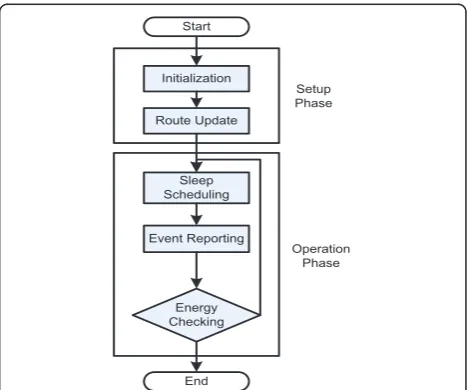
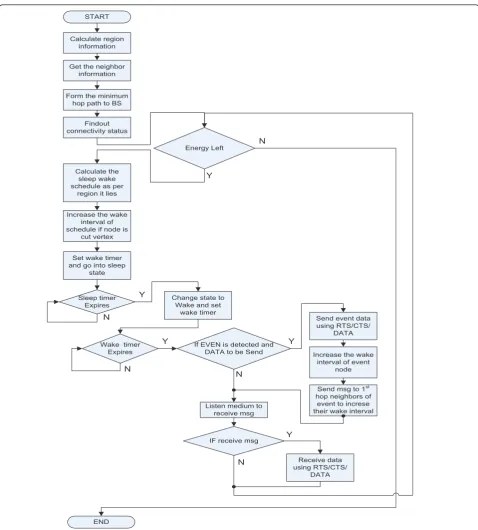
In this article, sleep scheduling algorithm is proposed for event-driven sensor networks for delay-sensitive applica-tions where events occurs rarely. The protocol consists of two main phases: the setup phase and the operation phase, as shown in Figure 2. These phases are further divided into sub-phases, as shown in Figure 3. The flow chart and the interaction among different phases are detailed in Figure 4. Different phases are discussed in the following paragraphs.
3.3.1. Setup phase
Setup phase is divided into two sub-phases: initialization and route update.
will not receive this message. All the other nodes receiving this message will mark their location status as region 2 and will go into the sleep state. Similarly rest of the nodes mark their region status as region 3 by receiving message TP3.
The region information is retained by the nodes. Each node sends control message to maintain first hop neighbor information. Once a node has its neighbor information, it decides whether it is a con-nectivity critical node or not. To compute this, cut vertex method is used as adopted in Ref. [34]. Based on this computation, it will mark itself as a connec-tivity critical node; otherwise, it will mark itself as normal node.
(2)Route update:In the route update phase, the sink node generates a route discovery message with hop count 0 that is broadcasted throughout the network. A node upon receiving this broadcast message updates its hop count value, that is, changes its value to new value if received hop count value is less than previous hop count value, otherwise, retains the previous value. Before forwarding the route discov-ery message, each node increments the hop count and then broadcasts the message to nodes in its communication range. In this way, a message arrives at each node along the desired minimum cost path. Consequently, each node has a minimum hop count path to the sink node.
3.3.2. Operation phase
This phase is sub-divided into the sleep wake scheduling and the event reporting phase.
(1) Sleep wake scheduling: In this phase, sleep wake scheduling is performed based on traffic loads.
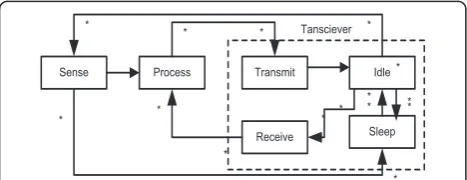
Traffic load of nodes differ according to region they lay, their connectivity importance, and their proxi-mity to the event occurrence. Based on these factors, each node determines its sleep wake pattern and accordingly switches between sleep/wake states (see Figure 6). In each sleep/wake cycle, node wakes up at set time intervals, waits for events to occur, scans the medium, and senses/receives data. The algorithm assigns three different wake interval (WT) WT1, WT2, and WT3 to nodes in region 1, region 2, and region 3, respectively, where WT1 < WT2 < WT3. The wake interval of the node is inversely propor-tional to the distance from the sink node, that is, les-ser the distance, the greater the wake interval (see Figure 7). It is done to make the wake interval adap-tive to the traffic load of the nodes. Nodes near to the sink node have greater traffic load as compared with the nodes away from the sink node and are assigned longer wake intervals as shown in Figure 8. Also, connectivity critical nodes are assigned longer wake intervals to cater for the heavy traffic load. Algorithm 1 (see Appendix), explains how each node do the sleep/wakeup scheduling.
Setup
Phase Operation Phase
Setup Phase
Time Time Slot
Sleep Wake……... Operation Phase
Sleep Wake
Figure 2Life cycle of sensor network operations in SMED protocol.
Initialization Route Update ScheudlingSleep Event Reporting
Setup Phase Operation Phase
Figure 3SMED operations.
Route Update
Sleep Scheduling
Event Reporting Initialization
Start
Setup Phase
Operation Phase
End Energy Checking
(2) Event reporting: The event reporting phase is responsible for forwarding data to the sink node on the occurrence of event in timely manner. In this phase, data is gathered from the sensor nodes and sent to the sink node. When an event occurs in node’s proximity, that node will increase its wake interval for the proceeding time slot. Furthermore, it sends message to its neighboring nodes to increase their wake interval to handle the expected traffic burst. This is because of the fact that when an event occurs in the node there is the probability of an event occurrence in the future as well (temporal dependency). Similarly if an event occurs at a node there is likelihood of occurrence of event in it neigh-borhood (spatial dependency). Both these case will result in expected traffic burst. Thus, the wake inter-val of a node where an event occurs and a node in its neighborhood is increased, to ensure the least delay in handling expected burst traffic (see Figure 9). Algorithm 2 (see Appendix), explains how each node do the sleep/wakeup scheduling based on the event occurrence.
To summarize, the flow chart of the SMED scheme is presented in Figure 10 for better understanding of the readers.
4. Simulations And Results
Based on the developed system model, simulations are carried out using OMNet++[22] to evaluate the perfor-mance of the proposed SMED protocol. Perforperfor-mance of proposed protocol is compared with the two contem-porary protocols: S-MAC [17] and Anycast protocol [33]. The following are the details of the simulation setup, energy model, and discussion of the results.
4.1 Simulation setup
Simulations were conducted in the sensing area of 200 × 200 m2and the number of sensor nodes varied from 20 to 260 for different experiments. Sensor nodes were ran-domly deployed and the random deployment is achieved by choosing (x, y) locations based on a uniform distribu-tion. The sink node is fixed and located at the center of the network. The simulations were conducted with com-munication range equal to double of their sensing range. The simulation parameters are adopted as used in Flex-iTP [8] which are based on Mica2Mote hardware. See the Table 1 for the listing of the simulation parameters.
Region# 1 Region#
2 Region# 3
TP1 TP2 TP3
Figure 5Dividing WSN into three regions.
Sense Process Transmit
Receive
Idle
Sleep
* *
*
*
* *
*
* *
* *
*
* ** Tansciever
Figure 6State transitions in SMED operations.
Increasing
distance
from
BS
Sensor Node Wake Mode Sleep Mode
4.2 Event summary
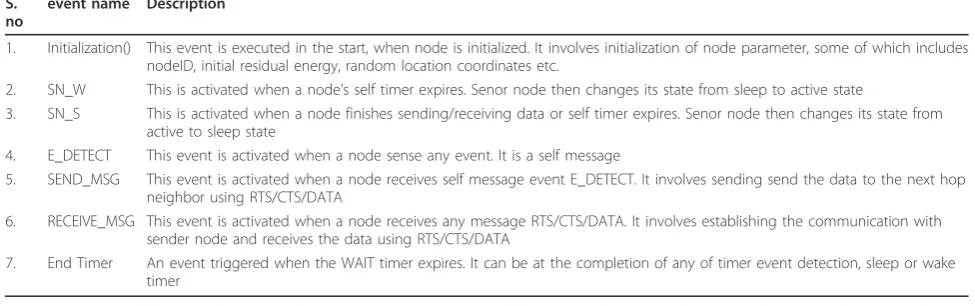
The following is the event summary of the main events as used in SMED protocol (see Table 2).
4.3. Energy model
It is assumed that the sensor nodes have the ability to adjust their transmission power according to the dis-tance of the receiving node. The energy model
presented in [10] is adopted here. The amount of energy consumed for transmission ETX of an l-bit message over a distance is given by
ETx =
l.Eelect+l.εfs·d2 for 0≤d≤dcrossover
l.Eelect+l.εmp·d4 for 0≥dcrossover
(1) Region#1
Region#2 Region#3
Receive
Send Idle Sleep
Base Station
Figure 8The path wakeup pattern of nodes in three regions.
Sensor Node 2 Sensor Node 3 Sensor Node n Sensor Node 1
Wakeup (timer)
Normal msg (synchronous) Self timer msg (asynchronous) Base Station
RTS CTS DATA
Wakeup (timer)
RTS CTS DATA RTS
CTS DATA
RTS CTS DATA
Wakeup (timer) Wakeup
(timer)
Wakeup (timer)
Wakeup (timer)
RTS CTS DATA
Wakeup (timer)
RTS CTS DATA
RTS CTS DATA RTS
CTS DATA
Wakeup (timer) Wakeup
(timer)
Wakeup (timer) Forwarding
other neighbor
data
Forwarding other neighbor
data
Forwarding other neighbor
data Forwarding
other neighbor
data
Forwarding other neighbor
data
Forwardi ng other neighbor data
Sleep Listen
where Eelect is the amount of energy consumed in electronics, εfs is constant for free space propagation and is the energy consumed in an amplifier when trans-mitting at distance shorter then dcrossover, and εmp is constant for multi-path propagation and is the amplifier energy consume in an amplifier when transmission at
distance greater the dcrossover. dis a distance threshold that depends on the environment. The energy expended in receiving1-bit message is given as
ERx=l Eelect (2)
Get the neighbor information
Form the minimum hop path to BS Calculate region
information
Findout connectivity status
If EVEN is detected and DATA to be Send Sleep timer
Expires Calculate the
sleep wake schedule as per
region it lies
Increase the wake interval of schedule if node is
cut vertex
Set wake timer and go into sleep
state
Send event data using RTS/CTS/
DATA
IF receive msg Listen medium to
receive msg
Receive data using RTS/CTS/
DATA Change state to
Wake and set wake timer
Wake timer Expires
Energy Left START
END
Y
N
Y
N
Y
N
Y
N
Y
N
Increase the wake interval of event
node
Send msg to 1st
hop neighbors of event to increse their wake interval
The total energy consumption is
Eradio=ETx+ERx (3)
4.4. Results and discussion
The performance of SMED is compared against the S-MAC and Anycast protocols. Experimental parameters, such as average delay per packet, energy per packet, average packet loss, and throughput, are used to mea-sure the performance of SMED.
4.4.1. Average delay per packet
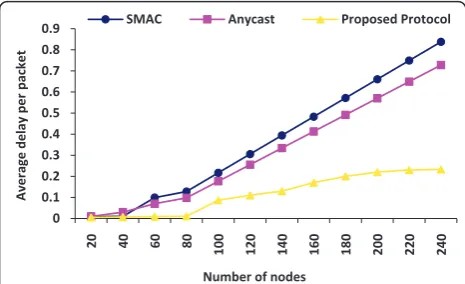
Delay is referred to as the time span between the packet sent from a sensor node and packet received at the sink node. Delay values are measured by changing the num-ber of sensor nodes from 20 to 260. As shown in Figure 11, the average delay experienced by the proposed SMED protocol is the least, while Anycast being the sec-ond and SMAC has the worst delay time. In SMED, nodes are given different wake intervals according to their traffic requirement with respect to their position in network, their topological importance and their proxi-mity from the event. The proposed protocol is able to
minimize delay at each hop because nodes have not to wait long for the wakeup interval of the next hop. As a result, average delay per packet in SMED is less than Anycast protocol and S-MAC. In the Anycast protocol, though the node has multiple next-hop relaying nodes by virtue of Anycast packet-forwarding scheme, which help to find next hop neighbor in quick manner, but still it does not consider the varied traffic requirement of different nodes. Thus, node wait time increases as packet approach to the nodes near to the sink node. Therefore, it has greater delay than the proposed proto-col. In S-MAC protocol, nodes have fixed wake interval for the whole network irrespective of their traffic requirement, thus, each node has to wait for the wake interval of the next hop. However, as all nodes have to relay their data all the way to sink node using multi-hop communication. Hence, it involves many relay nodes to reach the sink node, which increases end-to-end delay. Considering the local traffic at each node, sensed data had to wait for sometime at each node to get attended, thus delay become longer when packet approaches the nodes near to sink. The problem got worse when the packet approaches the nodes near to the sink node, where packet suffers maximum delay. It makes the Any-cast protocol and S-MAC prone to longer delays. Furthermore, as the number of nodes increases, the SMED clearly outperforms the other two strategies. For SMED, the performance remains the same for the increased number of nodes, since wake interval is adap-tive to the traffic load, whatever may be the size of the network. In this way, increasing the node number has no effect on SMED. Therefore, it suggests that the pro-posed SMED protocol is more scalable than S-MAC and Anycast protocol.
4.4.2. Average energy per packet
Average energy per packet is a measure of energy spent for forwarding a packet to the sink node. It is an indica-tor of the lifetime that can be achieved by the protocols.
Table 1 Simulation parameters for SMED protocol
Simulation parameter Value
Sensing area 200 × 200 m2
Bandwidth 38.4 Kbps
Transmission range 50 m
Transmit mode power 60 mW
Receive mode power 30 mW
Idle mode power 30 mW
Sleep mode power 0.003 mW
Transition power 30 mW
Transition time 2.45 ms
Packet size 96 bytes
Time slot size 42 ms
Simulation time 300 s
Table 2 Events summary for SMED
S. no
event name Description
1. Initialization() This event is executed in the start, when node is initialized. It involves initialization of node parameter, some of which includes nodeID, initial residual energy, random location coordinates etc.
2. SN_W This is activated when a node’s self timer expires. Senor node then changes its state from sleep to active state
3. SN_S This is activated when a node finishes sending/receiving data or self timer expires. Senor node then changes its state from active to sleep state
4. E_DETECT This event is activated when a node sense any event. It is a self message
5. SEND_MSG This event is activated when a node receives self message event E_DETECT. It involves sending send the data to the next hop neighbor using RTS/CTS/DATA
6. RECEIVE_MSG This event is activated when a node receives any message RTS/CTS/DATA. It involves establishing the communication with sender node and receives the data using RTS/CTS/DATA
In Figure 12, average energy per packet is plotted ony -axis, with varying number of sensor nodes (from 20 to 260) on x-axis. It can be observed that the average energy consumption per packet for the proposed SMED protocol is less than Anycast protocol and SMAC indi-cating comparatively extended network lifetime. The reason for increased lifetime in SMED can be attributed to the fact that it adjusts wake intervals based on traffic loads. By doing so, SMED avoids the case where the nodes remain awake and stay idle as no traffic is to be forwarded. Whereas, in the Anycast protocol many nodes stay awake to provide alternate paths for routing and mostly they remain idle, as expected traffic require-ments of nodes are considered while setting up sleep/ wake schedule. It results in increasing the wake node staying idle, which significantly limit the network life-time. Similarly in SMAC protocol random sleep/wake schedule is defined for all the nodes which increase the number of wake idle nodes especially as move away from the sink node. Nodes away from the sink node have to do less relaying. Ultimately, it uses the energy of the nodes in idle listening and ultimately the network lifetime of the network is reduced. Hence proposed
protocol has less energy per packet for both Anycast and SMAC protocol.
4.4.3. Packet loss ratio (%)
Packet loss ratio refers to the percentage of the packets that could not reach the BS, that is,
Packet loss ratio = Total number packets not recevied at the BS
Total number packets send by all the sensor nodes (4)
Figure 13 shows the measurement of packet loss ratio for the three protocols with varying number of sensor nodes (20 to 240). The packet loss ratio of all protocols increases as the number of nodes increases but their slopes are different. The packet loss ratio of the pro-posed protocol increases at the slowest rate because it considers the traffic pattern of different nodes and accordingly assigns wake intervals, which result in less packet loss. For S-MAC the packet loss ratio grows at relatively high speed because it use random sleep/wake schedule, which increases schedule misses and ulti-mately increases the packet loss ratio. It is clear from the Figure 13 that for the whole simulation, SMED has a far lower packet loss ratio as compared with S-MAC and Anycast protocols. It is because in the S-MAC and Anycast protocols, there is no congestion control mechanism to ensure adaptability in the wake interval, thus, the number of collisions/misses is higher. It makes S-MAC and Anycast more vulnerable to packet loss, thus reducing transmission reliability. With SMED, nodes have adaptive wake interval according to their traffic load requirement, thus, traffic flows through the network smoothly. Furthermore, in SMED critical nodes in terms of connectivity have longer wake interval, which results in decreased packet loss. Node detecting event and node in its vicinity are assigned greater wake interval, which also contribute in minimizing the lost packets. Hence, SMED is less prone to packet loss than other two protocols. As a result, SMED protocol has
0
Average delay per
packet
Number of nodes
SMAC Anycast Proposed Protocol
Figure 11Average delay per packet for different number of sensor nodes.
Average Energy per
Packet (J)
Number of nodes
SMAC Anycast Proposed Protocol
Figure 12Average energy per packet for different number of sensor nodes.
SMAC Anycast Proposed Protocol
outperformed the other two protocols in terms of packet lost ratio.
4.4.4. Throughput (packets per second)
Throughput is measured by the number of packets received per second at the sink node. In this simulation, the number of nodes were varied from 20 to 260 and the throughput is measured at the sink node. It can be seen from Figure 14 that by increasing the number of sensor nodes, the throughput for SMED, S-MAC, and Anycast protocols have increased. For greater network size after that, SMED has achieved throughput greater than both the S-MAC and Anycast protocols. It showed that the SMED protocol is scalable and could perform better as the size of the WSN becomes larger. Simply, out of the three evaluated protocols, SMED has the best throughput, while S-MAC second, and Anycast protocol has the least. 4.4.5. Coverage lifetime
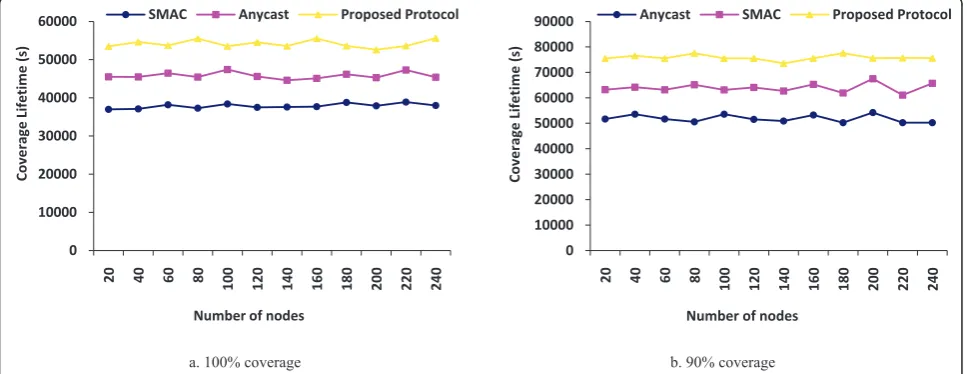
Coverage lifetime is referred as the time the network is able to preserve 100% or over 90% coverage of the whole
sensing area. As a generalization, coverage of less than this percentage is not tolerable and can be regarded as failure. In this experiment, number of nodes is varied from 20 to 260, and coverage lifetime (100%, 90%) is measured. Figure 15a provides coverage lifetime for 100% coverage area, while Figure 15b depicts coverage lifetime for 90% cover-age area. It can be observed that proposed outperformed Anycast and SMAC in terms of coverage lifetime in both cases of 100% and 90% coverage. In the SMAC approach, nodes used randomly do the sleep/wake scheduling. It increases the idle listening and involves more schedule miss because while defining sleep/wake schedule traffic requirement of the nodes are not considered. In Anycast protocol more than one paths are made active to have smooth routing. It wastes the energy of some of the nodes in idle listening and schedule misses because in making nodes active, traffic requirement of the nodes is not con-sidered. These nodes soon expire their energy and appear as coverage hole in the network. Whereas, in SMED, cov-erage hole is avoided by having efficient use of nodes energy by assigning nodes sleep/wake schedule according to its traffic requirement with respect to their position in network, their topological importance and their proximity from the sink node.
5. Conclusion
In this article, we have proposed the SMED in Multi-hop Wireless Sensor Networks. The proposed scheme is designed to have variable active duration of nodes according to their variable traffic load. The variable active durations are assigned to the nodes based on node dis-tance from the sink node, node topological impordis-tance, and occurrence of event in its vicinity. It will enable the nodes to gracefully handle the traffic, as nodes are dyna-mically assigned active durations according to their
0 10 20 30 40 50 60 70 80
20 40 60 80 100 120 140 160 180 200 220 240
Throughput
(Pa
cket / seco
nd)
Number of nodes
SMAC Anycast Proposed Protocol
Figure 14 Throughput (packet per second) for different number of sensor nodes.
a. 100% coverage b. 90% coverage
0 10000 20000 30000 40000 50000 60000
20 40 60 80 100 120 140 160 180 200 220 240
Coverage Lifetime
(s)
Number of nodes
SMAC Anycast Proposed Protocol
0 10000 20000 30000 40000 50000 60000 70000 80000 90000
20 40 60 80 100 120 140 160 180 200 220 240
Coverage Lifetime
(s)
Number of nodes
Anycast SMAC Proposed Protocol
expected traffic load. It minimizes delay at the nodes near to the sink node, node having critical topological posi-tion, and nodes in vicinity of event occurrence. This ensures rapid dissemination of data to the sink node and hence reduces the end-to-end delay. Simulations are car-ried out to evaluate the performance of the proposed protocol, by comparing its performance with S-MAC and Anycast protocols. Simulation results demonstrated that the proposed protocol has significantly reduced the end-to-end delay, as well as improved the other QoS para-meters of average energy per packet, average delay, packet loss ratio, throughput, and coverage throughput.
In future our plan is to extend the simulations to con-sider other parameters and scenarios, such as fault toler-ance, impact of aggregation, etc. Other important future extension is to evaluate the performance of SMED in clustered-based WSNs.
Appendix
Algorithms 1 and 2
Algorithm 1:sleep/wakeup scheduling algorithm
Input:WInormalthe Wake Interval Normal
Output:sleep/wakeup schedule
begin
checkregion status by each node
ifregion status is region 1then
set wake interval to 3 ×WInormal
else
if regionisregion 2then
set wake interval to 2 ×WInormal
else
set wake interval toWInormal
endif
endif
checktopology status by each node
iftopology status is criticalthen
set wake interval to 2 ×WInormal
else
set wake interval to WInormal
endif
follow up, by each sensor node, the determined sleep/ wake schedule and sense the environment for the occur-rence of the event for the specified interval defend by sleep/wake schedule.
ifevent occursthen
set wake interval of event occurrence node to 3 × WInormal
set wake interval first hop neighbors of event occur-rence node to
2 ×WInormaland send the message about the
chan-ged wake interval to the first hop neighbors
changeof sleep/wake interval by the first hop neigh-bor upon receipt of the updated sleep/wake schedule
waitof the event occurrence node for the arrival of next scheduled slot determined by self timer before sending the sensed event data
sendthe data to the next hop neighbor using three way communication RTS, CTS and DATA.
endif
end
Algorithm 2: sleep/wakeup scheduling algorithm
Input:WInormalthe Wake Interval Normal
Output:sleep/wakeup schedule
begin
follow the determined sleep/wake schedule and sense the environment for the occurrence of the event for the specified interval defend by sleep/wake schedule and employed by self timer
ifevent occursthen
setwake interval of event occurrence node to 3 × WInormal
setwake interval of the first hop neighbors of event occurrence node to 2 ×WInormaland send the mes-sage about the changed wake interval to the first hop neighbors
changeof sleep/wake interval by the first hop neigh-bor upon receipt of the updated sleep/wake schedule
waitof the event occurrence node for the arrival of next scheduled slot determined by self timer before sending the sensed event data
sendthe data to the next hop neighbor using three way communication RTS, CTS and DATA.
gointo sleep mode and wakeup in next schedule interval: a node will wakeup in next schedule slot determined by updated sleep/wake schedule.
endif end
Acknowledgements
would also like to thank Universiti Technologi PETRONAS for providing the financial assistance in the form of the Graduate Assistantship (GA) to carry out the research.
Author details
1Department of Computer and Information Sciences, Universiti Teknologi
PETRONAS, Bandar Seri Iskandar, 31750 Tronoh, Perak, Malaysia2COMSATS Institute of Information Technology (CIIT), Tobe Camp, University Road, 22060 Abbottabad, Pakistan
Competing interests
The authors declare that they have no competing interests.
Received: 5 March 2011 Accepted: 9 September 2011 Published: 9 September 2011
References
1. S Gyula, Maróti Miklós, L?é?deczi Ákos, B György, K Branislav, Nádas András, P Gábor, S János, F Ken, Sensor network-based countersniper system, in
Proceedings of the 2nd International Conference on Embedded Networked
Sensor Systems, ACM, Baltimore, (2004)
2. M Castillo-Effer, DH Quintela, W Moreno, R Jordan, W Westhoff, Wireless sensor networks for flash-flood alerting, inDevices, Circuits and Systems
(2004). inProceedings of the Conference on Fifth IEEE International Caracas
3. K Lorincz, DJ Malan, TRF Fulford-Jones, A Nawoj, A Clavel, V Shnayder, G Mainland, M Welsh, S Moulton, Sensor networks for emergency response: challenges and opportunities, IEEE Pervas. Comput.3(4), 16–23 (2004) 4. IF Akyildiz, S Weilian, Y Sankarasubramaniam, E Cayirci, A survey on sensor
networks. IEEE Commun Mag.40(8), 102–114 (2002). doi:10.1109/ MCOM.2002.1024422
5. Y Jennifer, M Biswanath, G Dipak, Wireless sensor network survey. Comput Netw.52(12), 2292–2330 (2008). doi:10.1016/j.comnet.2008.04.002 6. W Andrew, C SeongHwan, S Charles, C Anantha, Energy efficient Modulation and MAC for Asymmetric RF Microsensor Systems, in
Proceedings of the 2001 international symposium on Low Power Electronics
and Design, ACM, Huntington Beach, CA, (2008)
7. BA Myers, JB Willingham, P Landy, MA Webster, P Frogge, M Fischer, Design considerations for minimal-power wireless spread spectrum circuits and systems. Proc IEEE.88(10), 1598–1612 (2000). doi:10.1109/5.888998 8. WL Lee, A Datta, R Cardell-Oliver, Flexi TP, a flexible-schedule-based TDMA
protocol for fault-tolerant and energy-efficient wireless sensor networks. IEEE Trans Parallel Distrib Syst.19(6), 851–864 (2008)
9. C Srisathapornphat, S Chien-Chung, Coordinated power conservation for ad hoc networks, inIEEE International Conference on Communications(2002) 10. NA Pantazis, DD Vergados, A survey on power control issues in wireless
sensor networks. IEEE Commun Surv Tutor.9(4), 86–107 (2007) 11. AP Nikolaos, JV Dimitrios, DV Dimitrios, D Christos, Energy efficiency in
wireless sensor networks using sleep mode TDMA scheduling. Ad Hoc Netw.7(2), 322–343 (2009). doi:10.1016/j.adhoc.2008.03.006
12. J Liu, S Singh, ATCP: TCP for mobile ad hoc networks. IEEE J Sel Areas Commun.19(7), 1300–1315 (2001). doi:10.1109/49.932698
13. L Jie, Z Feng, P Cheung, L Guibas, Apply geometric duality to energy-efficient non-local phenomenon awareness using sensor networks. IEEE Wirel Commun.11(6), 62–68 (2004). doi:10.1109/MWC.2004.1368898 14. C Juan-Carlos, M Pietro, A performance comparison of energy consumption
for mobile ad hoc network routing protocols, inProceedings of the 8th International Symposium on Modeling, Analysis and Simulation of Computer
and Telecommunication Systems, IEEE Computer Society, (2000)
15. V Tsaoussidis, H Badr, TCP-probing: towards an error control schema with energy and throughput performance gains, inProceedings of 2000
International Conference on Network Protocols(2000)
16. S Suresh, CS Raghavendra, PAMAS—power aware multi-access protocol with Signalling for Ad Hoc Networks. SIGCOMM Comput Commun Rev.
28(3), 5–26 (1998). doi:10.1145/293927.293928
17. Y Wei, J Heidemann, D Estrin, An energy-efficient MAC protocol for wireless sensor networks, inProceedings on Twenty-First Annual Joint Conference of
the IEEE Computer and Communications Societies INFOCOM(2002)
18. C Benjie, J Kyle, B Hari, M Robert, Span: an energy-efficient coordination algorithm for topology maintenance in ad hoc wireless networks. Wirel Netw.8(5), 481–494 (2002). doi:10.1023/A:1016542229220
19. L van Hoesel, T Nieberg, W Jian, PJM Havinga, Prolonging the lifetime of wireless sensor networks by cross-layer interaction. IEEE Wirel Commun.
11(6), 78–86 (2004). doi:10.1109/MWC.2004.1368900
20. A Giuseppe, C Marco, F Mario Di, P Andrea, Energy conservation in wireless sensor networks: A survey. Ad Hoc Netw.7(3), 537–568 (2009). doi:10.1016/j. adhoc.2008.06.003
21. C Schurgers, V Tsiatsis, MB Srivastava, STEM: topology management for energy efficient sensor networks, inProceedings on Aerospace Conference
(2002)
22. C Schurgers, V Tsiatsis, S Ganeriwal, M Srivastava, Optimizing sensor networks in the energy-latency-density design space. IEEE Trans Mobile Comput.1(1), 70–80 (2002). doi:10.1109/TMC.2002.1011060
23. Y Xue, NH Vaidya, A wakeup scheme for sensor networks: achieving balance between energy saving and end-to-end delay, in10th IEEE Proceedings on Real-Time and Embedded Technology and Applications
Symposium, RTAS 2004(2004)
24. T Yu-Chee, H Chih-Shun, H Ten-Yueng, Power-saving protocols for IEEE 802.11-based multi-hop ad hoc networks, inProceedings on Twenty-First Annual Joint Conference of the IEEE Computer and Communications Societies
INFOCOM 2002(2002)
25. Z Rong, CH Jennifer, S Lui, Asynchronous wakeup for ad hoc networks, in
Proceedings of the 4th ACM International Symposium on Mobile ad hoc
Networking & Computing, ACM, Annapolis, MD, (2002)
26. D Jing, SH Yunghsiang, BH Wendi, KV Pramod, Scheduling sleeping nodes in high density cluster-based sensor networks. Mobile Netw Appl.10(6), 825–835 (2005). doi:10.1007/s11036-005-4441-9
27. D Jing, SH Yunghsiang, BH Wendi, KV Pramod, Balanced-energy sleep scheduling scheme for high-density cluster-based sensor networks. Comput Commun.28(14), 1631–1642 (2005). doi:10.1016/j.comcom.2005.02.019 28. Y Xu, J Heidemann, D Estrin, Adaptive energy-conserving routing for
multihop ad hoc network. (2000) Research Report 527, USC/Information Sciences Institute
29. T Di, DG Nicolas, A coverage-preserving node scheduling scheme for large wireless sensor networks, inProceedings of the 1st ACM international
workshop on Wireless sensor networks and applications, ACM, Atlanta, GA,
(2002)
30. P Lin, C Qiao, X Wang, Medium access control with a dynamic duty cycle for sensor networks. inWireless Communications and Networking Conference
(2004)
31. D Tijs van, L Koen, An adaptive energy-efficient MAC protocol for wireless sensor networks, inProceedings of the 1st international conference on
Embedded networked sensor systems, ACM, Los Angeles, CA, (2003)
32. Y Shih-Hsien, T Hung-Wei, EHK Wu, C Gen-Huey, Utilization based duty cycle tuning MAC protocol for wireless sensor networks, inGlobal
Telecommunications Conference, 2005. GLOBECOM‘05. IEEE(2005)
33. K Joohwan, L Xiaojun, NB Shroff, P Sinha, Minimizing delay and maximizing lifetime for wireless sensor networks with anycast. IEEE/ACM Trans Netw.
18(2), 515–528 (2010)
34. AA Abbasi, K Akkaya, M Younis, A distributed connectivity restoration algorithm in wireless sensor and actor networks, in32nd IEEE Conference on
Local Computer Networks 2007, LCN 2007(2007)
doi:10.1186/1687-1499-2011-92
Cite this article as:Naziret al.:Sleep/wake scheduling scheme for