R E S E A R C H
Open Access
The convergence of iterative learning
control for some fractional system
Xianghu Liu
1,2*, Yanfang Li
2and Yanmin Liu
2*Correspondence:
1School of Mathematics and
Computer Science, Guizhou University, Guiyang, Guizhou 550025, P.R. China
2Mathematics Department, Zunyi
Normal College, Zunyi, Guizhou 563006, P.R. China
Abstract
In this paper, we study the convergence of iterative learning control for some
fractional equation. Firstly, by using the Laplace transform and the M-L function, we
show the concept of mild solutions. Secondly, by using the Gronwall inequality, we
show the sufficient conditions of convergence for the open P-type and the close
P-type iterative learning control. At last, we give some examples to illustrate our main
results.
MSC:
93C10; 93C40
Keywords:
Caputo fractional derivative; iterative learning control; convergence;
Gronwall ineqality; P-type; Mittag-Leffler function
1 Introduction
In this paper, we will study the convergence of iterative learning control of the following
fractional system:
⎧
⎪
⎪
⎨
⎪
⎪
⎩
c
D
αt
x
(
t
) =
Ax
(
t
) +
f
(
x
(
t
),
u
(
t
),
t
),
t
∈
J
= [,
b
],
x
() =
x
,y
(
t
) =
g
(
x
(
t
),
u
(
t
),
t
),
()
where
cD
αt
denotes the Caputo fractional derivative of order
α
, <
α
< .
A
∈
R
n×n, the
functions
f
,
g
are continuous and
u
(
t
) is a control vector.
Iterative learning control (ILC) was described by Uchiyama in in Japanese, but
only few people noticed it. Arimoto
et al.
developed the ILC idea and studied the effective
algorithm until , they made it to be the iterative learning control theory, and more
and more people paid attention to it.
Fractional calculus and fractional difference equations have attracted lots of authors in
the past years [–], because they have been proved to be valuable tools in the modeling
of many phenomena in engineering, physics, science, controllability, and they also provide
an excellent tool to describe the hereditary properties of various materials and processes.
The work on fractional order systems in iterative learning control appeared in , and
extensive attention has been paid to this field and great progress has been made in the
following years [, , –]; many fractional nonlinear systems were researched
[–] and some operators have been studied [, ]. In [], the author discussed the
controllability of fractional control systems with control delay, and only used the
Mittag-Leffler function to deduce the solution. Because it is exponentially bounded, we think that
it should to be extensive studied and applied.
Motivated by the above mentioned works, we pay attention to and consider the system
(), the rest of this paper is organized as follows. In Section , we will show some definitions
and preliminaries which will be used in the following parts. In Section , we give some
results for P-type ILC for some fractional system. In Section , some simulation examples
are given to illustrate our main results. In this paper, the norm for the n-dimensional vector
x
= (
x
,x
, . . . ,x
n)Tis defined as
x
=
max
≤i≤n
|
x
i|
.
2 Preliminaries
In this section, we will give some definitions and preliminaries which will be used in the
paper.
Definition .
The integral
I
tαf
(
t
) =
(
α
)
t
(
t
–
s
)
α–f
(
s
)
ds
,
α
> ,
is called a Riemann-Liouville fractional integral of order
α
, where
is the gamma function.
For a function
f
(
t
) given in the interval [,
∞
), we have the expression
RL
D
α tf
(
t
) =
(
n
–
α
)
d
dt
n t
(
t
–
s
)
n–α–f
(
s
)
dt
,
where
n
= [
α
] + , [
α
] denotes the integer part of number
α
, is called the Riemann-Liouville
fractional derivative of order
α
> .
Definition .
Caputo’s derivative for a function
f
: [,
∞
)
→
R
can be written as
c
D
αt
f
(
t
) =
RLD
α tf
(
t
) –
n–
k=
t
kk
!
f
(k)
()
,
n
= [
α
] + ,
where [
α
] denotes the integer part of real number
α
.
Definition .
The definition of the two-parameter function of the Mittag-Leffler type is
described by
E
α,β(z
) =
∞k=
z
k(
α
k
+
β
)
,
α
> ,
β
> ,
z
∈
C
,
if
β
= , we get the Mittag-Leffler function of one parameter,
E
α(z
) =
∞k=
z
k(
α
k
+ )
.
Lemma .
The general solution of equation
()
is given by
x
(
t
) =
S
α,(
A
,
t
)
x
+
t
S
α,α(A
,
t
–
s
)
f
x
(
s
),
u
(
s
),
s
ds
,
()
where
S
α,β(A
,
t
) =
∞k=
A
kt
αk+β–(
α
k
+
β
)
.
Lemma .
(Lemma . in [])
The operators S
α,(t
)
and S
α,α(t
)
are exponentially
bounded
,
we have the constants C
=
α,
C
=
α
A
–α α
,
S
α,(A
,
t
)
≤
C
e
A
αt
,
S
α,α(A
,
t
)
≤
C
e
A
αt
.
()
Lemma .
([] Generalized Gronwall inequality)
Let u
(
t
)
be a continuous function on
t
∈
[,
T
]
and let v
(
t
–
s
)
be continuous and nonnegative on the interval
≤
s
≤
T
.
Moreover
,
let W
(
t
)
be a positive continuous and non-decreasing function on t
∈
[,
T
].
If
u
(
t
)
≤
W
(
t
) +
t
v
(
t
–
s
)
u
(
s
)
ds
,
t
∈
[,
T
],
then
u
(
t
)
≤
W
(
t
)
e
t
v(t–s)ds
,
t
∈
[,
T
].
3 P-type ILC for some fractional system
In this section, we consider the following fractional equation:
⎧
⎨
⎩
c
D
αt
x
k(
t
) =
Ax
k(
t
) +
f
(
x
k(
t
),
u
k(
t
),
t
),
t
∈
J
= [,
b
],
y
k(
t
) =
g
(
x
k(
t
),
u
k(
t
),
t
).
()
x
kdenotes the
k
th iteration of
x
,
u
kdenotes the
k
th iteration of
u
,
k
is the number of
iterations,
k
∈ {
, , , . . .
}
.
Firstly, we will make the following assumptions on the data of our problem.
H() The function
f
:
R
n×
R
n×
J
→
R
nsatisfies:
(i)
f
is measurable for all
t
∈
J
;
(ii) for
≤
i
≤
n
, there exists a constant
L
f>
such that
f
x
ki(
t
),
u
ki(
t
),
t
–
f
x
ki(
t
),
u
ki(
t
),
t
≤
L
fx
ki(
t
) –
x
ki(
t
)
+
u
ki(
t
) –
u
ki(
t
)
for all
x
ki,
u
ki,
x
ki,
u
ki∈
R
.
H()
g
:
R
n×
R
n×
J
→
R
n, for
β
j
>
,
j
= , , ,
,
⎧
⎪
⎨
⎪
⎩
β
≤
g
iuk:=
∂g(xki(t),uki(t),t) ∂uki(t)
≤
β
,β
≤
g
ixk:=
we also denote
x
ki(
t
) :=
x
k+i(
t
) –
x
ki(
t
)
,
u
ki(
t
) :=
u
k+i(
t
) –
u
ki(
t
)
;
e
ki(
t
) :=
y
di(
t
) –
y
ki(
t
)
where
γ
and
δ
are the parameters which will be determined.
Theorem .
Assume that the hypotheses H
(),
H
()
are satisfied
,
let y
k(
·
)
be the output of
Proof
Firstly, we know that
e
kFrom () and (), we have
lim
k→∞e
k= ,
the proof is completed.
3.2 Closed-loop case
For equation (), we consider the closed-loop P-type ILC,
t
∈
[,
b
]:
⎧
Proof
According to H(), H() and (),
e
k+=
+
δ
g
iuk(
ξ
(
t
),
ξ
(
t
),
t
)
e
k–
g
kix
(
ξ
(t
),
ξ
(t
),
t
)
+
δ
g
iuk(
ξ
(
t
),
ξ
(
t
),
t
)
x
kL≤
η
e
k+
β
+
δ
β
bL
fC
C
e
A
αb
x
k()
+
bL
fC
e
A
αb
u
k≤
η
e
k+
η
x
k()
+
η
e
k+.
Therefore
e
k+≤
η
–
η
e
k+
η
–
η
e
k()
,
it implies that
lim
k→∞e
k= ,
t
∈
J
, which completes the proof.
4 Simulations
In this section, we will give two simulation examples to demonstrate the validity of the
algorithm.
.. Consider the following Open-loop P-type ILC system:
⎧
⎪
⎪
⎨
⎪
⎪
⎩
c
D
.t
x
k(
t
) = (
x
k(
t
))
+
x
k(
t
) + .
u
k(
t
),
t
∈
J
= [, .],
x
() = .,
y
k
(
t
) =
x
k(
t
) + .
u
k(
t
),
()
with the iterative learning control
⎧
⎨
⎩
x
k+(
t
) =
x
k(
t
) + .
e
k(
t
),
u
k+
(
t
) =
u
k(
t
) + .
e
k(
t
),
we set
f
= (
x
k
(
t
))
and the initial control
u
(
·
) = ,
y
d(
t
) =
t
(–
t
),
t
∈
[, .], and set
L
f=
.,
β
= .,
β
= .,
β
= .,
β
= .,
γ
= .,
δ
= ., all conditions of Theorem .
are satisfied.
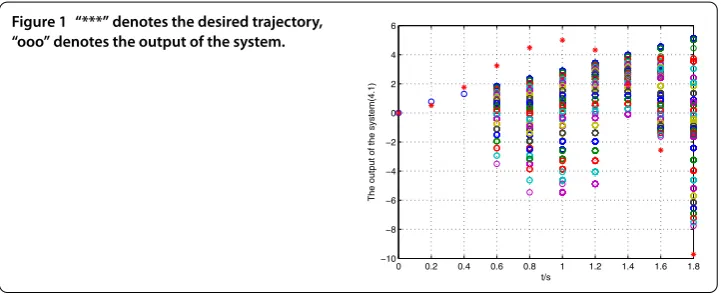
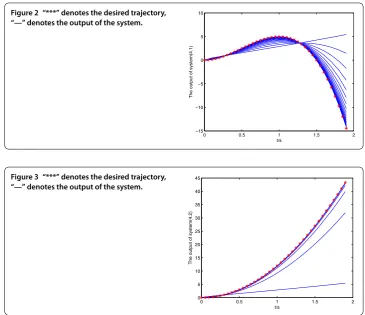
The simulation result can be seen from Figure and Figure , for the Open-loop P-type
ILC system (), with the increase of the number of iterations, it can track the desired
trajectory gradually by using the algorithm. Firstly, we use the single iteration rate to get
Figure 2 “***” denotes the desired trajectory, “—” denotes the output of the system.
Figure 3 “***” denotes the desired trajectory, “—” denotes the output of the system.
the result, from Figure , we find that late in the iteration, the output of the system jumps
around the desired trajectory, so we adopt the correction method, that is, when
e
j> ,
u
j=
u
j– .
×
e
jor
e
j< ,
u
j=
u
j+ .
×
e
j,
j
is the number of iteration, the result approaches
the desired trajectory stably and quickly; from Figure , the tracking error tends to zero at
the th iteration, so the iterative learning control is feasible and the efficiency is higher.
.. Consider the following Closed-loop P-type ILC system:
⎧
⎪
⎪
⎨
⎪
⎪
⎩
c
D
.t
x
k(
t
) = (
x
k(
t
))
+
x
k(
t
) + .
u
k(
t
),
t
∈
J
= [, .],
x
() = .,
y
k
(
t
) =
x
k(
t
) +
u
k(
t
),
()
with the iterative learning control
⎧
⎨
⎩
x
k+
(
t
) =
x
k(
t
) + .
e
k(
t
),
u
k+(
t
) =
u
k(
t
) +
e
k+(
t
),
we set the initial control
u
(·
) = ,
y
dFigure 4 Number of iterations and the tracking error.
Figure 5 “***” denotes the desired trajectory, “—” denotes the output of the system.
Figure 6 Number of iterations and the tracking error.
Figure 8 Number of iterations and the tracking error.
Table 1 The iteration number and the tracking error and the running time table
m The number of iterations The tracking error Run time (second)
0.7 5 0.0021 88.43
1 2 0.001 37.10
1.2 5 0.010 313.17
From Figure -Figure and Table , we find the tracking error tends to zero within six
iterations, so the output of the system can track the desired trajectory almost perfectly. By
comparing three cases, when
m
= , the iteration number is only , and the tracking error
is ., the tracking performance is best and improved over the iteration domain.
5 Conclusions
In this paper, the convergence of iterative learning control for some fractional equation
was discussed. Based on our results, the Open-loop and Closed-loop P-type ILC law were
proposed, by using the Gronwall inequality, the sufficient conditions of convergence for
the two types of iterative learning control were showed. Simulation results showed that
the algorithm is effective. In the future, we will study iterative learning control for some
fractional equation with impulse or delay.
Competing interests
The authors declare that they have no competing interests.
Authors’ contributions
All authors contributed equally to the writing of this paper. All authors read and approved the final manuscript.
Acknowledgements
Project supported by the National Natural Science Foundation of China (Grants nos. 71461027, 71471158), Zunyi Normal College Doctoral Scientific Research Fund BS[2014]19, BS[2015]09, Guizhou Province Mutual Fund LH[2015]7002, LH[2015]7006, LH[2016]7028, Guizhou Province Department of Education Fund (qian jiao he) KY[2014]295, KY[2015]391, KY[2015]451, KY[2016]046, Guizhou Province Department of Education teaching reform project [2015]337, Guizhou Province Science and technology fund (qian ke he ji chu) [2016]1160, [2016]1161, (qian ke he j zi) [2015]2147, Zunyi Science and technology talents [2016]15, Innovative talent team in Guizhou Province (Qian Ke HE Pingtai Rencai) [2016]5619.
The authors thank the referees for their careful reading of the manuscript and insightful comments, which helped to improve the quality of the paper. We would also like to acknowledge the valuable comments and suggestions from the editors, which vastly contributed to improving the presentation of the paper.
Publisher’s Note
Springer Nature remains neutral with regard to jurisdictional claims in published maps and institutional affiliations.
References
1. Miller, KS, Ross, B: An Introduction to the Fractional Calculus and Differential Equations. Wiley, New York (1993) 2. Kilbas, AA, Srivastava, HM, Trujillo, JJ: Theory and Applications of Fractional Differential Equations. North-Holland
Mathematics Studies, vol. 204. Elsevier, Amsterdam (2006)
3. Lakshmikantham, V, Leela, S, Vasundhara Devi, J: Theory of Fractional Dynamic Systems. Cambridge Academic Publishers, Cambridge (2009)
4. Diethelm, K: The Analysis of Fractional Differential Equations. Springer, Berlin (2010)
5. Wang, J, Zhou, Y, Medved, M: On the solvability and optimal controls of fractional integrodifferential evolution systems with infinite delay. J. Optim. Theory Appl.152, 31-50 (2012)
6. Wang, J, Zhou, Y: A class of fractional evolution equations and optimal controls. Nonlinear Anal., Real World Appl.12, 262-272 (2011)
7. Wang, J, Zhou, Y: Analysis of nonlinear fractional control systems in Banach spaces. Nonlinear Anal.74, 5929-5942 (2011)
8. Wang, J, Zhou, Y: Existence and controllability results for fractional semilinear differential inclusions. Nonlinear Anal., Real World Appl.12, 3642-3653 (2011)
9. Wang, J, Zhou, Y, Feckan, M: On recent developments in the theory of boundary value problems for impulsive fractional differential equations. Comput. Math. Appl.64, 3008-3020 (2012)
10. Wang, J, Feckan, M, Zhou, Y: Ulam’s type stability of impulsive ordinary differential equations. J. Math. Anal. Appl.395, 258-264 (2012)
11. Wang, J, Feckan, M, Zhou, Y: On the new concept of solutions and existence results for impulsive fractional evolution equations. Dyn. Partial Differ. Equ.8, 345-362 (2011)
12. Wang, J, Zhou, Y, Feckan, M: Nonlinear impulsive problems for fractional differential equations and Ulam stability. Comput. Math. Appl.64, 3389-3405 (2012)
13. Wang, J, Zhou, Y, Wei, W, Xu, H: Nonlocal problems for fractional integrodifferential equations via fractional operators and optimal controls. Comput. Math. Appl.62, 1427-1441 (2011)
14. Wang, J, Zhang, Y: On the concept and existence of solutions for fractional impulsive systems with Hadamard derivatives. Appl. Math. Lett.39, 85-90 (2015)
15. Wang, J, Ibrahim, AG, Feckan, M: Nonlocal impulsive fractional differential inclusions with fractional sectorial operators on Banach spaces. Appl. Math. Comput.257, 103-118 (2015)
16. Zhang, L, Ahmad, B, Wang, G: Explicit iterations and extremal solutions for fractional differential equations with nonlinear integral boundary conditions. Appl. Math. Comput.268, 388-392 (2015)
17. Zhang, X: On the concept of general solution for impulsive differential equations of fractional-orderq∈(1, 2). Appl. Math. Comput.268, 103-120 (2015)
18. Ge, F, Zhou, H, Ko, C: Approximate controllability of semilinear evolution equations of fractional order with nonlocal and impulsive conditions via an approximating technique. Appl. Math. Comput.275, 107-120 (2016)
19. Arthi, G, Park, JH, Jung, HY: Existence and exponential stability for neutral stochastic integrodifferential equations with impulses driven by a fractional Brownian motion. Commun. Nonlinear Sci. Numer. Simul.32, 145-157 (2016) 20. Hernández, E, O’Regan, D, Balachandran, K: On recent developments in the theory of abstract differential equations
with fractional derivatives. Nonlinear Anal.73(10), 3462-3471 (2010)
21. Zayed, EME, Amer, YA, Shohib, RMA: The fractional complex transformation for nonlinear fractional partial differential equations in the mathematical physics. J. Assoc. Arab Univ. Basic Appl. Sci.19, 59-69 (2016)
22. Zhang, X, Zhang, B, Repovš, D: Existence and symmetry of solutions for critical fractional Schrödinger equations with bounded potentials. Nonlinear Anal., Real World Appl.142, 48-68 (2016)
23. Bien, Z, Xu, JX: Iterative Learning Control Analysis: Design, Integration and Applications. Springer, Berlin (1998) 24. Chen, YQ, Wen, C: Iterative Learning Control: Convergence, Robustness and Applications. Springer, Berlin (1999) 25. Norrlof, M: Iterative learning control: analysis, design, and experiments. Linkoping Studies in Science and Technology,
Dissertations, No. 653, Sweden (2000)
26. Xu, JX, Tan, Y: Linear and Nonlinear Iterative Learning Control. Spring, Berlin (2003)
27. Wang, Y, Gao, F, Doyle, FJ III: Survey on iterative learning control, repetitive control, and run-to-run control. J. Process Control19(10), 1589-1600 (2009)
28. de Wijdeven, JV, Donkers, T, Bosgra, O: Iterative learning control for uncertain systems: robust monotonic convergence analysis. Automatica45(10), 2383-2391 (2009)
29. Wang, J, Feckan, M, Zhou, Y: A survey on impulsive fractional differential equations. Fract. Calc. Appl. Anal.19, 806-831 (2016)
30. Liu, S, Debbouche, A, Wang, J: On the iterative learning control for stochastic impulsive differential equations with randomly varying trial lengths. J. Comput. Appl. Math.312, 47-57 (2017)
31. Yu, X, Debbouche, A, Wang, J: On the iterative learning control of fractional impulsive evolution equations in Banach spaces. Math. Methods Appl. Sci. (2015). doi:10.1002/mma.3726
32. Xu, JX: A survey on iterative learning control for nonlinear systems. Int. J. Control84(3), 1275-1294 (2011) 33. Li, Y, Chen, Y, Ahn, H: Fractional-order iterative learning control for fractional-order systems. Asian J. Control13(1),
1-10 (2011)
34. Lan, Y: Iterative learning control with initial state learning for fractional order nonlinear systems. Comput. Math. Appl. 64(10), 3210-3216 (2012)
35. Lin, M, Yen, C, Tsai, M, Yau, H: Application of robust iterative learning algorithm in motion control system. Mechatronics23(5), 530-540 (2013)
36. Li, Y, Jiang, W: Fractional order nonlinear systems with delay in iterative learning control. Appl. Math. Comput. 257(15), 546-552 (2015)
37. Wang, J, Feckan, M, Zhou, Y: Center stable manifold for planar fractional damped equations. Appl. Comput. Math. 296, 257-269 (2017)
38. Zhou, Y, Jiao, F: Existence of mild solutions for fractional neutral evolution equations. Comput. Math. Appl.59(3), 1063-1077 (2010)
40. Wei, J: The controllability of fractional control systems with control delay. Comput. Math. Appl.64(10), 3153-3159 (2012)
41. Liu, S, Wang, J, Wei, W: Iterative learning control based on a noninstantaneous impulsive fractional-order system. J. Vib. Control22, 1972-1979 (2016)
42. Li, M, Wang, J: Finite time stability of fractional delay differential equations. Appl. Math. Lett.64, 170-176 (2017) 43. Bazhlekova, E: Fractional evolution equations in Banach spaces. Ph.D Thesis, Eindhoven University of Technology