Volume 2007, Article ID 98938,10pages doi:10.1155/2007/98938
Research Article
Tree-Based Distributed Multicast Algorithms for
Directional Communications and Lifetime Optimization
in Wireless Ad Hoc Networks
Song Guo,1Oliver W. W. Yang,2and Victor C. M. Leung1
1Department of Electrical and Computer Engineering, The University of British Columbia, Vancouver, BC, Canada V6T 1Z4 2School of Information Technology and Engineering, University of Ottawa, Ottawa, ON, Canada K1N 6N5
Received 1 June 2006; Revised 29 October 2006; Accepted 30 October 2006
Recommended by Xiuzhen Cheng
We consider the problem of maximizing the network lifetime in WANETs (wireless ad hoc networks) with limited energy re-sources using omnidirectional or directional antennas. Unlike most solutions that use a centralized multicast algorithm, we use graph-theoretic approach to solve the problem in a distributed manner. After providing a globally optimal solution for the special case of single multicast session using omnidirectional antenna, this approach leads us to a group of distributed algorithms for multiple multicast in WANETs using directional antennas. Experimental results show that our distributed multicast algorithms for directional communications outperform other centralized multicast algorithms significantly in terms of network lifetime for both single-session and multiple-session scenarios.
Copyright © 2007 Song Guo et al. This is an open access article distributed under the Creative Commons Attribution License, which permits unrestricted use, distribution, and reproduction in any medium, provided the original work is properly cited.
1. INTRODUCTION
There is an increasing interest in wireless ad hoc networks in many application domains where instant infrastructure is needed and no central backbone system and administration (like base stations and wired backbone in a cellular system) exist. Each communicating node in these networks acts as a router in addition to a host in order to communicate with each other over a limited number of shared radio channels. A communication session can be achieved either through a single-hop transmission if the communicating nodes are close enough to each other, or through multiple hops by re-laying through intermediate nodes. Since each node in such a network is usually powered by a battery with limited amount of energy, the wireless ad hoc network will become unus-able after the batteries are drained. Consequently, energy ef-ficiency is an important design consideration for wireless ad hoc networks.
Over the last few years, energy efficient communication in wireless ad hoc networks with directional antennas has re-ceived more and more attention. This is because directional communications can save transmission power by concentrat-ing RF energy where it is needed [1,2]. On the other hand, the broadcast/multicast communication is also an important
issue as many routing protocols for wireless ad hoc networks need this mechanism to maintain the routes between nodes. Therefore, one would be interested in finding an algorithm that would provide the maximum lifetime to the multicast session. The optimization metric is typically defined as the duration of the network operation time until the battery de-pletion of the first node in the network.
lifetime performance of the current solution by identify-ing the node with the smallest lifetime and revisidentify-ing routidentify-ing topology as well as corresponding beamforming behavior for an increased network lifetime. All existing solutions are cen-tralized, meaning that at least one node needs global network information in order to construct an energy efficient multi-cast tree.
In this paper, we explore the energy conservation of-fered by directional communications for providing long-lived broadcasting/multicasting in wireless ad hoc networks. Our focus is on establishing source-initiated multicast trees to maximize network operating time in energy-limited wire-less ad hoc networks with single or multiple multicast ses-sions. Similar to previous research on the same problems [1– 14], we only consider static networks because mobility adds a whole new dimension to the problem and it is out of the scope of this paper.
Unlike the previous work, we would like to design the distributed algorithms that can run on the wireless nodes with limited recourses (i.e., bandwidth, memory, computa-tional capacity, and power). We first use graph-theoretic ap-proach to solve the special case of single multicast session us-ing omnidirectional antenna. This graph-theoretic approach provides us insights into more general case of using direc-tional antennas, and inspires us to produce a group of dis-tributed algorithms. We will extend these solutions to max-imize the network lifetime over multiple sessions as well in more realistic scenarios for a wide range of potential civil and military applications. A straightforward approach is that the same trees that were optimized for single session operation are used for the multiple session operations.
The main contribution of this paper is that we present a group of distributed multicast algorithms for the network lifetime maximization problem in WANETs with omnidi-rectional antennas or diomnidi-rectional antennas. In particular, we prove that our distributed algorithm for a single multicast session using omnidirectional antennas is globally optimal. Experimental results also show that our distributed multi-cast algorithms for directional communications outperform other centralized multicast algorithms significantly in terms of network lifetime for both single-session and multiple-session scenarios.
The rest of this paper is organized as follows.Section 2 develops the system model.Section 3exploits some impor-tant properties of a min-max tree and proposes a group of distributed algorithms for both omnidirectional and direc-tional antenna scenarios. Section 4 demonstrates the per-formance of our algorithms through a simulation study. Section 5gives the conclusion on the results.
The following symbols and notations listed inTable 1will pertain to the remainder of this paper.
2. SYSTEM MODEL
We model our wireless ad hoc network as a simple directed graph G with a finite node set N and an arc set A cor-responding to the unidirectional wireless communication links. Each node is equipped with a directional antenna,
Table1: Symbols and notations.
G(A,N)
A directed graph modeling the wireless ad hoc network with a node setNand an arc setAcorresponding to the unidirectional wireless communication link
A(Ts) The arc set of a multicast treeTs
Cv The child node set of nodev
D The set of destination nodes of a multicast session
M The set of multicast members including source nodeand all destination nodes N(Ts) The node set of a multicast treeTs
Nv A set of neighboring nodes of nodeits maximum transmission range vlocated within
TNv
A tree node set in which each node belongs to the multicast treeTsand lies in the maximum
transmission range of nodev
Ts A multicast tree rooted at a source nodes
pvu The RF transmission power needed for the link fromnodevto nodeu
pmax The maximum RF transmission power level that anode can choose
precv The minimum power needed for reception processing
ptran processingThe minimum power needed for transmission
rvu The distance between nodevand nodeu
wvu The weight for an arc(v,u) in graphG
α The propagation loss exponent
δ(Ts) The maximum weight of the arc inTs
δmin The minimumδ(Ts) for allTsoverΩM
δv
LB The lower bound ofδminestimated at nodev
δLB A lower bound ofδmin
εv The residual battery energy of nodev
θv The antenna beamwidth of nodev(θmin≤θv≤θmax)
θv(Cv) The minimum possible antenna beamwidth for nodeto cover a node setC v v
τvu The maximal lifetime of a tree arc
ΩM The family of treesTsofGspanning all the nodes inM
are assumed to have the same signal detection threshold, which is typically normalized to one. Then the transmission powerpvuneeded by nodevto reach nodeucan be expressed as ceed some maximum valuepmax. In addition to RF propaga-tion, energy may be also expended for transmission ing (on modulation, encoding, etc.) and reception process-ing (on demodulation, decodprocess-ing, etc.). For simplicity, these quantities are the same for any node, denoted as ptran and
precv, respectively.
We consider a source-initiated multicast with a multicast setM = {s} ∪D, wheresis the source node andDis the set of destination nodes. All the nodes involved in the mul-ticast form a mulmul-ticast tree rooted at the node s, that is, a rooted treeTs, with a tree node setN(Ts), and a tree arc set
A(Ts). We define a rooted tree as a directed acyclic graph with a source node with no incoming arcs, and each other nodev has exactly one incoming arc. A node with no out-going arcs is called a leaf node, and all other nodes are internal nodes (also called relay nodes). An important property of a rooted tree is that for any nodevin the rooted treeTs, there must exist a single directed acyclic path in the tree.
Let the energy supplyε= {εu|u∈N}be the initial en-ergy level associated with each node inG. The residual life-timeτvuof a tree arc(v,u) is therefore
3. DISTRIBUTED MIN-MAX TREE ALGORITHMS We first consider the graph representation of the WANET with omnidirectional antennas (θv=360), and assign
wvu=τ1 the single session-based maximum lifetime multicast prob-lem is equivalent to themin-maxtree problem, which is to determine a directed treeTsspanning all the multicast mem-bers (i.e.,M⊆A(Ts)) such that the maximum of the tree arc weightδ(Ts) is minimized, where
δTs≡maxwvu|(v,u)∈ATs . (4)
Due to their equivalence, we will only investigate the properties of the min-max tree in this section. In the follow-ing, we will provide a related theorem that is used to derive our efficient algorithms.
s X
a
b
z N X
Figure1: Illustration of the proof forTheorem 1. (The arrow line
denotes the directed tree link and arrow curve denotes the directed tree path.)
3.1. A min-max tree theorem
LetTs∗be the min-max tree andΩMis the family of the trees spanning all the nodes inM, we therefore have
δmin≡δ
Theorem 1. Let(v,u)be the bottleneck link of the multicast treeTs∈ΩM. If there exists a node setX,s∈XandD∩(N−
X)=φ, such thatwvu≤wxyfor anyx∈Xandy∈N−X, thenTsis amin-maxtree.
Proof. For any multicast treeTs∈ΩM, let (v,u) be its
bot-tleneck link. Note that there is at least one multicast member
z(z=s) belonging toN−X, that is,z∈D∩(N−X), since otherwise it contradicts the factD∩(N−X)=φ. Therefore, there must exist an arc(a,b)∈A(Ts), as shown inFigure 1, connectingXandN−X(i.e.,a∈Xandb∈N−X) in or-der to satisfy the requirement that there exists a directed path fromsto the multicast memberz.
From the given condition inTheorem 1, we havewvu ≤ wab. Furthermore, since (a,b)∈ A(Ts), the bottleneck link weightδ(Ts) of treeTsmust be equal to or greater than the weight of any other tree link, for example, link (a,b). That is,
wab ≤δ(Ts). We thus can derive thatδ(Ts)=wvu≤wab ≤ δ(Ts) for anyTs∈ΩM, that is,Tsis a min-max tree.
3.2. Min-max tree algorithm
Theorem 1immediately suggests an MMT (min-max tree) algorithm for the maximum lifetime multicast problem as follows.
The MMT(G,s) algorithm
(1) InitializeTsby settingN(Ts)= {s}andA(Ts)=φ.
(2) Repeat
(i) Search phase:
Find the arc(v,u) connectingN(Ts) andN−N(Ts)
with minimum valuewvu, and then add (v,u) into
the tree by settingN(Ts)=N(Ts)∪ {u}and
A(Ts)=A(Ts)∪ {(v,u)}.
(ii) Grow phase:
while (exist link (x,y) connectingN(Ts)
andN−N(Ts) such thatwxy≤wvu)
Add (x,y) into the tree by setting
N(Ts)=N(Ts)∪ {x}and
A(Ts)=A(Ts)∪ {(x,y)}.
until (M⊆N(Ts)).
(3) Obtain the final multicast tree by pruning the broadcast treeTs.
Algorithm1: The MMT algorithm.
Search-and-grow procedure
Find the link (v,u) connecting tree node set and nontree node set with minimum weightwvu, and then include it into the multicast tree. Consequently, the treeTswould grow by including as many nontree links (x,y) as possible into the multicast tree ifwxy ≤wvuuntil no more such links can be
found.
A pseudocode of the MMT algorithm is given in Algo-rithm 1.
We will use a ten-node network as a simple example to illustrate the basic tree construction steps in MMT. All nodes are multicast members and node 0 is the source. Each node has the same initial energy supply in a 10×10 square as shown inFigure 2. The maximum transmission range is set to 5 and a propagation loss exponent isα=2.
Step 1. Initially, the tree consists of only the source node 0.
Step 2. In the first iteration, the link (0, 4) connecting node sets{0}and{1, 2, 3, 4, 5, 6, 7, 8, 9}is found with minimum weight, and then added into the tree as shown by the dark arc inFigure 2(a). There is no any other link included in the tree in the following grow operation.
Step 3. In the second iteration, the link (0, 7) connecting node sets{0, 4}and{1, 2, 3, 5, 6, 7, 8, 9}is found with mini-mum weight and added into the tree. The tree then grows by including link (7, 9) as shown by the light arcs inFigure 2(b) sincew79< w07.
Step 4. In the third iteration, the link (9, 1) connecting node sets{0, 4, 7, 9}and{1, 2, 3, 5, 6, 8}is found with minimum weight and added into the tree. The tree then grows by
including links (1, 3), (1, 5), (1, 6), (3, 8), and (6, 2) since their weights are all less thanw91. The min-max tree is eventu-ally obtained as shown inFigure 2(c)with the bottleneck link (9, 1) that is found in the last iteration.
We have the following observations for the search-and-growprocess.
(1) Only one link is chosen in search phase, for example, link (v,u) as shown in Figure 3, where Ts is a par-tially constructed multicast tree at the beginning of this search phase.
(2) The weightwvu, denoted asδLB, must be a lower bound ofδminand it is given by
δLB=min
wxy|(x,y)∈A, x∈NTs, y∈N−NTs .
(6)
(3) There would be multiple links to be included into the multicast tree in a subsequent grow phase. A larger constructed multicast treeTsis then obtained by the end of thesearch-and-growprocess.
(4) The new added links grow from certain nodes (e.g., nodev), called grow points, by absorbing as many new links as possible denoted as the tree branches in the darker shaded area inFigure 3. It is interesting to note that there would be multiple such grow points inTs, for example, nodev, ifwvu=wvu.
(5) The sequence of the weightwvuin the min-max tree formation is in an increasing order and the final one in the sequence is equal toδmin.
0
Figure2: Examples of min-max tree construction using the MMT algorithm.
u
Figure 3: Illustration of thesearch-and-growprocess. (The dark
nodes indicate the multicast members, and light nodes indicate the nonmembers. The dark arrows indicate links that are included into the tree insearchphases and the light arrows indicate the links that are included into the tree ingrowphases.)
Finally, it remains to show that the multicast tree discov-ered by the MMT algorithm is a min-max tree. This is stipu-lated as follows.
Lemma 1. At least one bottleneck link of the tree constructed by MMT is included in the tree in a search operation.
Proof. We prove it by contradiction. Suppose that each bot-tleneck link, for example, (x,y), of the tree constructed by MMT is added in the tree in a grow operation, and the link (v,u) is included into the tree just in the preceding search op-eration. From thesearch-and-growprocedure, we havewxy≤ wvu. On the other hand,wvu≤wxybecause (x,y) is a
bottle-neck link of the tree. Therefore, we derivewxy=wvu, that is,
(v,u) is also a bottleneck link, which contradicts the above assumption that all bottleneck links are included in grow op-erations.
Theorem 2. MMT constructs amin-maxtree.
Proof. From the conclusion ofLemma 1, there exists a bottle-neck link that is added into the tree in a search operation. Let
Tsbe the partially constructed multicast tree before entering such search operation. At this situation, the node set X = N(Ts) satisfies the conditions inTheorem 1and therefore we conclude that the final tree obtained from the MMT algo-rithm is a min-max tree.
3.3. The DMMT-OA algorithm
The above analysis would allow us to design distributed al-gorithm. Our DMMT-OA (distributed MMT algorithm for omnidirectional antenna) usessearch-and-growcycles to dis-cover a min-max tree. Such feature is beneficial to implement it in a distributed fashion. We have formulated a data struc-ture to maintain locally the multicast forwarding state at each tree nodev: a membership status and the neighborhood table
Nv. The membership status indicates if this node is asource,
receiver, orforwarder. A node can be both a receiver and for-warder. The neighborhood tableNv contains one entry for each neighbor u within its maximum transmission range. Each entry in the table includes a flag to indicate if the nodeu is atreenode or anontreenode. More specifically, ifuis a tree node, the relationship to nodevis further indicated as par-ent,child, orother(neitherparentnorchild). All tree nodes withinNvare denoted asTNv.
The distributed algorithm assumes an underlying bea-coning protocol which allows each node to be aware of the existence of all its neighbors and the information wxy be-tween any two neighbor nodesxandy. After the neighbor discovery, any nodevwill create an entry for each neighbor
uand set node uasnontree. When there is a multicast re-quest, the source will begin to construct a min-max tree as follows.
In a search operation, each tree node v (initially only source node s) first locally calculates an estimation of the lower bound ofδminas follows:
δv
LB=min
wvu|u∈Nv−TNv . (7)
It would unicast a multicast-join-reply (MJREP) message back to its parent with the parameterδvLBifvis a leaf node, or with the parameter min{δv
0
Figure4: DMMT-OA for directional antenna networks.
after collecting all MJREPs from its children if vis a relay node. Note that nodevdoes not send this message if the par-entflag is not set yet. Furthermore, ifvis a multicast member, it also attaches its own address in the MJREP message, which will be propagated to the source to notify its attendance to the multicast.
In this manner, the source will eventually obtain the lower bound δLB just as given in (6) once all MJREPs are received from its children. If not all multicast members are included in the tree, the source will initiate the grow op-eration by propagating the multicast-join-request (MJREQ) messages with the parameterδLBall over the network.
When receiving the first MJREQ message, each interme-diate nodevwill first set the transmitting node (from which MJREQ is received) asparentin its neighborhood table, then send back an acknowledgment message which allows its par-ent node to set itself as achild. Nodevwould also forward MJREQ to any node u only if wvu ≤ δLB. All subsequent duplicate MJREQs (with the same request ID) from other nodes are simply dropped, while the corresponding relation-ship flag is set as otherfor each of these nodes in nodev’s neighborhood table. The multicast forwarding state at each tree nodevis set as follows. If nodevis a destination, it will set it asreceiver. In addition, if nodevis a relay node (i.e., there is at least one entry with achildflag in its neighbor-hood table), it will set its membership status asforwarder.
After a short period of time, no more MJREQs would be received at nodev. This means that the grow operation completes around nodev, and it then goes to the search op-eration again as described earlier. Finally, a forwarding tree is created in thesesearch-and-growcycles until all members join the tree. After that, a min-max multicast tree is obtained by pruning all the unnecessary links in a distributed fashion from the nonmember leaf nodes.
The above DMMT-OA algorithm for the omnidirec-tional antenna networks can be straightforward applied for directional communications. Figure 4 shows the result by
running the DMMT-OA algorithm for the scenario with
θmin = 30 and θmax = 360, in which the shaded sectors indicate the areas covered by the directional antennas. This simple process is to reduce the antennas beamwidth of each internal nodevto the smallest possible value that provides beam coverage of all its downstream neighbors in the tree, subject to the constraintθmin≤θv≤θmax.
3.4. The DMMT-DA algorithm
The DMMT-DA (distributed MMT algorithm for directional antennas) algorithm is similar in principle to DMMT-OA for the formation of min-max tree, in the sense that new nodes are added into the tree insearch-and-growcycles. We must first incorporate the antenna beamwidth into the arc weight as follows: tenna beamwidth for nodevto cover all its childrenCvin the tree.
LetTsbe the partially constructed tree obtained at the be-ginning of a search phase. In order to obtain the lower bound provided by (7) in this search phase, each tree nodevneeds to recalculate the weightwvuusing (8), in which the node set
Cvis given as follows:
Cv=x|(v,x)∈ATs ∪ {u}. (9)
In a grow operation, the new children, for example, node
x, of each tree nodev, should be included into the tree as many as possible if a tree structure is still maintained and
wvxis not greater than the lower boundδLBthat is obtained from the previous search operation, that is,
Cv=arg max
Cv
x|x∈Nv−TNv∧wvx≤δLB . (10)
Finally, we use the same network configuration inFigure 2to illustrate the tree construction steps in DMMT-DA.
Step 1. Initially, the tree consists of only the source node 0.
Step 2. In the first iteration, the link (0, 4) is found and added into the tree with minimum beamwidth θ0({4}) = 30 as shown by the shaded sector inFigure 5(a). There is no any other link included in the tree in the following grow opera-tion.
0
Figure5: Examples of min-max tree construction using DMMT-DA algorithm.
Table2: Parameter values for simulation.
Parameters Description Values
n Network size 100
θmin Minimum antenna beamwidth 10◦, 30◦, 60◦, 90◦, 180◦, and 360◦
θmax Maximum antenna beamwidth 360◦
pmax Maximum RF power level 100
ptran Minimum power needed for transmission processing 0.1∗
precv Minimum power needed for reception processing 1∗
E(ε) Mean of the initial energy 500∗∗
D(ε) Variance of the initial energy 200∗∗
α Propagation loss exponent 2
∗We have also used other values of (ptran,precv)=(0, 0) and (0.01, 0.1), and have observed similar simulation results. ∗∗Can be arbitrary units that are consistent with the units of distance.
θ1({3, 6})=∠3161,θ3({8})=30, andθ6({2})=30, since the weightsw13,w16,w38, andw62are all less thanw41.
Step 4. In the third iteration, the link (8, 5) is found and added into the tree with minimum beamwidth. The tree then grows by including links (5, 9), and (9, 7). The min-max tree is eventually obtained as shown inFigure 5(c)with the bot-tleneck link (8, 5) that is found in the last iteration.
4. PERFORMANCE EVALUATION
We have evaluated the performance of our distributed algo-rithms in many network examples. The evaluation is done via simulation written in C++ for the set of heuristic algorithms
I= {DMMT-OA, DMMT-DA, RB-MIP-β, D-MIP-β}, where
β is a parameter that reflects the importance assigned to the impact of residual energy2 [2]. We use RB-MIP-β and
1The symbol∠abc indicates the degree of angle between arc(b,a) and
arc(b,c).
2The cost of a link (v,u) is defined ascvu= pvu·(Ev(0)/Ev(t))β, where Ev(t) is the residual energy at nodevat timet.
D-MIP-β to denote algorithms RB-MIP and D-MIP with different values ofβ, respectively. We have only considered
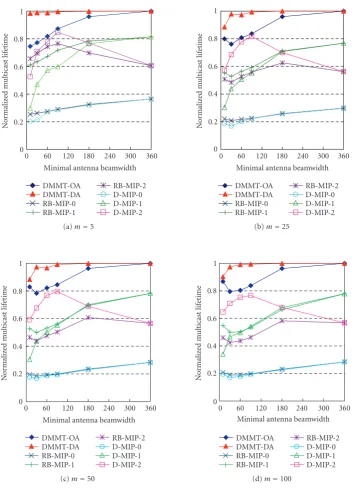
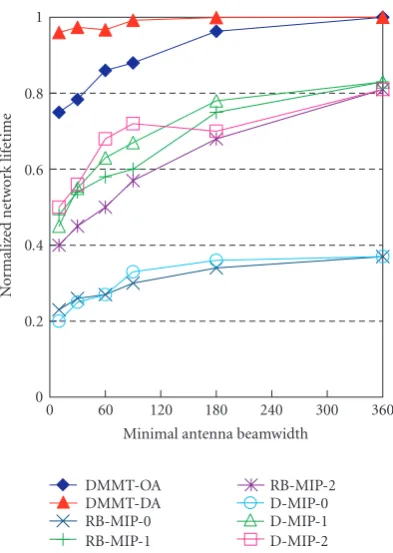
β=0, 1, and 2. In each network example, a number of nodes are randomly generated within a square region 10×10. The values of parameters used in simulation are given inTable 2. We use the metricnormalized network lifetime to eval-uate and compare algorithm performance. It is defined as the ratio of actual network lifetime obtained using heuris-tic algorithm to the best solution obtained by choosing the maximum lifetime from all heuristic algorithms. Such met-ric provides a measure of how close each algorithm comes to provide the longest lifetime tree. Thus allows us to facilitate the comparison of different algorithms over a wide range of network examples.
4.1. Performance in single session scenarios
0
Figure6: Performance comparison based on normalized network lifetime for 100-node networks with single multicast session.
Figure 6illustrates the meannormalized network lifetime as a function of multicast group size and minimal antenna beamwidth for all algorithms. In all cases, DMMT-DA pro-vides much better performance than other algorithms, and its superiority is even greater in network examples with larger
θmin, for example, always within 5% close to the best solu-tion whenθmin≥30◦. In fact, as guaranteed byTheorem 2, DMMT-DA degenerates into DMMT-OA and therefore both achieve the globally optimal solutions for the case of using omnidirectional antennas.
4.2. Performance in multiple session scenarios
0 0.2 0.4 0.6 0.8 1
N
o
rm
aliz
ed
netw
or
k
lifetime
0 60 120 180 240 300 360
Minimal antenna beamwidth DMMT-OA
DMMT-DA RB-MIP-0 RB-MIP-1
RB-MIP-2 D-MIP-0 D-MIP-1 D-MIP-2
Figure7: Performance comparison based on normalized network
lifetime for 100-node networks with multiple multicast sessions.
100 different scenarios. Note that the same random multicast request sequence is used for each algorithm, thereby facilitat-ing a meanfacilitat-ingful comparison of results.
Figure 7 shows how the normalized network lifetime changes as the minimal antenna beamwidth varies under multiple multicast sessions for all algorithms. In all cases, both DMMT-OA and DMMT-DA have better performance than other algorithms, and DMMT-DA is even better and al-ways performs very close (within 5%) to the best solutions.
Our key observations from all these experiments are the following.
(1) In single session scenarios, both DMMT-OA and DMMT-DA provide global optimal solutions for WANETs with omnidirectional antennas, and DMMT-DA outperforms all other algorithms for WANETs with directional antennas.
(2) In multiple session scenarios, DMMT-DA shows su-perior performance than other heuristic algorithms for both directional and omnidirectional antenna net-works.
(3) The minimal total energy consumption does not guar-antee maximum lifetime either for a network with sin-gle multicast session or for a network with multiple multicast sessions, as shown in Figures6and7, respec-tively.
(4) The revised minimum energy multicast algorithms, like RB-MIP-β/D-MIP-β(β=1 and 2), by incorporat-ing residual energy into the cost metric, could provide longer lifetime for both single and multiple session scenarios as shown in Figures6-7.
5. CONCLUSION
We have presented a group of distributed multicast algo-rithms for static WANETs with omnidirectional/directional antennas. The correctness of our algorithm in providing a maximum lifetime multicast tree has been proved as well for WANETs with omnidirectional antennas and single ses-sion. The performance of our algorithms in terms of network lifetime has been also validated using the simulations over a large number of network examples.
ACKNOWLEDGMENTS
This research was supported in part by the NSERC (Canada) Discovery Grant no. OGP0044286, NSERC Research Grant no. OGP0042878 and an NSERC Postdoctoral Fellowship Award.
REFERENCES
[1] J. E. Wieselthier, G. D. Nguyen, and A. Ephremides, “Energy-limited wireless networking with directional antennas: the case of session-based multicasting,” inProceedings of IEEE 21st An-nual Joint Conference of the IEEE Computer and Communica-tions Societies (INFOCOM ’02), vol. 1, pp. 190–199, New York, NY, USA, June 2002.
[2] J. E. Wieselthier, G. D. Nguyen, and A. Ephremides, “Energy-aware wireless networking with directional antennas: the case of session-based broadcasting and multicasting,”IEEE Trans-actions on Mobile Computing, vol. 1, no. 3, pp. 176–191, 2002. [3] I. Kang and R. Poovendran, “On the lifetime extension of energy-efficient multihop broadcast networks,” in Proceed-ings of the International Joint Conference on Neural Networks (IJCNN ’02), vol. 1, pp. 365–370, Honolulu, Hawaii, USA, May 2002.
[4] I. Kang and R. Poovendran, “Maximizing static network life-time of wireless broadcast ad hoc networks,” inProceedings of IEEE International Conference on Communications (ICC ’03), vol. 3, pp. 2256–2261, Anchorage, Alaska, USA, May 2003. [5] A. K. Das, R. J. Marks, M. El-Sharkawi, P. Arabshahi, and A.
Gray, “MDLT: a polynomial time optimal algorithm for maxi-mization of time-to-first-failure in energy constrained wireless broadcast networks,” inProceedings of IEEE Global Telecom-munications Conference (GLOBECOM ’03), vol. 1, pp. 362– 366, San Francisco, Calif, USA, December 2003.
[6] M. X. Cheng, J. Sun, M. Min, and D.-Z. Du, “Energy-efficient broadcast and multicast routing in ad hoc wireless networks,” in Proceedings of the 22nd IEEE International Performance, Computing and Communications Conference (IPCCC ’03), pp. 87–94, Phoenix, Ariz, USA, April 2003.
[7] B. Wang and S. K. S. Gupta, “On maximizing lifetime of mul-ticast trees in wireless ad hoc networks,” inProceedings of the International Conference on Parallel Processing (ICPP ’03), pp. 333–340, Taiwan, China, October 2003.
[8] P. Flor´een, P. Kaski, J. Kohonen, and P. Orponen, “Multicast time maximization in energy-constrained wireless networks,” inProceedings of the Joint Workshop on Foundations of Mo-bile Computing, pp. 50–58, San Diego, Calif, USA, September 2003.
[10] S. Guo, V. C. M. Leung, and O. W. W. Yang, “A scalable distributed multicast algorithm for lifetime maximization in large-scale resource-limited multihop wireless networks,” in
Proceedings of the International Wireless Communications and Mobile Computing Conference (IWCMC ’06), pp. 419–424, Vancouver, BC, Canada, July 2006.
[11] S. Guo and O. W. W. Yang, “Multicast lifetime maximization for energy-constrained wireless ad hoc networks with direc-tional antennas,” inProceedings of IEEE Global Telecommuni-cations Conference (GLOBECOM ’04), vol. 6, pp. 4120–4124, Dallas, Tex, USA, November-December 2004.
[12] S. Guo and O. W. W. Yang, “Formulation of optimal tree con-struction for maximum lifetime multicasting in wireless ad hoc networks with adaptive antennas,” inProceedings of IEEE International Conference on Communications (ICC ’05), vol. 5, pp. 3370–3374, Seoul, Korea, May 2005.
[13] Y. T. Hou, Y. Shi, H. D. Sherali, and J. E. Wieselthier, “Online lifetime-centric multicast routing for ad hoc networks with di-rectional antennas,” inProceedings of IEEE the 24th Annual Joint Conference of the IEEE Computer and Communications Societies (INFOCOM ’05), vol. 1, pp. 761–772, Miami, Fla, USA, March 2005.