corpus-tools.org: An Interoperable Generic Software Tool Set for Multi-layer
Linguistic Corpora
Stephan Druskat
1,2, Volker Gast
1, Thomas Krause
2, Florian Zipser
21Friedrich Schiller University, Dept. of English and American Studies, Ernst-Abbe-Platz 8, D-07743 Jena 2Humboldt-Universit¨at zu Berlin, Dept. of German Studies and Linguistics, Unter den Linden 6, D-10099 Berlin
{stephan.druskat, volker.gast}@uni-jena.de, [email protected], [email protected]
Abstract
This paper introduces an open source, interoperable generic software tool set catering for the entire workflow of creation, migration, annotation, query and analysis of multi-layer linguistic corpora. It consists of four components: Salt, a graph-based meta model and API for linguistic data, the common data model for the rest of the tool set; Pepper, a conversion tool and platform for linguistic data that can be used to convert many different linguistic formats into each other; Atomic, an extensible, platform-independent multi-layer desktop annotation software for linguistic corpora; ANNIS, a search and visualization architecture for multi-layer linguistic corpora with many different visualizations and a powerful native query language. The set was designed to solve the following issues in a multi-layer corpus workflow: Lossless data transition between tools through a common data model generic enough to allow for a potentially unlimited number of different types of annotation, conversion capabilities for different linguistic formats to cater for the processing of data from different sources and/or with existing annotations, a high level of extensibility to enhance the sustainability of the whole tool set, analysis capabilities encompassing corpus and annotation query alongside multi-faceted visualizations of all annotation layers.
Keywords:corpus tools, multi-layer corpora, interoperability
1.
Introduction
This paper introduces an interoperable generic software tool set1 which caters for the entire workflow of creation,
migration, annotation, query and analysis of multi-layer linguistic corpora. The tool set consists of four major com-ponents:
1. Salt (Zipser and Romary, 2010) (Humboldt-Universit¨at zu Berlin, 2016b), a meta model and API for linguistic data, working on a generic graph structure and functioning as a common data model for the other tools;
2. Pepper (Zipser et al., 2011) (Humboldt-Universit¨at zu Berlin, 2016a), a conversion tool and platform for lin-guistic data that can be used to convert a large number of different linguistic formats into each other;
3. Atomic (Druskat et al., 2014) (Friedrich Schiller University Jena, 2015), an extensible, platform-independent multi-layer desktop annotation software for linguistic corpora;
4. ANNIS (Krause and Zeldes, 2014) (Humboldt-Universit¨at zu Berlin, 2015), a search and visual-ization architecture for multi-layer linguistic corpora with many different visualizations and a powerful na-tive query language.
All components are open source under the permissive Apache License, Version 2.02.
We define the corpus-tools.org tools as a softwaresetrather than astack or atoolchain, as they are designed for close
1http://corpus-tools.org, (corpus-tools.org
Develop-ment Team, 2015).
2www.apache.org/licenses/LICENSE-2.0.html
.
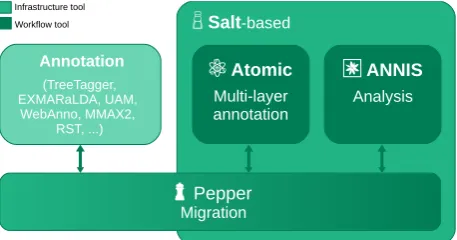
integration, but can be used independently of each other and must be differentiated by their target functions: Salt and Pepper are primarily infrastructure tools, i.e., they pro-vide infrastructural foundations for computer-based corpus research; Atomic and ANNIS are primarily workflow tools, i.e., they contribute to the actual processing of corpora. The above is reflected in the architecture of corpus-tools.org (Figure 1): Salt serves as a common data model for Atomic, ANNIS and Pepper. The main function of Pep-per is that of a “communication bus” between different cor-pus tools, both infrastructurally and within a concrete work-flow. The tools subset of Pepper, Atomic and ANNIS forms a complete corpus workflow toolchain in itself, which is based on Salt.
ANNIS Analysis Atomic
Multi-layer annotation Salt-based
Pepper Migration Annotation
(TreeTagger, EXMARaLDA, UAM,
WebAnno, MMAX2, RST, ...) Infrastructure tool Workflow tool
Figure 1: Overview of the corpus-tools.org architecture, with functional grouping.
corpus-tools.org software, it also assists collaboration among dif-ferent third-party tools; both Atomic and ANNIS have been built to be extensible via plugins. Thus, tried and tested an-notation editor types or NLP components can be added to Atomic, established visualization types to ANNIS. Let us take a step back now and look at the necessity of introducing yet more tools to the world of multi-layer cor-pora: While there already exist a number of corpus tools3
– some of them equipped to deal with multiple layers of annotation, or different annotation types –, not all of them interoperate well with other software, due to a lack of com-mon standards mostly on the part of data models and for-mats.
More generally, some key workflow problems have not been addressed comprehensively as of now:
1. To assure general interoperability, the tools in a cor-pus creation and analysis workflow should be able to transfer data losslessly between each other, ideally via a common data model.
2. Such a data model should avoid constraints on the types of annotation it can process. It must be suffi-ciently generic to be able to process diverse types of annotations, thus allowing for its utilization in a max-imum number of use cases.
3. As corpora and annotations exist in many different formats, migration/conversion capabilities are a key requirement for tools when creating and annotating corpora, especially when they come from different sources and/or have existing annotations.
4. User-facing tools should be extensible, as new for-mats will be introduced in the future, and new research questions will require specific annotation types, which in turn will require specific tooling (e.g., annotation editors, visualizations, NLP components).
5. Comprehensive analysis of multi-layer annotated cor-pora – which complements any corpus workflow – re-quires an analysis tool that is able to both query the corpus and its annotations, and present the user with a multi-faceted view on her data, incorporating the as-pects of all annotation layers.
With the corpus-tools.org tool set we try to address these challenges. In the following, we will present the single parts of the tool set in more detail, loosely following a hy-pothetical workflow.
2.
A common generic data model
As mentioned above, the tools in a corpus creation and anal-ysis workflow should ideally share a common data model, moreover one that is sufficiently generic to maximize the
3For example EXMARaLDA (Schmidt, 2004), WebAnno
(Yi-mam et al., 2013), ELAN (Brugman and Russel, 2004), @nnotate (Plaehn, 1998), Synpathy (http://www.mpi.nl/ tools/synpathy.html), MMAX2 (M¨uller and Strube, 2006), Arborator (http://arborator.ilpga.fr/), or Praat (Boersma and Weenink, 2013) .
tool set’s use cases, and thus its sustainability. The corpus-tools.org tool set’s common data model is Salt (Zipser and Romary, 2010).
Salt is a generic, graph-based meta model for linguistic data, implemented as an open source Java API for storing, manipulating and representing data. Due to its high level of abstraction, it remains independent of linguistic theo-ries, annotation schemes and tagsets. Salt is text-based, but also allows for the modeling of audio and video cor-pora. Its core structure is a graph, which allows for almost any conceivable annotation type, as long as it fits a graph structure4. This structure also helps to keep the model
sim-ple, with only a small set of model elements, given by
G= (V, E, L, labela, . . . labelb)with
• V being a set of nodes withv= (labelc, . . . labeld)∈ V
• Ebeing a set of directed edges withe= (v1∈V, v2∈
V, labele, . . . labelf)∈E
• L being a set of layers with l = (V0 ⊂ V, E0 ⊂
E, L0⊂L, labelg, . . . labelh)∈L
• and a set of labels labela, . . . labelb the graph is la-beled with. A labellis given by a triplel= (ns, n, v)
with a namespace ns, a name n and a value v. A namespace is optional and the combination ofnsand
nform a unique identifier for a label.
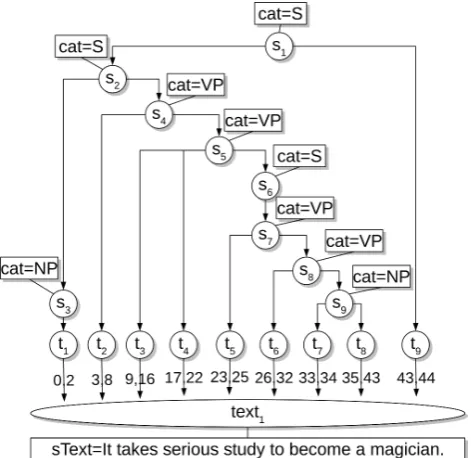
To illustrate the model of Salt, imagine a text which is syn-tactically annotated as given in Figure 2. In the Salt model,
Figure 2: A syntactically annotated sentence modeled in Salt.
nodes and edges are placeholders for an abstract structure. They are initially free of semantics, but are subsequently
4We have yet to encounter an annotation model which cannot be
specified by adding labels. Reading the example bottom up, we start with the base nodetext1representing the
pri-mary text. Its label contains a representation of the text. The nodest1. . . t9represent a tokenization of the primary
text. Each token node is related to the text node, and the relation between them determines the text sequence that the token overlaps, via an offset. The remaining nodes
s1. . . s9 in combination with the relations between them
define the syntax tree. Each node in the syntax tree has a labelcat=X, which adds semantics5to that node, such as
representing anN P, aV P, etc.
In a multi-layer corpus, the number of nodes and edges is prone to become very large. Layers alleviate this issue by representing a grouping mechanism for bundling nodes and edges into smaller subgraphs. For instance, all nodes and edges belonging to morphological annotation, syntax anno-tation, information structure annoanno-tation, etc., can be bun-dled in seperate layers.
The Salt meta model differentiates between corpora and documents. A document contains one or more primary texts, and corresponding annotations. A corpus is an ag-gregation of documents and/or other corpora, i.e., subcor-pora. The split of an entire corpus into non-overlapping documents – partitions – allows for processing each docu-ment independently. Salt is a main memory data structure, and its scalability is determined by the availability of main memory and the size of the largest document in a given corpus which will be required to reside in memory. Docu-ments can be partitioned along logical definitions, such as volumes, chapters, sections, etc., which will be spanned by discrete annotation graphs, or according to technical def-initions. Syntactic annotations, for example, will usually affect only one sentence. Therefore, each sentence can be a discrete partition. Thus we can build small documents along sentence boundaries. At the same time, unneeded documents can be serialized to disk and de-serialized for processing on demand. Hence, an intelligent distribution of document sizes can increase the potential size of corpora that can be represented in Salt models.
3.
Creating/migrating corpus resources for
annotation
Corpora and annotations exist in a multitude of different formats. In order to prepare them for further annotation, it is necessary to convert – and sometimes merge – them into a format the annotation software can process. This can be done via Pepper (Zipser et al., 2011), a platform-independent, modular framework for converting and pro-cessing linguistic data.
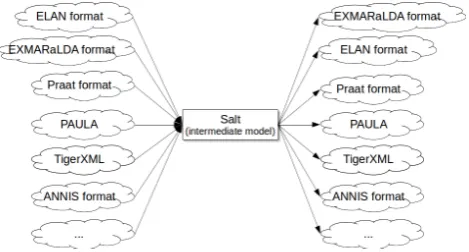
Pepper utilises an intermediate-model approach, with Salt as its intermediate model: Instead of implementing a di-rect conversion solution from format X to format Y, X is mapped onto Salt, manipulated where necessary, and sub-sequently mapped onto format Y. Thus, the number of map-pings to convertnintomformats is reduced to2n, as com-pared ton2−nmappings for direct conversion routes.
Pep-per supplies three types of modules: importers, manipula-tors, and exporters, an unrestricted number of which can be
5
“Semantics” not in its strict linguistic meaning.
combined into one single conversion workflow.
Figure 3: Intermediate model approach to convert linguistic formats.
The loose coupling of modules and the partitioning of data into documents in Salt enable the processing of data in isolation from preceding or following modules in the workflow. Let cbe a corpus consisting of the documents
d1, . . . , dn, let w be a workflow consisting of the mod-ules w = (m1, mo). For all 1 ≥ i, j ≥ n with (i 6= j) and 1 ≥ k ≥ o: The process mk(di), mk+1(di), mk(dj),mk+1(dj)is equal to the processmk(dj),mk(di), mk+1(di),mk+1(dj). Thus we can randomize the order of documents. Furthermore, documents can be processed in parallel, as long as each document passes each module in the workflow in the correct order. Therefore, Pepper has implemented multithreading in order to greatly reduce con-version times. The size of a corpus which can be processed with Pepper is not limited, as long as each single document fits into main memory.
The possibility to plug any manipulator module between an importer and an exporter allows for manipulation, en-hancement or reduction of data in every possible sense. It is possible, for instance, to merge data. Often a research question demands several annotation types on the same cor-pus. Unfortunately, many tools and formats were created for just a single kind of annotation, for instance the Tiger-XML format (Lezius et al., 2002), which was created exclu-sively for constituents, or the MMAX2 format (M¨uller and Strube, 2006), which was created exclusively for corefer-ences. However, in order to build multi-layer corpora we need to combine different kinds of annotation. Due to the fact that Salt is a graph-based model, the task of merging different Salt models is reducible to a graph merging task based on an identical primary text or primary texts. With the process based on the primary text, it is possible in a first step to merge the tokens. Since Salt allows for multi-ple tokenizations, even alternative tokenizations can be pro-cessed. Additionally, higher-level structures such as spans or hierarchies can be compared with each other and merged (Zipser et al., 2014). Furthermore, the isolation of mod-ules in the workflow allows for a combination of each set of importers with the merging step.
In addition to the merging module cited above, there al-ready are Pepper modules for a large number of different linguistic formats6, as well as a module for extracting
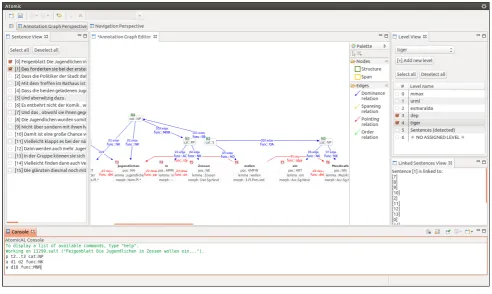
Tree-Figure 4: A screenshot of Atomic, showing a section of the pcc2 corpus (Stede and Neumann, 2014), with two annotation layers visible in the editor, and a number of AtomicAL commands in the console.
data, structural and annotation-related information from ex-isting corpora7(Voigt et al., 2016). Due to its plugin-based architecture, newly-developed modules can easily be added to Pepper at any time.
Pepper comes in two flavours: as an interactive standalone command line tool and as an API library, which can be in-tegrated in other software.
In an hypothetical workflow utilizing the corpus-tools.org tool set, Pepper is most likely to come in in two places: Firstly as the primary step, preparing corpora for annota-tion by merging and converting them into a format con-sumable by the annotation tool, and secondly in between or after annotation steps, preparing the resources for analysis or publication.
Pepper can process several documents in parallel, and only uses the main memory needed to hold the currently pro-cessed documents in the conversion workflow. For exam-ple, converting the syntactically annoted TIGER2 corpus (Brants et al., 2004), which has 888,578 tokens, 1,262,014 nodes and 1,971 documents, from SaltXML to the ANNIS format takes about one minute on a modern notebook with a 2.20GHz Intel i7-4770HQ CPU, using all four processor cores. In general, the time a conversion takes depends on the import and export modules used, and whether several import formats have to be merged, or if there are costly ma-nipulators in the pipeline.
Tagger format, TEI (subset), ANNIS format, PAULA and many more.
7For an example of the output this module creates, seehttps://
corpora.uni-hamburg.de/sfb632/a5hausanews/.
4.
Annotation
Most of the above-mentioned general challenges for multi-layer corpus tools can also be applied more specifically to annotation software: It should avoid putting constraints on the types of annotation it can process, it needs to be able to deal with the multitude of existing linguistic formats, and it should be extensible for new annotation processes, i.e. new annotation types, editors, data views, etc. Atomic (Druskat et al. (2014), cf. Figure 4), a platform-independent soft-ware for the desktop, addresses these issues through its ar-chitecture.
One of Atomic’s assets is that it hooks, as it were, into the Pepper process at its intermediate stage – effectively as an extended quasi manipulator module – by working di-rectly on Salt models. It includes the Pepper library and provides import and export GUI wizards for the different Pepper modules. Thus, Atomic inherits not only Salt’s spe-cific advantages – i.e., it is not limited to spespe-cific annotation types, layers, or tagsets – it is also highly compatible with a large number of linguistic formats via Pepper. Apart from that, it is also possible to initially create and pre-process, rather than import, corpora with Atomic (cf. below).
extension points8and interfaces for different common com-ponents: editors for different annotation types, data views, NLP components, model workflow steps, and annotation language dialects (see below). To facilitate the creation of corpora with Atomic, for example, the software does provide some basic pre-processing tools – a tokenizer and a partitioning tool –, but more importantly also extension points for further, custom pre-processing steps. Any cor-pus processing step, e.g., parsers, taggers, etc., can thus be implemented as an Eclipse plugin and added to Atomic dy-namically via the respective extension point. Thus, Atomic is in principle an annotationplatformrather than simply an annotation tool.
Another advantage of Atomic being implemented as an Eclipse RCP is that it benefits from the large number of ex-isting compatible software and resources within the Eclipse ecosystem.9 Third-party Eclipse RCP plugins, which can
be added to Atomic on the fly, exist for a variety of ap-plications: Editors for XML, TEX, R, and many others; version control system interfaces for Git, SVN and others (using a version control system enables collaborative an-notation as well as providing change management for cor-pora); distributed real-time collaboration; tools for seman-tic web applications; and many more. Additionally, due to the size and commercial importance of Eclipse, its ecosys-tem, and the Rich Client Platform, software developers pro-ficient in Eclipse-based development – and thus able to ex-tend Atomic, e.g., in the context of service contracts – are readily available, which increases Atomic’s sustainability. As a workflow tool, Atomic, in its current iteration, pro-vides the following features.
• A graphical editor for Salt annotation graphs. The editor provides a graphical representation of the Salt subgraph for selected partitions of a corpus document. The graph can be manipulated via the keyboard, e.g., by selecting and editing elements, and through mouse-driven tools available from a palette similar to those included in established graphics or desktop publishing applications.
• A synchronized, integrated command-line interface for use of the annotation language AtomicAL10 for
rapid creation and annotation of model elements. AtomicAL uses one-letter commands for common an-notation tasks on the Salt graph, which are reflected synchronously in the graphical editor. Commands can take a number of arguments and flags, specifying the
8
Extension points are basically contracts – usually a combination of a definition in XML markup, and Java interfaces – that exten-sions must conform to. New Atomic plugins that want to connect to a specific extension point must implement the specified con-tract. For an overview of Eclipse’s extension point mechanism see Clayberg and Rubel (2009, 637–660).
9
The best known Eclipse RCP-based product alone, an IDE for Java, has hundreds of thousands of users from IT and other dis-ciplines, cf.http://www.eclipse.org/downloads/.
10AtomicAL is based on a data manipulation language for
annota-tion graphs developed for use in the GraphAnno annotaannota-tion tool (Gast et al., 2015), but exhibits a different syntax and different commands.
model elements, annotation layer, annotations, etc., to work on. AtomicAL is designed to be extensible, so that different “dialects” can be implemented for differ-ent annotation types and editors.
• A customizable workbench-like GUI providing core application functionality (project management, pref-erences, update management for Atomic and the in-tegrated Pepper and Salt libraries, help and documen-tation) and task-specific view combinations, so-called “perspectives”. For example, the annotation graph ed-itor is embedded in a perspective which displays it to-gether with relevant views, such as a view for display-ing and selectdisplay-ing the corpus partitions to be edited; a view for displaying, creating, editing and selecting an-notation layers; a view for displaying partitions with links to the current selection; the AtomicAL Console.
Further extensions are being developed or planned (cf. 8.). Alternating with ANNIS (cf. 5.), Atomic would be at the heart of an hypothetical workflow using our tool set. As Atomic uses Salt as its data model, any corpus size re-strictions for Salt are applicable for Atomic as well. Hence, the available main memory must be able to hold the largest document in the corpus. However, as Atomic supports cus-tomized partitioning of corpus documents, and the anno-tation graph editor can work on a given custom partition while the others remain serialized, the potential size of cor-pora Atomic can process depends merely on the strategy of document size distribution over that corpus.
5.
Query and analysis
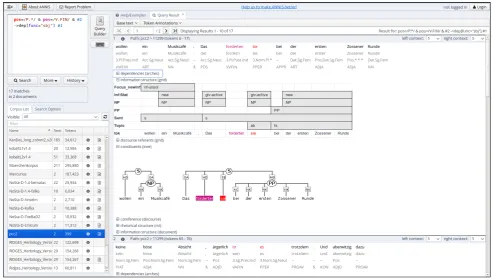
Comprehensive analysis of multi-layer annotated corpora requires a tool which provides extensive search functional-ity as well as appropriate visual representation of all anno-tation layers. With ANNIS (Krause and Zeldes, 2014) we provide a browser-based search and visualization architec-ture for complex multi-layer corpora.
ANNIS also makes use of Salt as a data model: Salt powers different visualizations and acts as an interchange format between front- and backend.
ANNIS furthermore provides the native query language AQL for complex search queries as well as different visu-alizations for corpus data, such as KWIC views, dependecy trees, grids, coreference and RST views, aligned A/V data, and many more.11
ANNIS can be extended with new visualizations for addi-tional types of annotations via new plugins. Addiaddi-tionally, existing visualizations – such as the HTML visualizer – are highly configurable.
In an hypothetical workflow, ANNIS would most likely come into play in one of the later steps, being used to query, visualize and analyze multi-layer annotated corpora. It could, however, be utilized earlier as well, for example to identify annotation candidates in a corpus. Additionally, in interplay with Atomic, it also facilitates iterated annotation, i.e., repeated iterations of annotation tasks in Atomic and their subsequent evaluation in ANNIS, the results of which
11corpus-tools.org/annis/visualizations.html
Figure 5: A screenshot of ANNIS, showing an AQL query over the pcc2 corpus, and example visualizations of the result.
entail another annotation iteration in Atomic, etc. And fi-nally, ANNIS can also be used as a repository of sorts for a release of annotated corpora.
ANNIS is optimized to handle corpora with a large num-ber of parallel annotation layers. Thus, the maximum size of corpora it can process mainly depends on the number of nodes and edges in a corpus, not on token figures. However, since ANNIS uses the PostgreSQL relational database12it
is key to have a powerful server with sufficient main mem-ory when querying corpora containing more than 1m nodes.
6.
Development and user communities
While the centres of development of the corpus-tools.org tool set are the Deptartment of English and American Stud-ies at the Friedrich Schiller University in Jena and the De-partment of German Studies and Linguistics at Humboldt-Universit¨at zu Berlin, a host of linguists and developers from around the world have made and continue to make valuable contributions to corpus-tools.org tools,13
render-ing our tool set a true community effort.
Tools from the corpus-tools.org tool set are used by projects from different research fields, such as spoken language
cor-12Cf.http://www.postgresql.org/.
13See, for example, the list of ANNIS contributors atgithub.
com/korpling/ANNIS/graphs/contributors.
pora14, historical corpora15, chat corpora16, newspaper cor-pora17, and many more.
7.
Conclusion
The corpus-tools.org software tool set we present here fa-cilitates a complete workflow for multi-layer corpora, from creation and annotation to analysis and release. At the same time it provides answers to some important challenges such a workflow poses, (a) through its internal interoperability by relying on a common data model which is also suffi-ciently generic to not limit the types of annotation it can model; (b) through its compatibility with a large number of linguistic formats by means of its integrated conversion framework; (c) through the extensibility of its components which contributes to its sustainability and versatility; (d) through its ability to integrate with third party tools.
14E.g., the Berlin Map Task Corpus (https://www.
linguistik.hu-berlin.de/en/institut-en/
professuren-en/korpuslinguistik/research/
bematac), or the KiezDeutsch-Korpus (http:
//www.kiezdeutschkorpus.de/en/).
15
Cf. for example Coptic Scriptorium (http://www. carrieschroeder.com/scriptorium/), Ridges (Reg-ister in Diachronic German Science, http://korpling. german.hu-berlin.de/ridges/index_en.html), Perseus Latin and Ancient Greek Treebank (http: //annis.perseus.tufts.edu/).
16
Cf. sms4science (http://www.sms4science.ch/ index.html), or What’s up, Switzerland? (http://www.
whatsup-switzerland.ch/index.php/en/). A
comprehensive list of projects that use, for example, ANNIS can be found at http://corpus-tools.org/annis/ cooperations.html.
17
8.
Outlook
The development of all corpus-tools.org tools is ongoing, i.e., they are constantly being extended, optimized, and it-eratively released. The below paragraphs give an insight into some development ideas and goals for the future. Salt is a mature tool, and currently available in version 3.0, last released in February 2016. Similarly, Pepper is available in stable release version 3.0, last released in early 2016. New Pepper modules are constantly developed, and enhance Pepper’s ability to integrate further tools and for-mats. Ideas for new Pepper modules are abundant. For example: In corpus linguistics, the comparison of corpora is a recurrent topic of discussion. For instance, after several annotation iterations one may want to find the differences between versions of a corpus. Similarly, when multiple an-notators have worked on the same corpus one may want to discover the differences between their respective annota-tion work. Due to Salt’s graph-based nature these quesannota-tions could be broken down into a graph-matching problem, in a similar fashion as with merging. As of now, Salt includes an API for graph comparison, but in order to inform annotators about changes in a well-structured manner, an easily acces-sible representation of differences of the above-mentioned natures is necessary. Such a visualization could be imple-mented as a Pepper module which would in turn offer the possibility to compare corpora across different formats. Atomic is available in preview version 0.2.1, and is cur-rently developed towards stable release version 1.0, due in 2016. After this, development efforts will focus on extend-ing its core functionalities, thereby providextend-ing exemplary cases for further development, including by third parties. The exemplary cases are planned to include, for example, further NLP components to be made available for corpus building, such as parsers and taggers; support for annota-tion schemes and tagsets, binding them to editing funcannota-tion- function-alities in graphical editors as well as AtomicAL; API for ad-ditional editor types, and default implementations, such as a tabular editor for span-based annotation, a graph- and text-based editor for coreference annotation, and a dedicated editor for syntax trees; exchangable backends: Currently, Atomic supports serialization to SaltXML as well as export into different linguistic formats provided by Pepper. How-ever, it should be possible for Atomic to persist Salt models in other ways, for example by storing them in a database or in the cloud, thus simplifying remote collaboration along the way; search functionality, and (semi-)automatic anno-tation of result sets; graphical and possibly TEX export of annotation graphs and trees.
ANNIS, currently available in stable version 3.3 released in September 2015, will continue to use a preview-release model where new features are added to frequent preview release versions, while more extensively tested regular ver-sions are released about twice a year. It is planned to have a better integration of search results from ANNIS in the corpus-tools.org tool set by allowing the export to different formats, including SaltXML. It should also be made eas-ier to update only parts of an already imported corpus, e.g. when annotation errors were corrected in Atomic. Instead of converting and re-importing the complete corpus in AN-NIS, the user should be able to import the changed
docu-ment only. Another substantial, and more long-term, devel-opment effort is the enhancement of ANNIS’ scalability by developing a new, graph database-based backend.
9.
Acknowledgements
We thank three anonymous reviewers for their valuable comments. Financial support from the German Science Foundation (DFG, grant GA-1288/5-1) is gratefully ac-knowledged.
10.
Bibliographical References
Boersma, P. and Weenink, D. (2013). Praat: do-ing phonetics by computer [computer program]. http://www.praat.org.
Brants, S., Dipper, S., Eisenberg, P., Hansen, S., K¨onig, E., Lezius, W., Rohrer, C., Smith, G., and Uszkoreit, H. (2004). TIGER: Linguistic Interpretation of a Ger-man Corpus. Journal of Language and Computation, (2):597–620.
Brugman, H. and Russel, A. (2004). Annotating multi-media/multi-modal resources with ELAN. In Proceed-ings of the 4th International Conference on Language Resources and Evaluation (LREC 2004). Lisbon, Por-tugal.
Clayberg, E. and Rubel, D. (2009). Eclipse Plug-ins. Addison-Wesley Professional, Boston, Mass., 3rd edi-tion.
Druskat, S., Bierkandt, L., Gast, V., Rzymski, C., and Zipser, F. (2014). Atomic: an open-source software plat-form for multi-level corpus annotation. In Josef Ruppert et al., editors,Proceedings of the 12th Konferenz zur Ver-arbeitung nat¨urlicher Sprache (KONVENS 2014), pages 228–234.
Gast, V., Bierkandt, L., and Rzymski, C. (2015). Annotat-ing modals with GraphAnno, a configurable lightweight tool for multi-level annotation. In M. Nissim et al., edi-tors,Proceedings of the Workshop on Models for Modal-ity Annotation, pages 19–28, Stroudsburg, PA. Associa-tion for ComputaAssocia-tional Linguistics (ACL).
Krause, T. and Zeldes, A. (2014). ANNIS3: A new archi-tecture for generic corpus query and visualization. Digi-tal Scholarship in the Humanities.
Lezius, W., Biesinger, H., and Gerstenberger, C. (2002). TIGER-XML Quick Reference Guide. Technical report, IMS, University of Stuttgart.
McAffer, J., Lemieux, J.-M., and Aniszczyk, C. (2010).
Eclipse Rich Client Platform. Addison-Wesley, Boston, 2nd edition.
M¨uller, C. and Strube, M. (2006). Multi-level annota-tion of linguistic data with MMAX2. In Sabine Braun, et al., editors,Corpus Technology and Language Peda-gogy: New Resources, New Tools, New Methods, pages 197–214. Peter Lang, Frankfurt a.M., Germany.
Plaehn, O., (1998). Annotate Programm-Dokumentation (NEGRA project report). Universit¨at des Saarlandes, Saarbr¨ucken.
Stede, M. and Neumann, A. (2014). Potsdam Commentary Corpus 2.0: Annotation for discourse research. In Pro-ceedings of the 9th International Language Resources and Evaluation Conference (LREC 2014). Reykjavik, Iceland.
Voigt, V., Zipser, F., and Odebrecht, C. (2016). SaltInfo-Module - the x-ray to your corpus. Poster presented at 38. Jahrestagung der Deutschen Gesellschaft f¨ur Sprach-wissenschaft, 25 February, Konstanz University, Kon-stanz, Germany.
Yimam, S. M., Gurevych, I., Eckart de Castilho, R., and Biemann, C. (2013). WebAnno: A flexible, web-based and visually supported system for distributed annota-tions. System demonstration presented at ACL 2013, 5 August, Sofia, Bulgaria.
Zipser, F. and Romary, L. (2010). A model oriented ap-proach to the mapping of annotation formats using stan-dards. InProceedings of the Workshop on Language Re-source and Language Technology Standards. Seventh International Conference on Language Resources and Evaluation (LREC 2010), Valletta, Malta.
Zipser, F., Zeldes, A., Ritz, J., Romary, L., and Leser, U. (2011). Pepper: Handling a multiverse of formats. Poster presented at 33. Jahrestagung der Deutschen Gesellschaft f¨ur Sprachwissenschaft, 24 February, G¨ottingen University, G¨ottingen, Germany. Zipser, F., Frank, M., and Schmolling, J. (2014).
Merg-ing data, the essence of creation of multi-layer cor-pora. Poster presented at 36. Jahrestagung der Deutschen Gesellschaft f¨ur Sprachwissenschaft, 6 March, Marburg University, Marburg, Germany.
11.
Language Resource References
corpus-tools.org Development Team. (2015).corpus-tools.org tool set for multi-layer corpora. Humboldt-Universit¨at zu Berlin and Friedrich Schiller University Jena, 1.0, ISLRN pending.
Friedrich Schiller University Jena. (2015). Atomic. Link-Type, Tools for crosslinguistic multi-level annotation, 0.2.1, ISLRN pending.
Humboldt-Universit¨at zu Berlin. (2015). ANNIS. Son-derforschungsbereich 632 “Information structure”, 3.3, ISLRN pending.
Humboldt-Universit¨at zu Berlin. (2016a). Pepper. Son-derforschungsbereich 632 “Information structure”, 3.0, ISLRN pending.