Effect Functors for Opinion Inference
Josef Ruppenhofer, Jasper Brandes
Universit¨at HildesheimUniversit¨atsplatz 1, 31141 Hildesheim {ruppenho, brandesj}@uni-hildesheim.de
Abstract
Sentiment analysis has so far focused on the detection of explicit opinions. However, of late implicit opinions have received broader attention, the key idea being that the evaluation of an event type by a speaker depends on how the participants in the event are valued and how the event itself affects the participants. We present an annotation scheme for adding relevant information, couched in terms of so-called effect functors, to German lexical items. Our scheme synthesizes and extends previous proposals. We report on an inter-annotator agreement study. We also present results of a crowdsourcing experiment to test the utility of some known and some new functors for opinion inference where, unlike in previous work, subjects are asked to reason from event evaluation to participant evaluation.
Keywords:Opinion Inference, Effects, Subjectivity
1.
Introduction
So far, sentiment analysis has mainly focused on the detec-tion ofexplicitopinions. However, recently the relevance of implicitopinions has received broader attention within the field. Here, the work of Klenner and colleagues on verb polarity frames (Klenner et al., 2014; Klenner, 2015), the functor-based framework of event evaluation by Anand and Reschke (Anand and Reschke, 2010; Reschke and Anand, 2011) and the work on opinion implicature by Wiebe and her colleagues (Deng et al., 2013; Deng and Wiebe, 2014; Wiebe and Deng, 2014), based on the effects that events have on object entities, have been the most important con-tributions to the theory of implicit opinions.
The key observation of this line of work is that, while some predicates do not denote sentiment, in combination with expressions of explicit sentiment and knowledge about atti-tudes towards entities, one can infer implicit opinions being conveyed that hinge on these inference-relevant predicates. Consider (1). From the explicit positive sentiment (in bold-face) by Peter towards the fact that the Colts lost, an event which affects them negatively (inSMALL CAPS), one can infer that he has a negative sentiment towards the Colts. Furthermore, depending on the context, one may infer that the speaker/writer producing (1) may have a positive or negative attitude towards Peter, depending on whether the speaker disapproves or approves of the Colts.
(1) Peter ishappybecause the ColtsLOST.
While we expect a sentiment lexicon to provide us with in-formation that e.g.happyexpresses positive sentiment, the information that the effect-bearing wordloseentails nega-tive affect on the subject can so far not be retrieved from any lexical-semantic resource.
In this contribution, we push the effort begun by Ruppen-hofer and Brandes (2015) toward a synthesis between the effect-based approach and the functor approach further in several respects. Firstly, we identify and propose additional functors for verbs embedding states of possibility, predi-cates expressinglocation, and predicates expressing simi-larity. These functors allow us to cover predicates whose
entailments have so far not been allowed for by Anand and Reschke’s functors (Anand and Reschke, 2010; Reschke and Anand, 2011). We added these new functors because they seem to us to be relevant to opinion inference, which we empirically confirmed for some of them (cf. Section 7.). Unlike Ruppenhofer and Brandes (2015), we add ex-plicit annotations of functor types to the annotations. In doing so, we also allow for multiple functors applying to the same effect predicate. Moreover, we do not only index the arguments relevant to the end state (=effect), but also those encoding the cause or agent.
The remainder of this paper is structured as follows. Sec-tion 2 discusses related work. In SecSec-tion 3, we present the data that we annotated following the annotation scheme outlined in Section 4. We develop a systematic account of the inventory of possible functor types and their inter-relationships in Section 5. We assess the reliability and validity of this extended annotation scheme via an inter-annotator agreement experiment in Section 6. We next re-port on a crowdsourcing experiment that we performed to assess the utility of some of the well-known and some of our new functors for opinion inference (cf. Section 7). We conclude the paper and discuss directions for future work in Section 8.
2.
Related Work
Resources that contain information relevant to opinion in-ference are rather sparse, compared to the abundance of sentiment lexica for English (Wilson et al., 2005; Taboada et al., 2011) and German (Klenner et al., 2009; Remus et al., 2010; Waltinger, 2010). In fact, even for English there seems to exist only one resource for this task, namely
+/-EffectWordNet in its current form does not include (mor-phosyntactic or semantic) information with regard to the entity affected. Inspired by +/-EffectWordNet, Ruppen-hofer and Brandes (2015) began work on a German re-source, annotating GermaNet (Hamp and Feldweg, 1997) synsets with information relevant to opinion inference.
3.
Data
We use the same GermaNet V9.0 (Hamp and Feldweg, 1997) synsets as Ruppenhofer and Brandes (2015). These authors extracted 1667 synsets for annotation in order to have gold standard data for automatic methods.1 Note that the relevant synsets include verbs and adjectives, but no nouns. Figure 1 displays an instance of a GermaNet synset, along with its annotations. We discuss the meaning of the annotations in the next section.
4.
Annotation Scheme
Figure 1 shows an example of our annotations. As in the earlier work of Ruppenhofer and Brandes (2015), the key parts of the scheme, which is exemplified in Figure 1, are
a the initial pair of square brackets containing our effect annotations (bold-face);
b the orth forms set, which lists the lemmas of the synset (underlined);
c the paraphrases, which help us understand the intended senses of the lemmas (italics);
d and the example sentences (lines beginning with “# GermaNet”).
Unlike in (+/-Effect)WordNet, each example sentence comes with a syntactic subcategorization frame which lists the set of arguments and adjuncts occurring with the lemma being exemplified. Thus, in the example sentence in Fig-ure 1, ¨ubergeben ‘turn sth over to sb’ is realized with a noun phrase in nominative case (NN), another in dative case (DN), and a third in accusative case (AN). We refer to these morphosyntactic phrase labels in our effect annotations, as illustrated by the arrows in Figure 1.
For instance, the initial block in the example says that the possession functor applies to the verb. Further, the effect polarity on the participant coded as a dative noun phrase (DN) representing the Possessor is dependent on the eval-uation of the Possession coded as an accusative case noun phrase (AN). We mark this dependence with the “∼” sym-bol. The participant coded as a nominative phrase (NN) is causally responsible for the effect on the Possessor. Note that the annotations of Ruppenhofer and Brandes (2015) do not name the specific functor type (e.g. posses-sion) and neither do they include the marking of a causally responsible participant, if there is one.
1
For information on how Ruppenhofer and Brandes (2015) se-lected the relevant synsets, we refer the interested reader to their paper.
4.1.
Functor Inventory
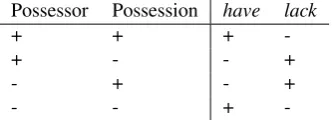
Following Reschke and Anand (2011), we treat predicates and their arguments as functors that map tuples of argu-ment and verb properties to state evaluations. For instance, the functor embedding a state of possession in Table 1 is to be read as follows. The first line of the table applies to the situation when there is a possessor who is positively evalu-ated by an external viewer (e.g. ‘her best friend’) as well as a positively evaluated possession (e.g. ‘a good job’). If the relationship between the two ishave(third column), as in (2), the state of possession is evaluated positively by the ex-ternal viewer. If the relationship islack(fourth column), the state is evaluated negatively. Note that here and with other functors, labels such as have and lackare intended only as mnemonics for the intended abstract relations. They do not stand for specific lexical items that other lexical items might entail.
(2) [Mein Freund]POSSESSOR hat [einen guten Job]POSSESSION.
’My boyfriend has a good job.’
The notion of an external perspective can be clarified when considering the third row of Table 1. Here, we have a neg-atively evaluated possessor (e.g. ‘her worst enemy’) and a positively evaluated possession (e.g. ‘a good job’). If the relationship between the two ishave, we would evaluate the situation negatively even though the possessor may actually be very happy about having a good job.
Of the functors that have been proposed by Anand and Reschke (2010), the main ones are those for possession (Ta-ble 1), existence (Ta(Ta-ble 2) and affectedness (Ta(Ta-ble 3).
4.1.1. Possession
This functor covers verbs entailing a state of possession, e.g. spenden‘to donate sth to sb’ or stehlen ‘to steal sth from sb’.
Possessor Possession have lack
+ + +
-+ - - +
- + - +
- - +
-Table 1: Functor for verbs embedding a state of possession
4.1.2. Existence
This functor covers verbs embedding a state of existence/non-existence, e.g. erbauen ‘to construct sth’ orzerst¨oren‘to destroy sth’.
Entity Eexist Enon exist
+ +
[image:2.595.340.507.518.578.2]-- - +
Table 2: Functor for verbs embedding a state of existence
4.1.3. Affectedness
[image:2.595.359.489.669.707.2]53:[+Possession:DN∼AN:NN] id: 52277, orth forms: [¨ubergeben], paraphrases: als Eigentum geben
verben Besitz [annotation-uncertain|meaning-uncertain] # GermaNet: Er hat das Gesch¨aft seinem Sohn ¨ubergeben. NN.DN.AN
Figure 1: Annotation of a synset.
Entity Epositive Enegative
+ +
[image:3.595.351.497.211.272.2]-- - +
Table 3: Functor for verbs embedding a state of affected-ness
In addition to the above three, we recognize further func-tors, including ones for possibility (Table 4), location (Ta-ble 5), similarity (Ta(Ta-ble 6), sentiment (Ta(Ta-ble 7), and scalar-ity (Table 8).
4.1.4. Possibility
This functor covers predicates embedding a state of pos-sibility, e.g. m¨oglich‘possible’,erm¨oglichen‘to facilitate sth’ orverhindern‘to prevent sth’.
Event Epossible Eimpossible
+ +
[image:3.595.106.235.211.246.2]-- - +
Table 4: Functor for predicates embedding a state of possi-bility
4.1.5. Location
This functor covers predicates entailing a state of location, e.g.auftragen‘to spread sth’ andabr¨aumen‘to clear away (the table)’.
Figure Ground in out of
+ + +
-+ - - +
- + - +
- - +
-Table 5: Functor for predicates expressing location
4.1.6. Similarity
This functor covers predicates expressing similarity, e.g.
angleichen‘to assimilate’ andunterschiedlich‘different’.
4.1.7. Sentiment
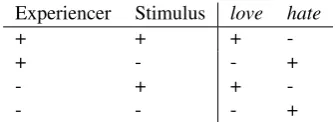
This functor covers predicates expressing sentiment, e.g.
m¨ogen‘to like sb’ andverschm¨ahen‘to despise sb/sth’.
4.1.8. Scalarity
Reasoning along the lines of ‘more is good, less is bad’, this functor covers predicates embedding a state of occupying a
Item1 Item2 similar differ
+ + +
-+ - - +
- + +
-- - - +
Table 6: Functor for predicates expressing similarity
Experiencer Stimulus love hate
+ + +
-+ - - +
- + +
[image:3.595.338.506.316.377.2]-- - - +
Table 7: Functor for predicates expressing sentiment
position on a scale, e.g.hoch‘high’,erh¨ohen‘to increase’, andverringern‘to diminish sth’.
Attribute Ahigh Alow
+ +
[image:3.595.103.238.430.466.2]-- - +
Table 8: Functor for verbs embedding a state of occupying a scalar position
A straightforward observation about the functors is that sev-eral of them are structurally identical. For instance, all the functors involving a single argument are the same (Tables 2, 3, 4, 8). We return to this point and also motivate the func-tor invenfunc-tory in Section 5.
4.2.
Explicit Functor Naming
[image:3.595.367.479.468.503.2]we could not distinguish betweenhaveandlack. Accord-ingly, we additionally annotate for each relational synset, whether it entails the holding of the relation or its not hold-ing. In Figure 1 the “+” preceding the functor name indi-cates that the verb ¨ubergebenentails a positive possession relation. By contrast, the verbvorenthalten‘withhold’ en-tails the absence of a possession relation.
4.3.
Multiple Functors
As observed in the analysis of annotation disagreements by Ruppenhofer and Brandes (2015), certain predicates may be related to more than one functor. We encountered fur-ther evidence for this finding in the annotation experiment for this paper (cf. Section 6.). For instance, verbs of plac-ing liketreiben‘drive sth into sth’ andbrennen ‘burn sth onto sth’ can co-occur with arguments realizing the agent, the theme and the target location. There may be contexts in which the theme’s creation is more salient, for example, when burning your initials into a tree. On the other hand, the correct placing of the theme in the target location may be more prominent in situations when considering whether bedrock is suitable for driving a tunnel into. These exam-ples suggest that, if annotators can perceive such multiple possibilities based on the example sentences in GermaNet, they should not be forced to choose just a single functor.
4.4.
Annotation of Causes
No previous effort related to opinion inference has dealt with the problem of how to identify causally responsible roles. The theory of Wiebe and her collaborators is focused on affected objects while the functor approach of Anand and Reschke does not label the participants as either af-fected or causally responsible: it simply maps the set of participants to an event evaluation polarity.
Trying to determine causally responsible participants heuristically is not trivial. First, we would need to know explicitly from information in the resource that there is a causally responsible party at all. Given the range of items we annotate, we cannot simply assume that this will be the case. For instance, if one finds a treasure by happenstance or one steals it, one ends up in possession of it. However, in the case of the accidental finding, nobody need have acted volitionally. Thus, although finding and stealing both have a possession entailment, the former has no causally respon-sible participant. Second, even if the predicates in a synset do not have core arguments expressing causally responsi-ble participants, such participants can be introduced via ad-juncts. Consider the set of paraphrases in examples (3)-(5). The causal role is an adjunct in the first example but an ar-gument in the last two.
(3) stativehigh.a: [y<high>]
My rent is high/15% higher because of city taxes.
(4) inchoativerise.v: [BECOME[y<high>]] My rent rose by 15% because of city taxes. (5) causativeraise.v:
[xCAUSE[BECOME[y<high>]]] City taxes raised my rent by 15%.
A full treatment of opinion inference would thus also re-quire that adjuncts expressing causal meanings are taken
into account. Further, while we did not encounter such cases in our example sentences, note that in principle more than one causal expression may be present. For instance, a causal argument and a cause-related adjunct may co-occur as in (6) and (7), where bothheand theout of-PP relate to the causation of the event.
(6) He stole the money out of greed.
(7) He stole the money out of love.
The above pair of examples illustrates that the interaction between a reason adjunct and an agent argument is not uni-form: a bad reason reinforces the causal responsibility (cul-pability) of the agent, as in the case of (6), while a good reason would seem to reduce it, as shown by (7).
At this time, we limit ourselves to annotating GermaNet synsets relative to what is provided in the syntactic valence frames that come with the example sentences. However, we still want to distinguish between predicates that are strictly stative and therefore do not involve a causally responsible agent and predicates that do allow a causal agent but which may not be realized in the provided valence frames. For the former, we leave the annotation slot for the causal agent empty, while for the latter, we annotate “NI” to mark a non-instantiated causal agent (adjunct) for the predicate.
5.
Towards a Typology of Functors
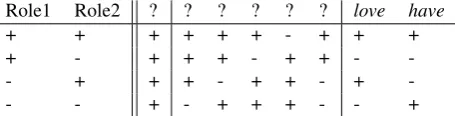
Role1 Role2 ? ? ? ? ? ? love have
+ + + + + + - + + +
+ - + + + - + + -
-- + + + - + + - +
[image:5.595.58.286.69.127.2]-- - + - + + + - - +
Table 9: Possible functors for predicates entailing two-argument states (question marks represent unattested pred-icate types)
Of the possible 8 output columns, we have found two to be attested (cf. Table 9). The functor exemplified by posses-sivehaverequirescongruenceto output positive evaluation. The functor exemplified by sentiment-bearing love repre-sents cases where the evaluation of one of the two argu-ments wins out completely and the features of the other ar-gument are ignored. A functor that always outputs positive (or negative) evaluation, as shown in column 3, would be a defective case, linguistically speaking, because the usual trigger factors would play no role: there would be nothing to implicate (for the speaker) or infer (for the hearer) in a context-dependent manner. And in fact, we think of verbs like murder, which would seem to fit the bill, as having lexically inherent negative evaluation.2 It is an empirical question whether the other possible functors in columns 4-8 occur. What is important is that they, too, are cases where the polarity towards the (post)state does not simply depend on one of the two arguments. If we find instances of these cases in our data, we will need to expand our functor inven-tory to be able to deal with them.
6.
Annotation Experiment
The authors of this paper independently annotated 300 GermaNet synsets from scratch. The synsets were anno-tated in four rounds of each 50 synsets and one final an-notation round of 100 synsets. After each round, we dis-cussed differences and adjudicated the annotations. For the inter-annotator agreement (cf. Table 10), we compute the percent agreement and Cohen’sκ(Cohen, 1960) along the lines of Ruppenhofer and Brandes (2015). In addition to phrase label (PHL), relational (REL) and contextual (CON) annotations as described in that paper, we also report on agreement results for the functor (FUNC) and causal entity (CAUS) annotations. Recall that this is the first effort of ef-fect annotations that also considers the functor applied and the entity causally responsible.
We achieved good agreement across all types of annota-tions.
7.
Crowdsourcing Opinion Inferences
In order to empirically assess the utility of the functors pre-sented in Section 4, we conducted a crowdsourcing experi-ment in which we asked speakers to judge the inferred eval-uative stance of an author towards a participant of an event. In previous work, Reschke and Anand (2011) tested the predictions implicit in their proposed functors (existence, affectedness, possession) using constructed sentences in2
The verbkillwould be a different case.
Percent Cohen’s Kappa
Synsets agreement PHL REL CON FUNC CAUS
[image:5.595.308.541.70.152.2]1-50 0.66 0.91 0.93 0.90 0.86 0.93 51-100 0.58 0.82 0.84 0.84 0.85 0.90 101-150 0.66 0.90 0.88 1.0 0.76 0.92 151-200 0.66 0.96 0.92 0.97 0.91 0.85 201-300 0.70 0.88 0.86 0.90 0.85 0.94 1-300* 0.91 0.98 0.98 0.99 0.96 0.97
Table 10: Inter-annotator agreement. *Bottom row: agree-ment after adjudication.
which the participants in the argument slots of each predi-cate are canonically positive (e.g.hero, cathedral), negative (e.g. villain, torture chamber), or neutral (e.g. man, build-ing). The authors presented annotators with a sentence such as in (8) and asked them to assess the overall evaluation of the author towards the event described in the sentence as being eitherpositive, negativeorneutral.
(8) The villain murdered the child.
Reschke and Anand (2011) report high inter-annotator agreement (κ = 0.92) for the predictions related to the affectedness and existence functors: “that is, killing was judged more positive when the entity losing existence was an enemy and judged more negative when it was an ally”. With regard to the possession functor, results seemed to be less clear-cut (κ= 0.68) for positively evaluated possessors possessing a positively evaluated possession (e.g. “a hero gaining a valuable watch”) and negative possessors show-ing evaluations similar to neutrally judged possessors. In contrast to Reschke and Anand (2011), we run the in-ference process in the opposite direction: we provide the speaker’s overall event evaluation but leave the participants of the functor predicates underspecified. Subjects are then asked to guess the speaker’s evaluation of one of the par-ticipants. Depending on the details of the specific functor at issue, we expect to find either a preference for a specific kind of polarity towards the participant in question, or con-siderable variation of the polarity, if the event evaluation is compatible with both a positive or negative towards the par-ticipant in question. With the latter cases, we are interested to find out whether raters choose among the two possible polarities with more or less equal likelihood or whether we can find evidence of biases or default preferences.
7.1.
Study Design
We collect our judgments as part of larger surveys in which we also elicit intensity ratings for complex phrases. Each survey contains approximately 40 utterances which are to be judged for their evaluative stance. There is roughly the same number of intensity ratings in each survey. The two types of questions serve to distract study participants from focusing too hard on a single main task within the survey. Items are randomized and presented individually to the par-ticipants. For each item, we elicit judgments from 20 in-dividuals.3 We use a local installation of the open source survey software LimeSurvey and distribute the surveys to
3Due to a technical error, we obtained judgments from 21
English native speakers located in the US via the crowd-sourcing websiteprolificacademic.co.uk. Aver-age completion time for the surveys varies from 10 to 21 minutes and we pay each user between 2.40 Euro and 2.80 Euro, depending on the number of items in a survey. Each user can only participate in one survey so as to avoid any learning effects or biases.
We test the predictions of four functors, the existence and possession functors by Anand and Reschke (2010) and two of the functors proposed in this paper: sentiment and sim-ilarity. We construct the utterances for the survey items by varying the stimuli along the dimensions shown in Table 11. However, for cost reasons we did not elicit data for all the combinatorial possibilities.
Element Values
Functor Existence, Possession,
Sentiment, Similarity
Functor polarity Affirmed, Denied
Event evaluation Positive, Negative
[image:6.595.305.539.116.201.2]Relevant argument Arg1, Arg2
Table 11: Dimensions of variation of the survey items
An utterance from one of the surveys is presented in (9). In this example, we assess thedeniedversion of the similar-ityfunctor with the predicate (‘to assimilate’). The overall event evaluation is explicitly positive as expressed by the adverb ‘luckily’. The relevant argument of the predicate is in theArg2position (‘the surrounding culture’) and sub-jects are asked to provide the speaker’s implicit evaluation of this participant.
(9) Luckily, the immigrants haven’t assimilated to [the surrounding culture].
(similarity; positive; denied; Arg2)
Let us, for the sake of clarity, repeat the similarity functor from Table 6 in Table 12. Using this functor, we can now predict the implicit evaluation by the speaker in example (9) towards the phrase in brackets (‘the surrounding cul-ture’). From the fact that the similarity functor is denied (‘haven’t assimilated’), we know that we first need to look into the fourth, bold-faced column of Table 12. The posi-tive evaluation (‘luckily’) by the speaker towards the event as a whole indicates that we now need to focus on the sec-ond and fourth rows of the table (i.e. the dot-circled rows). This information allows us to derive the speaker’s negative implicit attitude towards the item in brackets which equates to ‘Item2’ in Table 12 (i.e. the shaded cells).
Item1 Item2 similar differ
+ + +
-+ - - +
- + +
-- - - +
Table 12: Functor for predicates expressing similarity
When guessing the speaker’s evaluation of the participant in brackets, study participants could choose between five pos-sible responses: ‘positive’, ‘negative’, ‘neutral’, ‘mixed’,
[image:6.595.67.269.245.320.2]and ‘cannot tell’. In addition, users may leave a comment for each judgment. Figure 2 displays a screenshot of a sur-vey item as it was presented to the participants of the study.
Figure 2: Screenshot of a survey item
The utterance in Figure 2 is an example that contains a pred-icate expressing sentiment. Again, we can clarify the com-position of the utterance by referring to Table 11. Here, we have an eventive predicate and the sentiment functor is
denied(‘have fallen out of love’). The overall event evalu-ation by the speaker isexplicitly positiveas realized by the adverb (‘Fortunately’). In contrast to example (9), the rel-evant argument to be judged by the study participants is in theArg1position (‘voters’). The sentiment functor in Ta-ble 7 shows that both a positive and a negative evaluation of
Arg1are compatible with the positive event evaluation (cf. second and fourth line).
7.2.
Results
We present the crowdsourcing results separately for each functor for the features presented in Table 11. Hence, we contrastpositivevs.negativeevent evaluation,affirmedvs.
deniedfunctor polarity, andArg1vs. Arg2position of the functor participant to be judged. Thus, for each functor, we investigate 8 sentences that differ in the realizations of these features.
For ease of exposition, we oppose positive against nega-tiveevent evaluation. This allows us to represent the data in a two-dimensional fashion as in Table 13 in which, for a given overall event evaluation, we contrast the argument position of the relevant functor participant (in columns) against the affirmed (Aff) and denied (Den) functor (in rows).
The cells in this table contain, in that order, the response frequencies for a positive, negative, andunbiased evalua-tion by the author of the utterance towards the phrase in brackets. Note that for theunbiasedcategory, we conflate the three responses ‘neutral’, ‘mixed’, and ‘cannot tell’.
event evaluation
Argument
Arg1 Arg2
Functor Aff pos/neg/unbiased pos/neg/unbiased Den pos/neg/unbiased pos/neg/unbiased
Table 13: General format of the crowdsourcing results
7.2.1. Existence
The upper left cell in Table 14 captures the evaluation of an agent or causal force in a positively evaluated act of cre-ation such as the one reported in (10).
[image:6.595.316.528.637.682.2] [image:6.595.101.238.653.715.2]Unsurprisingly, the main response here was positive evalu-ation of that actor. The second most common response was neutral evaluation, which may seem somewhat surprising if causal forces are usually evaluated in the same way as the resulting state. However, recall that what functors provide are defeasible implicatures rather than firm entailments. It is thus not too surprising when speakers choose to refrain from inferring a biased evaluation towards a participant in the absence of any contextual support. Further, there may have been an issue that some raters did not strongly per-ceive causal responsibility and intentionality on the part of the agent, given that the items were rated in isolation, with-out further context. Had we used a graduated scale allowing for more or less strong positive and negative evaluation, we might have obtained further non-neutral responses. The lower left cell in Table 14 displays the ratings of an agent or causal force in a positively evaluated act of non-creation such as the one reported in (11). The results paral-lel those in the left upper cell: if there is a valenced assess-ments, then non-actors/refrainers tend to get credit for not bringing about negatively evaluated states of affairs.
(11) Luckily, John didn’t build a swimming-pool.
The upper right cell of Table 14 shows the evaluation of
Arg2, the created entity, when the overall event’s evaluation is positive (cf. (10)). The results are as expected.
The lower right cell of Table 14 shows the evaluation of
Arg2in a non-creation act when the overall event’s evalua-tion is positive (cf. (11)). The results here are not as clear: the functor predicts that we should find overwhelmingly negative assessments ofArg2, but we find quite a few posi-tive assessments and many neutral ones. It is not clear, if the positive responses result from a positivity bias introduced by the adverbluckily; inattention/random response; or some implicit context that those raters assumed. For instance, if one believes that John doesn’t do a good job of building things, then one may be happy he didn’t build a swimming-pool while maintaining a positive view of swimming-swimming-pools. We now turn to the evaluation of participants in negatively evaluated acts of creation. The results in Table 15 display the expected symmetry to the results for the positively eval-uated acts shown in Table 14. For instance, the upper right cell of Table 15 shows that the created entity tends to be negatively evaluated if that is true of the event overall. As with the positively evaluated events, we find unexpected re-sults forArg2in the lower right cell, that is, when its non-creation is negatively evaluated. We would have expected overwhelmingly positive responses but in fact find those (7) to be slightly outnumbered by the negative responses (9).
pos. Arg1 Arg2
Aff 11/1/8 18/0/2 Den 10/2/8 4/6/10
Table 14: Existence; positive event evaluation
neg. Arg1 Arg2
Aff 0/11/10 0/18/3 Den 1/12/8 7/9/5
Table 15: Existence; negative event evaluation
7.2.2. Possession
Results for positively evaluated states of possession are shown in Table 16. According to the possession functor,
a positive evaluation of an event, as in (12), is compatible with a positively valued possessor possessing a positively valued possession (cf. row 1 of Table 4) as well as with a negatively valued possessor possessing a negatively valued possession (cf. row 4 of Table 4). However, lacking con-text, our raters seem to default to the positive constellation, overwhelmingly rating both Arg1 and Arg2 positively.
(12) Luckily, Pat got a stereo.
For positively evaluated situations where somebody did not obtain a possession, as illustrated by (13), the functor again predicts that two different constellations are conceivable: (a) a deserving possessor having something negatively eval-uated, or (b) an undeserving possessor having something desirable. The ratings for the possessor in the lower left cell suggest that speakers favored interpretation (a) over (b). The ratings for the possession in the lower right cell show more balanced results.
(13) Luckily, Pat didn’t get a stereo.
We now turn to the negatively evaluated cases in Table 17. In row 1, where the state of possession does hold, posses-sors and possessions tend to be rated negatively. But note that the upper left and the upper right cell represent dis-tinct and incompatible constellations: negativity towards the possessor corresponds to line 3 of the possession func-tor, where the possession is positively valued. By contrast, negativity towards the possession corresponds to line 2 of the possession functor, where the possessor is positively valued. Thus, the raters were not consistent across the two aligned ratings of the two participants.
pos. Arg1 Arg2
Aff 14/1/5 18/0/2 Den 10/3/7 7/6/7
Table 16: Possession; positive event evaluation
neg. Arg1 Arg2
Aff 1/11/8 1/16/3 Den 4/7/9 8/5/7
Table 17: Possession; negative event evaluation
For negatively evaluated situations in which somebody lacks a possession, as illustrated by (14), we again get rather mixed results, as shown by row 2 of Table 17.
(14) Sadly, Pat didn’t get a stereo.
7.2.3. Sentiment
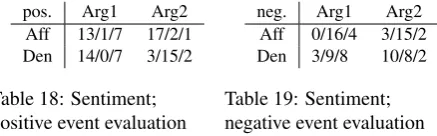
Table 18 shows the results for positively evaluated (posi-tive) sentiment, as illustrated by (15).
(15) Fortunately, voters have fallen in love with this candidate.
As predicted by the functor, Arg2, is mostly understood to be evaluated positively (upper right cell) when positive sen-timent holds. While the functor does not uniquely predict positive or negative evaluation for the combination of pos-itive event evaluation and pospos-itive evaluation of Arg2 (cf. lines 1 and 3 in Table 7), raters favor a positive interpreta-tion.
(16) Fortunately, voters have fallen out of love with this candidate.
The ratings suggest that the raters by default assume the constellation where a positively evaluated Experiencer (Arg1) rightly withholds positive sentiment from an unde-serving Stimulus (Arg2), rather than the case where a neg-atively evaluated Experiencer withholds positive sentiment from an undeserving Stimulus.
pos. Arg1 Arg2
[image:8.595.57.276.189.257.2]Aff 13/1/7 17/2/1 Den 14/0/7 3/15/2
Table 18: Sentiment; positive event evaluation
neg. Arg1 Arg2
Aff 0/16/4 3/15/2 Den 3/9/8 10/8/2
Table 19: Sentiment; negative event evaluation
Turning now to the negatively evaluated situations shown in Table 19, we observe that for cases where the Experi-encer’s positive sentiment toward a Stimulus is negatively evaluated from the external point of view, both Experiencer and Stimulus tend to be negatively evaluated by the raters (cf. line 4 of Table 7). The alternative constellation where the Experiencer is still viewed positively while the Stimu-lus is evaluated negatively seems not to have been salient (cf. line 2 of Table 7).
In the case of negative evaluation of a situation where pos-itive sentiment is withheld (row 2 of Table 19), the results are more mixed, which is as expected for the Experiencer but not so for the Stimulus (cf. lines 1 and 3 of Table 7).
7.2.4. Similarity
The results for positively evaluated similarity and differ-ence are shown in Table 20, those for the negatively evalu-ated counterparts in Table 21.
When similarity is positively evaluated, raters assume that both participants themselves must be positively valued, too (cf. row 1 of Table 20), even though the functor does not require that of Item1 (cf. lines 1 and 3 of Table 6). When difference between Item1 and Item2 is positively evaluated (cf. row 2 of Table 20), as in (17), Item2 is predicted to be negatively evaluated by the functor for similarity (cf. lines 2 and 4 Table 6). However, we do find surprisingly many positive ratings (6) for Item2.
(17) Fortunately, the immigrants haven’t assimilated to the surrounding culture.
When similarity is negatively evaluated, raters assume that both participants themselves must be negatively valued, too (cf. row 1 of Table 21), even though the functor does not require that of Item1 (cf. lines 2 and 4 of Table 6). When difference / lack of similarity is evaluated negatively, as in (18), we would expect to find Item2 positively evaluated. However, that is not what we found. Instead, Item2 was clearly rated negatively by the majority of raters.
(18) Unfortunately, the immigrants haven’t assimilated to the surrounding culture.
pos. Arg1 Arg2
Aff 14/0/6 16/1/3 Den 13/5/2 6/9/5
Table 20: Similarity; positive event evaluation
neg. Arg1 Arg2
Aff 0/16/4 2/13/5 Den 2/11/7 4/11/5
Table 21: Similarity; negative event evaluation
7.3.
Summary
Our crowdsourcing results suggest several points worth considering in future working on opinion functors. First, the results for affirmed situations (e.g. states of possession) typically are clearer than for denied situations (e.g. states of lack). This may reflect a difference in complexity be-tween processing affirmed and negative propositions. Sec-ond, even though many binary functors yield the same event evaluation for two distinct constellations of how the partici-pants are rated, we find that speakers in the rating task often seem to default to one of these constellations. It would be interesting to test on corpus data if these defaults reflect ac-tual tendencies in regular language use. Third, we found some completely unexpected results. It is not clear if this is a) a result of using non-experts; b) owed to our stimuli; or c) to additional assumptions that raters may introduce in their understanding because of the lack of context. Control-ling for such factors should shed further light on when the functors allow reliable conclusions and when not.
8.
Conclusion and Future Work
We have extended the theory of effect functors for opinion inference, introducing new functors and developing a ty-pology of possible functors. We have reported on the first effort to comprehensively annotate effect-relevant predi-cates with (i) the functor applied, (ii) the affected, and (iii) the causal entity. This information is essential for any rule-based opinion inference machinery to work effec-tively.4 We have demonstrated through an inter-annotator-agremeent study that we can annotate the various functors with good agreement. Finally, we performed a crowdsourc-ing experiment in which we tested the utility of various functors for opinion inference in a novel setting, where event evaluations were given, the arguments carried no ob-vious sentiment and subjects had to infer the evaluation of a specified participant.In terms of resource-building, we plan to use our gold stan-dard annotations for approaches that automatically anno-tate previously unlabeled synsets by either leveraging the GermaNet graph or using methods from distributional se-mantics. With respect to the effect functors themselves, we intend to perform additional experiments, including ones with contextualized sentences, to gain a better sense of why certain inferences are less robust than expected.
9.
Acknowledgements
Part of this work was supported by the German Research Foundation (DFG) under grant RU 1873/2-1.
4With the final version, we will release our annotations of all
10.
Bibliographical References
Anand, P. and Reschke, K. (2010). Verb classes as eval-uativity functor classes. InProceedings of Verb 2010 -Interdisciplinary Workshop on Verbs, pages 98–103. Choi, Y., Deng, L., and Wiebe, J. (2014). Lexical
acquisi-tion for opinion inference: A sense-level lexicon of bene-factive and malebene-factive events. InProceedings of the 5th Workshop on Computational Approaches to Subjectivity, Sentiment and Social Media Analysis (WASSA), pages 107–112. Association for Computational Linguistics. Cohen, J. (1960). A coefficient of agreement for
nomi-nal scales. Educational and psychological measurement, 20(1):37–46.
Deng, L. and Wiebe, J. (2014). Sentiment propagation via implicature constraints. InProceedings of the 14th Con-ference of the European Chapter of the Association for Computational Linguistics, pages 377–385, Gothenburg, Sweden, April. Association for Computational Linguis-tics.
Deng, L., Choi, Y., and Wiebe, J. (2013). Benefac-tive/malefactive event and writer attitude annotation. In
Proceedings of the 51st Annual Meeting of the Associa-tion for ComputaAssocia-tional Linguistics (Volume 2: Short Pa-pers), pages 120–125, Sofia, Bulgaria, August. Associa-tion for ComputaAssocia-tional Linguistics.
Hamp, B. and Feldweg, H. (1997). Germanet-a lexical-semantic net for German. InProceedings of ACL work-shop Automatic Information Extraction and Building of Lexical Semantic Resources for NLP Applications, pages 9–15. Association for Computational Linguistics. Klenner, M., Fahrni, A., and Petrakis, S. (2009). Polart:
A robust tool for sentiment analysis. InProceedings of the 17th Nordic Conference on Computational Linguis-tics (NODALIDA 2009), pages 235–238.
Klenner, M., Amsler, M., and Hollenstein, N. (2014). Verb polarity frames: a new resource and its application in target-specific polarity classification. InProceedings of the 12th Edition of the Konvens Conference, pages 106– 115. Universit¨at Hildesheim.
Klenner, M. (2015). Verb-centered sentiment inference with description logics. InProceedings of the 6th Work-shop on Computational Approaches to Subjectivity, Sen-timent and Social Media Analysis, pages 134–139, Lis-boa, Portugal, September. Association for Computa-tional Linguistics.
Miller, G. A., Beckwith, R., Fellbaum, C., Gross, D., and Miller, K. (1990). Wordnet: An on-line lexical database.
International Journal of Lexicography, 3:235–244. Remus, R., Quasthoff, U., and Heyer, G. (2010). SentiWS
– a publicly available German-language resource for sen-timent analysis. InProceedings of the 7th International Language Resources and Evaluation (LREC’10), pages 1168–1171.
Reschke, K. and Anand, P. (2011). Extracting contextual evaluativity. In Proceedings of the Ninth International Conference on Computational Semantics, pages 370– 374. Association for Computational Linguistics. Ruppenhofer, J. and Brandes, J. (2015). Extending
ef-fect annotation with lexical decomposition. In
Proceed-ings of the 6th Workshop on Computational Approaches to Subjectivity, Sentiment and Social Media Analysis, pages 67–76, Lisboa, Portugal, September. Association for Computational Linguistics.
Taboada, M., Brooke, J., Tofiloski, M., Voll, K., and Stede, M. (2011). Lexicon-based methods for sentiment analy-sis.Computational Linguistics, 37(2):267–307.
Waltinger, U. (2010). GermanPolarityClues: A lexical re-source for German sentiment analysis. InProceedings of the Seventh International Conference on Language Re-sources and Evaluation (LREC), Valletta, Malta, May. Wiebe, J. and Deng, L. (2014). An account of opinion
im-plicatures.CoRR, abs/1404.6491.
Wilson, T., Wiebe, J., and Hoffmann, P. (2005). Recogniz-ing contextual polarity in phrase-level sentiment analy-sis. In Proceedings of the conference on Human Lan-guage Technology and Empirical Methods in Natural Language Processing, HLT ’05, pages 347–354. Asso-ciation for Computational Linguistics.