A Semantically Compositional Annotation Scheme for Time Normalization
Steven Bethard, Jonathan L Parker
University of Alabama at Birmingham Birmingham, AL, USA [email protected], [email protected]
Abstract
We present a new annotation scheme for normalizing time expressions, such asthree days ago, to computer-readable forms, such as
2016-03-07. The annotation scheme addresses several weaknesses of the existing TimeML standard, allowing the representation of time expressions that align to more than one calendar unit (e.g.,the past three summers), that are defined relative to events (e.g.,three weeks postoperative), and that are unions or intersections of smaller time expressions (e.g.,Tuesdays and Thursdays). It achieves this by modeling time expression interpretation as the semantic composition of temporal operators like UNION, NEXT, and AFTER. We have applied the annotation scheme to 34 documents so far, producing 1104 annotations, and achieving inter-annotator agreement of 0.821.
Keywords:time expressions, normalization, compositionality
1.
Introduction
Time normalization is the task of translating natural lan-guage expressions of time, such as three days ago, to computer-readable forms, such as2015-10-12. Accu-rate time normalization is critical for enabling temporally-constrained search over free text language resources. Ap-plications range from the study of literary texts (Fischer and Str¨otgen, 2015) to mining patient records for potential causes of disease (Lin et al., 2014).
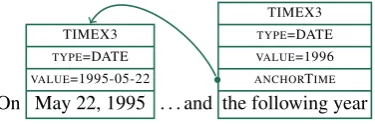
The most popular scheme for annotating such normalized forms is ISO-TimeML (Pustejovsky et al., 2010), an exten-sion of the TIDES annotation guidelines (Ferro et al., 2005). Figure 1 shows a sample of such annotations. Time ex-pressions are annotated as phrases and theVALUEattribute indicates the normalized form. This type of annotation has formed the basis for a wide variety of annotated corpora, in-cluding the TimeBank (Pustejovsky et al., 2003), WikiWars (Mazur and Dale, 2010), TimeN (Llorens et al., 2012), and the various TempEval shared tasks (Verhagen et al., 2007; Verhagen et al., 2010; UzZaman et al., 2013).
On
TIMEX3
TYPE=DATE
VALUE=1995-05-22
May 22, 1995 . . . and
TIMEX3
TYPE=DATE
VALUE=1996
[image:1.595.76.264.558.620.2]ANCHORTIME the following year
Figure 1: ISO-TimeML annotation of times in a sentence from the TimeBank article APW19980418.0210
However, there are a few drawbacks of the ISO-TimeML ap-proach. First, it struggles to represent times that do not align to a single calendar unit (day, week, month, etc.), such as
the past three summers, since this cannot be described with some prefix of a YYYY-MM-DDTHH:MM:SS date-time. Second, it does not permit times to be defined relative to events (only relative to times), as inthree weeks postopera-tive, where the three-week period is defined relative to some operation event. Finally, the flat nature of the annotations does not reflect the compositional semantics of time expres-sions. For example,followingcan be applied not only to
yearas in Figure 1, but also toweek,Tuesday, orDecember, and the semantics is identical: find the first such calendar unit in the future relative to the anchor time (May 22, 1995).
We thus propose a new annotation scheme for time nor-malization that can faithfully represent a wider variety of time expressions, that annotates fine-grained components of time expressions, and that formally defines the semantics of each annotation in terms of mathematical operations over intervals on the timeline.
2.
Definitions
Each annotation type in our schema corresponds to a formal interpretation of one of the following temporal concepts.
timeline,T: The infinite sequence of time points to which time expressions should be anchored. We will assume that each time point marks the start of a second. For ex-ample, 2015-08-03 09:35:47 and 1990-01-01 00:00:00 are both time points. For simplicity, when a time point ends in 00:00:00, we will abbreviate that time point by omitting the 00:00:00.
period,∆ :U →N: An amount of time, expressed as counts of standard time unitsU ={YEARS,MONTHS,
etc.}. For example,a week(i.e.,WEEKS→1) orthree months(i.e.,MONTHS→3). Note that periods are in-dependent of the timeline. For example, given only the period expression10 weeks, it is impossible to assign time points of the form NNNN-NN-NN NN:NN:NN to its start and end.
interval,i∈I={[ti, tj) :ti∈T∧tj ∈T∧ti< tj}:
An interval on the timeline, defined by a starting point (inclusive) and an ending point (exclusive). For example, the expression 1990 corresponds to the interval [1990-01-01, 1991-01-01). Figure 2 shows a graphical depiction of1990as a timeline interval.
1989 1990 1991
repeating interval,R⊂I: A sequence of intervals on the timeline. For example,January,08:00 am, orFriday the 13th. We view such expressions as the infinite sequence of all possible intervals they could refer to. For example,Januarycould refer to [01-01, 2000-02-01), to [2001-01-01, 2001-2000-02-01), to [2002-01-01, 2002-02-01), etc. Figure 3 shows a graphical depiction ofJanuaryas a repeating interval on the timeline.
Figure 3: The repeating intervalJanuaryon the timeline.
temporal operator,F :. . .→. . .: A function that takes periods, intervals and/or repeating-intervals as argu-ments and produces new periods, intervals or repeating-intervals. For example, the wordfollowingoften evokes the NEXToperator (I×R×N→ P(I)), which takes
an interval, a repeating interval, and a positive integer
n, and produces thensub-intervals of the repeating interval that follow the anchor interval.
3.
Annotation Types
For each of time concepts above, we define annotation types for marking them in the text. The annotation types have properties and links to other annotations that encode the in-formation necessary for their formal interpretation as above.
3.1.
Periods
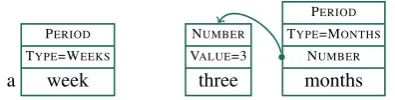
PERIODannotations implement theperiodconcept. The annotation spans a temporal unit (DAYS, WEEKS, etc.) and may link to a number. Examples are shown in Figure 4.
a
PERIOD
TYPE=WEEKS week
NUMBER
VALUE=3
three
PERIOD
TYPE=MONTHS
NUMBER months
Figure 4: PERIODannotations:a weekandthree months
3.2.
Intervals
Only one annotation directly represents an interval on the timeline: YEAR. All other intervals are the result of tempo-ral operators. A YEARrepresents the interval from the first second of the year (inclusive) to the first second of the next year (exclusive). The YEARannotation is also used to iden-tify decades and centuries, by marking the missing digits with the ‘?’ character. Examples are shown in Figure 5.
in
YEAR
VALUE=2014
2014 the
YEAR
VALUE=198?
1980s
Figure 5: YEARannotations:in 2014andthe 1980s
3.3.
Repeating Intervals
Thoughrepeating intervalscan represent any set of intervals on the timeline, they are most commonly used to identify
intervals named by the calendar system:Tuesday,January, etc. The following annotations have been defined to follow the semantics of the ISO calendar system (ISO 8601, 2004):
MONTH-OF-YEAR e.g.,February
WEEK-OF-YEAR e.g.,week 2 [of 1990]
DAY-OF-MONTH e.g.,3rd[of March] DAY-OF-WEEK e.g.,Thursday
HOUR-OF-DAY e.g.,08[:35:17]
MINUTE-OF-HOUR e.g.,[08:]35[:17]
SECOND-OF-MINUTE e.g.,[08:35:]17
The schema also includes annotation types for generic cal-endar intervals (e.g.,every day), and TimeML extensions of the ISO calendar system (e.g., PART-OF-DAYlikemorning
orevening). Examples are shown in Figure 6.
on
DAY-OF-WEEK
TYPE=WEDNESDAY
Wed. every
CALENDAR-INTERVAL
TYPE=YEAR year
HOUR-OF-DAY
VALUE=8
08 :
MINUTE-OF-HOUR
VALUE=0
00 :
SECOND-OF-HOUR
VALUE=0
[image:2.595.70.268.484.534.2]00
Figure 6: Repeating interval annotations: on Wed.,every year, and08:00:00
3.4.
Temporal Operators
Temporal operators take the above periods, intervals, and repeating-intervals and semantically compose them to pro-duce new times. Our annotation scheme contains 18 opera-tors, each with a formal definition of their semantics.
Sum Two periods can be combined to produce a new pe-riod whose duration is the sum of the original two. Formally:
SUM(∆1: PERIOD,∆2: PERIOD) :PERIOD= ∆1]∆2 where]is the multiset sum. Figure 7 shows an example SUMannotation which produces the formal interpretation
YEARS → 2,DAYS → 1.
NUMBER
VALUE=2
two
PERIOD
TYPE=YEARS
NUMBER years
SUM
PERIOD1
PERIOD2
and a
PERIOD
TYPE=DAYS day
Figure 7: SUMannotation:two years and a day
Difference Two periods can also be combined by subtract-ing the amount of time in one from the other. Formally:
SUM(∆1: PERIOD,∆2: PERIOD) :PERIOD= ∆1\∆2 where\is the multiset difference. Figure 8 shows an ex-ample DIFFERENCEannotation which produces the formal interpretationYEARS → 2,DAYS → −1.
a
PERIOD
TYPE=DAYS day
DIFFERENCE
PERIOD1
PERIOD2 under
NUMBER
VALUE=2
two
PERIOD
TYPE=YEARS
NUMBER years
[image:2.595.316.527.542.597.2] [image:2.595.312.534.709.772.2]Union Two repeating intervals can be combined to pro-duce a new repeating interval that is the union of the sub-intervals of the original two. Formally:
UNION(R1: R-INTERVAL, R2: R-INTERVAL) =R1∪R2
Figure 9 shows an example UNIONannotation along with a graphical depiction of its formal interpretation: the union of all calendar intervals namedMonday and all calendar intervals namedFriday.
DAY-OF-WEEK
TYPE=MONDAY Mondays
UNION
REPEATING-INTERVALS and
DAY-OF-WEEK
TYPE=FRIDAY Fridays
Mondays Fridays UNION
Figure 9: UNIONannotation:Mondays and Fridays
Intersection Two repeating intervals can be combined to produce a new repeating interval that is the intersection of the sub-intervals of the original two. Formally:
INTERSECTION(R1: R-INTERVAL, R2: R-INTERVAL)
=R1∩R2
Figure 10 shows an example INTERSECTIONannotation along with a graphical depiction of its formal interpretation: the intersection of all calendar intervals namedSaturday
with all calendar intervals namedMarch.
DAY-OF-WEEK
TYPE=SATURDAY Saturdays
INTERSECTION
REPEATING-INTERVALS in
MONTH-OF-YEAR
TYPE=MARCH March
Saturdays March INTERSECTION
Figure 10: INTERSECTIONannotation:Saturdays in March
Every-Nth A repeating interval can be sub-sampled by retaining only everynthof the sub-intervals. Formally:
EVERY-NTH(R:R-INTERVAL, n:N) :R-INTERVAL
={ri∈R:imodn= 0}
Figure 11 shows an example EVERY-NTHannotation along with a graphical depiction of its formal interpretation: every odd-numbered calendar interval namedFriday.
every
EVERY-NTH
VALUE=2 REPEATING-INTERVAL
other
DAY-OF-WEEK
TYPE=FRIDAY Friday
Fridays EVERY-NTH
Figure 11: EVERY-NTHannotation:every other Friday
Last (Period) The first variant of the LASToperator takes an INTERVAL and a PERIOD, and creates an interval of the given length that ends just before the given interval. Formally:
LAST([t1, t2) :INTERVAL,∆ : PERIOD) :INTERVAL
= [t1−∆, t1)
Figure 12 shows an example LASTannotation along with a graphical depiction of its formal interpretation: the four days preceding the time at which the document was written. Note that the INTERVALargument is DOC-TIME, a special time defined by the document metadata that identifies the time interval at which the document was written.
over the
LAST
INTERVAL=DOC-TIME
PERIOD past
NUMBER
VALUE=4
four
PERIOD
TYPE=DAYS
NUMBER days
DOC-TIME
LAST
Figure 12: LAST(PERIOD) annotation:over the past four days
Last (Repeating Interval) The second variant of the LAST operator takes an INTERVAL, a REPEATING -INTERVAL, and an integern, and finds thenlatest repeated intervals that appear before the given interval. Formally:
LAST([t1, t2) :INTERVAL, R: R-INTERVAL, n:N)
=nlatest of{[ts, te)∈R:te≤t1}
Figure 13 shows an example LASTannotation along with a graphical depiction of its formal interpretation: the two
summerintervals preceding the document creation interval.
the
LAST
INTERVAL=DOC-TIME
REPEATING-INTERVAL previous
NUMBER
VALUE=2
two
SEASON-OF-YEAR
TYPE=SUMMER
NUMBER summers
DOC-TIME
summers LAST
Next (Period) The first variant of the NEXToperator takes an INTERVALand a PERIOD, and creates an interval of the
given length that starts just after the given interval. Formally:
NEXT([t1, t2) :INTERVAL,∆ : PERIOD) :INTERVAL
= [t2, t2+ ∆)
Figure 14 shows an example NEXTannotation along with a graphical depiction of its formal interpretation: the week-long period following the document creation interval.
the
NEXT
INTERVAL=DOC-TIME
PERIOD coming
PERIOD
TYPE=WEEKS week
DOC-TIME
NEXT
Figure 14: NEXT(PERIOD) annotation:the coming week
Next (Repeating Interval) The second variant of the NEXT operator takes an INTERVAL, a REPEATING -INTERVAL, and an integern, and finds thenearliest repeated
intervals that appear after the given interval. Formally:
NEXT([t1, t2) :INTERVAL, R: R-INTERVAL, n:N)
=nearliest of{[ts, te)∈R:t2≤ts}
Figure 15 shows an example NEXTannotation along with a graphical depiction of its formal interpretation: the one calendar-week interval following the document creation in-terval. Note the difference between this and Figure 14: the repeating-interval variant of NEXTaligns to standard calen-dar intervals, while the period variant of NEXTdoes not.
the
NEXT
INTERVAL=DOC-TIME
REPEATING-INTERVAL
NUMBER coming
CALENDAR-INTERVAL
TYPE=WEEK week
DOC-TIME
week NEXT
Figure 15: NEXT(REPEATING-INTERVAL) annotation:the coming week
This (Period) The first variant of the THISoperator takes an INTERVALand a PERIOD, and creates an interval of the given length centered at the given interval: Formally:
THIS([t1, t2) :INTERVAL,∆ :PERIOD) :INTERVAL
= t
1+t2
2 − ∆
2,
t1+t2
2 + ∆
2
Figure 16 shows an example THISannotation along with a graphical depiction of its formal interpretation: a six-day-long interval centered around the document creation time.
THIS
INTERVAL=DOC-TIME
PERIOD these
NUMBER
VALUE=6
six
PERIOD
TYPE=DAYS
NUMBER days
DOC-TIME
THIS
Figure 16: THIS(PERIOD) annotation:these six days
This (Repeating Interval) The second variant of the THIS operator takes an INTERVAL and a REPEATING -INTERVAL, and finds the repeated interval(s) containing the given interval. Formally:
THIS([t1, t2) :INTERVAL, R:R-INTERVAL) :R-INTERVAL
={[ts, te)∈R:ts≤t1∧t2≤te}
Figure 17 shows an example THISannotation along with a graphical depiction of its formal interpretation: the calendar week containing the document creation time.
THIS
INTERVAL=DOC-TIME
REPEATING-INTERVAL this
CALENDAR-INTERVAL
TYPE=WEEK week
DOC-TIME
week THIS
Figure 17: THIS(REPEATING-INTERVAL) annotation:this week
Before (Period) The first variant of the BEFOREoperator takes an INTERVAL and a PERIOD, and shifts the input interval earlier by the given period. Formally:
BEFORE([t1, t2) :INTERVAL,∆ : PERIOD) :INTERVAL
= [t1−∆, t2−∆)
Figure 18 shows an example BEFOREannotation along with
a graphical depiction of its formal interpretation: an interval the same length as the document creation time but one year earlier on the timeline.
a
PERIOD
TYPE=YEARS year
BEFORE
INTERVAL=DOC-TIME
PERIOD ago
DOC-TIME
year BEFORE
Figure 18: BEFORE(PERIOD) annotation:a year ago
-INTERVAL, and an integern, and finds thenthlatest repeated
interval before the input interval. Formally:
BEFORE([t1, t2) :INTERVAL, R:R-INTERVAL, n:N)
=nthlatest{[ts, te)∈R:te≤t1}
Figure 19 shows an example BEFOREannotation along with a graphical depiction of its formal interpretation: the second closest calendar interval namedTuesdaythat precedes the document creation time.
NUMBER
VALUE=2
two
DAY-OF-WEEK
TYPE=TUESDAY
NUMBER Tuesdays
BEFORE
INTERVAL=DOC-TIME
REPEATING-INTERVAL ago
DOC-TIME
Tuesdays BEFORE
Figure 19: BEFORE(PERIOD) annotation: two Tuesdays ago
After (Period) The first variant of the AFTER operator takes an INTERVAL and a PERIOD, and shifts the input interval later by the given period. Formally:
AFTER([t1, t2) :INTERVAL,∆ :PERIOD) :INTERVAL
= [t1+ ∆, t2+ ∆)
Figure 20 shows an example AFTERannotation along with a graphical depiction of its formal interpretation: an interval the same length as the document creation time but one year later on the timeline.
a
PERIOD
TYPE=YEARS year
AFTER
INTERVAL=DOC-TIME
PERIOD later
DOC-TIME
year AFTER
Figure 20: AFTER(PERIOD) annotation:a year later
After (Repeating-Interval) The second variant of the AF
-TERoperator takes INTERVAL, a REPEATING-INTERVAL, and an integern, and finds thenthearliest repeated interval
after the input interval. Formally:
AFTER([t1, t2) :INTERVAL, R:R-INTERVAL, n: N)
=nthearliest{[ts, te)∈R:t2≤ts}
Figure 21 shows an example AFTERannotation along with a graphical depiction of its formal interpretation: the second closest calendar interval namedTuesday that follows the document creation time.
NUMBER
VALUE=2
two
DAY-OF-WEEK
TYPE=TUESDAY
NUMBER Tuesdays
AFTER
INTERVAL=DOC-TIME
REPEATING-INTERVAL later
DOC-TIME
TUESDAY
BEFORE
Figure 21: AFTER(PERIOD) annotation:two Tuesdays later
Between The BETWEENoperator finds the interval be-tween two input intervals. Formally:
BETWEEN([t1, t2) :INTERVAL,[t3, t4)) : INTERVAL
= [t2, t3)
Figure 22 shows an example BETWEENannotation, along with a graphical depiction of its formal interpretation: the in-terval starting at the end of 1994 and ending at the document creation time.
BETWEEN
START-INTERVAL
END-INTERVAL=DOC-TIME since
YEAR 1994
DOC-TIME
1994 BETWEEN
Figure 22: BETWEENannotation:since 1994
Nth The NTH operator selects thenth sub-interval of a repeating interval, counting from the start of another interval. Formally:
NTH([t1, t2) :INTERVAL, R: R-INTERVAL, n:N)
=nthof{[ts, te)∈R:t1≤ts∧ ≤te≤t2}
Figure 23 shows an example NTHannotation, along with a graphical depiction of its formal interpretation: the fifth day following the start of the 2016 interval.
NTH
VALUE=5 INTERVAL
REPEATING-INTERVAL fifth
CALENDAR-INTERVAL
TYPE=DAY
day of
YEAR
VALUE=2016
2016
2016 NTH
Figure 23: NTHannotation:fifth day of 2016
of another interval. Formally:
TWO-DIGIT-YEAR([t1, t2) :INTERVAL, n:N)
= [(C(t1) +n)-01-01,(C(t1) +n+ 1)-01-01)
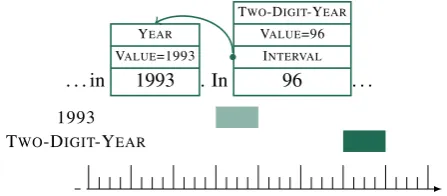
whereC(x)is the year ofxrounded down to the nearest hundred. Figure 24 shows an example TWO-DIGIT-YEAR
annotation, along with a graphical depiction of its formal interpretation: the year 96 in the century 1900 (i.e., 1996).
. . . in
YEAR
VALUE=1993
1993 . In
TWO-DIGIT-YEAR
VALUE=96 INTERVAL
96 . . .
[image:6.595.59.283.183.281.2]1993 TWO-DIGIT-YEAR
Figure 24: TWO-DIGIT-YEARannotation:. . . in 1993. In 96. . .
3.5.
Other Annotations
In addition to periods, intervals, repeating intervals, and temporal operators, the schema includes a few annotations to handle other phenomena that are needed for the interpre-tation of time expressions.
NUMBER annotations specify a numeric value.
MODIFIER annotations specify inexact time expressions.
[image:6.595.54.285.462.524.2]EVENT annotations specify events that are anchor intervals.
Figure 25 shows an example with such annotations.
MODIFIER
TYPE=APPROX about
NUMBER
VALUE=2
two
PERIOD
TYPE=WEEKS
MODIFIER
NUMBER weeks
AFTER
INTERVAL
PERIOD after the
EVENT crash
Figure 25: NUMBER, MODIFIER, and Event annotations:
about two weeks after the crash
4.
Corpus Annotation
To test the validity of the schema, it was used to annotate news articles from the TimeBank corpus. Three annotators participated in the annotation process, all of whom had some background in linguistics and computer science: a faculty member with more than ten years of experience, one un-dergraduate student with two years of experience, and one undergraduate student with one semester of experience. The Anafora annotation tool (Chen and Styler, 2013) was used for the annotation. Anafora supports the kind of strongly typed annotations required by our schema, where the dif-ferent properties of an annotation are restricted to difdif-ferent annotation types.
The first 10 documents in the corpus were used for schema refinement. All annotators annotated the documents, com-pared their annotations, and discussed disagreements. If revisions to the schema were necessary, they were made,
and the annotation process was restarted. This process took roughly 50 hours of effort per annotator to converge.
4.1.
Inter-Annotator Agreement
Once the schema had stabilized into the form described in the preceding sections, five new documents were selected that none of the annotators had previously seen. These documents were annotated independently by the two under-graduate students, with no discussion between annotators. This took a couple hours per annotator.
Agreement was then calculated asF1, the harmonic mean of precision and recall1, which in the case of two annotators
reduces to:
F1=
2·N1∧2
N1+N2
whereN1(N2) is the number of annotations from the first (second) annotator andN1∧2is the number of annotations matching between the two annotators. For span F1, an-notations were considered matching if they had the same annotation type and span (i.e., character offsets). For fullF1, annotations were only considered matching if the annotation type, span, and all properties and links matched exactly. For the overallF1, we use “micro”F1, where each annotation counts equally, regardless of type.
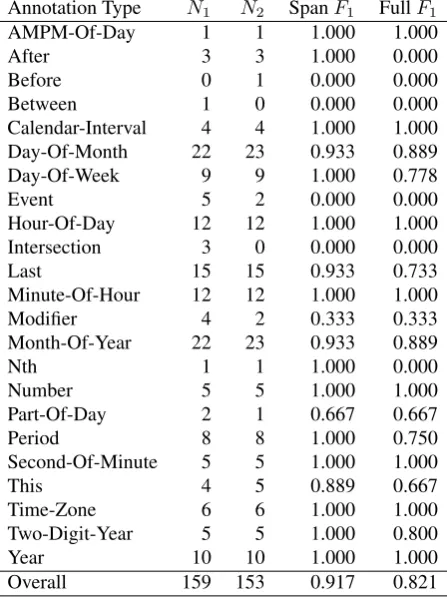
Table 1 shows the resulting inter-annotator agreement. Over-all agreement reachedF1of 0.917 for agreement on types and spans, andF1of 0.821 for agreement on all parts of the schema. The disagreements fell into 3 different categories:
missed annotations (44%) One annotator found a time concept that the other missed. For example, 08-08
in the header2ndLd 08-08 0257 BC-Kenya-Embassy
actually does represent August 8, but only one of the annotators found this expression.
added annotations (32%) One annotator marked some-thing as a time concept that should not have been. For example, one annotator markedjustinjust min-utes apartas a MODIFIER(TYPE=APPROX). However, sincejust minutesrepresents the same period asminutes
does (i.e.,just minutesis not an approximate version ofminutes)justshould not have been annotated as a MODIFIER.
wrong link (24%) Both annotators marked the same time concepts, but disagreed on how to link them. For ex-ample, consider the snippet:
“The incidents of Aug. 7 underscore that terrorists know no boundaries. . . ” said the U.S. Deputy Ambassador Peter Burleigh.
Both annotators identifiedAug. 7as a LAST(i.e., as referring to an August 7th closely preceding some an-chor interval), but one annotator marked the document creation time as the anchor interval, and the other an-notator markedsaidas the anchor interval. The latter is correct since the speech event could be years before the document creation time.
1
Note that theκcoefficient (Cohen, 1960) converges toF1in
Annotation Type N1 N2 SpanF1 FullF1
AMPM-Of-Day 1 1 1.000 1.000
After 3 3 1.000 0.000
Before 0 1 0.000 0.000
Between 1 0 0.000 0.000
Calendar-Interval 4 4 1.000 1.000
Day-Of-Month 22 23 0.933 0.889
Day-Of-Week 9 9 1.000 0.778
Event 5 2 0.000 0.000
Hour-Of-Day 12 12 1.000 1.000
Intersection 3 0 0.000 0.000
Last 15 15 0.933 0.733
Minute-Of-Hour 12 12 1.000 1.000
Modifier 4 2 0.333 0.333
Month-Of-Year 22 23 0.933 0.889
Nth 1 1 1.000 0.000
Number 5 5 1.000 1.000
Part-Of-Day 2 1 0.667 0.667
Period 8 8 1.000 0.750
Second-Of-Minute 5 5 1.000 1.000
This 4 5 0.889 0.667
Time-Zone 6 6 1.000 1.000
Two-Digit-Year 5 5 1.000 0.800
Year 10 10 1.000 1.000
[image:7.595.58.282.71.372.2]Overall 159 153 0.917 0.821
Table 1: Inter-annotator agreement on the double-annotated sample from the TimeBank Corpus. N1 (N2) is the num-ber of annotations identified by the first (second) annotator. Span F1 is the agreement on just the types and spans of the annotations, while FullF1requires agreement on all the annotation properties and links as well.
4.2.
The SCATE Corpus
Having achieved reasonable inter-annotator agreement, the student annotators then began to annotate the remainder of the TimeBank corpus. Table 2 shows the current size of our Semantically Compositional Annotation of Time Expressions (SCATE) corpus. The annotations may be downloaded fromhttps://github.com/bethard/ anafora-annotations.
5.
Discussion
The high level of inter-annotator agreement (0.821F1) in the first application of our time normalization scheme to a corpus is encouraging, and we believe the fine-grained, formally compositional nature of our annotation scheme is a significant advance over existing approaches such as ISO-TimeML. Others have attempted to provide formal semantics for ISO-TimeML, but they showed that “the formal semantic interpretation of the TimeML markup language is not nearly as straightforward as one might have expected” (Katz, 2007). Instead of trying topost-hocassign a formal semantics to an annotation scheme, we have built our annotation scheme from the ground up to ensure it has a consistent formal interpretation.
There are a couple limitations of the research that we are currently working to address. First, the annotation scheme
N
Documents 34
Annotations 1104
Month-Of-Year 139
Day-Of-Month 119
Last 112
Year 85
Day-Of-Week 77
Minute-Of-Hour 67
Hour-Of-Day 66
Period 64
This 56
Calendar-Interval 55
Number 43
Second-Of-Minute 37
Time-Zone 26
Event 26
Two-Digit-Year 25
Next 24
Modifier 17
Before 12
After 11
Between 9
Part-Of-Day 8
Intersection 6
Nth 5
Season-Of-Year 3
AMPM-Of-Day 3
Frequency 2
Union 1
[image:7.595.363.483.76.443.2]Sum 1
Table 2: Annotations in the corpus as of March 2016
has been developed primarily with reference to examples from the TimeBank corpus, which may bias the expres-siveness of the scheme towards expressions common in newswire. To address this, we have obtained the THYME corpus of clinical notes (Styler et al., 2014), and will soon begin testing the scheme on medical language. Second, while the scheme fully formalizes the semantic composi-tion of the time elements, some of the operacomposi-tions are not easy for humans to carry out manually (e.g., subtractingn
weeks from a date). To address this, we are currently de-veloping a Scala/Java library that can read in annotations from the schema and produce the corresponding machine readable timeline intervals. This library will be available fromhttps://github.com/bethard/timenorm.
Acknowledgments
The project described was supported in part by R01LM010090 (THYME) from the National Library Of Medicine. The content is solely the responsibility of the authors and does not necessarily represent the official views of the National Institutes of Health.
References
2013 NAACL HLT Demonstration Session, pages 14–19, Atlanta, Georgia, June. Association for Computational Linguistics.
Cohen, J. (1960). A coefficient of agreement for nomi-nal scales.Educational and Psychological Measurement, 20(1):37–46.
Ferro, L., Gerber, L., Mani, I., Sundheim, B., and Wilson, G. (2005). Tides 2005 standard for the annotation of temporal expressions. Technical report.
Fischer, F. and Str¨otgen, J. (2015). When does german literature take place? – on the analysis of temporal ex-pressions in large corpora. InProceedings of DH 2015: Annual Conference of the Alliance of Digital Humanities Organizations, Sydney, Australia, 6.
Hripcsak, G. and Rothschild, A. S. (2005). Agreement, the f-measure, and reliability in information retrieval. Jour-nal of the American Medical Informatics Association, 12(3):296–298.
ISO 8601. (2004). Data elements and interchange formats – information interchange – representation of dates and
times. Technical report, Geneva, Switzerland.
Katz, G., (2007). Annotating, Extracting and Reasoning about Time and Events: International Seminar, Dagstuhl Castle, Germany, April 10-15, 2005. Revised Papers, chapter Towards a Denotational Semantics for TimeML, pages 88–106. Springer Berlin Heidelberg, Berlin, Hei-delberg.
Lin, C., Karlson, E. W., Dligach, D., Ramirez, M. P., Miller, T. A., Mo, H., Braggs, N. S., Cagan, A., Gainer, V., Denny, J. C., and Savova, G. K. (2014). Automatic identification of methotrexate-induced liver toxicity in patients with rheumatoid arthritis from the electronic medical record.
Journal of the American Medical Informatics Association. Llorens, H., Derczynski, L., Gaizauskas, R., and Saquete, E. (2012). TIMEN: An open temporal expression nor-malisation resource. InProceedings of the Eight Interna-tional Conference on Language Resources and Evaluation (LREC’12), Istanbul, Turkey, May. European Language Resources Association (ELRA).
Mazur, P. and Dale, R. (2010). WikiWars: A new corpus for research on temporal expressions. InProceedings of the 2010 Conference on Empirical Methods in Natural Language Processing, pages 913–922, Cambridge, MA, October. Association for Computational Linguistics. Pustejovsky, J., Hanks, P., Saur´ı, R., See, A., Gaizauskas, R.,
Setzer, A., Radev, D., Sundheim, B., Day, D., Ferro, L., and Lazo, M. (2003). The TimeBank corpus. InCorpus linguistics, volume 2003, pages 647–656.
Pustejovsky, J., Lee, K., Bunt, H., and Romary, L. (2010). Iso-timeml: An international standard for semantic anno-tation. In Nicoletta Calzolari (Conference Chair), et al., editors,Proceedings of the Seventh International Confer-ence on Language Resources and Evaluation (LREC’10), Valletta, Malta, may. European Language Resources As-sociation (ELRA).
Styler, IV, W. F., Bethard, S., Finan, S., Palmer, M., Prad-han, S., de Groen, P. C., Erickson, B., Miller, T., Lin, C., Savova, G., and Pustejovsky, J. (2014). Temporal annotation in the clinical domain. Transactions of the
Association for Computational Linguistics, 2:143–154, 4. UzZaman, N., Llorens, H., Derczynski, L., Allen, J., Verha-gen, M., and Pustejovsky, J. (2013). SemEval-2013 Task 1: TempEval-3: Evaluating Time Expressions, Events, and Temporal Relations. InSecond Joint Conference on Lexical and Computational Semantics (*SEM), Volume 2: Proceedings of the Seventh International Workshop on Semantic Evaluation (SemEval 2013), pages 1–9, Atlanta, Georgia, USA, June. Association for Computational Lin-guistics.
Verhagen, M., Gaizauskas, R., Schilder, F., Hepple, M., Katz, G., and Pustejovsky, J. (2007). SemEval-2007 Task 15: TempEval Temporal Relation Identification. In Pro-ceedings of the Fourth International Workshop on Seman-tic Evaluations (SemEval-2007), pages 75–80, Prague, Czech Republic, June. Association for Computational Linguistics.