Region Information-Based ROI Extraction
by Multi-Initial Fast Marching Algorithm
Zhang Hongmei
School of Life Science and Technology, Xi’an Jiaotong University, Xi’an 710049, China Email:[email protected]
Bian Zhengzhong
School of Life Science and Technology, Xi’an Jiaotong University, Xi’an 710049, China Email:[email protected]
Guo Youmin
First Affiliated Hospital, Xi’an Jiaotong University, Xi’an 710049, China Email:[email protected]
Ye Min
Institute of Mechanical Engineering, Xi’an Jiaotong University, Xi’an 710064, China Email:[email protected]
Miao Yalin
School of Life Science and Technology, Xi’an Jiaotong University, Xi’an 710049, China Email:[email protected]
Received 23 March 2003; Revised 10 January 2004; Recommended for Publication by Kyoung Mu Lee
Region of interest (ROI) plays an important role in medical image analysis. In this paper, a new approach to ROI extraction based on the curve evolution is proposed. Different from the existent method, the proposed approach is efficient both in segmentation results and computational cost. The deforming curve is modeled as a monotonically marching front under a positive speed field, where a region speed function is derived by minimizing the new defined ROI energy, and integrated with the edge-based speed function. The curve evolution model integrating the ROI information has a large propagation range and could even drive the front in low-contrast and narrow thin areas. Moreover, a multi-initial fast marching algorithm, which permits the user to plant several seed curves as the initial front and evolves them simultaneously, is developed to fast implement the numerical solution. Selective planting seed curves could help the local growth and thus may further improve the segmentation results and reduce the computational cost. Experiments by our approach are presented and compared with that of the other methods, which show that the proposed approach could fast extract low-contrast and narrow thin ROI precisely.
Keywords and phrases:ROI extraction, curve evolution, multi-initial fast marching algorithm, front, segmentation.
1. INTRODUCTION
Region of interest (ROI) plays an important role in medi-cal image analysis. Quantitative analysis of the shape and the properties of ROI could provide reliable data for diagnosing disease and the follow-up treatment planning [1]. As a result, to exploit accurate and fast ROI extraction method is in great need.
In recent years, ROI extraction based on the curve evo-lution approaches that deform an initial curve towards the desired boundary have been extensively exploited. Snakes
the shapes that they can describe. In addition, the distri-bution of the shape parameters is assumed to be multivari-ate Gaussian prior that may also present its limitations. The segmentation is formulated as maximum a posteriori prob-ability, involving a lot of parameters to be estimated that bring great computational cost. Ivins and Zhu, respectively, proposed the statistical snakes for region growing and ap-plied these models to image/texture segmentation [4, 5]. However, due to its “Lagrangian” representation such that the coordinate system moves with the deforming curve, the parametrical snakes could not handle topological changes. To handle the splitting or the merging of the curve, ex-tra reparameterization procedures must be performed dur-ing iteration, which brdur-ings expensive computational cost [6].
A major breakthrough is made by introducing the level set theory to curve propagation, resulting in a very elegant tool. The level set method proposed by Osher and Sethian offers a highly robust mathematic and numerical imple-mentation on curve/surface evolution [7, 8]. Embedding the moving front to be zero level set of a higher dimen-sional function, topological changes can be handled natu-rally by exploiting the zero level set at any time. The level set method is introduced to image segmentation by Mal-ladi et al. [9, 10,11]. In this approach, selection of speed function is crucial. On one hand, the speed function con-trols the behavior of the front propagation; on the other hand, the form of the speed function decides the compu-tational complexity of the numerical implementation. As a solution to the level set evolution equation, fast marching method may be the first choice for its cheap computational cost [10]. However, it could only be used for a monotoni-cally marching front that requires the speed function to be always positive or negative. Narrowband method and Her-mes algorithm can cope with all sorts of the level set evo-lution but their computational costs are still far more ex-pensive than the fast marching method [12,13]. Malladi et al. in [9] proposed the image-based positive speed function that could stop the front in the vicinity of the ROI bound-ary, but this only edge-based curve evolution may mislead the deformation at weak boundary, as the speed is too weak to propagate the front there. To address this problem, many improvements on designing the speed function are achieved by introducing region information to guide the curve de-forming. Yezzi et al. proposed a fully global approach to im-age segmentation that is derived based on the determinis-tic principle of maximally separating the values of certain image statistics within a set of curves [14]. This is a pure region-based approach, thus it is very robust. However, be-cause the image statistics are variable with the deforming curve, these statistics need to be estimated during the curve evolution, which may bring much computational cost. More-over, it needsn−1 curves to segmentnregions with each curve corresponding to different curve evolution equation and level set function, which also present complex compu-tation. Similar to Yezzi et al.’s work, nonparametric statistical method for image segmentation is proposed in [15], where the curve evolution aims at maximizing the mutual
infor-mation within different curves. Another region-based curve evolution method is based on the criterion that the interior of the region has maximal similarity and different regions have maximal discrepancy [16]. But continually estimating variable statistics makes the computing expensive. Paragios and Deriche proposed the geodesic active regions by adding a region term onto the geodesic active contour model, which combines the region-based segmentation with edge informa-tion. The region term is derived as minimizing the negative log-likelihood function of the image, which is obtained by Markov random field (MRF) presegmentation [17]. Due to its complex form in speed function, the corresponding level set evolution equation is implemented by Hermes algorithm [13], which is more computationally expensive than the Fast Marching method.
Considering both the segmentation quality and the com-putational cost, in this paper, we propose an efficient proach to ROI extraction. Different from the other ap-proaches, neither statistics are needed to be computed con-tinuously nor complex numerical implementation is in-volved. The deforming curve is modeled as monotonically marching front under a new positive speed field, where a new region speed function is derived by minimizing the ROI energy. Integrating with the region information, the modi-fied speed function has large propagation range and could even drive the front propagating in low-contrast and nar-row thin areas. To further improve the segmentation re-sults, multi-initial scheme is adopted [14] and the multi-initial fast marching algorithm is developed, which permits the user to plant several seed curves as the initial front and evolves them simultaneously. All the seed curves are treated as one complex front driven by the same evolution equa-tion. Selective planting seed curves can avoid the monoton-ically marching front leaking out of the weak boundary too early to arrive at the desired boundary and it can also reduce the computational cost. Our approach is similar to that of Vilari˜no’s cellular neural networks (CNN) approach to im-age segmentation [18,19]. Both approaches evolve pixel by pixel from their initial shapes and locations until delimit-ing the objects of interest, and the curve evolution is guided by local information from the image under consideration, which can offer a high flexible and efficient parallel process-ing.
The remainder of the paper is as follows: inSection 2, fast marching method is briefly outlined; in Section 3, the curve evolution model is proposed, where a new speed func-tion is introduced by ROI energy minimizing; inSection 4, multi-initial fast marching algorithm is described in detail; in
Section 5, experimental results are presented and compared with those of the other methods; finally inSection 6, conclu-sions are reported.
2. FAST MARCHING METHOD
Let C(p, 0) be a closed parameterized curve in Euclidean planeR2. LetC(p,t) be the one-parameter family of curves
given by
∂C
∂t =F·N, C(p, 0)=C0(p).
(1)
In particular, for the speed function F is being always positive or negative, the front is marching monotonically. One way to characterize the position of this moving front is to compute the arrival timeT(x,y) of the front as it crosses each point (x,y). By embedding the moving front to the level set of time functionT(x,y), thus the normal vectorNcould
The advantages of this equation representation are that it is intrinsic and that it is topologically flexible since at any time t, different topologies ofCcan be handled naturally by ex-ploiting the level set{C(p,t)|T(C(p,t))=t}.
3. REGION-BASED CURVE EVOLUTION MODEL
3.1. ROI energy and region speed function
Assume that ROI is the region enclosed by the moving front and is corresponding to the class O in the image I. Let µo(I(x,y)) denote the membership of the pixel belonging to
the interesting object classO. Let
Po
whereε→0+is a small positive constant. We define the ROI
energy as follows:
A direct explanation of (4) is that ROI should include as much pixels as possible belonging to the classO.
Using the Green theorem and variational method, we could derive the corresponding curve evolution equation as follows:
∂C
∂t = −PO(I)·Nin=PO(I)·N, (5)
whereNis the outward normal vector. The detailed deriva-tions are given in the appendix.
From (5), we could conclude that if a pixel belongs to the classO, this region forcePo(I(x,y))·Naims at expanding the
front curve to include this pixel; otherwise, it aims at shrink-ing the front to exclude this pixel.
For many medical images, the gray values constitute an adequate statistic to distinguish one region from another. Therefore, histogram-based fuzzy cluster algorithm [20] is performed for initial segmentation to provide region infor-mation. Let U = [u(l,k)] (l = 0,. . ., 255; k = 1,. . .,K), whereu(l,k) denotes the membership of the gray levell be-longing to thekth class andKis the number of classes. Then µo(I)=u(I(·,·),O). The ROI classOcould be simply
deter-mined by mouse-choosing several pixels in this region.
3.2. Modified speed function
Malladi in [9,10] proposes an image-based speed function:
gI=e−α|∇Gσ∗I|, α >0, (6)
that could stop the front in the vicinity of the ROI boundary. However, this only edge-based speed is too weak to propa-gate the front in low-contrast and narrow thin areas. To ad-dress this problem, improvements have been exploited but that may bring expensive computational cost [14,15,16,17]. Considering both the segmentation quality and computa-tional cost, we introduce the ROI information to the model by integrating the new region speed functionPO(I) with the
edge speed functiongI. The modified speed function is given
by
Fmodi=wR·PO(I) +wE·gI. (7)
The corresponding curve evolution equation is
∂C
∂t =Fmodi·N=wR·PO(I)·N+wE·gI·N, (8)
wherewR,wE ∈(0, 1] are constants weighting the effects of
region-based speed term and edge-based speed term, respec-tively.
If we chooseε = min{wE·gI/wR}, the modified speed
functionFmodi=wR·PO(I) +wE·gIis always positive. The
corresponding fast marching equation is given by
Fmodi· |∇T| =1. (9)
The modified speed fuses both region and edge information that has large propagation range. Even at weak boundaries, it can provide proper speed to propagate the front.
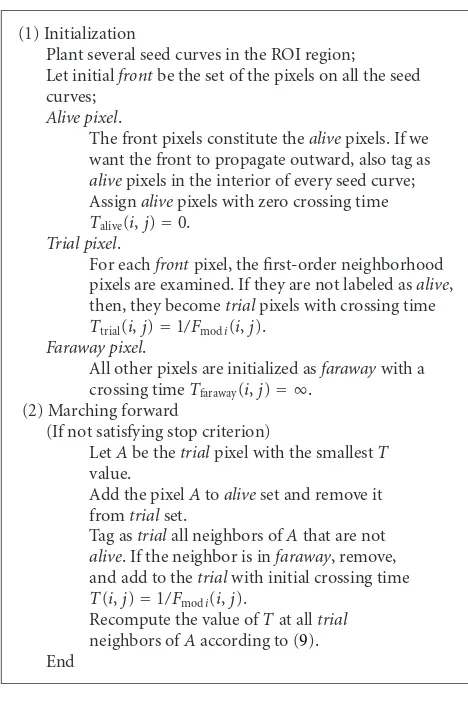
4. MULTI-INITIAL FAST MARCHING ALGORITHM
(1) Initialization
Plant several seed curves in the ROI region; Let initialfrontbe the set of the pixels on all the seed curves;
Alive pixel.
The front pixels constitute thealivepixels. If we want the front to propagate outward, also tag as alivepixels in the interior of every seed curve; Assignalivepixels with zero crossing time Talive(i,j)=0.
Trial pixel.
For eachfrontpixel, the first-order neighborhood pixels are examined. If they are not labeled asalive, then, they becometrialpixels with crossing time Ttrial(i,j)=1/Fmodi(i,j).
Faraway pixel.
All other pixels are initialized asfarawaywith a crossing timeTfaraway(i,j)= ∞.
(2) Marching forward
(If not satisfying stop criterion)
LetAbe thetrialpixel with the smallestT value.
Add the pixelAtoaliveset and remove it fromtrialset.
Tag astrialall neighbors ofAthat are not alive. If the neighbor is infaraway, remove, and add to thetrialwith initial crossing time T(i,j)=1/Fmodi(i,j).
Recompute the value ofTat alltrial neighbors ofAaccording to (9). End
Algorithm1
The multi-initial fast marching algorithm is given in
Algorithm 1.
An efficient technique of fast locating the grid pixel with smallestTvalues in the narrowband is to use a variation on heapsort algorithm, resulting in onlyO(NlogN) computa-tional expense [10].
5. EXPERIMENT
To demonstrate the efficiency of our approach, the proposed curve evolution equation (8) for ROI extraction by multi-initial fast marching algorithm is compared with the other methods.
Method 1. ROI extraction based on the only edge-based curve evolution [9]:
∂C
∂t =g·N. (10)
Method 2. ROI extraction by geodesic active contours equation [21]:
Method 3. Geodesic active region equation proposed by Paragios and Deriche [17]:
∂C
Method 4. Fully global approach proposed by Yezzi et al. [14]:
g is a monotonically decreasing function such thatg(r)→0 asr → ∞andg(0) = 1, andN is outward normal vector in (10) and (13) whereas inward normal vector in (11) and (12).c1,c2,c, andβare constant.PA(I(x,y)) andPB(I(x,y))
are the joint probability of the image with respect to two class hypothesis A and B, respectively.uandvare the average in-tensity inside and outside the deforming curve. The common choice ofgis given by (6). The numerical implementation of (8) and (10) is by our multi-initial fast marching algorithm. Due to the complex speed function form, the corresponding level set evolution equation of (11), (12), and (13) should be implemented by Hermes algorithm or by a more expensive narrowband method [12].
In the following experiments, we chooseα = 0.2,c1 =
−1,c2 =0.05,c= 0.05, andβ = 0.7. The ratio ofwR and
wEare recommended to be larger for low-contrast image or
images with many narrow thin branches as the region infor-mation is more reliable than the edge inforinfor-mation there. The ROI classO, the class numbersKused in fuzzy cluster, and the values ofwEandwRfor each case are given inTable 1.
Figures 1, 2,3, and4 are the comparison results. The first column shows the initial seed curves, the second and the third column show the random middle state of the marching front, while the fourth column shows the final front state. Group (a) provide the results for our approach and group (b) show the results of Method 1, Method 2, Method 3, and Method 4, respectively.
Figure 1 is a sarcoma pathological brain MR image, where three tumors are to be extracted. In the initial state, three seed curves are planted in the tumor areas, therefore, tumors can be extracted at one time. It can be seen from
Figure 1bthat because of the low-contrast and complex gra-dient of the ROI, the only edge-based speed misleads the de-forming behavior. However, the results ofFigure 1aare very promising, which show that the modified speed function in-tegrating region information has large propagation range in low-contrast area.
Figure 2is a meningioma pathological brain MR image, where the tumor area is the ROI. In this experiment, we want to compare the effect of the proposed region speed term with the advection speed term in geodesic active contours. In
Figure 2a, the tumor extraction by the proposed curve evolu-tion performs better in that it could even extract the narrow thin area on the top. Comparison of the results inFigure 2b
Table1: Parameters for each case.
Figure number 1 2 3 4 5 6 7 8 9
wR 1.0 0.9 1.0 0.9 Given 1.0 0.9 0.9 1.0
wE 0.2 0.1 0.2 0.2 Given 0.2 0.2 0.2 0.2
Interesting class Three Top Right DSA Vessel Vessel Vessel Vessel Bone O Tumors Tumor Tumor Vessels Branches Branches Branches Branches
K 3 5 5 2 2 2 2 2 2
(a)
(b)
Figure1: Sarcoma tumors extraction (a) by the proposed approach and (b) by Method 1.
area due to the low gradient information there. Experiments show that, compared with the advection term, the region force has larger attraction ability to guide the curve deform-ing in thin areas.
Figure 3is a metastatic bronchogenic carcinoma patho-logical brain MR image, where the tumor on the right is the ROI. The result of our approach is slightly different from that of Paragios’s geodesic active region method. The pre-segmentation map of Method 3 comes from MRF-based seg-mentation, and the region information used for curve evolu-tion involves two terms:PA(I(x,y)) andPB(I(x,y)) that
cor-respond to the joint probability of the image with respect to two-class hypothesis. However, our region information only involves the ROI classOhypothesis. In addition, the compu-tational cost of multi-initial fast marching algorithm used in our approach isO(NlogN), whereas the Hermes algorithm used for Method 3 is much expensive.
Figure 4is a DSA blood vessel. The result of our approach is almost the same as that of Method 4. However, the numer-ical implementation of Yezzi’s equation needs to use narrow-band algorithm that is far more expensive than fast marching
algorithm. Moreover, the statistics of the average intensityu andvare variable with the deforming curve, thus continu-ously computing these statistics are needed during the curve evolution which brings much computational costs.
Considering both the computing cost and the segmen-tation results, our approach performs better than that of the other methods in that it runs faster and could locate the curve in the desired boundary as well, which is suitable for real-time medical image ROI extraction.
In our approach, choosing parameters ofwR andwEis
important to guide the curve deforming.Figure 5show the impact of different combinations ofwRandwE on the
pul-monary vessels extraction. The obtained image is prepro-cessed by contrast enhancement, where vessels network is the ROI. From the comparison of the four groups inFigure 5, we can see that increasing the values forwRimproves the image
segmentation results significantly. Experimental results show that for low-contrast image or images with many narrow thin branches, largerwRcould perform better as region
(a)
(b)
Figure2: Meningioma tumor extraction (a) by the proposed approach and (b) by Method 2.
(a)
(b)
Figure3: Carcinoma tumor extraction (a) by the proposed approach and (b) by Method 3.
In fast marching algorithm, because the front is mono-tonically marching, front leaking from boundary too early is a serious problem. Multi-initial planting seed curves can help in selective growth of the front that may avoid the early leak-ing problem. Seed curves are recommended to be planted in some narrow thin vessels branches or low-contrast area,
(a)
(b)
Figure4: DSA vessel extraction (a) by the proposed approach and (b) by Method 4.
comparison show that selective planting of seed curves can do help in local growth of the front and also reduce the com-putational cost to some extent.
To further demonstrate the reliability of the proposed ap-proach, experiments on several medical images segmentation are provided. Figures7and8are pulmonary vessels selected from CT images. Observation shows that the front stops at the desired vessel boundary encouragingly, and even some small and thin vessel branches, which exhibit much vari-ability, could be located precisely as well. Almost the whole vessels network is extracted by our approach.Figure 9is a bone image. From the segmentation results, we could see thin bones on the two sides that are precisely extracted by our ap-proach.
6. CONCLUSIONS
In this paper, an efficient approach to ROI extraction based on the curve evolution was proposed. Region information was introduced to the model by minimizing the new defined ROI energy. Integrating region speed function with the edge-based speed term, the modified speed field has large propaga-tion range even in low-contrast and narrow thin areas. More-over, a multi-initial fast marching algorithm was developed, where selective planting seed curves may avoid the monoton-ically marching front leaking out of the weak boundary too early and further reduce the computational cost. ROI extrac-tion on several medical images by our approach was provided and compared with that of the other methods. Experiments show that considering both the computational cost and seg-mentation results, the proposed curve evolution integrating region information could perform faster and could precisely locate the front at the desired boundary as well. Experimen-tal results by our approach were very promising and it can be applied to medical image segmentation.
Nevertheless, due to the strict requirement of speed func-tion form in the fast marching method, the proposed ap-proach was only based on local image information, which in-volves a certain risk of being trapped in local minimum. Our future direction is to study global and real-time algorithm on clinical oriented medical image segmentation.
APPENDIX
Initial state 8280 iterations 10 440 iterations 12 180 iterations (a)
Initial state 8280 iterations 10 440 iterations 11 100 iterations (b)
Initial state 7560 iterations 10 080 iterations 11 580 iterations (c)
Initial state 2520 iterations 7560 iterations 8760 iterations (d)
Figure5: Impact of different ratios ofwRtowEon the pulmonary vessels extraction. (a)wR=0.9,wE =0.2; (b)wR =0.6,wE=0.4; (c) wR=0.2,wE=1.0; (d)wR=0,wE=1.0.
equation is
Fx− d
dsFx=0,
Fy− d
dsFy=0,
(A.4)
which could yield the following equations:
y(s)∂Q ∂x −x
(s)∂P
∂x + dP
ds =0,
y(s)∂Q ∂y −x
(s)∂P
∂y − dQ
ds =0,
(A.5)
where
dP ds =x
(s)∂P
∂x +y
(s)∂P
∂y, dQ
ds =x
(s)∂Q
∂x +y
(s)∂Q
∂y.
(A.6)
Substituting (A.6) to (A.5), we could get
y(s)·
∂Q ∂x +
∂P ∂y
=0,
−x(s)·
∂P ∂y +
∂Q ∂x
=0.
(A.7)
Therefore,
y(s)·f(x,y)=0,
−x(s)·f(x,y)=0. (A.8)
Using the gradient descent method, we could get the curve evolution equation:
∂x
∂t = −f(x,y)· d y
ds, ∂y
∂t =f(x,y)· dx ds.
Initial state 2160 iterations 7200 iterations 8940 iterations (a)
Initial state 2160 iterations 4680 iterations 9480 iterations (b)
Initial state 6120 iterations 10 080 iterations 10 860 iterations (c)
Initial state 2340 iterations 9180 iterations 15 180 iterations (d)
Figure6: Demonstration of selective planting seed curves: (a) and (b) demonstration of selective planting seed curves on helping local growth; (c) and (d) demonstration of selective planting seed curves on reducing computational cost.
Figure8: Pulmonary vessels extraction by the proposed approach.
Figure9: Medical bone image extraction by the proposed approach.
From differential geometry, we know thatα=(dx/ds,d y/ds) is the unit tangent vector, soN=(−d y/ds,dx/ds) is the unit inward normal vector. Thus we obtain
∂C
∂t = f(x,y)·N. (A.10)
REFERENCES
[1] L. M. Lorigo, O. D. Faugeras, W. E. L. Grimson, et al., “CURVES: curve evolution for vessel segmentation,” Medi-cal Image Analysis, vol. 5, no. 3, pp. 195–206, 2001.
[2] M. Kass, A. Witkin, and D. Terzopoulos, “Snakes: active con-tour models,” inProc. 1st International Conference on Com-puter Vision (ICCV ’87), pp. 259–268, London, UK, June 1987. [3] A. Chakraborty, L. H. Staib, and J. S. Duncan, “Deformable boundary finding in medical images by integrating gradient and region information,”IEEE Trans. on Medical Imaging, vol. 15, no. 6, pp. 859–870, 1996.
[4] J. Ivins and J. Porrill, “Active region models for segmenting textures and colours,” Image and Vision Computing, vol. 13, no. 5, pp. 431–438, 1995.
[5] S. C. Zhu and A. Yuille, “Region competition: unifying snakes, region growing, and Bayes/MDL for multiband image seg-mentation,”IEEE Trans. on Pattern Analysis and Machine In-telligence, vol. 18, no. 9, pp. 884–900, 1996.
[6] T. McInerney and D. Terzopoulos, “T-snakes: topology adap-tive snakes,” Medical Image Analysis, vol. 4, no. 2, pp. 73–91, 2000.
[7] S. Osher and J. A. Sethian, “Fronts propagating with curva-ture dependent speed: algorithms based on Hamilton-Jacobi formulations,” Journal of Computational Physics, vol. 79, no. 1, pp. 12–49, 1988.
[8] J. A. Sethian, Level Set Methods and Fast Marching Methods: Evolving Interfaces in Computational Geometry, Fluid Mechan-ics, Computer Vision, and Materials Science, Cambridge Uni-versity Press, New York, NY, USA, 1999.
[9] R. Malladi, J. A. Sethian, and B. C. Vemuri, “Shape modeling with front propagation: a level set approach,” IEEE Trans. on
Pattern Analysis and Machine Intelligence, vol. 17, no. 2, pp. 158–175, 1995.
[10] R. Malladi and J. A. Sethian, “AnO(NlogN) algorithm for shape modeling,” Proceedings of the National Academy of Sci-ences, vol. 93, no. 18, pp. 9389–9392, 1996.
[11] R. Malladi and J. A. Sethian, “A real-time algorithm for medi-cal shape recovery,” inProc. 6th IEEE International Conference on Computer Vision (ICCV ’98), pp. 304–310, Bombay, India, January 1998.
[12] D. Adalsteinsson and J. Sethian, “A fast level set method for propagating interfaces,”Journal of Computational Physics, vol. 118, no. 2, pp. 269–277, 1995.
[13] N. Paragios and R. Deriche, “A PDE-based level-set approach for detection and tracking of moving objects,” inProc. 6th IEEE International Conference on Computer Vision (ICCV ’98), pp. 1139–1145, Bombay, India, January 1998.
[14] A. Yezzi Jr., A. Tsai, and A. Willsky, “A fully global approach to image segmentation via coupled curve evolution equations,” Journal of Visual Communication and Image Representation, vol. 13, no. 1/2, pp. 195–216, 2002.
[15] J. Kim, J. W. Fisher, A. Yezzi Jr., M. Cetin, and A. S. Willsky, “Nonparametric methods for image segmentation using in-formation theory and curve evolution,” inProc. IEEE Inter-national Conference on Image Processing (ICIP ’02), vol. 3, pp. 797–800, Rochester, NY, USA, June 2002.
[16] B. Sumengen, B. S. Manjunath, and C. Kenney, “Image seg-mentation using curve evolution and region stability,” in Proc. 16th IEEE International Conference on Pattern Recogni-tion (ICPR ’02), vol. 2, pp. 965–968, Quebec City, Canada, August 2002.
[17] N. Paragios and R. Deriche, “Geodesic active regions for mo-tion estimamo-tion and tracking,” inProc. 7th IEEE International Conference on Computer Vision (ICCV ’99), vol. 1, pp. 688– 694, Kerkyra, Greece, September 1999.
[18] D. L. Vilari˜no, V. M. Brea, D. Cabello, and J. M. Pardo, “Discrete-time CNN for image segmentation by active con-tours,”Pattern Recognition Letters, vol. 19, no. 8, pp. 721–734, 1998.
segmentation,” Image and Vision Computing, vol. 21, no. 2, pp. 189–204, 2003.
[20] J. C. Bezdek,Pattern Recognition with Fuzzy Objective Function Algorithms, Plenum Press, New York, NY, USA, 1981. [21] V. Caselles, R. Kimmel, and G. Sapiro, “Geodesic active
con-tours,” International Journal of Computer Vision, vol. 22, no. 1, pp. 61–79, 1997.
Zhang Hongmeiwas born in 1973. She is currently a Ph.D. candidate at the School of Life Science and Technology, Xi’an Jiaotong University, China. She received her B.S. de-gree in material science from Nanjing Uni-versity of Science and Technology in 1996, and her M.S. degree from Xi’an Jiaotong University in the area of computing me-chanics in 2000. Her research interests are in the theory and technology of medical image
segmentation and fusion, machine learning, and bioinformatics.
Bian Zhengzhongwas born in 1938. He is currently a Professor and Doctor Supervisor at the School of Life Science and Technol-ogy, Xi’an Jiaotong University, China. He received his B.S. degree in wireless engineer-ing from Xi’an Jiaotong University in 1961. From 1982 to 1984, he studied at Oakland University as a Visiting Scholar. His research interests are in medical image processing and imaging, development of medical in-strument, and bioinformatics.
Guo Youminwas born in 1955. He is cur-rently a Professor and Doctor Supervisor at the Department of Radiology in the First Affiliated Hospital, Xi’an Jiaotong Univer-sity, China. He received his B.S., M.S., and Ph.D. degrees in medical imaging and ra-diology from Xi’an Medical University in 1979, 1994, and 1999, respectively. His re-search interests are in radiological diagnosis on chest.
Ye Minwas born in 1978. He is currently a Ph.D. candidate at the School of Mechan-ical Engineering, Xi’an Jiaotong University, China. He received his B.S. and M.S. degrees in mechanical engineering from Chang’an University in 2000 and 2003, respectively. His research interests are in pattern recog-nition and fuzzy control.