Design and Implementation of MC-CDMA
Systems for Future Wireless Networks
S ´ebastien Le Nours
CNRS UMR IETR (Institut en Electronique et T´el´ecommunications de Rennes), INSA Rennes, 20 avenue des Buttes de Co¨esmes, 35043 Rennes Cedex, France
Email:[email protected]
Fabienne Nouvel
CNRS UMR IETR (Institut en Electronique et T´el´ecommunications de Rennes), INSA Rennes, 20 avenue des Buttes de Co¨esmes, 35043 Rennes Cedex, France
Email:[email protected]
Jean-Franc¸ois H ´elard
CNRS UMR IETR (Institut en Electronique et T´el´ecommunications de Rennes), INSA Rennes, 20 avenue des Buttes de Co¨esmes, 35043 Rennes Cedex, France
Email:[email protected]
Received 28 February 2003; Revised 8 October 2003
The emerging need for high data rate wireless services has raised considerable interest in MC-CDMA systems. In this work, we describe an MC-CDMA system design process for indoor propagation scenarios. The system specifications and simulations are firstly given, and then implementation aspects on a mixed, multi-DSP and FPGA architecture are presented. In order to
reduce development cycle, we propose the use of efficient design methodologies to improve development steps such as complexity
evaluation, system distribution according to the architecture, and hardware-software code generation. Implementation results of the considered MC-CDMA system are then given.
Keywords and phrases:MC-CDMA, multi-DSP-FPGA architecture, codesign methodology, hardware-software distribution.
1. INTRODUCTION
The European third-generation (3G) terrestrial mobile
sys-tem under deployment aims at offering a large variety of
cir-cuit and packet services and greater capacity compared to second-generation (2G) systems. The evolution from 2G to 3G corresponds to adapting a new air interface but most of all to a change of focus from voice to multimedia. Fourth gener-ation (4G), as for it, will be defined by the ability to integrate heterogeneous networks, especially radio mobile networks
and wireless local area networks (WLAN), that is, to offer
ac-cess to all services, all the time and everywhere [1]. Besides,
the rapid growth of Internet services and the increasing inter-est in portable computing devices are likely to create a strong demand for high-speed wireless data services. Presumably, it is anticipated that systems with a maximum information bit rate of more than 2–20 Mbps in a vehicular environment and possibly 50–100 Mbps in indoor to pedestrian environments will be needed, using a 50–100 MHz bandwidth. Key issues to fully meet these evolution perspectives are based upon the
most efficient use of scarce spectrum resources, and upon the
advent of reconfigurable radio conceivable due to the
emer-gence of software defined radio (SDR) equipments [2].
On the one hand, the multicarrier code-division multiple-access (MC-CDMA) modulation scheme has al-ready proven to be a strong candidate as an access
tech-nique for broadband cellular systems [3]. Different concepts
based on the combination of multicarrier (MC) modula-tion with direct-sequence CDMA (DS-CDMA) have been
introduced in 1993 [4,5, 6,7]. Since that time, owing to
its high spectral efficiency and high flexibility, MC-CDMA
scheme has become a promising access technique for 4G air interface. MC-CDMA benefits are for example highlighted
in [8]; it is demonstrated that, with respect to universal
mo-bile telecommunications system (UMTS) and International Mobile Telecommunications 2000 (IMT2000) requirements based on a 5 MHz bandwidth channel, a net bit rate up to
4 Mbps with a 1/2 rate channel code and even 6 Mbps with
a 3/4 rate code could be assigned to a single user for
mobility. Thus, MC-CDMA is nowadays considered as a very promising technique, specifically for the downlink of the fu-ture cellular mobile radio systems. Then, MC-CDMA is for example studied within the European IST project MATRICE (MC-CDMA transmission techniques for integrated
broad-band cellular Systems)1. This work has been partly carried
out within this project MATRICE which aims at defining a new air interface for 4G systems.
On the other hand, the advent of such wireless commu-nication systems also depends on the use of optimized em-bedded architectures and consequently of advanced design methods. Due to increased complexity applications, achiev-ing high performances solutions is no more guaranteed by fully software (SW) implementation, using general-purpose processors (GPP) or digital signal processors (DSP), or fully hardware (HW) implementation on application specific in-tegrated circuits (ASIC). Thus, heterogeneous architectures based on the combined use of reconfigurable HW compo-nents as field programmable gate array (FPGA) and repro-grammable SW processors such as DSP represent attrac-tive and appropriate solutions for complex radiocommuni-cation systems implementation and rapid prototyping. As a result, concurrent design, or codesign, methods become con-venient to favour reduced development cycle for SDR system
design [9]. These methods notably make possible efficient
design spaces exploration to achieve an optimized match-ing between developed algorithms and targeted architectures
[10].
In this context, an implementation of an airport data link
based on MC communications was proposed in [11].
Be-sides, special focus on equalisation receiver design [12] or
system consumption [13] can also be found. In a general way,
this work aims at investigating MC-CDMA system design in the 4G context, from system definition to implementation under real-time constraints. This paper is dedicated to the study of MC-CDMA for indoor propagation scenarios. This first step is necessary to guarantee the feasibility of the imple-mentation under real-time constraints. According to channel
properties, different configurations for a MC-CDMA
down-link air interface are proposed and simulated.
Implementation results on a heterogeneous platform combining DSP and FPGA are also presented. Our imple-mentation approach is based on specific codesign methods
in order to propose an efficient design flow integrating
sys-tem modelisation, algorithms complexity evaluation, archi-tectural exploration, automatic code generation, and imple-mentation on the testbed platform.
This paper is organized as follows. InSection 2, first of
all, the main features of the studied MC-CDMA system are presented. Furthermore, used heterogeneous platform is de-scribed, and the benefits of our codesign approach will be
highlighted. In Section 3, system parameters are presented
and simulation results are given.Section 4deals with
com-plexity analysis of studied MC-CDMA functions, whereas Section 5 presents implementation aspects of our codesign
1www.ist-matrice.org
Figure1: Generic codesign flow.
approach on the mixed architecture. Finally,Section 6
sum-marizes the results and conclusions are given.
2. MC-CDMA SYSTEM DESIGN
codesign flow enables a top-down design from a system mod-elisation step to implementation on a prototyping board
un-der real-time constraints, as illustrated inFigure 1. The first
step aims at establishing MC-CDMA system specifications according to channel properties. Once validated, the system modelisation will then be used as an entry point in the ar-chitectural design. This important step deals with HW-SW distribution according to the specified functions complexity and the available architecture. Accurate modelisation is
re-quired to efficiently investigate various implementation
solu-tions according to real-time constraints, such as throughput and consumption. Then, automatic synthesis of the adopted solution, both for the SW part, the HW part, and the inter-faces, leads to a reduced development time and reliable solu-tion.
2.1. MC-CDMA system modelisation
The MC-CDMA air interface allows high-capacity networks and robustness in the case of frequency-selective channels,
taking benefits from CDMA capability offered by the spread
spectrum technique, and MC modulation as orthogonal frequency division multiplex (OFDM). A possible generic
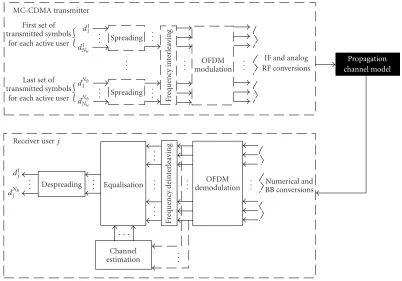
downlink transmission scheme is depicted inFigure 2.
Each user data can be simultaneously processed at the spreading step before MC modulation. In the following,
due to their good properties for the downlink [14],
Walsh-Hadamard (WH) spreading sequences will be considered. The presented MC-CDMA configuration is based on the transmission of multiple data per MC-CDMA symbol for
each user. Datadi
j(n) denotes theith, 1≤i≤Nb, data
Channel
Receiver userj
Propagation channel model
IF and analog RF conversions
Last set of transmitted symbols
for each active user First set of transmitted symbols
for each active user MC-CDMA transmitter
Figure2: Studied MC-CDMA transmitter and receiver.
The maximum number of available users, which is also equal to the length of the WH spreading sequences, will be denoted
Nu. The total number of subcarriers isNc=Nz+Ncu, where
NzandNcuare the number of unused and used subcarriers,
respectively. Therefore, the number of data transmitted by
each user in one MC-CDMA symbol is Nb = Ncu/Nu.
Fre-quency interleaving is performed in order to fully exploit the
frequency diversity offered by OFDM modulation.
At the receiver part, despreading is done according to the specific user sequence after equalisation in the frequency domain. The system synchronisation and intermediate fre-quency (IF) and baseband (BB) conversions problems are beyond the scope of this paper and will not be addressed. Among various equalisation techniques, we especially fo-cus on single-user detection techniques. Channel estimation
function can efficiently be performed by using pilot
subcar-riers insertion. The arrangement of these pilots must guar-antee an optimum sampling of the channel transfer function in time and in frequency, depending on the bandwidth
co-herence and on the time coco-herence of the channel [15].
Obviously, MC-CDMA system offers high flexibility in
resources (spectral efficiency, number of users) allocation
which consequently induces large design spaces. As a result, high-level design methods are convenient in order to deal
with such complexity and for efficient implementation.
2.2. Description of the proposed codesign approach
Most of radiocommunication systems designed on heteroge-neous platforms are faced by the complexity of mixing SW and HW design flows. Functions distribution according to
HW or SW mostly depends on designers experience. Besides, the matching between algorithm and architecture and es-timation performances for multicomponent architecture is rarely addressed.
Thus, as illustrated in similar works [16, 17], a
high-level specification is required to improve HW-SW distribu-tion and combined simuladistribu-tion. Our purpose is to propose an
efficient top-down design flow, making possible efficient
ar-chitectural choices taking into account specified algorithms and heterogeneous target properties. Besides, in order to favour reusability and to reduce design process duration, a multisource integration, as well as HW description language (HDL) sources such as C codes, is required. As illustrated in Figure 3, our design process is based on the concurrent use of two codesign methods and their associated tools: the code-sign methodology for embedded systems (CoMES)
method-ology [18], and the algorithm architecture adequation [19]
(AAA) methodology; “Adequation” is a French word
mean-ing an efficient matching. The first method is used for system
modelisation and simulation, algorithms complexity evalua-tion, and architectural design, whereas the second one is used for functions distribution and code generation.
System validation on the prototyping board FPGA
of the optimised distributed solution Automatic functions
distribution and scheduling AAA specifications
System simulation with architecture limitations and implementation performances evaluations System simulation without
architectural assumptions
Figure3: Considered design flow.
IP interfaces
module memory banksExternal
Figure4: Heterogeneous architecture description.
execution on each component, data communication dura-tions, and intercomponent interfaces behaviour. At this step, we can obtain a fully validated and detailed performances estimation of the mapped functions on the distributed ar-chitecture. The AAA methodology, as for it, is firstly used for functions automatic distribution, taking into account the
different complexity parameters given by the previous step.
This feedback makes possible accurate system evaluation.
Once an efficient matching between functions and
architec-ture has been found, the AAA methodology allows for algo-rithms and inter-component communications code genera-tion, as well as for C generation and for VHDL generation.
The next part presents the used architecture for the MC-CDMA system implementation.
2.3. Testbed architecture description
Our prototyping platform is based on a peripheral compo-nent interconnect (PCI) Sundance Multiprocessor mother-board where two DSP-based modules and one FPGA module
are plugged. As illustrated inFigure 4, two different
Table1: Propagation channel parameters.
Parameters Channel parameters
Maximum delayτmax 390 ns
Delay spreadστ 50 ns
Measured 50% coherence bandwidthBc 11 MHz
Measured 50% time coherenceTc 15 ms
Typical Doppler shiftfDat 1 m/s 17.33 Hz
Each SW module uses the TMS320C6701 DSP from Texas Instrument. This component is based on a very long instruction word (VLIW) architecture making it possible to compute 8 operations per cycle at a 167 MHz frequency. The FPGA is a XCV400 Virtex with 400 Kgates, corresponding to 2400 logic blocks. Memory blocks are also available in the FPGA. Dedicated components are used on the SW modules to make possible data exchanges between the DSP periph-erals and the communication ports. Besides, HW intellec-tual property (IP) cores are provided to be inserted in the FPGA component to control the communication channels. The FPGA is configured using a bitstream sent by a DSP. The described codesign approach will be applied to this architec-ture for system implementation.
The next part presents MC-CDMA system parameters and simulation results according to the used channel model.
3. SYSTEM DEFINITION
For indoor propagation scenarios, we considered the
BRAN-A channel as defined in [20], with a frequency carrier fc =
5.2 GHz. In our simulations, the propagation channel will
consist of 18 power loss paths with a flat Doppler spectrum
on each path. In Table 1, the required channel parameters
used to establish our simulation model for the propagation scenario are summed up.
This channel model has been implemented on the
pro-totyping board presented inSection 2in order to simulate
the studied MC-CDMA system. The system parameters are chosen according to the time and frequency coherence of the channel in order to reduce intersubcarrier interferences (ICI) and intersymbol interferences (ISI). Besides, investi-gated MC-CDMA configurations are designed to propose high throughput and high capacity solutions for indoor
sce-narios. From the system model illustrated inFigure 2, the
of-fered net bit rate per user can be expressed as follows:
Du= nNcu
(i) nis the bits number per symbol according to the used
modulation. In the following, QPSK modulation will
be considered (n=2);
(ii) Ncucorresponds to the number of used subcarriers per
MC-CDMA symbol;
(iii) Tu+Tgis the whole MC-CDMA symbol duration, with
a sampling frequency denoted byFs.Tgis the guard
in-Table2: Configurations parameters.
Parameters Configuration I Configuration II
Sampling frequencyFs 20 MHz 50 MHz
Number of total/used
subcarriers (Nc/Ncu) 64/48 256/192
Symbol/guard interval
duration (Tu/Tg) 3.2µs/0.8µs 5.12µs/0.8µs
Subcarrier spacing (∆f) 321.5 kHz 195.3 kHz
Used bandwidth (W) 15.4 MHz 37.5 MHz
Number of users
(Nu)—full-load system 4, 8, 16 16, 32, 64
Number of symbols per
user (Nb) 12, 6, 3 12, 6, 3
Net bit rate per user (Du) 6, 3, 1.5 Mbps 4, 2, 1 Mbps
Unused subcarrier symbol Data subcarrier
Figure5: MC-CDMA frame structures.
terval duration. According toτmax value and in order
to avoid ISI,Tg will be taken equal to 0.8
microsec-onds.
The first proposed configuration, which parameters set
is summed up in Table 2, is based on HIPERLAN Type 2
specifications with a 20 MHz sampling frequency. The
ra-tiosOg =Tu/(Tu+Tg)=0.8 show a low spectral efficiency
loss due to guard interval insertion, which corresponds to a
power efficiency loss equal to 0.97 dB.
In the second studied configuration, a 50 MHz sampling
frequency is targeted to achieve a better tradeoffbetween bit
rate and users capacity. In that case, Og = 0.86 leads to a
power efficiency loss equal to 0.63 dB. Besides, in both cases,
Doppler shift is very low compared to the subcarrier spacing. An appropriate approach for channel estimation in high-speed packet transmission is the use of a dedicated pilot sym-bol periodically inserted in the transmission frame. Further-more, the very high ratio between the BRAN-A channel time coherence and the MC-CDMA symbol duration induces very slow channel evolution during the transmission of each sym-bol. Thus, the considered frame structure, illustrated in a
general way inFigure 5, includesNp =1 pilot symbol at the
beginning of each frame andNsadditional MC-CDMA data
Table3: Frame structure parameters.
Parameters Configuration I Configuration II
Number of data symbols
per frameNs 100/1000 100/500
Frame duration 400µs/4 ms 592µs/3 ms
Then, channel estimation is processed from the pilot symbol received at the beginning of each frame. As a result, nonideal channel estimation parameters impact on the qual-ity of the transmission could be studied. Moreover, a con-stant power is allocated to pilots for all configurations. Sim-ulations were performed considering a 1 m/s mobile speed. Table 3gives the different simulated frame structures.
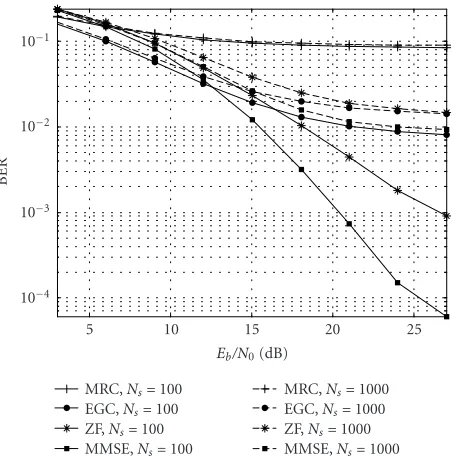
Besides, we investigated different detection techniques:
maximum ratio combining (MRC), equal gain combining (EGC), orthogonality restoring combining (ORC), and sub-optimal minimum mean square error (MMSE) techniques
[21]. This last one is done using a fixed signal-to-noise
parameter at 12 dB for the MMSE coefficients
computa-tion. Figure 6 illustrates the BER performance of
consid-ered single-user detectors for configuration I withNu = 8,
whereas Figure 7represents performance for configuration
II withNu=32, both in the full-load case.
The depicted curves obviously demonstrate efficiency of
MMSE-based detector compared to others techniques. Be-sides, the two detectors using linear channel equalisation, that is, ORC and MMSE detectors, are more sensitive to in-accurate channel estimation than diversity combining detec-tors such as EGC.
According to the presented configurations and the frame
structure, a tradeoff between the power allocated to pilot
symbols and the performance degradation resulting from channel estimation errors should be found. A similar
ap-proach as described in [22] could be used.
In the following parts, we present the MC-CDMA system
implementation results and the different steps of our design
methodology used from system simulation to integration.
4. MODELISATION AND COMPLEXITY ANALYSIS EVALUATION
4.1. Modelisation step
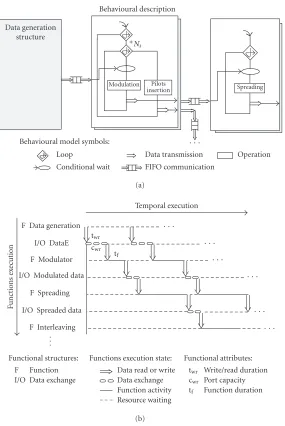
In our design approach and according to specifications given Section 3, the CoMES methodology and its associated tool is used to firstly model the studied MC-CDMA system with-out any assumption abwith-out the architecture. The benefits of this approach is that the model will both be used for func-tional and architectural descriptions at an abstract level to ease HW-SW distribution and to evaluate implementation performances. The functional model is based on three
com-plementary viewpoints [23]:
(i) the structural organisation viewpoint, which repre-sents data dependencies between functional elements, is firstly specified. At the functional level, data are ex-changed through ideal FIFO (first-in first-out) com-munication ports;
MRC,Ns=100 EGC,Ns=100 ZF,Ns=100 MMSE,Ns=100
MRC,Ns=1000 EGC,Ns=1000 ZF,Ns=1000 MMSE,Ns=1000
5 10 15 20 25
Eb/N0(dB) 10−4
10−3 10−2 10−1
BER
Figure6: Performances results for configuration I,Nu=8.
MRC,Ns=100 EGC,Ns=100 ZF,Ns=100 MMSE,Ns=100
MRC,Ns=500 EGC,Ns=500 ZF,Ns=500 MMSE,Ns=500
5 10 15 20 25
Eb/N0(dB) 10−3
10−2 10−1
BER
Figure7: Performances results for configuration II,Nu=32.
(ii) the behavioral viewpoint defines the set of operations and their time order for each function. These two com-plementary specifications are graphically defined; (iii) the algorithm viewpoint is finally specified in C/C++
language and describes the set of instructions for each operation previously defined.
This description approach leads to an efficient
Data generation structure
Behavioural description
Modulation Pilots insertion
∗N s
Spreading
· · ·
Behavioural model symbols: Loop
Conditional wait
Data transmission FIFO communication
Operation
(a)
Functional structures: F Function I/O Data exchange
Functions execution state: Data read or write Data exchange Function activity Resource waiting
Functional attributes: twr Write/read duration cwr Port capacity tf Function duration .
. . F Interleaving I/O Spreaded data
F Spreading I/O Modulated data
F Modulator I/O DataE F Data generation
twr cwr
tf
Temporal execution
F
u
nctio
n
s
ex
ecu
tio
n
· · · · · · · · · · · ·
· · · · · ·
(b)
Figure8: Example of (a) the MC-CDMA system modelisation and (b) execution graph representation according to associated functional attributes.
uninterpreted model, taking into account system attributes such as operation durations, data exchange formats, FIFO ca-pacity, and so forth. The CoMES simulation model is then a true timed model and not only a functional model as used by most of commercial simulators. To illustrate system
attributes influence, Figure 8shows an MC-CDMA system
modelisation example and the associated execution graph at the functional level. At this step, attributes can be set by de-fault and will be more accurately determined once the func-tions durafunc-tions evaluation step is done.
Figure 9 illustrates CoMES tool system simulation ca-pabilities at the structural viewpoint and at the algorithm viewpoint. Moreover, generic parameters such as spreading length, number of users, or equalisation techniques can be set before simulation to obtain a flexible description and to ease design space exploration.
Then, the MC-CDMA system could fully be modeled using the CoMES tool. Besides, BER simulations were per-formed to validate system behaviour and used algorithms. This modelisation and functional validation is the first step to achieve before function complexity analysis.
4.2. Complexity analysis evaluation
Data evolution BER evolution
Average power evolution
Figure9: Example of system simulation applying the CoMES methodology and using the associated tool. On the left-hand side, the struc-tural simulation is based on an execution graph representation of functions activity, and on the right-hand side, algorithmic simulation capabilities are presented.
Data
Figure10: Function complexity evaluated for MC-CDMA
config-uration usingNu=32 andNc=256.
description and coding style still without any architectural assumption.
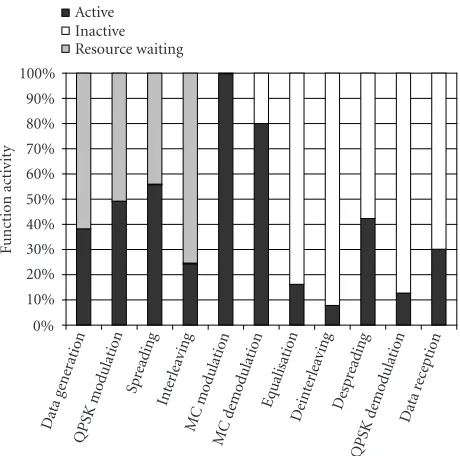
Besides, each function activity can also be measured. Figure 11illustrates the potential bottleneck represented by MC modulation and demodulation compared to other func-tions. Then, this function still remains the most computing function in the considered MC-CDMA system.
This profiling step helps designers to identify critical computing functions. In addition, for accurate architectural design, we completed this complexity evaluation by con-sidering functions implementation performances according
to processors targeted on our testbed platform [24]. Thus,
whereas OFDM modulation is efficiently performed by an
Data
Figure 11: Functions activity in system execution evaluated for
MC-CDMA configuration usingNu=32 andNc=256.
inverse fast fourier transform (IFFT) algorithm, spreading can conveniently be implemented using a fast hadamard transform (FHT).
Results given inTable 4highlight benefits of FPGA
im-plementation for most of the considered MC-CDMA func-tions. Computation times are measured according to C6701 DSP clock, that is, 6 nanoseconds, and considering a 20 nanoseconds cycle for the FPGA.
These values measured by implementation of each ele-mentary function on the testbed components are used in
order to find an efficient matching of MC-CDMA system
Table4: Function implementation results in microseconds.
Parameters Parameters set C6701 DSP implementation FPGA implementation
QPSK modulation Nc=64, 256 0.9, 3.5 0.96, 3.84
Spreading Nu=4, 8, 16, 32, 64 0.642, 1.542, 3.624, 8.274, 18.684 0.08, 0.16, 0.32, 0.64, 1.28
Interleaving Nc=64, 256 1.1, 4.2 0.96, 3.84
OFDM modulation Nc=64, 256 28.7, 146.718 3.84, 15.36
Channel estimation Nc=64, 256 0.7, 2.4 Not implemented
Equalisation Nc=64, 256 1.37, 4.83 3.84, 15.36
HW processor
HW
interface interfaceHW Cint
Communication
links Tex
1st SW processor
SW
interface interfaceSW
SW interface
Cconc-Sover
2nd SW processor
SW interface
Cconc-Sover Architectural attributes:
Cint Interface capacity
Cconc Software processor concurrency Tex Data exchange duration Sover Software overhead
Figure12: Architecture model using CoMES methodology.
5. ARCHITECTURAL DESIGN AND IMPLEMENTATION RESULTS
5.1. Architectural design: functions distribution study and implementation efficiency evaluation
The purpose of the architectural design step is to define an
efficient matching between the developed functions and the
available architecture. The CoMES methodology allows to study the impact of functions distribution on the architec-ture. Architectural attributes such as SW component concur-rency, cycle duration for each component, SW overhead, and intercomponent communications durations complete the ar-chitecture description. We then modeled our platform as
il-lustrated inFigure 12.
Nevertheless, despite the fact that the CoMES tool is still used as the performances evaluation method, the AAA methodology is followed to ease the distribution step. In-deed, this method and its associated tool SynDEx makes pos-sible a quasiautomatic distribution and scheduling of the de-fined system on the architecture, taking into account previ-ous evaluated functions durations and communication costs. Heuristic research is done to reduce system execution cycle. An example of function distribution and scheduling on the
target architecture is illustrated inFigure 13.
Distribution FPGA
Communication
port 1 DSP 1 DSP 2
0 Data generation
Data to modulation
QPSK modulation
Spreading Interleaving
MC modulation
MCM to channel
Channel Channel to MCM
MC demodulation
Equalisation Deinterleaving
Despreading Demodulation
Demodulation to data reception
Data reception Estimated
computation time
Sc
hedule
Figure13: Matching exploration result.
Thanks to this exploration step, different distribution
performances can easily be investigated, improving the dif-ficult task of HW-SW partition. The retained solution can then be more accurately evaluated in the CoMES tool in terms of pipelined behaviour. The concurrent simulation of algorithms allocated on the architecture makes it possible, on the one hand, to optimize the target architecture or, on the other hand, to evaluate implementation performances at an abstract level. Then, achievable throughputs according to
the architecture configuration can then be evaluated.Table 5
gives examples of simulation results following the CoMES methodology. The ideal case denotes results obtained ne-glecting the communication ports influence. Others cases takes into account the communication kind. It illustrates
poor efficiency of a fully SW implementation and the
Table5: Implementation performances evaluation per user.
Parameters Configuration I Configuration II
Nu=8,Nc=64 Nu=32,Nc=256
Fully SW implementation
Ideal 181 Kbps 36.4 Kbps
Slow port 93.9 Kbps 31.4 Kbps
Quick port 167 Kbps 35.8 Kbps
HW-SW implementation
Ideal 2.9 Mbps 780 Kbps
Slow port 444 Kbps 125 Kbps
Quick port 2.5 Kbps 645 Kbps
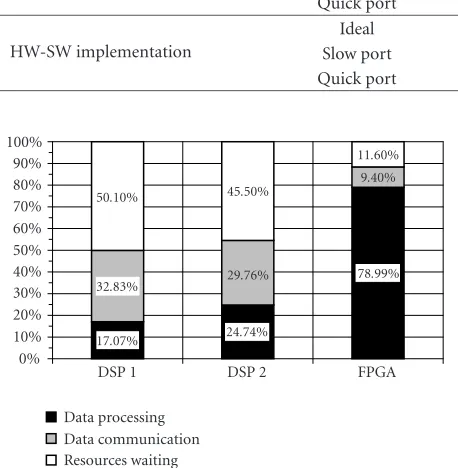
Figure 14: Component activity estimation for configuration II,
Nu=32, implemented on HW-SW architecture with quick ports.
Finally, the components activity can be measured for the
most satisfactory solution, as illustrated inFigure 14for the
HW-SW implementation using quick ports.
Before implementation on the testbed platform, the last step of the design process is the generation of the codes both for the SW and the HW parts.
5.2. Hardware-Software code generation and implementation results
As indicated inFigure 3, the AAA methodology is used in
or-der to generate codes at once for the SW, the HW part, and the interfaces. The code generation process is described in Figure 15. After the distribution step, the tool SynDEx makes it possible to generate distributed executives for each com-ponent. This code takes into account intercomponent syn-chronisations and calls to functions. The code generation uses specific libraries built according to the component kind. The description of theses libraries will not be addressed in the present paper, the reader should be refered to works
de-scribed in [25].
The benefits of this approach are the generation of fully validated codes reducing the verification step once imple-mentation on the testbed is done. The libraries used for SW
generation already exist [26]. We built the needed library for
HW generation [27]. This library uses the different
devel-oped functions and the required interfaces. The main
synthe-System validation on the prototyping board DSP 1 DSP 2 FPGA
SynDEx code generation C and VHDL
libraries (communications,
functions)
Retained architectural solution
Figure15: SynDEx code generation process.
sis results in terms of FPGA logic elements for each function
implemented in the HW part are given inTable 6.
For example, in the Configuration I case, the automatic generation of the HW part of the transmitter retained so-lution, both for the required interface and the computation functions, corresponds to 1132 logic elements and 12 mem-ory blocks. Then, the HW synthesis results made it possible to fully validate this design at a 50 MHz frequency.
6. CONCLUSION
We have presented a codesign approach and associated tools for the MC-CDMA system rapid prototyping on a mixed ar-chitecture. This design goes from system specification and simulation to HW-SW code generation and implementation on a testbed platform. The use of the CoMES model allows system simulations at the functional level as well as at the ar-chitectural one. Then, this top-down design approach makes it possible to accurately evaluate system implementation ef-ficiency, according to functions complexity and architecture properties. Finally, the use of the AAA methodology com-pletes this HW-SW design by covering the distribution and code generation steps.
The described design process, applied to MC-CDMA sys-tem, facilitates and reduces the development cycle. Then, we
easily investigate different implementation solutions
accord-ing to the considered HW platform. Besides, the benefits of this approach fit into the SoftWare Radio (SWR)
require-ments for efficient design methods.
Table6: Synthesis results in terms of occupied logic elements for the HW implemented functions.
Parameters Configuration I Configuration II
Spreading 138 400
Interleaving 143 325
OFDM modulation 590 – 6 memory blocks 655 – 6 memory blocks
Equalisation 200 315
Quick communication ports 80 80
feasibility of the studied MC-CDMA system could lead to its enhancement of the outdoor propagation characteristics.
ACKNOWLEDGMENT
This work has been partly carried out within the European Union IST research project MATRICE (MC-CDMA trans-mission techniques for integrated broadband cellular sys-tems).
REFERENCES
[1] J. Pereira, “A personal perspective of fourth generation,”
Telektronikk, vol. 97, no. 1, pp. 20–30, 2001.
[2] M. Arndt, S. Martin, B. Miscopein, V. Bella, L. Bollea, and E. Buracchini, “Software radio: the challenges for
reconfig-urable terminals,” Annals of Telecommunications, vol. 57, no.
7-8, pp. 570–612, 2002.
[3] S. Hara and R. Prasad, “Overview of multicarrier CDMA,”
IEEE Communications Magazine, vol. 35, no. 12, pp. 126–133, 1997.
[4] N. Yee, J. P. Linnartz, and G. Fettweis, “Multi-carrier CDMA
in indoor wireless radio networks,” inProceedings of the IEEE
Personal Indoor and Mobile Radio Communications (PIMRC
’93), pp. 109–113, Yokohama, Japan, September 1993.
[5] K. Fazel and L. Papke, “On the performance of convolu-tionally-coded CDMA/OFDM for mobile communication
system,” inProceedings of the IEEE Personal Indoor and
Mo-bile Radio Communications (PIMRC ’93), pp. 468–472, Yoko-hama, Japan, September 1993.
[6] A. Chouly, A. Brajal, and S. Jourdan, “Orthogonal multicar-rier techniques applied to direct sequence spread spectrum
CDMA systems,” inProceedings of Global Telecommunications
Conference (GLOBECOM ’93), pp. 1723–1728, Houston, Tex, USA, November 1993.
[7] V. M. DaSilva and E. S. Sousa, “Performance of orthogo-nal CDMA codes for quasi-synchronous communication
sys-tems,” inProceedings of the IEEE International Conference
on Universal Personal Communications (ICUPC ’93), pp. 995– 999, Ottawa, Ont, Canada, October 1993.
[8] M. H´elard, R. Le Gouable, J.-F. H´elard, and J.-Y. Baudais, “Multicarrier CDMA techniques for future wideband wireless
networks,”Annals of Telecommunications, vol. 56, no. 5-6, pp.
260–274, 2001.
[9] A. A. Kountouris, C. Moy, and L. Rambaud,
“Reconfigurabil-ity: a key property in software radio systems,” inFirst
Karl-shruhe Workshop on Software Radio, Karlshruhe, Germany, March 2000.
[10] J. Staunstrup and W. Wolf, Hardware/Software Co-Design:
Principles and Practice, Kluwer Academic Publishers, Norwell, Mass, USA, 1997.
[11] E. Haas, H. Lang, and M. Schnell, “Development and imple-mentation of an advanced airport data link based on
multi-carrier communications,”European Transactions on
Telecom-munications, vol. 13, no. 5, pp. 447–454, 2002.
[12] A. C. McCormick, P. M. Grant, J. S. Thompson, T. Arslan, and
A. T. Erdogan, “Implementation of a SIC based MC-CDMA
base station receiver,” European Transactions on
Telecommu-nications, vol. 13, no. 5, pp. 513–518, 2002.
[13] A. C. McCormick, P. M. Grant, J. S. Thompson, T. Arslan, and A. T. Erdogan, “A low power MMSE receiver architecture for
multi-carrier CDMA,” inProceedings of IEEE International
Symposium on Circuits and Systems (ISCAS ’01), pp. 41–44, Sydney, Australia, May 2001.
[14] S. Nobilet, J.-F. H´elard, and D. Mottier, “Spreading sequences for uplink and downlink MC-CDMA systems: PAPR and MAI
minimization,” European Transactions on
Telecommunica-tions, vol. 13, no. 5, pp. 465–473, 2002.
[15] P. H¨oher, S. Kaiser, and P. Robertson, “Two-dimensional
pilot-symbol-aided channel estimation by Wiener filtering,” inIEEE International Conference on Acoustics, Speech, and Sig-nal Processing (ICASSP ’97), pp. 1845–1848, Munich, Ger-many, April 1997.
[16] M. Vasilko, L. Machacek, M. Matej, P. Stepien, and S. Hol-loway, “A rapid prototyping methodology and platform for
seamless communication systems,” inProceedings of 12th IEEE
International Workshop on Rapid System Prototyping (RSP
’01), pp. 70–76, Monterey, Calif, USA, June 2001.
[17] I. Seskar and N. B. Mandayam, “A software radio architecture
for linear multiuser detection,” inConference on Information
Sciences and Systems, Princeton, NJ, USA, March 1998.
[18] J.-P. Calvez,Embedded Real-Time Systems: A Specification and
Design Methodology, vol. 23 ofWiley Series in Software Engi-neering Practice Ser., John Wiley & Sons, New York, NY, USA, 1993.
[19] T. Grandpierre, C. Lavarenne, and Y. Sorel, “Optimized rapid prototyping for real-time embedded heterogeneous
multipro-cessors,” inProceedings of the 7th International Workshop on
Hardware/Software Codesign (CODES ’99), pp. 74–78, New York, NY, USA, May 1999.
[20] ETSI, “Project Broadband Radio Access Networks (BRAN), HIPERLAN Type 2; Physical layer,” Technical specification, October 1999.
[21] S. Kaiser, Multi-carrier CDMA mobile radio system-analysis
and optimization of detection, decoding, and channel
estima-tion, Ph.D. thesis, University of Munich, Munich, Germany,
1998.
[22] T. S¨alzer, D. Mottier, and L. Brunel, “Influence of system load on channel estimation in MC-CDMA mobile radio
com-munication systems,” inProceedings IEEE Vehicular
Technol-ogy Conference (VTC ’01), pp. 522–526, Rhodes, Greece, May 2001.
[23] J. P. Calvez, D. Heller, and O. Pasquier, “Uninterpreted co-simulation for performance evaluation of Hw/Sw systems,” in
4th International Workshop on Hardware/Software Co-Design (CODES/CASHE ’96), pp. 132–139, Pittsburgh, Pa, USA, March 1996.
[24] J.-F. H´elard, F. Nouvel, and S. Le Nours, “A MC-CDMA
sys-tem analysis in a software radio context,” Annals of
Telecom-munications, vol. 57, no. 7-8, pp. 699–720, 2002.
[25] V. Fresse, O. D´eforges, and J.-F. Nezan, “AVSynDEx: a
digital image processing applications on multi-DSP and
FPGA architectures,”EURASIP Journal on Applied Signal
Pro-cessing, vol. 2002, no. 9, pp. 990–1002, 2002.
[26] Y. Le Mener, M. Raulet, J.-F. Nezan, A. Kountouris, and C. Moy, “SynDEx executive kernel development for DSPs TI C6X applied to real-time and embedded multiprocessors
ar-chitectures,” inProc. 11th European Signal Processing
Confer-ence (EUSIPCO ’02), Toulouse, France, September 2002. [27] F. Nouvel, S. Le Nours, and I. Hermann, “AAA methodology
and SynDEx tool capabilities for designing on heterogeneous
architecture,” in18th Conference on Design of Circuits and
In-tegrated Systems (DCIS ’03), Ciudad Real, Spain, November 2003.
S´ebastien Le Noursreceived the Engineer-ing degree in electronics from the ISEN School, Brest, France, in 2000. In 2003, he received the Ph.D. degree in electron-ics from the National Institute of Applied Sciences (INSA), Rennes, France. His re-search interests include design methodolo-gies for embedded systems and signal pro-cessing techniques, with particular empha-sis on multicarrier spread spectrum for
mo-bile communications. He is currently working as an Assistant Pro-fessor at the UBS University and is associated to the LESTER labo-ratory, Lorient, France.
Fabienne Nouvelreceived the Engineering degree in electronics from the National In-stitute of Applied Sciences (INSA), Rennes, France, in 1985. She worked for 5 years in networks domains. In 1994, she received the Ph.D. degree in electronics from the INSA, Rennes. Since 1995, she has been an Associate Professor at INSA in electronics. Her research topics include electronics, sig-nal processing techniques, especially spread
spectrum for embedded indoor and outdoor communications, and design methodologies for heterogeneous systems.
Jean-Franc¸ois H´elard received his Dipl.-Ing. degree from the National Institute of Applied Sciences (INSA), Rennes, France, in 1981. From 1982 to 1997, he was a Research Engineer and then Head of the channel cod-ing for digital broadcastcod-ing research group at the CCETT (France Telecom Research Center) in Rennes, where he worked succes-sively on digital audio broadcasting within EUREKA 147 DAB (digital audio