R E S E A R C H A R T I C L E
Open Access
Determinants of puerperal sepsis among
post partum women at public hospitals in
west SHOA zone Oromia regional STATE,
Ethiopia (institution BASEDCASE control
study)
Getu Alemu Demisse
1*, Samuel Dessau Sifer
2, Buseraseman Kedir
3, Daniel Belema Fekene
4and
Gizachew Abdissa Bulto
4Abstract
Background:Puerperal sepsis is an infection of the genital tract, which occurs from rupture of amniotic sacs and within 42ndday after delivery. It happens mainly after discharge in the 1st 24 h of parturition. It is the third leading cause of direct maternal mortality in developing nations. It is also among preventable conditions. Even though multiple interventions were done to overcome these health problems, maternal mortality and morbidities were still significant. Mainly, in Ethiopia lack of clearly identified causes of maternal mortality and morbidity makes the problem unsolved. Methods:Case-control study was conducted at public Hospitals in west shoa zone Oromia regional state, Ethiopia from February 01 to April 30/2018.women with puerperal sepsis (n= 67) were selected by convenience method. Controls (n= 213) were selected by systematic random sampling. Controls to cases ratio was 3:1 and structured questionnaire was used to interviewafter verbal consent was obtained. Data was entered in to epi–info 7.2 then exported to SPSS version 20.0 for analysis. A logistic regression model was used for data analysis. Those variables which havep-value < 0.05 were accepted that they are independent determinants of puerperal sepsis.
Result:Rural residence (AOR [95%CI] = 2.5(1.029–6.054),Mothers with no formal education (AOR [95%CI] = 6.74([1.210–37. 541]), up to primary level of education(AOR [95%CI] = 6.72(1.323–34.086), total monthly income of the mother or family<=500 ETB and 501–1500 ETB(AOR [95%CI] = 5.94(1.471–23.93) and (AOR [95%CI] =6.57 (1.338–32.265) respectively, Mothers having 1–2 times antenatal care(ANC)visit (AOR [95%CI] = 6.57([1.338–32.265]), Duration of Labor12–24 h (AOR [95%CI] = 3.12 (1.805–12.115),> = 25 h (AOR [95%CI] = 4.71([1.257–17.687]),vaginal examinations > = 5times (AOR [95%CI] = 4.00([1.330–12.029]), Delivery by C/S (AOR [95%CI] = 3.85 ([1.425–10.413]), Rupture of membrane > 24 h (AOR [95%CI] = 3.73([1.365–10.208]) and those Referred from other health institutions (AOR [95%CI] = 2.53([1.087–5.884],were independent determinants of puerperal sepsis in this study.
Conclusion:Majority of determinants of puerperal sepsis were related with pregnancy and childbirth. Therefore, to tackle a problem of puerperal sepsis all concerning bodies should take measures during prenatal, natal and postnatal period.
Keywords:Puerperal sepsis, West shoa, Oromia, Ethiopia, Arbaminch, Determinant, Cases, Controls
* Correspondence:[email protected]
1Department of Public health, College of Medicine and Health Sciences,
Ambo University, Ambo, Ethiopia
Full list of author information is available at the end of the article
Background
Puerperal sepsis is an infection of genital tract, which oc-curs at any time from the rupture of membranes or time of labor and up to 42nddays from parturition.It accompanied with 2 or more of the following conditionsare present: pel-vic pains, high body temperature (that is oral temperature 38.5 °C or above on any occasion, abnormal genital discharge (presence of pus), bad smell or foul odor of discharge, delay in the reduction of the size of the uterus (< than 2 cm / day with in the first Eight days) [1].
World health organization reported about 358,000 mater-nal deaths occurring during labor and childbirth and 15% were related with puerperal sepsis. Puerperal sepsis is among the preventable conditions in developing and devel-oped nations.It is mainly occurs after discharge in the 1st 24 h of parturition [2].It is ranked as the sixth leading cause of disease burden for women of age 15-44 years, next to de-pression, HIV/AIDs, tuberculosis, abortion and schizophre-nia [3]. As many as 5.2 million, new cases of maternal sepsis are annually occurring and an estimated 62,000 of maternal deaths will result from the condition [3].Even though mater-nal mortality is slightly decreasing globally, most matermater-nal mortality occurs during childbirth is high [4].
Global risk factors that contribute to infections are caused by poor hygiene practices during delivery and postpartum [4]. This is related to repeated manipulation of patients dur-ing delivery, prolonged time of labor or rupture of amniotic sacs, as well as poor sanitary conditions and poor services within health care facilities [4].In Africa, maternal mortality ratio increased by nearly 5% from 2013 to 2015 [5,6]. It was planned to reduce maternal mortality by 3/4th by the end of 2015 [7]. The majorly strategies drafted to achieve this plan were, ensuring that every birth occurs with the assistance of skilled health personnel, access to emergency obstetric and newborn care,as well access to family planning and effective referral system [7]. However, this is not achieved in Ethiopia by this year. i.e. it was expected to be reduced to 246/ 100,000 maternal mortality ratio. Even by the year 2015, it is reported that maternal mortality is still 353/100,000 [7] which is still far from the planed strategies. Sustainable de-velopment plan (SDP) indicates that, every country should reduce maternal mortality ratio to < 70/100,000 by the year 2030 [8]. Thus to achieve this plan and speed up maternal mortality reduction, it is better to identify cause and contrib-utors to maternal mortality. This study is based on the indi-cated gaps and lack of a single study conducted in the country in identifying determinants of puerperal sepsis, which contribute in maternal mortality and high fatality of the case makes the study important.
Methods
Study area and period
The study was conducted in west shoa zone Oromia re-gional state Ethiopia from February 01/ to April 30/2018.
West Shoa is one of the 18 zones of Oromia Regional State. Ambo is the capital of the zone and it is found at 114 km to the west of Addis Ababa, the capital city of Ethiopia. There are seven public Hospitals in the zone, 96 public health centers, 77 private clinics, 526 health posts providing Service for about 2,150,045 dwellers(west shoa zone health department report 2016, unpublished).
Study design and population
Facility -based prospective Case- control study design was employed. All postpartum mothers who get service at public hospitals in the zone were our study population.
Sample size determination
The sample size was estimated using a double population proportion formula. It was based on high proportion of case (83.8) and controls (16.2) [9].Considering a 95% confidence level, 80% power of the test, with 3:1 ratio of controls to cases, the maximum sample size obtained was 258. The final sample size was determined by adding 10% non-response rate, 258 + 26 = 284 study participants.
Sampling procedure
All hospitals in the zone giving obstetric and gynecologic services were included in the study.
Postpartum mothers admitted with puerperal sepsis were accepted as cases& selected purposively. Those postpartum mothers who were not reported they have puerperal sepsis were taken as controls. Each control selected from the same hospitals for each case with One to three ratio of case to control.
Data collection procedures and quality assurance
A structured, interview administered questionnaire which was adapted from study conducted in Kenya (Additional file1) [10] was used to collect data from the study partici-pants. The questionnaire was prepared in English and translated in to local language Afan Oromo bythetransla-tor, and then translated back to English by a third person to check for consistency.
Data management and analysis
Data was coded, entered in to Epi info version 7.2,and then transported to SPSS version 20.0Itwasrecorded, cat-egorized, sorted, cleaned and analyzed using SPSS. Fre-quency distribution was done to check missing data. Categorical variables were expressed as frequency and percentages. Cross tabulations of independent variables with the occurrence or experiences of puerperal sepsis were performed. On Logistic regression, Initially, All in-dependent variables were analyzed by bivariate logistic regression analysis. Those variables with p -value < 0.25 in the bivariate analysis were taken and analyzed by back ward stepwise method in multivariable logistic regres-sion. Hosmer-lemeshow test was used for checking model fitness with p-value > 0.05.Those variables, with p-value < 0.05, were taken as statistically significant de-terminants of puerperal sepsis.
Ethical approval
Ethical review Committee (IRC) of Arbaminch Univer-sity approved the proposal of this research. Letter of per-mission was obtained from West shoa Zone health department and from each hospital administrative. In-formed verbal consent was obtained from the study sub-jects after the data collectors explained the study objectives, procedures and their right to refuse not to participate in the study. Furthermore, confidentiality of the study subjects was assured.
Results
Demographic and socio-economic characteristics of participants
Overall, the demographic and socio-economic character-istics of the cases and controls were almost similar.Total 280 mothers were participated in the study (67 = cases) and (213 = controls) with anoverall response rate of 99.6%. Results in this study shows that the age of re-spondents ranged from 16 to 40 with a mean age of 26(±5) years among controls and 24(±4) years among cases. Majority of the participants were within age group of 25–29. From this age group, 22.4% were from cases and 42.7% were from among controls. Majority of the study participants were multiparous, composing about 56.8%. About 60.7% of mothers with puerperal sepsis were delivered spontaneously (Table1).
Determinants of puerperal sepsis
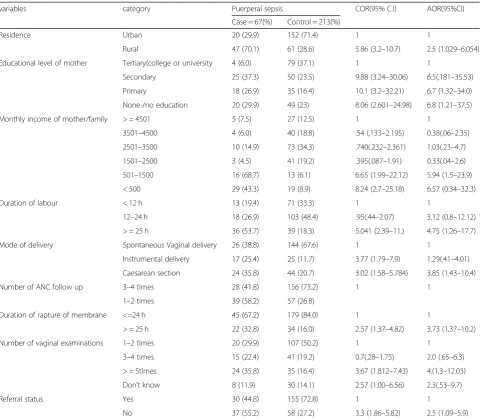
Residence of mothers was significantly associated with puerperal sepsis. It shows that women who live in the rural areas were 2.5 times more likely to develop puer-peral sepsis when compared to those mothers living in the urban area (AOR: 2.5; 95% CI 1.03, 6).
Educational level of mothers is also associated with the puerperal sepsis. Those Mothers who have no formal
education affected (AOR: 6.8; 95%CI 1.2, 37.5), and those who completed up to primary level were also de-veloped puerperal sepsis (AOR: 6.7;95% CI 1.3, 34).Fur-thermore, monthly income is also associated with puerperal sepsis. Mothers who have total monthly in-come /total family inin-come <=1500 ETB/month were also developed puerperal sepsis compared to those who get total monthly income of > = 4500ETB (AOR: 5.9; 95%CI 1.471, 23.9).
Number of Antenatal care follow up is another signifi-cant variable associated with puerperal sepsis. The result shown that mothers who have ANC follow up one to two times were 4.2 times more likely to develop puer-peral sepsis compared to those who had three to four times(AOR:4.2;95%CI 1.74,10).
Mothers who were in labour for > = 25 h were 4.7times more likely to develop puerperal sepsis compared with those < 12 h duration on labour (AOR: 4.7; 95% CI 1.26, 17.7).Number of vaginal examination was also identified as determinant of puerperal. Participants who undergo five or more vaginal examination (VE) during delivery were 4.0 times more likely to develop puerperal sepsis (AOR: 4.0; 95%CI 1.3, 12.0). Mode of delivery is also sig-nificant determinant of puerperal sepsis in this study. It was indicated that mothers who delivered by cesarean section(c/s) were 3.8 times more likely to develop puer-peral sepsis compared to those delivered by spontaneous vaginal delivery (SVD) (AOR: 3.85; 95%CI1.43, 10.4). Participants whose amniotic membrane ruptured 24 h before delivery were 3.7 times more likely to develop puerperal sepsis compared to those < 24 h duration (AOR: 3.7; 95%CI1.37, 10.2). Mothers, who were referred from other health institutions were 2.5.times more likely to develop puerperal sepsis (AOR: 2.5; 95%CI1, 5.9) (Table2).
Discussion
This study tried to identify the determinants of puer-peral sepsis in the study area.
In this study, rural dwellers were 2.5 times more likely to develop puerperal sepsis compared with that of mothers from urban. This is in line with a study con-ducted in Uganda [10]. But Study from Bangladesh con-trast with this study, showing that no significant association between puerperal sepsis and place of living [9].The association may be due to unclean delivery at home, low awareness about ANC follow up and low sanitation in rural areas.
developing puerperal sepsis. This might be due to that mothers in low socio economic status cannot afford for their health expense, poor nutrition and low immunity in resisting themselves.
Participants who have no formal education were 6.7 times and those learned up to primary level of education were 6.8 times more likely to develop puerperal sepsis compared to those who joined college and above re-spectively. Similar findings have been revealed that 96% of women were uneducated and only the rest had a pri-mary level of education from those developed puerperal sepsis [9]. A study from Karachi Pakistan [11],Alexandria Egypt (28) also in line with this study.
It was shown that mothers with rapture of mem-brane > 24 h were 3.7 times More likely to develop puerperal sepsis compare to those have amniotic fluid
leakage 24 h or below before delivery as this study in-dicated. It shows22 (32.8%) of cases with amniotic fluid leakage were developed puerperal sepsis when compare to 34(16.0%) of controls with the leakage. Study from Pakistan revealed that 68 (73.8%) of cases with puerperal sepsis were those who have prolonged history of amniotic liquor(amniotic fluids) leakage 48-72 h before delivery [12]. Study from Kenya [13] and Pakistan [11] also in lined with this study. This is due to prolonged exposure of internal parts when natural protections like membrane is removed and prolonged opening of cervix which leads in entry of ascending microorganisms.
Number of Vaginal examination is also associated with puerperal sepsis in this study, 24(35.8%) of cases had vaginal examination > = 5 times compare to 35(16.4%) of controls > = 5 times vaginal examinations during delivery. Those mothers who had > = 5 times va-ginal examination during delivery had 4.0 times more likely to develop puerperal sepsis compared to those who had Vaginal examination 1–2 times. This is in a row with study conducted in Egypt which indicated that having > = 5 times vaginal examination can lead in de-veloping puerperal sepsis [14, 15].Similarly systemic re-view study conducted in south Asia evidenced that putting hands, frequently in vagina end with puerperal sepsis [16]. Study from Kenya reported that women who had 2or more vaginal examination were 3.95 times more likely to develop puerperal sepsis [17].This fre-quent manipulation of genital tracts will facilitate as-cension of microorganisms from lower genital tract and thereby increase in probability to develop puerperal sepsis.
The study result also indicated that mode of delivery is significantly associated with puerperal sepsis.
That is mothers who delivered by caesarean section were 3.9 times more likely to develop puerperal sepsis when compared to those delivered by spontaneous vagi-nal delivery. Studies from different regions [18],42 [19]) were in line with this study .
In this study mothers who was in labor for 12–24 h& > 25 h were 3.1 &4.7times more likely to develop puerperal sepsis compared to those in labor < 12 h respectively. This is in line with study conducted in Kenya which exposed that mothers in labor for > 25 h were 3.95times more likely at risk in developing puerperal sepsis [17].Studies from Nepal [12], patan hospital Nepal [2] and Tanzania summarizes duration of labor contribute in the develop-ment of puerperal sepsis as prolonged labor with frequent vaginal examinations leads to puerperal sepsis.
This study also revealed number of ANC follow up is significantly associated with puerperal sepsis. Those mothers who had ANC follow up one to two times be 4.2times more likely to develop puerperal sepsis when
Table 1Socio demographic characteristics of respondents in Public hospitals in west shoa zone Oromia, Ethiopia April 2018
Variables categories Cases Residence Urban 20 (29.9) 152 (71.4) 172 (61.42)
Rural 47 (70.1) 61 (28.6) 108 (38.6) Educational
level
Tertiary(college or university
4 (6.0) 79 (37.1) 83 (29.6) Secondary 25 (37.3) 50 (23.5) 75 (26.8) Primary None unemployed 51 (76.1) 131 (61.5) 182 (65.0) Others 2 (3.0) 6 (2.8) 8 (2.9) Marital
status
compared to those who had three to four times. This is supported by study from Pakistan.
Referral status of mothers was also independent deter-minant of associated with puerperal sepsis in this study. Those mothers who referred from other health institu-tions were 2.5 times more likely to develop this health problem. Study from Pakistan in line with this result in which (73.64%) of cases were referred from outside of the study hospital [11].Study from Uganda also in line with this study in which cases referred from other health institutions were more likely to develop puerperal sepsis when compared to that those from study hospital [10]. This might be due to prolonged time to arrive the hos-pital and probable unclean vaginal examination on the way to hospital will contribute in development of puer-peral sepsis.
Limitation
Because the study conducted only at public hospitals, those mothers who went to private clinic my missed and they can be different in socio economic status from those treated at public hospitals.
Conclusion and recommendation
This study revealed majority of puerperal sepsis occurs during Natal and postnatal period in general. Rural resi-dence, Educational level of primary or less, monthly in-come of mother or family <=1500ETB, Being on labour for > 24 h, delivered by caesarean section, Having ANC follow up to two or less, ruptured membrane> 24 h before delivery, frequent vaginal examination, and being referred from other health institution were identified determinants
Table 2Multivariable logistic regression analysis Result indicating determinants of puerperal sepsis among postpartum mothers in Public Hospitals in West shoa zone Oromia, Ethiopia April 2018
variables category Puerperal sepsis COR(95% C.I) AOR(95%CI) Case = 67(%) Control = 213(%)
Residence Urban 20 (29.9) 152 (71.4) 1 1
Rural 47 (70.1) 61 (28.6) 5.86 (3.2–10.7) 2.5 (1.029–6.054) Educational level of mother Tertiary(college or university 4 (6.0) 79 (37.1) 1 1
Secondary 25 (37.3) 50 (23.5) 9.88 (3.24–30.06) 6.5(.181–35.53) Primary 18 (26.9) 35 (16.4) 10.1 (3.2–32.21) 6.7 (1.32–34.0) None /no education 20 (29.9) 49 (23) 8.06 (2.601–24.98) 6.8 (1.21–37.5) Monthly income of mother/family > = 4501 5 (7.5) 27 (12.5) 1 1
3501–4500 4 (6.0) 40 (18.8) .54 (.133–2.195) 0.38(.06–2.35) 2501–3500 10 (14.9) 73 (34.3) .740(.232–2.361) 1.03(.23–4.7) 1501–2500 3 (4.5) 41 (19.2) .395(.087–1.91) 0.33(.04–2.6) 501–1500 16 (68.7) 13 (6.1) 6.65 (1.99–22.12) 5.94 (1.5–23.9) < 500 29 (43.3) 19 (8.9) 8.24 (2.7–25.18) 6.57 (0.34–32.3) Duration of labour < 12 h 13 (19.4) 71 (33.3) 1 1
12–24 h 18 (26.9) 103 (48.4) .95(.44–2.07) 3.12 (0.8–12.12) > = 25 h 36 (53.7) 39 (18.3) 5.041 (2.39–11.) 4.75 (1.26–17.7) Mode of delivery Spontaneous Vaginal delivery 26 (38.8) 144 (67.6) 1 1
Instrumental delivery 17 (25.4) 25 (11.7) 3.77 (1.79–7.9) 1.29(.41–4.01) Caesarean section 24 (35.8) 44 (20.7) 3.02 (1.58–5.784) 3.85 (1.43–10.4) Number of ANC follow up 3–4 times 28 (41.8) 156 (73.2) 1 1
1–2 times 39 (58.2) 57 (26.8)
Duration of rapture of membrane <=24 h 45 (67.2) 179 (84.0) 1 1
> = 25 h 22 (32.8) 34 (16.0) 2.57 (1.37–4.82) 3.73 (1.37–10.2) Number of vaginal examinations 1–2 times 20 (29.9) 107 (50.2) 1 1
3–4 times 15 (22.4) 41 (19.2) 0.7(.28–1.75) 2.0 (.65–6.3) > = 5times 24 (35.8) 35 (16.4) 3.67 (1.812–7.43) 4.(1.3–12.03) Don’t know 8 (11.9) 30 (14.1) 2.57 (1.00–6.56) 2.3(.53–9.7) Referral status Yes 30 (44.8) 155 (72.8) 1 1
of puerperal sepsis. Considering this, community aware-ness about frequency of ANC, cares needed during post partum, scaling up educational level of community and supporting those in low socio economic status were rec-ommended interventions.
Additional file
Additional file 1:Questioners. (DOCX 19 kb)
Abbreviations
AIDS:Acquired immune deficiency syndrome; ANC: Antenatal care; AOR: Adjusted odds ratio; BSC: Bachelor of science; C/S: Caesarean section; COR: Crude odds ratio; ETB: Ethiopian birr; HIV: Human immune virus; HO: Health officer; PS: Puerperal sepsis; SDG: Sustainable development goal; SPSS: Statistical package for social science; SVD: Spontaneous vaginal delivery
Acknowledgements
We thank full all who was with us when conducting this study. Secondly our acknowledgement extends to study participants, data collectors and supervisors for their invaluable contribution in conducting this study.
Funding Not applicable.
Availability of data and materials
The datasets generated and/or analyzed during the current study are not publicly available due to some privacy reasons but are available from the Corresponding author on reasonable request.
Authors’contributions
GA; conceived and designed the study, supervise the date collection, analyze the data and draft the manuscript. SD, BS, DB and GA supervised the data collection, analyzed the data and reviewed the manuscript critically. All authors read and approve the final manuscript.
Ethics approval and consent to participate
Ethical review Committee (IRC) of Arbaminch University approved the proposal of this research. Letter of permission was obtained from West shoa Zone health department and from each hospital administrative. Informed verbal consent was obtained from the study subjects after the data collectors explained the study objectives, procedures and their right to refuse not to participate in the study. Furthermore, confidentiality of the study subjects was assured.
Consent for publication Not applicable.
Competing interests
The authors declared that they have no competing interests.
Publisher’s Note
Springer Nature remains neutral with regard to jurisdictional claims in published maps and institutional affiliations.
Author details
1Department of Public health, College of Medicine and Health Sciences,
Ambo University, Ambo, Ethiopia.2Departmentof Nursing, Arbaminch college of health science, Arbainch, Ethiopia.3Department of Midwifery,
Bona hospital, Bona, Ethiopia.4Department of midwifery, Ambo University
College of medicine and health science, Ambo, Ethiopia.
Received: 17 August 2018 Accepted: 25 February 2019
References
1. kareem T, Abbas M, Ibadi A. Bacteriological study of puerperal sepsis in Al-Najaf city. Journal for biology. 2016;VOL8/NO2(073–8854):143–151. 2. Bhandary S, rc L. Puerperal Sepsis and its cause in Patan hospital. Nepal
Journal of Obstetrics and Gynaecology. 2015;(19):33–5.
3. Hussein J, Mavalankar DV, Sharma S, D’Ambruoso L. A review of health system infection control measures in developing countries. Glob Health. 2011;7(14):1–9.
4. Nouri L, Zakour B, Venturin C, Beatson SA, Walker MJ. Analysis of a streptococcus pyogenes puerperal Sepsis cluster by use of whole-genome sequencing. J Clin Microbiol. 2012;50:2224–8.
5. GATLocYAMAMSAWAHe a. Treands and causes of maternal mortality in Ethiopia during 1990-2013 :findig from global burden of disease study in 2013. BMC Public Health. 2017;17.
6. union A. status report on Maternal New born Child and Adolecent Health: Focusing on Unfineshed Buiseness In Africa. Addis Abeba, Ethiopia 2017 . 7. Nation U. The millennium development goals report, 2015. Accessed from
http://www.un.org/millenniumgoals/2015_MDG_Report/pdf/ MDG%202015%20rev%20(July%201).pdf.
8. Nation U. sustainable development goals the 2030 agenda New york 2015. 9. Taskin T, Sultana M, Islam T, Khan NA, Chowdhury SM. Socio-demographic
factors and puerperal Sepsis: experiences from two tertiary level hospitals in Bangladesh. Int J Community Fam Med. 2016;1(113):1–4.
10. Ngonzi J, Tornes YF, Mukasa PK, Salongo W, Kabakyenga J, Sezalio M, et al. Puerperal sepsis, the leading cause ofmaternal deaths at a Tertiary University teaching Hospital in Uganda. BMC Pregnancy and Childbirth. 2016:1–7. 11. Khaskheli M-N, Baloch S, Sheeba A. Risk factors and complications of puerperal
sepsis at a tertiary healthcare Centre. Pak J Med Sci. 2013;29:972–6. 12. Shamshad S. S, BusharaR. PUERPERAL SEPSIS STILL a MAJOR THREAT FOR
PARTURIENT. J Ayub Med Coll Abbottabad. 2010;22(3):18–22.
13. Maritim CV, Jackim N, Margaret K. Associated factors with puerperal Sepsis among reproductive age women in Nandi County, Kenya. Journal of Midwifery and Reproductive Health. 2017;5(4):1032–40.
14. El-Mahally AA, Kharboush IF, al.T. Risk factors of puerpural sepsis in Alexanderia. Egyptian public Health Association 2004;3(4):312–331. 15. Kaur T, Mor S, Puri M, Sood R, Nath J. A study of predisposing factors and
microbial flora in puerperal sepsis. International Journal of Reproduction, Contraception, Obstetrics and Gynecology. 2017;5(9):3133–6.
16. Laura O. The prevalence and risk factors of puerperal sepsis in South Asia: a systematic review. 2014–2015 108664.
17. shatary DNA. Magnitude and Riask factors associted with puerpural sepsis University of Nairobi, 2013 Contract No.: H58/69529/2013.
18. Acosta C, Bhattacharya S, Tuffnell D, Kurinczuk J, Knigh M. Maternal sepsis: a Scottish population-based case–control study. BJOG. 2012;119:474–83. 19. Winani S, Coffey P, Wood S, Mosha F, Chirwa T. Evaluation of a clean