R E S E A R C H
Open Access
Multiuser 3D massive MIMO transmission
in full-duplex cellular system
Dongmei Zhang
1, Ximing Wang
1*, Kui Xu
1, Yijun Yang
2and Wei Xie
1Abstract
In this paper, we provide an effective multiuser transmission scheme in three-dimensional (3D) massive multiple-input multiple-output (MIMO) cellular systems, where the full-duplex (FD) base station (BS) equips two separate large-scale uniform planar antenna array (UPA). In order to reduce the computational and implementation complexity, we investigate the characteristic of the beam-domain (BD) 3D massive MIMO channels and self-interference (SI) channel. We propose the 3D multiuser beamspace transmission (MUBT) scheme that requires the spatial angular information of the users and the SI channel. We show that, due to the reduced dimension property of the effective beamspace channel, the overhead for channel estimation is reduced. Furthermore, a user scheduling algorithm is proposed to enable the 3D MUBT scheme in the FD systems. Finally, both the theoretical analysis and simulation results show the the SI can be effectively reduced and demonstrate the effectiveness and superiority of the proposed 3D MUBT scheme on spectral efficiency compared with the conventional half-duplex (HD) and FD transmission schemes. Keywords: Multiuser cellular system, 3D massive MIMO, Full-duplex, Beamspace channel representation, Minimum mean square error (MMSE) channel estimation, Beamforming
1 Introduction
With the booming development of smart terminals and the growing demand for new mobile services, the mobile Internet traffic will continue to grow exponentially, which will increase by roughly 1000 times beyond 2020. Multiple-input multiple-output (MIMO) techniques can obtain multiplexing gain, diversity gain, and antenna gain by exploiting the spatial dimension of wireless resources, which as a result can significantly enhance the capacity and reliability in wireless communications [1]. In order to further improve the spectral efficiency (SE) of the communication systems, massive MIMO has attracted considerable attention. Massive MIMO is first advocated in [2], which can make the simple linear precoder tend to optimal and eliminate the noise along with uncorre-lated interference by simply scaling up the numbers of antenna elements at the base station (BS). In this way, the SE of massive MIMO systems is improved dramatically because more users can be served in the same time-frequency resource. Furthermore, massive MIMO enables
*Correspondence:[email protected]
1Army Engineering University of PLA, No. 88, Houbiaoying Street, Nanjing, China
Full list of author information is available at the end of the article
users to reduce the transmit power arbitrarily without compromising the SE [3].
However, in the practical massive MIMO systems, all these performance gains are profitted from the channel state information (CSI) that is available. Time-division duplex (TDD) seems to be more suitable for massive MIMO systems since the channel reciprocity can be exploited to obtain the instantaneous downlink (DL) CSI through uplink (UL) training [2]; thus, the overhead for channel estimation is linear with the number of user antennas. For this reason, a great deal of research work has been done for TDD [3–7]. However, the imperfect calibra-tion between the UL/DL radio frequency chains [8] and pilot contamination [9,10] in the practical TDD systems limits the performance gains of massive MIMO, which as a result motivates the research on frequency-division duplex (FDD) massive MIMO systems [11–13]. Since the channel reciprocity does not hold for FDD systems, the training overhead for DL estimation scales linearly with the number of BS antennas. This poses a heavy burden on user equipments and the feedback links in the sys-tem where the BS is equipped with a large number of antennas. One attempt is to adopt the closed-loop training scenarios to sequentially design the optimal beam patterns
[11]. Another alternative method is to exploit the low-rank property of channel covariance matrix in massive MIMO systems [12,13]. Utilizing the correlation between channels, the reduced dimension effective channels can be obtained by the eigen-decomposition of channel covari-ance matrix, which can reduce the overhead of training and feedback.
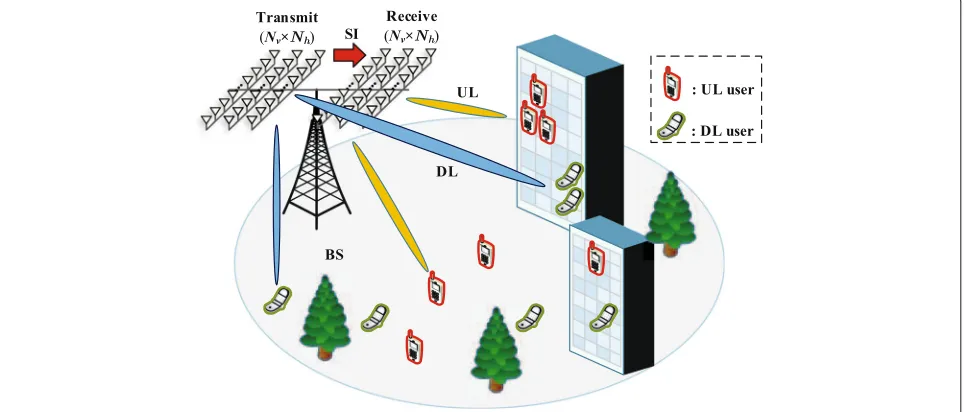
Furthermore, most of the prior works assume the large-scale antenna array deployed along the horizontal axis, which is not applicable for most BSs due to the lim-ited space on the roof or mast. Three-dimensional (3D) massive MIMO, which is referred to as full-dimension MIMO, can overcome this practical challenge because large-scale antennas are arranged in both the horizontal and vertical dimensions when two-dimensional (2D) uni-form planar antenna array (UPA) are deployed. In this way, the extra degrees of freedom for vertical dimen-sion can be exploited to improve the capability of serv-ing 3D distributed users, as illustrated in Fig.1. In [14], the channel correlation matrix based on a generic ray-tracing 3D channel model is investigated, and the study shows that the channel correlation matrix can be well approximated by the Kronecker production of the corre-lations in horizontal and vertical directions. References [12,15–17] investigate the DL transmission for 3D mas-sive MIMO systems. Based on both statistical and instan-taneous CSI, [12] proposes a joint spatial division and multiplexing with 3D precoding scheme. By exploiting the Kronecker structure of the 3D MIMO channel matrix, Wang et al. [15] propose a 2D precoding scheme to fully exploit the degrees of freedom provided by the ver-tical dimension, which can reduce the multiuser inter-ference (MUI) and inter-cell interinter-ference (ICI). Li et al. [16,17] assumes that the BS has only the statistical CSI
of each user. Through eigen-decomposition of horizontal and vertical correlation matrices, the beamforming vector for each user are obtained. Moreover, the space division multiple access transmission scheme based on the 3D beamforming is proposed.
Both TDD and FDD systems are half-duplex (HD) sys-tems that assign orthogonal time or frequency resources to the UL and DL, which theoretically leads to half of the time-frequency resources wasted. With the devel-opment of signal and hardware processing techniques, recently, the full-duplex (FD) techniques become one of the attractive options for wireless communications. The severe self-interference (SI) due to the signal leakage from the transmitter to the receiver is one of the major chal-lenges for FD communications, which results in the rapid development of various kinds of SI cancellation (SIC) techniques [18–20]. Due to the FD transmission, the DL users may suffer from the interference transmitted by UL users in cellular systems, which can be controlled by using different beams [21–23]. In order to achieve higher SE performance, a lot of research has been done on FD massive MIMO technology [24–28]. Xia et al. [28] shows that adopting linear beamforming techniques can signif-icantly reduce the adverse impact of SI, and FD massive MIMO systems outperform the HD counterpart in SE even without active SI cancellation.
In this paper, we assume that two separate large-scale UPAs are deployed at the BS, and investigate 3D multiuser transmission in the FD massive MIMO cellular system. The contributions of our works are as follows:
• The beam-domain (BD) characteristic of the 3D channel is investigated, including UL, DL, and SI channels. In the BD channel, most of the power is
concentrated on each user’s own beamspace. The algorithm of calculating each user’s best beamspace is provided.
• By exploiting the low-dimension property of the effective beamspace channels in the BD, we propose the 3D multiuser beamspace transmission (MUBT) scheme which processes the signals in each users’s beamspaces. Utilizing the orthogonality of beamspaces between groups, we show that our the 3D MUBT can eliminate the inter-group interference (IGI), and significantly reduce the overhead of channels estimation.
• The SI channel in 3D massive MIMO is modeled, and the beamspaces of the SI channel are derived. Based on the beamspaces of SI channel and features of co-channel interference (CCI) within the cellular systems, we introduce a simple cell partitioning strategy and propose a user-scheduling algorithm. Both the theoretical analysis and simulation results show that the proposed scheme reduce the SI effectively.
Notation:We use boldface uppercase letterAand bold-face lowercase letter a to represent matrix and column vector, respectively. E(·), ·, (·)∗, (·)H, (·) and Tr(·) stand for the expectation, the Euclidean norm, the con-jugate, the conjugate transpose, the spectral radius of a matrix and trace of a matrix, respectively.|B|denotes the cardinality of a setB. [A]i,jdenotes theith-row and j th-column entry of matrixA.INrepresents theN×Nidentity matrix.CNμ,σ2stands for the complex-Gaussian
dis-tribution with mean ofμand variance ofσ2.eirepresents a vector whoseith entry is 1 and the other are 0.δ (·)is the Dirac delta function.
2 Methods
The outline of this paper is as follows: Section3describes the system and the channels model. In Section4, the BD characteristics of 3D massive MIMO channels are inves-tigated and the beamspace representation of channel is given. In Section 5, we detail the proposed 3D MUBT scheme, which includes user scheduling, channel estima-tion, and data transmission. In Section6, we perform vari-ous simulation results using MATLAB to demonstrate the effectiveness of the proposed scheme, and furthermore, the existing approaches are compared under the same setting to show the superiority of the proposed scheme. Finally, the concluding remarks are offered in Section7.
3 System and channel models
As shown in Fig.1, we consider a 3D multiuser massive MIMO system, whereKu UL users andKd DL users are distributed in 3D space. We assume that all the users work in HD mode and equipped with single antenna. The FD
BS deploys two separate large-scale UPAs1(one for
trans-mitting and one for receiving), and both of them hasNv antennas in the vertical dimension andNhantennas in the horizontal dimension and each dimension is a uniform linear antenna array (ULA). Letdvanddhdenote the dis-tance of adjacent antennas in the vertical and horizontal directions.
3.1 UL and DL channel models
In this paper, we consider a 3D massive MIMO chan-nel model and assume that the chanchan-nels between the BS and users passes through a great number of rays [29]. Therefore, the channel of UL userkucan be written as:
Gku=
(θku,ϕku)∈ku
ru
θku,ϕku
Aθku,ϕku
dθkudϕku (1)
whereθkuandϕkurepresent the direction of arrival (DoA) of user ku in vertical and horizontal directions;ku =
θku,ϕkuθku ∈
θmin ku ,θ
max ku
,ϕku∈
ϕmin ku ,ϕ
max ku
denote the angular spread (AS) range resulting from scatters in the vertical and horizontal directions; and ru
θku,ϕku
denotes the UL complex response gain. Here, Aθku,ϕku
∈CNv×Nh is the array response matrix which can be expressed as:
Aθku,ϕku
= (2)
⎡ ⎢ ⎢ ⎢ ⎣
1 · · · ej(Nh−1)hku
ejvku · · · ej[vku+(Nh−1)hku] ..
. . .. ...
ej(Nv−1)vku · · · ej[(Nv−1)vku+(Nh−1)hku]
⎤ ⎥ ⎥ ⎥ ⎦,
wherevku =
2πdv
λ cosθku andhku =
2πdh
λ sinθkucosϕku, andλis the carrier wavelength. Define
avku
=1,ejvku,· · ·,ej(Nv−1)vku
T ,
bhku=1,ejhku,· · ·,ej(Nh−1)hku
T ,
(3)
then we can rewriteAθku,ϕku
= avku
bhku
T . As a result, the UL channel matrix can be rewritten as:
Gku=
(θku,ϕku)∈ku
ru
θku,ϕku
avkubhkuTdθkudϕku.
(4)
Therefore, the equivalent vectorial form ofGkuis:
gku =vec
Gku
= (5)
(θku,ϕku)∈ku
ru
θku,ϕku
bhku
⊗avku
Similarly, define θkd and ϕkd as the direction of departure (DoD) of DL user kd in verti-cal and horizontal dimension, and let kd =
θkd,ϕkdθkd ∈
θmin kd ,θ
max kd
,ϕkd ∈[ϕmink d ,ϕ
max
kd ] and
rd
θkd,ϕkd
be the AS range of DoD and DL response gain; then, the channel vector of userkdcan be expressed as:
gkd =
θkd,ϕkd∈kd
rd
θkd,ϕkd
bhkd
⊗avkd
dθkddϕkd.
(6)
In this paper, the AS rangekuandkdare assumed to be relatively narrow, which is reasonable when the BS is set at a relatively high altitude [13].
3.2 3D SI channel model
We assume that some SIC techniques have been adopted at the BS, e.g., passive SI cancellation technique, so that there exists no light-of-sight (LOS) signals from transmit antenna array to receive antenna array and the two arrays are independent. Moreover, we assume that there are sev-eral scatters (e.g., tall buildings) surrounding the arrays; then, the SI signal consists of several non-ligth-of-sight (NLOS) rays.
Let GSI ∈ CNvNh×NvNh be the channel from transmit antenna array to receive antenna array, i.e., SI channel. According to the Kronecker stochastic channel model [14,30], the SI channel can be modeled as
GSI=C
1 2
RGw
C12
T
T
(7)
whereGwis aNvNh×NvNhrandom matrix with indepen-dent and iindepen-dentical distributed (i.i.d.)CN(0,βSI)elements. Here,βSIcan be understood as the level of the residual SI, which is related to the path loss of the SI channel and the capability of the SIC techniques.CRandCT denote the receive and transmit spatial correlation matrices which are also the corresponding covariance matrices. In this paper, we assume that only the antenna-domain (passive) SIC techniques are adopted and no analog or digital-domain (active) SIC techniques are used [19].
Now, we need to find out the expressions for every entry ofCRandCT, which are expressed asCa,a ∈ {R,T}for simplicity of illustration. Define the correlation between
(k,l)-th and (p,q)-th antenna element of antenna array asC(ak,l),(p,q). According to [14],C(ak,l),(p,q)can be approx-imately written as a product of vertical and horizontal correlations; then, the correlation matrix can be expressed as
Ca=Cah⊗Cav (8)
whereCavandCahare the vertical and horizontal correla-tion with
[Cah]l,q= 1 √
Ae
−B2cos2ϕa
2A ej Ccosϕa
A e−( Csinϕaσa)2
2A
[Cav]k,p=ej
2πdv
λ (p−k)cosθae−12
ξa2πλdv
2
(p−k)2sin2θ
a (9)
whereA =
ξa2πλdh(q−l)cosθa
2
(sinϕaσa)2+1,B = ξa2πλdh(q−l)cosθaandC= 2πλdh(q−l)sinθa. Here,θa, ϕa,ξa, andσadenote the DoA (a = R) or DoD (a = T) in vertical and horizontal directions and the normal dis-tribution variance of the angular perturbation in vertical and horizontal directions. Note that, from (9), we can see thatCais Hermitian matrix.
4 Beam-domain characteristics of 3D massive MIMO channel
In the cellular systems, due to the fact that the antenna array at the BS are generally set at a relative high building where the scatters around are relatively sparse, therefore, most of the energy of the channels concentrate on sev-eral spatial directions [31], i.e., several beams of signals. Hence, in order to realize multiuser transmission in the 3D massive MIMO system, we first investigate the physi-cal beam characteristic of 3D massive MIMO channels.
4.1 Beamspaces of UL and DL channels
To get started, we introduce the following lemma:
Lemma 1The channels of UL user kuand iuor DL user kd and id (k = i) are asymptotically orthogonal if their vertical or horizontal AS ranges are disjoint, i.e.,
lim Nv,Nh→∞
1 NvNh
vecGkx
Hvec Gix
=0⇔
θmin
kx ,θ max
kx
∩θmin
ix ,θ max
ix
∩ϕmin
kx ,ϕ max
kx
∩ϕmin
ix ,ϕ max
ix
=∅
(10)
where x∈ {u,d}represents UL and DL, respectively.
Proof Using the property of vec(ABC)=CT⊗Avec(B) and
lim Nv,Nh→∞
= 1
NvNh
bhkx
⊗avkx
H bhix
⊗avix
= 1
NvNh
bhkx
H bhix
⊗avkx
H avix
=δhkx−hix
·δvkx−vix
,
(11)
Lemma1can be easily obtained.
high so that users have different DoD or DoA can be simultaneously scheduled, e.g., users in the same build-ing havbuild-ing the same horizontal angle while different in the vertical dimension. Note that, in 2D massive MIMO sys-tem where ULA is deployed at the BS, users can only be distinguished in horizontal plane.
To investigate the physical beam property of 3D massive MIMO, we first defineNv × Nv and Nh × Nh
normal-BD channel, then the entries of G˜kx have non-negligible
values only at limited 2D points as Nv,Nh → ∞which constitutes the beamspace of channelGkx.
ProofWe first assume that the UL or DL channels only consist of single ray, i.e.,Gkx = rx cates the direction of the signal, i.e.,θkx =arccos
p0λ
dvNv and ϕkx = arccos
q0λ
dhNhsinθkx. Particularly,p0andq0 are usu-ally not integers, which as a result will cause the power at point(p0,q0)to leak to the surrounding points.
Then, we consider the case of large number of rays, i.e., Gkx =
According to (13), it can be concluded that each ray of
Gkx is corresponding to a (or limited) nonzero point as
Nv,Nh → ∞, and is restricted in a relatively small range under the narrow AS range condition, which is given by (14), shown at the top of the next page, where theBkx is called the beamspace of channelGkx. This completes the proof of Lemma2.
Based on Lemma2, the channel matrix can be approxi-mately represented by
Gkx=F
kx is the beamspace chan-nel whose dimension has been efficiently reduced from Nv×NhtoBkx, whereBkxdenotes the cardinality of the beamspaceBkx. Note that, according to Lemma2it can be obtained that (15) becomes equality whenNvandNhtend to infinity. Then, the beamspace channel can be written as:
˜
} are called the vertical beamspace and horizontal beamspace which consist of the vertical beams and horizontal beams inBkx, respectively.
Corollary 1In the large Nv and Nh regime, if the beamspaces of user kx and ix (k=i,x∈ {u,d}) are non-overlapping, then the BD channels of kxand ixare orthog-onal, which mathematically can be expressed as
lim
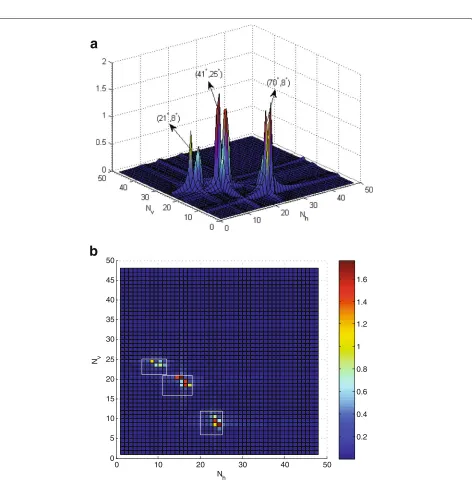
To illustrate the concept of beamspace, an example of DL BD channelsG˜kdwhose DoDs are(21◦, 8◦),(41◦, 25◦), and (70◦, 8◦) are depicted in Fig. 2. In most cases in the reality, the AS in the vertical domain is relatively small due to the height of the BS [32]; therefore, we set the AS in the horizontal directions δh is 10◦ and in the vertical directions δv is 5◦. Obviously, the channel power is concentrated on the beamspace, but with the finite number of antennas, the power might leak to the around points.
In order to facilitate the operation, we rewrite the BD channel into equivalent vectorial form as g˜kx = vec
˜ Gkx
= vecFNvGkxFNh
. Using the property
vec(ABC)=CT⊗Avec(B), we can get
˜ gkx =
FTNh⊗FNv
gkx=Fgkx (18)
where F = FTN h⊗FNv
andx ∈ {u,d}. Similarly, the
beamspace channel vector is g˜vec{Bkx}
kx = vec
˜ G{Bkx}
kx
,
0 10 20 30 40 50
0 5 10 15 20 25 30 35 40 45 50
Nh
Nv
0.2 0.4 0.6 0.8 1 1.2 1.4 1.6
b
a
Fig. 2Example of BD channels and their beamspaces withNv=Nh=48, the AS in the horizontal directionsδhis 10◦and in the vertical directions
δvis 5◦.aThe BD channelsG˜kdwhose DoDs are(21◦, 8◦),(41◦, 25◦), and(70◦, 8◦).bThe top view ofaand the beamspace of each channel which is
where vecBkx is the vectorial beamspace which is denoted asBkx. Then, we have
˜ g{kBkx}
x =F
{Bkx}g kx =
⎡ ⎣ !
F
Bcol
kx Nh
"T ⊗F
Brow
kx Nv
⎤ ⎦gkx.
(19)
From Lemma2, we can see that, with the practical finite number of antennas, most power of the beamspace chan-nel are concentrated around the points as (14) shows, and the dimension of beamspace is also related to the AS range of the signal rays. For keeping the required channel power of the beamspace channel, the dominant beams that are selected for the transmission at the userkxare defined as:
Bkx =
1≤i≤Nv, 1≤j≤Nh:
G˜kx
i,j
2≥ξkxmax i,j
G˜kx
i,j
2
# (20)
where thresholdξkx ∈(0, 1)which can be selected so that ˜
G{kBkx}
x captures a significant fractionρof the power ofG˜kx (e.g.,ρ≥0.9).ρis the required effective power ratio close to 1. SinceBkxis only related to the direction information, i.e.,θkx,ϕkx, which varies over a relatively long time and can be accurately obtained at the BS with little hindrance through long-term feedback [33]. Therefore, we can pre-establish an off-line data table of differentθkx,ϕkx
for the
Bkxin order to decrease the complexity of computation. 4.2 Beamspace of SI channel
In FD 3D massive MIMO systems, the dimension of SI channel is ultra-high (NvNh×NvNh); therefore, the com-pressibility ofGSIis urgent to be explored and exploited.
We first introduce an eigenvalue characteristic of large-scale UPA. Using the eigenvalue decomposition,Cavand Cahcan be expressed as:
Cav=UavDavUHav
Cah=UahDahUHah
(21)
wherea∈ {R,T},UavandUahare unitary matrices,Dav= diagλ(1)av,· · ·,λ(Nv)
av andDah=diag
λ(1)ah,· · ·,λ(Nh) ah . According to [12], for the large dimension of ULA, the eigenvector matrix can be approximated by a unitary DFT matrix. Since UPA is composed of ULAs in each row and column, and under the assumption of large dimension of antenna array at the BS, we can approximate theCavand Cahas
CavNv=→∞FNvDavF H Nv,
Cah Nh=→∞
FNhDahF H Nh,
(22)
and the eigenvalues Dav and Dah have the following characteristic:
Dav=diag
0,· · ·,0,λ(avi),· · ·,λ(avk), 0,· · ·,0
Dah=diag
0,· · ·,0,λ(aht),· · ·,λ(ahu), 0,· · ·,0
(23)
whereλavandλahare non-negligible. Then, we can get the dominate domain ofDaas:
D{a} a =diag
⎧ ⎪ ⎨ ⎪ ⎩λ
(i) avλ(
t)
ah,· · ·,λ(avi)λ( u)
ah,· · ·,λ(avk)λ( u) ah
( )* +
(k−i)×(u−t)
⎫ ⎪ ⎬ ⎪ ⎭
(24)
where Da = Dah ⊗ Dav, a =
(a,a)m∈a, [Da]m,m=0 andais the set that contains the indexes of rows (columns) of the dominate domain ofDa.
In practical FD systems, the SI signal is the main bot-tleneck of further improving the SE; thus, minimizing the harmful effect of SI is the primary task. In order to real-ize 3D multiuser FD transmission, we first define the BD SI channelG˜SI asG˜SI = FrGSIFHt, whereFr andFt can be equal toFor a submatrix ofF. Letrowa = {(a, :)}, col
a = {(:,a)}, P = F2 be a permutation matrix and d=(1, 2,· · ·,NvNh)Tdenotes the indexes of rows ofDR. Then, the SI channel gain EGSI2
can be effectively weakened by the following lemma:
Lemma 3Define BT = rowT and BR =
(Pd){rowR }, : as the beamspaces of the transmit and
receive SI, thenE /0
00G˜SI000
21
tends to zero ifFt=F{Bu}and
Fr =F{Bd}, where Bu∩BT = ∅and Bd∩BR= ∅.
ProofSeeAppendix: Proof of Lemma 3.
5 3D multiuser beamspace transmission scenario With 2D large-scale antenna arrays deployed at the BS, the spatial resolution of vertical and horizontal directions in 3D massive MIMO systems are high. We can exploit the slow time-varying angular information such as DoA, DoD, and channel correlation to efficiently estimate channels and transmit data. In this section, we detail our pro-posed 3D MUBT scheme. Based on user grouping scheme and beamspace channel estimation method, we show the scheme is capable of eliminating the SI, IGI, and MUI.
5.1 Beamspace-aware user scheduling
with, the user are partitioned into groups on the basis of the following criteria:
Criterion:Allocate the UL/DL users whose beamspaces are the same to the same group, while the beamspaces of different UL/DL groups are orthogonal, i.e.,
Bgu
i ∩Bgju= ∅,Bgid∩Bgjd= ∅ (25)
whereBgiuandBguj are the beamspaces of UL groupg u i and gju,Bgd
i andBgdj are the beamspaces of DL groupg d i andgjd. To simplify the illustration, the cardinalities of the beamspaces are set to be the same, i.e.,Bgu
i
=Bgu
j
=bu andBgd
i
= Bgd j
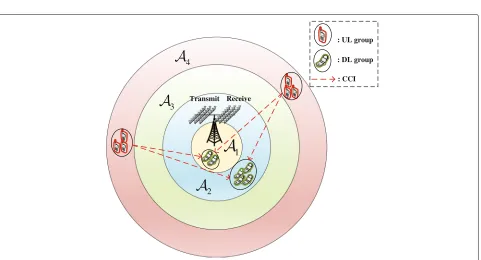
= bd. Assume that Kgix is the num-ber of users in groupgix, andgix,kdenotes the index of the kth user in groupgix, wherex ∈ {u,d}. In the FD cellular systems, if the co-channel UL and DL users are too close to each other, the CCI may cause a serious trouble to the DL users’ signal-to-interference ratio. Therefore, we pro-vide a simple user scheduling algorithm to mitigate the SI and attenuate the CCI. The main idea of our scheduling strategy to suppress the CCI is to locate the co-channel users apart. Within the cellular systems, the sufficient dis-tance isolation between co-channel users can significantly reduce the CCI due to the plenty of obstructions such as buildings and trees, which as a result makes the CCI negligible compared to the signals transmitted from the high-altitude BS2
Firstly, we partition the cell into four areasA1,A2,A3,
andA4as Fig.3shows, then the user scheduling algorithm
is proposed as the following.
Algorithm 1User Scheduling Based on the Distance and SI Beamspaces Isolation
1: Calculate the beamspaces of all UL and DL users
through (14) and (20).
2: Partition UL and DL users into groups according to
the beamspace-aware grouping criterion (25). LetGu andGdbe the set of UL and DL groups which satisfy
Gu =
giuBgu
i
2
BT =∅,i=1,· · ·,Gu andGd =
gidBgd
i
2
BR=∅,i=1,· · ·,Gd , respectively.
3: Schedule Gu UL groups in location areaA.If A =
A1A2,thenschedule the DL users inA4;else ifA=
A3A4,thenschedule the DL users inA1.
4: If all UL groups’ beamspaces are orthogonal to BT, then scheduleGd DL groups;else, scheduleGd DL groups from Gd so as to eliminate the SI in the beamspace ofgiu.
5: To include all the possibility, in the orthogonal time/frequency resources, schedule Gd DL groups, and use the similar method in step 3 to determine in which area the UL groups are scheduled.Ifall DL groups’ beamspaces are orthogonal toBR,then sched-uleGuUL groups;else, scheduleGuUL groups from
Gu.
6: Repeat3, 4, 5.
1
2 3
4
: UL group
: DL group
: CCI
Transmit Receive
5.2 Effective beamspace channel estimation
During the estimation phase of the FD system, all UL users transmit the pilot sequences to the BS, and simultane-ously, the BS transmits the pilot sequences to the DL users. Then, the received pilot signals at the BS and theith DL group are written as:
Yu=
i are the channel
matri-ces between the BS and theith UL and DL user group, respectively.Hgd
i,gju is the co-channel matrix betweenjth UL group andith DL group. The second term of the right side of (27) is the CCI resulting from the simultaneous UL and DL transmission at the same frequency. Based on the user scheduling algorithm, the CCI can be ignored in the FD scenario, which as a result is omitted in the later analysis. Xgu
i ∈ C
Kgui×τu
is pilot sequences of the ith UL group,τudenotes the length of pilot sequence for
each UL user, X˜gd
i denotes the
pre-coded DL pilot sequence whereXgd
i ∈ C
bd×τd is the DL
beamspace pilot sequences for theith DL group,τdis the length of DL pilot sequence,NuandNgd
i are the additive white Gaussian noise (AWGN) matrices which have inde-pendent and identically distributedCN(0, 1)elements. In order to reduce the overhead of channel estimation, we can reuse the same pilot sequences between different
groups. LetXu ∈ C max
1≤i≤GuKgui×τu and
Xd ∈ Cbd×τd be the orthogonal UL pilot sequence set and DL pilot sequence set which satisfyXaXHa = τaPpaI,a ∈ {u,d}, wherePap is the transmit power of each pilot symbol and Iis the identity matrix with appropriate size. Then, the UL and DL pilot sequences assigned to the different groups are assumed to share the same UL and DL pilot sequence set. Mathematically, the UL pilot sequences allocated for
groupgui is given byXgiu = X
1:Kgui,:
u , and the DL pilot sequences allocated for groupgidis given byXgd
i =X
5.2.1 UL beamspace channel estimation
In order to eliminate the IGI, which is also the pilot
con-tamination, we multiply both sides of (26) withF
Then, the BS obtains the observation of UL beamspace channel as: tamination between thekth users in all UL groups due to the reuse of the same pilot sequence. Note that, accord-ing to the groupaccord-ing criterion and Corollary 1, the pilot contamination approaches to zero asNv,Nh → ∞. The last term is the SI caused by the simultaneous UL and DL training. Note that if users are scheduled by Algorithm 1, according to Lemma 3, the SI can be wiped out in the large Nv, Nh regime. Based on the observation in (29), the minimum mean square error (MMSE) estimation of
the beamspace channelg˜
whereSu
Based on the orthogonal property of MMSE estimation
[34], the channel eatimation error isg¯˜
5.2.2 DL beamspace channel estimation
(27) can be rewritten as:
Then, the observation of the DL beamspace channel is written as contamination caused by the reuse of the same DL pilot sequence set over all DL groups, and it tends to vanish asNv,Nh → ∞according to the grouping criterion and Corollary1.
Using the similar method as UL estimation, we have:
ˆ˜
Similarly, the covariance of DL channel estimation error
¯˜
5.3 Data transmission
At the data transmission stage3, UL and DL users transmit signals in the same time-frequency resource. In our trans-mission scheme, the data are transmitted in each group’s own beamspace. In the BD, the received signal at the BS from theith UL group and the received signal at theith DL group can be written as:
ygd
mit data of theith UL group and the BD precoded data for users in the ith DL group, respectively, andn˜gui =
For massive MIMO systems, linear signal process-ing techniques have already been shown to have good performance [2]. Therefore, in this paper, define
Wgu
i as the linear UL detector
and DL precoder at the BS. Multiplying (40) withWHgu
i. Then, the received signal of userg u second term of the right side of (42) is the MUI within the group. For DL, the BD precoded data can be written as xgd
We adopt the zero-forcing (ZF) beamforming scheme to eliminate the MUI. The CSI of UL and DL beamspace channels is assumed to be obtained by (30) and (36); then, the beamforming matrices can be expressed as:
Wgu
diagonal matrix for the normalization of the precoder. Based on (42) and according to [35], we can obtain the signal-to-interference-plus-noise ratio (SINR) of usergui,k as (45), shown at the top of the next page, wherePgu
are the transmit power matrices,l =
γgd
6 Simulation results
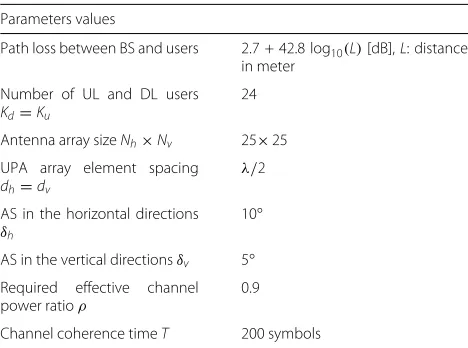
In this section, we present the performance of the pro-posed scheme through simulation results. The parameters of the simulated single-cell multi-user systems are listed in Table1. For path loss, we consider the 3GPP LTE simula-tion model [36]. It is assumed that the transmit and receive antenna arrays are separated in distance and some passive SIC techniques, such as radio frequency absorber material, are adopted so that the level of residual SIβSI = 15 dB. We consider that both the UL and DL users are scheduled by Algorithm 1 and are gathered into three groups. We assume that each group has 8 users and the range of DoA or DoD of users within each group is the same.
6.1 Channel estimation
In order to evaluate the performance of our proposed channel estimation method, we define the average indi-vidual MSE as the performance metric which is given by:
κa=
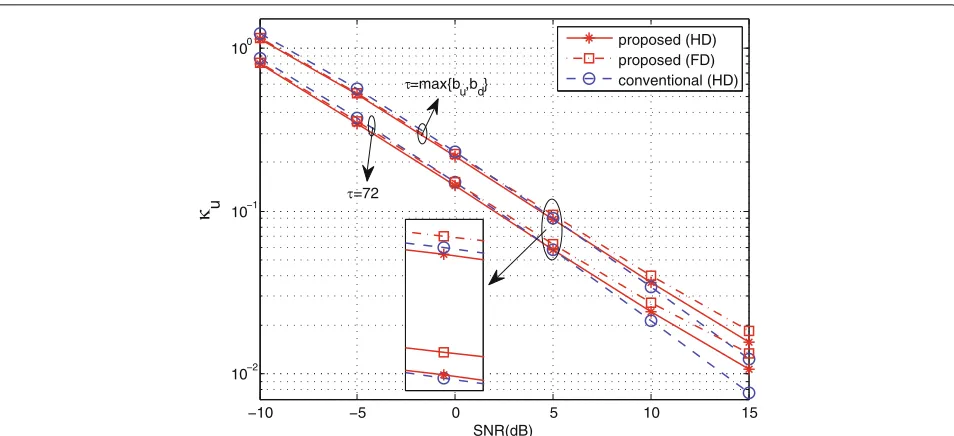
Figures4and 5present the comparison of the UL and DL channel estimation performance between the proposed
Table 1Simulation parameters
Parameters values
Path loss between BS and users 2.7 + 42.8 log10(L)[dB],L: distance in meter
Number of UL and DL users Kd=Ku
24
Antenna array sizeNh×Nv 25×25
UPA array element spacing dh=dv
λ/2
AS in the horizontal directions
δh
10◦
AS in the vertical directionsδv 5◦
Required effective channel power ratioρ
0.9
Channel coherence timeT 200 symbols
beamspace channel estimation and the conventional full-dimension channel estimation as a function of average UL and DL receive SNR, respectively. In our proposed HD/FD beamspace channel estimation scheme, the length of pilot sequence is related to the dimension of beamspace; hence, we setτu = τd = τ = max{bu,bd}. Under this setup, the default length of pilot sequence isτ = 42. We also compare the cases of τ = 54 and τ = 72. From the numerical results, we can see that the DL performance of the proposed scheme outperforms the conventional full-dimension method and the UL performance of the proposed scheme is better in the low-SNR region. What is more, comparing the proposed HD and FD scenarios, we can observe that in the low-SNR case, the performance is very close between HD and FD. As the SNR grows, the harmful impact of SI increases, which brings down the performance of FD scenario.
Note that, in the HD massive MIMO systems, the required minimum length of pilot sequence in the conven-tional TDD systems with DL reciprocity [5] and FDD sys-tems [12] are;Gu
bd = 66 (approximate), respectively. In the FD massive MIMO systems, [24] assumes that transmit and receive radio-frequency chains share the transmit antennas at the BS so that DL CSI can be obtained by utilizing the reciprocity which is at the cost of hardware, and the required minimum length of pilot sequence is;Gu
i=1Kgu i +
;Gd
i=1Kgdi = 48. In addition, we know that the compu-tational complexity of MMSE estimation is On3 due to the matrix inversion operation wherenis the dimen-sion of the channel covariance matrix, which lays a heavy burden on the system ifnis large, especially for massive MIMO system. For example, the computational complex-ity of the conventional full-dimension MMSE estimation [6] isO(NvNh)3
=O6253, which is very high.
Never-theless, the complexity of our low-dimension beamspace channel estimation scheme isO[max(bu,bd)]3
which is
O303. From this perspective, our 3D MUBT scheme is
competitive in 3D massive MIMO system application.
6.2 Data transmission
The SE in this subsection is defined asSE = SEu+SEd
−10 −5 0 5 10 15 10−2
10−1 100
κ u
SNR(dB)
proposed (HD) proposed (FD) conventional (HD)
τ=max{b
u,bd}
τ=72
Fig. 4Comparison of the UL channel estimation performance between the beamspace channel estimation and conventional estimation versus
average receive SNRs
scheme. Besides, by using the user scheduling algorithm, the anti-SI capability of the proposed scheme outper-forms the linear transceiver. Nevertheless, as the SNR grows, the performance gap between the FD 3D MUBT scheme and the FD scheme with linear transceiver decreases, and that between the HD 3D MUBT scheme and TDD case increases. The reason of them both is that as the SNR increases, the truncation error limits the
performance of the proposed 3D MUBT scheme. What is more, the HD 3D MUBT outperforms the FDD [12] mainly due to the less training overhead.
Meantime, the comparisons that with less number of antennas ( 15× 15 ) and no user scheduling are made. As expected, with less number of antennas, the overlap of beamspaces will increase which will increase the IGI and SI. Similarly, without the user scheduling algorithm, the
−10 −5 0 5 10 15
10−2 10−1 100
SNR(dB) κ d
proposed (HD) conventional (HD)
τ=max{b
u,bd} τ=54
τ=72
Fig. 5Comparison of the DL channel estimation performance between the beamspace channel estimation and conventional estimation versus
−5 0 5 10 15 20 0
20 40 60 80 100 120
Spectral Efficiency (bit/s/Hz)
SNR (dB) 3D MUBT
FD (linear) [24] HD (TDD) [5] HD (FDD) [12]
FD
15×15 HD
no user scheduling
Fig. 6SEs versus average receive SNRs in different scenarios
orthogonality of beamspaces between different groups of simultaneously scheduled users and SI cannot be guaran-teed. And the CCI will also damage the system.
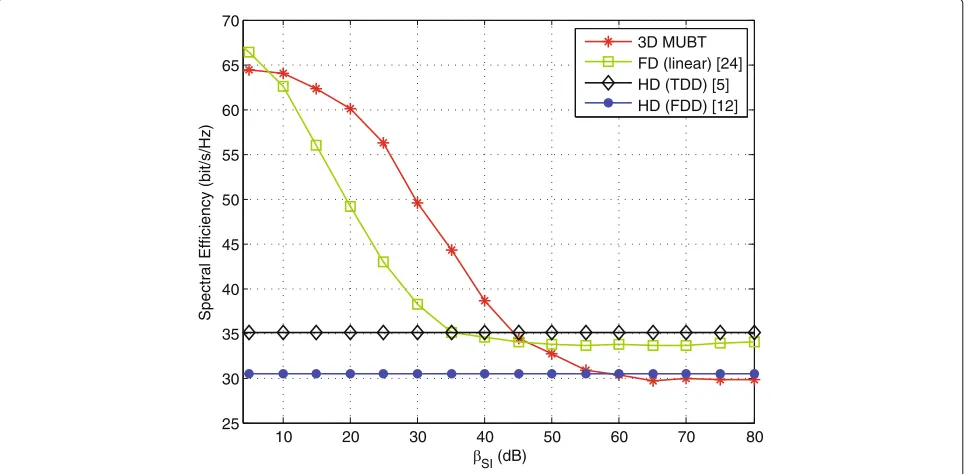
In the previous simulations, theβSI is set to the fixed value. To investigate how the SI level influences the SE performance in the FD massive MIMO systems, we com-pare the performance between HD system and FD system with different SI level βSI in Fig. 7. As expected, the
performance of FD systems outperform that of HD sys-tems when βSI level is low and reduces asβSI grows. It is observed that in the low βSI regions, the linear FD scheme achieves the better SE performance, which is because when the SI is relatively small, the channel esti-mation error, IGI and AWGN restrict the SE performance mainly; then, as a result, the linear scheme outperforms the proposed scheme due to the truncation error. For
10 20 30 40 50 60 70 80
25 30 35 40 45 50 55 60 65 70
Spectral Efficiency (bit/s/Hz)
βSI (dB)
3D MUBT FD (linear) [24] HD (TDD) [5] HD (FDD) [12]
Fig. 8SEs versus average DL receive SNRs in different 3D precoding scenarios
the similar reason, when the SI becomes the dominate, the impact of the SI on the two schemes is almost the same; therefore, the linear FD is superior when the SI level is high. However, when theβSI is within(8, 45), the FD 3D MUBT scheme outperforms the linear FD, which indicates that with the user scheduling strategy, the FD 3D MUBT scheme has better anti-SI capability. In other words, applying the FD 3D MUBT scheme can lower the requirement for the SIC techniques. Take SE = 49 bit/s/Hz for example, the correspondingβSI for the FD scheme with linear transceiver and the FD 3D MUBT scheme are 20 and 30dB, which indicates that the SIC capability in conventional FD system needs 10dB more than that in the proposed scheme and will bring the extra hardware cost and complexity.
6.3 3D precoding schemes
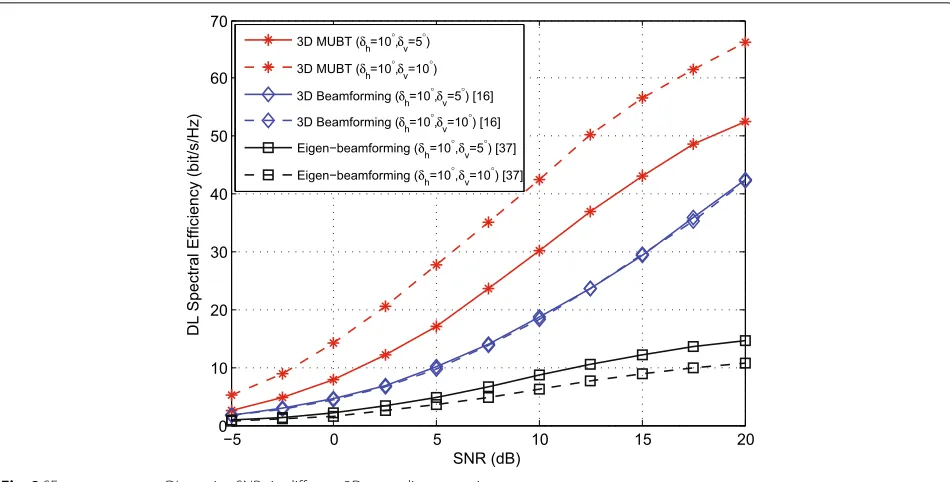
According to [14], the channel correlation matrix can be well approximated by the Kronecker production of the correlations in horizontal and vertical directions, i.e.,C= Ch⊗Cv. Based on this, [37] designs a eigen-beamforming scheme. This scheme first chooses the principle eigenvec-tor ofCv, to perform the vertical dimension beamforming, then use the eigenvector matrix ofChto do the horizon-tal dimension beamforming. In [16], Li et al. exploit the eigenvalue characteristic of large-scale UPA as discussed in Section 5.2 (23), and select the optimal DL beamform-ing vector for thekth user asbk =
FNh
:,n⊗
FNv
:,mto
maximize the average signal-to-leakage-plus-noise ratio, wherenandmare the indexes of columns where the max-imum eigenvalues ofChandCvare, respectively. In Fig.8,
we investigate the DL transmission with different 3D pre-coding schemes under the different conditions ofδv. Here, we get rid of the 1 / 2 pre-log factor of the DL SE for the sake of illustration. We can see that the proposed scheme achieves the best performance. The performance of eigen-beamforming scheme decreases whenδvincrease. This is because the power of the channel is concentrated around the dominant eigenmode, and as the vertical AS increase, the power of the principle eigenvalue decrease. More-over, the 3D beamforming scheme is insensitive to δv under this setup4. However, we can see that the SE perfor-mance of the proposed scheme increase asδvgrows; this can be explained by (14). The dimension of the beamspace channel increases as AS grows while keep the distance between the beamspaces of groups and the IGI at accept-able levels, which as a result improves the SE.
7 Conclusions
In this paper, we propose a 3D MUBT scheme for FD cellular systems. By adopting the property of beamspace, the 3D MUBT scheme can not only efficiently miti-gate the SI due to FD transmission, but also significantly reduce the overhead of channel estimation. The simula-tion results show that the proposed 3D MUBT scheme outperforms the FD scheme with linear transceiver and the HD (TDD/FDD) schemes in massive MIMO cellular system.
Endnotes
1Note that in FD techniques, the antenna
antenna array to accomplish transmission and reception [19]. Nevertheless, due to the serious cross-talk within the antennas, it is impractical in MIMO system for now.
2We assume that the radius of the cell is 1000m.
Accord-ing to the 3GPP LTE BS-to-user and user-to-user path loss models for macrocell environment [36], the path loss between BS to users and users to users are PL = 2.7+ 42.8log10(RBS - UE) and PL = 55.78 + 40log10(RUE - UE), respectively, whereRBS - UE andRUE - UE are distances in
meter. When the distance between BS and users is 400m (the shortest distance between users and users is 350m according to the Algorithm 1), the interference channel between the two users is about 43dB weaker than the useful channel.
3The estimated DL CSI feedback process is also
impor-tant and is studied in a lot of literatures [11,38,39]. Choi et al. [39] shows that the influence of channel feedback noise and errors can be made negligible with respect to the channel estimation errors especially when the SNR is high, hence in this paper we consider the ideal DL CSI feedback for simplicity, as assumed in [12].
4In fact, the simulation results in [16] have the
simi-lar conclusion with the eigen-beamforming scheme, but when the number of user in each group is small, the decrease of the SE performance is inconspicuous.
Appendix: Proof of Lemma 3
Since bothFNv andFNh are unitary, then Fis a unitary matrix, based on which we can obtain
E/000G˜SI000
Then, we have
E/000G˜SI000
can be effectively
repre-sented. Take the last two brackets of the right side of (34) for example, which is denoted asI1andI2, we have: the beamspaces of transmit SI and receive SI, respec-tively, P = F2 is the permutation matrix and d =
(1, 2,· · ·,NvNh)T denotes the indexes of rows ofDR. It can be observed that (53) and (54) become equality asNv andNhtend to infinity. The other brackets can be similarly approximated asI1andI2do. In that way, ifBu∩BT = ∅
2D: Two-dimensional; 3D: Three-dimensional; AS: Angular spread; BS: Base station; CCI: Co-channel interference; CSI: Channel state information; DoA: Direction of arrival; DoD: Direction of departure; DL: Downlink; FD: Full-duplex; FDD: Frequency-division duplex; HD: Half-duplex; ICI: Inter-cell interference; IGI: Inter-group interference; LOS: Light-of-sight; MIMO: Multiple-input multiple-output; MMSE: Minimum mean square error; MUBT: Multiuser beamspace transmission; MUI: Multiuser interference; NLOS: Non-ligth-of-sight; SE: Spectral efficiency; SI: Self-interference; SIC: SI cancellation; SINR: Signal-to-interference-plus-noise ratio; TDD: Time-division duplex; UL: Uplink; ULA: Uniform linear antenna array; UPA: Uniform planar antenna array; ZF: Zero-forcing
Funding
(BK20160079), and National Natural Science Foundation of China (No. 61371123, No. 91438115).
Authors’ contributions
XW is the main writer of this paper. He proposed the main idea, conducted the simulations, and analyzed it. DZ, KX, and WM assisted the review of this manuscript. All authors read and approved the final manuscript.
Competing interests
The authors declare that they have no competing interests.
Publisher’s Note
Springer Nature remains neutral with regard to jurisdictional claims in published maps and institutional affiliations.
Author details
1Army Engineering University of PLA, No. 88, Houbiaoying Street, Nanjing, China.2Unit 32020 of PLA, Wuhan, China.
Received: 20 April 2018 Accepted: 30 July 2018
References
1. J Mietzner, R Schober, L Lampe, WH Gerstacker, PA Hoeher, Multiple-antenna techniques for wireless communications - a comprehensive literature survey. IEEE Commun. Surv. Tutorials.11(2), 87–105 (2009) 2. T Marzetta, Noncooperative cellular wireless with unlimited numbers of
base station antennas. IEEE Trans. Wirel. Commun.9(11), 3590–3600 (2010) 3. HQ Ngo, E Larsson, T Marzetta, Energy and spectral efficiency of very large multiuser MIMO systems. IEEE Trans. Commun.61(4), 1436–1449 (2013) 4. F Fernandes, A Ashikhmin, TL Marzetta, Inter-cell interference in
noncooperative TDD large scale antenna systems. IEEE J. Sel. Areas Commun.31(2), 192–201 (2013)
5. J Hoydis, S Brink, M Debbah, Massive MIMO in UL/DL of cellular networks: how many antennas do we need. IEEE J. Sel. Areas Commun.31(2), 160–171 (2013)
6. L You, X Gao, XG Xia, N Ma, Y Peng, Pilot reuse for massive MIMO transmission over spatially correlated rayleigh fading channels. IEEE Trans. Wireless Commun.14(6), 3352–3366 (2015)
7. H Cui, L Song, B Jiao, Multi-pair two-way amplify-and-forward relaying with very large number of relay antennas. IEEE Trans. Wireless Commun. 13(5), 2636–2645 (2014)
8. RCD Lamare, Massive MIMO systems: signal processing challenges and future trends.URSI Radio Science Bulletin.86(4), 8–20 (2017)
9. J Jose, A Ashikhmin, TL Marzetta, S Vishwanath, Pilot contamination and precoding in multi-cell TDD systems. IEEE Trans. Wireless Commun.10(8), 2640–2651 (2011)
10. N Krishnan, RD Yates, NB Mandayam, Uplink linear receivers for multi-cell multiuser mimo with pilot contamination: large system analysis. IEEE Trans. Wireless Commun.13(8), 4360–4373 (2014)
11. A Duly, T Kim, D Love, J Krogmeier, Closed-loop beam alignment for massive MIMO channel estimation. IEEE Commun. Lett.18(8), 1439–1442 (2014)
12. A Adhikary, J Nam, J Ahn, G Caire, Joint spatial division and
multiplexing-the large-scale array regime. IEEE Trans. Inf. Theory.59(10), 6441–6463 (2013)
13. C Sun, X Gao, S Jin, M Matthaiou, Z Ding, C Xiao, Beam division multiple access transmission for massive mimo communications. IEEE Trans. Commun.63(6), 2170–2184 (2015)
14. D Ying, FW Vook, TA Thomas, DJ Love, A Ghosh, inIEEE International Conference on Commun. (ICC). Kronecker product correlation model and limited feedback codebook design in a 3D channel model (IEEE, Sydney, 2014), pp. 5865–5870
15. Z Wang, W Liu, C Qian, S Chen, L Hanzo, Two-dimensional precoding for 3-d massive mimo. IEEE Trans. Veh. Technol.66(6), 5485–5490 (2017) 16. X Li, S Jin, X Gao, RW Heath, Three-dimensional beamforming for
large-scale fd-mimo systems exploiting statistical channel state Information. IEEE Trans. Veh. Technol.65(11), 8992–9005 (2016) 17. X Li, S Jin, HA Suraweera, J Hou, X Gao, Statistical 3-d beamforming for
large-scale mimo downlink systems over rician fading channels. IEEE Trans. Commun.64(4), 1529–1543 (2016)
18. Z Zhang, X Chai, K Long, AV Vasilakos, L Hanzo, Full duplex techniques for 5G networks: self-interference cancellation, protocol design, and relay selection. IEEE Commun. Mag.53(5), 128–137 (2015)
19. D Kim, H Lee, D Hong, A survey of in-band full-duplex transmission: from the perspective of PHY and MAC layers. IEEE Commun. Surv. Tutorials. 17(4), 2017–2046 (2015)
20. A Sabharwal, P Schniter, D Guo, DW Bliss, S Rangarajan, R Wichman, In-band full-duplex wireless: challenges and opportunities. IEEE J. Sel. Areas Commun.32(9), 1637–1652 (2014)
21. C Psomas, M Mohammadi, I Krikidis, HA Suraweera, Impact of directionality on interference mitigation in full-duplex cellular networks. IEEE Trans. Wireless Commun.16(1), 487–502 (2017)
22. M Mohammadi, HA Suraweera, Y Cao, I Krikidis, C Tellambura, Full-duplex radio for uplink/downlink wireless access with spatially random nodes. IEEE Trans. Commun.63(12), 5250–5266 (2015)
23. J Lee, TQS Quek, Hybrid full-/half-duplex system analysis in heterogeneous wireless networks. IEEE Trans. Wirel. Commun.14(5), 2883–2895 (2015) 24. HQ Ngo, HA Suraweera, M Matthaiou, EG Larsson, Multipair full-duplex
relaying with massive arrays and linear processing. IEEE J. Sel. Areas Commun.32(9), 1721–1737 (2014)
25. X Xia, D Zhang, K Xu, W Ma, Y Xu, Hardware Impairments Aware Transceiver for Full-Duplex Massive MIMO Relaying. IEEE Trans. Signal Process.63(24), 6565–6580 (2015)
26. M Mohammadi, BK Chalise, HA Suraweera, Z Ding, inIEEE International Conference on Communications. Wireless information and power transfer in full-duplex systems with massive antenna arrays (IEEE, Paris, 2017), pp. 1–6
27. Y Li, P Fan, A Leukhin, L Liu, On the Spectral and energy efficiency of full-duplex small-cell wireless systems with massive mimo. IEEE Trans. Veh. Technol.66(3), 2339–2353 (2017)
28. X Xia, Y Xu, K Xu, D Zhang, W Ma, Full-duplex massive mimo AF relaying with semiblind gain control. IEEE Trans. Veh. Technol.65(7), 5797–5804 (2016)
29. H Yin, D Gesbert, M Filippou, Y Liu, A coordinated approach to channel estimation in large-scale multiple-antenna systems. IEEE J. Sel. Areas Commun.31(2), 264–273 (2013)
30. JP Kermoal, L Schumacher, KI Pedersen, PE Mogensen, F Frederiksen, A stochastic MIMO radio channel model with experimental validation. IEEE J. Sel. Areas Commun.20(6), 1211–1226 (2002)
31. B Clerckx, C Oestges,MIMO Wireless Networks: Channels, Techniques and Standards for Multi-Antenna, Multi-User and Multi-Cell Systems. 2nd. (Academic Press, Oxford, 2013)
32. J Wang, R Zhang, W Duan, SX Lu, L Cai, inProc. ICC 2014. Angular spread measurement and modeling for 3D MIMO in urban macrocellular radio channels (IEEE, Sydney, 2014), pp. 20–25
33. MA Maddah-Ali, DNC Tse, Completely stale transmitter channel state information is still very useful. IEEE Trans. Inform. Theory.58(7), 4418–4432 (2012)
34. T Kailath, AH Sayed, B Hassibi,Linear Estimation. (Upper Saddle River, Prentice-Hall, 2000)
35. B Hassibi, BM Hochwald, How much training is needed in
multiple-antenna wireless links? IEEE Trans. Inf. Theory.49(4), 951–963 (2003)
36. 3GPP TR 36.828, Further enhancements to LTE time division duplex (TDD) for downlink-uplink (DL-UL) interference management and traffic adaptation. (2012). v.11.0.0.www.3gpp.org. Accessed 7 Aug 2018 37. Y Song, S Nagata, H Jiang, L Chen, inIEEE International Conference on
Communications. CSI-RS design for 3D MIMO in future LTE-Advanced (IEEE, Sydney, 2014), pp. 5101–5106
38. G Caire, N Jindal, M Kobayashi, N Ravindran, Multiuser MIMO achievable rates with downlink training and channel state feedback. IEEE Trans. Inf. Theory.56(6), 2845–2866 (2010)