Volume 2008, Article ID 286351,11pages doi:10.1155/2008/286351
Research Article
How Equalization Techniques Affect the TCP Performance of
MC-CDMA Systems in Correlated Fading Channels
Barbara M. Masini,1Giacomo Leonardi,1Andrea Conti,2Gianni Pasolini,1Alessandro Bazzi,1 Davide Dardari,1and Oreste Andrisano1
1WiLab, University of Bologna, Viale Risorgimento 2, 40136 Bologna, Italy 2ENDIF, University of Ferrara, 44100 Ferrara, Italy
Correspondence should be addressed to Barbara M. Masini,[email protected]
Received 30 April 2007; Revised 24 August 2007; Accepted 2 November 2007
Recommended by Arne Svensson
This paper investigates the impact of several equalization techniques for multicarrier code division multiple access systems on the performance at both lower and upper layers (i.e., physical and TCP layers). Classical techniques such as maximal ratio combining, equal gain combining, orthogonality restoring combining, minimum mean square error, as well as a partial equalization (PE) are investigated in time- and frequency-correlated fading channels with various numbers of interferers. Their impact on the perfor-mance at upper level is then studied. The results are obtained through an integrated simulation platform carefully reproducing
all main aspects affecting the quality of service perceived by the final user, allowing an investigation of the real gain produced by
signal processing techniques at TCP level.
Copyright © 2008 Barbara M. Masini et al. This is an open access article distributed under the Creative Commons Attribution License, which permits unrestricted use, distribution, and reproduction in any medium, provided the original work is properly cited.
1. INTRODUCTION
Multicarrier code division multiple access (MC-CDMA) techniques have achieved considerable attention and, ow-ing to their efficiency in counteracting both multiuser in-terference and frequency selective fading, are also proposed for fourth generation mobile radio systems (see, e.g., [1–5]). Several MC-CDMA schemes have been proposed in the lit-erature (an overview on MC-CDMA systems can be found in [6]) and different variants can be derived from them. In this work, we investigate the downlink performance, in real-istic channel conditions, of the MC-CDMA system presented in [1,7]. For what concerns the equalization and combin-ing techniques, several solutions are here considered with the aim of evaluating their impact at upper layers through an in-tegrated approach which takes into account all aspects aff ect-ing the performance perceived by the final user, from physical to application level [8].
In particular, the MC-CDMA scheme here considered performs the signal spreading in the frequency-domain, thus resulting in a combination of orthogonal frequency division multiplexing OFDM and CDMA techniques, and adopts
or-thogonal Walsh-Hadamard (W-H) spreading sequences with spreading factor equal to the number of subcarriers for the receiver block schemes). However, in spite of the use of W-H codes, the orthogonality of the sequences of different users is lost due to the different fading in each subchannel [4]. There-fore, in order to improve the system performance, the choice of the combining technique is a crucial point.
a threshold is introduced with TORC (see, e.g., [9]) to cancel the contributions of those subchannels highly corrupted by the noise [10]. Among linear combining techniques, the opti-mum solution is represented by miniopti-mum mean square error (MMSE) (see, e.g., [11]), but it also requires the knowledge of the SNR and the number of active users, increasing the re-ceiver’s complexity. A suboptimal MMSE solution has been, therefore, proposed which reduces the burden of MMSE im-plementation [4].
In addition to the above mentioned techniques, in this paper, we also consider a promising partial equalization (PE) technique investigated in [12]. In uncorrelated fading chan-nels its performance is analytically tractable: PE has a mean bit-error probability (BEP) averaged over fast fading close to the optimum MMSE, despite having the same complexity of EGC, MRC, ORC, and TORC.
The novelty of this work consists in evaluating the ef-fect of the above-mentioned physical level combining tech-niques not only on the bit-error rate (BER), but also at TCP level in terms of normalized throughput (whose definition will be given inSection 6), thus providing an insight on the performance experienced by the final user. Moreover, real-istic channel conditions with correlation in both frequency and time are considered here. In fact, in the literature (see, e.g., [13–16]), the effects of the equalization techniques are essentially investigated at the physical level (typically on the BER), without considering the upper levels performance. If the upper layers protocols are without memory, the effect of physical level equalization techniques on the throughput would directly be related to those on the BER. Since the TCP protocol is widely affected by the memory effect produced by the channel correlation, hence, this does not a priori allow to assert what is the effect of the combining techniques on the throughput. These considerations suggested us to care-fully investigate, in this paper, how equalization techniques play on the TCP throughput.
Moreover, let us emphasize that in order to derive mean-ingful results, the TCP level performance has been derived through a complete investigation which carefully takes into account all main aspects affecting the throughput perceived by the final user, such as channel characteristics, modulation and coding schemes, Automatic Repeat reQuest (ARQ) strat-egy, TCP behavior, and so forth. A simulative approach has been adopted since it is the only feasible way to take all the above mentioned aspects into account.
To summarize, the goals of the paper are
(i) to understand how equalization techniques affect the performance at upper layers in realistic conditions; (ii) to compare several equalization techniques not only in
terms of physical level performance but also at TCP level;
(iii) to verify which technique is more suitable to serve dif-ferent amount of users in realistic channel conditions; (iv) to maturate the feeling on the presence or absence of general rules on equalization techniques in different conditions for a given target TCP performance.
The paper is organized as follows: in Section 2, mod-elling and assumptions for the investigated MC-CDMA
sys-tem are detailed, and inSection 3an overview of equaliza-tion techniques is provided. In Secequaliza-tions4and5, the adopted simulation platform and its configuration are discussed. In Section 6, the numerical results are provided and, finally, in Section 7, the final conclusions are drawn.
2. MODELLING AND ASSUMPTIONS AT PHY LEVEL
Following the MC-CDMA architecture in [6], the number of subcarriers,M, is equal to the spreading factor. Each data-symbol is copied over all subcarriers, and multiplied by the chip assigned to each particular subcarrier. Consequently, the spreading is performed in the frequency-domain. In the fol-lowing we will focus our attention on the downlink of an MC-CDMA system with the commonly accepted assump-tions such as the system remains always synchronous, and possible different delays affecting each subcarriers are as-sumed to be perfectly compensated (see, e.g., [1,7,17]).
We consider W-H orthogonal code sequences for the multiple access and binary phase shift keying (BPSK) modu-lation. Considering that, exploiting the orthogonality of the code, all the different users use the same carriers, the to-tal transmitted signal results in (being in the downlink, the phase is the same for all the values ofm, thus assumed zero for simplicity)
wheremis the subcarrier index,idenotes the data index,g(t) is a rectangular pulse waveform, with duration [0,T] and unitary energy,Tb is the bit-time, fm = f0+m·Δf is the
subcarrier frequency (withΔf·T and f0T integers to have
orthogonal frequencies),Eb is the energy per bit,M is the
number of subcarriers,Nuis the number of active users and,
because of the use of orthogonal codes,Nu ≤ M,cmis the mth chip (taking value±1): and a(k)[i] is the data-symbol
transmitted during theith time-symbol. We assume orthog-onal sequencesc(k)for different users, such that
ration, increased with respect to T of a time-guardTg
in-serted between consecutive multicarrier symbols to eliminate the residual intersymbol interference (ISI) due to the channel delay spread and the inter carrier interference.
As far as the channel model is concerned, we consider two cases:
Table1: Three rays SUI channels models: delays, attenuations, and
KRicean factor (K=0 means Rayleigh distribution ).
SUI-1 Tap1 Tap2 Tap3
Delay [μs] 0 0.4 0.9
Attenuation [dB] 0 15 20
K 4 0 0
SUI-2 Tap1 Tap2 Tap3
Delay [μs] 0 0.4 1.1
Attenuation [dB] 0 12 15
K 2 0 0
Table2: Rayleigh three paths (R3P) channels models: delays and attenuations.
R3P-A Tap1 Tap2 Tap3
Delay [μs] 0 0.4 1.1
Attenuation [dB] 0 12 15
R3P-B Tap1 Tap2 Tap3
Delay [μs] 0 0.4 1.1
Attenuation [dB] 0 8 12
R3P-C Tap1 Tap2 Tap3
Delay [μs] 0 0.2 0.8
Attenuation [dB] 0 12 15
R3P-D Tap1 Tap2 Tap3
Delay [μs] 0 0.2 0.8
Attenuation [dB] 0 8 12
The assumption of uncorrelated fading among subcar-riers represents the situation when the subcarsubcar-riers are suf-ficiently spaced in frequency (i.e., more than the coherence bandwidth) or when only a sparse subset of the total amount of subcarriers is used for a symbol transmission.
In the case of correlated fading channels,
(i) the SUI three-rays channel models [18] (adopted, e.g., for WiMAX system)
(ii) the Rayleigh three paths (R3P) channel models
have been assumed in the 2 GHz band as summarized in Ta-bles1and2, respectively.
Since we are now focusing on the downlink, we assume that considering thenth receiver, the information associated to different users experiments the same fading. Due to the CDMA structure of the system, each user receives the infor-mation of all the users and selects only its own data through the spreading sequence. The received signal can be written as
r(t)=s(t)∗h(t) +n(t), (4)
where operator∗here denotes the convolution operation, h(t) is the impulse response of the channel, and n(t) is the additive white Gaussian noise with two-side power spectral density (PSD)N0/2.
Hence, by denoting withHmthe channel gain for themth
subcarrier, themth signal at the FFT output can be written as
zm[i]=Hm[i]Am[i] +nm[i]. (5)
Figure1: Receiver block-scheme for thenth user.
To be rigorous,zm[i]=δd·Hm[i]Am[i] +nm[i], whereδd =
1/(1+Td/T) represents the loss of energy caused by the
time-spreading of the impulse. Since δd 1, we will neglect it
in the following. Focusing, without loss of generality, on the nth user, the decision variable (i.e., the test statistic),v(n)[i],
is obtained by linearly combining the weighted signals from each subcarrier as follows (seeFigure 1):
v(n)[i]=
M−1
m=0
zm[i]Gmc(mn), (6)
beingGm themth channel weight, which has to be properly
chosen according to the equalization strategy. Its impact on the performance at both physical and TCP level is investi-gated.
3. EQUALIZATION TECHNIQUES FOR MC-CDMA SYSTEMS
Within the family of linear combining techniques, different schemes based on the channel state information are known in the literature (see, e.g., [19]), where signals coming from different subcarriers are weighted by suitable coefficientsGm.
The EGC technique, for instance, consists in equally weighting each subchannel contribution and compensating only the phases, as in
Gm= H ∗ m
Hm, (7)
where operation∗stands for complex conjugate.
As investigated in [1], if the number of active users is negligible with respect to the number of subcarriers, that is, the system is noise-limited, the best choice is represented by a combination in which subchannels with the higher SNRs have the higher weights, as in the MRC, where
Gm=Hm∗. (8)
On the other hand, this choice totally destroys the orthogo-nality among the codes. For this reason, if the number of ac-tive users is high (the system is interference-limited), a good choice is given by restoring at the receiver the orthogonality among the sequences. This means to cancel the effects of the channel on the sequences as in ORC, where
Gm= 1 Hm.
(9)
App. Pres. Sess. Transp. Network
DL
Phy.
Destination
Base station
Mobile terminal
Wireless
Wired· · · Server
Traffic generator, mobility management
TCP, UDP
Client
Fading channel, MC-CDMA, equalization, ARQ
LLS: Lower layers simulator ULS: Upper layer simulator
Figure2: Simulation platform architecture.
In [1] it is shown that in a Rayleigh fading chan-nel, this technique raises the noise contribution to infinity (i.e.,E|Hm|−2
approaches infinity, whereE{·}represents the statistical expectation). Consequently, a correction onGm
is introduced in [10], as follows:
Gm=uHm−ρTH 1
Hm
, (10)
where u(·) is the unitary-step function and the threshold ρTHis introduced to cancel the contributions of subchannels
highly corrupted by the noise. This method is the so-called controlled equalization (CE) or TORC technique.
However, exception made for the two opposite cases of one active user in the presence of noise (giving MRC as the best solution) and multiple users with negligible noise (giv-ing ORC), none of the presented methods represents the op-timum solution for real cases of interest.
Still considering simple equalization techniques, here we also investigate the PE strategy presented in [12], where co-efficientsGmdepend on a parameterβas in the following:
Gm= H ∗ m
Hm1+β. (11)
Note that (7), (8), (9) can be viewed as particular cases of (11) for which the parameterβassumes the values 0 (EGC), −1 (MRC) and 1 (ORC), respectively. The key idea is that since MRC and ORC are optimum in the extreme cases of noise-limited and interference-limited systems, respectively, for each intermediate situation there should exist an opti-mum value of the parameter βwhich minimizes the mean BEP averaged over fast fading.
For linear equalization, the optimum solution is the well-known MMSE technique, whose coefficient expression is given by
Gm= H ∗ m Hm2
+ 1/Nuγ
, (12)
whereNu is the number of active users andγis the mean
SNR averaged over fast fading. However, while the previously mentioned techniques are only based on the channel state in-formation, MMSE has the additional complexity to obtain information about the SNR and the number of active users, thus representing a more complex solution, especially in the downlink where the computation is done in the mobile unit. For this reason a suboptimal MMSE technique was presented in [4], where the term 1/(γNu) in (12) is replaced by the
co-efficientλ:
λ= 1 γmax·M
, (13)
whereγmaxis the maximum allowable SNR to achieve a max-imum acceptable BEP in fully loaded conditions andMis the number of subcarriers (M is equal to the spreading factor, thusNu=Mis the full user capacity).
More complex nonlinear equalizers, such as the maxi-mum likelihood detection (MLD) and iterative detection, at-tain better performance [4]. However, in many cases, such as in mobile radio scenarios, the computation is done in the mobile unit and it is fundamental to have a detection scheme capable to attain good performance with low complexity. For these reasons, in this work, we will focus on linear equaliza-tion techniques.
value of the parameterβ) in (6), the decision variable
be-where U,N, and I are the useful, noise, and interference term, respectively. In the same way, the decision variable for TORC, MMSE, and suboptimum MMSE techniques can be obtained.
In order to derive the numerical result presented in Section 6, the value of the decision variable is assessed for each transmitted symbol during the simulation and the deci-sion on the correct/erroneous reception of symbols is taken by comparing it with the threshold 0 (let us recall that we are considering a BPSK modulation scheme).
4. THE SIMULATION TOOL
In order to investigate the impact of PE on TCP level per-formance, we realized an accurate MC-CDMA physical level simulator, carefully reproducing all modulation and equal-ization aspects, and then we integrated it in our simulation platform SHINE simulation platform for heterogeneous in-terworking networks [20] which, as detailed in the following, allows to reproduce the behavior of the entire protocol pil-lar of a communication system, from physical to application level.
SHINE was developed, in particular, with the objective to reproduce the behavior of wireless access-networks (3G, 4G, WLAN, WiMAX, etc.), taking care of all aspects related to ev-ery single protocol level affecting the achieved performance. In order to have a complete picture of the methodol-ogy adopted to derive the numerical results provided in Section 6, further details on SHINE are given in the follow-ing.
4.1. SHINE architecture.
The SHINE simulation platform has been realized accord-ing to a client-server structure and is constituted, in particu-lar, by one server-core simulator hereafter called upper layers simulator (ULS) and one or more client simulators lower lay-ers simulators (LLSs), specific for the considered access tech-nologies (seeFigure 2where, for the sake of clarity, only one LLS is depicted).
The ULS simulator is, in its turn, constituted by an ac-cess network(s) side and a core network side: at the acac-cess network(s) side the ULS takes care of all information re-lated to those users operating within the region covered by the simulated access-networks, such as their mobility, class of service, and so forth and of the end-to-end aspects of each connection, such as the generation of the application-level
traffic and the users’ TCP or UDP dynamics; at the core-network side, instead, the ULS takes care of all aspects con-cerning communications.
Focusing the attention on the access network(s) side, it is worth noting that the ULS structure, being related to the end-to-end aspects of communications, is independent on the particular access technology (WLAN, 3G, 4G, etc.) adopted to establish the user connection.
All aspects related to the access technologies adopted, hence related to the data-link and physical layers, are man-aged by LLSs, which are the client simulators and are spe-cific for each access technology, so that our simulation plat-form provides the presence of so many LLSs as technologies adopted in the investigated scenario (seeFigure 2).
For the purpose of the investigation described in this pa-per, we realized an “ad hoc” LLS which reproduces the be-havior of an MC-CDMA physical level, and, as far as the data link level is concerned, the medium access control (MAC), ARQ, and duplexing strategies detailed in the following sec-tion.
What is really remarkable about SHINE is that ULS and LLSs are distinct executables; nonetheless the ULS commu-nicates run time with the LLS through the TCP sockets of the computer operating-system, thus simulating vertical com-munications among the protocol layers.
4.2. ULS and LLSs main tasks
As previously stated, the ULS manages the end-to-end as-pects of each connection (no matter the access technology supporting it at the physical and data-link levels), hence its tasks are mainly concerned with communications manage-ment (connections setup and closure, managemanage-ment of appli-cation level traffic flows, etc.), the simulation of transport level protocols (TCP, UDP, etc.) and the processing of sim-ulation outcomes to provide application level performance. In particular, the main tasks of ULS are
(i) to set the starting instant of each new traffic session originated by users according to the arrival statistics of the traffic class it belongs to (http, e-mail, voice calls, etc.), as well as users positions within the investigated scenario;
(ii) to manage connection setup and closure procedures; (iii) to generate the bit-flows up(down)loaded by users in
each session according to the statistics of their class of traffic;
(iv) to reproduce the transport protocol behavior; (v) to perform packet segmentation and reassembly; (vi) to collect, finally, all simulation outcomes and to
gen-erate the outputs (user satisfaction rate, throughput, packet delivery delays, etc.) from an end-to-end point of view.
(i) to perform, if required, the call admission control spe-cific of the technology it simulates and all technology specific radio resource management actions;
(ii) to manage, if required, the transmission scheduling at the data-link level level;
(iii) to perform MAC or RLC fragmentation and reassem-bly of TCP-IP level packets;
(iv) to simulate MAC/RLC behavior of the given technol-ogy;
(v) to reproduce all physical level procedures related to each transmission and reception: power control, han-dover, radio frequency measurements, channel coding, modulation, information detection, decoding, and so forth;
(vi) to collect, finally, all simulation outcomes and to gen-erate the outputs (user satisfaction rate, throughput, packet delivery delays, etc.) from the wireless links point of view (i.e., at data-link and physical levels).
The specific configuration of the simulation platform adopted for the present investigation is detailed in the fol-lowing section.
5. LLS AND ULS ASSUMPTIONS
ULS assumptions
Since our investigation is focused on the impact of physical level phenomena (interference, equalization technique, etc.) on TCP performance, the ULS does not implement any rout-ing strategy, whose investigation is outside the scope of this paper. The transport level has been, on the contrary, accu-rately simulated, since its behavior is very sensitive to the reliability of communications; all aspects of slow-but-steady variant of TCP New Reno [21], in particular, have been im-plemented.
Finally, the simulated application level traffic reproduced heavy traffic conditions, corresponding to a huge file transfer (FTP session) saturating the downlink communication ca-pacity.
Section 6, the quality of service perceived by the final user is investigated in terms of normalized TCP level throughput. This performance figure is defined as the average amount of TCP level data bits that is correctly received in one sec-ond, normalized to its maximum value (achieved when no transmission error occurs). Please remind that, before trans-mission over the wireless channel, TCP data bits are added of TCP and IP overheads, fragmented, added of RLC-MAC overheads, coded and finally modulated; all these passages are carefully reproduced in our simulator.
LLS assumptions
As previously illustrated, LLS should simulate the behavior at physical and data-link levels of the investigated system. It follows that we had to simulate not only an MC-CDMA receiver with different equalization techniques, which are strictly physical level aspects, but also data link aspects, such as the MAC and ARQ strategies as well as the duplexing scheme.
As far as channel coding technique is concerned, we adopted a 1/2 rate convolutional code with 64 states, polyno-mial generators (133,171) in octal and hard decision. More-over, we consider an interleaving process with depth equal to the codeword length (12 byte in the present work).
As for the MAC strategy, its implementation is intrinsic in the nature of MC-CDMA signals, which allow multiple users to transmit in the same frequency and time domains by simply exploiting the orthogonality of spreading codes.
As far as the ARQ strategy is concerned, the following mechanism has been implemented in the LLS:
(i) a cumulative ACK is periodically sent to the transmit-ter when no transmission error is detected;
(ii) a selective negative ACK is sent as soon as a transmis-sion error is detected.
Finally, with reference to the duplexing technique, we implemented the time division duplexing (TDD) scheme. To accommodate asymmetric traffic flows in the two direc-tions, we assumed a 7/3 downlink/uplink duration ratio and 10 milliseconds of total frame duration.
6. NUMERICAL RESULTS
In this section, the performance at both physical and TCP levels for the downlink of the above described MC-CDMA system is investigated. Different conditions in terms of com-bining technique, propagation channel, number of interfer-ers, and SNR are considered.
As far as the system parameters are concerned, a to-tal bandwidth of 14 MHz with M = 64 equally spaced subcarriers has been considered, with symbol time Tb =
4.57μmicroseconds, and guard timeTg =T/4, thus greater
than the highest delay of the channel models.
In the two directions, we assume asymmetric traffic flows with downlink/uplink duration ratio equal to 7/3, a total frame duration of 10 milliseconds and ideal uplink. Thus, it is immediate to verify that in this scenario the down-link maximum available throughput at TCP level results to be 55.4 Kbps per each user. Since we are interested in understanding how physical level impacts the TCP through-put despite its maximum value, which depends on system pa-rameters, in the following the achieved throughput will be normalized to the maximum available and presented in per-centage.
0 5 10 15 Eb/N0(dB)
10−4 10−3 10−2 10−1 100
BER
MRC, simulation β=0.5, simulation
MRC, analytical β=0.5, analytical MRC, interf.=0
β=0.5, interf.=0, 15, 31, 63 MRC, interf.=15, 31, 63
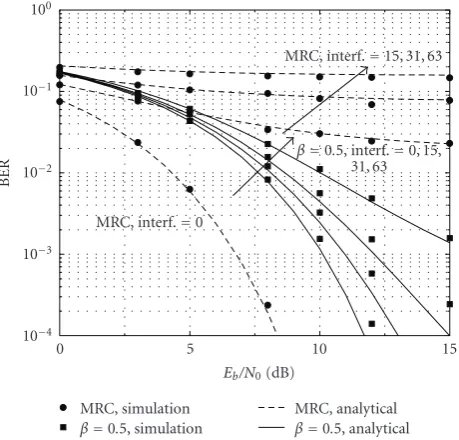
Figure3: BER versusEb/N0(dB) for partial equalization withβ=
−1 (MRC) andβ=0.5 when varying the number of interferers in
uncorrelated Rayleigh fading channels. Analytical and simulation results are compared.
of interference. As the number of interferers increases (note that MC-CDMA systems are usually considered for highly in-terfered conditions), the performance becomes significantly worst. On the other hand, PE withβ=0.5 significantly im-proves the performance as the interference increases with re-spect to MRC and makes the system less sensitive to the num-ber of interferers. In fact, as an example result, in the case of 15 interferers (i.e., with a system load of 25%), the case β=0.5 outperforms MRC already with 15 interferers.
It is now interesting to understand how these behaviors are confirmed also in time and frequency correlated fading channels, such as in SUI-1. InFigure 4, the impact of equal-ization techniques at both physical and TCP levels is inves-tigated in SUI-1 channel model. Here, the normalized TCP throughput is reported as a function ofEb/N0in dB as well
as of the number of interferers and of the equalization tech-niques (β= −1 andβ=0.5 are considered).
As can be observed, considerations similar to those made forFigure 3in uncorrelated channel can be made for Figure 4(a). Also in this case the impact of the combining technique and the number of interferers can be clearly ob-served. Moreover, all considerations suggested byFigure 4(a) with reference to the physical level are confirmed also at TCP level (seeFigure 4(b)). It is noticeable that the limited sensi-tivity of the performance to the number of interferers given by PE withβ=0.5 is even more evident at TCP level. More-over, the adoption of a particular equalization technique, such as PE in this case, at physical level can result in rele-vant throughput gain for several system loads at low SNRs, whereas the impact at the TCP level of the combining tech-nique is less evident when the SNR increases. Note that the performance at TCP level for uncorrelated Rayleigh channel
0 5 10 15
Eb/N0(dB) 10−4
10−3 10−2 10−1 100
BER
MRC β=0.5
Interf.=31, 63
Interf.=0, 31, 63 Interf.=0
(a) BER versusEb/N0(dB)
0 5 10 15
Eb/N0(dB) 60
80 100
N
o
rm
aliz
ed
thr
o
ug
hput
(%)
MRC, 0 interf. MRC, 31 interf. MRC, 63 interf.
β=0.5, 0 interf. β=0.5, 31 interf. β=0.5, 63 interf. (b) Normalized throughput versusEb/N0(dB)
Figure4: BER and normalized throughput versusEb/N0(dB) for
β= −1 (MRC) andβ=0.5 and for different number of interferers.
Time and frequency correlated SUI-1 channel.
is not investigated due to the TCP characteristic of being par-ticularly sensitive to correlated events.
This is an example on how our framework enables the careful verification of the impact of physical level solutions on the TCP performance.
In Figure 5, the BER and normalized throughput as a function ofEb/N0(dB) are shown in different types of
0 5 10 15 Eb/N0(dB)
10−3 10−2 10−1 100
BER
MRC
β=0.5 A
B C
D A B C D
(a) BER versusEb/N0(dB)
0 5 10 15
Eb/N0(dB) 60
80 100
N
o
rm
aliz
ed
thr
o
ug
hput
(%) β=0.5
MRC A B
C D
A B C
D
(b) Normalized throughput versusEb/N0(dB)
Figure5: BER and normalized throughput versusEb/N0(dB) for R3P time and frequency correlated channels. Fully loaded system.
a value ofβ=0.5 with respect to classical MRC can be ob-served both in terms of BER inFigure 5(a)and normalized throughput inFigure 5(b). These results enable a discussion on the impact of propagation channel on the performance at TCP level.
A comparison among PE withβ = 0.5 and other lin-ear combining techniques such as MRC, ORC, and EGC in SUI-1 channel model is presented inFigure 6in fully loaded conditions. As can be observed, PE outperforms the other techniques both in terms of BER and normalized through-put. Note also that MRC and ORC techniques do not allow to achieve the maximum normalized throughput for SNRs of interest.
InFigure 7, a comparison among optimum MMSE, sub-optimum MMSE, and PE with β = 0.5 is given in SUI-1 channel model. In particular,Figure 7(a)shows the BER
ver-0 2 4 6 8 10 12 14
Eb/N0(dB) 10−3
10−2 10−1
BER
MRC ORC
EGC β=0.5 (a) BER versusEb/N0(dB)
0 5 10 15
Eb/N0(dB) 60
80 100
N
o
rm
aliz
ed
thr
o
ug
hput
(%)
MRC ORC
EGC β=0.5 (b) Normalized throughput versusEb/N0(dB)
Figure6: BER and normalized throughput versusEb/N0(dB) for
β=−1 (MRC),β=0.5,β=0 (EGC) andβ=1 (ORC) when the
sys-tem is fully loaded. Time and frequency correlated SUI-1 channel.
susEb/N0(dB) for optimum MMSE in the fully loaded
con-dition, suboptimums MMSE and PE withβ = 0.5 for half and fully loaded system (note that suboptimums MMSE and PE have the same complexity). For the suboptimal MMSE so-lution we have assumedγmax=11.5 (dB) giving BER=10−3
0 5 10 15 Eb/N0(dB)
10−4 10−3 10−2 10−1 100
BER
Subopt. MMSE, 31 interf. β=0.5, 63 interf. β=0.5, 31 interf.
Subopt. MMSE, 63 interf. MMSE, 63 interf. (a) BER versusEb/N0(dB)
0 5 10 15
Eb/N0(dB) 60
80 100
N
o
rm
aliz
ed
thr
o
ug
hput
(%)
MMSE, 63 interf. Subopt. MMSE, 63 interf. β=0.5, 31 interf.
β=0.5, 63 interf. Subopt. MMSE, 31 interf. (b) Normalized throughput versusEb/N0(dB)
Figure7: BER and normalized throughput versusEb/N0(dB) for time and frequency correlated SUI-1 channel. Comparison among
MMSE, suboptimum MMSE and partial equalization withβ=0.5.
Note that we are comparing parameterized combining techniques, such as suboptimums MMSE and PE with fixed value of the parameter. Since suboptimum MMSE is tuned for the fully loaded case, a reduction of the actual num-ber of interferers implies an underestimate of the parameter 1/(Nuγ) in (12) towards the ORC scheme, thus
emphasiz-ing the effect of thermal noise with respect to the optimum
−1 −0.8 −0.6 −0.4 −0.2 0 0.2 0.4 0.6 0.8 1 β
10−3 10−2 10−1 100
BER
Uncor., 31 interf. Uncor., 63 interf. SUI-1, 31 interf. SUI-1, 63 interf.
SUI-2, 31 interf. SUI-2, 63 interf. R3P-A, 31 interf. R3P-A, 63 interf. Uncorrelated
R3P-A
SUI-2
SUI-1
(a) BER versusβ
−1 −0.8 −0.6 −0.4 −0.2 0 0.2 0.4 0.6 0.8 1 β
60 65 70 75 80 85 90 95 100
N
o
rm
aliz
ed
thr
o
ug
hput
(%)
R3P-A, 31 interf. R3P-A, 63 interf. SUI-1, 31 interf.
SUI-1, 63 interf. SUI-2, 31 interf. SUI-2, 63 interf. R3P-A
SUI-2 SUI-1
(b) Normalized throughput versusβ
Figure 8: BER and normalized throughput versusβvarying the
channel model and the numbers of interferers forEb/N0=10 dB.
choice ofλ. Same considerations can be derived in terms of throughput by observingFigure 7(b).
SNRs of interest in [23]), but, as can be observed, the TCP throughput is affected by the adopted equalization technique for low SNRs and it is quite insensible to the physical level technique when the SNR increases.
Finally, inFigure 8the impact of the PE parameter, β, on both the BER and the normalized throughput can be ob-served for a given SNR varying the channel models and the system load. In particular, inFigure 8(a)the BER at the de-coder input is presented as a function ofβforEb/N0=10 dB
and for different system loads (half loaded and fully loaded system). A comparison among uncorrelated and correlated SUI-1, SUI-2, and R3P-A fading channels is also shown. As can be observed, the choice of β significatively affects the physical level performance when considering uncorrelated Rayleigh fading channels, while the BER behavior is more slightly affected by the values ofβin correlated channels con-ditions. What is remarkable is that the optimum value of β(minimizing the BER) depends on many parameters: the channel model, the system loads, and the mean SNR. Note also the impact of an accurate choice ofβon the performance in terms of throughput perceived by the user inFigure 8(b) in particular for SUI-2 and R3P-A channel models.
7. CONCLUSIONS
In this paper, we investigated the impact, at both physical and TCP levels, of different combining techniques for the down-link of MC-CDMA systems. By means of an integrated plat-form carefully taking into account all main aspects affecting the quality of service at the final user, the results in terms of bit-error rate at the decoder input and the TCP through-put for a huge file transfer in downlink have been derived. In our opinion, they enable relevant considerations on how equalization techniques that improve the performance at the physical level in the presence of interference, really affects the quality of service perceived by the final user. In particular, our numerical results show the impact of the different chan-nel conditions (such as uncorrelated Rayleigh fading, time and frequency correlated Rayleigh fading, and SUI channels), system loads and combining techniques on the performance at physical and TCP level, allowing us to draw the following conclusions:
(i) the BER is more sensitive to the combining technique in uncorrelated channels than in time and frequency correlated channels;
(ii) the throughput is sensitive to the combining technique for low and moderate SNRs, while the impact of the combining technique is less evident when the SNR in-creases;
(iii) PE technique is less sensitive to the number of interfer-ers rather than classical MRC or suboptimum MMSE, providing a good solution for MC-CDMA systems. This effect is still more evident in terms of throughput.
ACKNOWLEDGMENTS
The authors would like to thank the anonymous Reviewers for the helpful suggestions enabling us to improve the
qual-ity of the paper. This research work was supported by the European network of excellence in wireless communications (NEWCom). This paper reflects part of the activities made in Project C of the European Network of Excellence in Wireless Communication (NEWCom).
REFERENCES
[1] N. Yee, J.-P. Linnartz, and G. Fettweis, “Multi-Carrier-CDMA
in indoor wireless networks,” in Proceedings of the
Confer-ence (PIMRC ’93), pp. 109–113, Yokohama, Japan, September 1993.
[2] K. Fazel, “Performance of CDMA/OFDM for mobile
commu-nication system,” inProceedings of the 2nd International
Con-ference on Universal Personal Communications (ICUPC ’93), vol. 2, pp. 975–979, Ottawa, Canada, October 1993.
[3] S. Kaiser, “OFDM-CDMA versus DS-CDMA: performance
evaluation for fading channels,” in Proceedings of the IEEE
International Conference on Communications (ICC ’95), pp. 1722–1726, June 1995.
[4] S. Kaiser, “On the performance of different detection
tech-niques for OFDM-CDMA in fading channels,” in
Proceed-ings of the 1995 IEEE Global Telecommunications Conference (GLOBECOM ’95), vol. 3, pp. 2059–2063, Singapore, Novem-ber 1995.
[5] M. Schnell and S. Kaiser, “Diversity considerations for
MC-CDMA systems in mobile communications,” in Proceedings
of the IEEE 4th International Symposium on Spread Spectrum Techniques and Applications, vol. 1, pp. 131–135, September 1996.
[6] S. Hara and R. Prasad, “Overview of multicarrier CDMA,” IEEE Communications Magazine, vol. 35, no. 12, pp. 126–133, 1997.
[7] N. Yee and J.-P. Linnartz, “BER of multi-carrier CDMA in an
indoor Rician fading channel,” inProceedings of the 27th
Asilo-mar Conference on Signals, Systems & Computers, vol. 1, pp. 426–430, Pacific Grove, Calif, USA, November 1993.
[8] O. Andrisano, D. Dardari, and G. Mazzini, “An integrated
ap-proach for the design of wide-band wireless LANs,” in
Proceed-ings of the IEEE (ICT ’98), pp. 121–126, Porto Carras, Greece, June 1998.
[9] J. G. Proakis, Digital Communications, McGraw-Hill, New
York, NY, USA, 4th edition, 2001.
[10] N. Yee and J.-P. Linnartz, “Controlled equalization of
multi-carrier CDMA in an indoor Rician fading channel,” in
Pro-ceedings of the 1994 IEEE 44th Vehicular Technology Conference, vol. 3, pp. 1665–1669, Stockholm, Sweden, June 1994. [11] N. Yee and J.-P. Linnartz, “Wiener filtering for Multi-Carrier
CDMA,” inProceedings of the IEEE Conference on Personal
Indoor Mobile Radio Communications (PIMRC) and Wireless Computer Networks (WCN), vol. 4, pp. 1344–1347, Hague, The Netherlands, September 1994.
[12] A. Conti, B. Masini, F. Zabini, and O. Andrisano, “On the down-link performance of multi-carrier CDMA systems with
partial equalization,”IEEE Transactions on Wireless
Communi-cations, vol. 6, no. 1, pp. 230–239, 2007.
[13] S. Kaiser, “OFDM code-division multiplexing in fading
chan-nels,”IEEE Transactions on Communications, vol. 50, no. 8, pp.
1266–1273, 2002.
[14] I. Cosovic and S. Kaiser, “Exploitation of diversity in
MC-CDMA systems,” inProceedings of the 6th IEE International
[15] I. Cosovic, M. Schnell, and A. Springer, “Combined
equaliza-tion for uplink MC-CDMA in Rayleigh fading channels,”IEEE
Transactions on Communications, vol. 53, no. 10, pp. 1609– 1614, 2005.
[16] I. Cosovic, M. Schnell, and A. Springer, “Pre-, post-, and combined-equalization single-user bounds for MC-CDMA,” inProceedings of the 7th European Conference on Wireless Tech-nology (ECWT ’04), pp. 321–324, Amsterdam, The Nether-lands, October 2004.
[17] S. B. Slimane, “Partial equalization of Multi-Carrier CDMA in
frequency selective fading channels,” inProceedings of the IEEE
International Conference on Communications, vol. 1, pp. 26–30, New Orleans, La, USA, June 2000.
[18] V. Erceg, K. V. S. Hari, M. S. Smith, et al., “Channel Models for Fixed Wireless Applications,” revised version of the document IEEE 802.16.3c-01/29r4. The IEEE 802.16 Working Group on Broadband Wireless Access Standards, http://wirelessman.org/tga/docs/80216a-03 01.pdf.
[19] M. K. Simon and M.-S. Alouini,Digital Communication over
Fading Channels: A Unified Approach to Performance Analysis, John Wiley & Sons, New York, NY, USA, 1st edition, 2000. [20] A. Bazzi, C. Gambetti, and G. Pasolini, “SHINE: simulation
platform for heterogeneous interworking networks,” in
Pro-ceedings of the IEEE International Conference on Communica-tions (ICC ’06), Istanbul, Turkey, June 2006.
[21] S. Floyd and T. Henderson, “The NewReno Modification to TCP’s Fast Recovery Algorithm,” RFC 2582, April 1999.
[22] H. S. Abdel-Ghaffar and S. Pasupathy, “Asymptotical
performance of M-ary and binary signals over
multi-path/multichannel Rayleigh and Rician fading,”IEEE
Trans-actions on Communications, vol. 43, no. 11, pp. 2721–2731, 1995.
[23] A. Conti, M. Z. Win, and M. Chiani, “On the inverse
symbol-error probability for diversity reception,”IEEE Transactions on