Earth Planets Space,55, 705–711, 2003
Numerical study on the spatial extent of interaction region surrounding comet
nucleus—Ion pick-up process
Yuto Katoh1∗, Hiroshi Oya2, Masahide Iizima1, and Takayuki Ono1
1Department of Geophysics, Graduate School of Science, Tohoku University, 980-8578, Japan 2Fukui University of Technology, 910-4272, Japan
(Received July 15, 2003; Revised October 26, 2003; Accepted October 28, 2003)
The observations made by Sakigake revealed the asymmetric distribution of the interaction region of Halley’s comet, and the center of the interaction region was shifted toward the post-encounter side on the spacecraft trajectory. Oya (1993) proposed the model that this asymmetric distribution is explained by the field aligned motion of picked up ions. Based on this model, we examined spatial and time scale of field aligned motion of cometary ions in the ion pick-up process by using numerical experiments and the shift of the interaction region is estimated. In the simulation results, it was shown that the braking process of the field aligned motion of picked up ions are understood by the wave particle interaction through the excitation of the MHD wave and pitch angle scattering caused by the turbulent magnetic field, and spatial scale of field aligned motion of cometary ion was estimated to
1.5×10⁶km. This result suggests that observed asymmetrical distribution of the interaction region of the comet is
formed by the motion of picked up ions toward the field aligned direction until their merging into the solar wind, as it was proposed by Oya (1993).
Key words:Comet-solar wind interaction, ion pick-up, ion beam instability, hybrid simulation.
1.
Introduction
Since the achievement of the international collaboration of Comet Halley observation (IHW in 1986–1987), there have been many remarkable studies on the interaction of the cometary plasma with the solar wind. Based on results of the plasma wave experiments made by Sakigake for Comet Halley, Oya (1993) states that the plasma turbulence region distributes with a very clear asymmetrical feature with re-spect to the nucleus of Halley’s Comet; plasma turbulence
was first observed at the distance of 107km from the nucleus
in the pre-encounter side, and extended to the distance of
2.2×10⁷km in the post-encounter side. Since the
obser-vational results showed that the center of interaction region
was shifted 5×10⁶km toward the post-encounter side, Oya
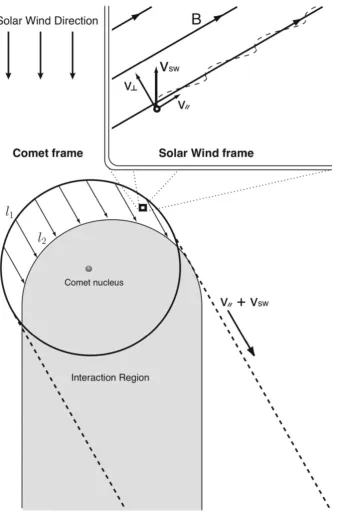
(1993) proposed a model that this asymmetric distribution is caused by an obliqueness of interplanetary magnetic field with respect to the direction of solar wind plasma flow, as shown in Fig. 1. In this model, cometary ions move along the magnetic field direction and this field aligned motion makes asymmetrical distribution in a plane which is paral-lel to the magnetic field line till merging into solar wind. This asymmetric picture was also observed by ion detector
onboard Giotto (McKenna-Lawloret al., 1986).
In the present paper we study on the wave particle interac-tion process carried out in the ion pick-up process examining nonlinear evolution of electromagnetic waves in the
Comet-∗Present address: Radio Science Center for Space and Atmosphere,
Kyoto University, 611-0011, Japan.
Copy right cThe Society of Geomagnetism and Earth, Planetary and Space Sciences (SGEPSS); The Seismological Society of Japan; The Volcanological Society of Japan; The Geodetic Society of Japan; The Japanese Society for Planetary Sciences.
Coma region extended up to a scale size of 107km.
Spa-tial scale size of asymmetry of Comet-Coma region is deter-mined by the scale of field aligned motion of picked up ions. Trapped cometary ions are finally merged into the solar wind plasma flow due to the nonlinear wave particle interaction process. To explain the asymmetric distribution of cometary ion, it is necessary to understand the quantitative character of the ion pick-up process inside the Comet-Coma region. Our purpose in this paper is to investigate the braking process of the field aligned motion of picked up ions which directly de-termines the spatial scale of the asymmetry of Comet-Coma region.
There have been many theoretical studies and numeri-cal experiments of the wave particle interaction caused by
the ion beam instability (e.g. Garyet al., 1986; Omidi and
Winske, 1987) concerning the ion pick-up process near the cometary coma region. They achieved the basic understand-ing of ion pick up process; namely, the large amplitude MHD wave is excited by ion beam instability where cometary ions act as energy source of waves. Large amplified MHD wave induces the daughter waves through its decay process (Tera-sawaet al., 1986; Kojimaet al., 1989) and turbulent state is generated in the upstream of the comet (Krauklis and John-stone, 1998). Near the cometary shock, in those scenario, picked up ions are thermalized through the interaction with the turbulent fluctuations and form shell distribution in the
velocity space (Wuet al., 1986; Karimabadiet al., 1994).
Generation process of MHD waves and particle motions in the vicinity of the cometary shock region has been well in-vestigated, however, it remains to be studied about details of field aligned motion and merging process of cometary ions into solar wind plasma. This problem requires a numerical
Fig. 1. Schematic diagram of asymmetric distribution of interaction region (after Oya, 1993). When the ionization of cometary particles takes place on the co-circular linel1, the ions start to move in the direction of arrow which is controlled by the local magnetic field direction. The field aligned motion of cometary ions survive till merging into the solar wind. In this diagram, cometary ions stop their field aligned motion at the linel2, and asymmetry is formed as described by shaded region.
experiments with a long time scale, which was difficult to be carried out for a decade because of the limitation of the computational resources and the technical problem due to suffering of numerical heating of ions through the long sim-ulation running caused by small number of superparticles in the “particle in cell” (PIC) method. By using results of long time scale hybrid simulation in this paper, we discuss on the merging process of cometary ions into solar wind where spa-tial distribution of interaction region is deeply influenced by field aligned motion of picked up ions.
2.
Linear Theory
Y. KATOHet al.: NUMERICAL STUDY ON THE ION PICK-UP PROCESS 707
(a) 0.28
0.26
0.24
0.22
0.20
0.18
Ener
gy of Ma
gnetic Field
T
urb
ulence
(b) 0.22
0.20
0.18
0.16
0.14
0.12
Kinetic Ener
gy ( Oxyg
en )
(c) 0.80
0.75
0.70
0.65
0.60
0.55
0.50
Kinetic Ener
gy ( Pr
oton )
(d) 10
8
6
4
2
0
V
elocity [
VA
]
800 600
400 200
0
Time Step [ Tcp ]
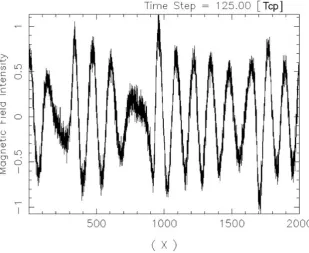
Fig. 3. Snap shot of Y component of magnetic field at 125Tcp. Large amplitude MHD wave is excited by ion beam instability with wave length 140
VATcp.
is much greater than initial velocity of ionized cometary
par-ticles (∼1 km/s). The beam drift velocity along the magnetic
fieldvb is defined by vb = VSWcosθ, whereθ is an
an-gle betweenB0 andVSW. Although the modification of the
instability in the case of the non-zeroθhas been well
investi-gated by several workers (e.g. Winskeet al., 1985), in order
to see detail of field aligned motion of cometary ions, here we examine a special case that solar wind flow is directed in
parallel to the ambient magnetic field direction,θ=0◦.
The plasma parameters used in this model are selected based on the results of in-situ observation at Comet-Coma
region measured by Sakigake (Saitoet al., 1986); namely,
magnetic field intensity ofB0=5 nT and the solar wind
ve-locity ofVSW =450 km/s. The particle number densities are
given asnp =ne=5 cm−3, andnO=nE =4×10⁻³cm−3,
which are based on the model estimated by using
observa-tion results by Giotto (Wegmannet al., 1987). Temperature
of particles are selected as Tp = Te = TE = 1×10⁵K,
TO = 1.93×10³K, where the subscripts p, e denote the
quantities associated with solar wind protons and electrons,
and the subscripts O, E denote the quantities of cometary
origin oxygen ions and electrons, respectively. For the par-ticle distribution functions of ions and electrons in the solar wind and cometary origin, a shifted bi-Maxwellian velocity distributions are assumed for each species.
Numerical calculations of the linear dispersion equation showed plasma instability of ion waves due to the cometary ion beams. The dispersion relation reveals that plasma waves
are generated due to the ion beam instability,ω+kvb= co,
where co is gyrofrequency of oxygen ion, in the region
ω: 2.34×10⁻² p, k: 6.0×10⁻³ R−p1, where Rp is the
Larmor radius of solar wind proton, with the growth rate
of 3.4 ×10⁻³ −p1. This solution is consistent with
previ-ous studies that ion beam instability is the dominant factor
of wave excitation whenθ is nearly zero (e.g., Omidi and
Winske, 1986), and this wave mode has Right-handed prop-agation mode. Wave length with the maximum growth rate
is 138vATcpwhereTcprefers the gyro-period of proton; this
results from the linear dispersion relation give an important parameter for the preparation of computer simulation scheme that the scale size of simulation system should be larger than this wave length.
3.
Hybrid Simulation
To examine the nonlinear evolution of MHD waves, we utilize one dimensional hybrid simulation code, while ions are treated as particles while electrons are assumed to be a fluid with negligible mass. We adopt the periodic condition at the boundary of our model. The simulation frame is as-sumed to be moving with the solar wind velocity. Within the
simulation frame, protons of solar wind origin and O+ ions
of cometary origin are taken into account, while electrons behave to establish the charge neutrality.
Basic equations are given as,
Y. KATOHet al.: NUMERICAL STUDY ON THE ION PICK-UP PROCESS 709
(a) (b)
(c) (d)
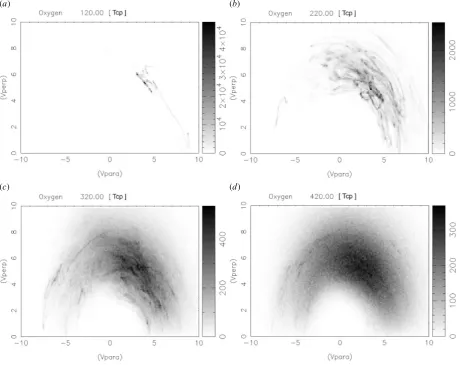
Fig. 4. Velocity distribution of cometary ions inv−v⊥plane at (a) 120, (b) 220,(c) 320, (d) 420Tcp. After saturation of MHD wave amplitude, pitch
angle of cometary ions is scattered and become isotropic.
J= 1
μ0
∇ ×B (5)
∇ ·B=0 (6)
where the subscripti denote the quantities associated with
ions; solar wind proton and cometary oxygen ions, and the
subscriptedenote the electrons, respectively. The constant
ηin Eqs. (1) and (3) represent the viscosity of MHD plasma,
however, it is assumed asη=0, because a mean free path is
significantly larger than the scale size (about 106km) of the
present model.
To implement the simulation code, each physical values are normalized to be a dimensionless quantities, namely,
time is normalized by proton gyro-periodTcp, and velocity
and length are normalized by Alfv´en speed VA andVATcp,
respectively. We choose grid length x as 0.4 VATcp and
time stept as 0.02Tcp, and system lengths Lxas 5000x,
which satisfy the time and spatial limits comparing with the results of the linear analysis.
Since the motions of both cometary ions and solar wind protons are treated by using PIC (Particle in Cell) method, we assumed the number of superparticles as 160 per grid
that is relatively large number comparing with previous stud-ies (e.g., Winske and Omidi, 1993) to avoid numerical ther-malization of particles due to the long time scale simulation. We have confirmed that the numerical accuracy (10% for the conservation of total energy) are conserved till time step of
800Tcp by employing 160 superparticles.
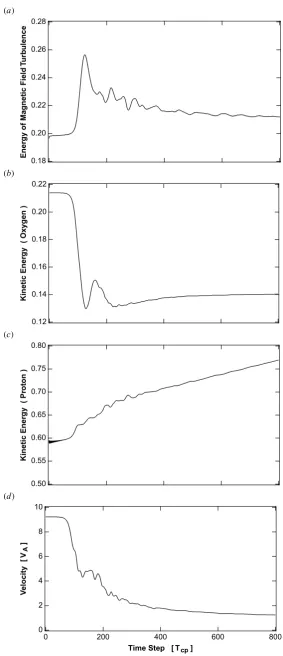
Figure 2 shows the results of the hybrid simulation giving time progress of energies and the average field aligned ve-locity of cometary ions. The variation of the magnetic field energy is given in Fig. 2(a), while a significant growth of the magnetic field energy arises with the maximum
inten-sity at the time step of 125Tcp. This is due to the excitation
of large amplitude MHD wave. Figure 3 shows a snap shot of magnetic field fluctuation along the background magnetic
field line at the time step of 125Tcp. Examining the plasma
waves shown in Fig. 3, we can see plasma instability gener-ating large amplitude MHD wave with the R-mode propaga-tion character that is recognized as Fast-mode Alfv´en wave.
At time-step 125Tcp in Fig. 2(d), excitation of large
ampli-tude wave is associated with rapid decrease of the ion beam drifting parallel to the magnetic field.
Since amplitude of MHD wave reaches a saturation level
grad-10
Field aligned velocity of cometar
y ions [
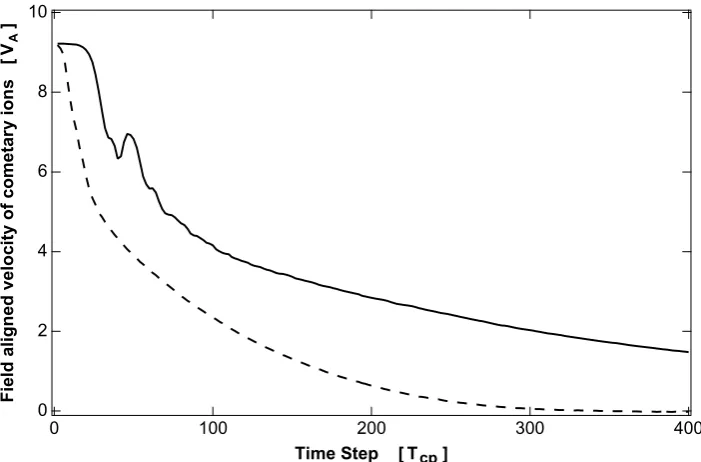
Fig. 5. Variation of field aligned velocity of pick-up ions in test simulations assuming helium (solid line) and proton ions (dashed line) for the cometary ions.
ual damping signature. Although kinetic energy of cometary ions converges to an appropriate value, field aligned com-ponent of cometary ion velocity still keeps decreasing sig-nature continuously. Figure 4 shows velocity distribution
of cometary ions in phase space at 120, 220, 320, 420Tcp.
As it is shown in Fig. 4 that pitch angle of cometary ions is scattered and velocity distribution of cometary ions becomes isotropic that is similar to the shell distribution of cometary
ions discovered in the Comet-Coma region (Mukai et al.,
1986) which is explained by the pitch angle scattering of
cometary ions (Wuet al., 1986; Garyet al., 1986). Based on
the temporal change of the pitch angle distribution, it is con-cluded that a gradual decrease of the bulk velocity of oxygen ions is caused by the effect of pitch angle scattering.
4.
Summary and Discussion
Simulation results show that field aligned drifting speed of cometary ion is decreased due to the energy transfer to the generating of MHD waves and initial pitch angle distri-bution is suffered by a significant scattering effect due to an effective collision process with MHD wave. Turbulent state of MHD waves also causes energization of background solar wind protons as it is shown in Fig. 2(c). Even after the satura-tion of MHD waves, pitch angle scattering of cometary ions is still sustained and the velocity distribution of ions is also kept changing forward to the isotropic character because tur-bulent state of MHD waves is still active due to the remainder of beam component of cometary ions. An effective collision process between cometary ions and MHD waves results pitch angle scattering of cometary ions as shown in Fig. 4, that is the major process of the decreasing of field aligned velocity of cometary ions as it has been shown in Fig. 2(d). There-fore, Figure 2 shows the acceleration process of cometary ion to the solar wind velocity due to the nonlinear wave par-ticle interaction between the MHD waves and oxygen ions
of comet origin.
At the time progress of 800Tcp, bulk velocity of cometary
ions reaches nearly equal to Alfv´en velocity. Although it is a little amount, there can be still seen a continuous decrease of the field aligned velocity component. To see the terminal stage of the ion pick-up process, we examine test simulations assuming helium and proton ions for the cometary ions. We tested by using ions because these simulation results show that light cometary ions excite MHD waves rapidly and also they are rapidly merged into solar wind clearly, as shown in Fig. 5, although intensity of MHD waves is lower than the case of oxygen. The results of these simulations showed that cometary oxygen ions are possibly merged into the solar wind finally. Since spatial scale of asymmetry of Comet-Coma region is controlled by field aligned motion of pick up ions, we estimate spatial scale of field aligned motion of
cometary ion from Fig. 2(d) to 1.5×10⁶km. Although this
scale is rather small comparing with the scale of observed
asymmetry, namely 5×10⁶km, asymmetry of Comet-Coma
region by Sakigake was observed in a condition where the angle between solar wind flow and magnetic field was nearly
45◦. This condition suggests that intensity of MHD wave
was lower than the case of present study because of initial speed of field aligned motion of cometary ion was lower than that of solar wind. Low wave activity causes a tendency that field aligned motion of cometary ions survive for a long time, so it is inferred that spatial extent of the turbulent
region becomes larger than that of the present case ofθ =
0◦. Therefore, it should be said that the spatial scale of the
interaction region which is examined in the present paper is the minimum case. Although a two dimensional simulation
is required to study the more realistic case of non-zero θ,
the physical basis of the merging process of cometary ions would be same as studied in the present paper.
Y. KATOHet al.: NUMERICAL STUDY ON THE ION PICK-UP PROCESS 711
the field aligned motion of picked up ions are understood by the wave particle interaction through the excitation of the MHD wave and pitch angle scattering caused by the turbu-lent magnetic field, and cometary ions are finally merged into the solar wind plasma flow. The result of the present paper supports the scenario that observed asymmetrical distribu-tion of the interacdistribu-tion region of the comet is formed by the motion of picked up ions toward the field aligned direction until their merging into the solar wind, as it was proposed by Oya (1993).
Acknowledgments. The base of this research was built by master thesis of Mr. Takashi Inaba, Tohoku University, 1996. Numerical computation in the present work were performed at the Information Synergy Center of Tohoku University and at the Information Sci-ence Center, National Institute of Polar Research, Japan. Effort of T. Ono is supported by the 21th Century COE program by the Min-istry of Education, Culture, Sports, Science and Technology, Japan. The authors thank D. Winske and another referee for valuable com-ments and discussions.
References
Gary, S. P., C. D. Madland, D. Schriver, and D. Winske, Computer simula-tions of electromagnetic cool ion beam instabilities,J. Geophys. Res.,91, 4188–4200, 1986.
Karimabadi, H., D. Krauss-Varban, N. Omidi, S. A. Fuselier, and M. Neuge-bauer, Low-frequency instabilities and the resulting velocity distributions of pickup ions at comet Halley,J. Geophys. Res.,99, 21541–21556, 1994. Kojima, H., H. Matsumoto, Y. Omura, and B. T. Tsurutani, Nonlinear evo-lution of high frequency R-mode waves excited by water group ions near comets: computer experiments,Geophys. Res. Lett.,16, 9–12, 1989. Krauklis, I. and A. D. Johnstone, The turbulent state of cometary ion
pickup generated fluctuations near comet P/Halley,J. Geophys. Res.,103,
12005–12014, 1998.
McKenna-Lawlor, S., E. Kirsch, D. O’Sullivan, A. Thompson, and K. P. Wenzel, Energetic ions in the environment of comet Halley,Nature,321, 347–349, 1986.
Mukai, T., W. Miyake, T. Terasawa, M. Kitayama, and K. Hirao, Plasma ob-servation by Suisei of solar-wind interaction with comet Halley,Nature, 321, 299–303, 1986.
Omidi, N. and D. Winske, A kinetic study of solar wind mass loading and cometary bow shocks,Geophys. Res. Lett.,13, 397–400, 1986. Omidi, N. and D. Winske, Simulation of the solar wind interaction with the
outer regions of the coma,J. Geophys. Res.,92, 13409–13426, 1987. Oya, H., Interaction of plasma of Halley’s comet with the solar wind, in
Primitive Solar Nebula and Origin of Planets,edited by H. Oya, pp. 579– 614, 1993.
Saito, T., K. Yumoto, K. Hirao, T. Nakagawa, and K. Saito, Interaction between comet Halley and the interplanetary magnetic field observed by Sakigake,Nature,321, 303–307, 1986.
Terasawa, T., M. Hoshino, J.-I. Sakai, and T. Hada, Decay instability of finite-amplitude circularly polarized Alfv´en waves: a numerical simula-tion of stimulated Brillouin scattering,J. Geophys. Res.,91, 4171–4187, 1986.
Wegmann, R., H. U. Schmidt, W. F. Huebner, and D. C. Boice, Cometary MHD and Chemistry,Astron. Astrophys.,187, 339–350, 1987. Winske, D. and N. Omidi, Hybrid codes: methods and application, in
Com-puter Space Plasma Physics: Simulation Techniques and Software, edited by H. Matsumoto and Y. Omura, 103 pp, Terra Scientific Publishing Company, Tokyo, 1993.
Winske, D., C. S. Wu, Y. Y. Li, Z. Z. Mou, and S. Y. Guo, Coupling of newborn ions to the solar wind by electromagnetic instabilities and their interaction with the bow shock,J. Geophys. Res.,90, 2713–2726, 1985. Wu, C. S., D. Winske, and J. D. Gaffey, Jr., Rapid pickup of cometary ions
due to strong magnetic turbulence,Geophys. Res. Lett.,13, 865–868, 1986.