R E S E A R C H
Open Access
Instantly decodable network coding for
real-time device-to-device communications
Ahmed Douik
1*, Sameh Sorour
2, Tareq Y. Al-Naffouri
2,3and Mohamed-Slim Alouini
3Abstract
This paper studies the delay reduction problem for instantly decodable network coding (IDNC)-based device-to-device (D2D) communication-enabled networks. Unlike conventional point-to-multipoint (PMP) systems in which the wireless base station has the sufficient computation abilities, D2D networks rely on battery-powered operations of the devices. Therefore, a particular emphasis on the computation complexity needs to be addressed in the design of delay reduction algorithms for D2D networks. While most of the existing literature on IDNC directly extend the delay reduction PMP schemes, known to be NP-hard, to the D2D setting, this paper proposes to investigate and minimize the complexity of such algorithms for battery-powered devices. With delay minimization problems in IDNC-based systems being equivalent to a maximum weight clique problems in the IDNC graph, the presented algorithms, in this paper, can be applied to different delay aspects. This paper introduces and focuses on the reduction of the maximum value of the decoding delay as it represents the most general solution. The complexity of the solution is reduced by first proposing efficient methods for the construction, the update, and the dimension reduction of the IDNC graph. The paper, further, shows that, under particular scenarios, the problem boils down to a maximum clique problem. Due to the complexity of discovering such maximum clique, the paper presents a fast selection algorithm. Simulation results illustrate the performance of the proposed schemes and suggest that the proposed fast selection algorithm provides appreciable complexity gain as compared to the optimal selection one, with a negligible degradation in performance. In addition, they indicate that the running time of the proposed solution is close to the random selection algorithm.
Keywords: Device-to-device communications, Instantly decodable network coding, Maximum weight clique
1 Introduction
Network coding (NC), initiated by Ahlswede, Cai, Li, and Yeung in their seminal paper [1], is a simple yet powerful technique to improve the performance of the communication systems significantly. The fundamental concept of NC is to perform arbitrary coding opera-tions on the contents of packets rather than the direct replication and forwarding implemented in traditional store-and-forward networks. Such inter-network coding enables a high throughput [2], a fast recovery [3], and reli-able communications over lossy channels [4]. The merits of NC are even more noticeable in broadcast wireless net-works allowing it to be a graceful solution and a suitable technique for real-time applications [5, 6].
*Correspondence: [email protected]
1California Institute of Technology (Caltech), Pasadena, California, USA Full list of author information is available at the end of the article
In the last few years, instantly decodable network cod-ing (IDNC) attracted a considerable amount of research [7–10]. As its name indicates, IDNC allows instantaneous and progressive decoding of packets, a propriety of great interest for real-time applications. IDNC is implemented by mixing packets using the binary fieldF2, i.e., encoding
is performed using binary XOR operations [11]. To further reduce the decoding complexity, non-instantly decodable packets are discarded at users [12]. Such features in IDNC enable the design of cost-efficient receiver devices as they allow fast XOR-based encoding and decoding and remove the need for buffers.
Consider a radio access network in which a base station (BS) is required to deliver a frame, composed of sev-eral packets, to a set of users. In an initial phase, the BS broadcasts the packets one after the other. The era-sure nature of the wireless medium creates a diversity of received/lost packets at each user. The “sender" takes advantage of such diversity to transmit XOR-encoded
packets targeting multiple receivers. The process, called the recovery phase, is repeated until all users success-fully receive all packets. In previously mentioned IDNC works, the BS is assumed to be the sole sender in the sys-tem and hence the only responsible for both the initial and the recovery phases. Such point-to-multipoint (PMP) network configuration jeopardizes the ability of the BS to satisfy the ever more increasing data rate requirements notably in the next generation mobile radio system (5G) [13]. To mitigate the aforementioned effect, the notion of device-to-device (D2D) communications [14] is proposed as a promising technique for 5G. Taking advantages of the potentially more reliable short-range communications [14], devices are allowed to transmit to each other coded packet resulting in an increase in performance [15–18].
Despite its obvious advantages, the emergence of the D2D paradigm entails the redesign of the old proto-cols instead of their mere transplantation as it brings an additional set of challenges, particularly in terms of the computation complexity. Whereas in conventional PMP systems, the BS has the sufficient computation abilities to carry sophisticated optimizations, and D2D networks rely on battery-powered operations of the devices. There-fore, a particular emphasis on the computation complexity needs to be addressed in the design of delay reduction algorithms for D2D networks. Such redesign ranges from the optimization steps to the sacrifice of optimality to the benefit of convergence speed. This paper proposes to reduce the complexity of the delay reduction algorithms through efficient construction, update, and dimension reduction of the solution. The paper, further, suggests a fast selection algorithm with appreciable complexity gain as compared to the literature schemes and a negligible degradation in performance.
1.1 Related work
Due to the erasure nature of the links in wireless networks that affects the delivery of meaningful data, the receivers are no longer able to decode the frame synchronously. Therefore, a better use of the channel and network does not reflect an adequate throughput at higher communica-tion layers [19]. Studies on IDNC can mainly be divided into two groups in which the delay is considered as the following:
• Completion time: the overall transmission time • Decoding delay: the individual delay when delivered a
useless packet at its reception moment
The completion time experienced is composed of a fixed delay (the initial transmission phase of the frame) and a variable delay (the recovery period). This defini-tion of delay depends on the channel condidefini-tion. If the channel condition is harsh, i.e., high erasure probability, the completion time increases regardless of the reception
status of the packet. On the other hand, the decoding delay offers a definition more independent of the chan-nel conditions since no delay is taken into account if the intended packet is erased and only delays due to the chosen encoded packet are considered. Furthermore, the decoding delay quantifies the degradation as compared to the “optimal” scheme in which the sender is able to satisfy all users by a new packet at each transmission.
In all aforementioned works, the authors considered the decoding delay as the sum of all the individual decoding delays experienced by all receivers. This definition of delay does not permit to have an equitable distribution of the delays between the different receivers since only the sum of all the individual delays counts. This paper introduces the maximum delay, i.e., the maximum value of the decod-ing delay experienced by all users, as a more reliable delay metric in IDNC that offers a better quality of service.
Recently, some works [20–23] begin to address the delay reduction problem in IDNC-enable D2D network config-uration. While the authors in [20, 21, 23] design algorithm for the sum decoding delay reduction, references [20, 22] propose schemes for the completion time reduction. However, these works intersect as they directly extend the delay reduction PMP schemes, known to be NP-hard, to the D2D setting without considering the complexity issue for such battery-powered networks.
This paper’s main contribution is to propose efficient algorithms for the delay reduction in IDNC-based D2D networks. This paper introduces and focuses on the maximum-delay reduction as it represents the most gen-eral solution. The paper reduces the complexity of the solution by first proposing efficient methods for the con-struction, the update, and the dimension reduction of the IDNC graph. The paper, further, shows that, under par-ticular scenarios, the problem boils down to a maximum clique problem. Due to the complexity of discovering such maximum clique, the paper presents a fast selection algorithm.
The techniques proposed in this paper are independent of the setting and the considered metric. Indeed, as delay minimization problems in IDNC-based systems are equiv-alent to a maximum weight clique problems in the IDNC graph, the presented algorithms can be applied to different delay aspects and network settings. For example, they can be applied to reduce the complexity of the sum decoding delay minimization problem in imperfect feedback sce-nario proposed in [24] to the decentralized completion time reduction algorithm for D2D networks proposed in [22].
2 System model and problem formulation
2.1 System model and parameters
this paper, the term packet has a general connotation that includes messages, files, frames from a video stream, etc. Each devicei∈Mis interested in receiving all the packets of the frameN, regardless of the order.
In the firstNtime slots, the BS broadcasts theNsource
packets of the frame N uncoded. Each device listens
to the transmitted packets and sends an acknowledge-ment (ACK) upon each successful reception. The ACK is communicated with the appropriate frequency and mod-ulation so its reception is perfect. The channel between the BS and theith device is modeled as a memory-less era-sure channel with a packet eraera-sure probabilityqiassumed
to be, at each transmission, constant and independent of the other channels. At the end of this phase, each packet of the frame is considered to be acknowledged by at least one device. Otherwise, such packet is re-transmitted by the BS until the assumption is satisfied. Therefore, for each devicei, packets of the frameN can be in one of the following sets:
• The Has setHi: packets received by devicei
• The Wants setWi=N\Hi: packets erased at devicei
This paper assumes single-hop transmissions, i.e., all devices are in the transmission range of each other. There-fore, the system does not require any additional feedback load as ACKs can be overheard by all devices. Similar to the BS-user ACKs, the reception of the user-to-user feedback is assumed to be perfect. Each device stores the information, concerning the diversity of received/lost packets, in astate matrix(SM)S=[sij] ,∀i∈M,∀j∈N
After the initial transmissions, devices cooperate to recover their missing packets by transmitting to each other binary XOR-encoded packets of the ones they already hold. In the considered single-hop transmissions system, at each time slot, only one device is transmitting. The packet combination is chosen according to the diver-sity of lost/received packets represented in the SM and the expected erasure patterns of the links. Following the same channel model as the BS-device, letpij,i,j ∈ Mdenote
the packet erasure probability of the memory-less channel from device jto device i. All the packet erasure proba-bilities are assumed to be known and constant during a single transmission. A packet combination, in the recov-ery phase, can be one of the following two options for each devicei:
• Instantly decodable: a combination is instantly decodable for devicei if it contains exactly one packet fromWi.
• Non-instantly decodable: a combination is non-instantly decodable for devicei if it does not contain exactly a single packet fromWi.
The decoding delay [12] is defined as follows:
Definition 1.At any recovery phase transmission, a devicei, with non-empty Wants set, increases by one unit if it successfully receives a packet that is non-instantly decodable. The maximum delay is the highest decoding delay experienced by all devices.
In other words, the decoding delay measures the num-ber of non-instantly decodable packets received by each user which translates the degradation from the perfect scheme in which the sender is able to satisfy users with a new packet at each transmission.
2.2 Problem formulation
The decoding delay reduction problem is the one of select-ing the communicatselect-ing devices and the packet combina-tions that reduce the maximum delay of all devices. Due to the dynamic nature of the links, finding a schedule of transmission that optimally reduce the decoding delay for the entire recovery phase, prior to its start, is intractable. A commonly adopted technique [9, 10, 12, 20, 21, 23] is to minimize the decoding delay on-line, i.e., at each recovery transmission. Dj(κi,n) is define as the total
decoding delay experienced by devicejfrom the beginning of the recovery phase until the transmission at timenin which deviceiis transmitting the packet combinationκi.
The on-line decoding delay reduction problem, at thenth transmission, can be written as follows:
min
where the notationP(X)refers to the power set of the set
XandErefers to the expectation operator.
The following lemma reformulates the maximum-delay reduction problem in a more tractable form:
Lemma 1.The on-line decoding delay reduction prob-lem (2) can be reformulated by the following more tractable expression: event that the maximum delay increases at the nth trans-mission, i.e.,
X(κi,n)=
max
Proof. Leti∗andκi∗be the transmitting user and packet combination that optimally solve (2). Furthermore, letj∗
andj†be defined as the users that maximize the decoding delay after sending the combinationsκi andκi∗. In other
words,
To show the lemma, it is sufficient to show that the combination of the transmitting useri∗and the packetκi∗ achieves the minimal value of the optimization problem (3).
By inspection of the on-line decoding delayDj(κi,n)in
(2), the transmitted packet combinationκiaffects only the
most recent increase in the decoding delay. Hence, such on-line decoding delay can be decomposed asDj(κi,n) = dj(κi,n) + Dj(n−1), wheredj(κi,n)is the delay
experi-enced by devicejfor the transmission of the packet com-binationκiandDj(n−1)is the cumulative decoding delay
experience until thenth transmission excluded. Therefore,
Dj(κi,n)is Bernoulli random variable that takes the
val-uesDj(n−1)andDj(n−1)+1 with probabilitiesαand
1−αwhereαis a parameter that depends on the transmit-ting user and packet combination. Therefore, the expected decoding delay can be written as:
E(Dj(κi,n))=αDj(n−1)
+(1−α)(Dj(n−1)+1)
=Dj(n−1)+1−α. (6)
Given that (i∗,κi∗) is the optimal solution to (2), the following inequality holds for any combination(i,κ):
max
whereα∗andα†are the probabilities of the Bernoulli ran-dom variables of usersj∗andj†to increase the maximum delay. Since both usersj∗ andj†can potentially increase the decoding delay at thenth transmission, they have the same value of the cumulative decoding delayDj∗(n−1)= Dj†(n−1). Finally,
1−α∗≥1−α† (8)
To conclude the proof, it is sufficient to note that the probability that the maximum-delay increase can be writ-ten as follows: the inequality illustrated in (8), it can easily be seen that
i∗,κi∗is an achievable lower bound for the optimization problem (3). Finally, we conclude that both optimization problems (2) and (3) are equivalent.
The rest of the paper presents efficient methods to opti-mally and heuristically solve the optimization problem (3). In the next section, the probability distributions of the maximum-delay increase are derived. Such expres-sions allow the construction of the IDNC graph and the reformulation of the optimal packet selection problem as a maximum weight clique search that can be globally solved using efficient algorithms, e.g., [25, 26]. To fur-ther reduce the complexity of the proposed solution, the paper suggests optimizing the construction, the update, and the dimension of the graph. Finally, the paper presents a fast device selection algorithm so as to decrease both the complexity and the signaling in the system.
3 Maximum decoding delay reduction
This section illustrates the optimal solution to the opti-mization problem (3). First, the maximum-delay incre-ment are expressed for an arbitrary transmitting device and a feasible packet combination. Such expressions allow the reformulation of the packet combination problem as a maximum weight clique problem in the IDNC graph. Searching for the maximum weight clique for each device identifies the optimal transmitting device and the opti-mal packet combination to be transferred. Finally, with the optimal solution of (3) being potentially not unique, a multi-layer solution is suggested so as to improve the per-formance of the system by an efficient choice of one of the optima.
3.1 Maximum-delay increment
As the cumulative decoding delay is an increasing func-tion, then for any transmitting deviceiand packet com-binationκi, it is clear thatDj(n−1) ≤ Dj(κi,n), ∀j ∈ M, ∀n>1. Therefore, the probability of a decoding delay increase can be reformulated as follows:
P(X(κi,n))=P
delay reached in the(n−1)th transmission.
Define L(n) as the set of devices having the maximal decoding delay at timen−1, i.e.,i∈L(n)⇔Di(n−1)= D∗(n−1)). As the decoding delay increase by, at most, one unit at each transmission, then devicesj∈/L(n)have zero probability to increase the maximum delay as compared to
the probability (10) is controlled solely by devicesj∈L(n)
and may be written as follows:
P(X(κi,n))=1−P
enced by devicej, with non-empty Wants set, at thenth transmission by deviceiof the packet combinationκican
be expressed as follows:
where a devicejis said to be targeted by the combination
κif it is instantly decodable for him.
Let τ(κ) be the set of targeted devices by the packet combination κ and letMw be the set of devices having
non-empty Wants set. Substituting (12) in (11), the prob-ability of event X(κi,n) to occur can be expressed as
To determine both all possible XOR-based combinations and the devices that can instantly code each of them in a PMP system, the authors in [12] introduce the IDNC graph. This subsection extends the formulation to the D2D setting under investigation. While the BS in a PMP network can generate any packet combination, devices, in a D2D configuration, can produce combination using only the packets they have already received in previous transmissions. This subsection illustrates how an arbi-trary transmitting deviceican build a similar IDNC graph. In the context of D2D communications, such graph is referred to as thelocalIDNC graph.
The local IDNC graph Gi(Vi,Ei) of device i is
con-structed by creating a vertexvjk ∈Vifor each devicej =i
and each packetk∈Wj∩Hi. The intersection of the
pack-ets with the Has set of devicei, i.e.,k ∈ Hi, ensures that
the device holds all the packets of the combination. Two distinct verticesvjk andvlm are connected with an edge ejk,lm∈Eiif one of the two following conditions is true:
• C1:k=m⇒packetk is needed by both devices j andl
• C2:k∈Hlandm∈Hj⇒the packet combination k⊕mis instantly decodable for both devicesj and l
Given the local IDNC graphGias constructed above, the
following lemma links the set of possible packet combina-tions to the set of cliques of the graph.
Lemma 2.The set of all feasible packet combinations that device i can generate is represented by the set of max-imal cliques inGi. Applying binary XOR to the vertices of a selected maximal cliqueκi produces the packet combi-nation that targets the devicesτ(κi) represented by that maximal clique.
Proof.The proof of this lemma is omitted as it mirrors the steps used in proving Proposition 1 in [27]. In fact, as deviceican generate combination using only the packets it already holds, then the whole network can be consid-ered as if it containsM= M\{i}devices andN =Hi
packets. Following a similar steps as in [27], the reduced network yields the desired result.
3.3 Maximum decoding delay reduction
In order to reach the optimal solution to the optimiza-tion problem (3), the optimal packet combinaoptimiza-tion that an arbitrary device i can generate in the nth transmission is first derived, i.e., the optimal solution to the following problem:
min
κi∈P(Hi)
[P(X(κi,n))] . (14)
The optimal solution to the optimization problem (14) is characterized in the following theorem.
Theorem 1.The optimal packet combinationκi∗device i that can generate in the nth transmission to minimize the maximum delay is the maximum weight clique in its local IDNC graphGi in which the weight of a vertex vjk is the
Proof.Let κi∗ be the optimal packet combination that deviceican generate in thenth transmission. Substituting expression (13) in the optimization problem (14) yields the following expression ofκi∗:
According to Lemma 2, the set of feasible packet com-binations that deviceican generate is represented by the set of maximal cliques inGi. Therefore, the optimization
problem (17) may be written as:
κi∗=arg maxκi∈C
whereCiis the set of maximal cliques in the local IDNC
graph Gi of device i. In other words, the optimal packet
combinationκi∗that deviceican generate in thenth trans-mission is the maximum weight clique inGiin which the
weights of vertices are defined in (15).
In virtue of Theorem 1, the optimal packet combina-tion that each device can generate can be determined along with its corresponding weight, i.e., the objective function of the optimization problem (14). The optimal solution of the maximum-delay reduction problem (3) can be obtained by simply choosing the transmitting device as the one that achieves the maximum weight. Such trans-mitting device selection can be reached via one of the following schemes:
• Each device broadcasts the weight of its maximum weight clique and the device with the maximum weight transmits for the upcoming time slot. The algorithm complexity per device isO(M2N),and the broadcast load isM collision-free transmissions. • Each device determines the maximum weight clique
of all the other devices and the device with the maximum weight transmits. The algorithm complexity per device isO(M3N). However, no
broadcast load is required.
3.4 Multi-layer solution
As shown in the previous subsection, the optimal trans-mitting devicei∗is the one that maximizes maxi∈Myκi∗
, where y(.) is the objective function of (3) and κi∗ is the optimal packet combination obtained from Theorem 1. This subsection improves upon the proposed solution by noting that the optimal solution may not be unique and suggesting an improvement based on an efficient choice of one of the optima of (14).
According to Theorem 1, the optimal packet combi-nation is the maximum weight clique in the local IDNC graph of devicei∗. However, since verticesv∈/ L(n)have a zero weight, then the maximum weight clique may not be unique. To improve the performance of the proposed algorithm, this paper proposes prioritizing devices that are more likely to be inL(n+δ),δ > 0. It is easy to see that a devicejis potentially inL(n+δ),δ > 0 ifδ is the smallest integer such that Dj(n− 1) +δ = D∗(n−1)
whereD∗(n −1) = maxj∈MDj(n−1)is the maximum
delay at the(n−1)th transmission. In fact, such devicejis inL(n+ δ)if he experiencesδsuccessive decoding delay increases.
Based on the prioritization above, this subsection sug-gest dividing the local IDNC graph into layer of decreasing importance. LetLδ,δ=0, 1,· · ·be the layers of the graph containing only the vertices vjk such thatj ∈ L(n+δ).
Further, let Lδ(κ) be the layer that contains vertices in
Lδ that are adjacent to all the vertices in κ. In the lay-ered graph proposed above, the weight of a vertexvjk is w(vjk) = −log(pij). The following corollary indicates an
efficient choice of one of the optima of (14).
Corollary 1.The optimal packet combination κi∗∗ can be obtained by solving the maximum weight clique in the first layerL0 = L(n) of the local IDNC graph of device i∗. To serve the maximum number of devices according to their prioritization, the maximum weight clique problem is sequentially solved for layersLδ(κ),δ =1, · · · contain-ing the vertices connected to the maximum weight clique chosen so far. The steps are summarized in Algorithm 1.
Algorithm 1Multi-Layer Delay Reduction Initializeκi∗∗ =∅
Proof. It is clear that the algorithm described above respects the prioritization among devices as the maxi-mum weight clique problem is solved sequentially for a decreasing order of priority. Therefore, it is sufficient to show that the set of vertices produced by Algorithm 1 is the maximum weight clique in the local IDNC graph.
Letκ be the set of vertices generated by Algorithm 1. It is easy to note that it is a clique since all the vertices are connected to each other. Further, assume thatκis not maximal, i.e.,∃v∈Vi∗such thatκ∪vis a clique. LetLδ
be the layer of vertexv. Sinceκ ∪vis a clique, thenvis connected to all vertices inκ and as a resultv ∈ Lδ(κ). Since the algorithm computes the maximum weight clique inLδ(κ), then eitherv∈κorvis not connected toκ. Both options are in contradiction with the original assump-tion. Therefore, such vdoes not exist. To conclude the proof, note that, in the local IDNC graph, only vertices inL(n)have a non-zero weight. The algorithm begins by searching the maximum weight clique in theL0 =L(n),
then both approaches produce the same set of vertices in
4 Proposed algorithms
This section proposes reducing the complexity of find-ing the optimal solution to the maximum-delay reduction problem. The fundamental concept of such complexity reduction is improving the local IDNC graph formula-tion and the maximum weight clique search algorithm. Therefore, the first part of this section suggests an opti-mized method for the construction of such graph and its update. Afterwards, the paper derives sufficient condi-tions for reducing the size of the graph and transforming the maximum weight clique search to a simpler maximum clique discovery problem. Finally, the section proposes a heuristic to reduce further the complexity of the pro-posed solution and adapt the computation to the abilities of mobile devices.
4.1 IDNC graph construction and update
As shown in the previous section, the optimal solu-tion to the maximum-delay reducsolu-tion problem involves a maximum weight clique over the local IDNC graph of each device. Due to the update in the SM, such search requires the construction of the corresponding graph at each transmission. The complexity of generating the graph depends on the number of wanted packets by each device. However, it is always proportional to the quan-tity O(M2N) where the proportionality constant is the number of desired packets, i.e., the number of 1’s in the SM. This section proposes reducing such complexity by constructing an extended version of the local IDNC graph containing hidden vertices and updating it at each transmission.
The key idea of constructing the extended local IDNC
graph of device i is to generate an IDNC graph
simi-lar to the BS’s one. As a device is unable to target itself, its vertices are removed from the graph. Finally, ver-tices representing packets the device does not hold so far are hidden. Note that removing such vertices reduce the extended local IDNC graph to the one constructed in the previous section. Such hidden vertices are activated as soon as the device receives the corresponding packets. Therefore, the construction of the extended local IDNC graph Gi(Vi,Ei) of device i requires the generation of a
vertexvjk for eachj ∈ Mandk ∈ Wj. The
connectiv-ity conditions between two vertices are the conditions C1 and C2 proposed in the previous section. Afterward, all vertices belonging to devicei are removed, and all ver-tices representing packets that are not in the possession of devicei(i.e.,vjk|k ∈/ Hi) are set as hidden. The steps
of the construction are summarized in Algorithm 2. Note that the complexity of generating the extended local IDNC graph is similar to the one of constructing the local IDNC graph, i.e.,O(M2N).
For a transmitted clique κ, only a subset κ+ of the
targeted devices in κ receives the combination due to
Algorithm 2Extended Local IDNC Graph Construction Generatevjk∈Vifor eachj∈Mandk∈Wj.
GenerateEiby connecting vertices using C1 and C2.
SetGi=(Vi,Ei)
for all vkl ∈Vido
ifk=ithen
RemovevklfromGi.
end if ifl∈/Hithen
HidevklinGi.
end if end for
possible erasures that may occur. In order to update the extended local IDNC graph, the considered devices over-hear the acknowledgement to determineκ+. Vertices in
κ+being received are discarded from the graph, and the additional connections between the remaining vertices are added. Furthermore, if the device itself is targeted, then the hidden vertices corresponding to the packet he just received are activated, and the connections added. The complexity of updating the graph is proportional to
O(MN)where the proportionality constant is the number of vertices in κ+ which is clearly less than the num-ber of 1’s in the SM. The steps of the graph update are summarized in Algorithm 3.
Algorithm 3Extended Local IDNC Graph Update for all vkl ∈κ+do
ifk=ithen
Activate hiddenvjl,∀j∈M.
else
RemovevklfromGi.
for allm≤M, m =ido for alln≤Ndo
ifsml =1 andskn=1 andsmn=0then
Connectvmlandvkn.
end if end for end for end if end for
4.2 Complexity reduction
Assume the maximum clique in the local IDNC graph is unique, the following theorem states a sufficient con-dition under which the maximum weight clique problem is equivalent to a maximum clique problem that can be solved efficiently.
Theorem 2.Let wmax and wmin be, respectively, the maximum and the minimum weight in the graph and let
w=wmax−wminbe the weight range. A sufficient condi-tion to transform the maximum weight clique search to a maximum clique problem is the following:
|Mw| ≤wmax/w. (18)
Proof. To prove this theorem, a sufficient condition is first derived in terms of the maximum clique size. To conclude the proof, an upper bound on the size of the maximum clique is established.
LetC be the maximum clique in the graph of size|C|. Assume that the maximum weight cliqueCwof size|Cw|
is different fromC. Since the maximum clique is unique, then it is easy to infer that|Cw|<|C|. While the weight of Cwis upper bounded by|Cw|wmax, the weight ofCis lower
bounded by|C|wmin. Therefore, the difference in weight is
upper bounded by the following quantity:
w(Cw)−w(C)≤ |Cw|wmax− |C|wmin. (19)
ForCwto be the maximum weight clique, it should
pro-vide the highest weight among all cliques. In particular, its weight should be greater than that ofC. Therefore, a suffi-cient condition guaranteeing that such maximum weight clique does not exist is the following:
w(Cw)−w(C)≤ |Cw|wmax− |C|wmin≤0. (20)
With the weights being positive quantities, the function
f(|Cw|)= |Cw|wmax− |C|wminis increasing in|Cw|. Hence,
verifying max|Cw|<|C|f(|Cw|) = f(|C| −1) ≤ 0 is
suffi-cient to establish the results. Rearranging the terms of the former inequality yields the following condition:
|C| ≤wmax/w. (21)
The following lemma links the size of the maximum clique to the number of devices having non-empty Wants set:
Lemma 3.The size of any clique in the local IDNC graph cannot exceed|Mw|. In particular, the size|C|of the maximum cliqueCverify|C| ≤ |Mw|.
Proof. Assume∃Cclique in IDNC such that|C|>|Mw|.
Since all the vertices belongs toMw, then in virtue of the
pigeonhole principle ∃ vij = vik ∈ C. By construction
of the graph, the packets belong to the Wants set, i.e.,
j,k ∈ Wi. Therefore, the packet combination containing j⊕kis not instantly decodable for devicei. However, the packet combination represented by the clique is instantly decodable for all the devices included in it. Thus, the size of any clique cannot exceed|Mw|.
Substituting the result of Lemma 3 in the inequality (21) gives the sufficient condition (18) to transform the maximum weight clique search to a maximum clique problem:
Furthermore, the following corollary derives a sufficient condition to transform the maximum weight clique prob-lem to a maximum clique search for all the remaining transmissions:
Corollary 2. Assuming that at the nth transmission, the
following inequality is verified |Mw| ≤ wmin
w
, then for
any transmission at time m ≥ n, the maximum weight clique problem can be transformed to a maximum clique problem.
Proof. According to Theorem 2, to prove the corollary, it is sufficient to show that for any time instantm, the
fol-lowing inequality holds|Mw(m)| ≤
wmax(m)
w(m)
where the
argumentmis added to differentiate the different quan-tities at different transmissions. It is easy to infer that the property holds thenth transmission as shown in the following equality:
|Mw(n)| ≤
wmin(n)
w(n) ≤
wmax(n)
w(n)
. (22)
As the update of the graph of transmission to transmis-sion consist of removing vertices, the following inequality can be easily inferred:
|Mw(m)| ≤ |Mw(n)| (23)
w(m)≤w(n) (24) wmin(n)≤wmin(m). (25)
Combining the inequalities in (25) with (22) yields the following result:
|Mw(m)| ≤ |Mw(n)| ≤
wmin(n)
w(n) ≤
wmin(m)
w(m)
. (26)
Using the same step as in (22), it is easy to conclude that
|Mw(m)| ≤
wmax(m)
w(m)
, ∀m≥n.
4.3 Dimension reduction
local IDNC graph. While the first part of the subsec-tion reduces the number of devices, the rest reduces the number of packets.
LetG(V,E)be the local IDNC graph and leti,jbe the two devices such thatHi = Hj. The fundamental
con-cept in reducing the number of devices is that such devices
i,j can be served simultaneously. Therefore, instead of representing each by a vertex, this subsection suggest gen-erating only a single vertex for both vertices. The weight of the vertex is defined as the sum of the individual weights of the vertices. The steps of the algorithm are illustrated in Algorithm 4. The following proposition characterizes the maximum weight clique in the reduced graph produced by Algorithm 4.
Algorithm 4Local IDNC Graph Device Reduction for all i,j∈Msuch thatHi=Hjdo
for all(vik,vjk)∈V2do
RemovevikandvjkfromV.
Generatev{i,j}kinV.
Set weightwv{i,j}k
=w(vik)+w(vjk).
end for end for
Proposition 1.The maximum weight clique in the reduced graph produced by Algorithm 4 is equivalent to the maximum weight clique in the local IDNC graph.
Proof.To prove this proposition, it is sufficient to show that the vertices representing devices i and j have the same set of connections in the local IDNC graph and that they are connected to each other. In fact, having the same set of connection implies that if one of the vertices, e.g.,
vik, belongs to the maximum weight clique in the local
IDNC graph, then the other, e.g.,vjk, also belongs and vice
versa. The weight being the sum of the individual weights concludes the proof.
First, it is easy to infer that verticesvik andvjkare
con-nected since they satisfy the connectivity condition C1. Assume that a vertexvikis connected to a vertexvml. Two scenarios can occur:
• Vertices are connected through C1, i.e.,k=l. Therefore, C1 is also verified forvjkandvmland they
are connected.
• Vertices are connected through C2, i.e.,l∈Hiand k∈Hm. SinceHi=Hj, thenl∈Hj. The condition k∈Hmstill being valid; hence, C2 is also verified for vjkandvmland they are connected.
Finally, vertices vik and vjk have the same set of
connections, and they are connected to each other which concludes the proof.
Let Tk = {i ∈ M | k ∈ Wi} be the set of devices
wanting packetk, and letk,lbe the two packets such that
Tk =Tl. The key idea in reducing the number of packets
is that such packetsk,l can never be served simultane-ously. Therefore, instead of representing each by a vertex, this subsection suggest generating only one of them. The steps of the algorithm are illustrated in Algorithm 5. The following proposition characterizes the maximum weight clique in the reduced graph produced by Algorithm 5.
Algorithm 5Local IDNC Graph Packet Reduction for all k,l∈N such thatTk =Tldo
for all(vik,vil)∈V2do
Removevik(orvil) fromV. end for
end for
Proposition 2.The maximum weight clique in the reduced graph produced by Algorithm 5 is equivalent to the maximum weight clique in the local IDNC graph.
Proof.To prove this proposition, it is sufficient to show that the vertices representing packets k and l have the same set of connections in the local IDNC graph and that they are not connected to each other. In fact, having the same set of connection implies that if one of the vertices, e.g.,vik, belongs to the maximum weight clique in the local
IDNC graph, then the other, e.g.,vil, cannot belong to it
and vice versa. With both vertices having the same weight, the removal of packetkor packetlis arbitrary.
First, it is easy to infer that verticesvik andvjl,∀i,jare
not connected since they violate the connectivity condi-tions C1 and C2. Assume a vertexvik is connected to a vertexvmr withr = k. Then, from the connectivity
con-dition C2, the following holdsik = srm = 1 andsmk = sri = 0. SinceTk = Tl, then it is clear thatsik = sil and sml = smk. Substituting in the previous equalities yield sil = 1 andsml = 0 which conclude that verticesvjland vmrare connected. Since the weight depends solely on the
device represented by the vertex rather than the packet, then the vertices vik and vil have the same weight and
removing any one of them is arbitrary.
4.4 Fast selection algorithm
device is the one that possesses both most of the pack-ets that allow to achieve the upper bound and the least cumulative decoding delay.
Assuming erasure-free transmissions, the optimal packet combination that reduces the maximum delay is the maximum cliqueκ˜ in the graph un-weightedG(V,E) containing only L(n). Each device can compute such packet combination by activating all the hidden vertices in its local IDNC graph and removing the weights and the vertices not belonging toL(n). Due to the difference between the erasure between devices and the limitation on the number of simultaneously targeted devices, the first layerL(n)is expected to contain only a few vertices; therefore, the determination of the maximum clique in this graph is cheap in terms of computation.
Choosing the transmitting device according to its ability to achieve the upper bound guarantee that the transmis-sion is beneficial to the largest number of devices. How-ever, as the transmitting device experiences an increase in the decoding delay, the decoding delay of such device should be considered in the selection process. Therefore, the transmitting device is the one that has the minimum decoding delay among the ones that have the maximum number of packets to achieve the upper bound. In other words, the device is selected according to the following optimization problem:
i∗=arg max
i∈MDi(n)
subject to|Hi∗∩ ˜κ| =max
i∈M|Hi∩ ˜κ|. (27)
If more than one device satisfy the upper bound with the minimum decoding delay, i.e., the optimal solution of (27) is not unique, then the one with the smallest index transmits. The steps of the fast selection algorithm are illustrated in Algorithm 6. The complexity of the pro-posed fast selection algorithm isO(MN)as compared to the O(M2N) of the algorithm proposed in the previous section. It is also worth mentioning that the proposed fast selection algorithm does not have a broadcast load as all devices solve the optimization problem (27).
Algorithm 6Fast Selection Algorithm
Generate un-weightedG(V,E)containing onlyL(n). Solveκ˜the maximum clique inG.
Select devicei∗using (27).
Transmitκ∗the maximum weight clique inGi∗.
5 Simulation results
This section presents the simulation results comparing the average maximum delay encountered by the devices
while applying the point-to-multipoint system, the opti-mal, the fast, and the random device selections for D2D-enabled networks. The number of devices, packets, and erasure probabilities vary so as to study multiple scenario. In the random client selection algorithm, only the selec-tion of the transmitting device is random. The packet selection for that device is optimal. To assess that the pro-posed algorithm provides a more equitable distribution of the delay, the last simulation assumes that the receivers are subject to a hard deadline constraintTafter which the user is considered as not served.
In these simulations, the maximum delay is computed over a large number of iterations and the average value is presented. The packet erasure probability is assumed to be perfectly known and to remain constant during a delivery period and changes from iteration to iteration while keep-ing its mean constantPof the D2D channel andQfor the BS/device one. As the short-range communications, i.e., D2D, are more reliable, this paper assumes thatQ = 2P. The last part of these simulation study the effect of such parameter.
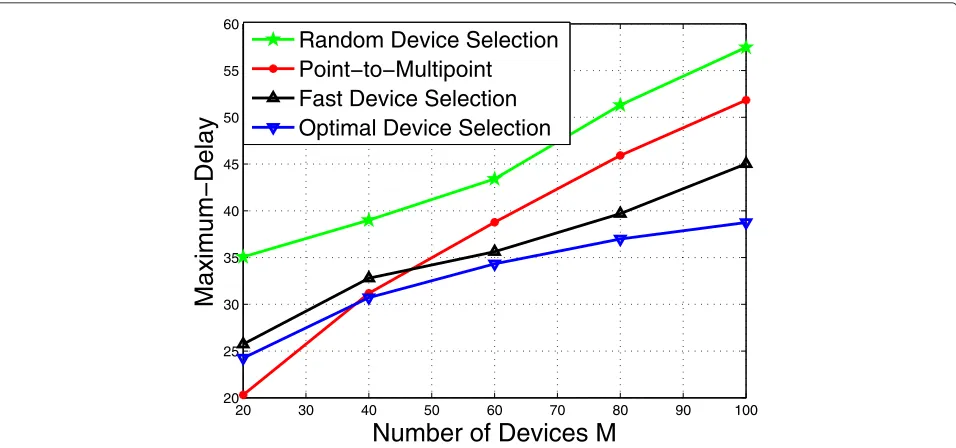
Figure 1 depicts the comparison of the average
maxi-mum delay against the number of devicesMforN = 30,
Q = 0.3, andP = 0.15. Figure 2 illustrates the
maxi-mum delay against the number of packets in the frame
N forM = 60, Q = 0.3, and P = 0.15. From both
figures, the proposed optimal and fast D2D algorithms outperform the other approaches. Figure 1 shows that for a small number of devices, the PMP setting outperforms the D2D algorithms. This can be explained by the fact that of a small number of devices, the probability that a device holds the required packets to form the optimal clique as the one that the sender can form is low. However, this probability increases as the number of devices increases, which explain the difference between the proposed algo-rithm and the PMP one for a large number of devices. The same thinking is applicable to explain the degradation of the fast selection algorithm for a large number of packets in Fig. 2 as the probability that one device hold all of them decreases.
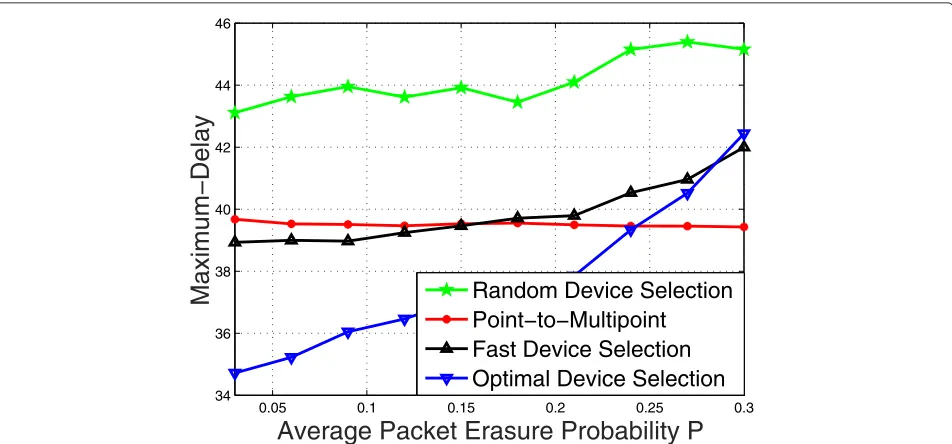
Figure 3 shows the maximum delay against the packet
erasure probability P for M = 60, N = 30, andQ =
20 30 40 50 60 70 80 90 100 20
25 30 35 40 45 50 55 60
Number of Devices M
Maximum−Delay
Random Device Selection
Point−to−Multipoint
Fast Device Selection
Optimal Device Selection
Fig. 1Mean maximum delay versus number of deviceMfor a network composed ofN=30 packets, a BS-device erasure probabilityQ=0.3, and a device-device erasure probabilityP=0.15
Fig. 4, it can be clearly noted that as the D2D commu-nication channel becomes more and more reliable, e.g., geocentrically close devices, the proposed optimal and fast device selection algorithms result in a better decoding delay. The optimal device selection outperforms the PMP policy forP=0.8Qand fast algorithm forP=0.5Q.
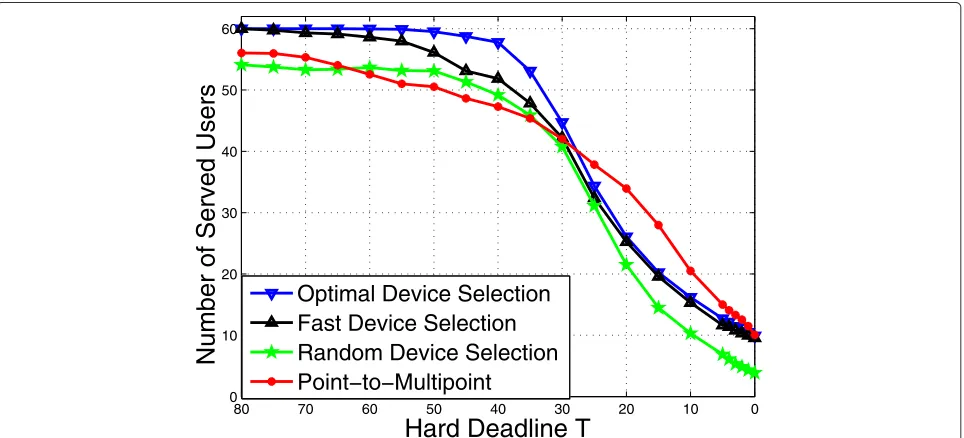
Figure 5 illustrates the number of served device against the delay constraintT forM=60,N=30,Q=0.3, and
P=0.15. For a reasonable delay constraint, the proposed algorithms achieve the best number of served devices. The optimal device selection does not experience degradation untilT = 55 whereas for this value of constrain, the fast selection helps 99 % and PMP scheme only 90 % of the devices. However, for a very strict delay constraint, PMP achieves the best number of served devices. This can be explained by the fact that in the proposed schemes, there
10 15 20 25 30 35 40 45 50
10 20 30 40 50 60 70 80
Number of Packets N
Maximum−Delay
Random Device Selection
Point−to−Multipoint
Fast Device Selection
Optimal Device Selection
0.1 0.12 0.14 0.16 0.18 0.2 0.22 0.24 0.26 0.28 0.3 20
40 60 80 100 120 140 160
Average Packet Erasure Probability P
Maximum−Delay
Random Device Selection
Point−to−Multipoint
Fast Device Selection
Optimal Device Selection
Fig. 3Mean maximum delay versus the device-device erasure probabilityPfor a network composed ofM=60 devices,N=30 packets, and a BS-device erasure probabilityQ=2P
is always one device that is transmitting and thus experi-encing a decoding delay. Furthermore, non-active devices, i.e., that exceeded the delay constraint, do not longer contribute to the recovery process. On the other hand, in PMP, the BS transmits and thus can achieve possible transmission without delay for all devices.
Table 1 shows the computation time for different
algo-rithms for N = 30,Q = 0.3, andT → ∞. The table
presents the overall computation complexity for the whole
recovery phase system. Note that the complexity is not computed per iteration basis. For example, as the ran-dom algorithm poorly chooses the transmitting devices, it requires more iterations to complete the recovery of the missing packets. From Fig. 1 and Fig. 2, the proposed fast selection algorithm achieves a tolerable degradation against the optimal one: 8 % in Fig. 1 and 5 % in Fig. 2. However, as shown in Table 1, it provides a huge complex-ity gain as compared to the optimal selection algorithm.
0 10 20 30 40 50 60 70 80 0 10 20 30 40 50 60
Hard Deadline T
Number of Served Users
Optimal Device Selection
Fast Device Selection
Random Device Selection
Point−to−Multipoint
0.05 0.1 0.15 0.2 0.25 0.3 34
36 38 40 42 44 46
Average Packet Erasure Probability P
Maximum−Delay
Random Device Selection
Point−to−Multipoint
Fast Device Selection
Optimal Device Selection
Fig. 5Mean number of served clients versus the delay constraintTfor a network composed ofM=60 devices,N=30 packets, a BS-device erasure probabilityQ=0.3, and a device-device erasure probabilityP=0.15
As claimed in the previous section, the number vertices in the first layer of the graph is negligible as compared to the size of the graph, and therefore, the maximum clique algorithm applied in that sub-graph requires few compu-tation. Furthermore, Table 1 shows that the fast algorithm have a running time very close to the random selection algorithm, and hence, they have a comparable complexity. Therefore, it gives a good trade-off between performances and computation complexity.
6 Conclusions
This paper investigates the maximum-delay reduction problem for instantly decodable network coding-based device-to-device communication-enabled systems. A par-ticular emphasis on the computation complexity is given to the proposed delay reduction algorithms for D2D sys-tems by a rigorous analysis and minimization of the complexity of the algorithms for battery-powered devices. The paper reduces the complexity of the solution by first proposing efficient methods for the construction, the update, and the dimension reduction of the local IDNC
Table 1Running time of the different schemes
Parameters M=60 M=100 M=604
Schemes P=0.15 P=0.15 P=0.3
Optimal selection 571.71 1039.85 681.06
Point-to-multipoint 220.07 340.15 212.73
Fast selection 130.73 193.37 156.94
Random selection 128.50 190.18 148.72
graph. The paper, further, shows that, under particular scenarios, the problem boils down to a maximum clique problem. Due to the complexity of discovering such max-imum clique, the paper presents a fast device selection algorithm. Simulation results illustrate the performance of the proposed schemes and suggest that the proposed selection algorithm provides appreciable complexity gain as compared to the existing schemes, with a negligible degradation in performance.
Competing interests
A part of this paper [28] is published in proc. of IEEE Vehicular Technology Conference (VTC-Fall’ 2014), Vancouver, BC, Canada.
Author details
1California Institute of Technology (Caltech), Pasadena, California, USA.2King Fahd University of Petroleum and Minerals (KFUPM), Dhahran, Eastern Province, Saudi Arabia.3King Abdullah University of Science and Technology (KAUST), Thuwal, Makkah Province, Saudi Arabia.
Received: 1 June 2015 Accepted: 1 December 2015
References
1. R Ahlswede, N Cai, S-YR Li, RW Yeung, Network information flow. IEEE Trans. Inform. Theory.46(4), 1204–1216 (2000)
2. S Katti, D Katabi, W Hu, H Rahul, M Medard, inProc. of Annual Allerton Conference on Communication, Control and Computing (Allerton’ 2005). The importance of being opportunistic: practical network coding for wireless environments, (Monticello, Illinois, USA, 2005)
3. J-S Park, M Gerla, DS Lun, Y Yi, M Medard, Codecast: a
network-coding-based ad hoc multicast protocol. IEEE Wireless Commun.
13(5), 76–81 (2006)
5. HDT Nguyen, L-N Tran, E-K Hong, On transmission efficiency for wireless broadcast using network coding and fountain codes. IEEE Commun. Lett.
15(5), 569–571 (2011)
6. L Keller, E Drinea, C Fragouli, inIEEE 4th Workshop on Network Coding, Theory and Applications (NetCod’ 2008). Online broadcasting with network coding, (Hong Kong, China, 2008), pp. 1–6
7. A Douik, S Sorour, TY Al-Naffouri, M-S Alouini, A lossy graph model for delay reduction in generalized instantly decodable network coding. IEEE Wireless Commun. Lett.3(3), 281–284 (2014)
8. L Lu, M Xiao, LK Rasmussen, Design and analysis of relay-aided broadcast using binary network codes. J. Commun.6(8), 610–617 (2011) 9. S Sorour, A Douik, S Valaee, TY Al-Naffouri, M Alouini, Partially blind
instantly decodable network codes for lossy feedback environment. IEEE Trans. Wireless Commun.13(9), 4871–4883 (2014)
10. A Douik, S Sorour, M-S Alouini, TY Al-Naffouri, inProc. of IEEE 9th International Conference on Wireless and Mobile Computing, Networking and Communications (WiMob’ 2013). Delay reduction in lossy intermittent feedback for generalized instantly decodable network coding, (Lyon, France, 2013), pp. 388–393
11. P Sadeghi, R Shams, D Traskov, An optimal adaptive network coding scheme for minimizing decoding delay in broadcast erasure channels. EURASIP J. Wireless Commun. Netw.2010, 1–14 (2010)
12. S Sorour, S Valaee, inProc. of IEEE Global Telecommunications Conference (GLOBECOM’ 2010). Minimum broadcast decoding delay for generalized instantly decodable network coding, (Miami, Florida, USA, 2010), pp. 1–5 13. JG Andrews, S Buzzi, W Choi, SV Hanly, A Lozano, ACK Soong, JC Zhang,
What will 5G be? IEEE J. Selected Areas Commun.32(6), 1065–1082 (2014) 14. SE Tajbakhsh, P Sadeghi, inProc. of IEEE Information Theory Workshop (ITW’
2012). Coded cooperative data exchange for multiple unicasts, (Lausanne, Switzerland, 2012), pp. 587–591
15. S Li, S-HG Chan, inProc. of IEEE International Conference on Multimedia and Expo (ICME’ 2007). Bopper: wireless video broadcasting with peer-to-peer error recovery, (Beijing, China, 2007), pp. 392–395
16. MV Pedersen, FHP Fitzek, inProc. of the IEEE International Conference on Communications Workshops (ICC’ 2008). Implementation and performance evaluation of network coding for cooperative mobile devices, (Beijing, China, 2008), pp. 91–96
17. P Vingelmann, MV Pedersen, FHP Fitzek, J Heide, inProc. of IEEE Global Telecommunications Conference (GLOBECOM’ 2011). On-the-fly packet error recovery in a cooperative cluster of mobile devices, (Houston, Texas, USA, 2011), pp. 1–6
18. S Hua, Y Guo, Y Liu, H Liu, SS Panwar, Scalable video multicast in hybrid 3G/Ad-hoc networks. IEEE Trans. Multimedia.13(2), 402–413 (2011) 19. T Ho, D Lun,Network Coding: An Introduction. (Cambridge University Press,
New York, NY, USA, 2008)
20. SE Tajbakhsh, P Sadeghi, N Aboutorab, inProc. of Australian
Communications Theory Workshop (AusCTW’ 2014). Instantly decodable network codes for cooperative index coding problem over general topologies, (Sydney, Australia, 2014), pp. 84–89
21. N Aboutorab, P Sadeghi, SE Tajbakhsh. Proc. of IEEE International Symposium on Information Theory (ISIT’ 2013), (Istanbul, Turkey, 2013), pp. 3095–3099
22. A Douik, S Sorour, H Tembine, M-S Alouini, TY Al-Naffouri, inProc. of IEEE Global Telecommunications Conference (GLOBECOM’ 2014). A game theoretic approach to minimize the completion time of network coded cooperative data exchange, (Austin, Texas, USA, 2014), pp. 1583–1589 23. MS Karim, N Aboutorab, AA Nasir, P Sadeghi, inProc. of IEEE Information
Theory Workshop (ITW’ 2014). Decoding delay reduction in network coded cooperative systems with intermittent status update, (Hobart, Tasmania, Australia, 2014), pp. 391–395
24. A Douik, S Sorour, TY Al-Naffouri, M-S Alouini, Delay reduction for instantly decodable network coding in persistent channels with feedback imperfections. IEEE Trans. Wireless Commun.PP(99), 1–1 (2015) 25. PRJ Ostergard, A fast algorithm for the maximum clique problem.
Discrete Appl. Math.120, 197–207
26. K Yamaguchi, S Masuda, inProc. Of the 23rd International Technical Conference on Circuits/Systems, Computers and Communications (ITC-CSCC’ 2008). A new exact algorithm for the maximum-weight clique problem, (Yamaguchi, Japan
27. A Le, A Tehrani, A Dimakis, A Markopoulou, inProc of International Symposium on Network Coding (NetCod’ 2013). Instantly decodable network codes for real-time applications, Calgary, Canada, 2013), pp. 1–6 28. A Douik, S Sorour, M Alouini, TY Al-Naffouri, inProc. of IEEE Vehicular
Technology Conference (VTC-Fall’ 2014). On minimizing the maximum broadcast decoding delay for instantly decodable network coding, (Vancouver, BC, Canada, 2014)
Submit your manuscript to a
journal and benefi t from:
7Convenient online submission
7Rigorous peer review
7Immediate publication on acceptance
7Open access: articles freely available online
7High visibility within the fi eld
7Retaining the copyright to your article