Optimization of Color Conversion for Face Recognition
Creed F. Jones III
Bradley Department of Electrical and Computer Engineering, Virginia Polytechnic Institute and State University, Blacksburg, VA 24061-0111, USA
Department of Computer Science, Seattle Pacific University, Seattle, WA 98119-1957, USA Email:[email protected]
A. Lynn Abbott
Bradley Department of Electrical and Computer Engineering, Virginia Polytechnic Institute and State University, Blacksburg, VA 24061-0111, USA
Email:[email protected]
Received 5 November 2002; Revised 16 October 2003
This paper concerns the conversion of color images to monochromatic form for the purpose of human face recognition. Many face recognition systems operate using monochromatic information alone even when color images are available. In such cases, simple color transformations are commonly used that are not optimal for the face recognition task. We present a framework for selecting the transformation from face imagery using one of three methods: Karhunen-Lo`eve analysis, linear regression of color distribution, and a genetic algorithm. Experimental results are presented for both the well-known eigenface method and for extraction of Gabor-based face features to demonstrate the potential for improved overall system performance. Using a database of 280 images, our experiments using these methods resulted in performance improvements of approximately 4% to 14%.
Keywords and phrases:face recognition, color image analysis, color conversion, Karhunen-Lo`eve analysis.
1. INTRODUCTION
Most single-view face recognition systems operate using in-tensity (monochromatic) information alone. This is true even for systems that accept color imagery as input. The reason for this is not that multispectral data is lack-ing in information content, but often because of practical considerations—difficulties associated with illumination and color balancing, for example, as well as compatibility with legacy systems. Associated with this is a lack of color image databases with which to develop and test new algorithms. Al-though work is in progress that will eventually aid in color-based tasks (e.g., through color constancy [1]), those efforts are still in the research stage.
When color information is present, most of today’s face recognition systems convert the image to monochromatic form using simple transformations. For example, a common mapping [2,3] produces an intensity valueIiby taking the
average of red, green, and blue (RGB) values (Ir,Ig, andIb,
resp.):
Ii(x,y)=Ir(x,y) +Ig(x,y) +Ib(x,y)
3 . (1)
The resulting image is then used for feature extraction and analysis.
We argue that more effective system performance is pos-sible if a color transformation is chosen that better matches the task at hand. For example, the mapping in (1) implic-itly assumes a uniform distribution of color values over the entire color space. For a task such as face recognition, color values tend to be more tightly confined to a small portion of the color space, and it is possible to exploit this narrow con-centration during color conversion. If the transformation is selected based on the expected color distribution, then it is reasonable to expect improved recognition accuracies.
Other work [4] has suggested that alternative color spaces provide no real benefit for locating skin in images because these spaces do not increase the separability of the skin and nonskin classes. However, to extract features for face recog-nition, we do not wish to discriminate skin from nonskin re-gions, but rather to extract meaningful image features within the skin area. Queisser [5] used the properties of color distri-butions of a set of similar images to select a new color space for object classification. Abbott and Zhao [6,7] developed a color-space quantization approach for the recognition of naturally textured objects, but did not consider that for face recognition. Torres has demonstrated that color information can provide additional accuracy for the “eigenface” approach [8], although there is no discussion of optimal color rep-resentation. Heseltine et al. [9] measured the performance effect on eigenface-based face recognition of a number of preprocessing techniques, including several color transfor-mations (RGB to hue, brightness-insensitive hue, etc.) and found that these color methods actually degraded the recog-nition accuracy. However, the techniques that they explored were general color transformations that were not based on the content of the images.
The remainder of this paper is organized as follows.
Section 2presents our approach for using KL analysis to de-termine a suitable single color axis for a given set of RGB images, andSection 3presents experimentally derived color transformation data using this method. InSection 4, we in-vestigate the use of KL analysis on color data in CIE L-a-b format.Section 5describes an alternative method based on linear regression analysis of RGB pixel data, whileSection 6
discusses our experimental use of a genetic algorithm to se-lect the color conversion.Section 7presents the face recog-nition accuracy improvement observed with the eigenface method from using the KL derived color transformation, and
Section 8describes the effect of the optimal color conversion on feature vectors (“jets”) extracted using complex Gabor fil-ters. Finally,Section 9presents concluding remarks.
2. KL COLOR CONVERSION—RGB
Pixels in the original color image can be represented as the vector I(x,y) = [Ir(x,y) Ig(x,y) Ib(x,y)]T, where the r, g, and b subscripts denote the red, green, and blue color planes, respectively. As described in (1), face recog-nition systems typically use an intensity plane derived as Ii(x,y) = 1/3[1 1 1]I(x,y). We propose that human face
images exhibit common characteristics that can be exploited in the conversion from a full-color representation to a monochrome image. In the hue-saturation plane, for exam-ple, face pixels from a mixture of ethnic groups are well clus-tered [10], with only the intensity plane varying markedly. This suggests that the standard intensity plane is in fact more sensitive to variation due to ethnic type, which is undesirable. To determine an improved linear transformation, we want to find the optimum transformation vectorwsuch that M(x,y)=wTI(x,y), whereIis the original color image and
Mis the resulting single-plane image. We make the assump-tion that the optimum transformaassump-tion corresponds closely to
the expected distribution of pixel values within the original color space. With this in mind, it is possible to selectwby us-ing the KL transformation to determine the projection with uncorrelated axes. The resulting color space has been called the “Karhunen-Lo`eve color space” for an unspecified pixel population [11,12]; here, we specifically restrict it to the face area. For a given distribution of pixel values, the eigenvec-tor corresponding to the largest eigenvalue defines the direc-tion along which the data is the least correlated, and therefore most likely to be of use in recognition tasks.
The KL transformation is determined from the covari-ance matrix of the distribution. For this application, the in-put datum is the ensemble of pixel values from a set of train-ing images, taken from the region containtrain-ing the face. We form the covariance matrixSas follows:
S= 1
where p is the collection ofN color pixel vectors. The KL transformation is then given by the eigenvectors {ui}ofS,
concatenated into the matrixU = [u1 u2 u3]. The eigen-vectoru1, associated with the largest eigenvalue, is of primary interest here; it represents the direction of most variability in the data within the original space. Projection of RGB values onto this axis represents a color-to-grayscale conversion with the highest potential for discrimination.
The normalization of the conversion vector w requires consideration. A unit vector will, by definition, not change the magnitude of the vector quantity that it operates on. However, this is not appropriate for conversion of three-component color quantities (where each three-component can range up to full scale) to monochrome, since any three-color vector with magnitude greater than unity will saturate in the monochrome plane. We prevent saturation by normalizing the vector having RGB components at full scale to a magni-tude of 1. Therefore, the conversion vectors that we compute are normalized by√3.
3. RESULTS OF KL ANALYSIS ON RGB DATA
eye centers is 60 pixels, in accordance with developing stan-dards for face recognition image interchange [15]. No ef-fort was made to color-correct or contrast-equalize the im-ages. To determine the color conversion that is most suited for the face features, we process only a portion of the face image that represents the area of the face with minimal in-cluded background and hair. The extent to be processed, a region 90 pixels wide by 140 pixels high, is indicated in
Figure 1.
The KL analysis described inSection 2yields an eigenvec-toru1describing the axis of projection with the largest vari-ance in the original data, which we call the conversion vec-tor. Let the three components of this vector be represented byu1=[u11 u12 u13]T. Because this vector has unit length r = u2
11+u212+u213 = 1, we can represent it using spher-ical coordinates and completely describe the color mapping by the two angular quantitiesθandφ:
φ=arccosu13, θ=arccos u11
sin(φ) . (3)
To illustrate the meaningfulness of the transformation, several scatter diagrams are shown inFigure 2. Four collec-tions of face images are represented as well as some nat-ural images of random content. For each image, the color histogram was computed and the conversion vectoru1 ob-tained. The resulting conversion vectors are indicated as points in [φ,θ] space. Each face image collection consists of several sets of 21 images, each for a single individual. The natural images contain a mix of object types including land-scapes, photographs of sporting events, and astronomy im-ages.
It can be seen that the optimal color conversion vectors u1computed for the face images are distinct from those for more general natural images, indicating that the red, green, and blue color planes carry different degrees of information for the specific class of face images. The figure also indicates the position in this space of an equal-weighted color conver-sion, which appears to represent a good estimate for the op-timal conversion for general natural images, but is not well suited for the face image collections. The selection of face databases used in our testing contain color distributions that generally correspond to [φ=1.01,θ=0.662], which in turn corresponds to a conversion vector of
u1=√1 3
sinφcosθ sinφsinθ
cosφ =
0.3858 0.3004 0.3070
. (4)
This should be compared with the equal-weighted values of [0.333 0.333 0.333]T. We observe that the KL procedure
for these images results in a color space that more heavily weights the red color component than the green and blue. This indicates that face images contain more uncorrelated variation in the red plane than in the green or blue planes.
Note that the preceding eigenvalue-eigenvector analysis concerns only the color-to-monochrome conversion process, and is independent of the face recognition approach that is
Figure1: Illustration of image extent to be processed for color
con-version and recognition. This monochrome image is an “average” image.
1.2 1.15 1.1 1.05 1 0.95 0.9 0.85 0.8 0.75
φ(rad) 0.5
0.55 0.6 0.65 0.7 0.75 0.8 0.85 0.9 0.95 1
θ
(r
ad)
KL face DB 1 KL face DB 2 KL face DB 3 KL face DB 4
KL natural images Equal-weighted RGB Line-fit face DB 1 Line-fit face DB 2
Figure2: Principal component directions, using spherical
coordi-nates [φ,θ], for several histograms in RGB space. Each point in the diagram represents the orientation of greatest variability in the ag-gregate color histogram of a complete image database. The “line-fit” cases listed in the legend are described inSection 5.
used. We propose thatanyface recognition technique could benefit from a careful examination of the initial conversion from color to monochrome images.
4. KL COLOR CONVERSION—L-a-b
The L-a-b space is defined as follows [16]:
for the D65 standard illuminant used as the color reference point ([X0 Y0 Z0]=[1004.26 1056.79 1150.71]).
Our KL-based approach for selecting the color conver-sion produces a linear transformation of the RGB color val-ues; thus, we could expect that using the KL process on the XYZ values would produce the same result within compu-tation accuracy. However, the relation between RGB and L-a-b is nonlinear, and the L-L-a-b space is in some sense more relevant to human perception, so that application of the KL procedure defined inSection 2would be expected to produce useful results.
In fact, as can be seen inFigure 3, the KL transformation on L-a-b data does not yield distinctive data for face pixels as opposed to image pixels from more general scenes. This suggested that the “optimal” color conversion obtained from L-a-b data does not provide any beneficial added feature con-tent. Experimentation with the eigenvalues of face images converted to L-a-b representation, and then projected onto the axis found by using KL on the resulting histogram data (as described inSection 7) showed that this was the case; in-formation contained in the most significantnaxes was not greater (and in fact frequently less) than that for the L plane of the corresponding L-a-b images. It is possible that a trans-formation resulting in a linear perception of color distance inherently concentrates useful detail information in the L plane.
5. COLOR CONVERSION THROUGH LINEAR
REGRESSION
Queisser discusses (in [5]) the use of a least-squared-error line-fit to RGB data to define a new color axis that is best suited to images of a particular class of object. In his study, images of wood panels and food products were shown to be more suited for object detection and inspection in the re-sulting single-color plane than in any of the hue-saturation-intensity (HSI) axes. The other axes relate to additional mag-nitude and chromaticity information.
We consider a similar approach in the RGB space. We performed least-squared-error fits to our RGB data with the added constraint that the new axis of projection should pass through the RGB origin. The purpose of this is to force a pixel
2
Figure3: Principal component directions, using spherical
coordi-nates [φ,θ], for several histograms in L-a-b space. Each point in the diagram represents the orientation of greatest variability in the ag-gregate color histogram of a complete image database. The “line-fit” cases listed in the legend are described inSection 5.
with zero in all color planes to map to a black pixel in the new space. The transformation matrix is as follows:
Applying (7) to the pixel data from the face box areas of the sample databases, we obtain the data presented in Figure 2
as the “line-fit” data. As before, we are only interested in the primary axis,βin this transformation. The results are very similar to those obtained by the KL method, but with much lower computational cost because only the red, green, and blue sample means are required.
6. COLOR CONVERSION THROUGH GENETIC
ALGORITHM SEARCH
To further investigate the determination of the color projec-tion by optimizing the face recogniprojec-tion accuracy, we applied a genetic algorithm to the color vector selection process. Each individual in the population consisted of a [φ,θ] pair as de-fined in (3). The optimization algorithm had the following properties:
(i) population size of 100;
(ii) breeding by averaging of [φ,θ] values; (iii) population initialized with random values;
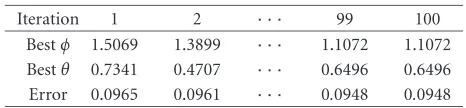
Table1: Results of genetic algorithm.
Iteration 1 2 · · · 99 100
Bestφ 1.5069 1.3899 · · · 1.1072 1.1072 Bestθ 0.7341 0.4707 · · · 0.6496 0.6496 Error 0.0965 0.0961 · · · 0.0948 0.0948
(v) mutation by perturbation of a random individual (probability of mutation was 0.005);
(vi) error function to be minimized was the difference be-tween 1.0 and the sum of the first 8 normalized eigen-values.
This study therefore attempted to maximize the performance of the face recognition system as simulated by the sum of the largest 8 eigenvalues.
The results of 100 generations of testing on one sam-ple database are summarized in Table 1. The testing data suggested that the error surface was slowly changing and not unimodal. After only 100 iterations, the convergence is clearly dominated by the effect of mutation rather than breeding. The resulting vector differs in error from the re-sults obtained by KL computation by only 0.00077.
The advantage of the genetic algorithm for this purpose is its flexibility in that it is possible to define the error func-tion in terms of any computable metric of overall system per-formance. For example, this could be biased toward a par-ticular combination of Type I (false positive) and Type II (false negative) errors of recognition on a given database. The major disadvantage of this method is its computational re-quirements. For a relatively modest database of fifty individ-uals, 100 generations took more than six hours to run on a 1 GHz Pentium III machine. In addition, the genetic algo-rithm has unpredictable convergence behavior and a set of performance parameters that may require tuning. Our ex-perimentation with a GA roughly confirmed the earlier com-puted results.
7. EFFECT OF OPTIMIZED COLOR CONVERSION ON FACE RECOGNITION ACCURACY
To evaluate the effect of our color conversion method on face recognition accuracy, we considered the effect on per-formance of the well-known eigenface method [18,19]. This technique uses principal components analysis of a collection of face images, treated as one-dimensional vectors, to deter-mine the linear combinations of pixel locations that form the best projective axes for the collection. Early work in this area focused on the use of a small set of these projections to adequately represent a face image, while later work (begin-ning around 1990) applied this same technique to recogni-tion. The new “face space” defined by the most significant basis vectors, called “eigenfaces,” is used for pattern recogni-tion based on a distance measure.
For any principal component analysis, the ratio of an eigenvalue to the sum of all the eigenvalues is proportional to the mean squared error implied by exclusion of the
cor-responding eigenvector [20]. Thus, we can examine the cu-mulative sum of eigenvalues 1 throughn, plotted versusn, to compare the information contained in the firstneigenfaces (the “principal components”). In this way, we can predict the performance of the eigenface method on the two databases.
Table 2shows the individual and cumulative eigenvalues for a typical database of face images.
Figure 4 shows a plot of the cumulative eigenvalues, which gives a measure of the accuracy achievable by truncat-ing all higher eigenvalues. Ustruncat-ing the optimized color conver-sion produces a modest, yet consistent, improvement in the potential accuracy. The increased information is more pro-nounced for the more significant eigenvalues.
By comparison, we also evaluated the magnitude of the initial eigenvectors for the eigenface method when using the line-fit method described inSection 5. The cumulative eigen-values computed by using theβaxis as the new image plane are shown in Table 3 and exhibit a similar increase in in-formation in the lowest eigenfaces. In fact, for all of the databases we examined, the use of the line fit gave essentially equal performance as measured by the normalized eigenval-ues.
For confirmation of these predictions of increased per-formance, we measured the face recognition accuracy on a complete eigenface recognition implementation. We will not describe the specifics of the eigenface method here as they are covered well in [18,19]. For our test, a training phase and a test phase were implemented. The training phase computes the desired transformation by solving for the eigenvalues of the matrix composed of the concatenation of the training im-ages. Testing is performed by applying this transformation to a set of probe images of the same individuals and measur-ing the Euclidean distance from the probe image data to the exemplars of each individual, defined as the average in “face space” of each training image of that individual. The probe images were not present in the training set. Note that the eigenface implementation was fairly simplistic; our objective was not to achieve overall high recognition accuracy but to measure the effect of using our color conversion.
To measure the performance in a consistent fashion, we adopted the method used in the NIST FERET studies [21]. The results for each probe image are ranked in order of in-creasing Euclidean distance. The performance score for a particular experiment Rn is defined to be the ratio of the
number of times that the correct identity is in the topn can-didates (thennearest exemplars to the probe image) to the total number of probe images tested.
Table2: Eigenvalues for a typical face database using the KL method to determine the RGB conversion.
Indexi 1 2 3 4 5 6 7 8
Equal-weighted RGB conversion
Eigenvalueλi 0.51613 0.13616 0.06179 0.05184 0.04326 0.03875 0.02879 0.02683
Cumulativeλi 0.51613 0.65229 0.71408 0.76592 0.80918 0.84793 0.87672 0.90354
KL-computed RGB conversion
Eigenvalueλi 0.53441 0.13210 0.05929 0.05223 0.04181 0.03812 0.02850 0.02488
Cumulativeλi 0.53441 0.66651 0.72580 0.77803 0.81984 0.85796 0.88646 0.91134
Table3: Eigenvalues for a typical face database using the line-fit method to determine the RGB conversion.
Indexi 1 2 3 4 5 6 7 8
Equal-weighted RGB conversion
Eigenvalueλi 0.51613 0.13616 0.06179 0.05184 0.04326 0.03875 0.02879 0.02683
Cumulativeλi 0.51613 0.65229 0.71408 0.76592 0.80918 0.84793 0.87672 0.90354
Line-fit RGB conversion
Eigenvalueλi 0.53280 0.13175 0.05801 0.05210 0.04064 0.03644 0.02898 0.02512
Cumulativeλi 0.53280 0.66445 0.72256 0.77467 0.81531 0.85174 0.88073 0.90585
9 5
1
Eigenvalue indexi
0.5 0.55 0.6 0.65 0.7 0.75 0.8 0.85 0.9 0.95
C
u
m
ulati
ve
eigen
value
Equal-weighted RGB toI Optimized conversion RGB toI
Figure4: Comparison of cumulative eigenvalues for the eigenface
procedure. The optimized RGB to monochrome conversion results in more significant information in the firstneigenfaces.
taken in extrapolating these accuracy values to larger sets, they provide a strong indication that the color conversion process can have a sizable impact on face recognition per-formance.
Because the face images had a noticeable increase in con-trast as a result of the KL derived RGB to monochrome trans-formation, there was a concern that the KL derived method was doing no more than could be obtained from a com-mon histogram equalization on the color image. To explore this idea, the eigenface performance was also measured with and without the use of a histogram equalization preprocess-ing step. Each color plane in the original RGB space was en-hanced using a standard 256-to-64-bin histogram flattening procedure. The results show that, rather than a performance increase similar to that obtained from the optimized color conversion, the histogram equalization actually produced a
severe decrease in accuracy. It is believed that this is due to the global nature of the process, which may have resulted in a suppression of the facial features that are useful for recog-nition. We conclude that color histogram equalization is not a useful preprocessing step for eigenface face recognition, re-gardless of the choice of method for color transformation.
8. EFFECT ON FACE FEATURE DISCRIMINABILITY USING GABOR FILTERS
Another technique for face recognition is based on the appli-cation of a family of Gabor filters to monochrome face im-ages [22,23,24]. A two-dimensional Gabor filter is a directed complex sinusoid in the image plane, decaying exponentially as a function of distance from the filter’s origin. At a set of preselected locations on the face, Gabor filters at various re-lated directions and sinusoidal frequencies are applied and the complex responses are assembled into a feature vector known as a “jet.” Several techniques exist for performing face recognition using these jets.
We have evaluated the potential improvement in Gabor-based methods from the use of an optimized color transfor-mation by evaluating the relative distances between the Ga-bor jets from the same point on different faces, with and without the use of the KL derived color transformation. To obtain the interjet distances, we consider the jets as 80-element vectors and determine the Mahalanobis distance by the usual method. To measure the effectiveness of a set of jets for face discrimination, we consider (at each facial landmark) the ratio of the minimum interjet distance between two dif-ferent faces to the maximum interjet distance, as well as the ratio of the minimum interjet distance to the average of all interjet distances for that landmark. Ratios were used to pro-vide some normalization.
Table4: Improvement in face recognition performance with new color conversion procedure. The monochrome eigenface recognition procedure was used on a database of 280 color images. The second and third columns show the recognition accuracy values that were obtained when the images were color-converted with the standard equal-weight method and with our KL method, respectively.
Equal-weighted RGB KL RGB Improvement
R2—probe in top 2 0.343 0.371 8.3%
R5—probe in top 5 0.514 0.600 13.8%
R10—probe in top 10 0.686 0.728 6.2%
ratio increased by 6%. Interestingly, the average interjet dis-tance actually decreased slightly, indicating that the min-imum interjet distances were larger than when the usual monochrome intensity images were used. This is an initial indication that Gabor-based methods may have greater dis-crimination between different individuals when the KL de-rived color-to-monochrome transformation is used, since the underlying features are more distinctive.
9. CONCLUSIONS
This paper has presented a new approach for converting color images to monochromatic form. By tailoring the con-version process to the needs of a particular task, such as hu-man face recognition, it is possible to improve the overall sys-tem performance.
Most existing face recognition systems operate using monochromatic information alone, even when color infor-mation is available. In such cases, a simple and suboptimal conversion process is typically used. We argue that recogni-tion accuracies can be improved if the color-conversion pro-cess is selected based on the expected color distributions. We explored three such approaches to determine an im-proved mapping empirically: Karhunen-Lo`eve analysis of the color pixel distributions, a least-squared-error line fit in RGB space, and a genetic algorithm.
The color-conversion method presented in this paper is independent of the actual face recognition approach that is used. For testing purposes, however, we have used the well-known eigenface method. Our experiments using the eigen-face method for recognition resulted in performance im-provements in the range of approximately 6% to 14% for a database of 280 color images. Relative distance measure-ments of Gabor jets of the face area also showed an increase in discriminability of 4% to 6%. Evaluation of the cumula-tive eigenvalues produced by an eigenface analysis of inten-sity images and images converted to grayscale form using the computed conversion vector showed a modest yet consistent improvement in the potential accuracy in retaining only the most importantnbasis vectors.
REFERENCES
[1] G. D. Finlayson, S. D. Hordley, and P. M. Hubel, “Color by correlation: a simple, unifying framework for color con-stancy,” IEEE Trans. on Pattern Analysis and Machine Intelli-gence, vol. 23, no. 11, pp. 1209–1221, 2001.
[2] R. Gonzalez and R. Woods,Digital Image Processing, Addison-Wesley, NY, USA, 1st edition, 1992.
[3] R. Hunt, “Why is black and white so important in colour?,” inColour Imaging: Vision and Technology, L. MacDonald and M. Luo, Eds., John Wiley & Sons, NY, USA, 1999.
[4] A. Albiol, L. Torres, and E. Delp, “Optimum color spaces for skin detection,” inProc. IEEE International Conference on Im-age Processing (ICIP ’01), vol. 1, pp. 122–124, Thessaloniki, Greece, October 2001.
[5] A. Queisser, “Color spaces for inspection of natural objects,” in Proc. IEEE International Conference on Image Processing (ICIP ’97), vol. 3, pp. 42–45, Washington, DC, USA, October 1997.
[6] A. L. Abbott and Y. Zhao, “Adaptive quantization of color space for recognition of finished wooden components,” in Proc. 3rd IEEE Workshop on Applications of Computer Vi-sion (WACV ’96), pp. 252–257, Sarasota, Fla, USA, December 1996.
[7] Y. Zhao, “A color identification system based on class-oriented adaptive color space quantization,” M.S. thesis, Bradley De-partment of Electrical and Computer Engineering, Virginia Tech, Blacksburg, Va, USA, 1996.
[8] L. Torres, J. Reutter, and L. Lorente, “The importance of the color information in face recognition,” inProc. IEEE Inter-national Conference on Image Processing (ICIP ’99), vol. 3, pp. 627–631, Kobe, Japan, October 1999.
[9] T. Heseltine, N. Pears, and J. Austin, “Evaluation of image pre-processing techniques for eigenface-based face recognition,” inProc. 2nd International Conference on Image and Graphics (ICIG ’02), Wei Sui, Ed., vol. 4875 ofProc. SPIE, pp. 677–685, Hefei, Anhui, China, July 2002.
[10] S. Gong, S. McKenna, and A. Psarrou, Dynamic Vision: From Images to Face Recognition, Imperial College Press, London, UK, 2000.
[11] C. Lee, J. Kim, and K. Park, “Automatic human face loca-tion in a complex background using moloca-tion and color infor-mation,” Pattern Recognition, vol. 29, no. 11, pp. 1877–1889, 1996.
[12] W. Pratt, Digital Image Processing, John Wiley & Sons, NY, USA, 1978.
[13] T. Sim, S. Baker, and M. Bsat, “The CMU pose, illumina-tion, and expression (PIE) database of human faces,” Tech. Rep. CMU-RI-TR-01-02, Robotics Institute, Carnegie Mellon University, 2001.
[14] L. Spacek, “University of Essex Face Database,” 2002,
http://cswww.essex.ac.uk/.
[15] P. Griffin, “Face recognition format for data interchange,” INCITS M1 Biometrics Standards Committee, Document M1/02-0228, October 2002, http://www.ncits.org/tc home/
m1.htm.
[16] D. MacAdam, Color Measurement: Theme and Variations, Springer-Verlag, Berlin, Germany, 1985.
[18] M. Turk and A. Pentland, “Eigenfaces for recognition,” Jour-nal of Cognitive Neuroscience, vol. 3, no. 1, pp. 71–86, 1991. [19] P. Grother, “Software Tools for an Eigenface Implementation,”
2001,http://www.nist.gov/humanid/feret/.
[20] M. Nadler and E. Smith, Pattern Recognition Engineering, John Wiley & Sons, NY, USA, 1993.
[21] P. J. Phillips, H. Moon, S. Rizvi, and P. J. Rauss, “The FERET evaluation methodology for face-recognition algo-rithms,” IEEE Trans. on Pattern Analysis and Machine Intel-ligence, vol. 22, no. 10, pp. 1090–1104, 2000.
[22] I. Fasel, M. Bartlett, and J. Movellan, “A comparison of Gabor filter methods for automatic detection of facial landmarks,” in Proc. 5th IEEE International Conference on Automatic Face and Gesture Recognition (FG ’02), pp. 242–247, Washington, DC, USA, May 2002.
[23] L. Wiskott, J.-M. Fellous, N. Kr¨uger, and C. von der Mals-burg, “Face recognition by elastic bunch graph matching,” IEEE Trans. on Pattern Analysis and Machine Intelligence, vol. 19, no. 7, pp. 775–779, 1997.
[24] J. G. Daugman, “Complete discrete 2-D Gabor transforms by neural networks for image analysis and compression,” IEEE Trans. Acoustics, Speech, and Signal Processing, vol. 36, no. 7, pp. 1169–1179, 1988.
Creed F. Jones III is a faculty member at Seattle Pacific University in Seattle, Wash-ington, where he is an Associate Professor in the Computer Science Department. He received the B.S. and M.S. degrees in elec-trical engineering from Oakland University, Rochester, Michigan, in 1980 and 1982, re-spectively, and is a candidate for the Ph.D. degree in computer engineering from Vir-ginia Tech in 2004. From 1982 to 2000, he
was an Engineer and Engineering Director with several organiza-tions in the machine vision industry. Mr. Jones’ primary research interests involve biometric identification including face recogni-tion, computer vision, and image processing. Mr. Jones is the Chair of the International Committee for Information Technology Stan-dards (INCITS) M1.3, task group for standardization of biometric data formats, and is a member of the IEEE Computer Society.
A. Lynn Abbottis a faculty member at Vir-ginia Tech, Blacksburg, VirVir-ginia, where he is an Associate Professor in the Bradley De-partment of Electrical and Computer Engi-neering. He received the B.S. degree from Rutgers University in 1980, the M.S. degree from Stanford University in 1981, and the Ph.D. degree from the University of Illinois in 1990, all in electrical engineering. From 1980 to 1985, he was a member of Technical
![Figure 2: Principal component directions, using spherical coordi-nates [φ, θ], for several histograms in RGB space](https://thumb-us.123doks.com/thumbv2/123dok_us/896054.1107930/3.600.367.495.73.236/figure-principal-component-directions-using-spherical-coordi-histograms.webp)